
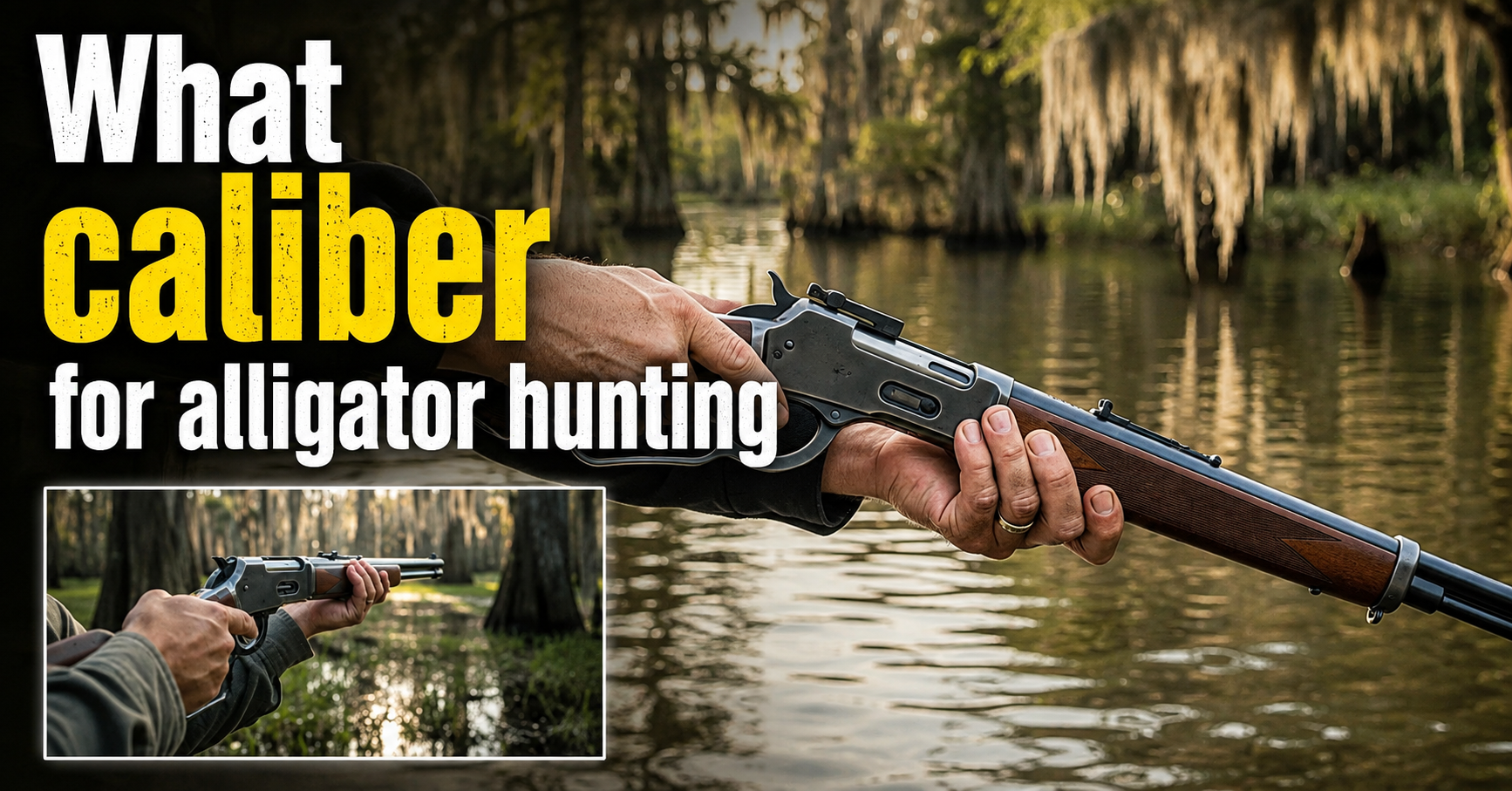

Choosing a firearm for alligator hunting is unusually dependent on local law. In many regulated hunts, the alligator must first be captured, attached to a restraining line, and brought beside the boat or bank. A firearm or bangstick is then used only for close-range dispatch—not for shooting at a free-swimming animal.
The permitted firearm, caliber, ammunition, capture method, and dispatch procedure vary by state and sometimes by individual hunting area. This guide explains practical caliber categories while prioritizing official regulations, humane harvest, boat safety, and responsible firearm handling.
Quick Answer
There is no universally legal or best caliber for alligator hunting. Where a handgun may be used to dispatch a lawfully restrained alligator, low-recoil rimfire or centerfire handgun cartridges may be permitted, depending on the state. Other programs require a bangstick, specify a minimum such as .38 caliber, permit a particular shotgun load, or prohibit ordinary firearms entirely.
Florida allows a bangstick as its only firearm method and only after the alligator is attached to a restraining line. Alabama’s 2026 rules require a bangstick chambered in .38 caliber or larger or a shotgun using an authorized shot size. Georgia allows any-caliber handgun or bangstick for a lawfully restrained alligator.
Therefore, choose the legal firearm category first, then select a manufacturer-approved caliber you can control safely at extremely close range. Complete the state training program and follow its dispatch procedure exactly.
Important Legal Notice
Information was reviewed on August 3, 2026. Alligator regulations can change by state, season, management area, public or private land, and permit program. Always check the current agency regulations again immediately before hunting.
Never assume that a caliber permitted in one state is legal elsewhere. For example:
- Florida Fish and Wildlife Conservation Commission regulations prohibit ordinary firearms and allow bangsticks only for alligators attached to a restraining line.
- Alabama’s 2026 alligator regulations restrict firearm dispatch equipment to approved shotguns and bangsticks chambered in .38 caliber or larger.
- Georgia’s 2025–2026 hunting regulations state that lawfully restrained alligators may be dispatched with any-caliber handgun or bangstick.
- South Carolina’s 2026 Alligator Hunting Guide allows specified dispatch equipment while prohibiting rifles and shotguns in its public hunt program.
- Louisiana Department of Wildlife and Fisheries publishes separate alligator methods and restrictions, including a prohibition on possessing shotguns while taking wild alligators.
Official regulations, permit conditions, and agency training override all general online recommendations.
Alligator Dispatch Caliber Comparison
| Firearm or Caliber Category | Possible Application | Advantages | Limitations | Legal Check |
|---|---|---|---|---|
| .22 LR handgun | Close-range dispatch where any-caliber handguns are expressly allowed | Low recoil and limited equipment weight | May provide little margin for error and may be prohibited | Confirm caliber, ammunition, and handgun legality |
| .22 WMR handgun | Restrained-alligator dispatch in programs allowing suitable handguns | Manageable recoil and compact equipment | Not universally legal or appropriate for every animal | Verify state program and ammunition rules |
| 9mm handgun | Close-range dispatch where centerfire handguns are permitted | Controllable for many trained shooters | Greater muzzle blast and boat-handling concerns than rimfire options | Verify handgun possession and ammunition restrictions |
| .38 Special or .357 Magnum handgun | Programs allowing any-caliber handguns | Available in different recoil levels and firearm designs | Not interchangeable in every revolver; more power is not automatically safer | Follow the firearm manual and agency rules |
| .38-caliber-or-larger bangstick | Contact dispatch where required or permitted | Meets the stated minimum in Alabama’s 2026 program | Specialized equipment requiring training and exact manufacturer procedures | Confirm minimum caliber and underwater-use requirements |
| Shotgun | Dispatch in the limited programs that expressly authorize it | Agency-approved option in some jurisdictions | Prohibited in several major alligator programs; ammunition restrictions may apply | Verify gauge, shot size, possession, and discharge rules |
| Centerfire rifle | Only where the applicable program specifically permits rifle use | May be lawful in limited programs | Frequently prohibited or unnecessary; presents serious boat, ricochet, and overpenetration concerns | Obtain explicit confirmation from the agency |
| .30-caliber-or-larger pre-charged pneumatic air gun | Texas hunts where compliant air guns are legal | Recognized as a lawful category under Texas statewide standards | Additional projectile-weight, velocity, or energy standards apply | Check current Texas and property-specific rules |
What Caliber for Alligator Hunting Should You Choose?
Selecting the right option requires answering four questions in order:
- Does the state permit an alligator hunt in the selected location?
- Must the alligator be captured and restrained before firearm dispatch?
- What firearm types, calibers, and ammunition does the program authorize?
- Which authorized option can the hunter operate accurately and safely after completing the required training?
If the regulations allow only a bangstick, comparing rifle calibers is irrelevant. If the program permits a handgun but prohibits rifles and shotguns, select among the approved handgun options rather than bringing additional firearms into the boat.
1. .22 LR
A .22 LR handgun may be lawful where a program permits any-caliber handguns. Its low recoil can help a trained hunter maintain control, but it offers less margin for imperfect placement than more powerful options.
Do not assume that its common use in traditional alligator harvesting makes it legal or suitable for every hunt. It should never be used to take speculative shots at an unrestrained or partially visible animal.
2. .22 WMR
The .22 WMR is often discussed as a manageable close-range dispatch option. It generally produces more velocity and muzzle blast than .22 LR while remaining easier to control than many centerfire handgun cartridges.
Its suitability still depends on the individual firearm, ammunition, animal, agency procedure, and legal rules. A hunter should not select it solely because another hunter uses it successfully.
3. 9mm
A 9mm handgun may be an option in states allowing centerfire handguns without a larger minimum caliber. Many trained shooters can manage its recoil, but firing from a boat introduces unusual muzzle-control, noise, movement, and bystander hazards.
Confirm the ammunition permitted by the program and use only ammunition approved by the firearm manufacturer. Do not assume that additional magazine capacity has any practical benefit in a controlled dispatch procedure.
4. .38 Special
A .38 Special handgun can provide moderate recoil in a compatible revolver. However, Alabama’s reference to a “.38 caliber or larger” bangstick is a rule for bangsticks and should not be interpreted as authorization to carry a .38 Special handgun.
Legal firearm type matters just as much as caliber.
5. .357 Magnum
A .357 Magnum may be legal in an any-caliber-handgun program, but its greater recoil, muzzle blast, and penetration do not automatically make it a better choice. Only use cartridges specifically approved for the firearm, and never fire .357 Magnum ammunition from a firearm chambered solely for .38 Special.
6. Bangstick Calibers
Bangsticks are specialized contact-discharge devices. Available chamberings vary, but the legal minimum may be specified by the state. Alabama requires .38 caliber or larger, while Florida focuses on the bangstick as the only permitted firearm method for a restrained alligator.
Use only a commercially manufactured device and exactly the ammunition specified by its manufacturer. Never build, modify, improvise, or defeat a bangstick’s safety mechanism.
7. Shotgun Options
Some programs authorize a shotgun for dispatch, but many do not. Alabama’s 2026 program permits shotguns under specific shot-size restrictions and requires them to remain cased and unloaded until a restraining line has been attached.
Florida prohibits conventional firearms, and South Carolina’s public alligator guide prohibits rifles and shotguns. Always check both possession and use restrictions; an unauthorized firearm may be illegal even if it remains unfired.
Why Larger Rifle Calibers Are Usually the Wrong Starting Point
Online discussions sometimes recommend deer-rifle or dangerous-game cartridges for alligators. Those suggestions frequently ignore how regulated alligator hunts actually operate.
Many hunts require the animal to be secured beside a boat before dispatch. At that distance, a high-powered rifle can introduce unnecessary recoil, muzzle blast, overpenetration, ricochet, property-damage, and bystander risks. Rifles are also prohibited in several prominent public alligator programs.
A larger caliber cannot compensate for poor restraint, an unstable boat, unsafe muzzle direction, inadequate training, or failure to follow the agency’s dispatch protocol.
Current State Examples
| State or Program | General Firearm Rule | Critical Restriction |
|---|---|---|
| Florida statewide harvest program | Bangstick is the only permitted firearm method | Alligator must be attached to a restraining line |
| Alabama 2026 program | Approved shotgun or bangstick chambered in .38 caliber or larger | Alligator must be captured, restrained, and brought adjacent to the boat, bank, or dock |
| Georgia 2025–2026 program | Any-caliber handgun or bangstick | Alligator must be lawfully restrained |
| South Carolina 2026 public hunt | Bangstick or handgun under guide requirements | No rifles or shotguns may be possessed for the hunt |
| Louisiana | Authorized firearms may vary with the harvest method and current program | Shotguns are prohibited while hunting or taking wild alligators |
| Texas | Legal firearm and qualifying pre-charged pneumatic options may be available | Public hunt areas may impose stricter rules, including restraining the alligator before dispatch |
| North Carolina | Alligator hunting is permit-only | Harming an alligator without specific authorization is prohibited |
This table is a planning aid, not a substitute for the regulation booklet, permit terms, agency training, or property-specific rules.
Caliber Is Only One Part of the Decision
Firearm Type
A legal caliber in an illegal firearm type remains illegal. Verify whether the program authorizes a handgun, bangstick, shotgun, rifle, air gun, or only non-firearm capture equipment.
Animal Restraint
Many programs prohibit firearm use until the alligator is under control beside the boat or shore. The restraining requirement protects hunters, reduces the chance of losing the animal, and supports a more humane dispatch.
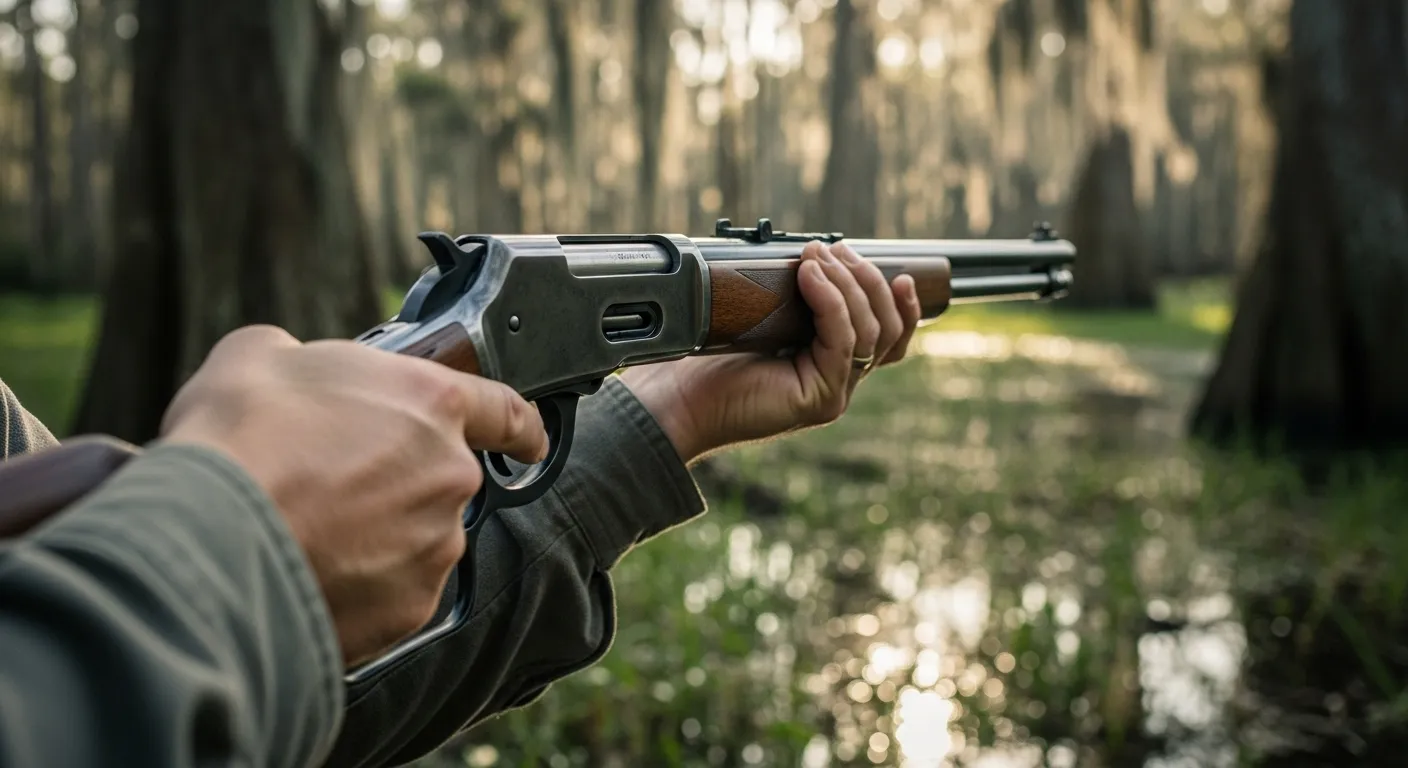
Recoil and Muzzle Blast
Hunters often operate at night in a small boat with other people nearby. Excessive recoil or blast can make safe handling more difficult. Choose the least powerful legal option that the agency and equipment manufacturer recognize as suitable.
Firearm Reliability
Water, mud, humidity, and vegetation can affect equipment. Use a maintained firearm or bangstick in sound working condition and follow the manufacturer’s storage, inspection, and cleaning instructions.
Ammunition Compatibility
Caliber markings alone do not establish compatibility. Read the firearm or bangstick manual and use only the cartridge designation expressly marked and approved for that device.
Hunter Experience
Alligator hunting is not an appropriate setting for learning basic firearm handling. Practice with the chosen equipment before the hunt and attend the agency’s training course. First-time hunters should work with an experienced, properly licensed guide or mentor.
Alligator Hunting Safety
Alligator hunting combines firearm risks with darkness, water, ropes, hooks, moving boats, and a powerful wild animal. Every participant must understand the plan before leaving the launch.
Follow the Four Firearm-Safety Rules
- Treat every firearm as if it is loaded.
- Keep the muzzle pointed in a safe direction.
- Keep your finger outside the trigger guard until ready to fire.
- Be certain of the target and what is in front of and beyond it.
These principles are reinforced by the Hunter-Ed firearm-safety guide. A mechanical safety does not make careless handling acceptable.
Boat Safety
The Florida alligator safety guide recommends that everyone in the boat wear a properly fitted life jacket because night obstructions and restrained-alligator behavior are unpredictable.
- Wear a life jacket rather than merely keeping one onboard.
- Carry functioning navigation lights and backup lighting.
- Stay within the boat’s capacity and distribute weight carefully.
- Keep hands, feet, firearms, and equipment clear of lines under tension.
- Assign one person to control the boat and avoid crowding the person handling the animal.
- Keep the firearm unloaded and cased until the law and hunt procedure permit preparation for dispatch.
- Never point a firearm across another person, another boat, or an occupied shoreline.
- Stop the hunt when weather, visibility, equipment failure, or crew fatigue makes continuing unsafe.
Bangstick Safety
- Use only a commercially manufactured, undamaged device.
- Read the complete manufacturer manual before the hunt.
- Keep all safety devices engaged until the official procedure requires otherwise.
- Use only the exact ammunition approved for the chamber.
- Observe state rules concerning underwater discharge.
- Follow the manufacturer’s misfire procedure without improvisation.
- Never use a bangstick as a pushing, restraining, or general-purpose pole unless its manufacturer expressly permits that use.
Humane Dispatch and Game Recovery
Follow the anatomical target and dispatch procedure taught by the responsible wildlife agency. Do not rely on entertainment programs, social-media videos, or generalized advice from another state.
After the authorized dispatch, follow agency training for safely confirming the animal’s condition. An alligator that appears motionless may still present a serious hazard. Do not bring a live alligator into a boat or vehicle, and do not remove restraints prematurely.
Attach the required harvest tag immediately at the time specified by the permit. The U.S. Fish and Wildlife Service explains that CITES alligator tags help document that hides were legally acquired through monitored harvest programs.
Common Mistakes
- Choosing caliber before checking the law: The program may prohibit that entire firearm category.
- Planning to shoot a free-swimming alligator: Many public hunts require capture and restraint first.
- Bringing an unauthorized backup firearm: Some regulations prohibit possession, not merely use.
- Assuming more power is safer: Greater recoil, blast, and penetration can increase risk in a boat.
- Using unfamiliar equipment: A nighttime hunt is not the place to learn a new handgun or bangstick.
- Ignoring ammunition markings: Similar cartridge names are not necessarily interchangeable.
- Overloading the boat: Hunters, lights, lines, coolers, and capture equipment add substantial weight.
- Failing to assign crew roles: Multiple people grabbing lines or equipment can create dangerous confusion.
- Removing restraints too early: An apparently incapacitated alligator may still move violently.
- Forgetting tagging and reporting: A legal harvest can become a violation if documentation procedures are not followed.
What Not to Do
- Do not hunt without the required permit, license, tag, or training.
- Do not use a caliber or firearm based solely on another hunter’s recommendation.
- Do not shoot at eyes, movement, or a silhouette you cannot positively identify.
- Do not fire toward another boat, person, residence, launch, livestock, or unsafe shoreline.
- Do not shoot an unrestrained alligator where the program requires restraint.
- Do not attempt to dispatch an alligator from an unstable position.
- Do not manufacture or modify a bangstick.
- Do not mix ammunition or carry cartridges incompatible with the firearm.
- Do not use alcohol or impairing substances before or during the hunt.
- Do not handle an alligator without following official training and recovery procedures.
Alligator Hunt Preparation Checklist
- Current alligator harvest permit and hunting license
- Required temporary or CITES tag
- Official regulation booklet and permit conditions
- Completed state alligator training course
- Legal capture and restraint equipment
- Authorized firearm or commercially manufactured bangstick
- Manufacturer-approved ammunition
- Secure firearm case
- Properly fitted life jacket for each person
- Navigation lights and backup lights
- Communication and emergency equipment
- First-aid kit
- Weather forecast and float plan
- Written landowner permission where required
- Harvest-reporting and check-station information
Final Answer
There is no single answer to what caliber for alligator hunting because the permitted dispatch equipment differs substantially among states. A .22 LR, .22 WMR, 9mm, .38 Special, or .357 Magnum handgun may be considered only where the applicable program authorizes that handgun and caliber. Other programs require a bangstick, specify a .38-caliber minimum, permit a restricted shotgun load, or prohibit ordinary firearms.
Do not begin by selecting the most powerful caliber. Begin with the current wildlife-agency rules, permit conditions, and mandatory training. Then select a reliable, manufacturer-approved option you can control safely while following the state’s close-range dispatch procedure for a lawfully restrained alligator.
FAQs
1. What is the best caliber for alligator hunting?
There is no universal best caliber. The correct choice is an agency-authorized caliber in the permitted firearm type that the hunter can use safely after completing the required training.
2. Is .22 LR enough for alligator hunting?
It may be permitted for close-range dispatch in an any-caliber-handgun program, but it is prohibited or unsuitable in other programs. It should not be treated as a universal recommendation.
3. Is .22 Magnum good for alligator hunting?
.22 WMR is a manageable dispatch option where legally authorized, but firearm type, animal restraint, ammunition, and agency procedures still determine suitability.
4. Can you use a 9mm for alligator hunting?
A 9mm handgun may be legal in programs permitting any-caliber handguns. It is not legal in Florida’s statewide program, which permits only a bangstick as a firearm method.
5. Can you use a .357 Magnum for alligator hunting?
Only where the regulations allow that handgun and cartridge. Its additional recoil and muzzle blast do not automatically make it preferable.
6. Can you use a .38 Special?
Possibly in an any-caliber-handgun program. A rule requiring a .38-caliber-or-larger bangstick does not necessarily authorize a .38 Special handgun.
7. Can you use a .45-caliber handgun?
Only where handguns of that caliber are legal. Larger diameter and greater recoil do not replace accurate control or compliance with the dispatch procedure.
8. Can you hunt alligators with a rifle?
Some jurisdictions or private-land programs may permit rifles, but Florida and South Carolina’s public program do not. Obtain explicit agency confirmation before bringing one.
9. Is a .223 rifle suitable for alligator hunting?
Its technical capability does not establish legality or safety. Rifles are prohibited or unnecessary in many close-range alligator harvest programs.
10. Can you use a .308 rifle?
Only where a specific regulation or permit authorizes it. A high-powered rifle can present unnecessary recoil, penetration, and boat-safety concerns.
11. Can you use a shotgun for alligator hunting?
Alabama permits an approved shotgun load under its 2026 rules, while Florida, Louisiana, and South Carolina impose different prohibitions. Check the exact jurisdiction.
12. What shotgun gauge is legal?
Gauge and ammunition requirements vary. Consult the current state regulations rather than assuming every shotgun or shell is legal.
13. What is a bangstick?
A bangstick is a specialized contact-discharge device mounted on a shaft. It must be commercially manufactured, legally permitted, and used according to agency and manufacturer instructions.
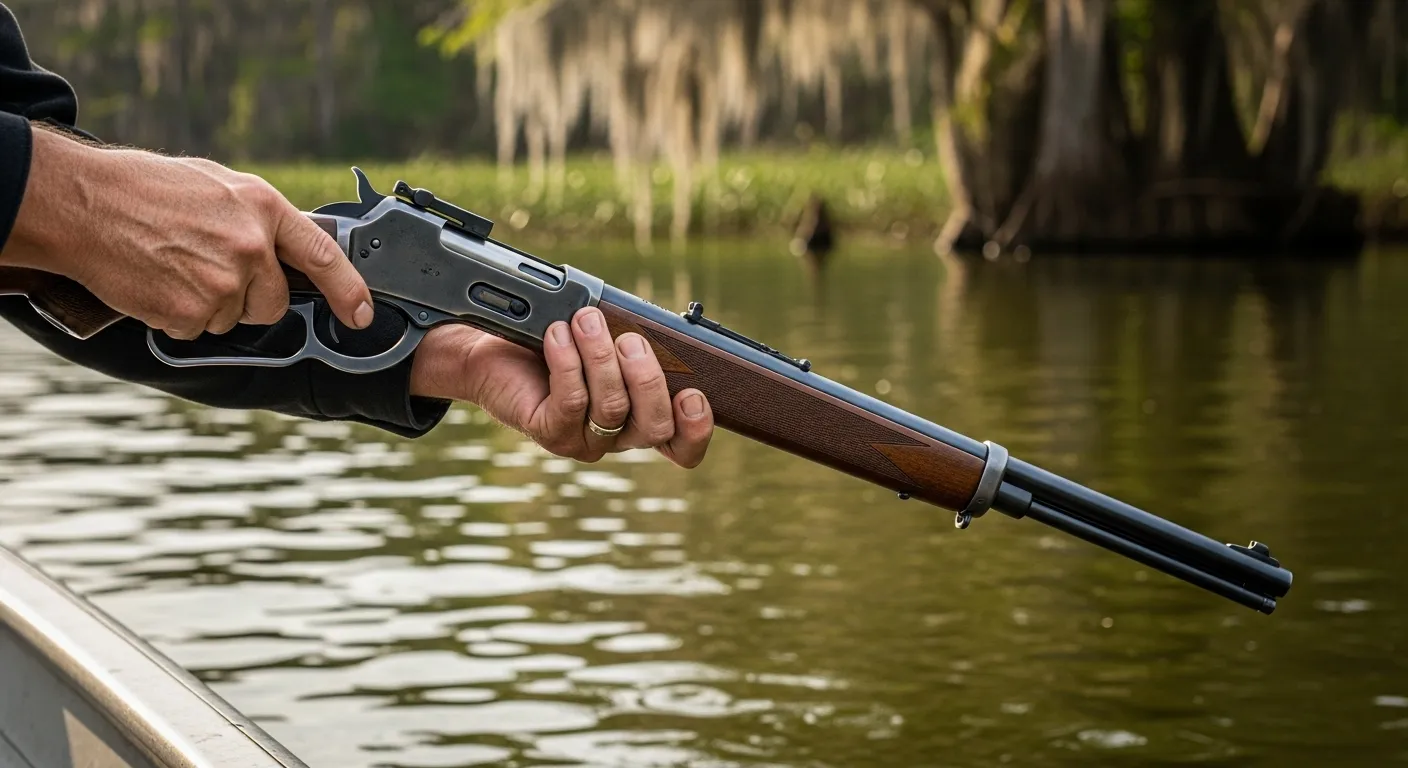
14. What caliber bangstick should I use?
Use a legal chambering approved by the device manufacturer. Alabama requires .38 caliber or larger, while other programs may apply different standards.
15. Can I make my own bangstick?
No. Improvised firearm devices can be unsafe and may violate state or federal law. Use only commercially manufactured, compliant equipment.
16. Are firearms legal for Florida alligator hunting?
Ordinary firearms are prohibited. Florida permits a bangstick only after the alligator is attached to a restraining line.
17. What caliber is legal in Georgia?
Georgia’s 2025–2026 regulations allow any-caliber handgun or bangstick for a lawfully restrained alligator. Other permit and equipment requirements still apply.
18. What caliber is legal in Alabama?
Alabama’s 2026 program permits a bangstick chambered in .38 caliber or larger or a shotgun using the authorized shot size. The alligator must first be restrained.
19. What firearm is legal in South Carolina?
The 2026 public-hunt guide permits a handgun or bangstick for dispatch under its procedures and prohibits rifles and shotguns.
20. Can you use a shotgun in Louisiana?
Louisiana prohibits possessing a shotgun while hunting or taking wild alligators. Verify all other authorized methods in the current LDWF regulations.
21. Can you hunt alligators with an air rifle?
Texas recognizes qualifying pre-charged pneumatic air guns for alligators, subject to minimum projectile and performance standards. This is not a nationwide rule.
22. Can you shoot a free-swimming alligator?
Many programs prohibit it and require capture and restraint before dispatch. Never attempt it unless the current regulation expressly authorizes the method.
23. Why must an alligator be restrained first?
Restraint allows a controlled, close-range dispatch, reduces the chance of losing the animal, and improves safety and humane recovery.
24. How close is an alligator during dispatch?
In restraint-based programs, the animal is generally brought adjacent to the boat, bank, or dock. Follow the precise distance and positioning taught by the state program.
25. Where should an alligator be shot?
Use only the anatomical target and procedure demonstrated by the wildlife agency’s official training. Incorrect placement can injure rather than immediately dispatch the animal.
26. Can you shoot an alligator between the eyes?
Do not rely on this common assumption. Alligator skull anatomy makes some apparent targets ineffective. Follow the agency’s designated dispatch point.
27. Is a head shot always safe?
No. The animal’s position, line tension, water, boat occupants, muzzle direction, and background all create additional hazards.
28. Is a larger caliber more humane?
Not automatically. Humane dispatch depends on a legal method, secure restraint, correct placement, appropriate equipment, and a trained operator.
29. Does alligator size change the required caliber?
It may influence equipment selection, but the legal firearm category and agency training remain controlling. Never exceed the firearm or program’s requirements without a clear reason.
30. Do I need a permit to hunt alligators?
Yes in regulated recreational programs. Permits may be limited by drawing, location, season, residency, or management area.
31. Can a hunting partner dispatch the alligator?
Only if that person has the required license or agent authorization and the permit program allows it. Florida, for example, distinguishes licensed participants from people merely operating the boat or light.
32. Can I carry a backup firearm?
Not necessarily. Some programs prohibit possession of unauthorized firearms during the hunt, even if they are not used.
33. Must the firearm remain unloaded in the boat?
Follow the program’s rule. Alabama requires authorized shotguns and bangsticks to remain cased and unloaded until a restraining line is attached.
34. Should everyone wear a life jacket?
Yes. Night operation, submerged obstacles, lines under tension, and an unpredictable restrained alligator make continuous life-jacket use the responsible choice.
35. Can an alligator still move after dispatch?
Yes. Reflexive or continued movement can remain dangerous. Follow official training before handling the animal or removing restraints.
36. When should the harvest tag be attached?
Attach it at the exact time and location required by the permit—usually immediately after dispatch and before moving or transporting the animal.
37. Why do alligator hides need CITES tags?
CITES tags document legal acquisition and support regulated international trade. Untagged hides may be rejected by processors and cannot be legally exported.
38. Should a beginner hunt with a guide?
Yes. An experienced, properly licensed guide or mentor can help manage boat operation, capture equipment, legal procedures, and emergency decisions.
39. What is the most important equipment besides the firearm?
Required permits, lawful capture and restraint equipment, life jackets, navigation lights, communication equipment, and the correct harvest tag are essential.
40. What should I check immediately before the hunt?
Recheck agency regulations, permit conditions, weather, boating notices, equipment condition, firearm compatibility, crew roles, tagging procedures, and emergency contacts.
Read more: