
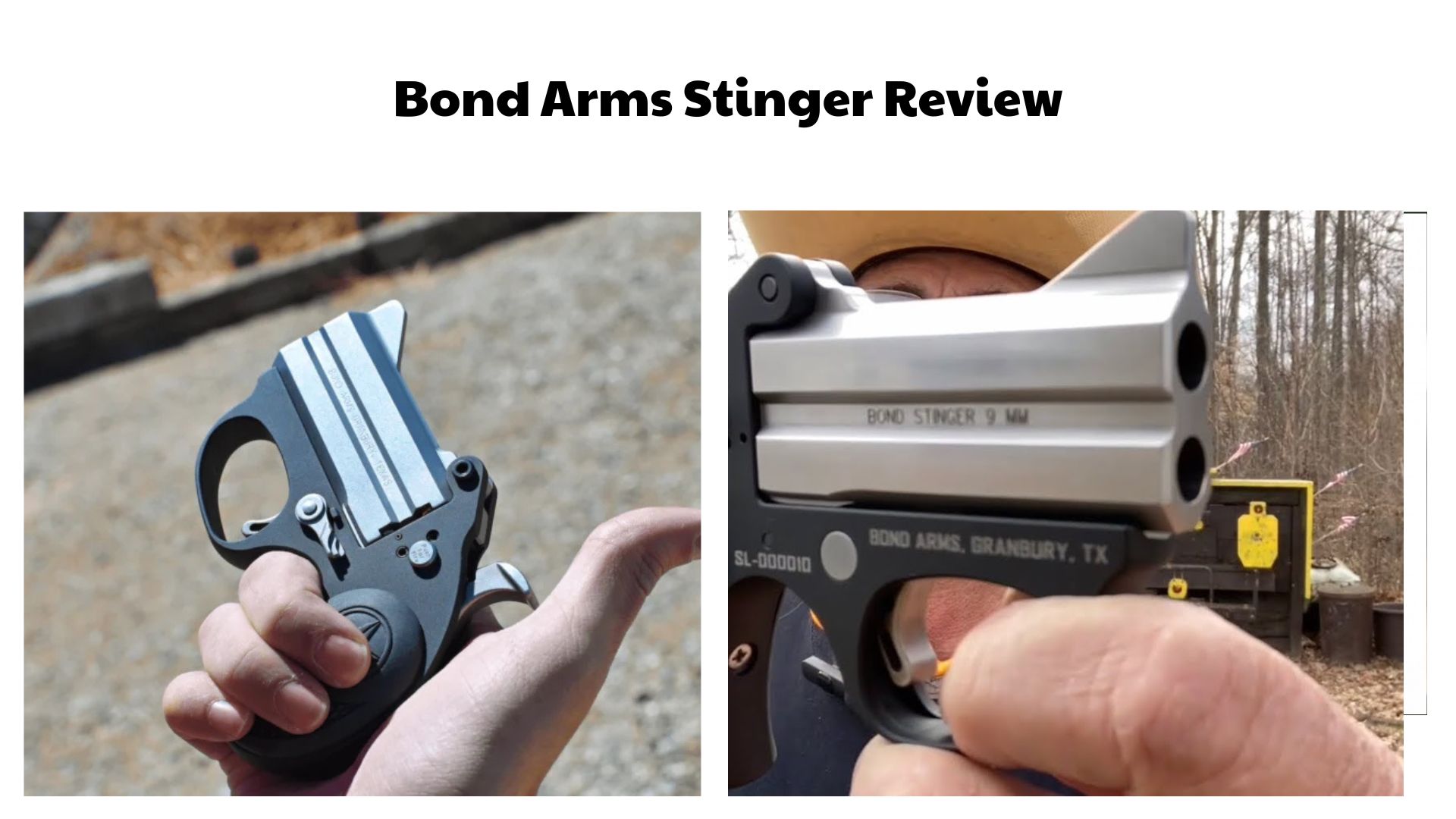

The Bond Arms Stinger represents a modern interpretation of the classic derringer platform, designed for users who prioritize extreme concealability and mechanical simplicity above all else. Unlike traditional compact semi-automatic pistols that focus on capacity and rapid follow-up shots, the Stinger embraces a different philosophy—minimal size, direct operation, and dependable close-range defensive capability.
Developed by Bond Arms, a manufacturer well known for high-quality derringer-style firearms, the Stinger line refines the over-under barrel concept into a more practical and carry-friendly design. It is intended for deep concealment scenarios where even micro-compact pistols may feel too large or noticeable. This makes it a specialized tool rather than a general-purpose concealed carry handgun.
Chambered in a variety of calibers including .22 LR, .22 WMR, .380 ACP, and 9mm depending on configuration, the Stinger offers flexibility within its niche role. Each caliber choice reflects a different balance between recoil, power, and shootability. While it is not designed to replace a primary defensive pistol, it serves as a capable backup or “last resort” firearm in situations where discretion and portability are critical.
In today’s concealed carry market, the Bond Arms Stinger competes not with full-size duty pistols, but with ultra-compact pocket guns and minimalist defensive platforms. Its appeal lies in its stainless-steel construction, extremely small footprint, and straightforward manual operation. For users who value reliability through simplicity, it remains a distinctive and purpose-driven option.
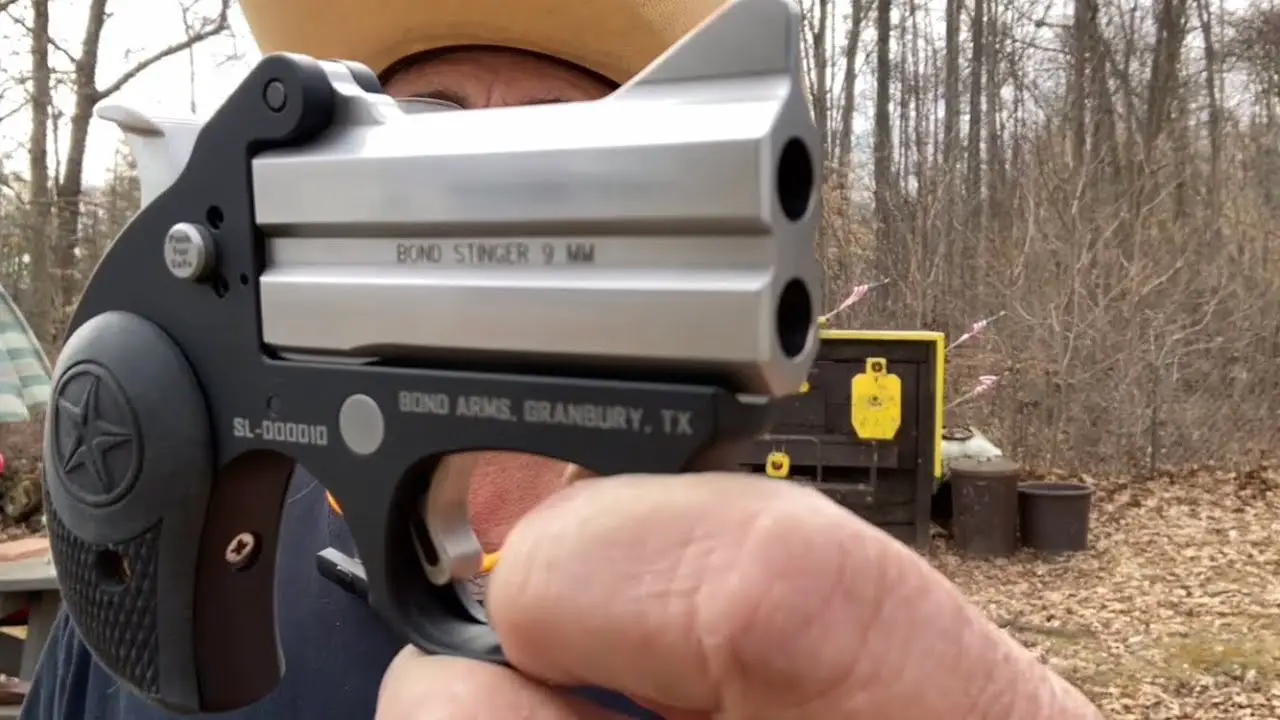
Key Specifications
The Bond Arms Stinger is built around a compact and highly simplified mechanical system that reflects its derringer heritage. While modern in materials and construction, its operating concept remains intentionally straightforward.
Caliber options vary depending on the model, with choices including .22 LR, .22 WMR, .380 ACP, and 9mm. This range allows users to select a configuration that best matches their intended balance between recoil management and defensive power. Smaller calibers like .22 LR prioritize minimal recoil and ease of control, while 9mm variants deliver significantly more defensive capability at the cost of increased snap.
The firearm operates using a single-action, break-open over/under derringer design. This means the shooter must manually open the barrel assembly to load and unload, and cock the hammer for each shot. While this system is slower than semi-automatic platforms, it contributes to mechanical simplicity and reliability under a wide range of conditions.
In terms of size, the Stinger maintains a compact profile with an approximate barrel length of around 3 inches and an overall length of roughly 5 inches. These dimensions make it one of the most easily concealable centerfire-compatible platforms available, particularly in pocket or ankle carry setups.
Weight varies depending on configuration, typically ranging from approximately 11 to 18 ounces. Aluminum-framed versions are lighter and more carry-friendly, while stainless steel variants provide increased durability and a more solid shooting feel. Regardless of material choice, the design emphasizes strength and longevity in a very small package.
Capacity is fixed at two rounds, delivered through the dual-barrel system. While this is significantly lower than modern semi-automatic pistols, it reflects the Stinger’s intended role as a backup or emergency-use firearm rather than a high-capacity defensive weapon. This limitation is balanced by extreme simplicity and ease of concealment.
The frame is typically constructed from 7075 aluminum or stainless steel, depending on the variant. Both materials are chosen for strength and resistance to wear, ensuring the firearm can withstand long-term carry and repeated use. The barrel system is made of stainless steel and is part of Bond Arms’ interchangeable barrel platform, allowing users to switch calibers on compatible models.
Sighting is intentionally minimal. The Stinger uses a fixed front blade combined with a rear notch cut directly into the frame or barrel. This design prioritizes durability and snag-free carry over precision aiming at longer distances. It is best suited for close-range defensive scenarios where instinctive shooting is more realistic than precise sight alignment.
Safety is handled through a combination of mechanical systems including a cross-bolt safety, rebounding hammer, and manual safety features depending on the model. These redundancies are designed to prevent accidental discharge while maintaining simple operation. Controls are kept intentionally minimal, with the break-open loading system serving as the primary interface for operation.
Overall, the Bond Arms Stinger’s specifications reflect a clear design philosophy: prioritize concealability, simplicity, and durability over capacity and speed. It is a specialized tool built for a specific role in the concealed carry spectrum, appealing to users who understand its limitations and value its strengths.
Design & Build Quality
The Bond Arms Stinger stands out in the concealed carry market because it does not try to imitate modern semi-automatic pistols. Instead, it embraces a proven derringer platform and refines it with modern engineering, stronger materials, and tighter manufacturing tolerances. The result is a compact defensive tool that prioritizes simplicity, durability, and absolute concealability over firepower or rapid shooting capability.
Modern Derringer Platform Design
At its core, the Stinger uses an ultra-compact over-under barrel configuration that stays true to the traditional derringer concept. However, unlike older designs that were often crude or underpowered, Bond Arms has re-engineered this platform using modern manufacturing techniques and defensive-grade materials.
The focus of the design is clearly on deep concealment scenarios where even micro-compact pistols may be too large or noticeable. This makes the Stinger especially appealing for users who prioritize discretion in everyday carry situations or need a secondary firearm that can disappear almost anywhere on the body.
Instead of chasing high capacity or tactical expansion, the design emphasizes mechanical strength and simplicity. There are fewer moving parts compared to semi-automatic pistols, which reduces complexity and potential failure points. This makes the platform highly predictable in operation, even under less-than-ideal conditions.
Premium Materials & Construction
One of the most defining characteristics of the Bond Arms Stinger is its use of premium-grade materials. Depending on the specific model, the frame may be constructed from stainless steel or aircraft-grade 7075 aluminum. Both materials are chosen for their strength-to-weight ratio and long-term durability.
The machining quality is a significant step above traditional derringer designs. Tight tolerances ensure consistent lock-up and reliable function over time. This is especially important for a break-open firearm that relies on precise alignment between barrels and firing components.
The stainless steel barrel system is another key feature, offering resistance to corrosion and wear. Many versions of the Stinger also benefit from Bond Arms’ interchangeable barrel system, allowing users to switch calibers on compatible frames. This adds versatility without compromising the firearm’s compact nature.
Overall, the construction is designed to handle repeated use with modern defensive ammunition, which is a major improvement over older derringer platforms that were often limited in strength and longevity.
Ergonomics and Handling
Ergonomics on the Stinger are intentionally minimalistic. The grip is compact and shaped primarily for concealability rather than extended shooting comfort. This is a deliberate design choice that reflects the firearm’s intended role as a backup or last-resort defensive tool.
Different grip styles, including bird’s-head and textured variations, help improve control depending on user preference. While the grip is small, it is designed to provide enough purchase for controlled firing at close distances, where precision shooting is less critical than immediate defensive response.
The short sight radius is one of the natural limitations of the platform. It reduces long-range precision but aligns with the firearm’s intended engagement distances. The Stinger is not designed for target shooting or extended range sessions, but rather for instinctive, close-quarters defensive use.
In practical handling, the firearm is intended for quick deployment and point shooting. Users typically rely on muscle memory and close-range accuracy rather than extended sight alignment. This reinforces its role as a highly specialized defensive tool rather than a general-purpose handgun.
Capacity & Concealability
Capacity is one of the most defining characteristics of the Bond Arms Stinger. The platform uses a fixed two-round system based on its over-under barrel design. While this is significantly lower than modern semi-automatic pistols, it is an intentional design trade-off that supports its extreme concealability.
With only two rounds available before reloading, the Stinger clearly prioritizes simplicity and size reduction over sustained fire capability. This makes it unsuitable as a primary defensive firearm for most users, but highly relevant as a backup option in critical or emergency situations.
Where the Stinger excels is concealability. Its extremely compact footprint allows it to be carried in environments where even micro-compact pistols might be difficult to conceal. Pocket carry, ankle carry, and other minimalist setups become realistic options due to its small dimensions and light weight.
In fact, it is one of the most concealable centerfire-capable firearm designs available on the market. This level of discretion is one of its strongest selling points, especially for users who prioritize complete concealment in professional, travel, or high-discretion environments.
However, this extreme concealability comes with a clear trade-off. Users must accept very limited capacity and slower reload procedures compared to semi-automatic platforms. Reloading requires manual break-open operation and individual cartridge loading, which is inherently slower and less efficient under stress.
Because of these limitations, the Stinger is best understood as a secondary or backup firearm rather than a primary defensive weapon. It fills a very specific niche where maximum concealability outweighs all other performance considerations.
In practical terms, the Bond Arms Stinger is ideal for situations where carrying a larger firearm is not possible or not desirable. It is not designed to compete with modern high-capacity pistols but to complement them as an ultra-discreet alternative when size constraints are the top priority.
Trigger Performance
The trigger system of the Bond Arms Stinger reflects its overall design philosophy: simplicity, safety, and controlled operation over speed or high-volume shooting. Unlike modern striker-fired pistols, the Stinger uses a single-action mechanism that requires deliberate handling for each shot. This creates a very different shooting experience that is closely tied to its derringer heritage.
Single-Action Trigger System
The Stinger operates on a single-action trigger system, which means the hammer must be manually cocked before each shot. This step is part of the natural firing sequence and cannot be bypassed. While this may feel slower compared to semi-automatic pistols, it contributes to a highly controlled and intentional shooting process.
The trigger pull itself is relatively short in travel, but it can feel heavier than expected due to the mechanical geometry of the design. This is not a flaw, but rather a characteristic of compact single-action derringer systems where leverage and space are limited.
Safety is a major benefit of this system. Because the hammer must be manually cocked, the firearm is less likely to discharge unintentionally during handling. This aligns with the Stinger’s intended role as a deep concealment or backup firearm where safe carry conditions are a priority.
Overall, the trigger system prioritizes mechanical simplicity and predictable operation over rapid-fire capability or competition-level performance.
Shooting Feel
In practical use, the trigger break on the Bond Arms Stinger is consistent but requires deliberate control from the shooter. Each shot demands a conscious sequence of actions: cock the hammer, align the sights (or point aim), and press the trigger in a controlled manner.
This operating style encourages slower, more deliberate shooting rather than rapid engagement. As a result, the Stinger is best suited for defensive scenarios where precision at close range is more important than volume of fire.
Training plays a significant role in improving performance with this trigger system. With repetition, shooters become more comfortable with the manual cocking process and can develop a smoother rhythm between shots. This improves confidence and consistency in defensive use situations.
Shooting Performance & Accuracy
Recoil Management
Recoil characteristics in the Bond Arms Stinger vary significantly depending on caliber choice. In lighter calibers such as .22 LR, recoil is minimal and very easy to control, making it accessible even for new shooters. However, in more powerful calibers like .380 ACP or 9mm, recoil becomes noticeably sharper due to the firearm’s compact size and lightweight frame.
Because the Stinger is built on a very small platform, there is less mass to absorb recoil energy. This means that perceived recoil, or “snap,” can feel more pronounced compared to larger handguns. Grip choice and shooting technique play an important role in managing this effect.
Many users find that rubberized grip options improve control and reduce discomfort during firing. These grips help absorb some of the recoil impulse and provide a more secure hold, especially during rapid or repeated shots.
The firearm is clearly designed for short, controlled defensive engagements rather than extended shooting sessions. It performs best when used in brief, close-range scenarios where quick response matters more than sustained fire.
Accuracy
Accuracy with the Bond Arms Stinger is primarily effective within a range of 5 to 15 yards, depending heavily on shooter skill and familiarity with the platform. Beyond this distance, the limitations of its short barrel and minimal sight system become more noticeable.
The firearm is not designed for precision shooting at extended ranges. Instead, it functions best as a point-and-shoot defensive tool where instinctive aiming and close-range accuracy are the primary focus.
The short sight radius and simple fixed sights reinforce this design philosophy. While they are durable and snag-free, they are not intended for precision target acquisition. As a result, consistent practice is important for developing reliable accuracy under real-world conditions.
With experience, shooters can achieve consistent center-mass hits at typical defensive distances. The key factor is familiarity with the firearm’s handling and recoil behavior rather than mechanical precision alone.
Reliability
The Bond Arms Stinger is generally considered reliable due to its extremely simple mechanical design. With fewer moving parts compared to semi-automatic pistols, there are fewer potential points of failure during operation.
Its manual operation also reduces dependence on cycling systems such as magazines, recoil springs, or feeding mechanisms. This simplicity contributes to consistent performance, especially in environments where reliability is critical.
However, like many compact firearms, performance can vary depending on ammunition type and caliber selection. Some loads may perform better than others, and users often benefit from testing different defensive and practice ammunition to determine optimal reliability.
Bond Arms is known for strong build quality and durable construction standards. This reputation extends to the Stinger platform, which is designed to withstand repeated use despite its compact size. When properly maintained and paired with appropriate ammunition, it delivers consistent and dependable performance within its intended role.
Controls & Features
The Bond Arms Stinger is built around a philosophy of simplicity, and this is clearly reflected in its controls and feature set. Unlike modern semi-automatic pistols that include multiple levers, rails, and configurable systems, the Stinger strips everything down to only what is necessary for safe and reliable operation. This makes it highly intuitive, especially under stress, where simplicity often becomes an advantage.
One of the most defining operational features is the break-open barrel loading system. This classic derringer-style mechanism allows the firearm to be opened at the hinge point for direct access to the chambers. Loading and unloading are straightforward and do not rely on magazines or feeding systems. While slower than modern semi-automatic platforms, this method significantly reduces mechanical complexity.
A cross-bolt safety is included to provide an additional layer of mechanical security. This safety system helps prevent accidental discharge during handling or carry. Combined with the manual hammer operation, it reinforces the firearm’s emphasis on deliberate and controlled use.
External controls are intentionally minimal. There are no slide releases, magazine buttons, or accessory rails found on typical semi-automatic pistols. This reduction in external components minimizes snag points, making the Stinger particularly suitable for pocket or deep concealment carry where smooth draw is important.
Sights are fixed and integrated directly into the frame or barrel assembly. While this limits adjustability, it also ensures durability and prevents any shifting or loosening over time. The sighting system is designed for close-range defensive use rather than precision target shooting.
Many Bond Arms models feature an interchangeable barrel system, and the Stinger benefits from this design philosophy in compatible configurations. This allows users to change calibers depending on barrel availability, offering some flexibility within a very compact platform.
Overall, the control layout is intentionally simple and stress-friendly. In high-pressure situations, fewer controls reduce the likelihood of user error. Maintenance is also straightforward due to the minimal number of moving parts, making cleaning and inspection relatively quick compared to more complex firearms.
Pros and Cons
Pros
The Bond Arms Stinger offers a unique combination of advantages that make it stand out in the ultra-compact firearm category. Its strongest feature is its extremely compact and highly concealable design, allowing it to be carried in situations where most other firearms would be impractical. This makes it especially appealing for deep concealment or backup carry roles.
Another major advantage is its strong stainless steel construction. Unlike many lightweight polymer-based pocket pistols, the Stinger is built with robust materials that enhance long-term durability and resistance to wear. This gives it a solid, premium feel despite its small size.
The mechanical system is also extremely simple, which contributes to its reliability. With fewer moving parts and no complex cycling mechanism, there are fewer potential points of failure. This simplicity is a key reason why derringer-style firearms continue to exist in modern carry discussions.
In addition, many models support interchangeable barrels, allowing users to switch between calibers depending on their needs. This adds versatility to an otherwise minimal platform and increases its practical value for different defensive scenarios.
The Stinger is also very easy to carry in a variety of concealment positions, including pocket or ankle carry. Its small footprint makes it one of the most discreet defensive firearms available. Finally, it represents a modernized take on a classic derringer platform, blending traditional design with improved materials and manufacturing standards.
Cons
Despite its strengths, the Bond Arms Stinger has clear limitations that define its niche role. The most obvious drawback is its very limited two-round capacity. Compared to modern semi-automatic pistols, this is a significant reduction in available firepower and requires careful consideration by the user.
Reload speed is another limitation. The break-open design requires manual reloading of each chamber, which is considerably slower than magazine-based systems. In extended defensive scenarios, this can become a tactical disadvantage.
The short sight radius also limits precision shooting capability. While acceptable for close-range defense, it is not designed for accurate engagement at extended distances. Users must rely heavily on instinctive shooting skills.
Recoil can also be sharp, especially in higher-pressure calibers such as 9mm. Due to the firearm’s lightweight frame and compact size, there is less mass to absorb recoil energy, making it feel more pronounced during firing.
Additionally, the Stinger is not well-suited for high-volume training or extended range sessions. Its design is focused on defensive carry and emergency use rather than recreational shooting or competition.
Finally, its overall role in the firearm market is highly niche. Compared to modern micro-compact pistols that offer higher capacity, faster reloads, and advanced features, the Stinger is a specialized tool rather than a general-purpose defensive handgun.
Comparison with Competitors
Bond Arms Stinger vs Ruger LCP
The Ruger LCP represents a very different approach to concealed carry compared to the Bond Arms Stinger. The LCP is a lightweight semi-automatic pistol designed around .380 ACP, offering higher capacity and faster follow-up shots through its magazine-fed system. This makes it more suitable for users who want a primary everyday carry firearm with practical defensive capability.
In contrast, the Stinger focuses on extreme concealability and mechanical simplicity. With its two-round derringer design, it sacrifices capacity in favor of a significantly smaller footprint and fewer mechanical dependencies. This makes it easier to conceal in situations where even pocket pistols may feel bulky.
Overall, the LCP is better suited as a primary carry gun due to its higher capacity and faster reload potential, while the Stinger functions more effectively as a backup or last-resort firearm.
Bond Arms Stinger vs Kel-Tec P32
The Kel-Tec P32 is another ultra-compact defensive firearm, but it uses a semi-automatic platform chambered in .32 ACP. This gives it a clear advantage in capacity and shooting speed compared to the Stinger. With a magazine-fed system, the P32 allows for multiple follow-up shots and quicker reloads, making it more practical for everyday defensive carry.
The Stinger, however, offers a simpler mechanical design with fewer moving parts. Its break-open derringer system is extremely straightforward, which contributes to its durability and reliability in a minimalist sense. It also tends to feel more solid due to its metal construction compared to the lightweight polymer frame of the P32.
In general, the P32 is better suited for daily concealed carry use, while the Stinger appeals more to users prioritizing simplicity and ultra-compact concealment over capacity.
Bond Arms Stinger vs North American Arms Mini Revolvers
The North American Arms mini revolvers share a similar philosophy with the Stinger, as both are designed for ultra-compact backup carry. Each platform emphasizes minimal size, simple operation, and extreme concealability over high capacity or rapid fire capability.
The Stinger offers greater flexibility in terms of caliber options and generally uses stronger modern materials in its construction. This gives it an advantage in durability and adaptability within its platform.
On the other hand, mini revolvers from North American Arms can offer slightly faster reload potential in certain scenarios, depending on user familiarity. However, both platforms remain highly specialized and are best viewed as backup firearms rather than primary defensive tools.
Best Use Cases
The Bond Arms Stinger is designed for a very specific set of real-world applications where concealment and simplicity matter more than capacity or rapid-fire capability. Its ultra-compact design makes it ideal for deep concealment backup roles.
One of its primary use cases is as a backup firearm carried in addition to a primary defensive pistol. In situations where a full-size or compact handgun is already carried, the Stinger can serve as a secondary option that is easier to conceal in tighter clothing or restricted environments.
It is also well-suited for pocket carry in situations where size is the most critical factor. Its minimal footprint allows it to be carried discreetly in environments where printing or visibility must be avoided.
Professionals who operate in security, law enforcement, or high-risk environments may also consider it as a secondary defensive weapon. Its simplicity and reliability make it useful in emergency backup scenarios where primary equipment may be unavailable.
Additionally, the Stinger can be practical for outdoor activities such as camping or hiking, where a lightweight emergency firearm is preferred. Its small size makes it easy to carry without adding noticeable weight or bulk.
Finally, it fits well into minimalist concealed carry setups where weight reduction and simplicity are prioritized over extended defensive capability. It is not designed to replace a primary firearm but to complement it in highly specific situations.
Aftermarket Support & Accessories
Aftermarket support for the Bond Arms Stinger is more limited compared to mainstream semi-automatic pistols, but it still offers functional options for users who want to enhance carry comfort and usability.
Holster availability includes pocket and ankle carry solutions, which are the most common methods for carrying such a compact firearm. These holsters focus on retention and concealment rather than rapid access or tactical features.
One of the most notable platform advantages is the interchangeable barrel system available on compatible Bond Arms models. This allows users to change calibers, increasing versatility within a compact frame without requiring a separate firearm.
Grip upgrades are also available and can improve handling comfort, especially for users who intend to practice or train with the firearm. These modifications can help reduce felt recoil and improve overall control.
Compared to mainstream pistols, the accessory ecosystem is relatively basic. There are fewer options for lights, optics, or modular attachments, which reflects the Stinger’s minimalist design philosophy.
Ammunition selection plays a particularly important role in performance optimization. Because of its short barrel and compact design, different loads can produce noticeably different results in recoil, reliability, and terminal performance.
Finally, the compact nature of the platform inherently limits accessory expansion. This is not a modular tactical system but a purpose-built defensive tool designed to remain simple and compact throughout its lifespan.
Who Should Buy the Bond Arms Stinger?
The Bond Arms Stinger is not a general-purpose handgun. It is a highly specialized defensive tool designed for users who understand and accept its limitations in exchange for extreme concealability and mechanical simplicity. Because of this, it fits a very specific type of firearm owner rather than the average concealed carry user.
One of the primary groups that benefits from the Stinger is users who prioritize extreme concealability above all else. These are individuals who may need a firearm that disappears completely in a pocket, ankle holster, or similarly discreet carry position where even micro-compact pistols could be noticeable.
It is also well-suited for experienced carriers who already own a primary defensive handgun and want a secondary backup firearm. In this role, the Stinger acts as a last-resort option that can be carried in addition to a more capable semi-automatic pistol.
Outdoor enthusiasts may also find value in the platform, particularly those who spend time hiking, camping, or traveling in remote areas. In such situations, a lightweight emergency firearm that is easy to carry and resistant to environmental stress can be useful.
Another group includes shooters who appreciate mechanical simplicity and rugged design. The Stinger’s break-open system and minimal moving parts make it appealing to those who prefer straightforward operation over complex modern firearm systems.
Finally, collectors and enthusiasts of derringer-style firearms may be drawn to the Stinger as a modern evolution of a classic design. It blends traditional concepts with improved materials and manufacturing quality, making it both functional and historically interesting.
Who Should Avoid It?
Despite its strengths, the Bond Arms Stinger is not suitable for many firearm users, especially those who require versatility, capacity, or rapid-fire capability in a defensive weapon.
Users who need high-capacity defensive pistols should avoid this platform. With only two rounds available before reloading, it cannot match the sustained defensive capability of modern semi-automatic handguns.
It is also not ideal for beginners who prefer simple semi-automatic operation. The manual cocking process, break-open loading system, and slower shooting rhythm require more familiarity and training than typical striker-fired pistols.
Competition shooters or individuals focused on range performance will also find the Stinger unsuitable. It is not designed for speed, accuracy at distance, or high-volume shooting sessions.
Another limitation is reload speed. Anyone who requires fast reload capability in defensive scenarios will find the break-open system significantly slower than magazine-fed alternatives.
Lastly, shooters who prioritize modern tactical features such as optics mounting systems, accessory rails, or modular customization will find the Stinger too minimal. Its design intentionally avoids these features to maintain compact size and mechanical simplicity.
Final Verdict
The Bond Arms Stinger occupies a very specific and clearly defined niche in the concealed carry world. It is a highly specialized ultra-compact derringer designed primarily for deep concealment and backup defensive roles rather than primary everyday carry use.
Its strongest advantages lie in its durable construction, extremely small size, and straightforward mechanical operation. These qualities make it reliable, easy to carry, and highly discreet in situations where larger firearms may not be practical or appropriate.
At the same time, the platform comes with significant trade-offs. Limited capacity, slower reload procedures, and reduced shooting comfort mean that it cannot compete directly with modern semi-automatic pistols in overall defensive capability.
Instead, the Stinger should be understood as a specialized tool rather than a replacement for mainstream carry firearms. It is designed for users who accept its limitations in exchange for maximum concealability and simplicity.
For those who clearly understand its role, the Bond Arms Stinger remains a dependable and distinctive option in the ultra-compact handgun category. It continues to serve a narrow but important purpose in modern concealed carry: providing a firearm that can be carried almost anywhere, with minimal footprint and maximum discretion.
Bond Arms Stinger FAQ (50+ Detailed Questions & Answers)
1. What is the Bond Arms Stinger designed for?
The Bond Arms Stinger is designed as an ultra-compact derringer for deep concealment and backup defensive use. It is not intended to replace a primary carry pistol but to provide a last-resort option when size and discretion matter more than capacity or speed.
2. Is the Bond Arms Stinger a good everyday carry gun?
It can be used for everyday carry, but it is more commonly chosen as a secondary or backup firearm. Its extremely limited capacity makes it less ideal as a standalone defensive pistol compared to modern semi-automatics.
3. How many rounds does the Stinger hold?
The Stinger holds 2 rounds total, using its over-under barrel configuration. This is a defining limitation of the platform and reflects its derringer-style design philosophy.
4. What calibers is the Stinger available in?
Depending on the model, the Stinger is offered in calibers such as .22 LR, .22 WMR, .380 ACP, and 9mm. Each caliber offers different trade-offs in recoil, power, and shootability.
5. Is the Bond Arms Stinger reliable?
Yes, it is generally considered reliable due to its very simple mechanical design. With fewer moving parts than semi-automatic pistols, there are fewer failure points during operation.
6. Is it better than a pocket pistol like the Ruger LCP?
It depends on priorities. The Ruger LCP offers higher capacity and faster follow-up shots, while the Stinger offers better concealability and mechanical simplicity.
7. Is the Stinger easy to conceal?
Yes, it is one of the most concealable centerfire-capable firearms available. Its small size allows pocket, ankle, or deep concealment carry in situations where other guns may print.
8. Can the Stinger be used as a primary self-defense gun?
It is not ideal as a primary defensive firearm due to its 2-round capacity and slow reload process. It is better suited as a backup or last-resort option.
9. How do you reload the Bond Arms Stinger?
The firearm is reloaded by breaking open the barrel assembly, removing spent casings, and manually inserting new rounds into the chambers. This process is slower than magazine-fed pistols.
10. Is the trigger hard to use?
The trigger is simple but requires manual hammer cocking before each shot. This creates a deliberate shooting rhythm rather than fast firing capability.
11. Does the Stinger have a safety?
Yes, it typically includes a cross-bolt safety and other mechanical safety features depending on the model. These help prevent accidental discharge during carry.
12. Is recoil strong on the Stinger?
Recoil depends heavily on caliber. .22 LR is very mild, while 9mm versions can feel noticeably snappy due to the lightweight frame.
13. Is it good for beginners?
It is not ideal for beginners because it requires manual operation, careful handling, and familiarity with single-action shooting mechanics.
14. Is the Stinger accurate?
It is accurate at close range (5–15 yards). Beyond that, its short barrel and minimal sights limit precision.
15. Does it have good sights?
The sights are minimal and fixed. They are designed for quick close-range aiming rather than precision shooting.
16. Can it handle defensive ammunition?
Yes, most models are designed to handle modern defensive ammunition, but performance may vary depending on caliber and load selection.
17. Is it comfortable to shoot?
Comfort varies by user and caliber. Smaller calibers are easy to shoot, while larger calibers can feel harsh due to limited grip surface.
18. Does it have recoil mitigation features?
Not advanced ones. Grip design and optional rubber grips help, but recoil control is mostly dependent on shooter technique.
19. How does it compare to revolvers?
It is similar in role to ultra-compact revolvers but offers different ergonomics and a break-open system instead of a cylinder.
20. Is it legal to carry?
Legality depends on local laws. In most regions where concealed carry is permitted, it is treated like any other handgun.
21. Is it heavy?
No, it is relatively lightweight, typically between 11–18 ounces depending on configuration.
22. Can you carry it in a pocket safely?
Yes, but only with a proper holster to prevent accidental discharge and protect the trigger area.
23. Is it better than a micro-9mm?
Not generally. Micro-9mm pistols offer higher capacity and faster follow-up shots, but the Stinger is smaller and simpler.
24. Does it require maintenance?
Yes, like all firearms, but maintenance is simple due to its minimal mechanical complexity.
25. Is it durable?
Yes, Bond Arms builds it with stainless steel or aluminum frames designed for long-term durability.
26. Can it be used for range training?
It can be used for training, but it is not designed for high-volume range sessions.
27. Does it support accessories?
Very limited. It does not support optics or rails due to its compact design.
28. Can you switch barrels?
Some Bond Arms models support interchangeable barrels, but compatibility depends on configuration.
29. Is it good for self-defense situations?
It can be effective at close range, but its limited capacity makes it a backup option rather than primary defense.
30. Why choose it over a semi-auto?
Users choose it for extreme concealability, simplicity, and reliability in niche carry situations.
31. Is the Bond Arms Stinger good for deep concealment?
Yes, this is one of its strongest advantages. The Stinger is specifically designed for deep concealment where even micro-compact pistols may be difficult to hide. Its small footprint allows pocket or ankle carry with minimal printing.
32. Can the Stinger be used for concealed carry in hot climates?
Yes, it performs well in hot climates because its compact size allows carry with light clothing. Many users choose it for summer carry when larger pistols become harder to conceal.
33. Does the Stinger require special training?
It does not require formal training, but practice is strongly recommended. The manual cocking system and break-open reload method require familiarity to use effectively under stress.
34. How fast can you fire follow-up shots?
Follow-up shots are slower compared to semi-automatic pistols because the hammer must be manually cocked after each shot. This makes it less suitable for rapid defensive engagements.
35. Is the Stinger noisy or flashy when fired?
Like most small firearms, it produces noticeable muzzle blast depending on caliber. Higher-pressure rounds like 9mm will have more flash and report due to the short barrel.
36. Can left-handed shooters use it easily?
Yes, the simple design makes it generally ambidextrous in use. However, handling comfort may vary depending on grip style and hand preference.
37. Is the Stinger safe to carry loaded?
Yes, when properly used with its safety engaged and carried in a holster. Like all firearms, safe handling practices are essential.
38. Does it have a magazine?
No, it does not use a magazine. It is a break-open derringer that loads directly into the barrels.
39. How long does it take to reload?
Reloading is slower than modern pistols because each round must be manually inserted after opening the action. This is one of its main operational limitations.
40. Is it suitable for home defense?
It can be used in emergencies, but it is not ideal for home defense compared to higher-capacity pistols or shotguns.
41. Does it jam or malfunction often?
Due to its simple mechanical design, it is less prone to traditional semi-auto malfunctions. However, ammunition quality still affects performance.
42. Is it expensive compared to other derringers?
It is generally priced higher than basic derringers because of its modern materials and manufacturing quality.
43. Can it be carried without a holster?
It is not recommended. A holster is important for safety, even with a simple firearm like this.
44. Is it good for elderly or low-recoil shooters?
Yes, especially in .22 LR configuration, it can be manageable for users who prefer very light recoil.
45. Does it rust easily?
No, most models use stainless steel or corrosion-resistant materials designed to withstand daily carry conditions.
46. Can it be used for training new shooters?
It can introduce basic firearm handling concepts, but it is not ideal as a primary training platform due to its unique operation.
47. How does it compare to small revolvers?
It is similarly simple but uses a break-open design instead of a cylinder. Revolvers may offer faster reloads in some cases.
48. Is the trigger consistent?
Yes, the trigger is mechanically consistent, though it requires deliberate control due to the single-action system.
49. What is the main disadvantage of the Stinger?
The main disadvantage is its extremely limited capacity and slow reload process, which restricts its role in defensive situations.
50. Final takeaway about the Bond Arms Stinger?
The Bond Arms Stinger is a niche defensive firearm built for extreme concealment and simplicity. It is not a replacement for modern pistols but a specialized backup tool for users who prioritize size reduction above all else.
Read more: