

The history of military engineering includes some of the most extraordinary and oversized weapons ever created. When discussing the most heavy guns, we are not just talking about firepower but also about sheer physical scale, engineering complexity, and battlefield purpose. These weapons were designed in different eras, primarily during major global conflicts when nations pushed the limits of artillery design. From railway siege cannons to massive naval guns and experimental super-heavy tanks, these systems reflect an era where size was directly associated with strategic dominance. This guide explores the most massive and heavy guns ever built, focusing on their design, role, and historical significance in a clear and structured way for enthusiasts and researchers alike.
30 Most Heavy Guns – Extreme Artillery and Super-Heavy Weapons
1. Schwerer Gustav 800mm Railway Gun
The Schwerer Gustav is widely recognized as the largest and heaviest artillery piece ever built in military history. Developed by Nazi Germany during World War II, this massive railway gun was designed specifically to destroy heavily fortified defensive structures such as the French Maginot Line. Its scale alone placed it far beyond traditional artillery systems, requiring a full railway infrastructure just to transport and assemble it in firing position. The barrel alone was over 30 meters long, and the entire system weighed over 1,300 tons, making it one of the most extreme engineering projects ever attempted in warfare.
Operationally, the Schwerer Gustav fired 800mm shells capable of penetrating reinforced concrete several meters thick. However, its battlefield effectiveness was limited by practical constraints. The gun required thousands of personnel to operate, and its setup time stretched into days. It also needed a dedicated rail network, making it highly vulnerable to air attacks and difficult to reposition quickly. Despite its destructive power, it was used only a few times during the Siege of Sevastopol, where it demonstrated its ability to obliterate heavily fortified bunkers and underground ammunition depots.
From an engineering perspective, the Schwerer Gustav represents the peak of oversized conventional artillery design. It was less of a practical battlefield weapon and more of a psychological and strategic instrument intended to demonstrate overwhelming force. Today, it stands as a symbol of how far military engineering can go when unrestricted by mobility concerns. Among all most heavy guns ever created, it remains unmatched in scale and weight.
2. Karl-Gerät 600mm Siege Mortar
The Karl-Gerät, also known as the “Karl mortar,” was another German super-heavy artillery system developed during World War II. Unlike railway guns, it was a self-propelled siege mortar mounted on a tracked chassis, giving it limited mobility compared to fixed railway systems. Even so, it was still an enormous piece of machinery, weighing around 124 tons. It was designed specifically for destroying fortresses and heavily reinforced urban targets.
The Karl-Gerät fired massive 600mm shells, including high-explosive and bunker-busting variants. These shells were capable of causing catastrophic destruction upon impact, often collapsing entire structures. However, the system had significant operational limitations. Its range was relatively short, and its rate of fire was extremely slow. Each shot required careful loading procedures, and the recoil system had to be meticulously managed to prevent structural damage to the vehicle itself.
Despite its limitations, the Karl-Gerät saw action on both the Eastern and Western fronts, including the siege of Warsaw and the Battle of Sevastopol. It demonstrated that mobile super-heavy artillery could be deployed, but only under highly controlled conditions. In the broader category of heavy guns, Karl-Gerät represents a rare attempt to combine mobility with extreme destructive power, even if practicality was limited.
3. Dora Railway Gun
The Dora railway gun was essentially a twin system to the Schwerer Gustav, sharing similar design principles and dimensions. Built by Krupp, one of Germany’s most prominent arms manufacturers, Dora was developed to deliver even greater psychological and physical impact on fortified enemy positions. It required an extensive railway setup and a massive logistical support system to operate effectively in the field.
Dora fired the same 800mm caliber shells as Gustav, making it one of the largest-caliber artillery systems ever deployed. The gun was mounted on dual railway tracks due to its extreme weight, and it required specialized cranes and support equipment for assembly and operation. Its firing process was slow and highly resource-intensive, limiting its tactical flexibility.
In combat history, Dora saw limited operational use, most notably during the Siege of Sevastopol. While its destructive capability was undeniable, military analysts often regard it as more of a strategic demonstration of engineering capability rather than a practical battlefield asset. Within the list of most heavy guns, Dora reinforces the pattern of extreme-scale artillery designed for psychological warfare as much as physical destruction.
4. BL 18-inch Mk I Naval Gun
The British BL 18-inch Mk I naval gun was one of the largest naval artillery pieces ever installed on a warship. Designed during World War I, it was mounted on monitors such as HMS Furious and intended for coastal bombardment rather than ship-to-ship combat. Its enormous 18-inch (457mm) caliber allowed it to deliver devastating explosive power against shore defenses and fortified positions.
The gun’s design prioritized raw destructive capability over rapid firing or maneuverability. Each shell was extremely heavy and required careful handling during loading. As a result, the rate of fire was very low, but each shot carried immense kinetic energy capable of reshaping coastal fortifications. The recoil system and mounting structures had to be reinforced heavily to accommodate firing stresses.
Although it was not widely deployed in combat, the BL 18-inch Mk I remains historically significant as one of the most powerful naval guns ever constructed. It reflects a period when naval warfare emphasized maximum shell size as a primary measure of dominance. In the context of heavy guns, it represents the naval equivalent of super-heavy siege artillery.
5. Obusier de 520 modèle 1916 Railway Howitzer
The French Obusier de 520 modèle 1916 was one of the most ambitious railway artillery systems developed during World War I. It featured an enormous 520mm caliber, making it one of the largest artillery pieces of its time. The system was designed to engage heavily fortified German positions and break through reinforced defensive lines.
This railway howitzer required a specially constructed track system for movement and firing stability. Its shells were massive, designed to deliver high-explosive payloads capable of penetrating deep fortifications. However, like many super-heavy artillery systems, it suffered from extremely slow deployment times and limited mobility, making it vulnerable to countermeasures.
Operational use of the Obusier de 520 was limited, and it faced several technical challenges during testing and deployment. Despite this, it remains an important example of early 20th-century engineering ambition in artillery design. Among all most heavy guns, it represents France’s attempt to match and exceed the extreme siege capabilities developed by other European powers during the same period.
6. Gamma Mörser 420mm Siege Mortar
The Gamma Mörser 420mm was one of Germany’s early super-heavy siege mortars developed before World War II. It was part of the evolution that eventually led to even larger systems like Karl-Gerät. Designed by Krupp, this weapon focused on destroying fortified bunkers and reinforced concrete positions that standard artillery could not penetrate. Its sheer size required a complex assembly process, often involving rail transport and field cranes just to bring it into firing position.
The 420mm shells fired by the Gamma Mörser carried massive explosive payloads capable of devastating fortified structures in a single impact. However, the system had a very slow rate of fire and limited mobility. Each firing sequence required careful calibration to ensure stability due to the extreme recoil forces generated. This made it more of a strategic siege tool rather than a flexible battlefield weapon.
Despite its limitations, the Gamma Mörser played an important role in German artillery development. It acted as a technological stepping stone toward later super-heavy weapons. In the broader category of most heavy guns, it represents an early attempt to combine engineering precision with overwhelming destructive force in siege warfare.
7. Type 94 460mm Naval Gun
The Japanese Type 94 460mm naval gun was one of the largest naval artillery systems ever mounted on a battleship. It was installed on the Yamato-class battleships during World War II, which were themselves among the heaviest battleships ever constructed. This gun symbolized Japan’s naval doctrine of overwhelming firepower through superior shell size and long-range engagement capability.
Each 460mm shell fired by the Type 94 weighed nearly a ton and could travel over long distances with devastating impact. These shells were designed for both armor penetration and high-explosive damage, making them effective against enemy battleships and coastal installations. The gun’s massive size required reinforced turrets and specialized loading systems to handle the extreme weight safely.
However, despite its impressive specifications, the Type 94 saw limited combat use. Air power had already begun to dominate naval warfare, reducing the strategic effectiveness of large-caliber battleship guns. Even so, it remains one of the most iconic examples in the list of heavy guns, representing the peak of battleship-era firepower.
8. Panzer VIII Maus Heavy Tank
The Panzer VIII Maus was the heaviest tank ever built, developed by Nazi Germany during World War II. While technically not a traditional “gun system,” its main armament and overall classification place it within the category of super-heavy armored weapon platforms. It weighed nearly 188 tons, making it extremely difficult to transport or deploy in real combat conditions.
The Maus was equipped with a 128mm main gun paired with a secondary 75mm cannon. This combination gave it significant firepower against both armored vehicles and fortified positions. However, its enormous weight severely limited mobility, and it required specialized transport infrastructure, including reinforced bridges or direct driving across prepared terrain.
In practical terms, the Maus was more of a technological demonstration than a battlefield success. Only a few prototypes were completed before the war ended. Within the discussion of most heavy guns, the Maus represents the fusion of tank design and heavy artillery philosophy taken to an extreme level.
9. T28 Super Heavy Tank
The American T28 Super Heavy Tank was developed during World War II with the goal of breaching heavily fortified German defensive lines. Weighing around 95 tons, it was designed as a mobile bunker-busting platform rather than a traditional combat tank. Its primary armament was a powerful 105mm gun intended to destroy fortified positions.
The T28 featured extremely thick armor on the front, making it nearly impervious to most anti-tank weapons of its time. However, this came at the cost of mobility, as the tank was very slow and difficult to maneuver. It also used a unique dual-track system to distribute its weight more effectively.
Although it never saw combat in World War II, the T28 remains an important example of American heavy armored experimentation. In the context of heavy guns, it demonstrates how artillery-level firepower was integrated into armored vehicle design for breakthrough operations.
10. T30 Heavy Tank Prototype
The T30 Heavy Tank was another American experimental design developed alongside the T29 and T28 programs. It was intended to counter heavily armored German tanks by mounting a massive 155mm gun. This made it one of the most heavily armed tanks of its era, even though it remained in prototype form.
The 155mm gun gave the T30 significant destructive capability against both armor and fortifications. However, the large ammunition size reduced the number of rounds it could carry, and the turret system had to be heavily reinforced to handle recoil. This created balance and weight distribution challenges during testing.
Like many late-war experimental tanks, the T30 never reached mass production. Still, it remains a notable entry in the evolution of most heavy guns, showing how artillery power was increasingly integrated into armored platforms during the mid-20th century.
11. T29 Heavy Tank
The T29 Heavy Tank was designed as a direct response to advanced German armor threats during World War II. It featured a powerful 105mm gun and extremely thick armor protection, making it one of the most heavily protected Allied tank designs of its time. The tank was built to operate in breakthrough roles where enemy fortifications needed to be destroyed or penetrated.
The 105mm gun provided strong anti-armor and anti-fortification capabilities. Combined with its heavy armor, the T29 was intended to survive direct battlefield engagements while delivering powerful counterattacks. However, its large size and weight made it difficult to deploy in real combat conditions, limiting its operational practicality.
Although it never entered active service, the T29 contributed valuable data to post-war tank development. In the broader category of heavy guns, it represents the transitional phase between traditional artillery and modern armored warfare systems.
12. M103 Heavy Tank
The M103 Heavy Tank was one of the last heavy tanks used by the United States during the Cold War era. It was designed to counter Soviet heavy armor threats and featured a powerful 120mm main gun. Unlike earlier experimental designs, the M103 entered limited service, making it one of the few operational heavy tanks of its time.
The 120mm gun provided strong long-range engagement capability against armored targets. However, the tank itself was heavy and relatively slow compared to medium and main battle tanks that were becoming dominant in military doctrine. This reduced its long-term relevance in modern armored warfare.
Despite its limitations, the M103 remains an important historical example of Cold War armored development. It shows how the concept of heavy guns evolved from siege artillery into mobile battlefield platforms capable of engaging armored threats at range.
13. FV214 Conqueror Heavy Tank
The FV214 Conqueror was Britain’s response to post-World War II heavy armor threats, particularly Soviet heavy tanks. It was built around a powerful 120mm rifled gun, which at the time was one of the most capable tank guns in NATO service. The Conqueror was designed with a clear purpose: to engage and destroy heavily armored targets at long range while supporting allied armored formations.
The tank itself was extremely heavy, with thick frontal armor designed to withstand high-caliber enemy fire. However, this protection came at the cost of mobility. The Conqueror was slow, fuel-hungry, and mechanically complex, which limited its operational deployment. It was often deployed in static defensive roles or as a support platform rather than a frontline breakthrough vehicle.
Even though its service life was relatively short, the FV214 Conqueror represents a key stage in the evolution of heavy guns integrated into armored warfare. It highlights the transition period where raw firepower and armor were still prioritized before the shift toward faster, more versatile main battle tanks.
14. IS-7 Heavy Tank Prototype
The IS-7 was one of the most advanced Soviet heavy tank prototypes ever developed, designed in the late 1940s. It featured a powerful 130mm naval-derived gun, making it one of the most heavily armed armored vehicles of its time. The tank was built to combine extreme firepower with surprisingly advanced mobility for its weight class.
Despite weighing around 68 tons, the IS-7 was engineered with a powerful engine that allowed it to reach impressive speeds for a heavy tank. Its armor design used sloped geometry to maximize protection efficiency without excessive weight increase. The 130mm gun provided devastating anti-armor capability, capable of defeating most contemporary armored threats.
However, logistical concerns and shifting Soviet doctrine prevented the IS-7 from entering mass production. Even so, it remains one of the most iconic experimental designs in armored warfare history. In the context of most heavy guns, it demonstrates how Soviet engineering pushed the limits of tank-based artillery power.
15. Object 279 Experimental Heavy Tank
The Object 279 was one of the most unusual heavy tank designs ever created by the Soviet Union. Its distinctive flying-saucer-shaped hull was specifically engineered to resist blast effects and improve survivability against nuclear battlefield conditions. It was equipped with a powerful 130mm gun, similar to other Soviet heavy tank projects of the same era.
The design prioritized protection and terrain mobility. Its unique four-track system allowed it to move over soft ground, snow, and debris more effectively than traditional tank designs. The low-profile hull also reduced its vulnerability to direct hits, making it one of the most advanced survivability concepts of its time.
Despite its innovation, the Object 279 never entered production due to complexity and changing military doctrine. However, it remains a fascinating entry in the evolution of heavy guns, showing how Cold War engineering explored extreme solutions for battlefield survivability and firepower.
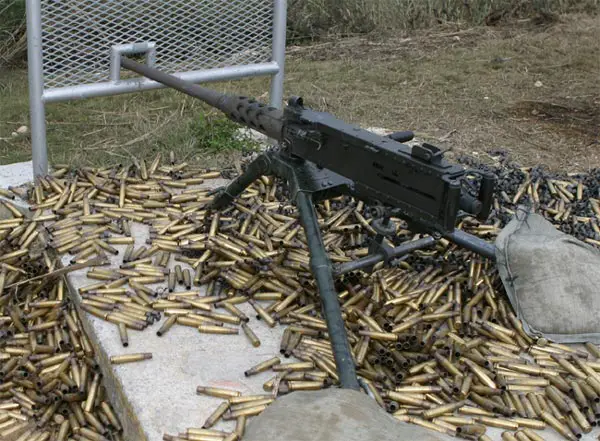
16. Browning M2 .50 Cal Heavy Machine Gun
The Browning M2, commonly known as the “Ma Deuce,” is one of the most legendary heavy machine guns ever created. Designed by John Browning, it has been in continuous service for over a century in various upgraded forms. It fires the powerful .50 BMG cartridge, giving it exceptional range, penetration, and destructive capability against light vehicles and fortified positions.
The M2 is widely used across infantry, vehicle mounts, naval platforms, and aircraft systems. Its versatility and durability are key reasons for its long service life. Despite its relatively simple recoil-operated design, it is extremely effective in suppressive fire roles and anti-material engagements.
Within the category of heavy guns, the Browning M2 represents one of the most successful and widely deployed heavy machine guns in history, combining simplicity, reliability, and raw firepower.
17. FN M240 General Purpose Machine Gun
The FN M240 is a NATO-standard general-purpose machine gun designed for sustained battlefield support. It fires 7.62×51mm NATO ammunition and is known for its high reliability under extreme conditions. The weapon is commonly mounted on vehicles, aircraft, and defensive positions.
One of the M240’s strengths is its ability to maintain consistent fire under prolonged use. Its gas-operated system is robust and designed for battlefield durability. While it is not as large as siege artillery or tank cannons, it plays a critical role in modern combined arms warfare.
In the broader classification of most heavy guns, the FN M240 represents the modern infantry support evolution of heavy automatic weapon systems, balancing firepower and endurance.
18. M60E6 Machine Gun
The M60E6 is a modernized version of the classic M60 machine gun used by U.S. forces. It retains the 7.62mm NATO caliber but improves reliability, weight distribution, and modularity. It is designed for infantry use, vehicle mounting, and support fire roles.
Compared to earlier versions, the M60E6 features better ergonomics and improved barrel change systems, making it more suitable for sustained combat operations. It is lighter and more controllable, while still delivering effective suppressive firepower.
As part of the heavy guns category, the M60E6 demonstrates how legacy systems can evolve into more efficient modern battlefield tools without losing core firepower capabilities.
19. PKM Soviet General Purpose Machine Gun
The PKM is one of the most widely used machine guns in the world, known for its extreme reliability and simple construction. It fires the 7.62×54mmR cartridge and has been used in countless conflicts due to its durability in harsh environments.
Its belt-fed system allows for sustained fire, and its lightweight design compared to Western counterparts makes it highly mobile for infantry use. The PKM is particularly valued for its ability to function in extreme cold, heat, and dusty conditions without frequent failures.
In the ecosystem of heavy guns, the PKM stands as one of the most practical and globally influential general-purpose machine guns ever developed.
20. GAU-19/A Gatling Gun System
The GAU-19/A is an electrically driven .50 caliber Gatling-style machine gun system designed for high-volume suppressive fire. It is typically mounted on helicopters, naval vessels, and light armored vehicles. Its rotating barrel system allows it to achieve extremely high rates of fire while reducing overheating.
The weapon is capable of delivering overwhelming firepower in short bursts, making it highly effective in both defensive and offensive suppression roles. Its design emphasizes sustained rapid fire rather than precision engagement.
Within the category of most heavy guns, the GAU-19/A represents modern high-rate-of-fire technology applied to heavy-caliber weapon systems, bridging the gap between machine guns and automatic cannons.
21. GAU-17/A Minigun System
The GAU-17/A Minigun is one of the most recognizable rotary machine gun systems in modern military use. It operates on an electrically driven multi-barrel Gatling mechanism and is typically chambered in 7.62×51mm NATO. This design allows it to achieve extremely high rates of fire while distributing heat across multiple barrels, preventing rapid overheating during sustained engagement.
The GAU-17/A is primarily used on helicopters, naval vessels, and some fixed defensive platforms. Its main role is suppressive fire, where volume of fire is more important than precision. In combat scenarios, it can create a dense stream of bullets that effectively denies enemy movement and suppresses hostile positions.
As part of the heavy guns classification, the GAU-17/A represents the evolution of machine gun technology toward high-speed, high-volume firepower systems designed for modern battlefield suppression roles.
22. Mk 19 Mod 3 Automatic Grenade Launcher
The Mk 19 Mod 3 is a belt-fed automatic grenade launcher used widely by U.S. and allied forces. It fires 40×53mm grenades at a high rate of fire, making it one of the most destructive infantry-operated weapons in service. Unlike traditional machine guns, it delivers explosive ordnance instead of bullets, significantly increasing its area-of-effect damage.
This weapon is commonly mounted on vehicles, naval craft, and defensive emplacements. Its ability to saturate an area with explosive grenades makes it highly effective against infantry, light vehicles, and fortified positions. The recoil system is robust, allowing controlled sustained fire despite the explosive payload of each round.
Within the category of most heavy guns, the Mk 19 represents a shift from kinetic bullet fire to explosive suppression systems, increasing battlefield lethality at medium ranges.
23. M120 120mm Heavy Mortar System
The M120 120mm mortar is a modern heavy indirect-fire support weapon used by mechanized infantry and armored units. It is vehicle-mounted or ground-deployed and provides high-angle fire support against enemy positions that are not directly visible to the operator.
The 120mm shells fired by this system deliver significant explosive power, making it effective against fortified positions, enemy concentrations, and light armored targets. Its mobility and relatively fast deployment time make it a critical asset in modern combined arms operations.
As part of the heavy guns family, the M120 highlights the importance of indirect fire systems in modern warfare, where precision and area suppression are equally important.
24. M252 81mm Mortar System
The M252 81mm mortar is a lightweight yet powerful indirect fire support weapon used primarily by infantry units. It is designed for rapid deployment and high mobility, allowing troops to provide immediate fire support in dynamic combat situations.
Although smaller than 120mm systems, the 81mm mortar still delivers effective explosive payloads capable of neutralizing enemy positions and disrupting formations. Its portability makes it ideal for rapid response operations in varied terrain conditions.
Within the broader classification of heavy guns, the M252 represents a balance between mobility and firepower in infantry-level indirect support systems.
25. M224 60mm Lightweight Mortar
The M224 60mm mortar is one of the smallest standard mortar systems used by modern infantry forces. Despite its compact size, it still provides valuable indirect fire support at short to medium ranges. It is highly portable and can be operated by small teams in difficult terrain.
The 60mm rounds carry explosive charges suitable for suppressing enemy positions, clearing obstacles, and supporting infantry advances. While not as powerful as larger mortar systems, its speed of deployment and ease of use make it highly practical.
In the context of most heavy guns, the M224 represents the lightweight end of indirect fire systems, emphasizing mobility over raw destructive power.
26. L16 81mm Mortar (UK System)
The L16 81mm mortar is a British-designed indirect fire weapon widely used by NATO forces. It is known for its reliability, accuracy, and ease of deployment in various combat environments. The system is typically man-portable and can be quickly set up by infantry units.
The mortar provides consistent fire support with a variety of high-explosive and illumination rounds. Its versatility makes it effective in both offensive and defensive operations, particularly in rough terrain where direct fire support is limited.
As part of the heavy guns ecosystem, the L16 demonstrates the importance of standardized NATO mortar systems in modern infantry warfare.
27. FGM-148 Javelin Anti-Tank Missile System
The FGM-148 Javelin is a man-portable anti-tank guided missile system designed to destroy modern armored vehicles with high precision. It uses an infrared-guided fire-and-forget system, allowing operators to engage targets and immediately relocate for safety.
The missile follows a top-attack trajectory, striking armored vehicles at their most vulnerable point. This makes it highly effective against even heavily armored main battle tanks. Its portability and precision have made it one of the most important modern infantry anti-armor systems.
Within the most heavy guns classification, the Javelin represents the transition from traditional artillery to precision-guided battlefield destruction systems.
28. BGM-71 TOW Missile System
The BGM-71 TOW is a long-range anti-tank missile system widely used by U.S. and allied forces. It is typically mounted on vehicles or tripods and uses wire-guided technology to steer the missile toward its target.
The system has been in service for decades and has undergone multiple upgrades to improve range, guidance, and armor penetration capability. It is effective against armored vehicles, bunkers, and fortified positions.
As part of the heavy guns category, the TOW system highlights the enduring relevance of guided missile technology in modern anti-armor warfare.
29. RPG-29 Vampir Heavy Rocket Launcher
The RPG-29 Vampir is a powerful shoulder-fired anti-tank rocket launcher developed in the Soviet Union. It fires large-caliber tandem-charge warheads designed to defeat reactive and composite armor systems found on modern tanks.
Unlike earlier RPG systems, the RPG-29 offers significantly improved penetration capability and extended range. It is capable of damaging or disabling heavily armored vehicles under the right conditions, making it a serious battlefield threat.
In the broader context of heavy guns, the RPG-29 represents portable anti-armor firepower at its most advanced level in shoulder-fired systems.
30. 9K111 Fagot Anti-Tank Missile System
The 9K111 Fagot is a Soviet-era wire-guided anti-tank missile system designed for infantry and vehicle deployment. It was developed to provide reliable long-range engagement capability against armored threats during Cold War conflicts.
The system uses SACLOS (semi-automatic command to line of sight) guidance, requiring the operator to maintain target tracking until impact. Despite being an older system, it remains effective against light to medium armored targets in modern warfare scenarios.
As the final entry in this list of most heavy guns, the 9K111 Fagot represents the foundational stage of modern guided anti-tank warfare, bridging traditional artillery and precision missile systems.
Conclusion – Understanding the World of the Most Heavy Guns
The exploration of the most heavy guns reveals more than just extreme weapon designs—it reflects the evolution of military engineering across different eras. From massive railway artillery like the Schwerer Gustav to modern guided missile systems such as the Javelin and TOW, the definition of “heavy” has gradually shifted from pure physical size to battlefield effectiveness and destructive capability. Early super-heavy guns were built to break fortifications through sheer mass and explosive power, while modern systems focus on precision, mobility, and tactical efficiency.
What remains consistent across all generations is the strategic intent behind these weapons. Whether it is siege warfare, armored breakthrough operations, or long-range anti-armor engagements, heavy guns have always been designed to overcome hardened defenses and dominate key battlefield zones. However, history also shows that extreme size often comes with limitations—slow deployment, logistical complexity, and reduced mobility have made many super-heavy systems impractical in real combat scenarios.
Today, the concept of heavy guns is no longer defined solely by weight or caliber. Instead, it includes a broader spectrum of systems ranging from machine guns and mortars to precision-guided missiles. Each plays a specific role in modern combined arms warfare. While the era of giant railway cannons has ended, the legacy of these engineering marvels continues to influence modern weapons development.
In conclusion, studying the most heavy guns offers valuable insight into how military technology balances power, practicality, and innovation. These systems, whether ancient or modern, represent humanity’s ongoing pursuit of battlefield dominance through engineering excellence.
50+ Frequently Asked Questions About the Most Heavy Guns
Below is a comprehensive FAQ section covering the most heavy guns, including historical artillery, tanks, machine guns, and modern missile systems. Each answer is written in a clear, informative way to help readers understand how these massive weapon systems work and why they were developed.
1. What are the most heavy guns in history?
The most heavy guns in history include super-heavy railway artillery like the Schwerer Gustav and Dora, massive siege mortars such as Karl-Gerät, and large naval guns like the BL 18-inch Mk I. These weapons were designed primarily for destroying fortified structures and coastal defenses using extremely large-caliber shells.
2. Why were super heavy guns built?
Super heavy guns were built to break through heavily fortified defensive lines that conventional artillery could not destroy. During world wars, nations invested in these weapons to gain strategic advantages against bunkers, fortresses, and naval targets protected by thick armor or reinforced concrete.
3. What is the heaviest gun ever made?
The Schwerer Gustav is widely considered the heaviest operational gun ever built. It weighed over 1,300 tons and required railway tracks for movement. Its purpose was to destroy heavily fortified military positions during World War II.
4. Are heavy guns still used today?
Modern warfare has largely replaced traditional heavy artillery with mobile systems, guided missiles, and precision weapons. However, indirect-fire systems like mortars and large-caliber machine guns still serve important battlefield roles.
5. What replaced super heavy artillery?
Precision-guided missiles, airstrikes, and modern artillery systems have replaced super-heavy guns. These systems provide similar or greater destructive power but with improved mobility, accuracy, and faster deployment.
6. What is the difference between heavy guns and artillery?
Heavy guns generally refer to very large-caliber weapons, while artillery is a broader category that includes mortars, howitzers, and missile systems. Heavy guns are a subset of artillery focused on extreme firepower.
7. Why are modern heavy guns smaller than older ones?
Modern warfare emphasizes mobility and precision. Smaller systems can be deployed faster, transported easily, and supported by air and satellite targeting systems, making extremely large guns less practical.
8. What is the largest naval gun ever built?
The Japanese Type 94 460mm naval gun, mounted on the Yamato-class battleships, is among the largest naval guns ever constructed, designed for long-range battleship combat and coastal bombardment.
9. Are tank guns considered heavy guns?
Yes, tank guns such as 120mm or 130mm systems are considered heavy weapons, especially in armored warfare. They are designed to destroy other tanks and fortified positions at long range.
10. What is the heaviest tank ever built?
The Panzer VIII Maus is the heaviest tank ever built, weighing nearly 188 tons. It featured a large-caliber gun and extremely thick armor but had limited mobility due to its weight.
11. Why are heavy guns difficult to move?
Heavy guns are difficult to move due to their massive weight, size, and logistical requirements. Many require rail systems, specialized vehicles, or multiple support crews for transportation and setup.
12. What is a railway gun?
A railway gun is a large artillery piece mounted on railway tracks. It uses rail systems for mobility because its weight makes traditional transport impossible.
13. Are railway guns still used today?
No, railway guns are no longer used in modern militaries. They have been replaced by mobile artillery systems and missile-based weapons.
14. What is the purpose of siege artillery?
Siege artillery is designed to destroy fortified positions such as bunkers, walls, and defensive structures during military sieges or large-scale assaults.
15. What makes a gun “heavy”?
A gun is considered “heavy” based on its caliber size, weight, destructive power, and intended role in warfare, particularly when designed for destroying fortified targets.
16. What is the most powerful machine gun?
The Browning M2 .50 caliber machine gun is one of the most powerful and widely used heavy machine guns, known for its durability and long service history.
17. Are grenade launchers considered heavy guns?
Yes, automatic grenade launchers like the Mk 19 are considered heavy weapons because they fire explosive projectiles at high rates.
18. What is the role of mortars in heavy weapons?
Mortars provide indirect fire support by launching explosive rounds at high angles, allowing them to hit targets behind cover or terrain obstacles.
19. What is the difference between mortars and artillery?
Mortars are generally lighter and fire at higher angles, while artillery systems are larger, more powerful, and capable of longer-range direct or indirect fire.
20. Why are missile systems replacing heavy guns?
Missile systems offer greater precision, longer range, and higher effectiveness while reducing logistical burden compared to traditional heavy artillery.
21. Why did armies invest in extremely large guns during World War I and II?
Armies invested in extremely large guns because warfare at the time was dominated by fortified positions, trenches, and reinforced bunkers. Conventional artillery often lacked the power to penetrate these defenses. Super-heavy guns provided the explosive force needed to break stalemates and destroy hardened structures, giving armies a psychological and tactical advantage on the battlefield.
22. Were heavy guns effective in actual combat?
Heavy guns were effective in very specific scenarios, especially against static fortifications and fixed targets. However, their effectiveness was limited by slow deployment, difficulty in transport, and vulnerability to air attacks. In many cases, their impact was more strategic and psychological than tactically flexible.
23. What is the biggest limitation of heavy guns?
The biggest limitation is mobility. Most super-heavy guns require rail systems, special transport, or extensive setup time. This makes them difficult to reposition and easy to target once their location is known.
24. Why are modern militaries moving away from heavy guns?
Modern militaries prioritize speed, mobility, and precision. Guided missiles, drones, and advanced artillery systems provide similar or greater firepower without the logistical burden of extremely large guns.
25. What replaced siege artillery in modern warfare?
Precision-guided missiles, airstrikes, and long-range rocket artillery systems have replaced traditional siege artillery. These systems can achieve similar destruction with far greater flexibility and accuracy.
26. Are any super heavy guns still operational today?
No traditional super-heavy railway guns or siege mortars are operational today. However, large-caliber naval guns and heavy artillery systems still exist in modernized forms.
27. What is the role of naval heavy guns?
Naval heavy guns were historically used for ship-to-ship combat and coastal bombardment. Today, they have largely been replaced by missiles, though some naval artillery still exists for support fire.
28. Why are tank guns considered important in heavy weapons?
Tank guns are critical because they combine mobility with high destructive power. They allow armored vehicles to engage enemy tanks, fortifications, and infantry effectively on the move.
29. What caliber is considered “heavy” for machine guns?
Machine guns above 12.7mm (.50 caliber) are generally considered heavy machine guns due to their increased penetration and effective range compared to lighter infantry weapons.
30. What is the purpose of anti-tank missiles?
Anti-tank missiles are designed to destroy armored vehicles, including modern main battle tanks. They use shaped charges or tandem warheads to penetrate heavy armor protection.
31. Are rocket launchers part of heavy guns?
Yes, rocket launchers such as RPG systems are considered part of heavy weapons because they deliver explosive payloads capable of damaging armored vehicles and structures.
32. How does recoil affect heavy guns?
Recoil is a major engineering challenge for heavy guns. Larger calibers generate extreme force, requiring reinforced mounting systems, recoil dampening mechanisms, or rail-based stabilization.
33. Why are some heavy guns mounted on railways?
Railways provide the only practical transportation method for extremely heavy artillery. Rails distribute weight and allow movement of multi-ton systems that would otherwise be immobile.
34. What is the most famous railway gun?
The Schwerer Gustav is the most famous railway gun due to its massive size, 800mm caliber, and use during World War II siege operations.
35. How long does it take to deploy a super heavy gun?
Deployment can take several days depending on the system. This includes transportation, assembly, stabilization, and targeting calibration before firing.
36. Why were heavy guns so expensive?
They required enormous amounts of steel, specialized engineering, logistics support, and thousands of personnel, making them extremely costly to design, build, and operate.
37. What is the difference between artillery and missile systems?
Artillery uses explosive shells fired from barrels, while missile systems use self-propelled guided rockets that can adjust their trajectory during flight.
38. Are modern tanks still considered heavy weapons?
Yes, modern tanks are still classified as heavy weapons due to their armor protection and large-caliber main guns, even though they are more mobile than historical heavy tanks.
39. What is the heaviest tank gun ever used?
Some experimental tanks mounted guns up to 155mm, but most operational heavy tank guns range between 105mm and 125mm in modern service.
40. Why do modern tanks use smaller guns than super heavy artillery?
Modern tanks prioritize mobility, rate of fire, and multi-role capability rather than extreme destructive power, making smaller but high-velocity guns more effective.
41. What is the role of support vehicles in heavy gun systems?
Support vehicles handle ammunition transport, maintenance, targeting assistance, and logistical coordination required to operate large artillery systems.
42. How accurate were historical heavy guns?
Accuracy was relatively low compared to modern systems. They relied more on explosive force than precision targeting, often requiring multiple rounds to ensure effectiveness.
43. Are heavy guns still studied in military engineering?
Yes, they are studied for historical, engineering, and tactical analysis to understand the evolution of firepower and logistics in warfare.
44. What materials are used in heavy gun construction?
High-strength steel alloys are commonly used, along with reinforced recoil systems and precision-machined components to handle extreme stress.
45. Why were some heavy guns never used in combat?
Some were never used due to war ending before deployment, logistical challenges, or rapid changes in military technology that made them obsolete.
46. What is the psychological impact of heavy guns?
Heavy guns often had a strong psychological effect, intimidating enemy forces due to their size, sound, and destructive capability even before actual impact.
47. Can heavy guns be moved by air transport?
Most traditional heavy guns are too large for air transport. Only modern compact artillery or missile systems can be transported by aircraft.
48. What replaced heavy artillery in air support roles?
Aircraft, drones, and precision-guided munitions have largely replaced heavy artillery for air-based support missions.
49. Are heavy guns still relevant in modern warfare doctrine?
They are relevant only in limited roles such as naval support, indirect fire artillery, and specialized siege scenarios, not as primary battlefield tools.
50. What is the future of heavy weapons?
The future focuses on smart weapons, automation, precision targeting, and networked battlefield systems rather than purely large-caliber traditional guns.
51. Why are heavy guns important in military history?
They represent a major stage in military evolution, showing how engineering was used to solve problems of fortification and battlefield stagnation.
52. Do heavy guns still influence modern weapon design?
Yes, principles like recoil management, ballistic engineering, and armor penetration from heavy guns continue to influence modern artillery and tank systems.
53. What is the most iconic heavy gun ever built?
The Schwerer Gustav is widely considered the most iconic due to its unmatched size and engineering complexity.
54. How did heavy guns change warfare strategy?
They shifted strategies toward siege destruction, forcing armies to develop stronger fortifications and eventually leading to more mobile warfare concepts.
55. What is the main takeaway about most heavy guns?
The main takeaway is that while most heavy guns represent incredible engineering achievements, their practical battlefield value has always been limited by mobility, logistics, and evolving military technology.
Read more: