
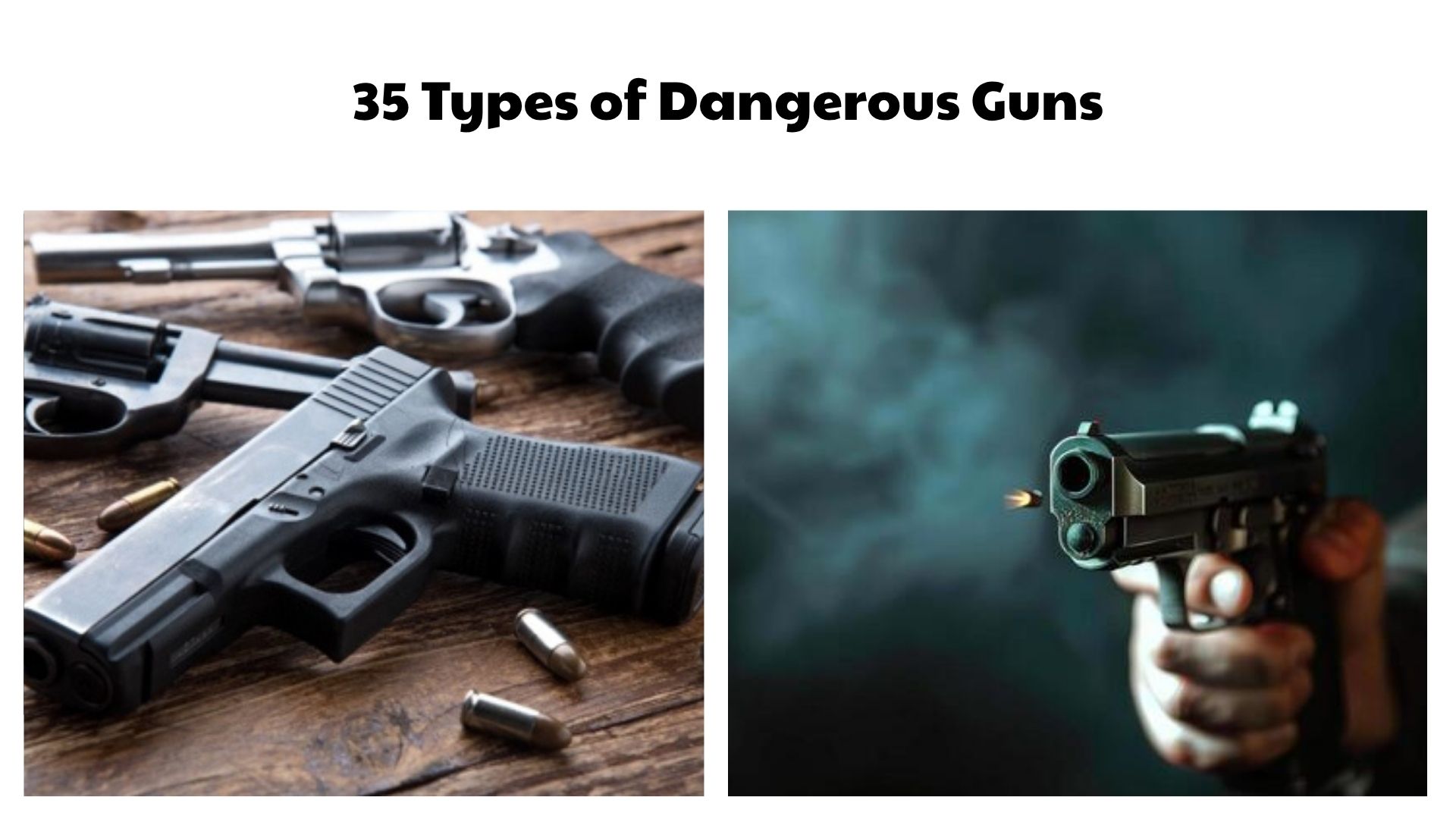

When discussing types of dangerous guns, we are not simply talking about military weapons or crime-related firearms. The term refers to any firearm platform that combines high lethality, rapid fire capability, long-range precision, or extreme stopping power. These weapons are designed for combat effectiveness, and in many cases, they have shaped modern warfare, law enforcement tactics, and global defense systems. This guide breaks down 35 of the most widely recognized dangerous guns in the world, explaining their roles, characteristics, and why they are considered highly influential in firearm history.
Each weapon listed below is analyzed in a clear and practical way, focusing on function, design purpose, and real-world usage. Let’s begin with the first five globally recognized systems.
35 Types of Dangerous Guns
1. AK-47 Assault Rifle
The AK-47 is one of the most iconic and widely distributed rifles in history. Known for its extreme reliability, it can function in mud, sand, and harsh climates with minimal maintenance. It uses the 7.62×39mm cartridge, which provides strong stopping power at short to medium range.
Its simple gas-operated system makes it easy to use and maintain, even in low-resource environments. This combination of durability and effectiveness is why it is frequently listed among the most dangerous guns ever developed. Despite its age, it remains widely used across the world.
2. AR-15 Platform Rifle
The AR-15 is a modular semi-automatic rifle platform known for its adaptability and customization options. Unlike fully automatic military versions, civilian AR-15 rifles are semi-automatic but still highly efficient in controlled shooting scenarios.
Its lightweight structure, ergonomic design, and accuracy make it a widely discussed firearm in both sporting and tactical contexts. The platform’s adaptability is one of its most defining characteristics, allowing users to modify optics, barrels, and accessories depending on use case.
3. FN FAL Battle Rifle
The FN FAL is a powerful 7.62×51mm NATO battle rifle that earned the nickname “The Right Arm of the Free World” due to its widespread adoption during the Cold War. It delivers strong long-range performance and significant stopping power.
Although heavier than modern rifles, its robust construction makes it extremely durable in combat environments. The FN FAL is often considered a classic example of a full-power battle rifle that prioritizes effectiveness over compact design.
4. M16 Assault Rifle
The M16 rifle is a lightweight, high-velocity firearm used extensively by military forces. It uses the 5.56×45mm cartridge, which allows for high accuracy and controllable recoil during sustained fire.
Over time, the M16 has undergone multiple upgrades, improving reliability and battlefield performance. Its long-range accuracy and modular upgrades make it one of the most influential rifles in modern military history.
5. M4 Carbine
The M4 Carbine is a shorter and more compact evolution of the M16 platform. Designed for close-quarters and mid-range combat, it offers better mobility without sacrificing effectiveness.
Its lightweight design, collapsible stock, and accessory rail system make it highly adaptable in modern tactical environments. The M4 is widely used by military and special forces due to its balance between power, size, and control.
6. Barrett M82 .50 Cal Sniper Rifle
The Barrett M82 is one of the most recognized anti-material sniper rifles in the world and is often included in discussions about types of dangerous guns due to its extreme long-range destructive capability. Chambered in .50 BMG (12.7×99mm), this weapon is designed not only for precision shooting but also for disabling vehicles, equipment, and fortified positions. It is widely used by military forces for high-value target engagement at extreme distances.
One of the defining characteristics of the Barrett M82 is its semi-automatic firing system, which allows for faster follow-up shots compared to traditional bolt-action sniper rifles. This gives operators a tactical advantage in dynamic combat environments where multiple targets may need to be engaged quickly. Despite its large caliber, the rifle incorporates a recoil mitigation system that reduces shooter fatigue and improves shot stability.
The weapon is extremely heavy and requires careful setup, often being deployed with bipods or mounted supports. However, its effective range exceeding 1,500 meters makes it one of the most feared precision weapons on the battlefield. It is not designed for infantry skirmishes but rather for strategic, long-distance elimination roles.
7. Dragunov SVD Sniper Rifle
The Dragunov SVD is a semi-automatic designated marksman rifle developed in the Soviet Union. It bridges the gap between standard infantry rifles and high-powered sniper systems. Chambered in 7.62×54mmR, it provides strong ballistic performance with a balance of range and control.
Unlike bolt-action sniper rifles, the SVD allows for quicker target re-engagement, making it suitable for supporting infantry units in medium-to-long range combat. Its rugged construction ensures reliability in extreme weather conditions, from freezing temperatures to desert heat.
Although not as powerful as anti-material rifles, the Dragunov remains a highly respected precision firearm. Its combination of semi-automatic operation and long-range accuracy makes it a consistent presence in military arsenals worldwide.
8. AK-74 Assault Rifle
The AK-74 is a modernized evolution of the AK-47, chambered in 5.45×39mm. It was designed to reduce recoil while improving accuracy and controllability during automatic fire. This makes it more suitable for modern infantry combat where precision and rapid response are essential.
The smaller caliber round produces less recoil, allowing soldiers to maintain better target tracking during sustained fire. The rifle also features a distinctive muzzle brake that further reduces recoil and muzzle rise.
While still based on the original Kalashnikov design philosophy of simplicity and durability, the AK-74 represents a shift toward more controlled and efficient battlefield engagement systems.
9. FN P90 Personal Defense Weapon
The FN P90 is a compact personal defense weapon designed for close-quarters combat. It uses the 5.7×28mm cartridge, which is capable of penetrating body armor under certain conditions. Its futuristic bullpup design allows for a compact frame while maintaining a long internal barrel.
One of its key features is the high-capacity top-mounted magazine, which holds up to 50 rounds. This makes it highly effective in prolonged close-range engagements where rapid target switching is necessary.
The P90 is widely used by special forces and security units due to its compact size, low recoil, and high fire rate, making it especially effective in confined environments such as buildings and vehicles.
10. Glock 18 Fully Automatic Pistol
The Glock 18 is a select-fire handgun capable of both semi-automatic and fully automatic firing modes. Chambered in 9×19mm, it is designed for high-rate close-quarters engagements where rapid fire capability is critical.
Despite its small size, the Glock 18 can reach extremely high cyclic rates, making it difficult to control without training. This level of firepower in a compact frame places it among the most specialized sidearms in existence.
It is primarily used by military and law enforcement units in controlled environments. The combination of portability and automatic fire capability makes it a unique entry in the category of dangerous guns.
11. M249 SAW (Squad Automatic Weapon)
The M249 SAW is a light machine gun widely used in infantry squads for sustained suppressive fire. It is chambered in 5.56×45mm NATO and is designed to provide continuous fire support during movement and engagement phases. In discussions about types of dangerous guns, it is often highlighted because of its ability to maintain high-volume fire over extended periods without losing operational reliability.
One of the defining characteristics of the M249 is its belt-fed ammunition system, which allows it to fire hundreds of rounds continuously when properly supplied. This makes it highly effective for suppressing enemy positions, forcing movement control, and supporting advancing troops. It can also accept magazine feeding in emergency situations, adding flexibility in combat scenarios.
Despite being lighter than traditional machine guns, the M249 still requires controlled handling due to recoil and sustained heat buildup during prolonged firing. Operators are trained to use it in short bursts or controlled suppressive patterns to maintain barrel integrity and accuracy. Its balance between mobility and firepower makes it a key support weapon in modern infantry tactics.
12. PKM General Purpose Machine Gun
The PKM is a Soviet-designed general-purpose machine gun chambered in 7.62×54mmR. It is known for its extreme reliability, simplicity, and durability in harsh combat environments. This weapon is often considered one of the most dependable machine guns ever produced.
Its belt-fed system allows for sustained fire over long durations, making it highly effective for defensive positions and area suppression. The PKM is relatively lightweight compared to other machine guns in its class, which improves mobility for infantry units operating in rugged terrain.
Because of its strong cartridge and high cyclic endurance, the PKM is widely used across multiple regions of the world. It remains a staple support weapon in many armed forces due to its combination of power and mechanical simplicity.
13. M240 Machine Gun
The M240 is a 7.62×51mm NATO general-purpose machine gun used extensively by modern military forces. It is known for its durability, accuracy, and ability to sustain long periods of suppressive fire without significant performance degradation.
Unlike lighter squad weapons, the M240 is often mounted on tripods or vehicles to stabilize recoil and improve sustained accuracy. Its heavier caliber provides strong penetration power against cover and light armor, making it effective in both offensive and defensive operations.
The M240 is highly respected for its battlefield reliability, and despite its weight, it remains a critical support weapon due to its consistent performance under extreme conditions.
14. M2 Browning .50 Cal Heavy Machine Gun
The M2 Browning is one of the most powerful and long-serving heavy machine guns in military history. Chambered in .50 BMG (12.7×99mm), it is capable of engaging both personnel and lightly armored vehicles at long distances.
This weapon is typically mounted on vehicles, naval platforms, or fixed defensive positions due to its weight and recoil force. Its ability to deliver sustained heavy fire makes it one of the most influential weapons in the category of dangerous guns.
The M2 has been in continuous service for decades, demonstrating exceptional durability and adaptability across multiple generations of warfare. Its destructive capability and long-range effectiveness make it a cornerstone of heavy weapons systems.
15. DShK Heavy Machine Gun
The DShK is a Soviet heavy machine gun chambered in 12.7×108mm. It is designed for anti-aircraft and anti-vehicle roles, making it one of the most powerful infantry-deployable machine guns in history.
Its high-caliber rounds allow it to penetrate light armor and deliver significant destructive impact at range. The DShK is typically mounted on tripods or vehicles due to its recoil and operational requirements.
Despite its age, it remains in use in various regions due to its reliability and destructive power. It is especially effective in defensive roles where sustained heavy fire is required.
16. UZI Submachine Gun
The UZI is one of the most iconic submachine guns ever developed, originally designed in Israel for close-quarters combat and rapid deployment scenarios. It is chambered in 9×19mm and is widely recognized for its compact design, simple construction, and high reliability. In discussions of types of dangerous guns, the UZI is often mentioned because of its historical use in military, law enforcement, and security environments worldwide.
One of the defining features of the UZI is its blowback-operated system combined with a telescoping bolt design, which helps reduce overall weapon length while maintaining a relatively long barrel for its size. This design makes it extremely effective in confined spaces such as vehicles, buildings, and urban combat zones. Its high rate of fire allows for rapid target engagement, which is essential in close-range encounters.
Despite its compact size, the UZI is built with a heavy steel receiver that helps control recoil during automatic fire. However, sustained full-auto use can still lead to reduced accuracy due to muzzle climb. Over time, the UZI became a symbol of close-combat firepower and remains one of the most recognizable SMGs in the world.
17. MP5 Submachine Gun
The MP5 is a German-engineered submachine gun widely used by military and law enforcement special forces. It is chambered in 9×19mm and is known for its exceptional accuracy, controllability, and low recoil compared to many other SMGs. Within the category of dangerous guns, the MP5 stands out for its precision in close-quarters engagements.
Unlike many open-bolt SMGs, the MP5 uses a roller-delayed blowback system, which significantly improves shooting stability and reduces recoil impulse. This makes it highly effective in controlled bursts and semi-automatic fire, allowing operators to maintain accuracy even in fast-paced tactical situations.
The MP5 is widely adopted by counter-terrorism units due to its balance of compact size and precision. Its modular design also allows for suppressors, optics, and tactical attachments, making it adaptable to a wide range of operational requirements.
18. MAC-10 Submachine Gun
The MAC-10 is a compact submachine gun known for its extremely high rate of fire and minimal size. It is chambered in 9×19mm or .45 ACP depending on configuration. Its small frame makes it highly portable, but also challenging to control during full-automatic fire.
The weapon uses a simple blowback system, which contributes to its high cyclic rate. While this allows for rapid fire output, it also results in significant recoil and muzzle rise. As a result, the MAC-10 is typically used in very short bursts or close-range engagements where volume of fire is prioritized over precision.
Despite its limitations, the MAC-10 gained recognition for its concealability and effectiveness in close-quarters scenarios. It is often associated with specialized tactical operations requiring compact firepower.
19. FN P90 Personal Defense Weapon
The FN P90 is a futuristic-looking personal defense weapon designed for close-quarters combat. It uses the 5.7×28mm cartridge, which is capable of high velocity and improved penetration compared to traditional pistol rounds. Its bullpup configuration allows for a long internal barrel while maintaining a compact external design.
One of the most distinctive features of the P90 is its top-mounted horizontal magazine, which holds up to 50 rounds. This high capacity makes it extremely effective in sustained close-range engagements where reloading opportunities may be limited.
The P90 is widely used by military and security units due to its low recoil, compact size, and high magazine capacity. It is particularly effective in urban environments and confined spaces where maneuverability is critical.
20. KRISS Vector SMG
The KRISS Vector is a modern submachine gun designed with a unique recoil mitigation system that redirects energy downward, significantly reducing muzzle climb. It is chambered in various calibers including 9×19mm and .45 ACP.
This innovative system allows the weapon to maintain high accuracy even during rapid automatic fire. The Vector is often used in tactical and special operations environments where control and precision are essential in close-quarters combat.
Its futuristic design and advanced recoil system make it one of the most technologically distinctive SMGs in modern firearm development. It represents a shift toward engineering-driven solutions in compact weapon systems.
21. Accuracy International AWM Sniper Rifle
The Accuracy International AWM (Arctic Warfare Magnum) is a high-precision sniper rifle designed for extreme long-range engagements. It is widely recognized in the category of types of dangerous guns because of its ability to deliver accurate shots at distances exceeding 1,500 meters. Chambered in powerful magnum calibers such as .338 Lapua Magnum, it is built specifically for military snipers operating in harsh environmental conditions.
One of the defining features of the AWM is its bolt-action system, which prioritizes accuracy over rate of fire. The rifle uses a rigid chassis design made from high-strength materials to minimize vibration and maintain shot consistency. This ensures that each round follows a predictable trajectory, even under extreme weather conditions such as wind, rain, or snow.
The AWM is often deployed with advanced optics systems that allow operators to engage targets at extreme distances with high precision. Its modular stock system is adjustable, enabling better ergonomics for different shooters and shooting positions. Although it is not designed for rapid fire, its long-range lethality makes it one of the most respected sniper systems in military use.
22. CheyTac M200 Intervention
The CheyTac M200 Intervention is an ultra-long-range sniper rifle designed for extreme precision engagements beyond typical battlefield distances. It is chambered in .408 CheyTac or .375 CheyTac, both of which are engineered for minimal bullet drop and high retained energy at long range.
This rifle is built with a focus on ballistic consistency, incorporating advanced engineering principles to reduce environmental influence on projectile flight. It is often paired with ballistic computers and range-finding systems to assist in extreme-distance targeting.
The M200 is heavy and requires a stable firing platform, but its accuracy potential places it among the most advanced long-range sniper systems in existence. It is used in specialized roles where precision at extreme distance is critical.
23. Dragunov SVD (Designated Marksman Rifle)
The Dragunov SVD is a semi-automatic designated marksman rifle developed in the Soviet Union to provide infantry units with extended-range engagement capability. It is chambered in 7.62×54mmR and is known for its balance between accuracy and rate of fire.
Unlike bolt-action sniper rifles, the SVD allows for faster follow-up shots, making it effective in dynamic combat situations where targets may move quickly. Its gas-operated system is designed for reliability in harsh environments, ensuring consistent performance in field conditions.
While not as precise as dedicated sniper platforms, the Dragunov fills the important tactical role of mid-to-long-range support fire, bridging the gap between standard rifles and sniper systems.
24. Barrett M107 Anti-Material Rifle
The Barrett M107 is a .50 BMG anti-material rifle designed for engaging vehicles, equipment, and fortified positions at extreme distances. It is an evolution of the M82 platform and is widely used by military forces worldwide.
Its semi-automatic system allows for rapid follow-up shots, which is uncommon in rifles of this caliber. The weapon includes recoil mitigation features to manage the intense force generated by the .50 BMG cartridge.
Due to its size, weight, and power, the M107 is typically deployed in specialized roles rather than standard infantry use. Its destructive capability places it among the most powerful entries in dangerous guns classifications.
25. DSR-50 Precision Sniper Rifle
The DSR-50 is a high-powered sniper rifle chambered in .50 BMG, designed for extreme long-range precision and anti-material operations. It features a bullpup configuration, which reduces overall length while maintaining barrel performance.
One of its key advantages is its integrated recoil reduction system, which significantly improves shooter control despite the massive caliber. This allows for more stable shot placement compared to traditional .50 caliber rifles.
The DSR-50 is typically used in specialized military and tactical roles where long-range precision and high-impact power are required. It is a highly specialized platform designed for extreme engagement scenarios.
26. M240B General Purpose Machine Gun
The M240B is a widely used 7.62×51mm NATO general-purpose machine gun known for its durability and sustained fire capability. In the broader classification of types of dangerous guns, it represents a balance between mobility and heavy suppressive firepower. It is commonly mounted on tripods, vehicles, or used in infantry support roles where continuous fire is required to suppress enemy movement.
One of the strongest characteristics of the M240B is its belt-fed system, allowing operators to maintain fire for extended periods without frequent reload interruptions. This makes it extremely effective in defensive positions or during coordinated assaults where sustained pressure is needed. The weapon is engineered for reliability under harsh conditions, including sand, mud, and extreme temperature environments.
Although it is heavy compared to standard rifles, the M240B provides significantly greater range and penetration capability. Its 7.62 NATO round allows it to engage both personnel and light cover effectively, making it a core support weapon in modern military operations.
27. MG42 Machine Gun
The MG42 is one of the most famous machine guns in military history, originally developed during World War II. It is known for its extremely high rate of fire, often exceeding 1,200 rounds per minute, which earned it the nickname “Hitler’s Buzzsaw.” It is frequently included in discussions about dangerous guns due to its overwhelming suppressive capability.
The weapon uses a belt-fed system and is chambered in 7.92×57mm Mauser. Its design emphasizes rapid area suppression, making it highly effective at controlling enemy movement across open terrain. The high cyclic rate allows it to create dense fire coverage in short bursts.
Despite its historical origin, the MG42 influenced many modern machine gun designs. Its mechanical efficiency and fire rate remain benchmarks in automatic weapon engineering, and derivatives of its system are still used today.
28. M2 Browning Heavy Machine Gun
The M2 Browning is a .50 caliber heavy machine gun that has been in continuous service for nearly a century. It is one of the most powerful infantry-supported weapons and is widely recognized in any list of types of dangerous guns.
Chambered in .50 BMG, the M2 is capable of engaging light vehicles, fortified positions, and aerial targets. It is typically mounted on tripods, armored vehicles, naval vessels, or aircraft due to its weight and recoil force.
Its exceptional durability and long service life demonstrate its engineering strength. Despite being an older design, it remains highly effective in modern combat environments due to its raw destructive capability and reliability.
29. RPG-7 Rocket Launcher
The RPG-7 is a portable anti-armor rocket-propelled grenade launcher widely used across the world. While not a traditional firearm, it is often included in dangerous guns classifications due to its explosive destructive power. It is designed to penetrate armored vehicles and fortified structures.
The weapon is simple to operate and highly rugged, allowing it to function in extreme combat environments. Its reusable launcher system makes it cost-effective compared to more advanced anti-tank systems.
Depending on the warhead type, the RPG-7 can be used against armor, personnel, or bunkers. Its versatility and widespread availability make it one of the most recognized explosive support weapons in modern warfare.
30. M72 LAW Rocket Launcher
The M72 LAW (Light Anti-Tank Weapon) is a portable, single-use rocket launcher designed for infantry anti-armor operations. It is lightweight, disposable, and highly effective against light armored vehicles and fortified positions.
Its simplicity is one of its greatest advantages. The operator does not need complex training to deploy the system, making it widely used in rapid-response combat situations. Once fired, the launcher is discarded.
Although less powerful than heavy rocket systems, the M72 LAW remains a critical tool for infantry units requiring immediate anti-armor capability in close or medium-range engagements.
31. HK G3 Battle Rifle
The HK G3 is a 7.62×51mm NATO battle rifle developed in Germany and widely exported around the world. It is frequently included in discussions of types of dangerous guns because of its powerful cartridge, strong penetration capability, and long-range effectiveness. The rifle was designed during the Cold War to provide infantry units with a high-power alternative to intermediate-caliber assault rifles.
One of the key features of the G3 is its roller-delayed blowback system. This mechanism allows the weapon to handle high-pressure ammunition without requiring a traditional gas system. The result is a mechanically simple yet extremely durable firearm capable of operating in harsh environments with minimal maintenance requirements.
The G3 is heavier than modern assault rifles, but this weight contributes to stability during firing, especially in semi-automatic mode. Its 7.62 NATO round provides strong stopping power, making it effective at both medium and long distances. Despite its age, the G3 continues to be used in various military forces due to its reliability and proven battlefield performance.
32. SCAR-H Battle Rifle
The FN SCAR-H is a modern modular battle rifle designed for special operations forces. It is chambered in 7.62×51mm NATO and is known for its adaptability and precision. In the category of dangerous guns, it represents a modern evolution of traditional battle rifle concepts.
One of its most important features is its modular upper receiver system, which allows quick barrel changes and configuration adjustments. This enables the weapon to be adapted for different combat roles, from close-quarters engagements to long-range precision shooting.
The SCAR-H also features improved ergonomics, including adjustable stocks and integrated rail systems for optics and accessories. This makes it highly flexible in modern combat environments where adaptability is critical.
33. Thompson M1A1 Submachine Gun
The Thompson M1A1, also known as the “Tommy Gun,” is a historical submachine gun chambered in .45 ACP. It became famous during the early 20th century and is often included in discussions of dangerous guns due to its high rate of fire and historical use in both military and criminal contexts.
The weapon uses a simple blowback system and is known for its heavy weight and controllable recoil despite its powerful cartridge. Its drum magazine variants allowed for sustained fire, making it effective in close-range engagements during its service era.
Although largely replaced by modern firearms, the Thompson remains an iconic example of early automatic weapon design and continues to appear in historical and collector contexts.
34. FN Five-seveN Pistol
The FN Five-seveN is a modern semi-automatic pistol chambered in 5.7×28mm. It is designed for high velocity and improved armor penetration compared to traditional handgun rounds. In classifications of types of dangerous guns, it is notable for its specialized ammunition and tactical use cases.
The pistol is lightweight and features a high-capacity magazine, allowing for extended firing without frequent reloads. Its low recoil makes it easier to control compared to larger-caliber handguns, improving accuracy in rapid fire scenarios.
It is often used by military and law enforcement units that require a compact sidearm with enhanced ballistic performance, especially in situations where body armor may be encountered.
35. Desert Eagle Magnum Pistol
The Desert Eagle is one of the most powerful semi-automatic pistols ever produced for civilian and limited tactical use. It is chambered in large calibers such as .50 AE, making it one of the highest-recoil handguns in production.
Its gas-operated mechanism is unusual for a handgun, as most pistols use simple blowback or recoil systems. This design allows it to handle extremely powerful cartridges that would otherwise be unmanageable in a standard handgun platform.
The Desert Eagle is known for its massive size, heavy weight, and distinctive appearance. While not practical for most combat roles, it is recognized for its raw stopping power and has become a cultural icon in film and gaming media.
Conclusion – Understanding the Full Range of Dangerous Guns
The study of types of dangerous guns shows that “danger” in firearms is not defined by a single factor. Instead, it comes from a combination of firepower, rate of fire, range, accuracy, and the tactical role each weapon is designed to fulfill. From compact pistols like the Desert Eagle to heavy machine guns such as the M2 Browning, each system contributes differently to modern combat capability.
Assault rifles like the AK-47 and M16 represent versatility and mass battlefield use, while sniper systems such as the Barrett M82 and CheyTac M200 focus on extreme long-range precision. Meanwhile, submachine guns and personal defense weapons dominate close-quarters environments where speed and mobility are critical. Heavy machine guns and explosive systems, on the other hand, define area control and maximum destructive power.
What makes this classification important is not only the technical diversity of these weapons, but also their global impact. Many of these firearms have shaped military doctrines, influenced conflicts, and become standard equipment across multiple continents. Their widespread adoption highlights how engineering, cost, and battlefield needs drive weapon evolution.
Ultimately, understanding these weapons provides insight into how modern armed forces and tactical units structure their firepower. Each category serves a purpose, and together they form the foundation of contemporary small arms and support weapon systems used around the world today.
Frequently Asked Questions (FAQs) About Types of Dangerous Guns
1. What are considered dangerous guns?
Dangerous guns typically refer to firearms that have high firepower, rapid firing capability, or are designed for military or tactical use, making them capable of causing significant harm.
2. What makes a gun more dangerous than others?
Factors include rate of fire, caliber size, magazine capacity, accuracy, and intended use (e.g., military vs civilian).
3. Are automatic weapons more dangerous than semi-automatic guns?
Yes, automatic weapons can fire continuously with one trigger pull, increasing their potential for harm compared to semi-automatic firearms.
4. What is the difference between semi-automatic and automatic firearms?
Semi-automatic firearms fire one round per trigger pull, while automatic firearms continue firing as long as the trigger is held down.
5. Are assault rifles considered dangerous guns?
Yes, assault rifles are often classified as dangerous due to their rapid-fire capability and use in military settings.
6. What types of guns are most commonly used in crimes?
Handguns are statistically the most commonly used firearms in criminal activities due to their size and concealability.
7. Are shotguns dangerous?
Yes, shotguns can be highly dangerous, especially at close range due to their spread and stopping power.
8. What is a high-caliber firearm?
A high-caliber firearm uses larger bullets, which generally deliver more energy and cause greater damage.
9. Are sniper rifles considered dangerous?
Yes, sniper rifles are extremely dangerous due to their long-range precision and high power.
10. What is a submachine gun?
A submachine gun is a compact automatic firearm that fires pistol-caliber rounds, often used in military and law enforcement.
11. Are machine guns legal for civilians?
In many countries, machine guns are heavily restricted or illegal for civilian ownership.
12. What is a tactical firearm?
A tactical firearm is designed for combat or defense situations, often featuring attachments and enhancements for performance.
13. Why are high-capacity magazines considered dangerous?
They allow more rounds to be fired without reloading, increasing potential damage in a short period.
14. What role does ammunition play in a gun’s danger level?
Ammunition type affects penetration, expansion, and overall lethality.
15. Are handguns less dangerous than rifles?
Not necessarily; while rifles may be more powerful, handguns are more commonly used and easier to conceal.
16. What is a fully automatic rifle?
A rifle that continuously fires rounds while the trigger is held down.
17. Are military-grade weapons available to civilians?
Most military-grade weapons are restricted and not legally available to civilians.
18. What is a bullpup firearm?
A firearm with the action located behind the trigger, making it more compact without reducing barrel length.
19. Are compact guns more dangerous?
They can be due to their concealability, making them easier to carry unnoticed.
20. What is the purpose of a suppressor?
A suppressor reduces the noise and muzzle flash of a gunshot but does not make a firearm silent.
21. Do silencers make guns more dangerous?
They can increase risk by making it harder to detect gunfire.
22. What is a combat shotgun?
A shotgun designed for military or tactical use, often with higher capacity and durability.
23. Are revolvers dangerous?
Yes, revolvers are still lethal firearms despite their simpler design.
24. What is a designated marksman rifle (DMR)?
A DMR bridges the gap between standard rifles and sniper rifles, offering enhanced accuracy at medium ranges.
25. What is a high-powered rifle?
A rifle capable of firing rounds at high velocity, often used for long-range shooting or hunting large game.
26. Are antique guns dangerous?
Some antique guns can still be functional and dangerous if properly maintained.
27. What is a tactical pistol?
A handgun equipped with features like extended magazines, optics, or suppressor compatibility.
28. Why are some guns banned?
Guns may be banned due to their high lethality, rapid-fire capability, or use in mass violence incidents.
29. What is the difference between civilian and military firearms?
Military firearms often have features like automatic fire and higher durability standards.
30. Are homemade guns dangerous?
Yes, they can be highly unpredictable and unsafe due to lack of regulation and quality control.
31. What is a ghost gun?
A ghost gun is a firearm without serial numbers, making it difficult to trace.
32. Are ghost guns legal?
Laws vary by country and region, but many places are implementing stricter regulations.
33. What is a carbine?
A shorter, lighter version of a rifle, often used for mobility in combat.
34. Are carbines dangerous?
Yes, they retain significant firepower despite their compact size.
35. What is recoil and does it affect danger?
Recoil is the backward force when a gun is fired; excessive recoil can reduce control and accuracy.
36. What is a firearm safety mechanism?
A feature designed to prevent accidental discharge.
37. Can safety mechanisms fail?
Yes, mechanical failure or misuse can lead to accidental firing.
38. Are air guns dangerous?
High-powered air guns can cause serious injury and should not be underestimated.
39. What is a long gun?
A firearm with a longer barrel, such as rifles and shotguns.
40. Are long guns more powerful?
Generally, yes, due to longer barrels and higher velocity rounds.
41. What is muzzle velocity?
The speed at which a bullet leaves the barrel, influencing its impact and damage.
42. What is a firearm caliber?
Caliber refers to the diameter of the bullet or barrel.
43. Do larger calibers mean more danger?
Typically, larger calibers result in more stopping power and damage.
44. What is overpenetration?
When a bullet passes through a target and continues traveling, posing additional risk.
45. What is a firearm modification?
Changes made to a gun to enhance performance, accuracy, or appearance.
46. Are modified guns more dangerous?
They can be, especially if modifications increase fire rate or capacity.
47. What is a rapid-fire trigger?
A modification that allows faster firing of semi-automatic weapons.
48. Are rapid-fire devices legal?
Many jurisdictions restrict or ban such devices.
49. What is gun control?
Gun control refers to laws and policies regulating firearm ownership and use.
50. Why is gun safety important?
Proper safety practices reduce accidents, injuries, and misuse.
51. How can people stay safe around firearms?
By following basic rules: treat every gun as loaded, keep it pointed in a safe direction, and store it securely.
52. What is safe gun storage?
Keeping firearms locked, unloaded, and away from unauthorized users, especially children.
53. Are training and education important for gun ownership?
Yes, proper training significantly reduces risks and promotes responsible handling.
Read more: