
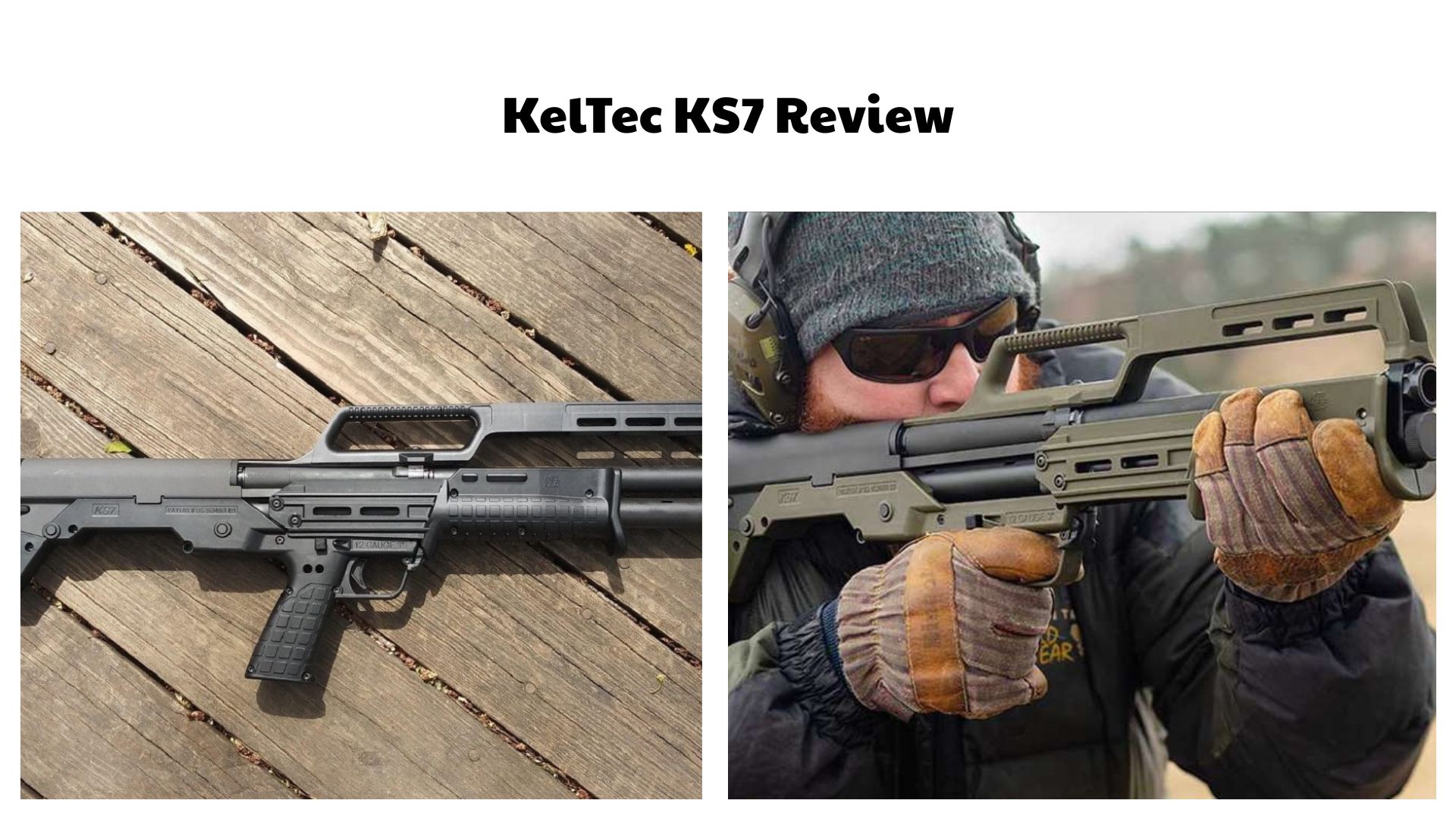

The KelTec KS7 is a compact 12-gauge bullpup pump-action shotgun designed for shooters who want full-size shotgun performance in a shorter, lighter package. It uses a single magazine tube, downward ejection, ambidextrous controls, and an 18.5-inch barrel inside a 26.1-inch overall length. That makes it much shorter than most traditional pump shotguns while staying outside short-barreled shotgun territory under standard U.S. federal configuration. This review covers the KS7’s specs, design, ergonomics, capacity, recoil, reliability, accessories, maintenance basics, comparisons, and whether it makes sense for home defense, range use, outdoor carry, or general-purpose ownership.
Overview of the KelTec KS7
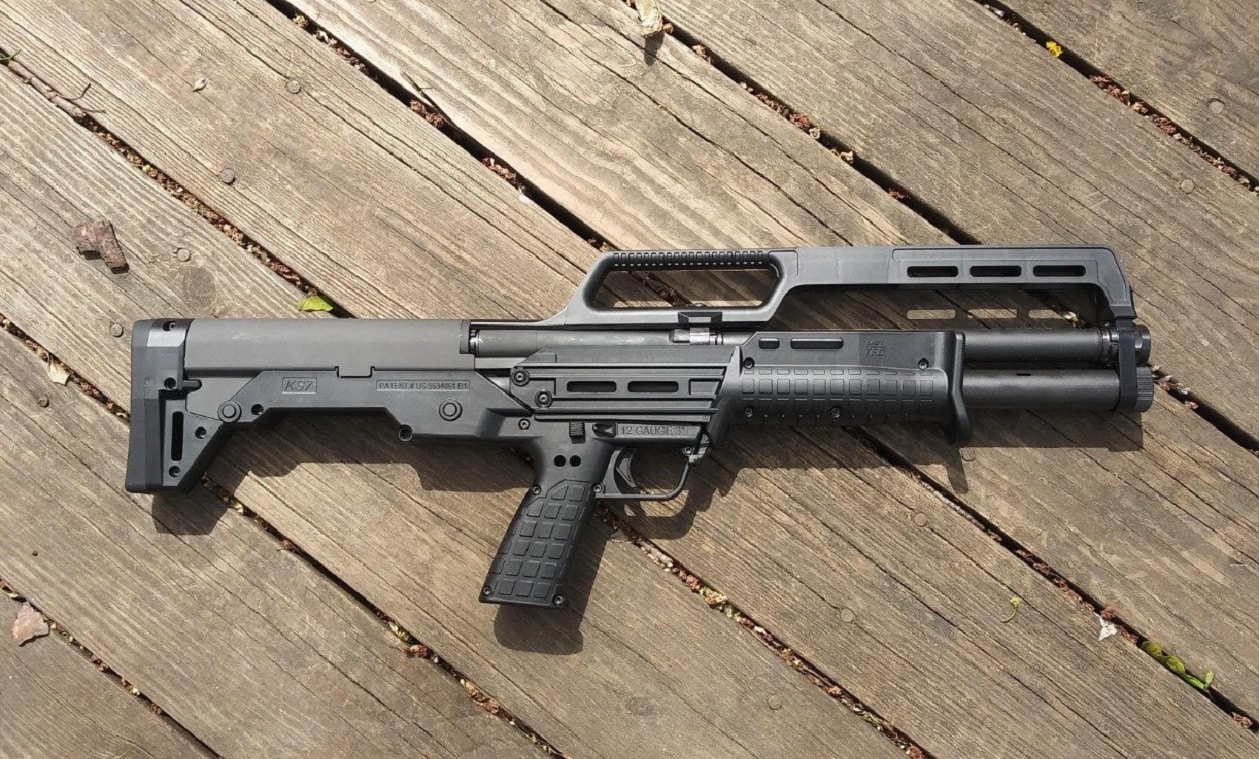
The KelTec KS7 is a 12-gauge bullpup pump-action shotgun built around a simple idea: keep the barrel length useful while reducing the overall footprint. Instead of placing the action in front of the shooter’s firing hand, the KS7 moves the action rearward into the stock area. That bullpup layout allows the shotgun to keep an 18.5-inch barrel while measuring just over 26 inches overall.
KelTec describes the current KS7 GEN2 as a lightweight, compact bullpup with a single magazine tube. It is chambered for 3-inch 12-gauge shells and holds 7+1 rounds with 2¾-inch shells or 6+1 rounds with 3-inch shells. The manufacturer also lists a 13-inch length of pull and an 18.5-inch barrel. :contentReference[oaicite:1]{index=1}
The KS7 is closely related to the KelTec KSG family, but it is not simply a smaller KSG. The KSG uses dual magazine tubes and offers greater capacity. The KS7 uses one magazine tube, which makes it slimmer, lighter, simpler, and usually easier to understand for new bullpup shotgun owners. KelTec lists the KS7 GEN2 as its single-tube 12-gauge bullpup shotgun, while the KSG series remains the company’s dual-tube 12-gauge bullpup shotgun line. :contentReference[oaicite:2]{index=2}
Key Specifications
Current manufacturer specifications should always take priority over older review data, because the KS7 has evolved and the GEN2 model adds updated features. According to KelTec’s current KS7 GEN2 page, the shotgun has the following core specifications. :contentReference[oaicite:3]{index=3}
| Model | KelTec KS7 GEN2 |
|---|---|
| Action | Pump-action bullpup shotgun |
| Gauge | 12 gauge |
| Chamber | 3 inches |
| Capacity | 7+1 with 2¾-inch shells; 6+1 with 3-inch shells |
| Overall Length | 26.1 inches |
| Barrel Length | 18.5 inches |
| Length of Pull | 13 inches |
| Unloaded Weight | 6.1 pounds listed in KelTec’s current specification table |
| MSRP | $699.99 listed by KelTec for the KS7 GEN2 |
One important note: older reviews often reference earlier KS7 pricing and weight figures. For example, older articles listed MSRP around $495 or $530, while KelTec’s current KS7 GEN2 page lists MSRP at $699.99. :contentReference[oaicite:4]{index=4} :contentReference[oaicite:5]{index=5} :contentReference[oaicite:6]{index=6}
Design and Build Quality
The KS7 looks futuristic, but its operating concept is still familiar. It is a manually operated pump shotgun. The shooter cycles the forend to extract, eject, load, and chamber each shell. The difference is that the action and loading area sit behind the firing grip, which gives the shotgun its short overall length.
The gun’s polymer-heavy construction helps keep weight down. This is one of the reasons the KS7 feels so handy when shouldered. It also explains one of the most common complaints across reviews: the shotgun can feel sharp under recoil because there is not much mass to absorb the energy of 12-gauge loads.
Reviewers generally agree that the KS7 is compact, fast-handling, and more practical than its unusual appearance suggests. Pew Pew Tactical called it surprisingly well made and smooth for the price, while Guns.com noted good overall functionality and praised the ambidextrous design. :contentReference[oaicite:7]{index=7} :contentReference[oaicite:8]{index=8}
The GEN2 model updates the platform with a revised forend and accessory support. KelTec says the GEN2 forend offers a more refined pump action and includes a five-slot Picatinny-style rail underneath, along with a top Picatinny-style rail for optics or sights. :contentReference[oaicite:9]{index=9}
Ergonomics and Handling
The KS7’s strongest everyday feature is its size. A traditional 18.5-inch-barreled pump shotgun is often much longer than the KS7. The bullpup layout places more of the shotgun’s weight close to the shooter’s body. This makes the KS7 feel quick to shoulder, easy to move, and comfortable to store compared with many full-length shotguns.
Several reviewers described the KS7 as fast handling. Firearms News praised the short overall length, light weight, intuitive pointing, and ambidextrous controls. Black Campbell also noted that the shotgun shoulders quickly and transitions naturally from target to target. :contentReference[oaicite:10]{index=10} :contentReference[oaicite:11]{index=11}
The handling is not perfect. The compact action changes the loading position, and the rearward loading/ejection port can feel unfamiliar to shooters who grew up with Remington 870, Mossberg 500, Benelli Nova, or similar conventional pump shotguns. The KS7 rewards practice, but it has a different manual of arms.
The 13-inch length of pull is relatively short, which helps many shooters square up behind the shotgun. It may feel cramped to larger shooters, especially when using heavier loads. Smaller shooters may appreciate the shorter stock geometry, but they should still evaluate recoil comfort before relying on the shotgun for serious use.
Capacity and Loading System
The KS7 uses a single internal magazine tube. This is one of the biggest differences between the KS7 and the KSG. The single-tube layout is easier to manage than the KSG’s dual-tube selector system, but it gives up the KSG’s higher capacity.
KelTec lists the KS7 GEN2 capacity as 7+1 with 2¾-inch shells and 6+1 with 3-inch shells. That is strong capacity for a shotgun of this length. It is not as high as the KSG, but it is still more than many traditional pump shotguns in factory defensive configurations. :contentReference[oaicite:12]{index=12}
Loading is done from the bottom/rear area of the receiver. Shooting Illustrated noted that loading and ejection use the same port and that shells must be loaded into the magazine before being chambered. This differs from some conventional shotgun habits, so new owners should read the manual and practice safe administrative handling with dummy rounds or under qualified instruction. :contentReference[oaicite:13]{index=13}
Some owners and reviewers discuss mini-shell use, but this is an area where caution is appropriate. Black Campbell reported that the KS7 could feed mini-shells but advised testing specific shells before depending on them. Because short shells can vary and reliability matters, buyers should not assume every reduced-length shell will run perfectly in every shotgun. :contentReference[oaicite:14]{index=14}
Barrel, Sights, and Controls
The KS7 uses an 18.5-inch barrel. That gives it a standard defensive shotgun barrel length while keeping the overall package short through the bullpup layout. KelTec lists the overall length at 26.1 inches, which is one reason the KS7 attracts buyers who want a compact shotgun without moving into specialized legal categories. :contentReference[oaicite:15]{index=15}
Controls are one of the KS7’s better features. The shotgun uses downward ejection, which helps make it more left-hand friendly than many bullpup firearms. KelTec describes its shotguns as downward-ejecting and ambidextrous, and multiple reviews highlight the KS7 as a better option for left-handed shooters than many conventional bullpup designs. :contentReference[oaicite:16]{index=16} :contentReference[oaicite:17]{index=17}
The safety is a crossbolt-style control. Guns.com’s GEN2 review described it as positive and functional but noted that it can be somewhat difficult to reach compared with an AR-style selector. That is a fair criticism. It works, but it may require deliberate familiarization. :contentReference[oaicite:18]{index=18}
Older KS7 models were known for the carry-handle sighting channel. Some shooters liked the low-profile simplicity. Others preferred a Picatinny rail for a red dot or iron sights. The current GEN2 configuration is more optic-friendly, with KelTec listing a top Picatinny-style rail and an underside five-slot rail in the forend. :contentReference[oaicite:19]{index=19}
Recoil and Shooting Experience
Recoil is the most repeated criticism in KS7 reviews. The reason is simple. A lightweight 12-gauge shotgun is easy to carry but harder on the shoulder. The KS7’s compact body, straight recoil path, and relatively light weight can make full-power shells feel brisk.
Inside Safariland described the KS7 as unforgiving under recoil because of its lightweight bullpup format. Eagle Gun Range also reported that the KS7 was easy to run and fun to shoot, but that the light weight made recoil very noticeable with hotter loads. :contentReference[oaicite:20]{index=20} :contentReference[oaicite:21]{index=21}
This does not mean the KS7 is unpleasant for everyone. It means buyers should be honest about their tolerance. Reduced-recoil loads, proper fit, and a quality recoil pad can make a major difference, but the KS7 will never feel like a heavy gas-operated semi-auto shotgun. Physics still collects rent.
The pump stroke gets better marks than some people expect. Eagle Gun Range specifically noted that the KS7’s pump action felt more like a traditional shotgun than the KSG’s action and was easier to cycle properly. :contentReference[oaicite:22]{index=22}
Accuracy and Reliability
Shotgun accuracy depends heavily on ammunition, sights, distance, and shooter familiarity. The KS7 is not designed as a precision firearm. It is a compact pump shotgun intended for practical shotgun distances. With buckshot, patterning matters. With slugs, sight setup and load choice matter even more.
Reviewers generally reported positive reliability experiences, but responsible wording is important. A single review cannot prove universal reliability. Guns.com reported no feeding issues while using several types of 12-gauge ammunition in its test gun. Firearms News reported its reviewed KS7 was 100-percent reliable. Pew Pew Tactical also gave the shotgun a positive overall rating. :contentReference[oaicite:23]{index=23} :contentReference[oaicite:24]{index=24} :contentReference[oaicite:25]{index=25}
The KS7 is still a pump shotgun. Reliability depends partly on the user running the action fully and consistently. Short-stroking can cause problems with any pump gun, especially under stress or when the shooter is new to the platform. This is not a flaw unique to the KS7, but the bullpup manual of arms makes practice more important.
Because the KS7 loads and ejects from the bottom/rear, owners should learn its specific rhythm before judging it against a conventional shotgun. A shooter who is very comfortable with a Mossberg 500 or Remington 870 may need time to become equally smooth with the KS7.
Pros and Cons
KelTec KS7 Pros
- Very compact overall length for an 18.5-inch-barreled 12-gauge shotgun.
- Good capacity for its size: 7+1 with 2¾-inch shells.
- Single magazine tube is simpler than the KSG’s dual-tube system.
- Downward ejection helps left- and right-handed shooters.
- Ambidextrous controls improve usability.
- GEN2 model adds improved accessory support.
- Light weight makes it easy to carry and handle.
- Distinctive design appeals to shooters who like unconventional firearms.
KelTec KS7 Cons
- Recoil can be sharp with full-power 12-gauge loads.
- Loading system feels unfamiliar compared with traditional pump shotguns.
- Lower capacity than the KelTec KSG.
- Crossbolt safety may not feel as natural as an AR-style selector.
- Light polymer construction may feel less solid than heavier traditional shotguns.
- Not ideal for high-volume range sessions unless the shooter is recoil tolerant.
- Aftermarket choices exist, but compatibility should be checked carefully.
Best Use Cases
The KS7 makes the most sense for people who value compact size above all else. It is easy to store, easy to maneuver, and easy to carry compared with many conventional pump shotguns. That makes it attractive for home-defense planning, property use, vehicle-adjacent storage where lawful, and outdoor carry in areas where a compact 12-gauge is practical and legal.
It can also be a fun range gun, especially for shooters who enjoy unusual firearm designs. It draws attention, feels different from standard pump guns, and offers a useful way to learn the strengths and tradeoffs of bullpup shotguns.
The KS7 is less ideal for clay shooting, upland hunting, waterfowl hunting, or competition divisions built around traditional shotgun ergonomics. It can launch shot like any other 12-gauge, but its design priorities are compactness and utility, not wingshooting balance or competition reload speed.
Comparison With Similar Shotguns
The KS7 does not have many direct rivals. Most 12-gauge pump shotguns use conventional layouts. The closest comparisons are the KelTec KSG, Smith & Wesson M&P 12, IWI Tavor TS12, and traditional pump shotguns like the Mossberg 500/590, Maverick 88, Remington 870, and Benelli Nova.
KelTec KS7 vs Traditional Pump Shotguns
A traditional pump shotgun usually feels more familiar. It is easier for many shooters to load, easier to inspect, and supported by decades of aftermarket parts. A Mossberg 500 or Remington 870 also tends to feel more conventional in balance and cheek weld.
The KS7 wins on compactness. It offers an 18.5-inch barrel in a much shorter overall package. It also gives left-handed shooters downward ejection and ambidextrous controls, which are meaningful advantages for some buyers.
KelTec KS7 vs Smith & Wesson M&P 12
The M&P 12 is another bullpup 12-gauge pump shotgun, but it follows the higher-capacity dual-tube concept more closely. It is generally larger and heavier. The KS7 is simpler and lighter. Buyers who want maximum onboard capacity may prefer a dual-tube design. Buyers who want a lighter, more straightforward bullpup may prefer the KS7.
KelTec KS7 vs IWI Tavor TS12
The Tavor TS12 is a semi-automatic bullpup shotgun with a rotating magazine system. It is more complex and typically more expensive. The KS7 is manually operated, simpler, and easier to understand mechanically. The TS12 may appeal to enthusiasts who want a semi-auto bullpup. The KS7 is a better fit for someone who wants pump-action simplicity in a compact shell.
KelTec KS7 vs KelTec KSG
The KS7 and KSG are often compared because they come from the same company and share the bullpup 12-gauge idea. The biggest difference is the magazine system. The KS7 uses one tube. The KSG uses two. KelTec currently lists the KS7 GEN2 as the single-tube 12-gauge bullpup and the KSG series as the dual-tube 12-gauge bullpup. :contentReference[oaicite:26]{index=26}
The KSG’s main advantage is capacity. It can carry significantly more shells than the KS7. That matters to buyers who want the highest possible onboard round count in a compact shotgun.
The KS7’s main advantage is simplicity. There is no tube selector to manage. The shotgun is slimmer and lighter. Many shooters also find the KS7 easier to understand because it behaves more like a normal pump shotgun once loaded.
For most buyers, the choice is simple. Choose the KS7 if you want the lighter, simpler, more streamlined bullpup. Choose the KSG if you want more capacity and are willing to accept extra weight, complexity, and a different loading routine.
Maintenance and Cleaning
Maintenance should stay basic, safe, and manual-driven. The owner’s manual should always be the primary source for disassembly, lubrication, inspection, and reassembly. The KS7 is not a firearm where guessing is a good plan.
Shooting Illustrated noted that KS7 disassembly involves two pushpins and that the gun benefits from lubrication around the rails and bolt. That is useful general context, but owners should still follow KelTec’s manual rather than relying on review articles for detailed service procedures. :contentReference[oaicite:27]{index=27}
At a practical level, owners should keep the bore clean, inspect the chamber and magazine area, remove fouling after range use, check the action for smooth cycling, and avoid letting debris build up around the loading/ejection port. A pump shotgun is mechanically simple, but simple does not mean maintenance-free.
Any repair, internal alteration, or parts replacement that affects safety or legal configuration should be handled through KelTec, a qualified gunsmith, or another competent professional. Avoid improvised modifications, especially on a defensive firearm.
Accessories and Upgrade Options
The KS7 GEN2 is more accessory-friendly than earlier versions. KelTec says the GEN2 includes a top Picatinny-style rail and a five-slot Picatinny-style rail molded into the forend for accessory attachment. :contentReference[oaicite:28]{index=28}
Common buyer-considered accessories include a red dot sight, upgraded iron sights, a sling, a weapon-mounted light where lawful and appropriate, a softer recoil pad, and shell management gear. These accessories can improve comfort and usability without changing the shotgun’s core function.
Recoil pads are one of the most commonly discussed KS7 upgrades because recoil is such a frequent complaint. Black Campbell reported that a thicker buttpad made the shotgun more pleasant to shoot, while Eagle Gun Range also suggested that recoil mitigation would help the experience. :contentReference[oaicite:29]{index=29} :contentReference[oaicite:30]{index=30}
Optics can also make sense. The KS7 is compact, and a simple red dot can be faster for many shooters than trying to align a minimal sighting channel. That said, any optic should be rugged enough for 12-gauge recoil, mounted properly, and verified at the range.
Avoid questionable upgrades that affect safety, legal status, or reliability. Short barrels, unverified magazine extensions, improvised muzzle devices, and non-factory internal parts can create legal or functional problems. The safer path is to use reputable accessories and verify compatibility with the current KS7 GEN2.
Who Should Buy the KelTec KS7?
The KS7 is a strong fit for buyers who want a compact 12-gauge pump shotgun and understand the tradeoff between light weight and recoil. It is especially appealing to shooters who like innovative designs, want ambidextrous controls, or need a short overall length while retaining a standard 18.5-inch barrel.
It also makes sense for experienced shotgun owners who already have a traditional pump and want something different. The KS7 is not just a novelty. It has real utility. But it does require more familiarization than a conventional shotgun.
Left-handed shooters should give the KS7 serious consideration. Downward ejection and ambidextrous controls make it more left-hand friendly than many long guns, especially many bullpup designs.
Who Should Avoid the KelTec KS7?
The KS7 is not the best choice for recoil-sensitive shooters unless they are willing to test it carefully before buying. A lightweight 12-gauge can be punishing, and the KS7’s compactness does not change the energy of the shell.
It may also be the wrong choice for buyers who want the most traditional, proven, and widely supported pump shotgun platform. A Mossberg 500/590, Maverick 88, Remington 870, or Benelli Nova may be a better fit for users who value conventional handling, broad parts availability, and decades of institutional familiarity.
Competition shooters and high-volume clay shooters should probably look elsewhere. The KS7 is compact and practical, but it is not optimized for rapid competition reloads, long strings of fire, or smooth swing dynamics on flying targets.
Final Verdict
The KelTec KS7 is a clever, compact, and genuinely useful bullpup shotgun. It offers a lot of capability in a short package: 12-gauge chambering, 18.5-inch barrel, 7+1 capacity with 2¾-inch shells, downward ejection, ambidextrous controls, and a simplified single-tube layout. The current GEN2 version improves accessory support and makes the platform more appealing to buyers who want optics or a more configurable forend. :contentReference[oaicite:31]{index=31}
The biggest drawback is recoil. That theme appears across multiple reviews, and it is easy to understand. The KS7 is light, short, and chambered in 12 gauge. It is comfortable enough for many shooters, but not soft. Buyers should test one if possible and budget for comfort-focused accessories if needed.
As a buyer’s choice, the KS7 is best for people who want compactness, simplicity, and bullpup handling more than traditional shotgun feel. It is not the universal answer for every shotgun owner. But for the right person, it is one of the most interesting pump-action shotguns on the market.
Frequently Asked Questions About the KelTec KS7
1. What is the KelTec KS7?
The KelTec KS7 is a 12-gauge bullpup pump-action shotgun. It places the action behind the firing grip, which allows it to keep an 18.5-inch barrel while measuring only 26.1 inches overall. It uses a single magazine tube, downward ejection, and ambidextrous controls. The design is meant for compact handling while still offering full-size shotgun capability.
2. What is the difference between the KS7 and KS7 GEN2?
The KS7 GEN2 is the current updated version listed by KelTec. It adds improved accessory support, including a top Picatinny-style rail and a five-slot Picatinny-style rail molded into the forend. KelTec also describes the GEN2 forend as offering a more refined pump action. Buyers comparing older reviews should remember that earlier KS7 models may not have the same rail layout or feature set as the GEN2.
3. Is the KelTec KS7 a 12-gauge shotgun?
Yes. The KS7 is chambered in 12 gauge and accepts 3-inch shells. It can also use 2¾-inch shells, which provide the higher listed capacity. As with any shotgun, owners should use ammunition that matches the markings on the firearm and the guidance in the manufacturer’s manual.
4. What is the KelTec KS7 capacity?
KelTec lists the KS7 GEN2 capacity as 7+1 with 2¾-inch shells and 6+1 with 3-inch shells. This is strong capacity for such a compact shotgun. The single-tube layout is simpler than the KSG’s dual-tube system, although it does not carry as many shells as the KSG.
5. How long is the KelTec KS7?
The KS7 GEN2 has a listed overall length of 26.1 inches. That short length is possible because of the bullpup configuration. The barrel is still 18.5 inches, so the shotgun offers a standard defensive barrel length inside a much shorter overall package than many traditional pump shotguns.
6. How much does the KelTec KS7 weigh?
KelTec’s current KS7 GEN2 specification table lists the unloaded weight at 6.1 pounds. Some older reviews may list different weights because they were written about earlier versions or measured with different configurations. The important buyer takeaway is that the KS7 is light for a 12-gauge shotgun, and that light weight contributes to both easy handling and sharper recoil.
7. Is the KelTec KS7 good for home defense?
The KS7 can be a practical home-defense shotgun for a trained, responsible owner who understands its controls, recoil, loading system, and legal responsibilities. Its compact length and ambidextrous layout are useful advantages. However, it is not a shortcut around training. Owners should pattern their chosen ammunition, practice safe handling, and make sure every adult in the home understands firearm safety and secure storage.
8. Is the KelTec KS7 reliable?
Several published reviews reported positive reliability experiences, including tests with different types of 12-gauge ammunition. That said, reliability can vary by individual firearm, ammunition, maintenance, and user technique. Because the KS7 is a pump shotgun, the shooter must run the action fully and consistently. Anyone relying on a KS7 should test it thoroughly with their chosen ammunition.
9. Does the KS7 have harsh recoil?
Many reviewers describe the KS7’s recoil as sharp. The shotgun is compact and light, and 12-gauge recoil is substantial. Recoil-sensitive shooters should try one before buying if possible. A quality recoil pad and suitable ammunition can help, but the KS7 will still feel more lively than a heavier shotgun.
10. Is the KS7 better than the KSG?
Neither shotgun is automatically better. The KS7 is lighter, simpler, and slimmer because it uses one magazine tube. The KSG offers greater capacity through dual magazine tubes. Buyers who value simplicity may prefer the KS7. Buyers who value maximum capacity may prefer the KSG.
11. What is the biggest advantage of the KS7?
The biggest advantage is compactness. The KS7 gives the shooter an 18.5-inch-barreled 12-gauge shotgun in a package just over 26 inches long. That makes it easy to store, carry, and handle compared with many conventional pump shotguns.
12. What is the biggest drawback of the KS7?
The biggest drawback is felt recoil. Light shotguns are convenient, but they transfer more energy to the shooter. The KS7’s compact bullpup layout also feels different from a conventional pump, so buyers should expect a learning curve.
13. Is the KelTec KS7 left-hand friendly?
Yes, the KS7 is one of the more left-hand-friendly bullpup shotguns because it ejects downward and uses ambidextrous controls. This avoids the common bullpup problem of ejecting shells near a left-handed shooter’s face. Left-handed shooters should still handle one in person to confirm comfort.
14. Does the KS7 eject downward?
Yes. The KS7 ejects downward through the bottom/rear area of the receiver. This supports ambidextrous use and helps keep the ejection path away from either side of the shooter’s face.
15. Is the KS7 legal?
Legality depends on jurisdiction. In its standard manufacturer configuration, the KS7 uses an 18.5-inch barrel and 26.1-inch overall length. However, firearm laws vary by country, state, and locality. Buyers should confirm current laws where they live before purchasing, transporting, modifying, or using any firearm.
16. Is the KelTec KS7 considered an NFA firearm?
In its standard factory configuration, the KS7 is generally discussed as a non-NFA shotgun because it has an 18.5-inch barrel and 26.1-inch overall length. However, legal status can change if a firearm is modified, and state or local laws may add restrictions. Owners should not alter barrel length, overall length, or configuration without qualified legal guidance.
17. Can the KS7 shoot 3-inch shells?
Yes. KelTec lists the KS7 GEN2 as chambered for 3-inch 12-gauge shells. Its listed capacity with 3-inch shells is 6+1. Shooters should expect stronger recoil with many 3-inch loads compared with 2¾-inch loads.
18. Can the KS7 shoot 2¾-inch shells?
Yes. KelTec lists the KS7 GEN2 capacity as 7+1 when using 2¾-inch shells. For many users, 2¾-inch shells offer a better balance of capacity, recoil, availability, and practical performance than 3-inch shells.
19. Can the KS7 use mini-shells?
Some reviewers and owners have reported success with mini-shells, but performance may vary. Short shells can be more sensitive to firearm design, shell length, and cycling technique. Anyone considering mini-shells should test them carefully and avoid relying on unverified ammunition for serious use.
20. Is the KS7 good for beginners?
The KS7 is not the easiest first shotgun for every beginner. Its compact size is appealing, but the bullpup loading system and sharper recoil add complexity. A new shooter may learn faster on a traditional pump or semi-auto shotgun. A motivated beginner can learn the KS7, but professional instruction and careful practice are strongly recommended.
21. Is the KS7 good for small shooters?
The KS7’s short length of pull and compact size may fit some smaller shooters well. However, its 12-gauge recoil can still be challenging. Fit and recoil tolerance matter more than size alone. Smaller shooters should test the gun with appropriate ammunition before deciding.
22. Is the KS7 good for large shooters?
Larger shooters may like the compact handling, but some may find the 13-inch length of pull short. The shotgun can feel cramped depending on arm length, stance, and accessory setup. A hands-on fit check is the best way to decide.
23. What sights come on the KS7?
Earlier KS7 models were known for a carry-handle-style sighting channel with a simple front sight. The current KS7 GEN2 is more rail-focused and supports optics or sights through its top Picatinny-style rail. Buyers should confirm the exact configuration of the model they are purchasing.
24. Can I mount a red dot on the KS7?
Yes, the current KS7 GEN2 is designed to support optics on its top Picatinny-style rail. A compact, durable red dot can make aiming easier for many shooters. Any optic should be rated for shotgun recoil and confirmed at the range after installation.
25. Can I mount a light on the KS7?
The KS7 GEN2 includes accessory rail support, which may allow a compatible light setup. Owners should choose reputable accessories, confirm fit, and avoid setups that interfere with safe operation. Local laws and safe storage considerations should also be considered.
26. Does the KS7 have a safety?
Yes. The KS7 uses a crossbolt-style safety. Reviewers generally describe it as functional, though some find it less natural than an AR-style selector. Owners should practice locating and operating the safety safely until it becomes familiar.
27. Is the KS7 easy to load?
The KS7 is easy enough once learned, but it is different from a traditional shotgun. Loading is done through the bottom/rear port area, and the bullpup layout changes hand position. New owners should learn the process from the manual and practice safely with dummy rounds before using live ammunition.
28. Is the KS7 fast to reload?
The KS7 is not known for fast reloads compared with competition-oriented or conventional shotgun setups. Its compact loading port location can be slower for some users. Capacity is good, but topping off the magazine efficiently takes practice.
29. Is the KS7 good for hunting?
The KS7 can fire 12-gauge hunting loads if legal and appropriate, but it is not primarily designed as a hunting shotgun. Its short bullpup layout, sighting setup, and defensive-style ergonomics are less ideal for wingshooting. Hunters should also check magazine capacity rules and local regulations.
30. Is the KS7 good for clay shooting?
The KS7 is not the best choice for clay sports. Clay shooting usually benefits from longer barrels, smoother swing dynamics, and traditional shotgun balance. The KS7 can be used recreationally, but it is not optimized for trap, skeet, or sporting clays.
31. Is the KS7 good as a truck gun?
Some owners like compact shotguns for vehicle-adjacent use, but the legal and safety issues are significant. Storage, transport, theft prevention, and local laws matter. The KS7’s compact size is useful, but responsible storage and legal compliance should drive the decision.
32. Is the KS7 suitable for backpacking or outdoor carry?
The KS7’s short length and light weight can appeal to outdoor users in places where carrying a shotgun is lawful and practical. However, 12-gauge ammunition is heavy, recoil is stout, and firearm transport laws vary. Outdoor users should balance capability against weight, training, and legal rules.
33. How does the KS7 compare to a Mossberg 500?
The Mossberg 500 is more traditional, widely supported, and familiar to many shooters. The KS7 is much shorter overall and more ambidextrous due to downward ejection. Choose the Mossberg for conventional handling and broad aftermarket support. Choose the KS7 for compact bullpup handling.
34. How does the KS7 compare to a Mossberg 590?
The Mossberg 590 is a proven defensive pump shotgun with strong aftermarket support and traditional ergonomics. The KS7 is shorter and more compact. The 590 may be better for users who want a conventional duty-style shotgun. The KS7 may be better for users who prioritize compact storage and maneuverability.
35. How does the KS7 compare to a Remington 870?
The Remington 870 is a classic traditional pump shotgun with decades of history. It generally feels more familiar and has extensive parts support. The KS7 is more compact and more unusual. The better choice depends on whether the buyer values traditional handling or compact bullpup design.
36. How does the KS7 compare to the Benelli Nova?
The Benelli Nova is a conventional pump shotgun known for durability and a solid feel. The KS7 is shorter, lighter, and more compact. Some reviewers have noted that the KS7 can feel less solid than heavier traditional shotguns, but it wins clearly on overall length.
37. Is the KS7 better than a semi-auto shotgun?
Not necessarily. A semi-auto shotgun may offer softer recoil and faster follow-up shots, depending on the model. The KS7 offers pump-action simplicity, compact size, and lower mechanical complexity. Buyers should compare the KS7 to semi-autos based on budget, recoil tolerance, maintenance expectations, and intended use.
38. Does the KS7 need a break-in period?
Some shotguns feel smoother after use, but buyers should not rely on a vague break-in period to solve reliability concerns. A new KS7 should be inspected, cleaned as directed, lubricated as directed, and tested safely with the ammunition the owner plans to use.
39. What ammunition works best in the KS7?
The best ammunition depends on the purpose. For range practice, common 2¾-inch target loads may be more comfortable. For defensive planning, owners should research reputable defensive shotgun loads and pattern them responsibly. Avoid assuming that any load is ideal without testing function, recoil, and point of impact.
40. Should I use 3-inch shells in the KS7?
The KS7 can use 3-inch shells, but many shooters will find them unpleasant in such a light shotgun. They also reduce capacity from 7+1 to 6+1. Unless there is a specific reason to use them, many owners may prefer 2¾-inch loads for better control and capacity.
41. Is the KS7 painful to shoot?
It can be uncomfortable for some shooters, especially with full-power buckshot, slugs, or 3-inch shells. Recoil comfort depends on the shooter, ammunition, stance, fit, and recoil pad. Anyone who is recoil sensitive should try the gun before buying or consider a heavier shotgun.
42. Can a recoil pad help the KS7?
Yes, a quality recoil pad can make the KS7 more comfortable. Several reviewers and owners mention recoil pads as a practical comfort upgrade. A recoil pad does not eliminate 12-gauge recoil, but it can make practice sessions more pleasant.
43. Is the KS7 easy to clean?
The KS7 is reasonably straightforward to maintain if the owner follows the manual. Because the layout is different from a conventional shotgun, new owners should not assume the disassembly process is identical to other pump guns. Basic cleaning, lubrication, and inspection should be done after range use and before storage.
44. Can I modify the KS7?
Owners should be careful with modifications. Comfort accessories, optics, slings, and compatible rail-mounted accessories are common. Internal changes, barrel changes, or configuration changes that affect safety or legal status should be avoided unless handled by qualified professionals and confirmed lawful.
45. Are KS7 accessories easy to find?
Accessory availability is better than it was when the KS7 first appeared, especially with the GEN2 rail setup. Still, the KS7 does not have the same massive aftermarket as a Mossberg 500 or Remington 870. Buyers should verify compatibility before purchasing accessories.
46. Is the KS7 a good survival shotgun?
The KS7 can serve some outdoor utility roles because it is compact and chambered in 12 gauge. However, “survival” use depends on lawful carry, ammunition selection, maintenance, training, and realistic needs. It is compact, but 12-gauge shells are bulky and heavy compared with many rifle or handgun cartridges.
47. Is the KS7 durable?
Published reviews generally describe the KS7 as functional and useful, though opinions on polymer feel vary. Durability depends on use, maintenance, ammunition, and individual sample quality. Buyers who want maximum proven institutional durability may prefer long-established conventional pump shotguns.
48. Does the KS7 feel cheap?
Some shooters find the KS7’s polymer-heavy build less solid than traditional steel-and-aluminum shotguns. Others appreciate the weight savings and compact design. The feel is subjective. The best approach is to handle one in person before buying.
49. Is the KS7 fun at the range?
Yes, for many shooters. The compact bullpup design is interesting, the action is engaging, and the gun has a distinctive personality. The main limit is recoil. Short range sessions with moderate loads are more enjoyable than long sessions with heavy loads.
50. Is the KS7 good for women shooters?
The KS7 can work well for some women shooters, especially those who appreciate compact dimensions and a shorter length of pull. It can also be too sharp-recoiling for others. Fit, training, and recoil tolerance matter more than gender. Trying the shotgun before buying is strongly recommended.
51. Is the KS7 safe?
The KS7 is a firearm and must be handled with strict safety discipline. It has mechanical safety features, but safe ownership depends on the user. Owners should follow the manual, keep the firearm secured, use correct ammunition, keep fingers off the trigger until ready to fire, and follow all standard firearm safety rules.
52. What should I check before buying a used KS7?
Inspect overall condition, confirm the exact generation and configuration, check for signs of abuse, verify smooth cycling, inspect the bore, and confirm that any accessories are properly installed and legal. A qualified gunsmith inspection is a smart idea if the buyer is unsure.
53. Is the KS7 worth the money?
The KS7 is worth considering if compact size, bullpup handling, ambidextrous controls, and 12-gauge capability are priorities. It is less compelling if the buyer wants soft recoil, traditional handling, or maximum aftermarket support. Value depends on the intended role and the shooter’s comfort with the platform.
54. Should I buy the KS7 or a traditional pump shotgun first?
Most new shotgun owners may be better served by learning on a traditional pump or semi-auto shotgun first. Traditional designs are easier to load, easier to inspect, and more familiar to instructors. The KS7 is a better second shotgun for many buyers, although a dedicated beginner can learn it with proper instruction.
55. What is the final verdict on the KelTec KS7?
The KelTec KS7 is a compact, innovative, and practical bullpup pump shotgun with real strengths and clear tradeoffs. It is short, light, ambidextrous, and capable. It also recoils sharply, loads differently from conventional shotguns, and requires practice. Buyers who understand those tradeoffs may find it one of the most useful compact 12-gauge shotguns available.
Read more: