
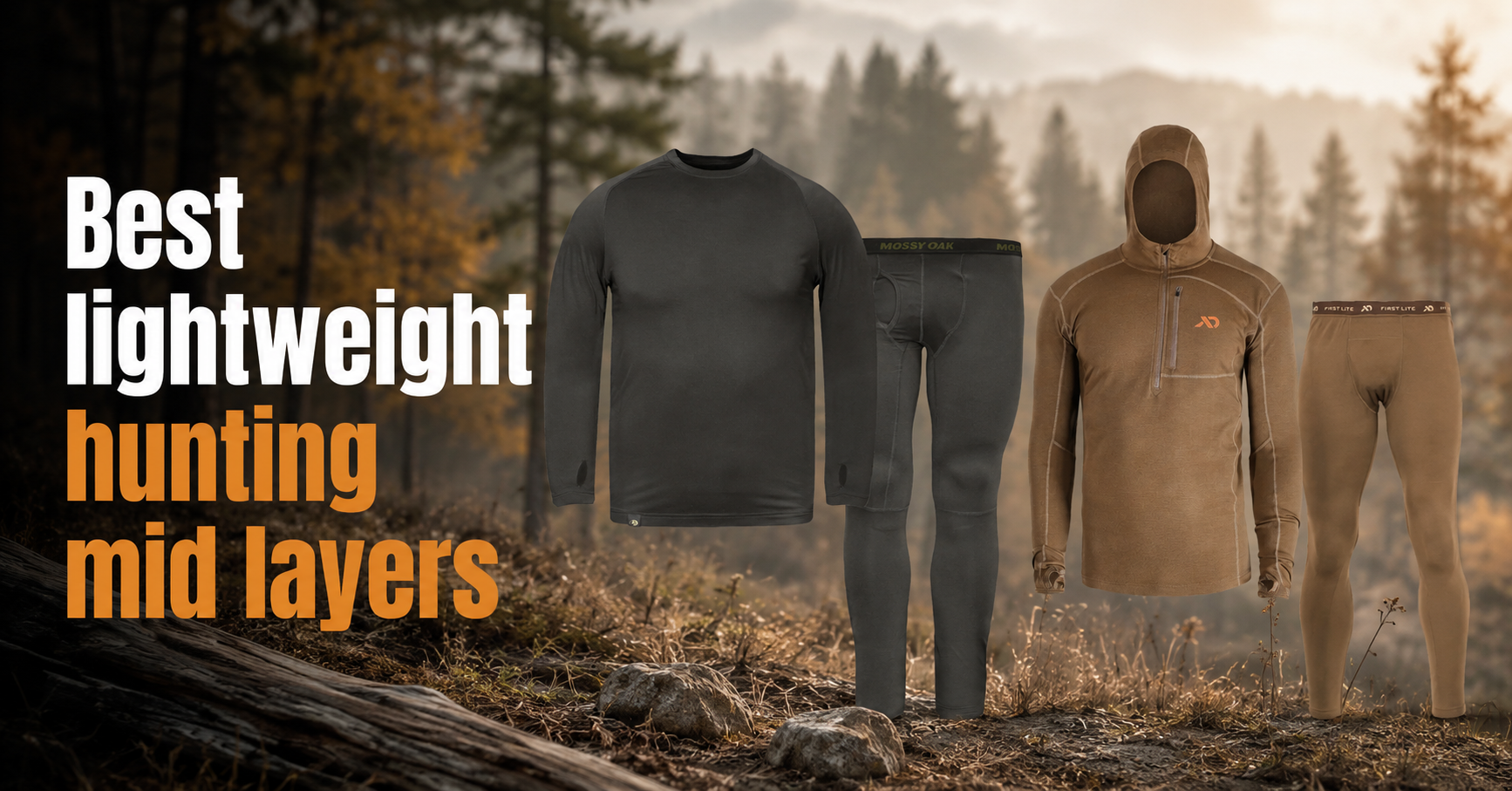

A steep approach followed by a motionless glassing session creates a difficult clothing problem. A layer that feels comfortable while walking may become too warm and damp, while an ultrathin shirt may provide too little insulation once you stop moving.
The best lightweight hunting mid layers balance warmth, breathability, mobility and packability. Lightweight fleece and merino garments are useful for active hunts, but no single layer is ideal for every temperature or hunting style. Hunters who walk continuously generally need less insulation than hunters spending hours in a tree stand, layout blind or exposed glassing position.
After validating the supplied Amazon list, 11 distinct products remained suitable for individual review. Two exact duplicate links were removed. A fleece-lined jacket-and-pants outerwear suit and a pair of fingerless gloves were excluded because they do not match the mid-layer product category.
Disclosure: Gunscorner.com may earn a commission from qualifying purchases made through affiliate links, at no additional cost to you.
Quick Picks
- Best Overall Crossover Layer: First Lite Men’s Kiln Hoody — a 250-gsm Merino-X top that can function as either a substantial base layer or a relatively low-bulk second layer.
- Best for Active Cold-Weather Hunts: SITKA Gear Men’s Heavyweight Hoodie — a 14.8-ounce stretch-fleece hoody with a half zipper for temperature regulation.
- Lightest Early-Season Option: King’s Camo Men’s XKG Elevation 1/4 Zip Tee — an ultrabreathable synthetic crossover shirt for cool mornings and high-output activity.
- Best Lightweight Merino Blend: Nomad Men’s Durawool Crew Baselayer Shirt — a 170-gsm merino, nylon and spandex blend for hunters prioritizing mobility and lower bulk.
- Best Full-Zip Fleece: King’s Camo XKG Pinnacle Full Zip Jacket — a warmer body-mapped fleece with full-length ventilation and useful pockets.
- Best Quiet Hooded Fleece: SITKA Gear Men’s Traverse Hunting Hoody — a quiet knit exterior with high-loft fleece and lighter mapped panels.
- Best Lower-Body Layer: SITKA Gear Men’s Heavyweight Bottom — a stretch-fleece bottom for cold stands, blinds and low-movement glassing.
What Counts as a Lightweight Hunting Mid Layer?
A mid layer is worn over a moisture-managing base layer and beneath an outer shell or insulated jacket. Its primary job is to trap warm air while allowing perspiration to move away from the body.
In practice, hunting clothing categories overlap. A 170-gsm merino shirt may be a base layer when worn next to the skin and a very light mid layer when placed over a thinner shirt. A fleece hoody may work as an outer layer in calm weather and become a mid layer beneath rain or wind protection.
Fleece, wool and synthetic insulation can all work as mid layers. Fleece typically dries quickly and breathes well, while merino is useful for repeated wear and changing temperatures. A full-zip garment offers more ventilation than a crew neck, but zippers and pockets usually add weight.
| Layer Style | Typical Strength | Best Use | Main Limitation |
|---|---|---|---|
| Light synthetic quarter zip | High breathability and low bulk | Early season and strenuous movement | Limited warmth after activity stops |
| 170–200-gsm merino shirt | Temperature versatility and odor management | Mobile and multi-day hunts | Less insulation than substantial fleece |
| 250-gsm merino crossover | Balanced warmth without jacket bulk | Cool-weather active-to-stationary hunts | May become warm during steep climbs |
| Stretch-fleece hoody | Warmth, mobility and faster drying | Cold active hunts and layering under shells | Can retain too much heat in mild conditions |
| High-loft or body-mapped fleece | Higher insulation for its clothing volume | Cold sits, glassing and late-season use | Heavier and less packable |
Comparison of the 11 Valid Supplied Layers
| Product | Layer Type | Verified Material or Weight | Ventilation | Best Hunting Role | Primary Trade-Off |
|---|---|---|---|---|---|
| First Lite Kiln Hoody | Merino crossover top | 250-gsm Merino-X | Quarter zip and hood | Versatile shoulder-season hunts | Warmer than a true lightweight shirt |
| SITKA Heavyweight Hoodie | Stretch-fleece hoody | 93% polyester, 7% elastane; 14.8 oz. | Half zip and mapped fleece channels | Active cold-weather hunting | Heavyweight insulation despite moderate garment weight |
| King’s XKG Elevation 1/4 Zip | Light synthetic crossover | Textured polyester mesh | Quarter zip and breathable panels | Early season and high-output travel | Provides limited insulation during long sits |
| Nomad Durawool Crew | Light merino-blend crossover | 170 gsm; 60% merino, 36% nylon, 4% spandex | Crew neck; breathable knit | Mobile hunts and pack travel | No zipper for rapid heat release |
| King’s XKG Pinnacle Jacket | Full-zip body-mapped fleece | 400-gsm torso, 320-gsm sleeves; 18.7 oz. | Full zipper | Cold mornings and late-season layering | Not genuinely ultralight |
| SITKA Traverse Hunting Hoody | High-loft hooded fleece | Polyester knit and Berber fleece | Lighter side and underarm panels | Quiet cold-weather outer or mid layer | Bulky compared with merino shirts |
| Merino.tech Merino Wool Set | Merino top-and-bottom system | 100% superfine merino; selected medium-weight family | Crew-neck shirt | Cold-weather base-to-mid crossover | Set includes more pieces than some shoppers need |
| Merino Protect Long Sleeve Shirt | Slim merino crossover shirt | Merino wool; medium weight | Crew neck | Close-fitting torso insulation | Low or no stretch in the selected variation |
| Mossy Oak Performance Tech Tee | Ultralight synthetic shirt | 100% smooth polyester | Breathable crew-neck construction | Warm-weather outer shirt or cool-weather crossover | Minimal insulation |
| Nomad Durawool Legging | Lower-body merino blend | 170 gsm; 60% merino, 36% nylon, 4% spandex | Breathable knit | Active lower-body layering | Not an upper-body mid layer |
| SITKA Heavyweight Bottom | Lower-body stretch fleece | 93% polyester, 7% elastane; 9.15 oz. | Channeled fleece construction | Cold stands, blinds and glassing | Too warm for many strenuous approaches |
1. Best Overall: First Lite Men’s Kiln Hoody

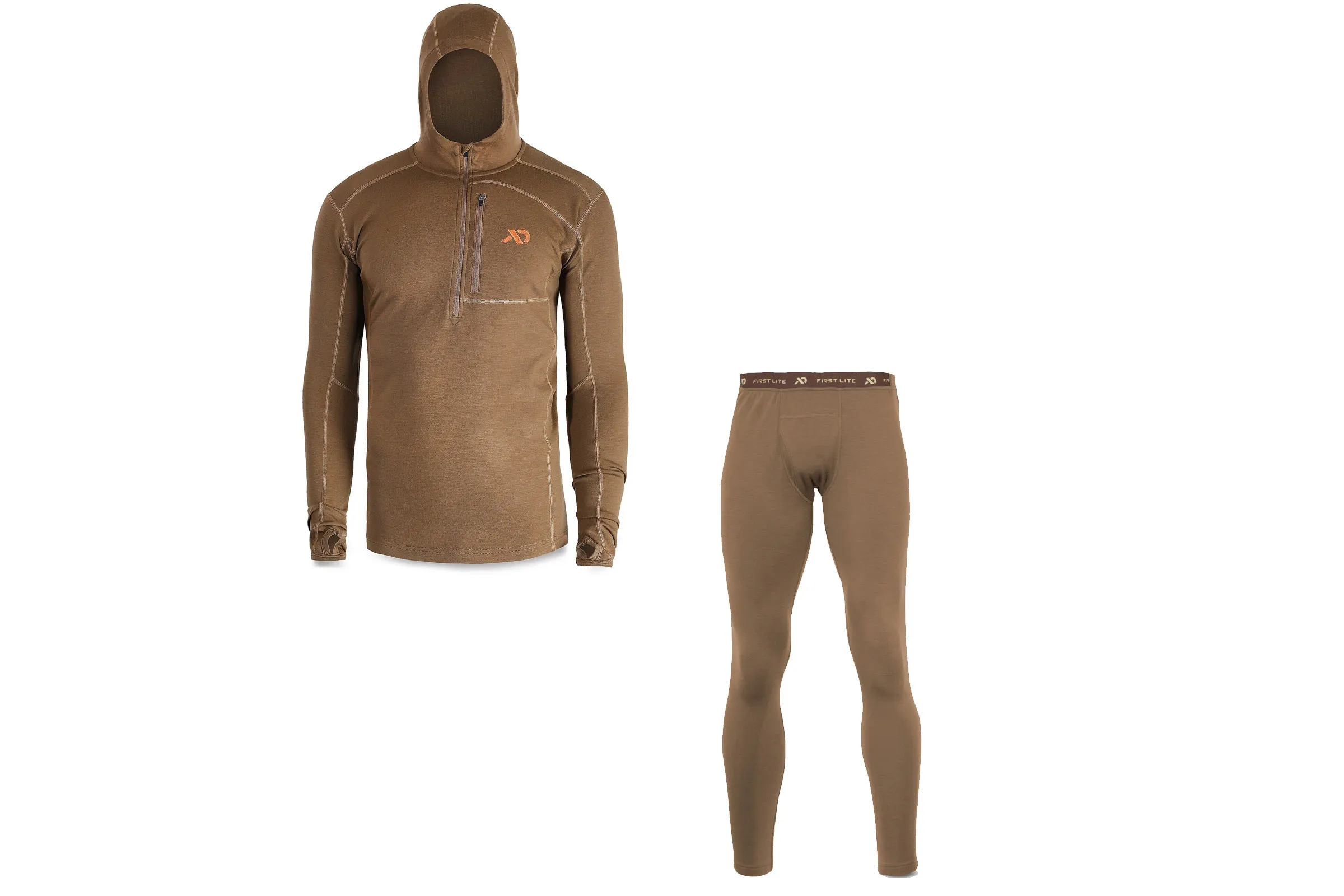
The First Lite Kiln Hoody is the strongest overall crossover option for hunters who want one garment to serve as a substantial base layer or a relatively streamlined second layer. First Lite classifies it as a Midweight 250 Merino-X garment and states that it can be worn as either the first or second layer.
The quarter zipper helps release heat during movement, while the hood adds neck and head coverage when activity slows. Its merino construction is especially practical for multi-day trips where repeated wear matters.
The Kiln is best for cool shoulder-season conditions, mobile whitetail hunting, elk approaches and hunts that alternate between walking and sitting. It is less suitable for hot early-season climbs or severe cold that requires lofted insulation.
Pros
- The 250-gsm Merino-X fabric can serve as either a substantial base or a streamlined second layer.
- The quarter zipper supports temperature regulation during changing activity levels.
- The hood adds flexible head and neck coverage without requiring a separate garment.
- The close layering profile fits beneath many shells more easily than a bulky fleece jacket.
- Merino is useful for repeated wear on multi-day trips.
Cons
- The 250-gsm fabric may be too warm for steep approaches in mild weather.
- It provides less wind resistance than a dedicated outer jacket.
- Merino-blend fabric requires more careful laundering than basic polyester fleece.
- The hood may feel redundant beneath some hooded outer shells.
2. Best for Active Cold Weather: SITKA Gear Men’s Heavyweight Hoodie
SITKA’s Heavyweight Hoodie uses 93% polyester and 7% elastane comfort-stretch fleece. The official listing gives a garment weight of 14.8 ounces in size large and includes a half-length zipper, low-profile hood, thumb loops and zippered chest pocket.
Despite the “heavyweight” name, the garment remains lighter and less bulky than many insulated hunting jackets. Its channeled fleece is intended to retain warmth while allowing moisture to move through the clothing system.
This is a strong choice for cold mountain travel, late-season still-hunting and active hunts where a full puffy jacket would be excessive. It can be worn over a thin base layer and beneath wind or rain protection.
Pros
- The half zipper allows more heat release than a crew-neck fleece.
- Stretch fleece supports climbing, kneeling and drawing a bow.
- The low-profile hood layers more easily beneath an outer hood.
- Thumb loops help keep the sleeves positioned while adding another layer.
- The zippered chest pocket provides secure storage without bulky hand pockets.
Cons
- The insulation may be excessive during strenuous early-season movement.
- The pullover design is slower to remove than a full-zip jacket.
- It is not a substitute for a windproof or waterproof shell.
- The close layering cut may feel restrictive if sized too small.
3. Lightest Early-Season Option: King’s Camo Men’s XKG Elevation 1/4 Zip Tee
King’s Camo describes the XKG Elevation 1/4 Zip as the lightest long-sleeve synthetic shirt in its XKG range. It uses two-way-stretch textured polyester mesh, a quarter zipper, flatlock seams, mesh paneling and Polygiene treatment.
This is not a conventional insulating fleece. It is better understood as an ultralight crossover layer that can be worn over a thin undershirt during cool mornings or used as the primary shirt during warm, active hunting.
The Elevation is best for early archery seasons, turkey hunting, strenuous public-land walks and climates where overheating is a greater concern than prolonged cold.
Pros
- The lightweight mesh fabric minimizes pack and clothing bulk.
- The quarter zipper provides useful ventilation during demanding movement.
- Flatlock seams reduce prominent seam ridges beneath pack straps.
- Stretch fabric supports upper-body movement.
- It can transition between a light second layer and a warm-weather outer shirt.
Cons
- It provides limited insulation once the hunter stops moving.
- The breathable mesh offers little wind protection.
- It should not be confused with a cold-weather fleece mid layer.
- A separate insulating garment may still be needed for long sits.
4. Best Lightweight Merino Blend: Nomad Men’s Durawool Crew Baselayer Shirt
The Nomad Durawool Crew uses 170-gsm fabric containing 60% merino wool, 36% nylon and 4% spandex. Nomad lists four-way stretch, a gusseted underarm, flatlock seams and a highly breathable construction.
At 170 gsm, this is one of the lightest insulating garments in the comparison. It works primarily as a base layer but can serve as a low-bulk mid layer over an ultrathin shirt when the weather is cool rather than cold.
The nylon content should make the fabric more practical around pack straps and repeated use than an equivalent pure-merino shirt, while the spandex improves mobility. That durability benefit is a reasonable material-based inference rather than an independent abrasion-test result.
Pros
- The 170-gsm fabric is suitable for active hunts and changing temperatures.
- The merino blend manages repeated wear while retaining synthetic reinforcement.
- Four-way stretch supports climbing and crouching.
- The gusseted underarms improve freedom of movement.
- Flatlock seams are useful beneath packs and outer layers.
Cons
- The crew neck provides less ventilation than a zip-neck garment.
- It is too light to replace fleece during long cold sits.
- The snug layering fit may feel restrictive if the wrong size is selected.
- Only 60% of the fabric is merino wool.
5. Best Full-Zip Fleece: King’s Camo XKG Pinnacle Full Zip Jacket
The XKG Pinnacle is a genuine technical mid layer rather than a base-layer crossover. King’s Camo lists body-mapped fleece weighing 400 gsm through the torso and 320 gsm through the sleeves, a full zipper, stretch fabric, hood, raised collar, thumbholes and zippered pockets. The current version weighs 18.7 ounces.
The heavier torso adds insulation where it matters most, while lighter sleeves help preserve arm mobility. The full zipper makes this one of the easiest supplied garments to vent or remove during temperature changes.
It is best for cold mornings, late-season layering and hunters who need more warmth than the Kiln or Durawool shirts provide. Its main conflict with the keyword is weight: it is versatile and relatively streamlined, but not ultralight.
Pros
- The full zipper provides the widest ventilation range in the comparison.
- Body-mapped fleece concentrates insulation around the torso.
- Lighter sleeves support mobility and easier outer-layer fit.
- Zippered hand and chest pockets secure small essentials.
- The raised collar and hood provide flexible cold-weather coverage.
Cons
- At 18.7 ounces, it is heavier than the merino crossover tops.
- The high fabric weights may cause overheating during steep climbs.
- It occupies more pack space than a 170–250-gsm shirt.
- The pockets and full zipper add bulk beneath fitted shells.
6. Best Quiet Hooded Fleece: SITKA Gear Men’s Traverse Hunting Hoody
The SITKA Traverse Hoodie combines a quiet polyester-knit exterior with a high-loft Berber fleece interior. Lighter fleece panels are placed at the sides and underarms, while the garment also includes a sculpted hood, zippered hand and chest pockets and a durable water-repellent finish intended to shed light precipitation.
This is a warmer, more substantial fleece than the keyword “lightweight” may suggest. Its mapped design nevertheless reduces some unnecessary bulk and helps improve movement compared with uniformly thick high-loft fleece.
The Traverse is a strong choice for cool waterfowl hunts, whitetail sits, cold camp use and hunters who want a fleece that can also function as outerwear in calm conditions.
Pros
- The quiet knit exterior is designed for hunting movement.
- High-loft fleece provides more stationary warmth than thin merino shirts.
- Lighter side and underarm panels improve mobility and breathability.
- Zippered hand and chest pockets increase stand-alone usefulness.
- The DWR finish can shed brief light precipitation.
Cons
- It is a heavyweight fleece rather than a truly lightweight layer.
- The high-loft interior occupies more space in a pack.
- A DWR finish does not make the garment waterproof.
- The hood and multiple pockets may feel bulky beneath a close shell.
7. Merino.tech Merino Wool Base Layer Men’s Set — A Full-System Crossover
The supplied Merino.tech ASIN is a 100% superfine-merino top-and-bottom thermal set from a listing that groups lightweight, midweight and heavyweight options. Available product information identifies this selected entry with the medium-weight family, so buyers should confirm the exact weight and color before ordering.
The shirt can function as a close second layer over a thinner undershirt, while the matching bottoms provide full-body insulation. The set is most useful for hunters who want coordinated merino coverage rather than a jacket-style mid layer.
It is less convenient for rapid ventilation because the shirt has a crew neck and no full zipper. Pure merino also requires protection from rough pack hardware and aggressive laundering.
Pros
- The package includes coordinated upper- and lower-body insulation.
- The 100% merino construction is useful for repeated wear.
- The shirt can be worn next to the skin or over an ultrathin base layer.
- The regular fit may suit hunters who dislike compression garments.
Cons
- The shared listing contains several fabric-weight options that can be confused.
- The crew neck provides limited ventilation during strenuous movement.
- The set may include a bottom that some buyers do not need.
- Pure merino is more vulnerable to abrasion than reinforced blends.
8. Merino Protect 100% Merino Wool Base Layer Men’s Long Sleeve Shirt
The supplied Merino Protect variation is a slim-fitting, medium-weight merino shirt intended for hunting and outdoor layering. Accessible product attributes describe a pull-on crew neck with little or no fabric stretch.
This is a simple torso-only alternative for hunters who already own leggings or insulated pants. Its slim profile should fit beneath jackets without substantial bunching, but the non-stretch construction makes accurate sizing important.
It is best for moderate activity and hunters who prefer pure merino. A quarter-zip or stretch-blend shirt is likely to be more comfortable during highly dynamic mountain hunting.
Pros
- The slim fit reduces fabric bulk beneath outer layers.
- The pure-merino construction is useful for multi-day wear.
- The shirt-only format avoids duplicating existing bottoms.
- The crew-neck design is simple and has no zipper to interfere with pack straps.
Cons
- Low stretch can make shoulder and arm fit less forgiving.
- The crew neck limits rapid heat release.
- The selected variation is medium weight rather than ultralight.
- It lacks a hood, pockets and adjustable ventilation.
9. Mossy Oak Men’s Camo Long Sleeve Performance Tech Tee Hunting Shirt
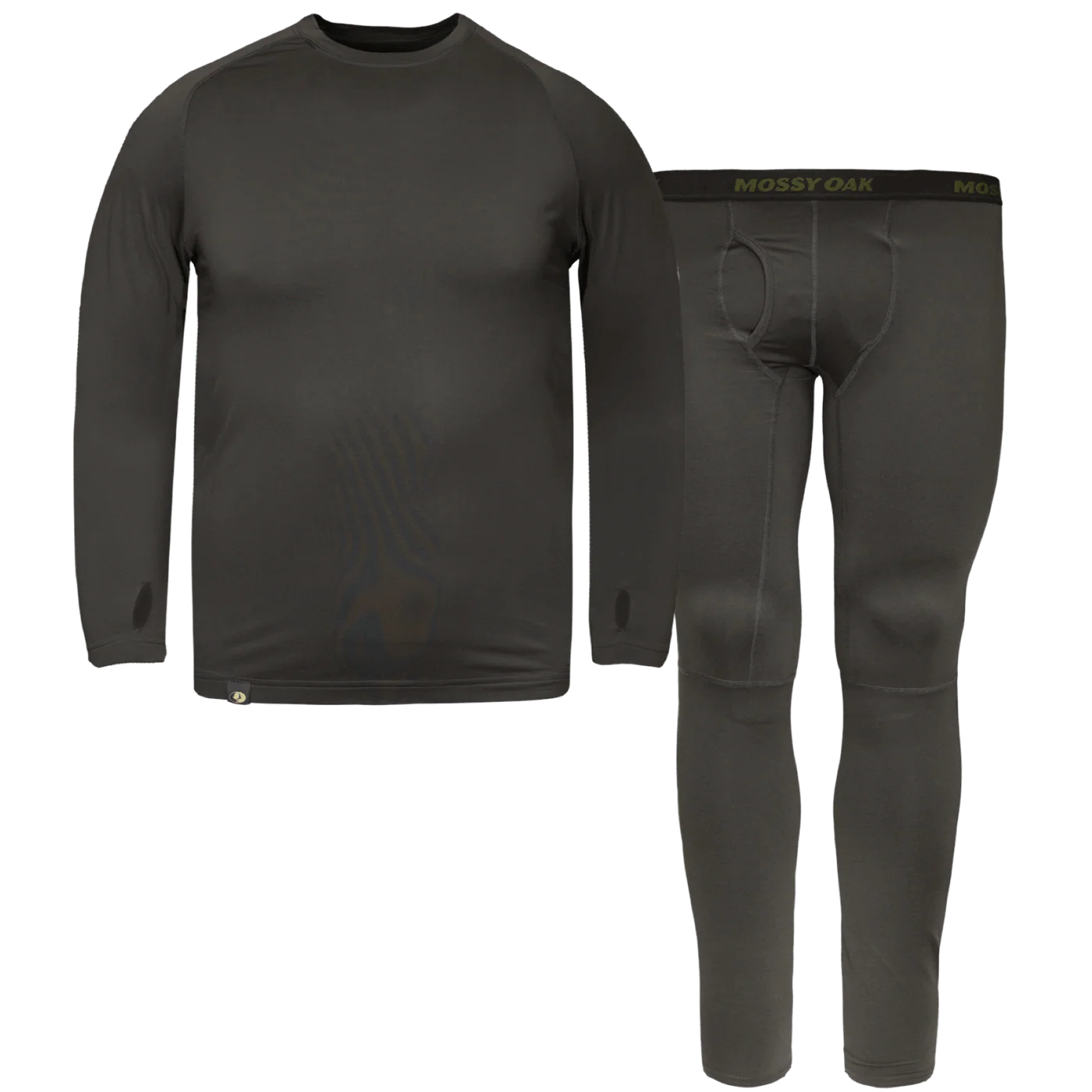
The Mossy Oak Performance Tech Tee is a lightweight 100% polyester long-sleeve shirt with a raglan cut and moisture-managing construction. Mossy Oak describes it primarily as a warm-weather shirt and a base layer for cooler temperatures.
It qualifies here only as an ultralight crossover option. Worn over a thin short-sleeve base, it can add coverage during a cool dawn without the weight of fleece. It should not be selected as the only insulating layer for cold stationary hunting.
This shirt is best for spring turkey hunting, early archery seasons, mild climates and buyers prioritizing low bulk over warmth.
Pros
- The lightweight polyester fabric is suitable for high-output activity.
- The raglan sleeves support shoulder movement.
- The material should dry faster than thick wool after light perspiration.
- The shirt can function as a warm-weather outer layer.
- Its simple construction packs into limited space.
Cons
- It offers very little insulation after activity stops.
- The crew neck has no zipper for ventilation.
- It is closer to a performance shirt than a conventional mid layer.
- Polyester may develop odor faster than merino during repeated wear.
10. Best Lightweight Lower-Body Crossover: Nomad Men’s Durawool Baselayer Legging
The Nomad Durawool Legging uses the same 170-gsm blend as the Durawool Crew: 60% merino wool, 36% nylon and 4% spandex. Nomad lists four-way stretch, an elastic waistband, gusseted crotch and flatlock stitching.
These leggings are technically a base layer, but they can become the insulating lower-body component in a lightweight hunting system. They are most useful beneath uninsulated hunting pants during active, cool-weather travel.
The low fabric weight is better suited to walking than long stationary exposure. Hunters wearing insulated bibs may not need an additional lower-body layer at all.
Pros
- The 170-gsm fabric provides low-bulk lower-body insulation.
- Four-way stretch supports climbing and long strides.
- The gusseted crotch improves movement.
- Flatlock seams reduce bulky ridges beneath hunting pants.
- The merino-nylon blend balances repeated wear with reinforcement.
Cons
- The product is a base-layer bottom rather than an upper-body mid layer.
- It may provide insufficient warmth during long cold sits.
- The waistband may overlap uncomfortably with tight pants or bibs.
- The snug fit requires accurate waist and hip measurements.
11. Best Cold-Weather Lower Layer: SITKA Gear Men’s Heavyweight Bottom
The SITKA Heavyweight Bottom uses 93% polyester and 7% elastane comfort-stretch fleece. SITKA lists a weight of 9.15 ounces in size large and describes it as a next-to-skin layer for cold stands, layout blinds and backcountry glassing.
This bottom provides considerably more warmth than the Nomad 170-gsm legging. Its channeled fleece can serve as a substantial lower-body insulating layer beneath uninsulated or lightly insulated pants.
It is best for low-output cold hunts rather than long uphill approaches. Hunters should vent or remove unnecessary upper layers before strenuous movement to prevent the entire clothing system from becoming damp.
Pros
- The stretch fleece provides more cold-weather insulation than lightweight leggings.
- Channeled construction supports some moisture movement and breathability.
- The 9.15-ounce garment remains lighter than many insulated outer pants.
- The close fit layers beneath hunting pants and bibs.
Cons
- The heavyweight insulation may cause overheating during steep approaches.
- It is a lower-body base layer rather than a conventional mid-layer jacket.
- The garment provides no wind or precipitation protection by itself.
- Two close waistbands can feel restrictive during long sits.
Match the Layer to Your Hunting Movement
| Hunting Pattern | Recommended Layer Direction | Strong Matches From This List |
|---|---|---|
| Continuous walking in mild or cool weather | Light synthetic or 170-gsm merino crossover | King’s Elevation, Nomad Durawool Crew, Mossy Oak Tech Tee |
| Long approach followed by moderate sits | Zip-neck 250-gsm merino or stretch fleece carried in the pack | First Lite Kiln, SITKA Heavyweight Hoodie |
| Short walk followed by a long cold sit | High-loft or body-mapped fleece | King’s Pinnacle, SITKA Traverse |
| Multi-day hunt with limited washing | Merino or merino-blend top | First Lite Kiln, Nomad Durawool Crew, Merino.tech, Merino Protect |
| Cold lower body beneath uninsulated pants | Light merino legging or stretch-fleece bottom | Nomad Durawool Legging, SITKA Heavyweight Bottom |
| Cold rain or strong wind | Breathable mid layer beneath suitable weather protection | Any correctly fitted layer paired with an appropriate shell |
How to Choose the Right Mid Layer
Start with expected movement
Buy for the hardest portion of the hunt rather than the coldest temperature printed in the forecast. A heavily insulated fleece may be comfortable at the truck and then become saturated during a climb.
Decide whether the layer will stay on all day
A thin merino or synthetic shirt is easier to leave on during changing activity. A warmer full-zip fleece is easier to remove and store when the temperature rises.
Check the ventilation design
Full zippers offer maximum control. Quarter and half zippers provide useful ventilation with less weight. Crew-neck shirts are simple but require removing another layer to release substantial heat.
Allow enough room for the base layer
The garment should fit over the intended base without compressing it flat or restricting the shoulders. It should still fit beneath the outer shell without bunching around the arms and hood.
Compare warmth with packed volume
High-loft fleece provides useful stationary warmth but occupies more pack space. Merino shirts pack more easily but cannot match the loft of thick fleece during long periods of inactivity.
Do not expect the mid layer to replace a shell
Most garments in this guide are not waterproof or fully windproof. Even a DWR-treated fleece is intended only to shed limited light precipitation, not sustained rain.
Cold-Weather Layering and Hunting Safety
NIOSH recommends several loose clothing layers because layering improves insulation and allows garments to be removed before overheating. Tight clothing can restrict circulation and movement, while damp clothing can accelerate cooling after activity stops.
- Begin strenuous travel slightly cool rather than fully insulated.
- Open zippers or remove the mid layer before heavy perspiration develops.
- Carry a dry base or mid layer in protected storage.
- Add insulation before becoming deeply chilled during a stationary period.
- Use an appropriate wind- and precipitation-resistant outer layer.
- Protect the head, hands, feet and face according to conditions.
- Carry navigation, water, lighting, communication, first aid and emergency shelter.
- Share the route and expected return time with a responsible person.
- Make sure sleeves, hoods and pockets do not interfere with safe equipment handling.
- Verify current hunting licenses, seasons, land-access rules and visibility-clothing requirements.
Uncontrolled shivering, confusion, slurred speech, stumbling, unusual drowsiness and loss of coordination can indicate hypothermia. Move toward shelter, replace wet clothing with dry insulation and request emergency help when cold illness is suspected.
Mid-Layer Buying Mistakes
| Mistake | Why It Causes Problems | Better Approach |
|---|---|---|
| Choosing the warmest garment automatically | Excess insulation can cause perspiration during movement | Match warmth to activity and carry additional insulation when practical |
| Calling every thermal shirt a mid layer | Some products provide moisture management but little insulation | Distinguish crossover shirts from true fleece mid layers |
| Wearing fleece directly against sweaty skin | A poor base layer can leave moisture next to the body | Use a suitable wool or synthetic base beneath substantial fleece |
| Sizing down for a “technical” fit | Compression reduces trapped air and may restrict movement | Follow the current chest, waist and sleeve chart |
| Assuming DWR means waterproof | Light precipitation resistance does not equal storm protection | Carry a suitable rain shell for sustained wet weather |
| Ignoring hood compatibility | Multiple bulky hoods can restrict head movement | Test the complete system before hunting |
| Leaving the mid layer on for the entire climb | Moisture can become a serious cooling problem during the sit | Vent or remove insulation before sweating heavily |
| Using camouflage as required visibility clothing | Camo does not satisfy hunter-orange rules where they apply | Follow the current official visibility requirements |
Troubleshooting Common Layering Problems
The mid layer becomes damp during the approach
Reduce insulation before beginning the climb, open available zippers and slow the pace when necessary. Carrying the fleece in the pack until the stationary phase may work better.
The sleeves bind beneath the outer jacket
The combined layers may be too small or too bulky. Test a thinner base layer, a fleece with lighter sleeves or a larger outer shell rather than forcing restricted movement.
The garment rides up beneath a backpack
Check torso length, hem shape and pack-belt position. A shirt that is too short or too loose can bunch above the hip belt.
The hood limits peripheral vision
Reposition the hood and outer collar. When visibility remains restricted, remove the hooded layer or choose a low-profile design.
The fleece feels cold after stopping
The clothing system may be damp, compressed or exposed to wind. Replace wet layers when possible and add dry insulation plus suitable outer protection.
The merino layer feels itchy
Wash it according to its care label and test it at home. Stop wearing the garment if irritation continues; a synthetic alternative may suit sensitive skin better.
The waistband feels restrictive
Two close-fitting lower layers may be overlapping at the same point. Adjust their positions or choose a single warmer bottom instead of stacking tight waistbands.
Cleaning and Storage
- Follow the care label for the exact product and selected variation.
- Close zippers and secure hook-and-loop tabs before washing.
- Wash technical fleece with a suitable mild detergent.
- Avoid fabric softener when the manufacturer warns that it may affect moisture performance.
- Use gentle washing for merino garments.
- Keep wool away from rough closures that can snag the fibers.
- Dry every layer completely before storage.
- Inspect seams, cuffs, zippers and pocket corners before the season.
- Store clean merino where insects and moisture cannot damage it.
- Replace garments with failed zippers, widespread thinning or damage that affects warmth and fit.
Frequently Asked Questions
1. What is the best lightweight hunting mid layer in this list?
The First Lite Kiln Hoody is the strongest overall crossover because its 250-gsm Merino-X fabric can work as either a substantial base layer or a streamlined second layer. The King’s Elevation is lighter but provides much less insulation.
2. What is a hunting mid layer?
A hunting mid layer is the insulating garment worn between a moisture-managing base layer and an outer shell. It may be made from fleece, merino wool or another synthetic insulation.
3. Should a mid layer fit tightly?
It should fit close enough to layer efficiently but not so tightly that it compresses insulation, restricts circulation or limits movement.
4. Is fleece or merino better for a hunting mid layer?
Fleece generally dries quickly and provides useful loft. Merino is effective across changing temperatures and repeated wear. The better choice depends on activity, weather and how much insulation is needed.
5. Is a 170-gsm merino shirt warm enough?
It can be warm enough for active hunting in cool conditions. It usually needs additional insulation during long stationary periods or stronger cold.
6. Is 250-gsm merino a base layer or mid layer?
It can serve either role. Worn next to the skin it is a substantial base layer; worn over a thinner shirt it becomes a low-bulk second layer.
7. Is the SITKA Heavyweight Hoodie lightweight?
It weighs 14.8 ounces in size large, which is moderate for a technical fleece. Its insulation is heavyweight even though the garment remains less bulky than many insulated jackets.
8. Is the King’s Pinnacle Jacket lightweight?
At 18.7 ounces with substantial body-mapped fleece, it is not ultralight. It is included as a warmer true mid layer for hunters who prioritize insulation and full-zip control.
9. Can a performance hunting shirt be a mid layer?
Yes, when worn over a thinner base in mild conditions. It will provide far less warmth than fleece or 250-gsm merino.
10. Should a mid layer be windproof?
Not necessarily. Highly breathable mid layers often allow wind through, which is why they are paired with a suitable outer shell when conditions require protection.
11. Does a DWR finish make fleece waterproof?
No. A DWR treatment may help shed brief light precipitation, but it does not replace a waterproof rain layer.
12. Do hunters need a hooded mid layer?
A hood adds flexible warmth, but it can create bulk when combined with other hoods. Some hunters prefer a collar and separate beanie or gaiter.
13. Is a full zipper better than a quarter zipper?
A full zipper provides more ventilation and makes the garment easier to remove. A quarter zipper weighs less and creates fewer bulky areas beneath a shell.
14. What is the best option for early-season hunting?
The King’s XKG Elevation and Mossy Oak Performance Tech Tee are the lightest choices for warm or highly active conditions. Neither is designed for prolonged cold.
15. What is the best option for a cold tree stand?
The SITKA Traverse and King’s XKG Pinnacle provide more stationary warmth than the thin crossover shirts. A complete system may still require additional insulation and wind protection.
16. What is the best mid layer for mountain hunting?
The First Lite Kiln, Nomad Durawool Crew and SITKA Heavyweight Hoodie provide useful balances of mobility, moisture management and insulation for changing activity.
17. Which product packs the smallest?
The thin King’s Elevation, Nomad Durawool Crew and Mossy Oak Tech Tee should occupy less pack space than high-loft fleece. Exact packed dimensions are not verified.
18. Can I wear a mid layer directly against my skin?
Many merino crossover garments are designed for next-to-skin wear. Thick fleece is generally more comfortable over a moisture-managing base layer.
19. Should I wear cotton beneath a hunting mid layer?
Cotton is a poor choice for cold, wet conditions because it retains moisture and loses useful insulation when wet. Wool and suitable synthetics are generally more appropriate.
20. How many mid layers should I carry?
Many hunts require one active layer and a warmer garment for stationary periods. The correct number depends on weather, distance, shelter, pack capacity and emergency planning.
21. Can a puffy jacket replace a fleece mid layer?
A puffy generally provides more warmth for its weight but may breathe less effectively during activity. Many hunters use fleece while moving and add a puffy when stationary.
22. Is merino wool odor-proof?
No garment makes a hunter odor-free. Merino generally develops odor more slowly than basic polyester, but it still requires washing and does not replace wind awareness.
23. Does camouflage pattern matter on a mid layer?
It matters mainly when the garment is worn as an exposed outer layer. Fit, insulation and moisture performance are usually more important when it remains beneath a shell.
24. Should I size up to fit layers underneath?
Use the manufacturer’s size chart and the intended layering fit. Excessively sizing up may create bunching, while sizing down can restrict movement and compress insulation.
25. Can lower-body thermals count as mid layers?
They can function as the insulating component between underwear and outer pants, although manufacturers often categorize them as base-layer bottoms.
26. Which lower-body option is better for active hunts?
The 170-gsm Nomad Durawool Legging is the lighter active option. The SITKA Heavyweight Bottom is better for colder, slower hunts.
27. How do I keep from sweating during a climb?
Start slightly cool, open ventilation and remove insulation before heavy perspiration begins. Put the layer back on when activity decreases.
28. How should I store a merino mid layer?
Wash and dry it fully, then store it away from moisture and insects. Avoid prolonged contact with rough hook-and-loop closures.
29. Can fleece be worn as an outer layer?
Yes, in calm and relatively dry weather. Most fleece provides limited protection from strong wind or sustained rain.
30. When should I replace a hunting mid layer?
Replace it when widespread thinning, damaged seams, failed zippers or loss of shape prevents proper insulation, layering or safe movement.
Conclusion
The best lightweight hunting mid layers should match movement level rather than simply provide the most warmth. Thin merino and synthetic shirts suit long approaches, while stretch fleece and high-loft garments become more useful when temperatures fall or the hunt involves extended inactivity.
After comparing the 11 valid supplied products, First Lite Men’s Kiln Hoody is the strongest overall choice for hunters wanting one garment that can move between base- and mid-layer roles. Its 250-gsm Merino-X construction, quarter zipper and hood provide useful versatility, although it may be too warm for strenuous mild-weather travel.
For hunters prioritizing the lowest possible bulk during active early-season use, King’s Camo Men’s XKG Elevation 1/4 Zip Tee is the best simple lightweight alternative. Its main limitation is minimal stationary warmth.
A cheapest-product recommendation could not be confirmed because current Amazon pricing was unavailable or not comparable across shirts, complete sets, jackets and lower-body garments. Amazon prices, sizes, colors and availability can change, so verify the exact listing variation before ordering.
Whatever layer you select, prevent heavy perspiration, carry dry backup clothing when conditions justify it and use an appropriate outer shell. Clothing does not replace weather planning, navigation, communication, emergency equipment, hunter education or responsible field judgment.
Read more: