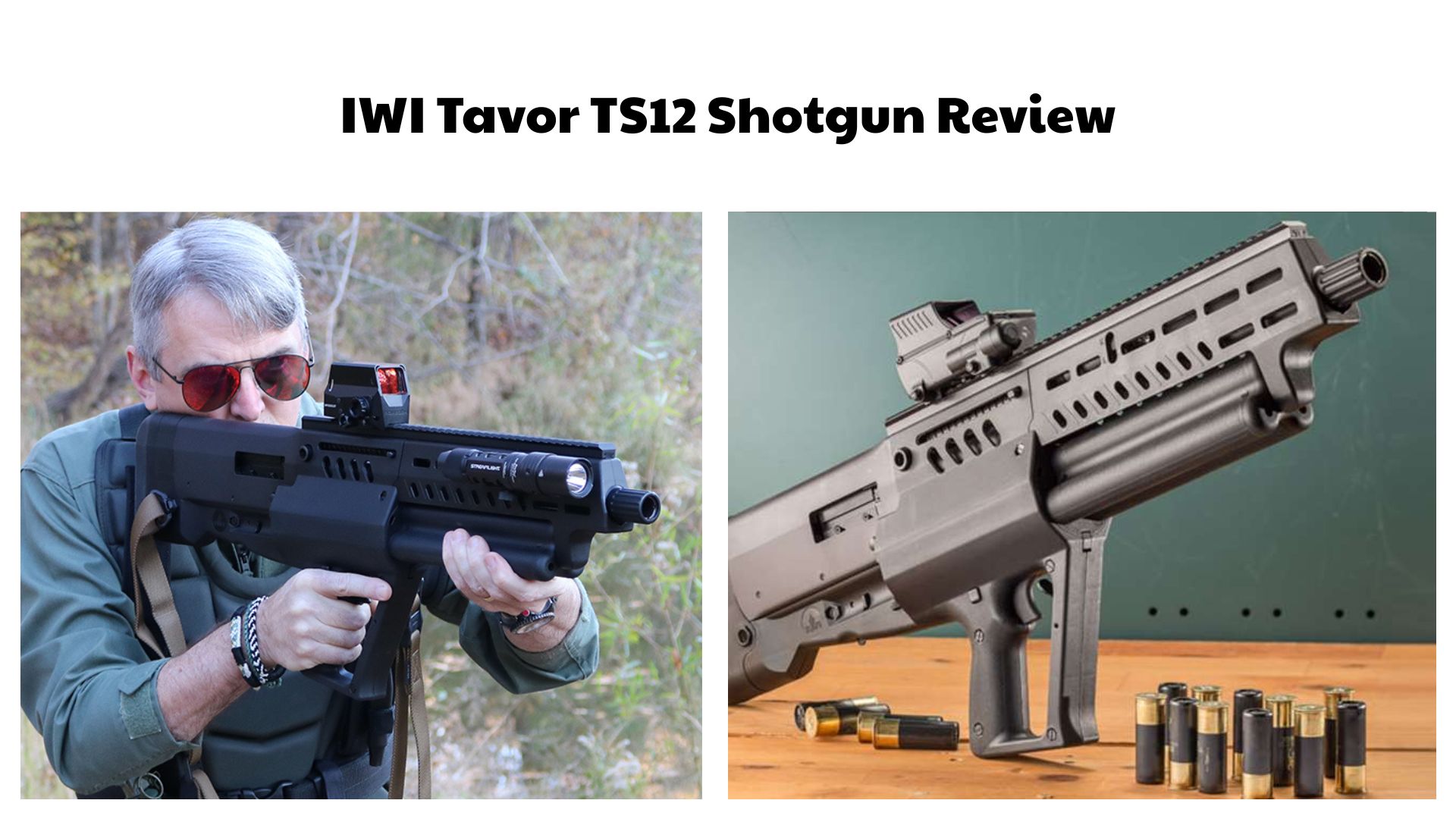

The IWI Tavor TS12 is a modern bullpup semi-automatic shotgun designed for tactical and home defense use, standing out as one of the most innovative shotgun platforms in recent years. Built by Israel Weapon Industries, it combines a compact bullpup layout with a gas-operated cycling system and a highly unusual triple-tube rotating magazine configuration. This design allows the TS12 to achieve an impressive onboard capacity while maintaining a short overall length that is ideal for close-quarters environments.
What makes the TS12 especially distinctive is its rotating tri-tube magazine system, which gives users access to multiple loaded tubes that can be switched rapidly depending on the situation. This feature, combined with its semi-automatic operation, creates a flexible and high-capacity defensive shotgun platform unlike traditional pump or tube-fed designs.
In this review, we will examine the TS12’s performance, design philosophy, reliability, ergonomics, pros and cons, and real-world defensive applications to understand where it excels and where it may present challenges for users.
IWI Tavor TS12 Overview and Design Philosophy
Bullpup Configuration and Compact Design
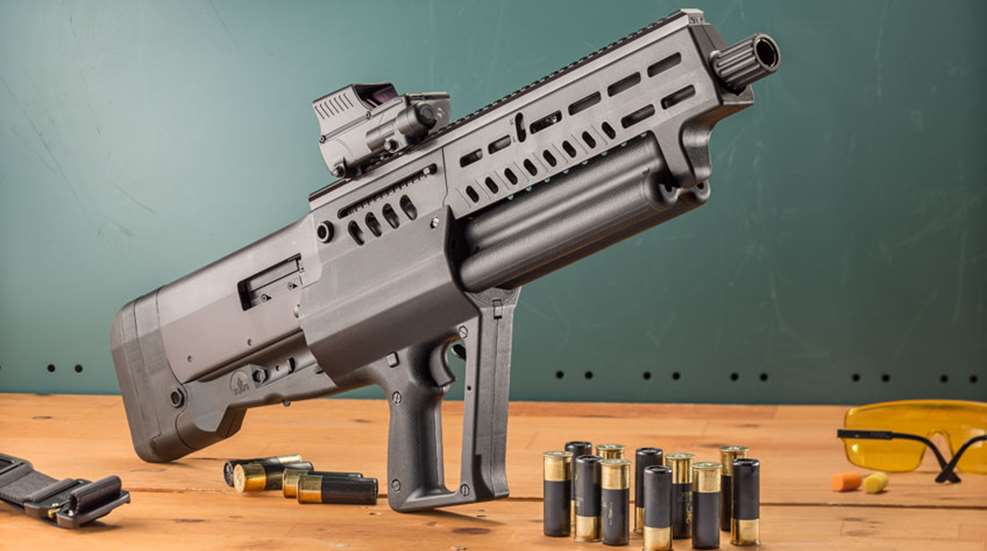
The IWI Tavor TS12 uses a bullpup configuration, meaning the action and magazine system are positioned behind the trigger group. This design allows the shotgun to maintain a full-length barrel while significantly reducing its overall length. The result is a compact firearm that is easier to maneuver in tight environments such as hallways, vehicles, or confined indoor spaces.
Despite its compact footprint, the TS12 retains the ballistic performance of a standard shotgun barrel. This balance between size and performance is one of the core advantages of the bullpup layout. However, the rear-heavy design also changes the handling dynamics, requiring some adjustment for users accustomed to traditional shotgun balance.
Overall, the bullpup configuration is clearly optimized for close-quarters defensive use, where maneuverability and compactness are more important than traditional sporting balance.
Tactical Purpose and Intended Use
The TS12 is primarily designed as a tactical and home defense shotgun rather than a sporting or hunting platform. Its features emphasize fast deployment, high capacity, and ease of engagement in defensive situations. It is not intended for clay shooting sports or traditional field hunting applications.
Instead, the focus is on accessibility and sustained fire capability in high-stress environments. The high-capacity system allows users to engage multiple threats without frequent reload interruptions, which is a key consideration in defensive scenarios.
This clear design intent positions the TS12 as a specialized tool for users who prioritize defensive readiness over versatility or sporting performance.
Why the TS12 Stands Out
One of the most defining characteristics of the TS12 is its unique rotating magazine tube system. Unlike conventional shotguns that rely on a single tube magazine or detachable box magazines, the TS12 uses three tubular magazines positioned beneath the barrel. These tubes can be rotated into alignment with the action, allowing the shooter to switch between loaded tubes quickly.
This system provides an exceptionally high onboard capacity, making the TS12 one of the most capacity-rich semi-automatic shotguns available. It also introduces a level of ammunition flexibility not commonly found in shotgun platforms, as each tube can be loaded with different shell types depending on tactical needs.
Combined with its modern, military-inspired design philosophy, the TS12 represents a highly unconventional but purpose-driven approach to shotgun engineering.
Rotating Tri-Tube Magazine System Explained
How the TS12 Feeding System Works
The TS12 feeding system is built around three fixed tubular magazines located under the barrel assembly. Each tube can hold multiple shotgun shells depending on configuration, and the entire system rotates around a central axis.
When the shooter operates the rotation mechanism, a different magazine tube is aligned with the feeding port of the action. This allows the shotgun to draw shells from a selected tube without needing to manually reload the chamber or change magazines in the traditional sense.
This rotating system is mechanically distinct from most shotgun designs and provides a unique method of managing ammunition during use.
Capacity Advantages
One of the primary advantages of the tri-tube system is its extremely high total capacity compared to traditional tube-fed shotguns. Instead of relying on a single magazine tube that must be manually reloaded under pressure, the TS12 distributes ammunition across three separate tubes.
This setup allows for a significantly higher onboard shell count, making it suitable for extended defensive scenarios where reload opportunities may be limited. It also enables tactical flexibility by allowing different types of shells to be loaded into separate tubes.
For example, one tube may contain buckshot, another slugs, and another specialty defensive loads, giving the user rapid access to different ammunition types depending on the situation.
Reloading Process
Reloading the TS12 involves loading each of the three magazine tubes individually. This process is straightforward but different from traditional shotgun loading methods. Each tube must be manually filled with shells until capacity is reached.
The rotation mechanism then allows the user to select which loaded tube is currently feeding into the action. While conceptually simple, effective use under stress requires familiarity and practice.
In real-world defensive conditions, the system offers significant capacity advantages, but it also introduces a learning curve in terms of reload timing and tube management strategy.
Gas Operating System and Cycling Performance
Semi-Automatic Gas Operation
The IWI Tavor TS12 operates using a gas piston-driven semi-automatic system. When a round is fired, gas pressure is diverted to cycle the action, ejecting the spent shell and chambering a new round automatically.
This semi-automatic operation reduces the physical effort required compared to pump-action shotguns and allows for faster follow-up shots. It also contributes to more consistent firing performance in rapid engagement scenarios.
The gas system is designed to balance recoil reduction with reliable cycling, making it suitable for defensive use where speed and consistency are important.
Reliability in Defensive Scenarios
The TS12 is designed with defensive reliability in mind, particularly when using buckshot and slug ammunition. These full-power loads provide sufficient energy for consistent cycling and dependable operation under stress conditions.
In rapid fire situations, the gas system helps maintain a steady rhythm of operation, allowing the shooter to focus on target acquisition rather than manual cycling. This can be a significant advantage in close-quarters defensive scenarios.
However, like many gas-operated systems, performance is generally optimized for defensive-grade ammunition rather than light target loads.
Ammunition Compatibility
The TS12 performs best with full-power 2¾-inch and 3-inch shotgun shells, particularly buckshot and slugs designed for defensive use. These loads provide the pressure necessary for consistent cycling and reliable operation.
With lighter target loads, performance may vary, especially during initial use or break-in periods. Some users report inconsistent cycling when using low-power ammunition, which is common in many tactical shotgun platforms.
For optimal performance, proper load selection is important, with defensive-grade ammunition being the most reliable choice for real-world applications.
Design, Build Quality, and Materials
Polymer Bullpup Construction
The IWI Tavor TS12 is built around a high-strength polymer chassis that forms the core of its modern bullpup design. This material choice helps keep the overall weight manageable while maintaining a high level of structural durability suitable for defensive applications.
Inside the polymer housing, key stress-bearing components are reinforced with steel inserts. This hybrid construction approach ensures that the shotgun can handle repeated firing cycles and the mechanical stress associated with its rotating magazine system.
The overall design philosophy focuses on achieving a balance between lightweight handling and rugged durability. The result is a shotgun that feels modern and purpose-built for tactical environments rather than traditional sporting use.
Compact Tactical Profile
One of the most noticeable design advantages of the TS12 is its compact overall length. The bullpup configuration allows it to maintain a full-length barrel while significantly reducing the firearm’s footprint. This makes it particularly effective in indoor or close-quarters environments where maneuverability is critical.
Despite being rear-heavy due to its bullpup layout, the shotgun maintains a manageable balance once properly shouldered. The weight distribution requires some adjustment but becomes more intuitive with familiarity and practice.
The compact design also provides practical benefits in terms of storage and transport. It is easier to store in confined spaces and quicker to deploy compared to traditional full-length shotguns.
Ergonomics and Controls Layout
The TS12 features an ambidextrous safety system, making it accessible for both left- and right-handed shooters. This is an important consideration for a defensive firearm intended for a wide range of users.
The rear-mounted grip and trigger configuration are direct results of the bullpup design. While this layout contributes to compactness, it also changes the shooting experience compared to traditional shotgun platforms.
For users transitioning from conventional shotguns, there is a noticeable learning curve. The controls are functional and well-placed, but they require time to become instinctive under stress.
Performance and Real-World Testing
Recoil Management and Control
The TS12 benefits from its gas-operated system, which helps reduce felt recoil during firing. This makes it more manageable than many pump-action shotguns, especially during rapid shooting sequences.
The bullpup design also contributes to recoil control by keeping more of the firearm’s weight closer to the shooter’s body. This helps reduce muzzle rise and improves overall stability during follow-up shots.
As a result, the shotgun remains controllable even during faster engagement scenarios, which is important for defensive use.
Close-Quarters Handling
The TS12 excels in close-quarters handling due to its shortened overall length. This makes it particularly effective in indoor environments such as hallways, rooms, and tight entry points.
Its compact profile allows for easier maneuvering around obstacles without sacrificing barrel length or ballistic performance. This is one of its strongest tactical advantages.
In defensive scenarios, the ability to quickly bring the shotgun on target in confined spaces can provide a significant operational benefit.
Reliability Under Stress
The TS12 is generally reliable when used with appropriate defensive ammunition, particularly buckshot and slugs. It is designed to function under rapid fire conditions where consistency is essential.
The high-capacity tri-tube system also provides a major advantage in extended engagements, reducing the need for immediate reloads and allowing sustained operation.
However, like many semi-automatic platforms, there may be a short break-in period and some sensitivity to lower-powered ammunition during early use. Proper load selection and familiarization help improve long-term reliability.
Controls and Ergonomics Challenges
Trigger Feel and Reach
One of the most commonly discussed aspects of the TS12 is its trigger feel. Because it uses a bullpup linkage system, the trigger is mechanically connected to the action located at the rear of the firearm.
This design can result in a heavier or less crisp trigger pull compared to traditional shotgun layouts. While it remains functional and safe, it may feel different for shooters accustomed to conventional trigger systems.
Over time, users typically adapt to the trigger characteristics, but it does require a learning curve for precision shooting.
Reloading Complexity
Reloading the TS12 is more complex than standard tube-fed or magazine-fed shotguns. Each of the three magazine tubes must be loaded individually, which takes more time and attention during preparation.
The rotating tube mechanism also requires familiarity to operate efficiently. Shooters must understand how to manage tube selection under different tactical conditions.
Compared to detachable magazine systems, this process is slower and more methodical, making training an important factor in effective use.
Manual of Arms
The TS12 introduces a unique manual of arms that differs significantly from traditional shotgun platforms. Its bullpup layout, rotating magazine system, and control placement all contribute to a distinct operating experience.
Because of this, training is required to achieve smooth and efficient handling under stress. Users who are unfamiliar with bullpup systems may initially find the operation unintuitive.
Once mastered, however, the system becomes more predictable, but it is not immediately instinctive for first-time users.
IWI Tavor TS12 vs Competitors
TS12 vs Benelli M4
The TS12 and Benelli M4 represent two very different tactical shotgun philosophies. The TS12 emphasizes high capacity and compact bullpup design, while the M4 focuses on proven military reliability and refined ergonomics.
The TS12 offers a significantly higher onboard capacity due to its tri-tube system, making it attractive for users prioritizing sustained fire capability. However, the M4 is widely regarded as having smoother handling characteristics and a more traditional, intuitive operating system.
Ultimately, the choice depends on whether the user values innovation and capacity or proven simplicity and ergonomic familiarity.
TS12 vs Pump-Action Shotguns
Compared to pump-action shotguns, the TS12 offers semi-automatic speed and higher capacity. This allows for faster follow-up shots and reduced manual cycling effort during firing sequences.
Pump-action shotguns, however, are often valued for their mechanical simplicity and reliability under a wide range of conditions. They do not depend on gas systems or cycling mechanisms.
This creates a trade-off between modern capacity and speed versus traditional reliability and manual control.
TS12 vs Kel-Tec KSG
When compared to the Kel-Tec KSG, the TS12 generally offers smoother cycling and a more refined build quality. Its gas-operated system contributes to a more controlled shooting experience.
The KSG, on the other hand, is often noted for its extreme compactness and alternative dual-tube layout. It achieves a very short overall length but can feel different in balance and operation.
User preference between the two typically comes down to ergonomics, perceived build quality, and how each system feels during handling and firing.
Ideal Use Cases for the TS12
Home Defense
The IWI Tavor TS12 is particularly well-suited for home defense scenarios due to its high-capacity tri-tube system and compact bullpup design. In a defensive situation, having a large number of readily available shells can reduce the need for immediate reloads, which may be critical under stress.
Its short overall length makes it easier to maneuver through hallways, doorways, and tight interior spaces compared to traditional full-length shotguns. This compact profile helps users maintain control in confined environments where movement is restricted.
Fast follow-up shot capability, supported by the semi-automatic gas system, further enhances its effectiveness in defensive use, allowing rapid engagement of multiple targets if necessary.
Tactical Training
The TS12 is also useful for tactical training environments, particularly for users who want to become familiar with bullpup shotgun platforms. Its unique layout and operating system provide valuable experience in handling non-traditional firearm designs.
It is well-suited for defensive shotgun drills that focus on movement, target transitions, and controlled rapid fire. The semi-automatic operation supports high-volume training without the physical fatigue associated with pump-action systems.
However, because of its complexity, consistent training is important to build confidence and efficiency in manipulation and reload techniques.
Vehicle or Close-Quarters Use
The compact design of the TS12 makes it suitable for vehicle storage and close-quarters tactical applications. Its reduced overall length allows for easier handling inside confined spaces such as vehicles or small rooms.
In these environments, maneuverability is often more important than long-range precision, and the TS12’s design supports quick orientation and target engagement.
This makes it particularly appealing for users who prioritize readiness in restricted or unpredictable spaces.
Accessories and Customization Options
Optics and Rail Systems
The TS12 is equipped with a Picatinny rail system that allows for the mounting of red dot sights or other compatible optics. This can significantly improve target acquisition speed, especially in low-light or high-stress conditions.
While shotguns traditionally rely on bead sights, adding a red dot optic can enhance precision and help shooters maintain faster visual tracking during rapid engagements.
The platform is designed with tactical compatibility in mind, allowing users to adapt the shotgun to their specific operational needs.
Lights and Tactical Add-ons
Weapon-mounted lights are a common and practical addition for home defense use, allowing users to identify targets in low-light environments. The TS12 supports these accessories through standard mounting options.
Additional fore-end accessories and grip enhancements can also be added depending on user preference. These modifications can improve control and handling during rapid fire situations.
Sling mounting options provide added convenience for transport and readiness, especially for users who may need to carry the firearm for extended periods or transition between positions.
Ammunition Configuration Strategy
One of the unique advantages of the TS12 is its ability to separate ammunition types across its three magazine tubes. Users can dedicate individual tubes to different load types such as buckshot, slugs, or specialty defensive rounds.
This creates a tactical advantage by allowing rapid access to different ammunition types without manually reloading the system. It enables flexible response options depending on engagement distance or scenario type.
Effective use of this system requires planning and familiarity, but it significantly expands the shotgun’s operational versatility.
Reliability and Maintenance
Cleaning and Disassembly
The TS12 features a modular design that allows for relatively straightforward disassembly for cleaning and maintenance. Key components can be accessed without excessive complexity, making routine maintenance manageable for most users.
The gas system does require periodic cleaning to maintain optimal cycling performance, especially after extended firing sessions. Regular maintenance helps ensure long-term reliability.
Overall, the design prioritizes accessibility of internal components, which supports consistent upkeep.
Long-Term Durability
The TS12 is constructed using a combination of durable polymer and reinforced steel components. This hybrid approach provides a balance between lightweight handling and structural strength.
It is designed for defensive-grade durability, meaning it can withstand repeated firing cycles and operational stress associated with high-capacity use.
With proper maintenance and care, the platform has demonstrated strong durability and reliability over extended use.
Pros and Cons of the IWI Tavor TS12
Pros
The TS12 offers several notable advantages, starting with its extremely high capacity provided by the rotating tri-tube system. This feature sets it apart from most traditional shotgun designs.
Its compact bullpup configuration enhances maneuverability in tight spaces, making it highly effective for close-quarters defensive use. The semi-automatic gas operation also helps reduce recoil, improving control during rapid firing sequences.
Additionally, its ability to separate ammunition types across different tubes provides tactical flexibility, making it a versatile tool in defensive scenarios.
Cons
Despite its strengths, the TS12 has some drawbacks. Its rear-biased weight distribution can feel heavy and unusual for users accustomed to traditional shotgun balance.
The manual of arms is more complex than standard shotguns, requiring training and familiarity to operate efficiently under stress. The trigger feel is also less refined compared to conventional designs due to its linkage system.
Reloading is slower than magazine-fed systems, and the platform presents a learning curve for new users who are unfamiliar with bullpup shotguns.
Price and Value Analysis
Why It Costs More
The higher cost of the TS12 is largely due to its innovative rotating magazine system, which is mechanically complex and unique in the shotgun market. This design requires precision engineering and specialized manufacturing.
It also reflects Israel Weapon Industries’ military-grade engineering philosophy, which emphasizes durability and tactical effectiveness. The overall mechanical architecture is more advanced than traditional shotgun systems.
These factors combined contribute to its premium price point.
Is It Worth It?
The TS12 offers strong value for users who prioritize tactical capability and home defense readiness. Its high capacity and compact design make it highly effective in defensive scenarios.
However, it may be unnecessary for casual shotgun users who do not require its advanced features or capacity. Its complexity also makes it better suited for experienced firearm owners.
Overall, it is best viewed as a specialized defensive platform rather than a general-purpose shotgun.
Final Verdict
The IWI Tavor TS12 stands out as one of the most unique and high-capacity tactical shotguns available today. Its strengths lie in its innovative tri-tube magazine system, compact bullpup design, and tactical flexibility.
However, it also has limitations, including ergonomic challenges, operational complexity, and a noticeable training requirement. These trade-offs are the result of its highly specialized design approach.
In conclusion, the TS12 is best suited for home defense users, tactical firearm enthusiasts, and experienced shotgun owners who are willing to invest time in mastering its system. For the right user, it offers a highly capable and distinctive defensive shotgun platform.
IWI Tavor TS12 Shotgun Review – 55 Frequently Asked Questions (FAQ)
1. What is the IWI Tavor TS12 designed for?
The IWI Tavor TS12 is primarily designed for home defense and tactical applications. It is not a sporting or hunting-focused shotgun. Its purpose is to provide high-capacity defensive capability in a compact bullpup platform that performs well in close-quarters environments such as hallways, rooms, and confined spaces.
2. Why is the TS12 considered unique?
It is considered unique because of its rotating tri-tube magazine system. Instead of using a traditional single tube or detachable magazine, it has three rotating tubes that allow users to carry and select different ammunition types. This design is rare and highly innovative in the shotgun world.
3. How does the tri-tube magazine system work?
The system uses three separate tubular magazines mounted under the barrel. The shooter rotates the assembly to align a chosen tube with the action. This allows quick access to different loaded tubes without reloading immediately, providing tactical flexibility and high onboard capacity.
4. How much ammunition can the TS12 hold?
The TS12 offers a high total capacity compared to traditional shotguns, with each tube holding multiple shells. Combined across all three tubes and the chamber, it can carry a substantial number of rounds, making it one of the highest-capacity semi-automatic shotgun platforms available.
5. Is the TS12 semi-automatic or pump-action?
The TS12 is a semi-automatic shotgun. It uses a gas-operated system to cycle the action after each shot, eliminating the need for manual pumping and allowing faster follow-up shots.
6. Does the TS12 use a gas system?
Yes, it uses a gas piston-driven operating system. This system redirects gas pressure from fired shells to cycle the action, eject spent shells, and chamber new rounds automatically.
7. Is recoil heavy on the TS12?
Recoil is moderate and manageable. The gas system helps reduce felt recoil, and the bullpup design keeps weight closer to the shooter, which also helps control muzzle rise during rapid firing.
8. Is the TS12 good for beginners?
It can be used by beginners, but it is not ideal as a first shotgun. The unique operating system, bullpup layout, and rotating magazine require training and familiarity to use effectively under stress.
9. How does it compare to pump shotguns?
Compared to pump-action shotguns, the TS12 offers faster follow-up shots and higher capacity. However, pump shotguns are simpler, easier to maintain, and often more intuitive for new users.
10. Is it good for home defense?
Yes, it is widely considered effective for home defense due to its compact size, high capacity, and semi-automatic operation. These features allow quick engagement in confined indoor environments.
11. Is the TS12 suitable for hunting?
No, it is not designed for hunting. Its weight, design, and tactical focus make it less suitable for field use compared to traditional hunting shotguns.
12. How reliable is the TS12?
It is generally reliable with proper ammunition and maintenance. It performs best with full-power defensive loads such as buckshot and slugs. Like many semi-auto shotguns, it benefits from a break-in period.
13. Does it require a break-in period?
Yes, many users report improved cycling reliability after an initial break-in period. Early use may show sensitivity to lighter loads until the system settles in.
14. What ammunition works best?
The TS12 performs best with 2¾-inch and 3-inch buckshot and slug loads. These provide sufficient gas pressure for consistent cycling and reliable operation in defensive scenarios.
15. Can it shoot light target loads?
It can, but performance may be inconsistent with very light loads. It is optimized for defensive ammunition rather than low-recoil target shells.
16. Is the TS12 heavy?
It has a noticeable weight, especially toward the rear due to the bullpup design and magazine placement. However, this weight helps stabilize recoil during firing.
17. Is it hard to handle indoors?
No, it is actually well-suited for indoor use due to its short overall length. It is easier to maneuver in tight spaces compared to traditional long shotguns.
18. What is the biggest advantage of the TS12?
Its biggest advantage is its extremely high capacity combined with compact size. This allows extended engagement capability without frequent reloads.
19. What is the biggest disadvantage?
The biggest disadvantage is its complexity. The rotating magazine system and bullpup layout require training and are less intuitive than traditional shotgun designs.
20. How does reloading work?
Each of the three tubes must be loaded individually. The shooter fills each tube manually and then rotates between them as needed during use. It is simple but slower than magazine-fed systems.
21. Is reloading slow?
Yes, compared to detachable magazine shotguns or box-fed systems, reloading is slower. However, the high capacity reduces how often reloading is needed in defensive situations.
22. Does it have optics mounting options?
Yes, it includes a Picatinny rail for mounting optics such as red dot sights. This improves target acquisition speed in defensive scenarios.
23. Can I attach a flashlight?
Yes, weapon-mounted lights are commonly used with the TS12 for home defense. They can be mounted using rail systems or accessory mounts.
24. Is it ambidextrous?
Yes, it features ambidextrous safety controls, making it usable for both left- and right-handed shooters.
25. How is the trigger feel?
The trigger is often described as heavier and less crisp than traditional shotgun triggers due to the bullpup linkage system. This is a common characteristic of bullpup firearms.
26. Is it good for rapid shooting?
Yes, its semi-automatic operation allows fast follow-up shots, making it effective for rapid engagement scenarios in defensive situations.
27. Does it jam easily?
It does not jam easily when using proper ammunition and maintaining the firearm. However, like all semi-autos, it is sensitive to low-quality or underpowered shells.
28. How difficult is maintenance?
Maintenance is moderate. It requires regular cleaning of the gas system and standard firearm care, but it is not overly complicated compared to other semi-automatic platforms.
29. Is field stripping easy?
Yes, the TS12 can be field stripped into modular components without excessive difficulty. It is designed for user-friendly maintenance.
30. How durable is it?
It is highly durable due to its polymer and steel reinforced construction. It is built for defensive use and can withstand repeated firing cycles.
31. Does it get hot during use?
Like most semi-auto shotguns, it can become warm during extended firing sessions, but this does not typically affect performance under normal conditions.
32. Is it good for tactical training?
Yes, it is often used for defensive shotgun training, especially for users learning bullpup platforms or high-capacity tactical systems.
33. How does it compare to Benelli M4?
The TS12 offers higher capacity and a more compact bullpup design, while the Benelli M4 is known for smoother ergonomics and proven military reliability.
34. Is it better than pump shotguns?
It is faster and holds more ammunition, but pump shotguns are simpler and often more reliable in extreme conditions.
35. Can it be used in competition shooting?
It is not designed for competition shooting sports. Its design is focused on tactical use rather than speed or sporting disciplines.
36. How accurate is the TS12?
The TS12 is generally accurate within typical shotgun engagement distances. Its performance depends more on ammunition type (buckshot, slugs) than precision rifle-style accuracy. With slugs, it can achieve solid accuracy at defensive ranges, while buckshot is effective for close-quarters spread patterns.
37. Is the TS12 good for left-handed shooters?
Yes, it is generally ambidextrous due to its safety design and central bullpup layout. However, because of its unique configuration, some handling aspects may still require adaptation for left-handed users.
38. Does the TS12 have a learning curve?
Yes, there is a noticeable learning curve. The bullpup layout, trigger linkage, and rotating magazine system are very different from traditional shotguns. Most users need training to become fully efficient with it.
39. How long does it take to get comfortable with it?
Most shooters become comfortable after several range sessions. Mastery of reload rotation, tube management, and trigger familiarity may take longer depending on experience level with firearms.
40. Is it legal in most countries?
Legality depends on local firearm laws. In some regions, high-capacity semi-automatic shotguns or bullpup designs may be restricted. Users must always verify compliance with local regulations before purchasing.
41. Does it support suppressors?
Shotgun suppressors are uncommon and typically not used with the TS12 in standard configurations. The platform is not commonly designed for suppressor use in typical defensive setups.
42. Can it be used in low-light situations?
Yes, it performs well in low-light scenarios when equipped with a weapon-mounted light and optic. This is one of the reasons it is favored for home defense applications.
43. How does it handle recoil compared to other shotguns?
It has moderate recoil that is reduced by its gas system and bullpup design. It is softer shooting than most pump-action shotguns but not as soft as some high-end sporting semi-autos.
44. Is it beginner-friendly for home defense?
It can be used for home defense by beginners, but only after proper training. Its complexity means users should practice regularly to ensure safe and effective operation under stress.
45. What makes the tri-tube system useful in defense?
It allows multiple ammunition types to be preloaded and instantly accessible. This means a user can switch between buckshot, slugs, or specialty rounds without fully reloading the shotgun.
46. Is it faster than magazine-fed shotguns?
In some respects yes, especially in sustained fire due to high capacity. However, magazine-fed systems can reload faster once empty, so each has different advantages.
47. How reliable is the rotating mechanism?
The rotating mechanism is generally reliable when properly maintained. Like any mechanical system, it benefits from cleanliness and regular inspection to ensure smooth operation.
48. Does dirt affect performance?
Yes, excessive dirt or fouling can affect gas operation and rotation smoothness. Routine cleaning helps maintain optimal performance, especially after heavy use.
49. Is it suitable for professional use?
It can be used in professional tactical environments, but it is more niche compared to widely adopted platforms like the Benelli M4. Its unique system requires training and familiarity.
50. What is the main drawback of the TS12?
The main drawback is its complexity. While innovative, the system is not as intuitive or fast to reload as simpler shotgun designs, especially under stress.
51. Does it require special training?
Yes, users benefit significantly from training focused on bullpup handling, reload rotation, and defensive shotgun tactics to use it effectively.
52. Is it good for long-term ownership?
Yes, it is designed for durability and long-term use. With proper maintenance, it can serve reliably for many years in defensive or training roles.
53. Is it better than traditional hunting shotguns?
No, it is not designed for hunting applications. Traditional hunting shotguns are lighter, simpler, and better suited for field use and long-distance carrying.
54. Who should avoid buying the TS12?
Casual shooters, beginners without training interest, or users wanting a simple, traditional shotgun may find the TS12 too complex and unnecessary for their needs.
55. What is the final verdict on the IWI Tavor TS12?
The final verdict is that the IWI Tavor TS12 is one of the most innovative and high-capacity tactical shotguns available today. It excels in home defense and close-quarters applications thanks to its compact bullpup design and tri-tube magazine system. However, its complexity and learning curve mean it is best suited for trained users or enthusiasts who appreciate advanced firearm engineering.
Read more: