
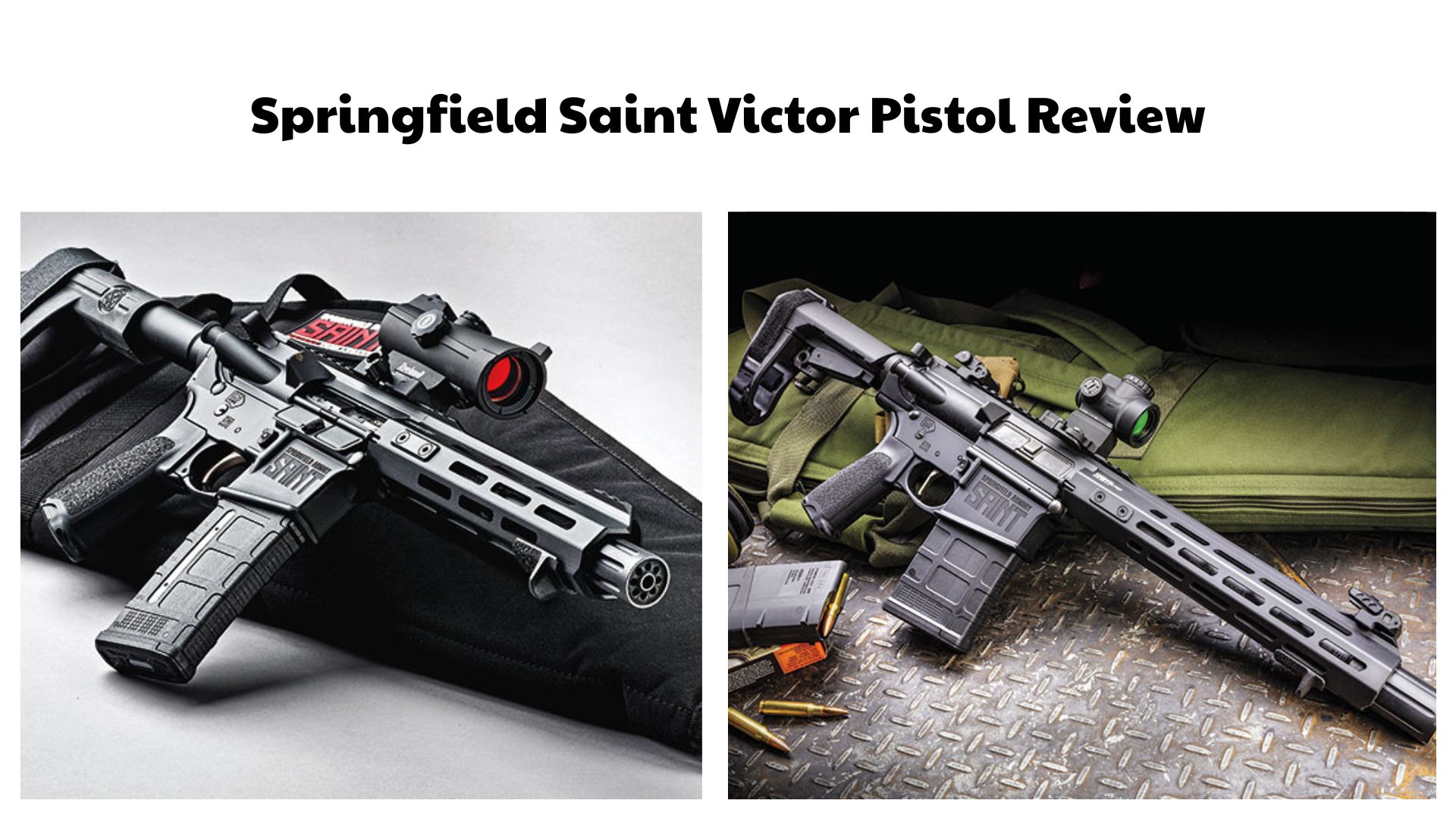

The Springfield Saint Victor Pistol is a compact AR-style pistol built for shooters who want rifle-caliber performance in a shorter, more maneuverable platform. In this Springfield Saint Victor Pistol Review, we will cover its specifications, design, ergonomics, barrel, controls, recoil, accuracy, reliability, accessories, best use cases, legal considerations, comparisons, and final verdict. The Saint Victor Pistol has been offered in several configurations, including 5.56 NATO, .300 Blackout, .308 Winchester, and newer 9mm PDW-style versions. The most common version discussed here is the 5.56 Saint Victor Pistol, which uses an 11.5-inch barrel, M-LOK handguard, SBA3 brace, upgraded trigger, and Springfield’s Accu-Tite receiver system.
Quick Verdict
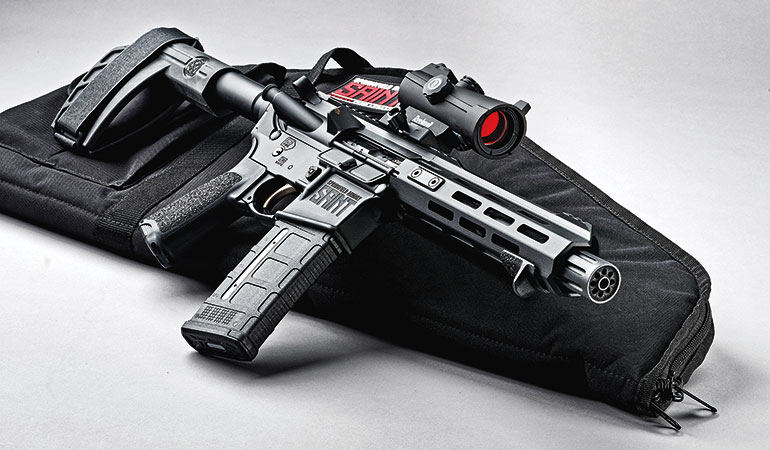
The Springfield Saint Victor Pistol is a compact, feature-rich AR pistol that gives buyers many upgrades straight from the factory. It is not just a basic short-barreled AR with a brace attached. It includes a free-float handguard, quality furniture, a nickel-boron-coated trigger, upgraded bolt carrier group, ambidextrous safety, full-length top rail, and practical M-LOK accessory space.
Its biggest strengths are maneuverability, reliability, factory features, and overall value. GunMade praised the Saint Victor Pistol for reliability, accuracy, compact handling, included sights, included soft case, M-LOK handguard, SB Tactical brace, Accu-Tite tension system, and HPT/MPI-tested bolt carrier group. Its main complaints were that the handguard can heat up quickly and that the charging handle is not ambidextrous.
The Saint Victor Pistol is best for range use, compact AR training, home-defense planning where legal and appropriate, and buyers who want a factory-built AR pistol rather than assembling one from parts. It is less ideal for people who dislike loud muzzle blast, want a full-length rifle, or live in areas with strict firearm or brace restrictions.
What Is the Springfield Saint Victor Pistol?
The Springfield Saint Victor Pistol is part of Springfield Armory’s SAINT series of AR-pattern firearms. The Victor line sits above the base SAINT models and below the more premium Edge line. It is intended to offer upgraded components without reaching custom-gun pricing.
The 5.56 version is a short AR pistol with an 11.5-inch barrel and stabilizing brace. Earlier SAINT pistol models used shorter 7.5-inch barrels, and other Victor pistol variants have been offered in calibers such as .308 Winchester and 9mm. Firearms News reviewed an earlier SAINT AR pistol with a 7.5-inch 1:7 barrel, Melonite-treated components, forged 7075-T6 receivers, Accu-Tite tension system, nickel-boron-coated trigger, and heavy buffer.
The current review focus is the Saint Victor Pistol concept, especially the 5.56 model. Springfield’s official 5.56 Victor pistol page lists an 11.5-inch CMV Melonite barrel, forged 7075-T6 receivers, full-length Picatinny rail, M-LOK handguard, SBA3 brace, nickel-boron-coated trigger, and 45-degree ambidextrous safety.
Key Specifications
| Feature | Springfield Saint Victor 5.56 Pistol Specification |
|---|---|
| Platform | AR-style pistol |
| Caliber | 5.56x45mm NATO / .223 Remington |
| Action | Direct-impingement semi-automatic |
| Barrel Length | 11.5 inches |
| Barrel Material | CMV steel, Melonite finish |
| Twist Rate | 1:7 inches |
| Gas System | Carbine-length direct impingement |
| Upper Receiver | Forged 7075-T6 aluminum, Type III hardcoat anodized |
| Lower Receiver | Forged 7075-T6 aluminum, Type III hardcoat anodized, Accu-Tite tension system |
| Bolt Carrier Group | Enhanced M16 BCG with 9310 steel bolt, HPT/MPI, Melonite finish |
| Handguard | Aluminum free-float M-LOK handguard with SA locking tabs |
| Top Rail | Full-length Picatinny rail |
| Brace | SB Tactical SBA3 stabilizing brace |
| Trigger | Nickel-boron-coated flat trigger |
| Safety | 45-degree ambidextrous safety |
| Muzzle Device | A2 flash hider on the official 11.5-inch 5.56 listing |
| Magazine | AR-15/STANAG-pattern magazine |
Springfield’s listing confirms the 11.5-inch CMV Melonite barrel, 1:7 twist, forged 7075-T6 receivers, Accu-Tite lower, HPT/MPI-tested 9310 steel bolt, M-LOK free-float handguard, SBA3 brace, nickel-boron-coated trigger, B5 Systems grip, 45-degree ambidextrous safety, and standard charging handle.
Design and Build Quality
The Saint Victor Pistol is built around familiar AR architecture, but Springfield adds several parts that buyers often upgrade later. The forged 7075-T6 receivers give the pistol a proper AR foundation. The Type III hardcoat anodized finish is a serious finish for aluminum receivers. The Accu-Tite tension system helps reduce upper-to-lower receiver movement and gives the gun a more solid feel.
The free-float M-LOK handguard is one of the best design choices. A free-float handguard does not put pressure directly on the barrel in the same way a traditional two-piece handguard can. That can help consistency. It also gives the shooter M-LOK slots for accessories such as lights, hand stops, sling mounts, and cable management.
The bolt carrier group is another important feature. Springfield lists the bolt as 9310 steel, high-pressure tested, magnetic-particle inspected, and Melonite treated. These details matter because the bolt and carrier are critical reliability parts in an AR system.
Overall build quality is strong for a factory AR pistol. The Victor line is not a bargain-bin AR. It is designed to give the buyer a practical, ready-to-use firearm with fewer immediate upgrades required.
Ergonomics and Handling
The Saint Victor Pistol handles like a compact AR. Its short barrel and brace make it easier to maneuver than a full-size rifle. That is the main reason AR pistols became popular in the first place. They are easier to store, easier to move in tight areas, and easier to transport legally where allowed.
The SBA3 brace is a major handling feature. Springfield describes it as an adjustable stabilizing brace with a minimalist design and ambidextrous QD sling socket. The brace gives the shooter additional support and makes the pistol more controllable than a bare buffer tube setup.
The B5 Systems Type 23 grip is another upgrade over a basic A2 grip. It has a more vertical angle, which usually feels better on shorter ARs. A vertical grip angle can reduce wrist strain when the firearm is held closer to the body.
The 45-degree ambidextrous safety is a useful modern feature. A shorter safety throw allows faster operation than a traditional 90-degree selector, and ambidextrous controls help left-handed shooters or right-handed shooters working around barricades.
Capacity and Loading System
The 5.56 Saint Victor Pistol uses standard AR-15/STANAG-pattern detachable magazines. Capacity depends on the magazine used and local law. In many areas, 30-round magazines are common, but capacity restrictions apply in some states and localities.
The loading system is standard AR. Insert a magazine, chamber a round with the charging handle or bolt catch, and fire in semi-automatic mode. The manual of arms is familiar to anyone who has used an AR-15 rifle or pistol.
The major advantage here is magazine availability. Quality AR magazines are common, relatively affordable, and widely tested. Magpul PMAGs, aluminum GI-style magazines, Lancer magazines, and other reputable options are commonly used. Always test magazines before depending on them for serious use.
Other Saint Victor pistol variants use different magazines. For example, Handguns Magazine notes that the .308 Saint Victor pistol uses DPMS/Magpul-pattern magazines and ships with a 20-round PMAG. The newer 9mm PDW version uses Colt-pattern 32-round stick magazines.
Barrel, Muzzle Device, and Gas System
The 11.5-inch barrel is one of the most important parts of the 5.56 Saint Victor Pistol. Compared with a 7.5-inch barrel, an 11.5-inch barrel usually gives better velocity, better dwell time, and a more useful ballistic balance. Compared with a 16-inch rifle barrel, it is shorter and handier but gives up velocity.
Springfield lists the barrel as CMV steel with a Melonite finish and 1:7 twist. Melonite is a surface treatment designed to improve hardness, corrosion resistance, and wear resistance. The 1:7 twist works well with many common 5.56 loads, including heavier bullets.
The official 11.5-inch 5.56 model uses a carbine-length direct-impingement gas system and a low-profile pinned gas block. The pinned gas block is a welcome reliability detail because it helps keep the gas block securely positioned under hard use.
The muzzle device on the official 11.5-inch 5.56 listing is an A2 flash hider. Earlier and larger-caliber Saint pistols have used blast diverters. Firearms News and Handguns Magazine both describe how blast-forward devices can help direct noise and concussion forward, especially on very short barrels or .308 pistols.
Sights, Optics, and Controls
The Saint Victor 5.56 Pistol ships with flip-up sights. That is helpful because many AR pistols are sold without sights, forcing the buyer to add an optic immediately. Springfield’s inclusion of sights makes the pistol more complete out of the box.
The full-length Picatinny top rail makes optic mounting easy. A red dot is the most natural optic choice. It keeps the firearm fast and compact. A holographic sight or small prism optic can also work well, depending on the shooter’s eyes and use case.
The controls are mostly standard AR controls, with a few upgrades. The 45-degree ambidextrous safety is better than a basic one-sided selector. The charging handle, however, is standard. GunMade lists the lack of an ambidextrous charging handle as one of the pistol’s cons.
The nickel-boron-coated flat trigger is a meaningful upgrade. It is not a high-end match trigger, but it is cleaner than many basic mil-spec triggers. Handguns Magazine noted that Saint Victor rifles and pistols use Springfield’s enhanced flat, nickel-boron-coated single-stage trigger, with samples measuring around six pounds and feeling relatively smooth.
Recoil and Shooting Experience
In 5.56, the Saint Victor Pistol is easy to control compared with larger-caliber pistols, but it is louder and sharper than a full-size rifle. Short barrels increase blast and concussion. That is the tradeoff for compact size.
The 11.5-inch barrel is much more pleasant than many 7.5-inch 5.56 pistols. The extra barrel length helps with gas timing, velocity, blast, and reliability. It is still compact, but not as extreme as ultra-short AR pistols.
Firearms News reported that an earlier 7.5-inch SAINT pistol was handy and useful in tight spaces, including vehicle-related training, but also noted the 7.5-inch barrel’s lower velocity compared with a 16-inch carbine. That point matters for the Saint Victor line too. Short 5.56 barrels are handy, but they sacrifice velocity and increase muzzle blast.
The .308 Saint Victor Pistol is a different animal. Handguns Magazine described the .308 version as loud with substantial recoil, though not abusive, partly due to the weight and blast diverter. Most buyers looking for the easiest shooting experience should choose the 5.56 version over the .308 pistol.
Accuracy and Reliability
The Saint Victor Pistol is accurate enough for its role. It is not a benchrest rifle, and the shorter barrel limits velocity, but the free-float handguard, decent trigger, and stable brace system support practical accuracy.
GunMade lists the Saint Victor Pistol as reliable and accurate, and notes that it is compact and maneuverable for home-defense roles. The Armory Life’s broader Saint Victor reliability review emphasizes that reliability is the primary duty-grade standard and reports extensive training use with SAINT Victor rifles and SBRs running reliably under hard use.
Reliability depends on ammunition, magazines, lubrication, gas setup, and shooter technique. The Saint Victor has good components, including an HPT/MPI-tested bolt and pinned gas block. Still, every owner should test the exact ammunition and magazines they plan to use.
The newer 9mm Saint Victor PDW also shows how the Victor pistol concept has evolved. Guns.com reported just over 500 rounds through its 9mm PDW review sample across a dozen loads with no issues, while noting softball-sized groups at 15 and 25 yards with an Aimpoint PRO once the shooter found the best support method.
Pros and Cons
Pros
- Compact and maneuverable AR-style platform.
- 11.5-inch 5.56 barrel offers a better balance than many ultra-short 7.5-inch barrels.
- Forged 7075-T6 receivers with Type III hardcoat anodizing.
- Accu-Tite tension system improves receiver fit.
- Free-float M-LOK handguard provides accessory flexibility.
- Full-length Picatinny rail makes optic mounting simple.
- Nickel-boron-coated flat trigger is better than many basic factory triggers.
- 45-degree ambidextrous safety is a useful upgrade.
- SB Tactical SBA3 brace improves stability.
- HPT/MPI-tested 9310 steel bolt supports confidence.
- Ships with flip-up sights.
- Uses common AR-15 magazines and parts.
Cons
- Short 5.56 barrels are loud and produce noticeable blast.
- Lower velocity than a 16-inch rifle or 20-inch rifle.
- Handguard can heat up quickly during fast strings.
- Standard charging handle is not ambidextrous.
- Brace laws and state regulations can change and vary by location.
- Not as stable as a full rifle with a proper stock.
- Not ideal for long-range shooting.
- Discontinued status may affect availability of the exact 5.56 model.
Best Use Cases
Range Training
The Saint Victor Pistol is a fun and practical range platform. It lets shooters train with AR controls in a compact package. The 5.56 version is manageable, common magazines are easy to use, and the full-length rail supports red dots or backup sights.
Compact AR Practice
This pistol is useful for practicing with shorter AR platforms. The shorter handguard and barrel change how the gun balances and moves. Shooters who already understand rifles can use the Saint Victor Pistol to learn compact AR handling.
Home-Defense Planning
The Saint Victor Pistol can be considered for home defense where legal and appropriate. Its compact size and red-dot compatibility are advantages. However, short 5.56 barrels are loud indoors, and any defensive firearm requires training, safe storage, and knowledge of local laws.
Vehicle or Travel Storage Where Legal
Firearms News highlighted the usefulness of AR pistols in vehicle-related training because their shorter overall length can make them faster to deploy in confined spaces. Legal rules for vehicle carry vary widely, so this is a use case only where lawful.
Suppressor Host Potential
Some Saint Victor pistol variants may be useful suppressor hosts, especially .300 Blackout or 9mm versions. The 5.56 version can also be suppressed, but short 5.56 suppressor setups require attention to gas, backpressure, heat, and muzzle device compatibility.
Comparison With Similar Firearms
| Model | Main Strength | Best For |
|---|---|---|
| Springfield Saint Victor 5.56 Pistol | Factory upgrades, compact handling, AR familiarity | Buyers wanting a ready-to-run compact AR pistol |
| Daniel Defense DDM4 PDW | Premium build and .300 BLK focus | Buyers wanting a higher-end PDW-style platform |
| Sig Sauer MCX Rattler | Compact piston system and folding capability | Users wanting maximum compactness and premium engineering |
| Ruger AR-556 Pistol | Value and availability | Budget-focused AR pistol buyers |
| PSA AR Pistol | Low cost and configuration variety | Buyers who want the cheapest entry point |
| Springfield Saint Victor 9mm PDW | Compact 9mm blowback platform | Users wanting lower blast and common pistol-caliber operation |
Springfield Saint Victor Pistol vs Standard AR-15 Rifle
A standard 16-inch AR-15 rifle is easier to shoot well at distance, usually has less blast, and may offer better velocity. It is also more stable with a stock. For many general-purpose users, a 16-inch rifle is still the most practical AR format.
The Saint Victor Pistol wins on compactness. It is easier to maneuver and store. It also gives shooters a shorter AR platform without going through the NFA short-barreled rifle process, depending on current law and configuration.
Choose the rifle if you want general-purpose performance. Choose the pistol if compact size is the priority.
Springfield Saint Victor Pistol vs Springfield Saint Victor SBR
The Saint Victor SBR is similar in concept but legally different. An SBR has a stock and a short barrel, making it subject to National Firearms Act regulation in the United States. The pistol version uses a brace rather than a stock and is configured as a pistol.
The SBR is generally more stable because a stock is better than a brace for traditional rifle shooting. The pistol is easier to buy in many contexts because it avoids the SBR registration process, where legal. Rules can change, and buyers should confirm current federal, state, and local requirements.
Springfield Saint Victor Pistol vs Springfield Saint Victor 9mm PDW
The Saint Victor 9mm PDW is a newer pistol-caliber version. Guns.com lists it with a 5.5-inch barrel, blowback action, Colt-pattern 32-round magazines, HBPDW brace, 45-degree ambidextrous safety, and compact 18.5-inch collapsed length.
The 5.56 version offers rifle-caliber performance and AR-15 magazine compatibility. The 9mm PDW offers lower blast, cheaper training potential, and better suppressor friendliness for many users. The better choice depends on whether the buyer prioritizes rifle-caliber capability or pistol-caliber compactness.
Springfield Saint Victor Pistol vs .308 Saint Victor Pistol
The .308 Saint Victor Pistol is much more powerful, heavier, louder, and more specialized. Handguns Magazine describes the .308 pistol as using DPMS/Magpul-pattern magazines, a flat nickel-boron trigger, and a blast diverter, while noting that recoil is substantial but not abusive.
The 5.56 version is easier to shoot, lighter, cheaper to feed, and more practical for most buyers. The .308 version is for people who specifically want short .308 power and understand the blast, recoil, and weight tradeoffs.
Important Note: This Is Not a Shotgun Review
The requested outline included “comparison with similar shotguns” and “KelTec KS7 vs KelTec KSG.” Those topics do not match the Springfield Saint Victor Pistol because it is an AR-style pistol, not a shotgun.
The KelTec KS7 and KSG are bullpup pump-action shotguns. They are not direct competitors to the Saint Victor Pistol. For SEO clarity and reader usefulness, this review focuses on AR pistols, compact rifle-caliber platforms, Saint Victor variants, and related PDW-style firearms.
Legal Considerations
AR pistols and stabilizing braces have been involved in changing federal litigation and regulation. ATF’s 2026 reform notice states that it is proposing to formally rescind the 2023 regulatory changes regarding firearms equipped with stabilizing braces, after multiple courts found the rule violated the Administrative Procedure Act or otherwise enjoined, stayed, or vacated it.
This does not mean every configuration is legal everywhere. State laws, local rules, magazine restrictions, assault-weapon definitions, transport rules, and brace-related interpretations can vary. Buyers should check current law before purchasing, modifying, transporting, or using any AR pistol.
Adding a vertical foregrip, changing a brace to a stock, changing barrel length, or altering the firearm’s overall configuration can have legal consequences. When in doubt, consult qualified legal guidance or the manufacturer before making changes.
Maintenance and Cleaning
The Saint Victor Pistol maintains like a standard direct-impingement AR. Always unload the firearm, remove the magazine, clear the chamber, and keep ammunition away from the cleaning area before maintenance.
Routine cleaning should include the bolt carrier group, chamber, bore, locking lugs, receiver interior, and charging handle. The bolt should be inspected for extractor condition, gas rings, and general wear. The pistol should be lubricated according to Springfield’s manual.
Short AR pistols can run hotter and dirtier than longer rifles, especially during rapid fire or suppressed use. The handguard can heat up quickly, which GunMade lists as one of the Saint Victor Pistol’s drawbacks. Gloves, rail covers, and a sensible firing cadence can help.
Do not run an AR completely dry. Proper lubrication helps reliability. The Armory Life’s long-term Saint Victor reliability discussion notes that the author kept his guns lubricated even with only rudimentary cleaning, and they continued to run reliably.
Accessories and Upgrade Options
Red Dot Sight
A red dot is the most logical optic for the Saint Victor Pistol. It keeps the firearm fast and compact. Choose a durable optic with good battery life, clear brightness settings, and a mount height that works with your brace and cheek position.
Weapon Light
A weapon light is useful for defensive planning because identification matters. The M-LOK handguard gives several mounting options. Make sure the light and switch do not interfere with hand placement or heat management.
Sling
A sling is one of the best upgrades. The SBA3 brace has a QD sling socket, and Springfield lists a QD receiver end plate on the 5.56 model. A simple two-point sling works well for most users.
Ambidextrous Charging Handle
An ambidextrous charging handle is a practical upgrade because the factory charging handle is standard. This is especially useful if the pistol is used with optics, gloves, or support-side manipulation.
Rail Covers or Gloves
Because the handguard can heat quickly, rail covers or shooting gloves are useful. This is especially true during range sessions with rapid strings of fire.
Suppressor Setup
Suppressor use requires legal compliance and careful setup. Short 5.56 guns can be gassy and hard on suppressors. A quality muzzle device, proper gas tuning, and reliable ammunition matter. .300 Blackout and 9mm variants may be more suppressor-friendly depending on use.
Who Should Buy the Springfield Saint Victor Pistol?
The Saint Victor Pistol is a good choice for buyers who want a compact AR-style firearm with upgraded factory features. It is especially appealing to shooters who want a ready-to-run package with sights, M-LOK handguard, brace, upgraded trigger, and quality receivers.
It also fits people who already know the AR platform and want a shorter training firearm. The controls are familiar, magazines are common, and accessories are easy to find.
The 5.56 model is best for those who want compact rifle-caliber capability. The 9mm PDW is better for those who want lower blast and cheaper pistol-caliber training. The .308 pistol is only for users who specifically want compact .308 power and accept the tradeoffs.
Who Should Avoid It?
Buyers who want a simple, full-size rifle should avoid the Saint Victor Pistol and buy a 16-inch AR instead. A rifle is easier to shoot at distance, usually more comfortable, and less legally complicated in some places.
Shooters who are sensitive to blast should also be cautious. Short-barreled 5.56 firearms are loud. Indoor shooting without proper hearing protection can be extremely damaging.
People in restrictive states should confirm legality before purchase. AR pistol rules, magazine restrictions, brace rules, threaded-barrel rules, and transport laws can be complicated.
Final Verdict
The Springfield Saint Victor Pistol is a well-equipped, compact AR pistol with practical features and strong factory value. It offers a free-float M-LOK handguard, forged receivers, Accu-Tite tension system, upgraded trigger, quality bolt, flip-up sights, SBA3 brace, and ambidextrous safety in a factory package.
It is not perfect. The handguard can heat quickly, the standard charging handle is basic, and short 5.56 guns are loud. The exact 5.56 model is also listed by Springfield as discontinued, so availability may vary.
For buyers who want a compact AR pistol with better-than-basic components, the Saint Victor Pistol remains easy to recommend. It is best judged as a compact, maneuverable, factory-upgraded AR platform rather than a replacement for every rifle role.
55 Springfield Saint Victor Pistol FAQs
1. What is the Springfield Saint Victor Pistol?
The Springfield Saint Victor Pistol is an AR-style pistol from Springfield Armory’s SAINT Victor line. The 5.56 version uses an 11.5-inch barrel, brace, free-float M-LOK handguard, forged receivers, upgraded trigger, and direct-impingement operating system. It is designed to provide compact AR handling with many factory upgrades already installed.
2. Is the Springfield Saint Victor Pistol a rifle?
No. The pistol version is configured as a pistol, not a rifle. It uses a stabilizing brace instead of a rifle stock and has a shorter barrel. Legal classification depends on configuration and current law, so buyers should avoid modifying it without understanding federal, state, and local rules.
3. Is the Saint Victor Pistol a shotgun?
No. The Saint Victor Pistol is not a shotgun. It is an AR-style pistol. Shotgun comparisons such as KelTec KS7 vs KelTec KSG do not directly apply to it. Better comparisons include AR pistols, short-barreled rifles, PDW-style firearms, and compact carbines.
4. What caliber is the Saint Victor Pistol?
The most common Saint Victor Pistol version is chambered in 5.56x45mm NATO and can use appropriate .223 Remington ammunition. Springfield has also offered Victor pistol variants in .300 Blackout, .308 Winchester, and 9mm configurations, so always check the exact model before buying ammunition.
5. What barrel length does the 5.56 Saint Victor Pistol have?
The official Springfield Saint Victor 5.56 Pistol listing shows an 11.5-inch CMV barrel with Melonite finish and 1:7 twist. This barrel length is more practical than very short 7.5-inch 5.56 barrels while still being much more compact than a 16-inch rifle.
6. Is the 5.56 Saint Victor Pistol discontinued?
Springfield’s official product page currently labels the SAINT Victor 5.56 Pistol as discontinued. That does not mean examples are unavailable, but it does mean buyers may need to look at dealer inventory, used listings, or current alternative SAINT models.
7. What is the Accu-Tite tension system?
The Accu-Tite tension system is Springfield’s system for reducing movement between the upper and lower receiver. It helps the gun feel more solid. It is not a magic accuracy upgrade, but it improves fit and gives the firearm a more refined feel.
8. Does the Saint Victor Pistol have a free-float handguard?
Yes. The 5.56 Saint Victor Pistol uses an aluminum free-float M-LOK handguard with Springfield Armory locking tabs. This gives the shooter accessory mounting options and avoids putting direct pressure on the barrel in the same way a traditional handguard can.
9. Does the Saint Victor Pistol come with sights?
Yes. Springfield’s 5.56 listing states that the pistol ships with flip-up sights. This is useful because many AR pistols are sold without sights. A red dot can still be added later using the full-length Picatinny top rail.
10. What optic works best on the Saint Victor Pistol?
A red dot sight is usually the best optic for the Saint Victor Pistol. It keeps the gun compact and fast. Holographic sights and compact prism optics can also work well. Large magnified optics are usually not ideal because this platform is built for closer to intermediate distances.
11. Does the Saint Victor Pistol use AR-15 magazines?
The 5.56 version uses standard AR-15/STANAG-pattern magazines. That is one of its advantages because quality AR magazines are widely available. The .308 and 9mm variants use different magazine patterns, so always match magazines to the exact model.
12. What capacity does it have?
Capacity depends on the magazine and local law. In many unrestricted areas, 30-round AR magazines are common for 5.56 models. Some states restrict magazine capacity, so buyers must check current laws before purchasing magazines.
13. Is the Saint Victor Pistol reliable?
Reviews are generally positive. GunMade lists reliability as a major pro, and The Armory Life’s broader Saint Victor reliability discussion emphasizes extensive training use with reliable performance. Reliability still depends on magazines, ammunition, lubrication, and maintenance.
14. Is the Saint Victor Pistol accurate?
Yes, it is accurate enough for its intended role. The free-float handguard, decent trigger, and AR platform support practical accuracy. It is not designed as a long-range precision rifle, but it performs well for close to intermediate shooting distances.
15. Is the Saint Victor Pistol good for home defense?
It can be used for home-defense planning where legal and appropriate, but buyers should understand the tradeoffs. It is compact and easy to mount with a light and red dot, but short 5.56 barrels are extremely loud indoors. Training, safe storage, and legal awareness are essential.
16. Is the Saint Victor Pistol good for beginners?
It can work for beginners who are receiving proper instruction, but a standard 16-inch AR rifle may be easier to learn on. The pistol is shorter and louder, and brace technique may be less intuitive than a normal stock. New shooters should train with a qualified instructor.
17. How loud is the Saint Victor Pistol?
Short-barreled 5.56 firearms are loud and produce noticeable muzzle blast. This is one of the biggest downsides of any 5.56 AR pistol. Proper hearing protection is mandatory during range use, and indoor defensive use would be extremely loud.
18. Does the handguard get hot?
Yes, it can. GunMade lists fast handguard heating as one of the pistol’s downsides. Short AR pistols can heat quickly during rapid fire because the handguard is close to the barrel and gas system. Gloves or rail covers can help.
19. What trigger does the Saint Victor Pistol use?
The 5.56 Saint Victor Pistol uses a nickel-boron-coated trigger. Springfield lists it as a nickel-boron-coated flat trigger, and Handguns Magazine notes that Saint Victor rifles and pistols use Springfield’s enhanced flat single-stage trigger.
20. Is the trigger match-grade?
No. It is better than a basic mil-spec trigger, but it is not a high-end match trigger. It is smooth and practical for defensive-style and range use. Shooters who want precision performance may still prefer an aftermarket trigger.
21. Does it have an ambidextrous safety?
Yes. Springfield lists the 5.56 Saint Victor Pistol with a 45-degree ambidextrous safety. This is a useful upgrade because it is faster and easier to use than a traditional one-sided 90-degree safety for many shooters.
22. Does it have an ambidextrous charging handle?
No. The official listing shows a standard charging handle, and GunMade lists the lack of an ambidextrous charging handle as a con. This is an easy upgrade if the shooter wants improved manipulation from either side.
23. What brace does the Saint Victor Pistol use?
The official 5.56 Saint Victor Pistol listing shows an SB Tactical SBA3 brace. It is adjustable and includes an ambidextrous QD sling socket. Brace laws can vary and have changed over time, so buyers should verify current rules.
24. Are pistol braces legal?
Federal brace rules have changed through litigation. ATF’s 2026 reform notice says it is proposing to formally rescind the 2023 regulatory changes after multiple courts enjoined, stayed, or vacated the rule. State and local laws can still vary, so buyers should check current law before purchase or modification.
25. Can I put a stock on the Saint Victor Pistol?
Do not install a rifle stock on an AR pistol unless you understand and comply with all applicable NFA rules. Adding a stock to a short-barreled pistol can create a short-barreled rifle, which is federally regulated in the United States and may be illegal in some states.
26. Can I add a vertical foregrip?
Adding a vertical foregrip to a pistol can create legal classification issues depending on the firearm’s overall length and configuration. Do not add one without checking current federal, state, and local law. Angled hand stops are often used instead, but legality still depends on configuration.
27. What muzzle device does the 5.56 model use?
The official 11.5-inch 5.56 Saint Victor Pistol listing shows an A2 flash hider. Other Saint pistol variants have used blast diverters, especially very short or larger-caliber models. Always confirm the exact model before ordering muzzle devices.
28. Can the Saint Victor Pistol be suppressed?
It may be suppressor-compatible depending on barrel threading, muzzle device, caliber, and local law. Short 5.56 suppressor setups can be loud, hot, and gassy. Suppressor use requires legal compliance and careful testing for reliability.
29. Is 5.56 good from an 11.5-inch barrel?
An 11.5-inch 5.56 barrel is a practical compromise. It loses velocity compared with 16-inch or 20-inch barrels, but it is much more useful than many ultra-short 7.5-inch barrels. It is popular because it balances compact size and ballistic performance reasonably well.
30. Is 7.5-inch 5.56 too short?
Many shooters consider 7.5-inch 5.56 barrels very short because they produce heavy blast and lower velocity. Firearms News noted that its earlier 7.5-inch SAINT pistol produced much lower velocity than a 16-inch carbine. An 11.5-inch barrel is generally a better all-around choice.
31. Is the .308 Saint Victor Pistol practical?
It is practical only for a specific buyer. The .308 version offers serious power in a compact package, but it is loud, heavy, and produces more recoil than the 5.56 version. Handguns Magazine described its recoil as substantial but not abusive.
32. Is the 9mm Saint Victor PDW better than the 5.56 pistol?
It depends on the use case. The 9mm PDW has lower blast, uses pistol ammunition, and can be more suppressor-friendly. The 5.56 pistol offers rifle-caliber performance. Guns.com reported strong reliability from the 9mm PDW with just over 500 rounds across multiple loads.
33. Is the Saint Victor Pistol better than a 16-inch AR?
It is better for compactness and maneuverability. A 16-inch AR is better for velocity, stability, lower blast, and general-purpose use. Most shooters should choose based on whether compact size or all-around rifle performance matters more.
34. Is the Saint Victor Pistol better than an SBR?
An SBR with a proper stock is usually more stable and easier to shoot well. The pistol may avoid SBR registration requirements depending on law and configuration. The SBR is better from a shooting standpoint, while the pistol may be simpler from a purchasing standpoint where legal.
35. Is the Saint Victor Pistol good for left-handed shooters?
It is reasonably friendly because of the ambidextrous safety. However, the charging handle is standard unless upgraded, and other AR controls remain mostly right-handed. Left-handed shooters may want an ambidextrous charging handle and possibly other control upgrades.
36. What is the best first upgrade?
A red dot, sling, and weapon light are the most practical first upgrades. An ambidextrous charging handle is also useful. Avoid buying cosmetic upgrades before buying magazines, ammunition, and training time.
37. What magazines should I use?
Use quality magazines from reputable manufacturers. Magpul PMAGs, aluminum GI-style magazines, and other proven AR magazines are common choices for 5.56 models. Test each magazine with your chosen ammunition before relying on it.
38. What ammunition should I use?
Use quality 5.56 NATO or .223 Remington ammunition that matches the firearm’s chambering and your purpose. Short barrels can perform differently with different bullet weights and loads. Test your chosen load for reliability, accuracy, and point of impact.
39. Can I use steel-case ammunition?
Some ARs run steel-case ammunition well, while others may be less consistent. Brass-cased ammunition is usually preferred for reliability and cleaner operation. If you plan to use steel-case ammunition, test it thoroughly and keep the firearm properly lubricated.
40. How often should I clean it?
Clean it after range sessions or whenever it becomes dirty, wet, or exposed to dust. Short direct-impingement ARs can run dirty, especially with high round counts or suppressors. Keep the bolt carrier group lubricated.
41. Is it hard to maintain?
No. It maintains like a standard AR. Field-stripping, cleaning, lubrication, and parts inspection are familiar to AR owners. The main difference is that shorter ARs may heat up and foul faster during hard use.
42. Does it come with a case?
GunMade notes that the Saint Victor Pistol package includes a soft case, sights, a hand stop, and a magazine. Package contents can vary by model and dealer, so confirm what is included before purchasing.
43. Is it good for backpack carry?
Some compact AR pistols can fit in bags, but legality and safe transport rules vary widely. Guns.com noted that the newer Saint Victor 9mm PDW fit easily in a small backpack-style bag, but that is a different model. Always follow transport and storage laws.
44. Is it good for long-range shooting?
No, not compared with a rifle. The 5.56 Saint Victor Pistol is best for close to intermediate distances. The shorter barrel gives up velocity, and the platform is optimized for compact handling rather than long-range precision.
45. Is the Saint Victor Pistol durable?
It has durable components, including forged receivers, Melonite-treated barrel and bolt carrier group, HPT/MPI-tested bolt, and a pinned gas block. These are strong factory features. Long-term durability still depends on maintenance, ammunition, and shooting volume.
46. What is the biggest downside?
The biggest downside is short-barrel blast. The 5.56 cartridge was designed around longer barrels, so short barrels create more noise, flash, and concussion. The handguard can also heat quickly during rapid fire.
47. What is the biggest advantage?
The biggest advantage is a strong factory feature set in a compact AR platform. The Saint Victor Pistol comes with many parts buyers often add later, including a free-float handguard, better trigger, brace, sights, ambidextrous safety, and quality bolt components.
48. Is the Saint Victor Pistol worth it used?
It can be worth buying used if the price is fair and the firearm is in good condition. Check round count, gas block condition, muzzle device, brace, trigger, bolt wear, and any aftermarket modifications. Avoid poorly modified examples.
49. What should I inspect before buying one?
Inspect the bore, chamber, bolt, gas key, gas block, handguard screws, brace, trigger function, safety function, and receiver fit. Also verify the exact model, caliber, included accessories, and legal configuration.
50. Can I build a similar AR pistol cheaper?
Possibly. A builder can assemble a cheaper AR pistol, especially with budget parts. However, the Saint Victor Pistol offers a complete factory package with warranty support and carefully selected upgraded parts. That has value for many buyers.
51. Is the Saint Victor Pistol better than a budget PSA AR pistol?
The Saint Victor usually offers a more refined factory package with upgraded parts. A PSA pistol may cost less and offer many configurations. Choose the Saint Victor for a more complete factory setup. Choose PSA if budget is the main priority.
52. Is the Saint Victor Pistol better than a Daniel Defense PDW?
The Daniel Defense PDW is generally more premium and often more expensive. The Saint Victor Pistol is more value-focused. Choose Daniel Defense if you want a higher-end package and are willing to pay more. Choose Springfield if value and factory features matter most.
53. Who should buy the Springfield Saint Victor Pistol?
It is best for shooters who want a compact AR pistol with good factory features, common magazines, familiar controls, and strong accessory support. It fits range users, AR enthusiasts, and buyers who want a ready-to-use compact platform.
54. Who should avoid the Springfield Saint Victor Pistol?
People who want a quiet, soft-shooting, full-size rifle should avoid it. Buyers in restrictive states should also be cautious. New shooters who do not need compact size may be better served by a 16-inch AR rifle.
55. What is the final verdict on the Springfield Saint Victor Pistol?
The Springfield Saint Victor Pistol is a compact, capable, and well-equipped AR pistol. It offers useful factory upgrades, solid reliability features, good handling, and broad AR accessory support. Its main drawbacks are blast, heat, legal complexity, and discontinued availability for the 5.56 model. For the right buyer, it remains a strong compact AR platform.
Read more: