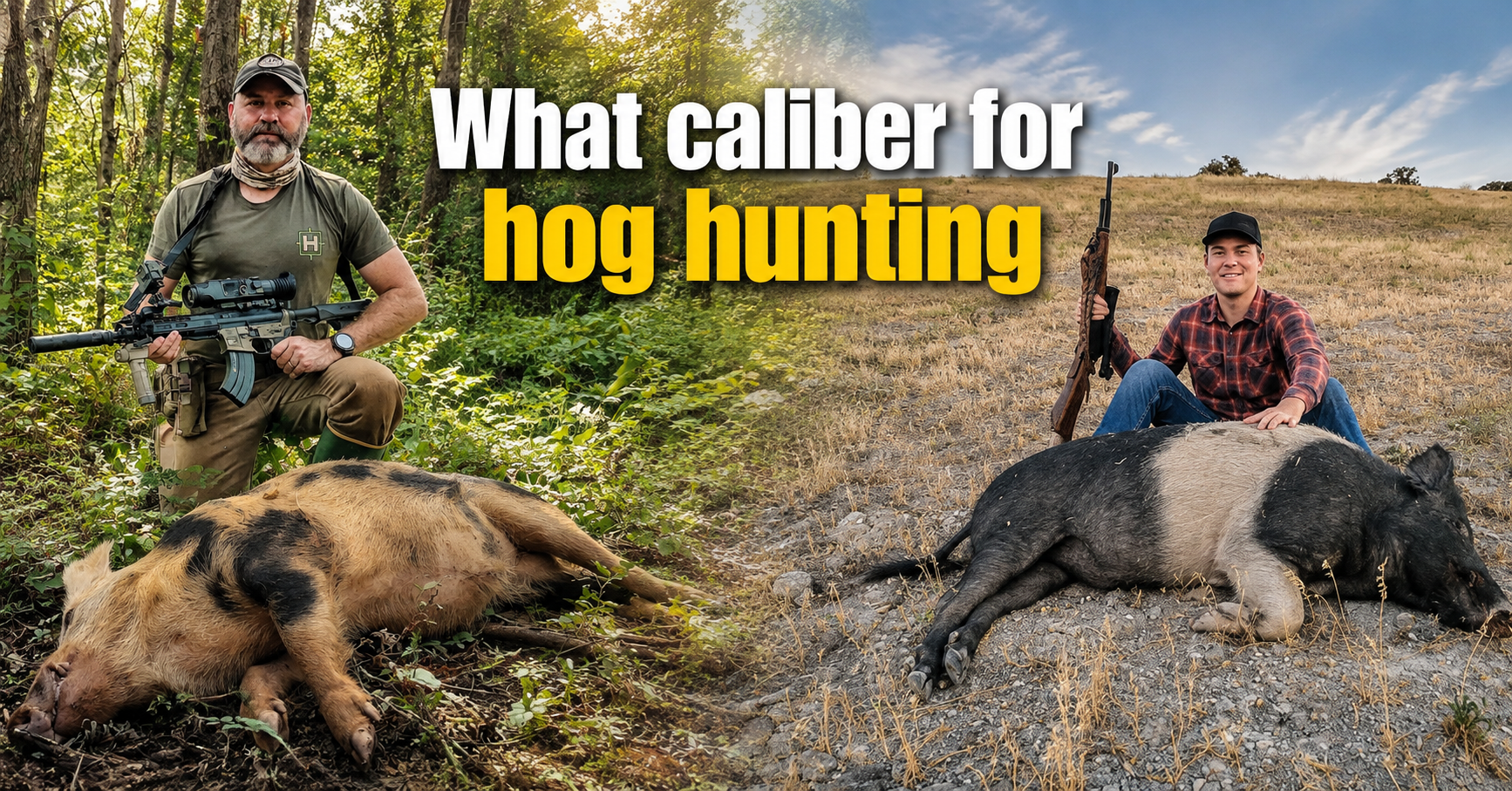

Choosing what caliber for hog hunting requires more than selecting the largest cartridge available. Feral hogs vary considerably in size, and hunting conditions may range from short shots in thick timber to longer opportunities across agricultural fields.
The most suitable cartridge is one you can shoot accurately with a controlled-expansion hunting bullet at the distances you realistically expect. Local firearm, ammunition, public-land, night-hunting, and nonlead requirements must also be checked before selecting a load.
Quick Answer
The .308 Winchester is the best general-purpose hog-hunting cartridge for many hunters because it offers an effective balance of penetration, practical range, ammunition selection, and manageable recoil. The .243 Winchester, 7mm-08 Remington, and 6.5 Creedmoor are useful lower-recoil alternatives when paired with appropriate hunting bullets. The .30-06 Springfield offers additional load versatility, while the .300 Blackout, .30-30 Winchester, .350 Legend, and .450 Bushmaster are primarily short- to moderate-range choices. No cartridge compensates for poor accuracy, an unsuitable bullet, a marginal shot angle, or hunting beyond your demonstrated ability.
Hog-Hunting Caliber Comparison
| Cartridge | Best Application | Main Advantages | Important Limitations | Legal Check |
|---|---|---|---|---|
| .308 Winchester | Versatile hunting for medium and large hogs | Broad hunting-load selection, dependable penetration, practical range | More recoil than smaller cartridges | Verify local centerfire and ammunition rules |
| .243 Winchester | Recoil-sensitive hunters and smaller-to-average hogs | Mild recoil and generally easy shooting | Bullet construction and shot selection are especially important | Minimum-caliber rules may apply |
| 6.5 Creedmoor | Open terrain and recoil-conscious hunters | Moderate recoil and useful hunting-bullet selection | Not an excuse for unnecessarily long shots | Verify centerfire and projectile rules |
| 7mm-08 Remington | Balanced performance with moderate recoil | Capable hunting bullets and manageable recoil | Ammunition may be less available than .308 | Check local caliber requirements |
| .270 Winchester | Open country and mixed big-game use | Flat trajectory and capable hunting bullets | Longer-action rifles and noticeable muzzle blast | Check local means and methods |
| .30-06 Springfield | Large hogs and hunters wanting broad load versatility | Wide range of suitable hunting ammunition | Usually produces more recoil than .308 | Verify legal firearm and ammunition use |
| .30-30 Winchester | Timber and short-to-moderate distances | Handy rifles and proven woods performance | More curved trajectory than modern bottleneck cartridges | Check centerfire-rifle restrictions |
| .300 Blackout | Close-range hunting with a compatible rifle | Compact platforms and several hunting-load options | Load selection and realistic range limits are critical | Suppressor and night-hunting laws vary |
| 6.5 Grendel | AR-15-size rifles at moderate distances | Moderate recoil and more reach than many close-range AR cartridges | Ammunition availability can vary | Magazine and firearm rules may apply |
| 7.62×39mm | Close-to-moderate shots in timber | Moderate recoil and compact rifle availability | Many loads are not designed for hunting | Magazine and ammunition restrictions may apply |
| .350 Legend | Straight-wall jurisdictions and moderate ranges | Moderate recoil and straight-wall configuration | Less suited to long shots than flatter-shooting cartridges | Confirm the jurisdiction’s exact straight-wall definition |
| .450 Bushmaster | Large hogs at close-to-moderate range | Large-diameter controlled-expansion bullets | Substantial recoil and a more curved trajectory | Verify straight-wall and magazine rules |
| .223 Remington/5.56 NATO | Experienced hunters under limited conditions | Low recoil and easy follow-up shooting | Limited margin on large hogs; unsuitable bullets can fail quickly | May not satisfy minimum-caliber requirements |
| 12-gauge slug | Shotgun-only locations and close-range hunting | Useful where centerfire rifles are prohibited | Heavy recoil and limited practical range | Check slug, barrel, and public-land rules |
Important Safety and Legal Notice
This general guidance was reviewed on August 5, 2026. Hunting and firearm regulations can change, and rules differ between states, countries, counties, public properties, wildlife management areas, and private land.
Before hunting, verify:
- Whether feral hogs are classified as game, nongame wildlife, invasive animals, or livestock
- License, permit, reporting, or landowner-permission requirements
- Minimum caliber or centerfire restrictions
- Magazine-capacity and firearm-type restrictions
- Public-land-specific means and methods
- Night-hunting, artificial-light, and thermal-optic rules
- Suppressor laws and land-specific restrictions
- Lead-free or certified nonlead ammunition requirements
- Carcass removal, tagging, transport, and disposal requirements
Official regulations override all general online advice. For example, the California Department of Fish and Wildlife requires nonlead ammunition when taking wildlife with a firearm. Elsewhere, rules may differ substantially. Individual public properties may also impose stricter firearm rules than the surrounding state.
Best Overall Hog-Hunting Caliber: .308 Winchester
The .308 Winchester is a sensible general recommendation because it works in a variety of rifle actions and has broad support from ammunition manufacturers. Suitable controlled-expansion hunting loads are commonly offered, and the cartridge has enough practical capability for hogs of widely varying sizes.
Its recoil is noticeable but generally more manageable than many magnum cartridges. This makes it easier for many hunters to practice regularly and place a controlled shot than with a cartridge chosen primarily for maximum power.
The .308 is not automatically the best choice for every hunter. Someone who shoots a .243, 7mm-08, or 6.5 Creedmoor more accurately may make a more ethical choice by using that familiar rifle with an appropriate bullet. Conversely, a hunter working at short distances in a straight-wall-only jurisdiction might reasonably prefer the .350 Legend or .450 Bushmaster.
Why Bullet Construction Matters as Much as Caliber
Hogs can have thick hide, dense muscle, and substantial shoulder structure. Mature males may develop a layer of toughened tissue around the shoulders, sometimes called a shield. This does not make a hog “bulletproof,” but it increases the importance of reliable penetration and controlled expansion.
Choose ammunition explicitly designed for medium or large game. Useful hunting-bullet categories include:
- Bonded bullets: Designed to help the jacket and core remain together during expansion
- Monolithic copper or copper-alloy bullets: Often selected for weight retention, penetration, or compliance with nonlead regulations
- Partition-style bullets: Designed to combine expansion with continued penetration
- Controlled-expansion soft points: Traditional hunting designs intended to expand while maintaining useful penetration
Manufacturers such as Hornady describe accuracy and controlled terminal performance as central requirements for hunting bullets. Always confirm that the exact load is compatible with your firearm and intended game.
Loads to Avoid
- Full-metal-jacket ammunition, which is generally not designed to expand for a humane hunting harvest
- Highly frangible varmint bullets intended for small, thin-skinned animals
- Unknown remanufactured ammunition with unclear components or performance
- Any cartridge not specifically marked as compatible with the firearm
- Loads that do not meet local nonlead, caliber, or ammunition requirements
Lower-Recoil Calibers for Hog Hunting
.243 Winchester
The .243 Winchester can be a practical option for a recoil-sensitive hunter who is accurate with the rifle. It is most appropriate with a robust hunting bullet rather than a lightweight varmint projectile.
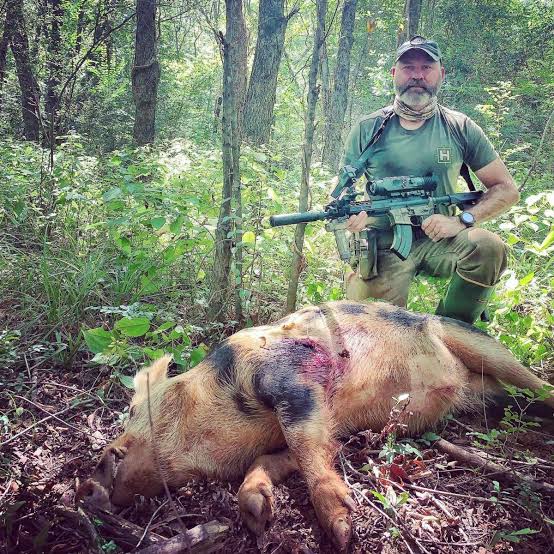
Because the cartridge provides less margin than larger options on heavy hogs or difficult angles, hunters should be conservative about animal size, distance, presentation, and their own accuracy. It is not the ideal choice for forcing a shot through heavy structure.
6.5 Creedmoor
The 6.5 Creedmoor combines moderate recoil with hunting bullets designed for controlled expansion and penetration. It is useful in open terrain, but its reputation for long-range target shooting should not encourage shots beyond a hunter’s proven field ability.
7mm-08 Remington
The 7mm-08 is another balanced option. It typically offers manageable recoil and bullets suitable for medium and larger game. Its main practical disadvantage is that local ammunition selection may be more limited than for .308 Winchester.
Short-Range and Thick-Cover Options
.30-30 Winchester
The .30-30 remains useful in timber, brushy terrain, and other places where shots are naturally limited. Compact lever-action rifles can be easy to carry, but tubular-magazine firearms require ammunition with a projectile profile approved by the firearm and ammunition manufacturers.
.300 Blackout
The .300 Blackout is primarily a close-range choice. Supersonic controlled-expansion hunting loads generally provide a wider performance margin than subsonic loads, although the exact ammunition must be evaluated according to manufacturer specifications.
Subsonic ammunition should not be assumed to perform like full-velocity hunting ammunition. Some subsonic bullets are not designed to expand reliably, and their trajectory and terminal performance impose significant limitations.
.350 Legend
The .350 Legend may suit hunters who want moderate recoil from a straight-wall cartridge. It is commonly considered for timber, fields, and jurisdictions that restrict certain bottleneck rifle cartridges.
Do not assume that every state defines legal straight-wall cartridges in the same way. Check case, caliber, firearm, and season requirements in the current regulation publication.
.450 Bushmaster
The .450 Bushmaster offers a large-diameter projectile for close-to-moderate hunting situations. Its trade-offs include greater recoil, more muzzle blast, and a trajectory that demands careful range estimation.
Hunters who flinch or cannot practice comfortably may achieve better results with a less powerful cartridge they can control consistently.
AR-Platform Calibers for Hog Hunting
Several cartridges commonly used in AR-style rifles can be suitable where legal. The most useful choice depends on the rifle platform, magazine compatibility, hunting distance, bullet construction, and the hunter’s accuracy.
6.5 Grendel
The 6.5 Grendel provides a useful combination of moderate recoil and practical reach in an AR-15-size platform. It may be a good choice for fields and mixed terrain, but hunting-ammunition availability should be confirmed before committing to the cartridge.
6.8 SPC
The 6.8 SPC is another moderate-range AR-15 option with appropriate hunting ammunition. Availability of rifles, magazines, and factory loads can be less consistent than for more common cartridges.
7.62×39mm
The 7.62×39mm can work at close-to-moderate distances with a reliable controlled-expansion hunting bullet. Much of the widely available ammunition in this caliber is full-metal-jacket or otherwise not intended for hunting, so the exact load matters considerably.
.223 Remington and 5.56 NATO
A .223 Remington or 5.56 NATO rifle can take hogs under appropriate conditions with a durable expanding hunting bullet and highly disciplined shot selection. However, it provides less margin for large animals, heavy shoulder structure, poor angles, or inaccurate hits than larger cartridges.
It is not the best general recommendation for a new hog hunter. It may also be prohibited by minimum-caliber regulations. Confirm whether the rifle is chambered for .223 Remington, 5.56 NATO, or another compatible chambering before selecting ammunition.
Do You Need a Magnum Caliber?
Most hog hunters do not need a magnum rifle. Cartridges such as the .300 Winchester Magnum are capable, but increased recoil, noise, ammunition cost, and rifle weight may reduce the quality or frequency of practice.
A magnum can be reasonable for an experienced hunter who already shoots it well and also uses it for larger game. It should not be selected merely because hogs are described as unusually tough. A well-placed controlled-expansion bullet from a standard big-game cartridge is usually a more practical solution.
Shot Placement and Ethical Range
Caliber selection cannot be separated from shot placement. Wait for a clear, stable presentation that exposes the heart-and-lung area, such as a broadside or modest quartering-away angle. Study hog anatomy through a recognized hunter-education program because their body proportions differ from those of deer.
Avoid low-percentage head and neck shots. These targets are small, frequently moving, and leave little room for error. A misplaced shot can wound the jaw, face, or neck without producing a quick recovery.
Your ethical range is the maximum distance at which you can repeatedly place shots into an appropriately sized vital-zone target from the field position you will actually use. It is not the distance printed on an ammunition box or achieved from a bench by another shooter.
Four Firearm Safety Rules for Hog Hunters
The four primary firearm-safety rules taught in hunter education apply before, during, and after every hunt:
- Treat every firearm as if it is loaded.
- Keep the muzzle pointed in a safe direction.
- Keep your finger outside the trigger guard until ready to shoot.
- Be certain of the target and what is in front of and beyond it.
Hog hunting may occur in low light, around feeders, near agricultural equipment, or with several hunters covering a field. Establish safe shooting zones before the hunt. Never fire at sound, movement, eyeshine, or an unclear silhouette.
A mechanical safety is an additional feature, not a substitute for safe muzzle control and trigger-finger discipline.
How to Choose Between the Main Calibers
- Check the law first. Eliminate cartridges or firearm types that are not legal for the location and hunting method.
- Estimate likely hog size. Large mature hogs favor cartridges and bullet designs offering a greater penetration margin.
- Consider the terrain. Thick cover favors maneuverable rifles and moderate-distance cartridges; open fields may reward a flatter trajectory.
- Be realistic about distance. Choose for your demonstrated accuracy rather than a theoretical maximum range.
- Evaluate recoil. Use the most capable cartridge you can control without flinching.
- Confirm hunting-ammunition availability. A cartridge is less useful if appropriate loads cannot be obtained consistently.
- Test the exact load. Different bullets can change accuracy, feeding, point of impact, and terminal performance.
- Practice from field positions. Include kneeling, sitting, supported standing, and the actual rest or tripod you expect to use.
What Not to Do
- Do not select a cartridge solely because it has the largest diameter or highest advertised velocity.
- Do not use target or varmint ammunition merely because it groups well.
- Do not assume a cartridge legal on private land is permitted on every public property.
- Do not take a shot at unidentified movement, sound, or eyeshine.
- Do not shoot without knowing the location of roads, homes, livestock, hunters, and the backstop.
- Do not attempt long shots without verified field-position accuracy and reliable range information.
- Do not pursue a wounded animal across property boundaries without legal permission.
- Do not climb, cross an obstacle, or enter a vehicle with a loaded firearm.
- Do not mix .223 Remington and 5.56 NATO ammunition without confirming firearm compatibility.
- Do not assume subsonic ammunition will expand or penetrate like a conventional hunting load.
Practice Checklist Before a Hog Hunt
- Verify that the firearm is mechanically sound and properly maintained.
- Confirm the barrel markings and exact ammunition compatibility.
- Zero the rifle with the hunting load, not a different practice load.
- Confirm point of impact at several realistic hunting distances.
- Practice from the intended rest, tripod, blind, or field position.
- Wear hearing and eye protection during practice.
- Learn the firearm’s loading, unloading, malfunction-clearing, and safety procedures from its manual.
- Establish a personal maximum range based on repeatable accuracy.
- Review hog anatomy and high-percentage shot presentations.
- Confirm current regulations and obtain all required permissions and documents.
Recovery and Carcass Safety
After firing, observe the hog’s direction of travel and mark the location where it was standing. Wait as appropriate for the observed reaction and shot before beginning recovery. Approach cautiously, maintain muzzle control, and do not assume an animal is dead based only on its position.
Make every reasonable legal recovery effort, but do not trespass. Contact the landowner, property manager, or an experienced tracker when necessary and permitted.
Feral swine can carry diseases that affect people and animals. The CDC recommends protective measures when handling wild-hog carcasses, including eye protection and latex or rubber gloves. Prevent hunting dogs from consuming raw organs or contacting carcass fluids, and follow current food-safety guidance when preparing meat.
FAQs
1. What is the best all-around caliber for hog hunting?
The .308 Winchester is the strongest general recommendation because it balances practical range, penetration, ammunition selection, and manageable recoil. A different legal cartridge may be better if you shoot it more accurately.
2. Is .308 Winchester good for hog hunting?
Yes. With a controlled-expansion hunting bullet, .308 Winchester is suitable for a wide range of hog sizes and hunting environments.
3. Is .30-06 too powerful for hog hunting?
No. The .30-06 is a capable hog cartridge, particularly for large animals and mixed big-game hunting. Its greater recoil compared with some alternatives should be considered.
4. Is .243 Winchester enough for hogs?
It can be, especially for smaller-to-average hogs when used with a robust medium-game hunting bullet. Shot angle and placement deserve extra caution on large mature hogs.
5. Is 6.5 Creedmoor good for hog hunting?
Yes. It offers moderate recoil and suitable hunting bullets. Its long-range reputation does not remove the need for a conservative, demonstrated field range.
6. Is 7mm-08 good for hogs?
Yes. The 7mm-08 provides a useful balance of manageable recoil, penetration, and practical hunting range with appropriate ammunition.
7. Is .270 Winchester suitable for wild hogs?
Yes. It is particularly useful in open terrain and can handle hogs effectively with a controlled-expansion hunting bullet.
8. Is .30-30 Winchester good for hog hunting?
Yes. It is a practical woods cartridge at sensible distances. Use ammunition approved for the rifle’s magazine and follow the firearm manufacturer’s instructions.
9. Is .300 Blackout good for hog hunting?
It can work well at close distances with ammunition specifically designed to expand at the expected impact velocity. Supersonic and subsonic loads have substantially different limitations.
10. Can subsonic .300 Blackout be used for hogs?
Only with a bullet designed to expand at subsonic velocity and within a conservative range. Many subsonic loads are target-oriented and should not be assumed suitable for humane hunting.
11. Is 6.5 Grendel good for hog hunting?
Yes. It is a useful moderate-recoil option for AR-15-size rifles, particularly when more practical reach is desired than many close-range cartridges provide.
12. Is 6.8 SPC suitable for hog hunting?
Yes, with a suitable hunting load. Verify rifle and magazine compatibility and confirm that appropriate ammunition is available locally.
13. Is 7.62×39mm enough for hogs?
It can be effective at close-to-moderate distances with a controlled-expansion hunting bullet. Full-metal-jacket ammunition is not a responsible substitute for a hunting load.
14. Can you hunt hogs with .223 Remington?
Where legal, an experienced hunter can use .223 Remington with a durable expanding bullet and disciplined shot selection. It offers less margin on large hogs and is not the best general beginner choice.
15. Is 5.56 NATO good for hog hunting?
It has similar limitations to .223 Remington. Confirm that the specific firearm is approved for 5.56 NATO ammunition, use a suitable hunting bullet, and verify minimum-caliber regulations.
16. Is .22 LR suitable for hog hunting?
It is not a responsible general recommendation for free-ranging hogs and may be illegal. A centerfire cartridge with an appropriate hunting bullet provides a substantially better margin.
17. Is .350 Legend good for hogs?
Yes. It is a practical moderate-range option, especially where qualifying straight-wall cartridges are required. Verify the exact local definition and legal specifications.
18. Is .450 Bushmaster good for large hogs?
Yes. It provides a large-diameter hunting projectile for close-to-moderate distances. Its recoil and trajectory require practice and accurate range judgment.
19. Is .45-70 Government excessive for hog hunting?
It is capable but unnecessary for most situations. Recoil, rifle type, trajectory, and the performance of the selected load should be considered.
20. Is .300 Winchester Magnum good for hogs?
It is more than capable, but most hunters do not need magnum recoil and muzzle blast for typical hog distances. Use it only if you already shoot the rifle accurately and comfortably.
21. Can a shotgun be used for hog hunting?
Yes, where legal. A compatible 12- or 20-gauge slug can be useful in shotgun-only areas or at limited distances. Match the ammunition to the barrel and sights.
22. Is buckshot good for hog hunting?
Buckshot legality and suitability vary. Pattern the exact load and shotgun, respect its limited effective distance, and do not substitute it for a slug where regulations or conditions make a slug more appropriate.
23. What bullet type is best for hog hunting?
A controlled-expansion medium- or large-game bullet that combines expansion with adequate penetration is the best general choice. Bonded, partition-style, monolithic, and robust soft-point designs are common options.
24. Are copper bullets good for hogs?
Monolithic copper or copper-alloy hunting bullets can offer controlled expansion and strong weight retention. They are also useful where nonlead ammunition is required.
25. Can full-metal-jacket ammunition be used for hog hunting?
It should generally be avoided because it is not designed to expand like hunting ammunition and may be prohibited. Use an appropriate legal hunting bullet.
26. Are varmint bullets suitable for hogs?
Light, highly frangible varmint bullets may expand too quickly and provide insufficient penetration, particularly on large hogs. Select a bullet intended for medium game.
27. What bullet weight should I use for hogs?
Choose a manufacturer-recommended medium- or large-game load appropriate to the cartridge and expected hog size. Construction, accuracy, and impact performance matter more than bullet weight alone.
28. Where should you aim on a hog?
Wait for a high-percentage presentation and place the shot into the heart-and-lung area based on verified hog anatomy. Broadside and modest quartering-away angles are generally preferable to marginal angles.
29. Are headshots ethical on hogs?
They are low-percentage shots because the target is small and often moving. A slight error can cause severe wounding without rapid recovery, so the heart-and-lung area is usually the more responsible target.
30. How far can you ethically shoot a hog?
Your ethical distance is the range at which you can repeatedly place shots into the vital zone from the same field position and conditions. Cartridge capability alone does not define that distance.
31. Do large boars require a magnum caliber?
No. Large hogs require dependable penetration, an appropriate shot angle, and accurate placement. Standard big-game cartridges with controlled-expansion bullets are usually sufficient.
32. What caliber has the least recoil for hog hunting?
The .243 Winchester is among the lower-recoil mainstream options, while 6.5 Creedmoor and 7mm-08 provide balanced alternatives. Rifle weight, stock fit, ammunition, and shooting position also affect perceived recoil.
33. What caliber is best for a youth hog hunter?
A low-recoil cartridge that the young hunter can operate safely and shoot accurately is preferable to a more powerful cartridge that causes flinching. Supervised practice, proper rifle fit, and legal requirements are essential.
34. What caliber is best for thick brush?
The .30-30, .300 Blackout, .350 Legend, 7.62×39mm, and similar moderate-distance cartridges can suit timber. No bullet can reliably deflect through brush without changing direction, so always maintain a clear shooting path.
35. What caliber is best for open fields?
The .308 Winchester, .270 Winchester, 7mm-08, and 6.5 Creedmoor are practical choices. Select based on recoil, ammunition, expected range, and demonstrated accuracy.
36. What is the best AR-15 caliber for hog hunting?
The 6.5 Grendel offers a strong balance for moderate distances, while .300 Blackout suits closer hunting. The 6.8 SPC and 7.62×39mm are also viable with appropriate hunting ammunition.
37. What is the best caliber for night hog hunting?
Night hunting does not change the basic need for accuracy and controlled-expansion ammunition. A familiar moderate-recoil cartridge may make follow-up shooting easier, but night hunting, lights, and thermal optics must be legal at the location.
38. Are suppressors legal for hog hunting?
Suppressor legality varies by country, state, and property, and federal requirements may apply in the United States. Verify current law before acquiring, transporting, or using one.
39. Do public lands have different hog-hunting caliber rules?
They often do. Wildlife management areas, national wildlife refuges, forests, and other properties may restrict firearm type, ammunition, season, or hunting hours beyond statewide rules.
40. Is nonlead ammunition required for hog hunting?
It depends on the jurisdiction and property. California requires nonlead ammunition when taking wildlife with a firearm, while other locations may have different requirements.
41. How should I test a hog-hunting load?
Confirm safe firearm compatibility, zero with the exact load, and test accuracy from realistic field positions. Verify point of impact at the distances you expect to encounter.
42. Does a bigger caliber make up for poor shot placement?
No. A larger projectile cannot reliably compensate for a miss or marginal hit. Accuracy, bullet construction, shot angle, and responsible range selection remain essential.
43. Should I use the same ammunition for practice and hunting?
You may use less expensive compatible ammunition for some practice, but you must zero and confirm accuracy with the exact hunting load because point of impact can change.
44. What should I do after shooting a hog?
Watch its reaction and direction of travel, mark the impact location, and follow a safe recovery plan. Respect property boundaries and use protective equipment when handling the carcass.
45. Can hunting dogs be exposed to diseases from feral hogs?
Yes. Prevent dogs from eating raw meat or organs and limit contact with carcass fluids. Ask a veterinarian about appropriate preventive care for hunting dogs.
Final Answer
For most hunters asking what caliber for hog hunting, the .308 Winchester is the best all-around answer. It combines practical range, suitable hunting-bullet availability, and adequate capability for hogs of many sizes without requiring magnum recoil. The .243 Winchester, 7mm-08, and 6.5 Creedmoor are good lower-recoil alternatives, while the .300 Blackout, .30-30, .350 Legend, and .450 Bushmaster suit shorter-range or specialized applications. Whatever cartridge you choose, use legal controlled-expansion ammunition, practice from field positions, wait for a high-percentage shot, and verify current regulations with the responsible wildlife agency.
Read more: