
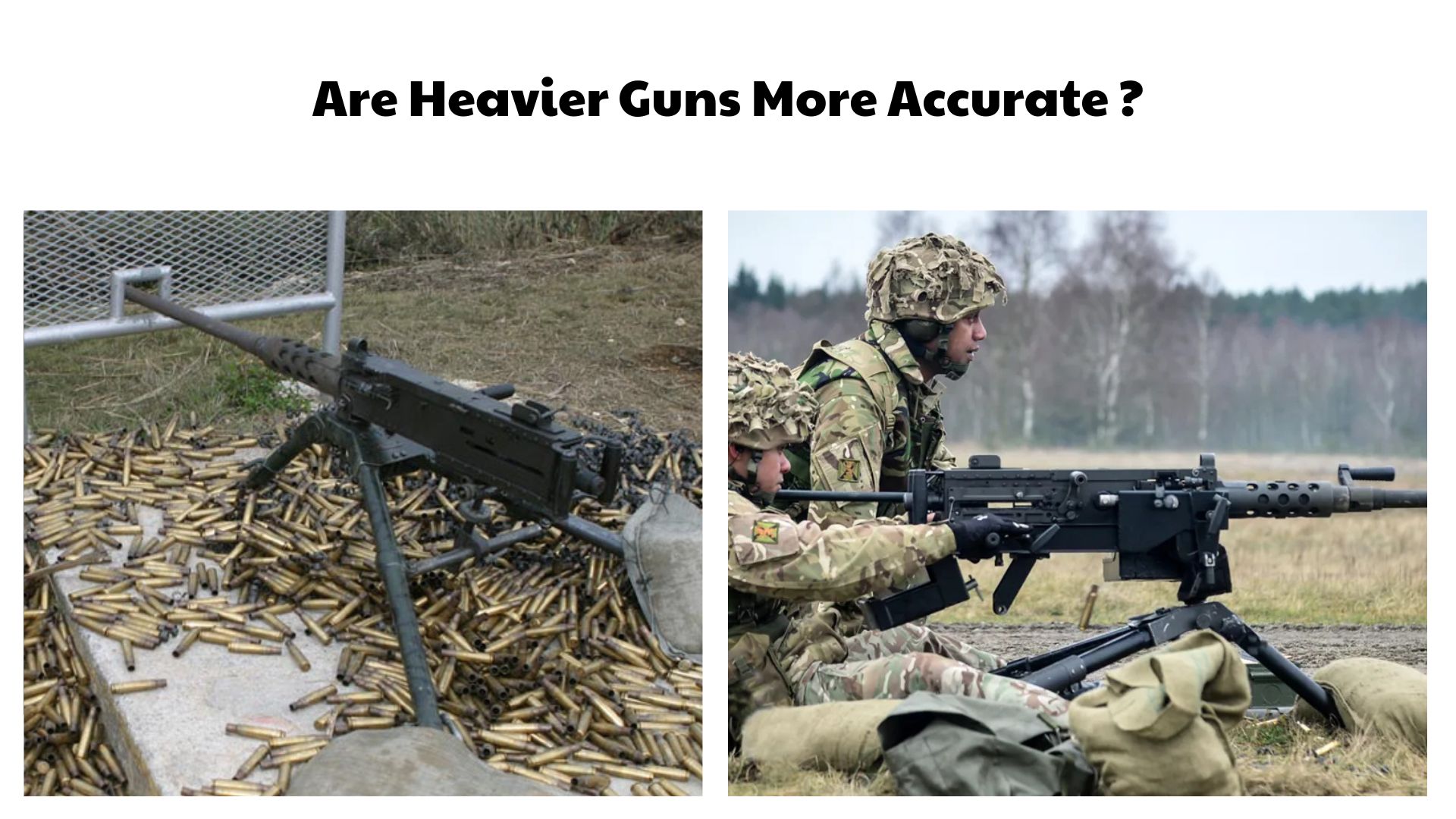

Does weight really improve accuracy in firearms? It’s one of the most debated questions among shooters, hunters, and long-range enthusiasts. Some believe that a heavier rifle automatically delivers better precision, while others argue that bullet weight is the real factor behind consistent performance. In reality, both perspectives contain some truth—but neither tells the full story on its own.
When discussing firearm performance, two key elements come into play: rifle weight and bullet weight. Rifle weight influences how stable the firearm feels in your hands, how it handles recoil, and how easily you can maintain a steady aim. Bullet weight, on the other hand, affects how the projectile behaves in flight—its speed, trajectory, and resistance to environmental factors like wind. Understanding the difference between these two is essential if you want to improve real-world shooting results.
Many shooters misunderstand the role of mass because they focus on simple assumptions, such as “heavier is better.” While added weight can improve stability and reduce movement, it can also introduce drawbacks like fatigue and reduced mobility. Similarly, heavier bullets may perform better at long range, but they are not automatically more accurate in every situation. Accuracy is influenced by a combination of factors, including firearm setup, ammunition compatibility, and shooter skill.
This guide breaks down the relationship between rifle weight and bullet weight in a clear and practical way. You will learn how each factor affects stability, recoil control, and overall shooting performance. More importantly, you will understand how these elements work together in real-world conditions, helping you make smarter decisions whether you are shooting at the range, hunting, or practicing long-range precision.
Understanding Accuracy vs Precision
Before diving into how weight affects shooting performance, it’s essential to understand two terms that are often used interchangeably but mean very different things: accuracy and precision. Confusing these concepts is one of the main reasons shooters misinterpret how rifle weight or bullet weight impacts results.
Accuracy refers to how close your shot lands to your intended target. In simple terms, it is the relationship between your point of aim and your point of impact. If you aim at the center of a target and your bullet hits that exact point, your shot is accurate. Even if your shots are spread out, as long as they are centered around your aiming point, the system can still be considered accurate.
Precision, on the other hand, describes how closely your shots group together. A tight grouping means high precision, regardless of where those shots land on the target. For example, if all your shots land close together but slightly off-center, your shooting is precise but not accurate. Ideally, you want both—tight groupings that are also centered on your target.
This distinction matters because weight—whether rifle or bullet—often affects precision more than true accuracy. A heavier rifle, for instance, can help stabilize your aim and reduce movement, leading to tighter shot groupings. However, if your scope is not properly zeroed, those tight groups may still be off target. In that case, weight improved precision, but not accuracy.
It’s also important to separate mechanical accuracy from practical (field) accuracy. Mechanical accuracy refers to the inherent capability of the firearm and ammunition system to produce tight groupings under ideal conditions, such as from a bench rest. Practical accuracy, however, includes real-world variables like shooter skill, body position, wind, and fatigue. In most situations, practical accuracy is what truly matters—and this is where factors like rifle weight can play a significant role.
Does Rifle Weight Affect Accuracy?
The Physics Behind Rifle Weight
At a fundamental level, rifle weight influences how the firearm behaves in your hands. Heavier rifles have greater mass, which means they naturally resist movement more than lighter ones. This increased inertia helps stabilize the rifle, especially during the aiming process, making it easier to hold the reticle steady on target.
Because heavier rifles resist small, unintended movements, they reduce shooter-induced error. Tiny shifts caused by breathing, muscle tension, or hand tremors are less likely to disrupt your aim. This is particularly noticeable in precision shooting disciplines, where even minor instability can affect shot placement.
Additionally, the extra mass helps absorb and distribute recoil energy more effectively. This reduces the overall movement of the rifle during firing, allowing the shooter to maintain better control and sight alignment. The result is a more stable shooting platform that promotes consistency.
Recoil Reduction and Control
One of the most practical advantages of a heavier rifle is its ability to manage recoil. When a shot is fired, the energy generated pushes the rifle backward. Heavier rifles absorb more of this energy, resulting in less felt recoil for the shooter.
Reduced recoil has several benefits. First, it minimizes flinching—a common issue among shooters that can negatively affect accuracy. Second, it allows for quicker and more controlled follow-up shots, especially in scenarios where multiple shots are required. Finally, it improves overall shooting comfort, making long practice sessions more manageable.
Over time, this improved control leads to greater consistency. Shooters are able to maintain better form and focus, which directly contributes to tighter shot groupings and more reliable performance.
Stability and Shooting Position
Rifle weight also plays a major role in how stable the firearm feels in different shooting positions. In supported positions such as bench rest or prone shooting, heavier rifles provide a solid and stable platform. They are less affected by small body movements, environmental factors, or minor shifts in position.
This stability is especially valuable in precision shooting, where consistency is critical. A heavier rifle can help maintain alignment between shots, reducing variation and improving overall performance.
However, this advantage comes with a trade-off. In offhand or dynamic shooting situations—such as hunting or tactical movement—heavier rifles can become more difficult to handle. They require more effort to hold steady over time, which can lead to fatigue and reduced control. In these cases, a lighter rifle may actually perform better despite being less stable in theory.
Barrel Weight and Harmonics
Barrel weight is another important factor that contributes to rifle performance. Heavier barrels, often referred to as “bull barrels,” are more rigid than thinner barrels. This increased rigidity helps reduce vibration, also known as barrel harmonics, when a shot is fired.
Every time a rifle is fired, the barrel vibrates slightly. These vibrations can affect the direction of the bullet as it exits the barrel. Heavier barrels minimize these vibrations, leading to more consistent shot placement.
In addition, heavier barrels handle heat more effectively. During extended shooting sessions, barrels can heat up and expand, which may affect accuracy. A heavier barrel takes longer to heat up and maintains its shape more consistently, allowing for better performance over multiple shots.
Real-World Trade-Offs
While heavier rifles offer clear advantages in stability and recoil control, they are not always the best choice in every situation. Increased weight can reduce mobility, making the rifle more difficult to carry over long distances or use in fast-paced environments.
Lighter rifles, on the other hand, are easier to handle and transport. They are often preferred for hunting or scenarios that require quick movement. However, they can be harder to hold steady, especially for inexperienced shooters or in unsupported positions.
Ultimately, the key is finding the right balance. Total weight matters, but so do factors like weight distribution, ergonomics, and how the rifle feels in your hands. A well-balanced rifle that suits your shooting style will often perform better than a heavier or lighter rifle that does not fit you properly.
Does Bullet Weight Affect Accuracy?
Bullet weight is one of the most discussed factors in shooting performance, especially among long-range shooters and reloaders. While it plays a significant role in how a bullet behaves in flight, it is often misunderstood when it comes to accuracy. Like rifle weight, bullet weight influences certain aspects of performance—but it does not act as a standalone factor that guarantees better results.
What Is Bullet Weight?
Bullet weight refers to the mass of the projectile and is typically measured in grains (gr). One grain equals 1/7000 of a pound, making it a very precise unit for measuring small differences. Different calibers support a range of bullet weights. For example, in .223 Remington, common bullet weights range from around 55 grains to 77 grains.
The choice of bullet weight affects how the projectile travels after it leaves the barrel. Heavier and lighter bullets behave differently in terms of speed, trajectory, and resistance to environmental factors. Understanding these differences is essential for choosing the right ammunition for your specific purpose.
Lighter Bullets – Pros and Cons
Lighter bullets are generally known for their higher velocity. Because they have less mass, they can be propelled faster by the same amount of powder. This results in a flatter trajectory over shorter distances, which can make aiming simpler and reduce the need for elevation adjustments.
Another advantage of lighter bullets is their faster time to target. This can be beneficial in situations where quick engagement is important, such as varmint hunting or close-to-medium range shooting. Additionally, lighter bullets typically produce less recoil, which can improve comfort and control, especially for newer shooters.
However, lighter bullets also have limitations. They are more susceptible to wind drift, meaning even mild wind conditions can push them off course more easily. They also tend to lose energy more quickly over distance, making them less effective for long-range applications. As distance increases, their initial velocity advantage becomes less significant compared to heavier bullets.
Heavier Bullets – Pros and Cons
Heavier bullets behave differently due to their increased mass. While they generally travel at lower velocities, they retain energy more effectively over long distances. This makes them more stable in flight and less affected by wind drift, which is a major advantage in long-range shooting.
Because of their improved stability, heavier bullets are often preferred for precision shooting and applications where consistency over distance is critical. They maintain momentum better, which helps them stay on a predictable trajectory even in less-than-ideal environmental conditions.
The trade-off is that heavier bullets have a more pronounced bullet drop due to their lower velocity. This requires more precise elevation adjustments or holdover when shooting at longer distances. They may also produce slightly more recoil, depending on the caliber and load, which can affect shooter comfort during extended sessions.
Bullet Weight vs Stability
One of the most important factors linking bullet weight to accuracy is stability. Heavier bullets are typically longer, and longer bullets require faster barrel twist rates to stabilize properly in flight. If the twist rate is too slow for the bullet weight, the bullet may not spin fast enough, leading to instability and poor accuracy.
For example, a barrel with a slower twist rate may perform well with lighter bullets but struggle with heavier ones. Conversely, a faster twist rate can stabilize heavier bullets effectively but may not provide optimal performance with very light bullets. This relationship highlights the importance of matching bullet weight to the barrel’s twist rate.
A mismatch between bullet weight and barrel characteristics can significantly reduce accuracy, even if all other factors are ideal. This is why experienced shooters often test different bullet weights to find the best match for their specific rifle.
The Myth: “Heavier Bullets Are More Accurate”
One of the most common misconceptions in shooting is that heavier bullets are inherently more accurate. In reality, no bullet weight is automatically more accurate than another. Accuracy depends on how well the bullet matches the rifle and how consistently it performs.
Several factors determine whether a particular bullet weight will deliver good results. Barrel compatibility, including twist rate and bore condition, plays a major role. Ammunition consistency—such as uniform powder charges and seating depth—is equally important. Environmental conditions, including wind and temperature, also influence performance.
In many cases, shooters find that a specific bullet weight works best in their rifle through testing and experience. This reinforces the idea that accuracy is not about choosing the “heaviest” or “lightest” option, but about finding the right combination for your setup.
Rifle Weight vs Bullet Weight – Key Differences
Although both rifle weight and bullet weight influence shooting performance, they affect entirely different aspects of the shooting process. Understanding these differences helps clarify why neither factor alone determines accuracy.
What Rifle Weight Affects
Rifle weight primarily affects how the firearm behaves in the shooter’s hands. A heavier rifle provides greater stability, reducing movement and helping maintain a steady aim. It also absorbs recoil more effectively, making shooting more comfortable and controlled.
However, increased weight can lead to fatigue, especially during extended use or when shooting in unsupported positions. This can negatively impact performance over time. As a result, rifle weight has a strong influence on practical field accuracy, where shooter comfort and endurance play a significant role.
What Bullet Weight Affects
Bullet weight, in contrast, affects what happens after the shot is fired. It determines how the bullet travels through the air, including its velocity, trajectory, and resistance to wind. Heavier bullets tend to perform better at long range due to their stability, while lighter bullets excel in speed and flatter trajectories at shorter distances.
Bullet weight also influences energy retention, which can be important for hunting or other applications where impact performance matters. These ballistic characteristics are independent of how stable the rifle feels during shooting.
Which Matters More for Accuracy?
The question of which factor matters more does not have a simple answer. Rifle weight affects shooter stability and consistency, while bullet weight affects ballistic performance and trajectory. Both contribute to the final result, but in different ways.
In practical terms, rifle weight helps the shooter deliver consistent shots, while bullet weight determines how those shots behave in flight. Neither factor alone guarantees accuracy. True performance comes from the combination of a well-balanced rifle, properly matched ammunition, and solid shooting fundamentals.
The Role of Balance and System Setup
When discussing firearm performance, many shooters focus too heavily on total weight. In reality, balance and overall system setup often matter far more than simply adding or reducing mass. A well-balanced rifle can feel more stable, easier to control, and more accurate in practical use—even if it is lighter than another setup.
The center of gravity plays a critical role in how a rifle handles. A rifle that is front-heavy may feel steady when aiming from a supported position, but it can become tiring to hold over time. Conversely, a rear-heavy rifle may feel quicker to maneuver but less stable when trying to maintain a precise sight picture. The ideal balance point allows the rifle to settle naturally on target without excessive effort from the shooter.
Rifle balance directly affects aiming speed and control. In dynamic situations, such as hunting or tactical shooting, a well-balanced rifle allows faster target acquisition and smoother transitions between targets. In precision shooting, proper balance helps maintain a steady hold and reduces unnecessary movement. These factors often have a greater impact on real-world performance than overall weight alone.
Equally important is matching the entire system to its intended purpose. Rifle weight, cartridge selection, and shooting application must all work together. A heavy precision rifle paired with long-range ammunition is ideal for bench shooting or prone positions, but it may be impractical for long hunts in rough terrain. On the other hand, a lightweight hunting rifle may be perfect for mobility but require more skill to shoot accurately at extended distances.
The key takeaway is that performance comes from balance and compatibility. A properly matched system—where rifle weight, ammunition, and intended use align—will always outperform a setup that focuses on a single factor like weight alone.
Other Factors That Matter More Than Weight
While weight does influence certain aspects of shooting performance, it is far from the most important factor. In many cases, other variables have a much greater impact on accuracy and consistency. Understanding these factors helps shooters focus on what truly improves performance rather than relying on misconceptions.
Shooter Skill and Technique
The most significant factor in shooting accuracy is the shooter. No amount of equipment optimization can compensate for poor fundamentals. Trigger control, breathing, and body stability all play a major role in determining where a shot lands.
A smooth, controlled trigger press prevents the rifle from shifting at the moment of firing. Proper breathing techniques help stabilize the body and reduce movement. Consistent shooting positions ensure repeatable results. These skills take practice to develop, but they have a far greater impact on performance than changes in rifle or bullet weight.
In fact, human error often outweighs equipment limitations. Even a highly accurate rifle can produce poor results if the shooter lacks consistency. This is why experienced shooters prioritize training and fundamentals over chasing minor equipment differences.
Ammunition Consistency
Consistency in ammunition is another critical factor that often gets overlooked. Variations in powder charge, bullet seating depth, and velocity can all affect how a bullet performs. Even small inconsistencies can lead to noticeable differences in shot placement.
Reliable ammunition ensures that each shot behaves the same way as the previous one. This consistency is essential for maintaining tight groupings and predictable performance. In many cases, improving ammunition quality will have a greater impact on accuracy than changing bullet weight alone.
For shooters who reload their own ammunition, attention to detail is especially important. Uniformity in every component helps maximize the potential of both the rifle and the shooter.
Barrel Quality and Twist Rate
The barrel is one of the most important components affecting accuracy. A high-quality barrel with consistent internal dimensions provides a stable path for the bullet, improving overall performance. Poor barrel quality can introduce inconsistencies that no amount of weight adjustment can fix.
Twist rate is equally important because it determines how well a bullet is stabilized in flight. Each barrel is designed to work best with a specific range of bullet lengths and weights. If the twist rate does not match the bullet, the projectile may not stabilize properly, leading to reduced accuracy.
Matching the correct bullet weight to the barrel’s twist rate ensures optimal performance. This relationship is far more important than simply choosing a heavier or lighter bullet without considering compatibility.
Environmental Conditions
Environmental factors can have a significant impact on shooting accuracy, especially at longer distances. Wind is one of the most challenging variables to manage, as it can push a bullet off course even over relatively short ranges.
Temperature and air density also affect bullet performance by influencing velocity and trajectory. Distance estimation plays a role as well—misjudging range can lead to incorrect holdover or adjustments, resulting in missed shots.
In many real-world scenarios, wind drift and environmental conditions cause more misses than any limitation related to rifle or bullet weight. Learning to read and adapt to these factors is a key skill for improving overall accuracy.
Insights from Real Shooters (Community Perspective)
Beyond technical theory, real-world experience from shooters provides valuable insight into how weight affects performance. Across various shooting communities, there is a general consensus that heavier rifles can improve stability and consistency—but only to a certain extent.
Many experienced shooters agree that a heavier rifle reduces movement during aiming and firing. The added mass helps absorb recoil and minimizes small, unintentional shifts, leading to tighter shot groupings. This is especially noticeable in precision shooting environments where stability is critical.
A commonly shared viewpoint is that “a heavier rifle means less movement and less recoil influence.” While this is true in controlled conditions, it does not automatically translate to better overall accuracy. Practical performance depends on how well the shooter can handle the rifle in real situations.
Lightweight rifles, while less stable, are still capable of excellent accuracy. However, they require more control and refined technique from the shooter. Small errors are more noticeable with lighter setups, making them less forgiving—especially for beginners.
When it comes to bullet weight, experienced shooters consistently emphasize that it is not a standalone factor for accuracy. Instead, bullet performance depends on context, including barrel compatibility, shooting distance, and environmental conditions. A bullet that performs well in one rifle may not perform the same in another.
The most consistent takeaway from real shooters is that consistency matters more than raw performance numbers. A balanced setup, reliable ammunition, and strong fundamentals will always outperform a heavier rifle or bullet chosen without considering the complete system.
When to Choose a Heavier vs Lighter Rifle
Choosing between a heavier or lighter rifle is not about which one is “better” in general—it’s about which one fits your specific shooting purpose. Each option offers clear advantages and trade-offs, and understanding when to use each can significantly improve your real-world performance.
Choose a Heavier Rifle If:
A heavier rifle is often the preferred choice for shooters who prioritize stability and precision. The added mass helps reduce movement, making it easier to maintain a steady sight picture, especially during slow, controlled shooting.
If your primary goal is long-range precision, a heavier rifle provides clear benefits. The increased weight minimizes small body movements and reduces the impact of recoil, allowing for tighter shot groupings. This is why many precision and benchrest rifles are built with heavier profiles.
Heavier rifles also excel when shooting from supported positions such as prone or bench rest. In these scenarios, mobility is less important, and stability becomes the top priority. The rifle can rest on a surface or support system, allowing the shooter to take full advantage of its weight.
Another key advantage is recoil reduction. Heavier rifles absorb more recoil energy, resulting in less felt kick and improved control. This makes them ideal for extended shooting sessions, where comfort and consistency are essential. Reduced recoil also helps prevent flinching, which can negatively impact accuracy.
Choose a Lighter Rifle If:
Lighter rifles are designed for mobility and ease of handling. If your shooting involves movement, such as hunting in varied terrain, a lighter rifle is often the better choice. Carrying a heavy rifle over long distances can lead to fatigue, which ultimately affects performance.
In offhand or unsupported shooting positions, lighter rifles can be easier to maneuver and bring on target quickly. This is particularly important in dynamic situations where speed and responsiveness matter more than absolute stability.
Lighter rifles are also advantageous when quick target acquisition is required. Their reduced weight allows for faster transitions between targets and less strain during prolonged use. While they may be less forgiving in terms of stability, skilled shooters can achieve excellent accuracy with proper technique.
Ultimately, choosing between a heavier and lighter rifle comes down to balancing stability and mobility. A heavier rifle offers control and precision, while a lighter rifle provides speed and practicality in the field.
When to Choose Heavier vs Lighter Bullets
Just like rifle weight, bullet weight should be selected based on your intended use rather than assumptions. Different bullet weights perform better in different scenarios, and understanding these applications helps maximize both accuracy and effectiveness.
Use Lighter Bullets For:
Lighter bullets are well-suited for short-range shooting, where their higher velocity provides a flatter trajectory. This reduces the need for elevation adjustments and makes aiming more straightforward, especially for newer shooters.
They are also ideal for faster target engagement. Because lighter bullets travel more quickly, they reach the target sooner, which can be beneficial in situations that require rapid response. This makes them a popular choice for varmint hunting and certain types of sport shooting.
Another advantage of lighter bullets is reduced recoil. Lower recoil improves shooter comfort and allows for better control, particularly in lightweight rifles. This combination makes lighter bullets a good option for training and high-volume shooting sessions.
Use Heavier Bullets For:
Heavier bullets are typically the preferred choice for long-range shooting. Their increased mass allows them to retain energy and velocity over greater distances, resulting in more predictable performance.
In windy conditions, heavier bullets offer a significant advantage. They are less affected by wind drift, helping maintain a more consistent trajectory. This makes them more reliable in challenging environmental conditions where lighter bullets may struggle.
Heavier bullets also provide better downrange energy and stability. This is particularly important for applications like hunting, where consistent performance at distance is critical. While they may require more precise adjustments due to increased bullet drop, their overall stability often leads to better results in the right context.
Common Myths About Weight and Accuracy
There are several persistent myths about how weight affects firearm accuracy. These misconceptions often lead shooters to focus on the wrong factors when trying to improve performance.
One of the most common beliefs is that heavier rifles are always more accurate. This is not true. While heavier rifles can improve stability and reduce recoil, they do not inherently increase mechanical accuracy. A poorly set up heavy rifle can still perform worse than a well-balanced lighter one.
Another widespread myth is that heavier bullets guarantee better accuracy. In reality, bullet weight alone does not determine performance. Accuracy depends on how well the bullet matches the rifle, including barrel twist rate, as well as the consistency of the ammunition and the conditions in which it is used.
A third misconception is that weight alone determines overall performance. This oversimplifies a complex system. Factors such as shooter skill, rifle balance, ammunition quality, and environmental conditions all play a larger role in real-world results.
The reality is that system balance and shooter skill matter most. A well-matched setup, combined with consistent technique and practice, will always outperform a configuration chosen based solely on weight. Understanding this principle is key to making smarter decisions and achieving better accuracy over time.
Expert Insight Summary
When evaluating the role of weight in firearm performance, it becomes clear that weight is an influencing factor—but not a defining one. Rifle weight primarily affects stability rather than inherent accuracy. A heavier rifle can help reduce movement and improve control, making it easier for the shooter to maintain a steady aim. However, this does not automatically translate into better shot placement if other fundamentals are lacking.
Heavier rifles are best understood as tools for improving consistency. By minimizing recoil and reducing small, unintended movements, they allow shooters to produce more repeatable results. This consistency often leads to tighter shot groupings, but it should not be confused with precision alone. Precision still depends on proper setup, ammunition compatibility, and shooter technique.
Bullet weight plays a different role entirely. Instead of influencing how the rifle handles, it affects how the projectile behaves in flight. Heavier bullets tend to offer better wind resistance and energy retention, making them more effective at longer distances. Lighter bullets, on the other hand, provide higher velocity and flatter trajectories at shorter ranges. Both have their place, depending on the shooting context.
The most important takeaway is that optimal performance comes from matching the entire system. Rifle weight, ammunition choice, and intended purpose must all align. A well-balanced setup tailored to its specific use will always outperform a mismatched configuration, regardless of how heavy or light it is.
Above all, shooter skill remains the most critical factor. Fundamentals such as trigger control, breathing, and consistency have a greater impact on accuracy than any equipment variable. Weight can support performance, but it cannot replace proper technique.
Conclusion
Weight plays a role in firearm performance, but it is not the deciding factor in accuracy. Rifle weight contributes to control, stability, and recoil management, while bullet weight influences trajectory, velocity, and behavior in flight. Each serves a different purpose, and neither alone determines how accurately a rifle will perform.
There is no universal “best weight” for achieving accuracy. The ideal setup depends on your specific needs, whether that involves long-range precision, hunting in the field, or general shooting practice. What works best in one scenario may not perform the same in another.
The most effective approach is to focus on balance and consistency. Choose a rifle that feels stable and manageable, pair it with ammunition that matches your barrel and shooting goals, and build strong fundamentals through regular practice. These elements working together will produce far better results than relying on weight alone.
Final recommendation: prioritize a well-balanced system, consistent training, and practical experience. When these factors are aligned, accuracy becomes a result of skill and understanding—not just equipment choices.
Frequently Asked Questions (FAQ)
1. Does rifle weight really improve accuracy?
Rifle weight can improve stability, which often leads to better shot consistency, but it does not directly increase mechanical accuracy. A heavier rifle reduces small movements and absorbs recoil more effectively, helping shooters maintain control. However, true accuracy still depends on factors like barrel quality, ammunition consistency, and shooter skill.
2. Are heavier rifles always better for beginners?
Not necessarily. While heavier rifles are more stable and easier to control recoil, they can also be tiring to hold and carry. Beginners may benefit from moderate-weight rifles that balance stability and comfort. The best choice depends on the user’s strength, experience, and intended use.
3. What is the ideal rifle weight for accuracy?
There is no universal ideal weight. For benchrest or long-range shooting, heavier rifles are often preferred. For hunting or mobile shooting, lighter rifles are more practical. The best weight is one that allows you to maintain control and shoot consistently without fatigue.
4. Does bullet weight affect accuracy at short range?
At short distances, bullet weight has minimal impact on accuracy. Lighter bullets may offer a flatter trajectory, making aiming easier, but both light and heavy bullets can be accurate if properly matched to the rifle and conditions.
5. Why do heavier bullets perform better at long range?
Heavier bullets retain energy and resist wind drift more effectively due to their higher momentum. This makes them more stable over long distances, resulting in more predictable trajectories compared to lighter bullets.
6. Can a lightweight rifle still be accurate?
Yes, lightweight rifles can be highly accurate. However, they require better shooting technique because they are less stable and more affected by movement and recoil. Skilled shooters can achieve excellent results with lighter rifles.
7. What matters more: rifle weight or bullet weight?
Both matter, but in different ways. Rifle weight affects stability and recoil control, while bullet weight affects trajectory and flight behavior. Neither is more important overall—accuracy comes from how well both are matched to the shooter and application.
8. Does a heavier barrel improve accuracy?
Heavier barrels are more rigid and resist vibration, which can improve shot consistency. They also handle heat better during repeated firing. This often results in tighter groupings, especially during extended shooting sessions.
9. How does recoil influence accuracy?
Recoil can cause flinching or disrupt aim, especially for less experienced shooters. Heavier rifles and lighter loads reduce felt recoil, making it easier to maintain control and shoot accurately.
10. What is the role of barrel twist rate in accuracy?
Twist rate determines how well a bullet is stabilized in flight. If the twist rate does not match the bullet weight and length, the bullet may not spin properly, leading to reduced accuracy.
11. Do heavier bullets always hit harder?
Heavier bullets generally retain more energy over distance, which can result in stronger impact. However, velocity and bullet design also play major roles in determining overall effectiveness.
12. Is balance more important than weight?
Yes, balance often matters more than total weight. A well-balanced rifle is easier to control and aim, even if it is lighter than a poorly balanced heavier rifle.
13. How does wind affect bullet performance?
Wind can push bullets off course, especially lighter ones. Heavier bullets are less affected due to their higher momentum, making them more reliable in windy conditions.
14. Should I choose lighter bullets for faster shooting?
Lighter bullets travel faster and can reduce the need for lead on moving targets. They are often preferred for short-range and fast-paced shooting scenarios.
15. Do heavier rifles reduce shooter fatigue?
Heavier rifles reduce recoil fatigue but can increase physical fatigue when carried or held for long periods. The overall effect depends on how the rifle is used.
16. What is practical accuracy?
Practical accuracy refers to real-world shooting performance, including factors like movement, environment, and shooter skill. It differs from mechanical accuracy, which is measured under ideal conditions.
17. Can bullet weight affect recoil?
Yes, heavier bullets generally produce more recoil due to increased momentum. However, the difference may vary depending on the firearm and load.
18. Is a heavier rifle better for long-range shooting?
Heavier rifles are often preferred for long-range shooting because they provide better stability and recoil control. However, proper setup and skill are still essential.
19. Does ammunition quality matter more than weight?
Yes, consistent ammunition quality often has a greater impact on accuracy than bullet weight alone. Variations in powder and construction can affect performance significantly.
20. Why do some shooters prefer lighter rifles?
Lighter rifles are easier to carry and maneuver, making them ideal for hunting or dynamic shooting. They are more practical in situations that require mobility.
21. How does gravity affect bullet trajectory?
Gravity pulls the bullet downward after it leaves the barrel, creating a curved flight path. This is why shooters must account for bullet drop at longer distances.
22. What is bullet drop?
Bullet drop is the downward movement of a bullet due to gravity. Heavier bullets often experience more drop due to lower velocity.
23. Can heavier rifles improve follow-up shots?
Yes, reduced recoil and movement make it easier to stay on target, allowing for faster and more accurate follow-up shots.
24. Do lighter bullets drift more in wind?
Yes, lighter bullets are more affected by wind due to their lower mass and momentum, making them less stable in windy conditions.
25. What is the best way to test accuracy?
The best way is to shoot multiple groups under consistent conditions and measure the grouping size. This helps identify the most accurate setup for your rifle.
26. Does rifle weight affect offhand shooting?
Yes, heavier rifles can be harder to hold steady offhand due to fatigue, while lighter rifles are easier to manage but less stable.
27. Why is consistency important in shooting?
Consistency ensures that each shot behaves the same way, leading to tighter groupings and more predictable results.
28. Can a mismatch between bullet and barrel reduce accuracy?
Yes, if the bullet weight does not match the barrel’s twist rate, stability is reduced, which negatively impacts accuracy.
29. Is there a perfect bullet weight?
No, the ideal bullet weight depends on the rifle, shooting distance, and environmental conditions.
30. How do environmental conditions affect accuracy?
Wind, temperature, and air density all influence bullet trajectory and performance, especially at longer distances.
31. Does a heavier rifle mean less recoil?
Yes, heavier rifles absorb more recoil energy, reducing the amount felt by the shooter and improving control.
32. Can lighter rifles be used for long-range shooting?
Yes, but they require more skill to manage stability and recoil compared to heavier rifles.
33. What is shooter-induced error?
Shooter-induced error refers to mistakes caused by movement, poor technique, or improper handling that affect shot placement.
34. Does bullet design matter as much as weight?
Yes, bullet shape and construction significantly affect aerodynamics, stability, and performance.
35. How important is practice for accuracy?
Practice is critical. Skill development has a greater impact on accuracy than equipment changes alone.
36. Can weight distribution affect performance?
Yes, how weight is distributed across the rifle affects balance, handling, and overall shooting comfort.
37. Do professional shooters prefer heavier rifles?
Many do for precision shooting, but preferences vary depending on the discipline and environment.
38. What is recoil management?
Recoil management involves controlling the movement of the firearm during and after firing to maintain accuracy and control.
39. Does bullet weight affect penetration?
Heavier bullets often penetrate deeper due to higher momentum, but design and velocity also play important roles.
40. Can beginners rely on equipment for accuracy?
No, equipment helps, but fundamentals like technique and practice are far more important for achieving accuracy.
41. What is the biggest factor affecting accuracy?
Shooter skill is the most significant factor, followed by rifle setup and ammunition consistency.
42. Should I prioritize weight or comfort?
Comfort should be a priority because it directly affects your ability to shoot consistently and effectively.
43. How do I find the best setup for my rifle?
Testing different combinations of ammunition and practicing under real conditions is the best way to determine what works for you.
44. Does weight matter for hunting?
Yes, but mobility is often more important. Hunters typically prefer lighter rifles for ease of carrying.
45. Can heavier bullets improve consistency?
They can improve stability at long range, but consistency depends on the entire system, not just bullet weight.
46. What is the role of inertia in shooting?
Inertia helps resist movement. Heavier rifles have more inertia, making them more stable during aiming and firing.
47. Do lighter bullets lose energy faster?
Yes, lighter bullets generally lose energy more quickly over distance compared to heavier ones.
48. Is weight the most important factor in accuracy?
No, it is just one of many factors. Skill, setup, and conditions are more important overall.
49. Can changing bullet weight improve my accuracy?
It can, if the new bullet weight better matches your rifle’s characteristics. Testing is essential to determine the best option.
50. What is the key takeaway about weight and accuracy?
Weight influences performance but does not determine accuracy on its own. A balanced system and strong fundamentals are the key to consistent results.
Read more: