
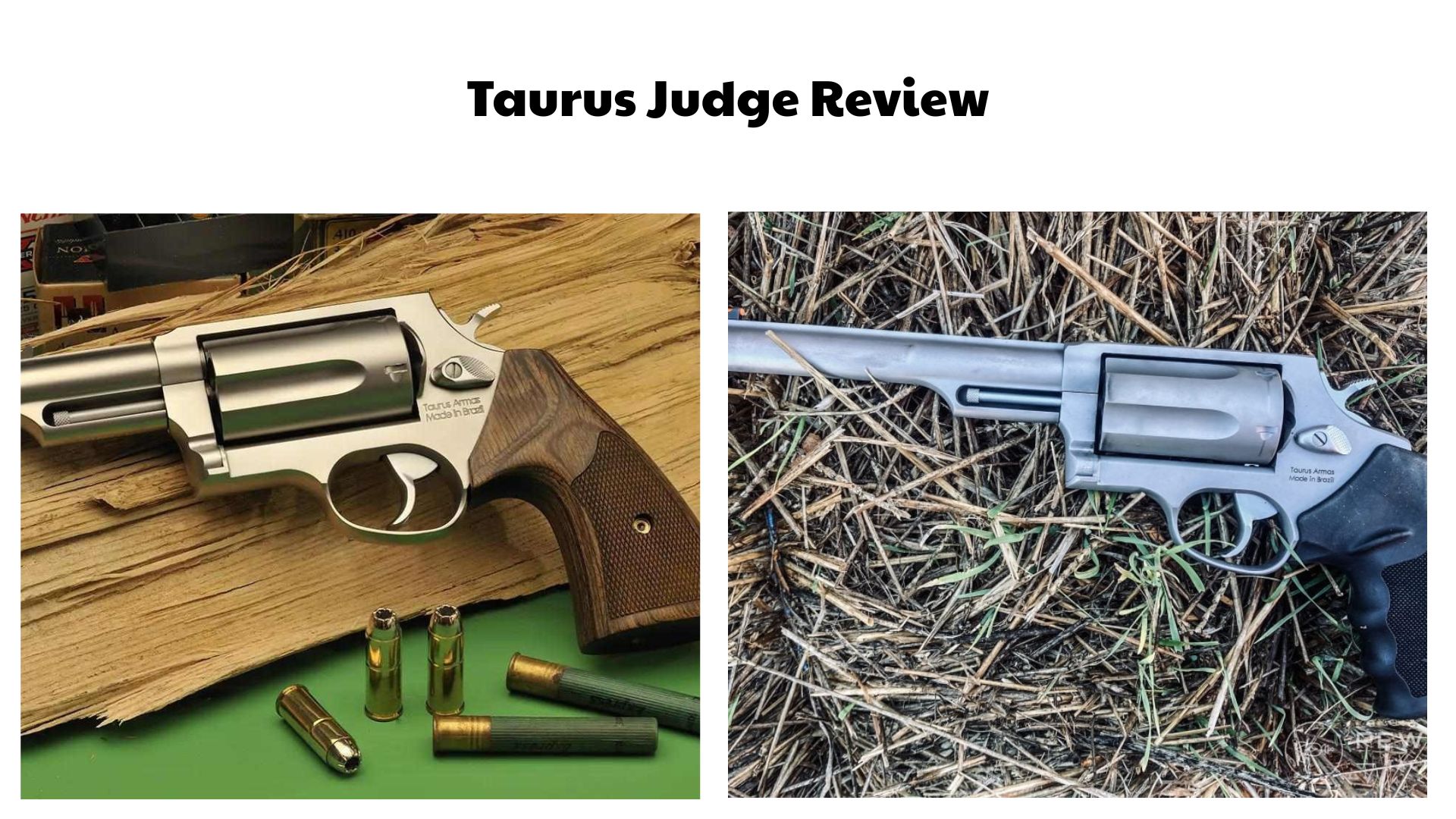

The Taurus Judge is one of the most recognizable and controversial revolvers in modern civilian firearms markets. Produced by Taurus International, it is designed as a dual-purpose handgun capable of firing both .45 Colt cartridges and .410 bore shotshells from the same cylinder. This unique hybrid concept has earned it the nickname “revolver-shotgun” among shooters and reviewers.
At its core, the Taurus Judge was developed to serve as a multi-purpose defensive revolver that could adapt to different real-world situations. The idea behind the platform is simple: combine the stopping potential of a traditional revolver round with the short-range spread capability of shotgun-style ammunition.
Because of this dual-purpose design, the Judge quickly gained attention in self-defense discussions as well as among outdoor users who needed a practical tool for unpredictable environments. Its ability to chamber both .45 Colt and .410 shotshells makes it appealing for users who want flexibility in ammunition choice without switching firearms.
However, the platform has also generated significant debate within the firearms community. Critics question its real-world defensive effectiveness, particularly when using .410 shotshells, while supporters argue that its versatility and simplicity provide meaningful advantages in specific scenarios.
Despite the controversy, the Taurus Judge has become especially popular in niche applications such as farm carry, rural property defense, and snake protection. These environments often require a firearm capable of handling close-range threats where precision rifle-style accuracy is not the primary concern.
Understanding the .45 Colt / .410 Bore Concept
Origins of the Platform
The concept behind the Taurus Judge is rooted in earlier attempts to design revolvers capable of firing both traditional handgun cartridges and shotshell ammunition. This idea was heavily influenced by the need for effective close-range pest control solutions, particularly in rural and agricultural settings.
One of the key inspirations was the use of “snake shot” ammunition, which consists of small pellets designed to spread quickly at short distances. This type of ammunition became popular among farmers and outdoorsmen who needed a fast and effective way to deal with snakes and other small threats.
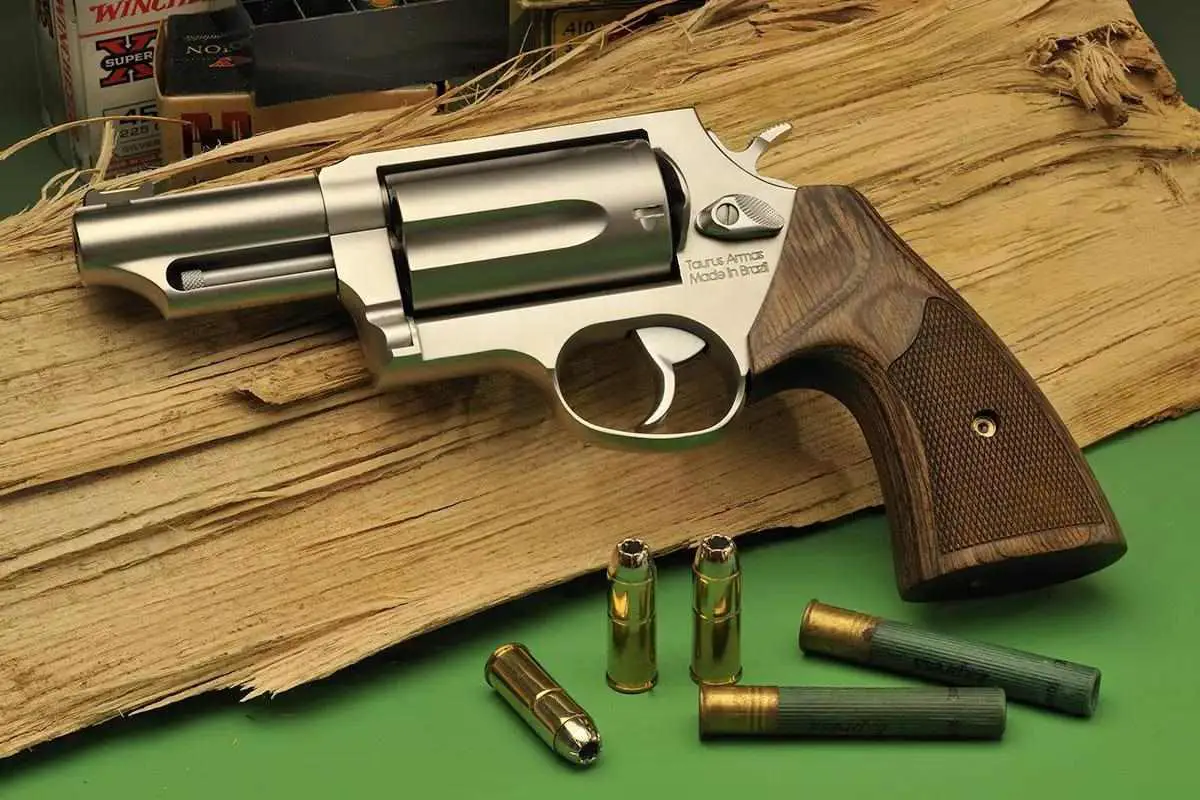
Taurus engineered a dual-caliber cylinder system that allows the firearm to chamber both .45 Colt cartridges and .410 bore shells. This engineering approach transformed a standard revolver platform into a hybrid defensive tool capable of serving multiple roles.
Over time, this design evolved from a niche concept into a widely recognized revolver category, sparking both interest and debate among firearm enthusiasts and professionals.
Advantages of Dual-Caliber Design
One of the primary advantages of the Taurus Judge is its versatility in ammunition selection. Users can choose between .45 Colt cartridges for more traditional handgun performance or .410 shotshells for short-range spread effectiveness.
This flexibility makes the revolver particularly useful for very close-range pest control situations where precision aiming may be less critical than immediate area coverage.
In certain defensive scenarios, the ability to switch between solid bullets and shotshells can provide tactical flexibility depending on the environment and perceived threat level.
Additionally, the revolver’s manual-of-arms simplicity is a major benefit. As a traditional double-action revolver, it is easy to operate under stress, with no need for magazine changes or complex mechanical manipulation.
Limitations of .410 in Handguns
Despite its versatility, the .410 bore in handgun platforms has several inherent limitations. One of the most significant drawbacks is the relatively low pellet count compared to full-sized shotgun platforms, which reduces overall spread effectiveness.
The effectiveness of .410 shotshells is also highly dependent on distance, with performance dropping significantly beyond very short ranges. This makes it less suitable for engagements outside close-quarters environments.
Ammunition performance can vary greatly depending on load type and quality, meaning results are not always consistent across different manufacturers or shot configurations.
Because of these factors, the defensive effectiveness of .410-fired handgun platforms remains a topic of ongoing debate within the firearms community.
Design and Build Quality of the Taurus Judge
Frame and Construction
The Taurus Judge is built on a medium to large revolver frame designed to accommodate both .45 Colt cartridges and .410 bore shells. Depending on the specific model, the frame may be constructed from steel or alloy materials to balance strength and weight.
The most defining structural feature of the Judge is its oversized cylinder, which is necessary to house the longer .410 shells. This contributes to the revolver’s distinctive and bulky appearance.
Overall, the construction is robust and built for durability, but the increased size and weight are noticeable compared to traditional revolvers chambered in standard handgun calibers.
Barrel and Rifling System
The Taurus Judge uses a rifled barrel rather than a smoothbore design. This is an important legal and functional distinction, as rifling ensures compliance with handgun regulations while stabilizing traditional .45 Colt bullets.
The rifling helps maintain accuracy when firing .45 Colt ammunition, while still allowing .410 shotshells to spread naturally after exiting the barrel.
Most models feature relatively short barrel lengths, which are optimized for close-range use rather than long-distance precision shooting.
This design creates a trade-off between accuracy with traditional bullets and spread behavior with shotshells, reflecting the hybrid nature of the platform.
Ergonomics and Handling
The Taurus Judge typically features a rubber grip with finger grooves designed to improve control and manage recoil from both .45 Colt and .410 loads.
Due to its heavier frame, the revolver offers improved stability during firing, although this also makes it less suitable for concealed carry or extended carry comfort.
The control layout follows traditional revolver design principles, making it simple and intuitive to operate even under stress or in low-light conditions.
Overall, the Judge is designed more for utility and functional versatility than for compactness or concealability.
Taurus Judge Specifications
The Taurus Judge is built around a dual-caliber revolver concept, allowing it to chamber both .45 Colt cartridges and .410 bore shotshells. Its specifications vary slightly depending on the model, but the overall platform remains consistent across the lineup.
Caliber: .45 Colt / .410 bore
Capacity: 5-shot cylinder (varies by model)
Barrel length: typically 2″–3″, with some extended variants available
Action: Double-action / single-action revolver
Frame type: Medium-large revolver frame
Construction: Steel or alloy depending on configuration
Sights: Fixed sights or basic fiber optic options depending on model
Performance and Shooting Experience
Accuracy with .45 Colt
When firing .45 Colt ammunition, the Taurus Judge delivers the most consistent and predictable performance. The rifled barrel stabilizes the bullet effectively, resulting in improved grouping and better overall accuracy compared to shotshell loads.
This makes .45 Colt the preferred option for users seeking traditional defensive handgun performance, particularly in close-range self-defense situations where precision is important.
Performance with .410 Shotshells
The .410 shotshell capability is what defines the Taurus Judge, but it also introduces the most variability in performance. At very short distances, shotshells produce a wide spread pattern that can be effective for pest control or extremely close-range defensive scenarios.
However, effectiveness decreases rapidly with distance, and performance is heavily dependent on ammunition type. Birdshot loads offer wide spread but limited penetration, while buckshot or specialty defensive loads provide more concentrated energy but still operate within short-range limitations.
Recoil and Control
Recoil characteristics of the Taurus Judge vary depending on the load and frame configuration. Lightweight models can produce noticeable recoil, especially when firing .45 Colt defensive loads or heavier .410 shells.
Heavier steel-frame versions help absorb recoil more effectively, improving control and making follow-up shots more manageable.
While recoil is generally manageable for experienced shooters, the platform is not always considered ideal for beginners using full-power ammunition loads.
Reliability and Durability
The Taurus Judge benefits from the inherent simplicity of a revolver mechanism, which contributes significantly to its reliability. Unlike semi-automatic firearms, it is not dependent on magazine feeding, cycling pressure, or complex recoil operation systems.
This mechanical simplicity makes it less sensitive to ammunition variations and reduces the likelihood of feeding-related malfunctions.
Built for outdoor and utility applications, the Judge is designed to withstand harsh environments and regular field use.
Overall, it has developed a reputation for solid durability in real-world conditions, particularly in rural and outdoor settings where reliability is critical.
Practical Use Cases of the Taurus Judge
Snake and Pest Control
One of the most common uses of the Taurus Judge is close-range pest control, particularly for snakes and small vermin. The ability to fire .410 shotshells makes it especially useful in agricultural and rural environments.
Farmers and outdoor workers often rely on the Judge as a quick-response tool for dealing with unexpected wildlife threats at very close distances.
When paired with specialty .410 loads, the revolver can be effective in eliminating small pests without requiring precise shot placement.
Farm and Ranch Carry
The Taurus Judge is widely used as a farm and ranch carry firearm due to its versatility and simplicity. It is commonly carried while walking property lines, tending livestock, or performing outdoor work.
Its combination of .45 Colt and .410 capability makes it suitable for a variety of unexpected encounters in rural environments, including wildlife defense and general utility tasks.
While not compact, its multifunctional role makes it a practical tool for users who prioritize versatility over concealability.
Home Defense Applications
The Taurus Judge is often discussed as a home-defense option, though opinions on its effectiveness vary widely. Supporters appreciate its simplicity, ease of use, and psychological deterrent effect.
However, critics point out its limited effective range and inconsistent performance of .410 shotshells compared to dedicated defensive handguns or shotguns.
As a result, it is generally viewed as a niche home-defense tool rather than a universally optimal solution.
Vehicle or Utility Gun Role
Due to its compact revolver design, the Taurus Judge can be stored in a vehicle as a utility firearm or backup defensive option. It is often used as a glovebox or truck gun in rural environments.
Its multi-purpose capability makes it suitable for outdoor users who may encounter a range of unpredictable situations while traveling or working in remote areas.
In this role, the Judge functions more as a general-purpose utility firearm rather than a specialized defensive platform.
Pros and Cons of the Taurus Judge
Pros
The Taurus Judge stands out in the handgun market due to its unusual dual-caliber capability. One of its biggest advantages is its extremely versatile ammunition options, allowing users to switch between .45 Colt cartridges and .410 bore shotshells depending on the situation.
This flexibility makes it especially effective at very close range, where shotshell spread can provide fast target coverage and .45 Colt rounds deliver more traditional handgun performance.
As a revolver, it also benefits from a simple operating system that is easy to understand and use, even under stress, with no reliance on magazines or complex cycling mechanisms.
The Judge has strong utility in outdoor and farm environments, where it is commonly used for pest control, snake protection, and general-purpose field carry.
Its mechanical design is straightforward and robust, contributing to a reputation for dependable function in a wide range of real-world conditions.
Cons
Despite its strengths, the Taurus Judge has several limitations that affect its overall performance profile. One of the most significant drawbacks is its limited effective range, particularly when using .410 shotshells.
Its size and weight make it relatively bulky for concealed carry, reducing its practicality for everyday urban self-defense use.
The effectiveness of .410 ammunition in defensive scenarios remains widely debated, with performance varying significantly depending on load type and engagement distance.
Additionally, the revolver’s 5-shot capacity is low compared to modern semi-automatic pistols, which may be a disadvantage in high-threat defensive situations.
There are also concerns about ammunition efficiency, as each cylinder load provides limited rounds before requiring a reload, which can be slower compared to magazine-fed platforms.
Taurus Judge vs Similar Firearms
When compared to traditional .357 Magnum revolvers, the Taurus Judge offers greater ammunition versatility due to its ability to fire both cartridges and shotshells. However, .357 revolvers typically provide better ballistic consistency and longer effective range.
Against compact defensive handguns, the Judge is significantly larger and less suited for concealed carry, but it offers unique utility that compact pistols cannot match, particularly in outdoor environments.
Compared to modern semi-automatic pistols, the Judge lacks magazine capacity, speed of reload, and ergonomic efficiency, but compensates with mechanical simplicity and dual-caliber flexibility.
Its role also partially overlaps with compact shotguns, especially in close-range defensive or pest-control scenarios, although true shotguns provide superior power and pattern consistency.
Who Should Buy the Taurus Judge?
The Taurus Judge is best suited for rural landowners and farmers who require a versatile tool for both defense and pest control in outdoor environments.
It is also a practical choice for outdoor workers who may encounter snakes or small wildlife threats and need a reliable close-range solution.
Users who prefer a simple mechanical defensive firearm with minimal complexity may also appreciate its revolver-based design.
Additionally, it appeals to shooters who are interested in niche hybrid revolvers and unique firearm platforms rather than conventional handgun designs.
Who Should Avoid the Taurus Judge?
The Taurus Judge is not ideal for concealed carry users who prioritize compact size, light weight, and discreet everyday carry options.
Shooters who require high-capacity defensive platforms will likely find its 5-shot cylinder limiting compared to modern semi-automatic pistols.
It is also not well-suited for users who need long-range accuracy, as its performance is primarily optimized for close-range scenarios.
Beginners seeking soft recoil, modern ergonomics, and simplified training platforms may also prefer more contemporary pistol designs.
Expert Verdict – Is the Taurus Judge Worth It?
The Taurus Judge is best described as a specialized tool rather than a universal defensive firearm. It offers strong niche utility, particularly in outdoor, rural, and pest-control roles where its unique capabilities can be fully utilized.
However, its effectiveness in traditional home-defense scenarios is mixed, largely due to the limitations of .410 performance and its relatively low capacity.
Overall, it is most valuable as a situational firearm designed for specific environments rather than as a primary all-purpose handgun.
Conclusion
The Taurus Judge represents a unique hybrid revolver concept that blends handgun and shotshell capabilities into a single platform, creating a distinct niche in the firearms market.
Its strengths lie in versatility, simplicity, and effectiveness in close-range outdoor applications such as pest control and farm use.
At the same time, it has notable weaknesses in defensive efficiency, limited capacity, and reduced effectiveness at longer distances.
Ultimately, the Taurus Judge is best understood as a highly specialized “tool gun” rather than a general-purpose sidearm, offering value in specific scenarios but not replacing more traditional defensive platforms.
50+ FAQs About the Taurus Judge
1. What is the Taurus Judge?
The Taurus Judge is a double-action/single-action revolver designed to chamber both .45 Colt cartridges and .410 bore shotshells. It is known for its hybrid “revolver-shotgun” concept, offering versatility in close-range defensive and utility applications.
2. Why is it called the “Judge”?
The name “Judge” was inspired by its intended use as a courtroom defense firearm concept—able to handle multiple threats at very close range. Taurus used this branding to emphasize its defensive flexibility and intimidation factor.
3. What calibers does the Taurus Judge use?
It uses two types of ammunition: the .45 Colt revolver cartridge and the .410 bore shotgun shell. This dual compatibility is the defining feature of the platform.
4. Is the Taurus Judge a shotgun or a handgun?
Legally, it is classified as a handgun because it has a rifled barrel. Although it can fire .410 shells, it is not considered a shotgun under U.S. firearms law.
5. How many rounds does it hold?
Most Taurus Judge models hold five rounds in the cylinder. This includes any combination of .45 Colt or .410 shells loaded together.
6. Is the Taurus Judge good for self-defense?
It can be used for self-defense at very close range, but its effectiveness depends heavily on ammunition type and distance. Many experts recommend it only for specific defensive scenarios rather than general use.
7. Is the Taurus Judge good for home defense?
It is sometimes used for home defense due to its simplicity and close-range effectiveness. However, its limited capacity and mixed .410 performance make it a debated choice compared to modern semi-automatic pistols or shotguns.
8. Is the Taurus Judge good for concealed carry?
Generally, no. It is large, heavy, and not designed for concealed carry. Smaller revolvers or compact pistols are more practical for everyday concealed carry use.
9. What is the effective range of the Taurus Judge?
The effective range depends on ammunition. .45 Colt rounds are effective at short handgun distances, while .410 shotshells are most effective at very close ranges, typically within a few yards.
10. Is .410 effective in a handgun?
Effectiveness is debated. At close range, .410 can be useful for spread patterns, but it lacks the power and consistency of traditional defensive handgun or shotgun rounds.
11. Can the Taurus Judge fire all .410 shells?
It can fire most .410 shells, but performance varies depending on shell length and load type. Always check manufacturer specifications for compatibility.
12. Does the Taurus Judge kick hard?
Recoil can be noticeable, especially in lightweight models or when using .45 Colt defensive loads. Heavier frames help reduce felt recoil significantly.
13. Is the Taurus Judge reliable?
Yes, it is generally considered reliable due to its revolver mechanism. Revolvers are less sensitive to ammunition feeding issues compared to semi-automatic pistols.
14. Does the Taurus Judge jam?
It is unlikely to jam in the traditional sense since it is a revolver. However, mechanical issues or ammunition inconsistencies can still cause malfunctions.
15. What is the best ammo for the Taurus Judge?
For .45 Colt, defensive hollow points are commonly used. For .410, buckshot or specialty defensive loads are preferred over birdshot for better stopping performance.
16. Can you shoot .45 Colt in a .410 revolver?
Yes, the Taurus Judge is specifically designed to fire both .45 Colt cartridges and .410 bore shells safely.
17. Is the Taurus Judge accurate?
It is reasonably accurate with .45 Colt ammunition at close range. Accuracy with .410 shells is less predictable due to pellet spread.
18. Is the Taurus Judge legal everywhere?
Legality depends on local firearm laws. In most U.S. states it is legal, but some jurisdictions may have restrictions on certain configurations or barrel lengths.
19. Is the Taurus Judge a good farm gun?
Yes, it is commonly used as a farm or ranch firearm for pest control and snake defense due to its versatility and simplicity.
20. Can the Taurus Judge kill snakes?
Yes, when loaded with appropriate .410 shotshells, it can be effective for close-range snake control.
21. Is the Taurus Judge good for bears?
It is not ideal for large predators like bears. More powerful handgun calibers or rifles are recommended for serious wildlife defense.
22. What is the weight of the Taurus Judge?
Weight varies by model but generally falls in the heavier revolver category due to its large cylinder and frame design.
23. Does the Taurus Judge have recoil reduction features?
It does not have mechanical recoil reduction systems, but its rubber grip helps absorb some recoil.
24. Is the Taurus Judge easy to use?
Yes, it is mechanically simple and easy to operate, making it user-friendly for those familiar with revolvers.
25. Is the Taurus Judge good for beginners?
It can be used by beginners, but recoil and size may be challenging for new shooters compared to smaller, lighter pistols.
26. How does the Taurus Judge reload?
It reloads like a standard revolver by swinging out the cylinder and manually inserting new rounds or using speed loaders.
27. Is reloading the Judge slow?
Yes, compared to magazine-fed pistols, revolver reloading is generally slower and requires more manual dexterity.
28. Does the Taurus Judge have a safety?
Most models do not have a manual external safety, relying instead on double-action trigger pull and internal safety mechanisms.
29. Can the Taurus Judge be used for competition?
It is not commonly used in competitive shooting due to its specialized design and limited capacity.
30. Is the Taurus Judge loud?
Yes, like most firearms, it produces significant noise, especially when firing .45 Colt or certain .410 loads.
31. Does the Taurus Judge have a lot of recoil with .410?
Recoil with .410 is generally lighter than .45 Colt, but it still depends on shell type and firearm weight.
32. Can the Taurus Judge be suppressed?
No, it is not typically suppressor-compatible due to its revolver design and use of shotshell ammunition.
33. What is the cylinder material?
The cylinder is made of steel to handle the pressures of both .45 Colt and .410 ammunition.
34. Does the Taurus Judge rust easily?
With proper maintenance, it resists rust well, especially stainless or coated variants, but like all firearms it requires care.
35. Is the Taurus Judge expensive?
It is generally moderately priced, sitting in the mid-range revolver category depending on configuration.
36. Why do people criticize the Taurus Judge?
Criticism mainly focuses on limited range effectiveness, questionable defensive value of .410, and low capacity compared to modern pistols.
37. Why do people like the Taurus Judge?
Supporters appreciate its versatility, simplicity, and effectiveness in close-range outdoor and pest-control scenarios.
38. Is the Taurus Judge outdated?
It is not outdated but is considered niche. It fills a specific role rather than competing with modern semi-auto pistols.
39. Can the Judge shoot both at once?
No, it fires one round per trigger pull, just like any revolver.
40. Is the Taurus Judge good for tactical use?
It is not ideal for modern tactical roles compared to semi-automatic pistols, but can serve in specialized close-range utility roles.
41. How long is the barrel?
Most models feature short barrels, typically between 2 and 3 inches, designed for close-range use.
42. Does barrel length affect performance?
Yes, longer barrels can slightly improve accuracy and velocity, while shorter barrels enhance portability.
43. Is the Taurus Judge heavy?
Yes, it is heavier than compact revolvers due to its large frame and cylinder.
44. Can it be used for hunting?
It is not suitable for traditional hunting but may be used for pest control or very small game at close range.
45. What makes it unique?
Its ability to fire both .45 Colt and .410 shotshells from the same cylinder makes it one of the most unique revolvers on the market.
46. Is it good for survival use?
It can be useful in survival situations due to ammunition flexibility and simplicity, but has limitations in range and capacity.
47. Does it have aftermarket support?
Aftermarket support exists but is more limited compared to mainstream handgun platforms like Glock or Smith & Wesson.
48. Is the Taurus Judge worth buying?
It depends on the intended use. It is worth it for niche roles like farm defense and pest control, but less ideal as a general-purpose handgun.
49. What is its biggest weakness?
Its biggest weakness is limited effectiveness beyond very close range, especially when using .410 ammunition.
50. What is its biggest strength?
Its biggest strength is versatility, offering two ammunition types in a simple and reliable revolver platform.
51. Final FAQ: Should you choose the Taurus Judge?
The Taurus Judge is best suited for users who need a specialized, close-range utility firearm rather than a primary defensive handgun. It excels in specific environments but is not a universal solution for all shooting needs.
Read more: