
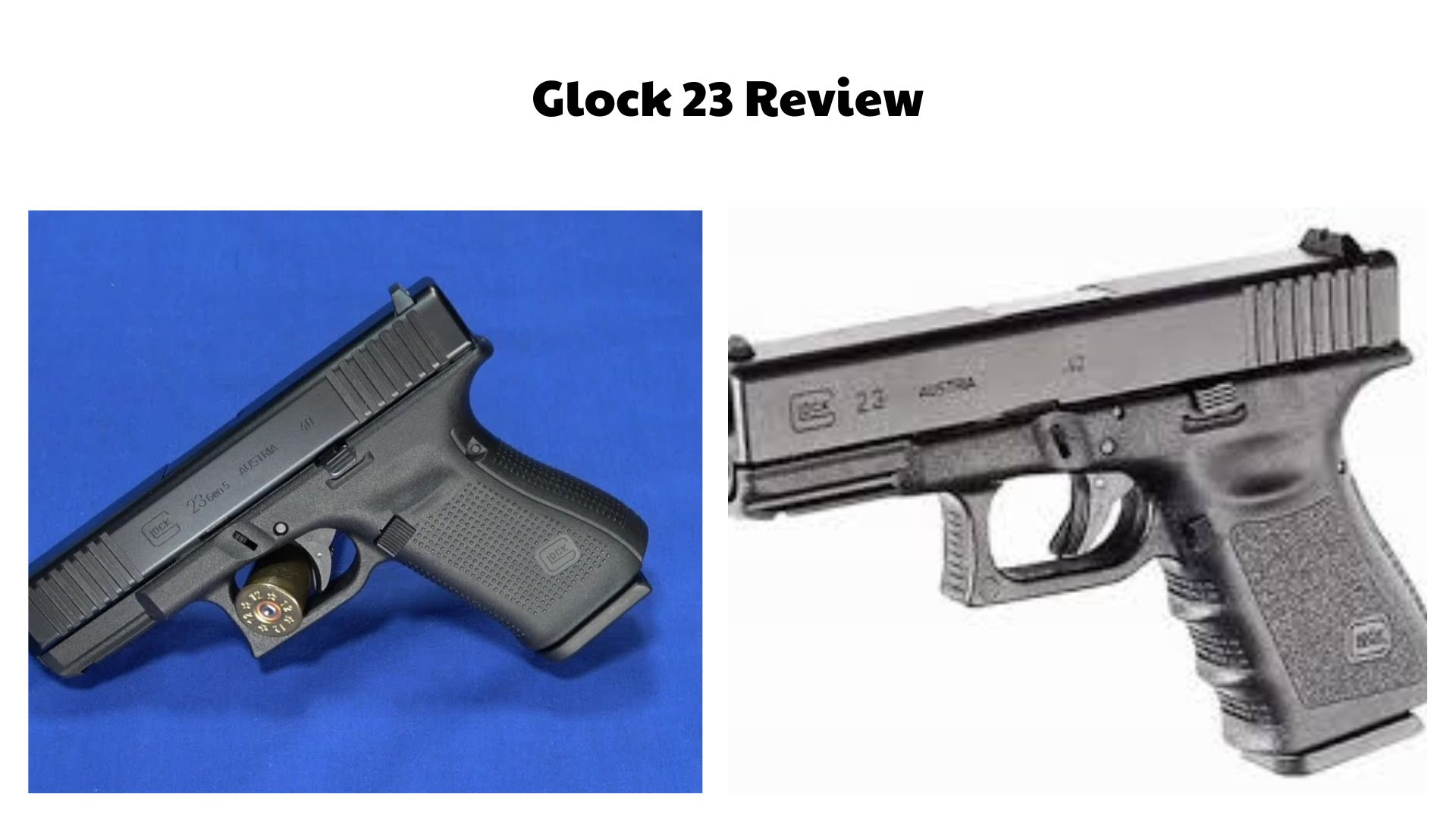

The Glock 23 is a compact, striker-fired pistol chambered in .40 S&W, designed as a mid-size defensive handgun that balances stopping power, concealability, and reliability. It is essentially the .40 caliber counterpart to the Glock 19, sharing a similar frame size but delivering more powerful ballistics.
Widely used by law enforcement and civilian shooters, the Glock 23 is known for its simplicity, rugged construction, and consistent performance under demanding conditions.
Despite the growing dominance of 9mm pistols, the Glock 23 remains popular due to its balance of firepower and size. The .40 S&W cartridge offers increased energy and stopping power compared to standard 9mm loads, making it attractive for defensive use.
Its compact frame also makes it suitable for concealed carry while still providing a full grip for improved control. Combined with Glock’s reputation for reliability, the G23 continues to be a trusted option for many shooters.
History and Platform Overview
Development of the Glock 23 in the .40 S&W Era
The Glock 23 was introduced during the rise of the .40 S&W cartridge in the late 1980s and early 1990s, when law enforcement agencies were seeking a balance between 9mm capacity and .45 ACP stopping power.
Glock designed the Model 23 as a compact duty pistol that could deliver higher energy performance while maintaining manageable recoil and magazine capacity. It quickly became a standard issue sidearm for many agencies.
Law Enforcement Adoption and Civilian Use
The Glock 23 saw widespread adoption in law enforcement due to its reliability, ease of training, and consistent performance. Many departments chose it as a standard-issue sidearm in .40 S&W for patrol officers and detectives.
In the civilian market, it gained popularity among concealed carriers who wanted more stopping power than 9mm compact pistols without moving to a full-size handgun.
Evolution Across Generations (Gen 3, Gen 4, Gen 5)
The Glock 23 has evolved through multiple generations, each improving ergonomics, reliability, and user customization. The Gen 3 models are known for simplicity and durability, while Gen 4 introduced interchangeable backstraps and improved recoil systems.
Gen 5 models bring further refinements such as an improved trigger, enhanced barrel design, ambidextrous slide stop, and updated finish technology, making the platform more modern and user-friendly.
Design and Build Quality
Polymer Frame and Steel Slide Construction
The Glock 23 uses a high-strength polymer frame paired with a steel slide, a design that prioritizes durability and weight reduction. This combination allows the pistol to withstand harsh environments while remaining lightweight enough for daily carry.
The simplicity of the design also reduces the number of moving parts, contributing to Glock’s reputation for mechanical reliability.
Compact Frame Dimensions and Concealability
As a compact handgun, the Glock 23 offers a balance between concealability and shootability. Its shorter slide and grip compared to full-size models make it easier to carry concealed, while still allowing a full firing grip for most users.
This makes it a practical choice for concealed carriers who want a duty-capable handgun in a more compact form factor.
Finish Durability (nDLC / Tenifer Coating)
Glock’s slide finish is designed for extreme durability and corrosion resistance. Earlier generations used Tenifer treatment, while newer models utilize nDLC coating, which improves wear resistance and reduces friction.
These finishes help the Glock 23 perform reliably in harsh environments, including moisture, dirt, and high-round-count training conditions.
Ergonomic Improvements in Newer Generations
Over time, Glock has improved the ergonomics of the Model 23 to enhance shooter comfort and control. Gen 4 and Gen 5 models feature modular backstraps, refined grip textures, and improved finger grooves or groove-free options depending on generation.
These updates help the pistol accommodate a wider range of hand sizes while improving overall shooting comfort and control during rapid fire.
Key Specifications of the Glock 23
Caliber, Capacity, and Barrel Length (.40 S&W, 13+1, ~4.02” Barrel)
The Glock 23 is chambered in .40 S&W, a cartridge designed to offer a balance between 9mm capacity and .45 ACP stopping power. It typically features a standard magazine capacity of 13+1 rounds, making it a compact yet powerful defensive option.
The barrel length is approximately 4.02 inches, which provides a good balance between concealability and ballistic performance. This setup makes the Glock 23 suitable for both concealed carry and duty use.
Striker-Fired Safe Action System Overview
The Glock 23 utilizes Glock’s well-known Safe Action system, a striker-fired mechanism that uses three passive safety systems. These include a trigger safety, firing pin safety, and drop safety, all working together to prevent accidental discharge unless the trigger is intentionally pressed.
This system eliminates the need for external safeties or decockers, simplifying operation and ensuring a consistent trigger pull for every shot.
Weight, Size, and Carry Profile
The Glock 23 is classified as a compact pistol, offering a balance between concealability and shootability. Its polymer frame helps keep weight relatively low, making it comfortable for everyday carry.
While slightly heavier than smaller subcompact models, it provides a full firing grip and better recoil control, making it more practical for defensive shooting scenarios.
Accessory Rail and Optics Compatibility (Gen 5 MOS Variants)
Modern Glock 23 models include an accessory rail, allowing users to mount lights, lasers, or other tactical accessories. This enhances its usability in low-light or home defense situations.
Gen 5 MOS (Modular Optic System) variants also support red dot optics mounting, giving shooters the ability to improve target acquisition speed and accuracy with modern sighting systems.
Trigger Performance
Trigger Pull Weight and Break Characteristics
The Glock 23 trigger typically features a pull weight in the range of approximately 5.5 to 6 pounds in stock configuration. The break is consistent but relatively utilitarian, designed for safety and reliability rather than competition-level refinement.
While not considered a “crisp” trigger by performance shooting standards, it is predictable and easy to learn with practice.
Reset Speed and Shooting Consistency
The trigger reset on the Glock 23 is short and tactile, allowing for relatively fast follow-up shots once the shooter becomes familiar with the system. This contributes to consistent shooting rhythm during defensive or training scenarios.
Many shooters appreciate the audible and tactile reset, which helps maintain control during rapid fire.
Comparison to Other Glock Triggers
Compared to other Glock models, the Glock 23 trigger is largely similar in design and feel, with only minor differences depending on generation. Gen 5 models tend to have a slightly smoother pull and improved consistency.
Overall, Glock triggers are known for their uniformity across the lineup, and the G23 follows this philosophy closely.
Real-World Shooter Feedback on Trigger Feel
User feedback on the Glock 23 trigger is generally positive in terms of reliability and predictability, but mixed when it comes to refinement. Many shooters describe it as “functional but not refined.”
With training, most users adapt quickly and find it suitable for defensive use, though some choose aftermarket trigger upgrades for improved feel.
Accuracy and Shooting Performance
Defensive Distance Accuracy (3–15 Yards)
At typical defensive distances, the Glock 23 performs very well, allowing shooters to achieve consistent center-mass hits with minimal difficulty. Its compact size and manageable recoil contribute to practical accuracy in close-range scenarios.
For trained shooters, accuracy remains consistent and dependable under stress-based shooting conditions.
Range Performance and Grouping Consistency
At extended ranges (15–25 yards), the Glock 23 is capable of producing solid grouping consistency for a compact .40 S&W pistol. Accuracy is largely dependent on shooter skill and trigger control rather than mechanical limitations.
Its inherent design prioritizes reliability over match-grade precision, but it still performs well for recreational and defensive training.
Recoil Behavior of .40 S&W vs 9mm Platforms
The .40 S&W cartridge produces noticeably more recoil than 9mm, resulting in a sharper and more pronounced muzzle rise. However, the Glock 23’s polymer frame and ergonomic design help mitigate some of this recoil.
Shooters transitioning from 9mm may require additional training to maintain fast follow-up shots, but experienced users often appreciate the increased energy of the round.
Role of Barrel and Sights in Precision Shooting
The Glock 23 uses a standard Glock barrel and factory sights, which are designed for durability and quick target acquisition rather than precision competition shooting.
Upgrading to aftermarket barrels or improved sight systems (such as fiber optic or night sights) can enhance precision and visibility, especially in low-light conditions or longer-range shooting.
Reliability and Durability
Long-Term Reliability Under High Round Counts
The Glock 23 is widely recognized for its long-term reliability, even under high round counts. Many users and law enforcement agencies report thousands to tens of thousands of rounds fired with minimal malfunctions when properly maintained.
Its simple striker-fired design, combined with tight manufacturing tolerances and durable materials, helps ensure consistent performance over extended use. This reputation is one of the primary reasons Glock pistols remain a standard in duty and defensive roles.
Ammunition Compatibility and Cycling Performance
The Glock 23 is designed to function reliably with a wide range of .40 S&W ammunition, including standard FMJ training rounds and most modern hollow-point defensive loads.
Cycling performance is generally strong, with the pistol reliably feeding and ejecting when using quality magazines and ammunition. Some users note that lighter or underpowered reloads may occasionally affect cycling, but factory ammunition typically runs without issue.
Performance in Harsh Conditions and Duty Use
One of the Glock 23’s strongest attributes is its ability to perform in adverse conditions. It is known to function reliably in environments involving dirt, dust, moisture, and temperature extremes.
This durability has made it a popular choice among law enforcement and military users, where reliability under stress is critical. The polymer frame and corrosion-resistant finish further enhance its resilience.
Maintenance Requirements and Longevity
The Glock 23 is relatively low-maintenance compared to many other handguns. Regular cleaning and light lubrication are typically sufficient to maintain optimal performance.
Its simplified internal design reduces wear points, contributing to long service life. With proper care, the pistol can remain fully functional for decades of use.
Pros and Cons of the Glock 23
Key Advantages (Reliability, Simplicity, Power, Durability)
The Glock 23 offers several major advantages that have contributed to its long-standing popularity. Its reliability is outstanding, with a proven track record in both civilian and law enforcement use.
The simple striker-fired design makes it easy to operate and maintain, even for less experienced shooters. Chambering in .40 S&W provides increased stopping power compared to 9mm, while still maintaining a compact form factor.
Durability is another strong point, with the pistol capable of withstanding harsh environments and heavy use over time.
Main Drawbacks (Recoil, Capacity vs 9mm, Trigger Feel)
Despite its strengths, the Glock 23 does have some drawbacks. The .40 S&W cartridge produces noticeably more recoil than 9mm, which can make rapid follow-up shots more challenging for some shooters.
Magazine capacity is also slightly lower compared to similar 9mm platforms like the Glock 19, which may influence some users toward higher-capacity alternatives.
Additionally, the factory trigger is often described as functional but not refined, lacking the smoothness or crisp break found in performance-oriented or upgraded systems.
Glock 23 vs Competitors
Comparison with Glock 19 (9mm Equivalent Platform)
The Glock 19 is often considered the direct counterpart to the Glock 23, sharing nearly identical dimensions but chambered in 9mm. The main difference lies in caliber performance versus controllability.
The Glock 23 delivers more energy and stopping power due to the .40 S&W cartridge, but this comes with increased recoil and slightly reduced magazine capacity. The Glock 19, on the other hand, offers softer recoil, higher capacity, and cheaper ammunition, making it more popular for training and defensive use today.
In practical terms, the Glock 19 is often favored for ease of shooting, while the Glock 23 appeals to shooters who prioritize .40 caliber performance.
Comparison with Smith & Wesson M&P40
The Smith & Wesson M&P40 is one of the Glock 23’s closest competitors in the .40 S&W compact category. It offers more ergonomic grip options and a slightly different trigger feel, which some shooters find more comfortable.
However, the Glock 23 generally maintains an edge in long-term reliability and simplicity of maintenance. The M&P40 may feel more refined in hand, but Glock’s reputation for durability and consistency remains a key advantage.
Comparison with Sig Sauer P229
The Sig Sauer P229 is a premium metal-framed compact pistol available in .40 S&W and is often considered a higher-end alternative to the Glock 23. It offers superior trigger refinement in double-action/single-action configuration and excellent build quality.
However, the P229 is heavier, more complex, and typically more expensive to maintain. The Glock 23 focuses on simplicity and reliability, while the Sig P229 emphasizes refinement and traditional craftsmanship.
Position in the Modern Compact .40 S&W Market
In today’s market, the Glock 23 remains one of the most recognizable compact .40 S&W pistols, though the overall popularity of the caliber has declined in favor of 9mm platforms.
Despite this shift, the Glock 23 continues to hold a strong position among users who prefer .40 S&W for its increased stopping power and proven law enforcement heritage.
Final Verdict
Is the Glock 23 Still Worth It Today?
Yes, the Glock 23 is still worth considering today, especially for shooters who value .40 S&W performance in a compact and reliable platform. While 9mm pistols dominate modern markets due to lower recoil and higher capacity, the Glock 23 continues to offer a proven balance of power and durability.
Its long track record in law enforcement and civilian use supports its reputation as a dependable defensive handgun, even if it is no longer the most popular choice in its category.
Who Should Buy the Glock 23?
The Glock 23 is best suited for shooters who specifically want the added energy of .40 S&W in a compact platform. It is also a strong choice for those who already prefer Glock systems and want a reliable defensive pistol with a bit more stopping power than 9mm.
It is less ideal for new shooters or those prioritizing low recoil and high-capacity training platforms. However, for experienced users comfortable with .40 S&W, it remains a solid and trustworthy option.
Frequently Asked Questions (FAQ) – Glock 23
1. What is the Glock 23 used for?
The Glock 23 is primarily used as a compact defensive handgun. It is widely carried by law enforcement officers, concealed carriers, and civilian shooters who want a balance between firepower and manageable size. Chambered in .40 S&W, it is designed for self-defense, duty use, and range training rather than competition shooting.
2. What caliber is the Glock 23?
The Glock 23 is chambered in .40 S&W (Smith & Wesson). This cartridge was developed to offer greater stopping power than 9mm while maintaining a similar platform size and capacity.
3. How many rounds does the Glock 23 hold?
Standard magazine capacity for the Glock 23 is 13+1 rounds. Extended magazines are also available, but 13 rounds remains the standard configuration for compact carry.
4. Is the Glock 23 good for concealed carry?
Yes, the Glock 23 is widely used for concealed carry. Its compact size allows it to be hidden under clothing while still offering a full grip and substantial firepower. However, it is slightly larger and heavier than subcompact pistols.
5. Is the Glock 23 reliable?
The Glock 23 is considered extremely reliable. It has a strong reputation for functioning in harsh environments, with minimal maintenance required. Law enforcement adoption further reinforces its reliability record.
6. Does the Glock 23 jam often?
No, the Glock 23 does not typically jam when properly maintained and used with quality ammunition. Most malfunctions are rare and often related to magazines or ammunition rather than the firearm itself.
7. Is the Glock 23 good for beginners?
It can be used by beginners, but it may not be ideal due to the increased recoil of .40 S&W. Many new shooters find 9mm pistols easier to learn with before transitioning to .40 caliber platforms.
8. How strong is the recoil on the Glock 23?
Recoil is moderate to strong compared to 9mm pistols. The .40 S&W cartridge produces a sharper recoil impulse, but the Glock 23’s design helps keep it manageable with proper grip and technique.
9. What is the difference between Glock 19 and Glock 23?
The main difference is caliber. The Glock 19 is chambered in 9mm, while the Glock 23 is chambered in .40 S&W. The Glock 23 offers more stopping power, while the Glock 19 offers higher capacity, lower recoil, and cheaper ammunition.
10. Is .40 S&W better than 9mm?
.40 S&W offers more energy per shot, but 9mm has lower recoil, higher capacity, and better control. In modern defensive use, many shooters prefer 9mm due to its balance of performance and shootability.
11. Is the Glock 23 still relevant today?
Yes, although 9mm pistols dominate the market, the Glock 23 remains relevant for users who prefer .40 S&W performance and want a proven, durable compact handgun.
12. What generation Glock 23 is best?
Gen 5 models are generally considered the most refined due to improved trigger systems, enhanced barrels, and better ergonomics. However, Gen 3 and Gen 4 models are still widely used and trusted.
13. Does Glock 23 have a safety?
It does not have a manual external safety. Instead, it uses Glock’s Safe Action System, which includes internal safeties such as a trigger safety, firing pin safety, and drop safety.
14. Is the Glock 23 striker-fired?
Yes, the Glock 23 is a striker-fired pistol. This means it does not use a traditional hammer and provides a consistent trigger pull for every shot.
15. How accurate is the Glock 23?
The Glock 23 is accurate enough for defensive and duty use. At typical engagement distances (3–15 yards), it performs very well, with accuracy depending more on shooter skill than mechanical limitations.
16. What is the barrel length of the Glock 23?
The barrel length is approximately 4.02 inches, which provides a balance between concealability and ballistic performance.
17. Can the Glock 23 use extended magazines?
Yes, extended magazines are available and can increase capacity beyond the standard 13 rounds. These are often used for range training or duty backup magazines.
18. Is the Glock 23 good for home defense?
Yes, it is a strong home defense option due to its reliability, stopping power, and ease of operation. Many users pair it with a weapon light for low-light defense situations.
19. Does the Glock 23 support optics?
Gen 5 MOS versions support optics through a modular mounting system, allowing red dot sights to be installed for improved target acquisition.
20. Is the Glock 23 heavy?
It is moderately light due to its polymer frame, but heavier than subcompact pistols. The weight helps reduce recoil and improve shooting stability.
21. What magazines fit Glock 23?
It uses Glock .40 S&W magazines designed for the compact frame. Some compatibility exists with other Glock .40 models depending on configuration.
22. Is the Glock 23 easy to maintain?
Yes, it is very easy to maintain. Regular cleaning and light lubrication are sufficient for long-term reliability.
23. How long does a Glock 23 last?
With proper care, a Glock 23 can last tens of thousands of rounds. Its durability is one of its most well-known features.
24. Can the Glock 23 shoot +P ammo?
Yes, it can handle +P .40 S&W ammunition, but frequent use is generally not recommended as it may increase wear over time.
25. Is Glock 23 good for law enforcement?
Yes, it has been widely used by law enforcement agencies due to its reliability and stopping power.
26. Is Glock 23 better than Glock 22?
The Glock 23 is more compact than the Glock 22, making it better for concealed carry, while the Glock 22 offers higher capacity and a larger frame for duty use.
27. What is the trigger pull weight?
The Glock 23 typically has a trigger pull weight around 5.5 to 6 pounds in factory configuration.
28. Is the trigger good?
The trigger is reliable and consistent but not considered highly refined. Many users upgrade it for smoother performance.
29. Does Glock 23 have aftermarket support?
Yes, Glock has one of the largest aftermarket ecosystems in the firearms industry, including triggers, sights, barrels, and holsters.
30. Is Glock 23 good for women?
Yes, but recoil in .40 S&W may be more challenging for some users. Proper training and grip technique are important.
31. What is the best ammo for Glock 23?
Quality 180gr or 165gr .40 S&W defensive hollow points are commonly used for self-defense, while FMJ rounds are used for training.
32. Does Glock 23 rust?
It is highly resistant to rust due to its protective finish, but regular cleaning is still recommended.
33. Is Glock 23 good for duty carry?
Yes, it has a strong history of duty use in law enforcement agencies.
34. Is Glock 23 better than revolvers?
It offers higher capacity, faster reloads, and more modern ergonomics compared to revolvers, but revolvers are simpler mechanically.
35. Can Glock 23 be concealed easily?
Yes, with proper holster selection and clothing, it can be concealed effectively despite its compact size.
36. What holster is best for Glock 23?
Quality IWB or OWB holsters designed specifically for the Glock 23 provide the best retention, comfort, and accessibility.
37. Is Glock 23 good for shooting practice?
Yes, it is widely used for range training and defensive practice.
38. Does Glock 23 have recoil reduction features?
It does not have mechanical recoil reduction systems, but its frame design helps manage recoil effectively.
39. Is Glock 23 snappy?
Yes, compared to 9mm pistols, it has a sharper recoil impulse due to the .40 S&W cartridge.
40. Is Glock 23 outdated?
It is not outdated, but it is less popular today due to the rise of 9mm pistols.
41. Is Glock 23 good for survival use?
Yes, it is reliable and durable enough for emergency preparedness and survival scenarios.
42. How often should Glock 23 be cleaned?
Cleaning after every range session is recommended, especially under heavy use conditions.
43. Is Glock 23 better than Sig P229?
The Glock 23 is simpler and lighter, while the Sig P229 offers a more refined metal-frame experience and DA/SA trigger system.
44. Is Glock 23 easy to shoot?
It is moderately easy to shoot but requires more recoil control than 9mm pistols.
45. What makes Glock 23 popular?
Its combination of reliability, stopping power, and compact size has made it popular among law enforcement and civilian shooters.
46. Can Glock 23 be upgraded?
Yes, it supports a wide range of aftermarket upgrades including sights, triggers, barrels, and grip enhancements.
47. Is Glock 23 good for tactical use?
Yes, it is suitable for tactical applications when paired with accessories like lights and optics.
48. Does Glock 23 come with accessories?
Standard packages typically include magazines, a loader, cleaning tools, and documentation depending on the dealer.
49. Is Glock 23 good for long shooting sessions?
Yes, but .40 S&W recoil may cause more fatigue compared to 9mm during extended sessions.
50. Final question: Is Glock 23 worth it?
Yes, the Glock 23 is still worth it for users who want a reliable compact .40 S&W pistol with proven durability and strong defensive capabilities, even in today’s 9mm-dominated market.
Read more: