
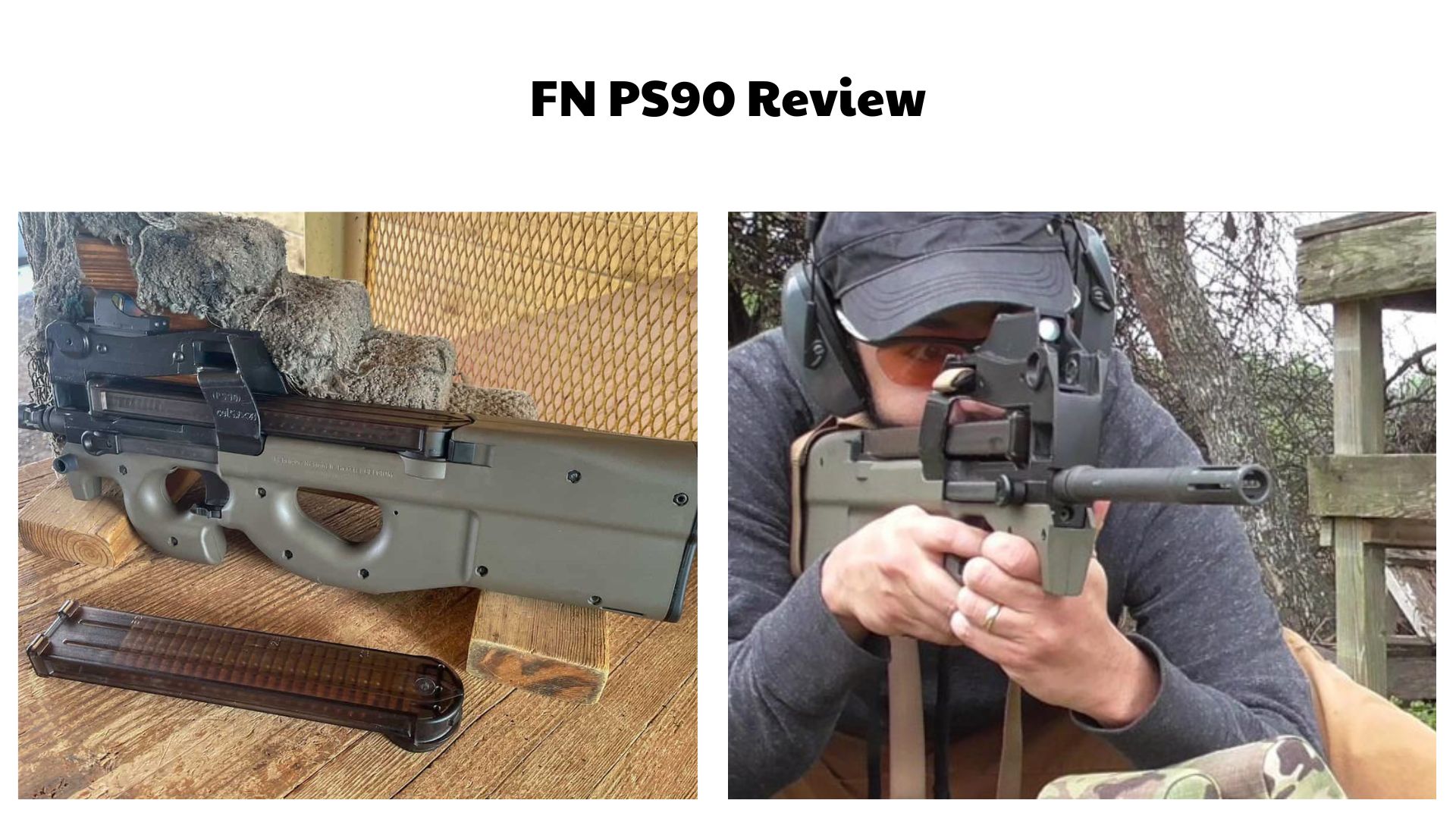

The FN PS90 is widely regarded as one of the most distinctive and futuristic-looking civilian carbines ever produced. Built around FN Herstal’s proven military P90 platform, it brings the same core design philosophy into a semi-automatic, civilian-legal configuration. Its most recognizable features include a compact bullpup layout, a fully ambidextrous control scheme, and a unique top-mounted 50-round magazine that feeds the proprietary 5.7×28mm cartridge.
Unlike traditional carbines that follow AR-15 or rifle-style architectures, the PS90 prioritizes compactness, control, and high-capacity feeding in a streamlined package. The bullpup configuration places the action and magazine behind the trigger, allowing a full-length barrel in a much shorter overall weapon profile. This design significantly improves maneuverability in tight environments without sacrificing ballistic performance.
Originally engineered as a Personal Defense Weapon (PDW) for military and law enforcement use, the PS90 was adapted for civilian ownership while retaining much of its original DNA. FN Herstal achieved this by converting the fully automatic P90 platform into a semi-automatic rifle, adjusting internal components while preserving the signature feeding system and ergonomics.
Today, the FN PS90 is popular among enthusiasts who value innovation, collectors attracted to its iconic design, and defensive shooters who appreciate its low recoil and high magazine capacity. Its combination of lightweight handling, extreme compactness, and unusual aesthetics makes it one of the most recognizable modern firearms in the world.
Overview of the FN PS90
What is the FN PS90?
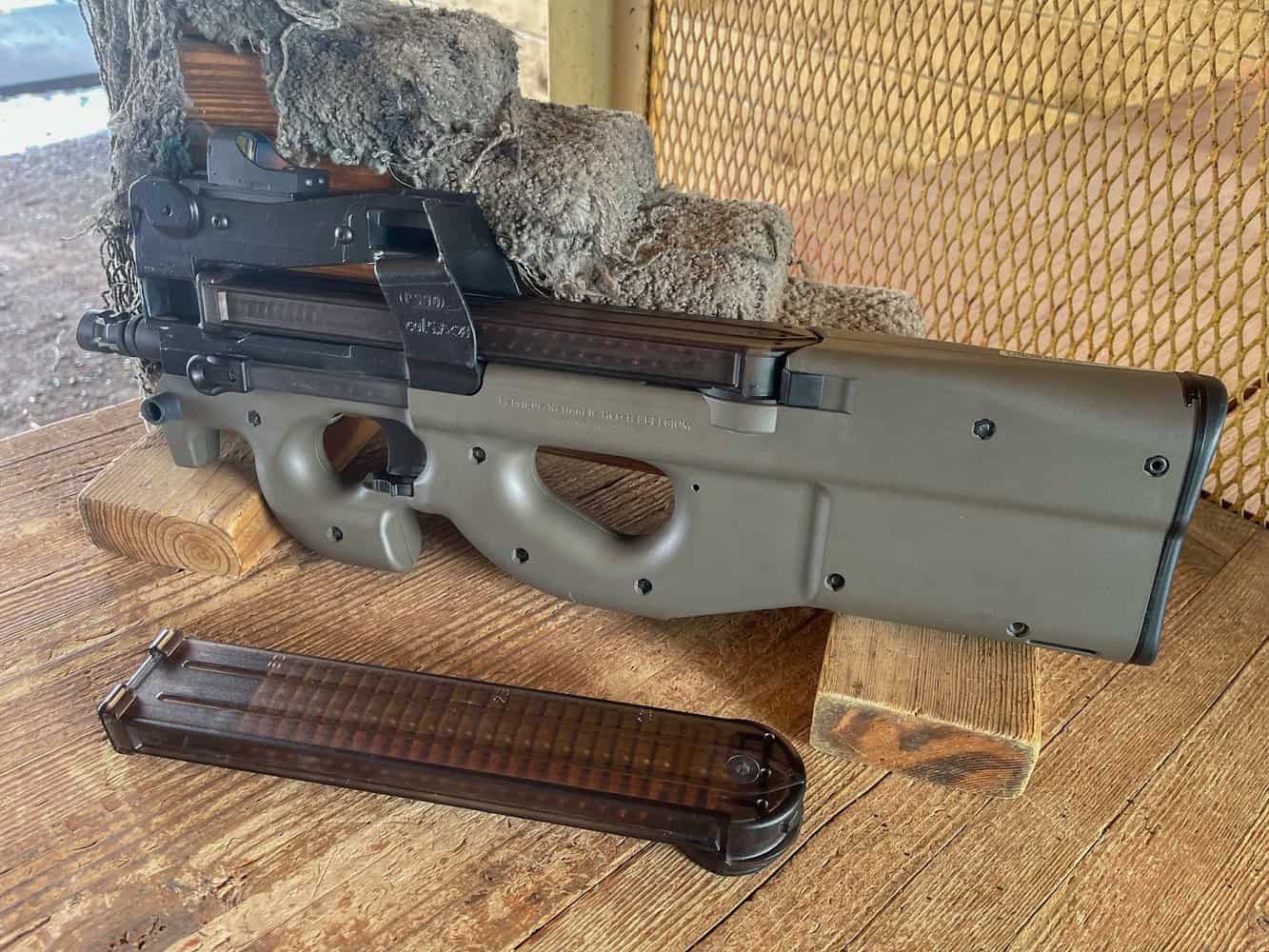
The FN PS90 is a civilian semi-automatic bullpup carbine chambered in 5.7×28mm. It is the commercial version of FN’s military P90 PDW, redesigned to comply with civilian firearm regulations while maintaining much of the original platform’s performance characteristics. It is known for its compact footprint, high-capacity magazine, and fully ambidextrous layout.
Origin and development from the FN P90 platform
The PS90 is directly derived from the FN P90, which was developed in the late 1980s by FN Herstal as a Personal Defense Weapon for military support personnel. The goal was to create a compact firearm capable of defeating body armor while being easier to handle than traditional submachine guns. The civilian PS90 retains the same core architecture but is configured for semi-automatic operation.
Purpose: personal defense weapon adapted for civilian use
While the original P90 was designed for military close-quarters combat, the PS90 serves a similar purpose in civilian contexts such as home defense and recreational shooting. Its low recoil, compact size, and high magazine capacity make it well-suited for controlled environments where maneuverability and fast follow-up shots are important.
Why the PS90 stands out in modern rifle design
The PS90 stands out because it breaks away from conventional rifle design norms. Its top-mounted magazine, downward-ejecting system, and fully ambidextrous controls are rarely seen in other civilian firearms. Combined with its futuristic aesthetic and polymer construction, it offers a shooting experience that feels fundamentally different from AR-15 or traditional rifle platforms.
Market position in the bullpup carbine segment
In the bullpup carbine market, the PS90 occupies a premium and highly specialized position. It is not a budget or entry-level firearm; instead, it is considered a niche, high-end platform aimed at enthusiasts, collectors, and shooters seeking something unique. Its closest competitors are other bullpup rifles like the Tavor series or AUG platforms, though none replicate its magazine system or caliber.
Design and Build Quality
Bullpup configuration and compact layout
The PS90 uses a bullpup design where the action and magazine are located behind the trigger assembly. This allows the rifle to maintain a full-length barrel while significantly reducing overall length. The result is a compact firearm that retains ballistic efficiency while being easier to maneuver in tight spaces such as vehicles or indoor environments.
Polymer clamshell receiver construction
The PS90 features a unique polymer clamshell receiver that encloses the internal components. This construction method reduces weight while maintaining structural rigidity. It also contributes to the rifle’s distinctive futuristic appearance, as most of the firearm’s internal mechanics are hidden within a smooth, enclosed shell.
Integrated top rail and sight bridge design
The top of the PS90 incorporates an integrated sight bridge and Picatinny rail system, allowing users to mount optics directly above the barrel. This alignment helps maintain a consistent sight picture and ensures proper cheek weld despite the bullpup configuration. It also supports modern red dot and holographic sight setups.
Overall length vs barrel length comparison (PS90 vs SBR variants)
One of the key advantages of the PS90 design is its efficient use of barrel length relative to overall size. The standard civilian PS90 features a barrel significantly longer than its compact frame suggests, providing better velocity and accuracy than many similarly sized carbines. Short-barrel rifle (SBR) variants further reduce length, though at the cost of ballistic performance.
Weight distribution and balance characteristics
The PS90 has a rear-biased weight distribution due to its bullpup layout. With the magazine and action positioned behind the trigger, the rifle feels balanced closer to the shooter’s shoulder. This improves handling in tight spaces and reduces perceived barrel weight during extended use.
Fit and finish of FN manufacturing standards
FN Herstal is known for high manufacturing standards, and the PS90 reflects this reputation. The rifle features tight assembly tolerances, durable polymer construction, and consistent finishing across components. While its appearance is unconventional, its build quality is generally considered robust and reliable for long-term use.
Action System and Operating Mechanism
Straight blowback semi-automatic system
The PS90 operates using a straight blowback system, meaning the bolt is held closed by spring pressure and bolt mass rather than a locking mechanism. Upon firing, gas pressure forces the bolt rearward, cycling the action and chambering the next round. This system contributes to mechanical simplicity and reliability.
Closed-bolt operation characteristics
Unlike many submachine gun designs, the PS90 operates from a closed bolt in semi-automatic mode. This improves first-shot accuracy and consistency because the bolt is already forward and locked into battery before firing. It also reduces movement during trigger pull.
Dual guide rod recoil system
The PS90 uses a dual guide rod recoil system that helps stabilize bolt movement during cycling. This design reduces wear on internal components and ensures smoother operation compared to simpler blowback systems.
Charging mechanism and bolt cycling behavior
The charging handles on the PS90 allow the shooter to manually cycle the bolt. When the trigger is pulled, the bolt cycles rapidly due to the lightweight 5.7×28mm cartridge and blowback system, resulting in fast follow-up shots and minimal delay between rounds.
Recoil spring strength and cycling speed
The recoil spring system is tuned to balance cycling reliability and recoil control. Because the 5.7×28mm cartridge produces relatively low recoil energy, the cycling speed is fast but controlled, allowing for rapid semi-automatic fire with minimal muzzle disruption.
Magazine System and Feeding Mechanism
50-round horizontal magazine design
One of the PS90’s most iconic features is its 50-round horizontal magazine mounted on top of the receiver. This design allows for extremely high capacity while maintaining a compact footprint. The magazine feeds cartridges sideways before rotating them into the chamber.
30-round and 10-round magazine variants
For compliance or training purposes, FN also offers reduced-capacity magazines, including 30-round and 10-round versions. These provide legal flexibility in restricted regions while maintaining the same feeding mechanism.
90-degree cartridge rotation feeding system
The PS90 uses a unique system where cartridges are stored horizontally and rotated 90 degrees before chambering. This complex feeding process is a defining feature of the platform and enables the use of a high-capacity, low-profile magazine.
Magazine loading and insertion method
Loading the PS90 magazine involves inserting rounds from the top in a continuous stack. The magazine is then placed into the top-mounted feed system, locking into position above the barrel line. While unconventional, it becomes intuitive with practice.
Magazine durability and transparency advantages
The PS90 magazine is constructed from durable polymer and is partially transparent, allowing shooters to visually monitor remaining ammunition. This is especially useful given the high capacity and unique loading method.
Feeding reliability in high-round-count shooting
When properly maintained, the PS90 magazine system is highly reliable even during extended firing sessions. Its internal feed geometry is designed to minimize jams, though proper loading technique is important for optimal performance.
Controls and Ergonomics
Fully ambidextrous control layout
The PS90 is fully ambidextrous, making it equally usable for left- and right-handed shooters. This includes symmetrical controls and a downward-ejecting system that prevents spent casings from interfering with either shooting side.
Dual charging handles
The rifle features dual charging handles located on both sides of the receiver. These allow easy manipulation regardless of shooting hand preference and improve accessibility in tactical or emergency scenarios.
Trigger-guard mounted safety system
The safety is integrated within the trigger guard area, allowing quick access without removing the firing hand from the grip. This design is consistent with FN’s focus on compact, intuitive control placement.
Magazine release mechanism and usability
The magazine release is located near the rear of the magazine housing and requires a different manipulation style compared to AR platforms. While secure and reliable, it can require training to operate efficiently under stress.
Downward ejection system and left-handed shooting advantage
The PS90 ejects spent casings downward through a chute beneath the rifle. This makes it exceptionally friendly for left-handed shooters and allows consistent operation without brass interference, a rare feature in civilian rifles.
Manual of arms learning curve
Due to its unconventional magazine system and control layout, the PS90 has a noticeable learning curve. Shooters transitioning from AR or traditional rifles may need training to fully adapt to its reload and manipulation procedures.
Trigger Performance
Bullpup trigger linkage system
The FN PS90 uses a bullpup trigger linkage system because the trigger is located far forward of the actual firing mechanism. A series of mechanical linkages connects the trigger to the sear group located in the rear of the receiver. This design is necessary for bullpup configurations but inherently introduces additional travel and mechanical complexity compared to traditional rifle triggers.
Trigger pull weight and feel
The trigger pull on the PS90 is often described as heavier and less crisp than AR-15 triggers. This is largely due to the extended linkage system and internal mechanical friction. While functional and consistent, it does not deliver the same clean break that many modern tactical shooters expect from match-grade AR platforms.
Reset characteristics and consistency
The trigger reset on the PS90 is longer and less tactile compared to AR-style systems. Shooters may notice a less pronounced reset point, which can affect rapid semi-automatic firing rhythm. However, the system remains reliable and predictable once the shooter becomes familiar with it.
Aftermarket trigger upgrades and modifications
Aftermarket support for PS90 trigger improvements is limited but does exist. Some users opt for trigger polishing, spring modifications, or specialized upgrade kits to improve pull weight and smoothness. However, modifications must be done carefully to preserve reliability and safety due to the firearm’s unique internal geometry.
Comparison to AR-15 trigger systems
Compared to AR-15 triggers, the PS90 trigger is generally considered inferior in terms of crispness, weight, and reset speed. However, this is a common trade-off in bullpup designs. While AR platforms benefit from direct mechanical linkage, the PS90 prioritizes compactness and ambidextrous functionality over trigger refinement.
Barrel, Caliber, and Ballistics
5.7×28mm cartridge overview
The PS90 is chambered in the 5.7×28mm cartridge, a high-velocity, small-caliber round originally developed by FN Herstal. It is designed for flat trajectory performance, low recoil, and improved penetration compared to traditional pistol calibers. Its lightweight projectile allows for high magazine capacity and fast follow-up shots.
Barrel length and velocity performance
The PS90 features a relatively long barrel for its compact size, which significantly improves velocity performance for the 5.7×28mm round. The extended barrel allows the cartridge to achieve higher muzzle velocities, enhancing range, accuracy, and terminal performance compared to shorter-barreled platforms.
Armor penetration and defensive capabilities
One of the most debated aspects of the 5.7×28mm cartridge is its ability to penetrate certain types of soft body armor. While civilian ammunition varies in performance, the round is known for its high velocity and ability to outperform many traditional handgun calibers in defensive scenarios.
Flat trajectory advantages
The 5.7×28mm cartridge produces a very flat trajectory, meaning the bullet drops less over distance compared to heavier pistol rounds. This makes the PS90 easier to shoot accurately at varying distances, particularly within typical defensive engagement ranges.
Ammunition types (FMJ, SS197, SS195, etc.)
Common ammunition options for the PS90 include FN SS195LF, SS197SR, and various FMJ loads. Each variant offers different performance characteristics in terms of velocity, expansion, and penetration. Shooters often choose ammunition based on intended use, such as defense or range training.
Effective range and real-world ballistics
The PS90 is generally effective out to 200–250 yards in practical use, though its optimal performance is within closer defensive distances. The combination of velocity and lightweight projectile allows for accurate shooting at ranges where many pistol-caliber carbines begin to lose effectiveness.
Accuracy and Shooting Performance
Accuracy potential (close to mid-range performance)
The FN PS90 offers solid accuracy for a compact bullpup platform. While not designed as a precision rifle, it performs very well within close to mid-range distances. Its long barrel relative to overall size contributes to stable ballistic performance.
Practical grouping results (100 yards performance)
At 100 yards, most PS90 rifles are capable of producing respectable groupings suitable for defensive and recreational shooting. Group sizes vary depending on ammunition quality, optics, and shooter skill, but consistent performance is achievable with practice.
Optics vs iron sight performance
While the PS90 can be used with iron sights, most shooters prefer optics due to the rifle’s integrated rail system. Red dot sights and holographic optics significantly improve target acquisition speed and accuracy, especially in dynamic shooting situations.
Stability in rapid fire
The PS90 performs well in rapid fire due to its low recoil and balanced bullpup design. The shooter can maintain sight picture more easily between shots, allowing controlled strings of fire with minimal muzzle disruption.
Shooting comfort and cheek weld quality
Despite its unconventional layout, the PS90 provides a consistent cheek weld due to its integrated top rail and compact stock design. Once properly set up with optics, it offers a stable and repeatable shooting position.
Recoil and Shooting Experience
Extremely low recoil characteristics
One of the most notable features of the PS90 is its extremely low recoil. The lightweight 5.7×28mm cartridge produces minimal rearward force, making the rifle easy to control even during rapid fire.
Blowback system recoil impulse behavior
The straight blowback system creates a unique recoil impulse that is more of a soft push than a sharp kick. This contributes to the firearm’s reputation as one of the easiest rifles to shoot accurately under stress.
Muzzle rise and control during rapid fire
Muzzle rise is minimal due to the inline design and low recoil energy. Shooters can maintain a stable sight picture during rapid firing sequences, improving overall accuracy in dynamic shooting scenarios.
Effect of lightweight 5.7mm cartridge
The 5.7×28mm cartridge plays a major role in recoil reduction. Its small projectile mass and efficient powder charge result in significantly less felt recoil compared to 5.56 NATO or pistol-caliber carbines.
Suppressed shooting behavior and gas dynamics
When suppressed, the PS90 can become louder at the action due to blowback gas cycling. However, recoil remains extremely manageable. Suppressor use may require attention to ammunition selection for optimal cycling reliability.
Reliability and Durability
Long-term reliability reputation
The FN PS90 has a strong reputation for reliability when properly maintained and fed quality ammunition. FN’s engineering ensures consistent cycling under a wide range of conditions, making it suitable for defensive and professional use.
Magazine system reliability performance
The unique top-mounted magazine system is generally reliable, though proper loading technique is critical. Incorrectly loaded magazines can cause feeding issues, while properly loaded ones perform consistently even under high round counts.
Sensitivity to ammunition type
The PS90 can be somewhat sensitive to ammunition variations, particularly lower-quality or underpowered loads. Using recommended factory ammunition helps ensure consistent cycling and reduces the likelihood of malfunctions.
Common cycling issues and causes
When issues do occur, they are often related to magazine loading errors, ammunition inconsistencies, or insufficient lubrication. Mechanical failures are relatively rare in well-maintained rifles.
Break-in period considerations
Some PS90 rifles benefit from a short break-in period where initial cycling smooths out internal components. During this time, reliability typically improves as parts settle into consistent operation.
Maintenance impact on reliability
Regular maintenance plays a significant role in ensuring reliability. Keeping the bolt assembly, chamber, and magazine system clean helps prevent feeding issues and ensures long-term performance.
Maintenance and Cleaning
Field stripping procedure complexity
Field stripping the PS90 is moderately complex compared to traditional rifles due to its enclosed polymer shell design. While not overly difficult, it requires familiarity with FN’s disassembly process and internal layout.
Polymer shell disassembly system
The PS90 uses a clamshell-style polymer housing that encloses the internal components. Disassembly involves separating the shell to access the bolt, recoil system, and magazine feed path.
Bolt and guide rod maintenance
The bolt and dual guide rod system require periodic cleaning and lubrication to ensure smooth cycling. Carbon buildup in these areas can affect reliability if not properly maintained.
Chamber and feed ramp cleaning requirements
The chamber and feed ramp must be kept clean to maintain reliable feeding, especially given the unique cartridge orientation system. Fouling in this area can lead to misfeeds or cycling issues.
Magazine cleaning and care
The magazine should be regularly inspected and cleaned to ensure smooth cartridge rotation and feeding. Dirt or debris inside the magazine can disrupt the 90-degree rotation mechanism.
Long-term wear points
Over time, wear typically appears in high-contact areas such as the bolt face, guide rods, and magazine feed components. With proper maintenance, however, the PS90 is capable of long service life with minimal degradation in performance.
Optics and Sight System
Integrated Picatinny rail bridge
The FN PS90 features an integrated Picatinny rail bridge mounted along the top of the receiver. This rail is structurally connected to the barrel assembly, ensuring a stable and consistent mounting platform for optics. Because it is not mounted on a removable cover or polymer flex point, it maintains zero effectively even under repeated firing and transport.
Original FN optic vs modern red dot setups
Early PS90 configurations were often paired with FN’s proprietary ring-style optic, designed specifically for the platform’s sight height and bullpup geometry. While functional, most modern users prefer red dot or holographic sights, which offer faster target acquisition, better clarity, and improved low-light performance compared to the original optic.
Backup iron sight system limitations
The PS90 includes basic backup iron sights, but they are generally considered secondary to optics. Their compact design and elevated placement make them less intuitive for rapid engagement. As a result, most shooters rely heavily on optics rather than iron sights for practical use.
Optics height and cheek weld alignment
Due to the bullpup design and elevated rail system, optic height plays a significant role in shooting comfort. Proper cheek weld alignment is essential for consistent sight picture. Many users prefer low-profile red dots to maintain a natural head position and reduce strain during extended shooting sessions.
Best optics for PS90 platform
The PS90 performs best with compact red dot sights or holographic optics that offer quick target acquisition and minimal weight. Popular choices include enclosed red dots for durability and holographic sights for fast reticle acquisition. Magnified optics are less common but can be used for extended-range shooting if needed.
Weight, Size, and Handling
Compact bullpup footprint advantages
The PS90’s bullpup configuration significantly reduces its overall footprint while retaining a full-length barrel. This makes it highly maneuverable in confined spaces such as vehicles, hallways, and close-quarters environments without sacrificing ballistic performance.
Weight comparison with AR carbines
Despite its futuristic appearance, the PS90 is relatively lightweight and compares favorably with many AR-15 carbines. Its polymer construction helps reduce weight, making it comfortable for extended carry and handling.
Storage and transport benefits
The compact design of the PS90 makes it easier to store and transport compared to traditional rifles with similar barrel lengths. Its short overall length allows it to fit in smaller cases and storage spaces, making it practical for travel or discreet storage.
Maneuverability in tight spaces
One of the PS90’s biggest advantages is its maneuverability in tight environments. The bullpup layout keeps most of the mass close to the shooter’s body, allowing easier movement around corners, doorways, and confined areas without sacrificing barrel length.
Balance and center of gravity feel
The PS90 has a rear-biased balance due to its magazine and action placement. This results in a unique handling feel where the rifle naturally sits closer to the shooter’s shoulder, improving control during sustained aiming and rapid transitions between targets.
Advantages of the FN PS90
Extremely high magazine capacity
One of the most notable advantages of the PS90 is its 50-round magazine capacity. This significantly reduces the need for frequent reloads and provides a tactical advantage in defensive or sustained shooting scenarios.
Ambidextrous design
The PS90 is fully ambidextrous, making it equally suitable for left- and right-handed shooters. Its downward ejection system ensures that spent casings do not interfere with either shooting orientation.
Low recoil shooting experience
Thanks to the 5.7×28mm cartridge and blowback operation, the PS90 offers extremely low recoil. This makes it easy to control during rapid fire and accessible for shooters of all experience levels.
Compact bullpup platform
The bullpup design allows the PS90 to maintain a full-length barrel while remaining highly compact. This combination enhances maneuverability without sacrificing ballistic performance.
Unique 5.7×28mm performance benefits
The 5.7×28mm cartridge provides a flat trajectory, high velocity, and reduced recoil compared to traditional pistol calibers. This makes it effective for close to mid-range engagements and contributes to overall shooting ease.
Military-inspired reliability
Derived from FN’s military P90 platform, the PS90 inherits a reputation for reliability and durability. Its design has been tested in demanding environments, contributing to strong confidence in its operational consistency.
Disadvantages and Limitations
High ammunition cost
One of the biggest drawbacks of the PS90 is the cost of 5.7×28mm ammunition, which is significantly higher than common rifle or pistol calibers. This can make high-volume training expensive for regular shooters.
Unconventional magazine system learning curve
The top-mounted, horizontally loaded magazine requires a learning curve for new users. Proper loading technique is essential to ensure reliable feeding, and it differs significantly from traditional magazine systems.
Trigger feel limitations
The PS90 trigger is often considered one of its weaker aspects due to the bullpup linkage system. It is heavier and less crisp than most modern AR-15 triggers, which may affect precision shooting performance.
Limited aftermarket support
Compared to AR platforms, the PS90 has limited aftermarket customization options. While some upgrades exist, the ecosystem is relatively small and focused mainly on optics and minor internal enhancements.
Bulkiness despite compact length
Although the PS90 is short in overall length, its wide polymer body and top-mounted magazine make it feel bulkier than expected. This can affect concealability and handling in certain scenarios.
Reloading speed complexity
Reloading the PS90 is more complex and slower compared to AR-style rifles. The unique magazine design and insertion method require practice to perform efficiently under stress.
Ideal Use Cases
Home defense applications
The PS90 is well-suited for home defense due to its low recoil, high capacity, and compact size. Its ability to maneuver easily in confined spaces makes it effective in indoor environments.
Tactical and range training
The platform is also popular for tactical training and recreational range use. Its unique handling characteristics make it a useful tool for developing weapon manipulation skills.
Close-quarters shooting environments
The PS90 excels in close-quarters scenarios where maneuverability and rapid target engagement are important. Its compact bullpup design provides a clear advantage in tight spaces.
Collection and enthusiast ownership
Many owners purchase the PS90 as a collector’s firearm due to its iconic design and historical significance. It is often valued as much for its uniqueness as for its practical application.
Not ideal for long-range precision shooting
While capable at moderate distances, the PS90 is not designed for long-range precision shooting. Its cartridge and platform design are optimized for close to mid-range engagements.
Final Verdict on FN PS90
Overall performance summary
The FN PS90 delivers a highly unique combination of compact design, low recoil, and high-capacity performance. It excels in maneuverability and ease of use while maintaining respectable accuracy and reliability.
Balance between novelty and practicality
The PS90 sits at the intersection of novelty and practicality. While its design is unconventional, it still offers real-world defensive and recreational utility, making it more than just a collector’s piece.
Value for defensive and recreational shooters
For defensive users and range enthusiasts, the PS90 provides strong value in terms of controllability, capacity, and ease of shooting. However, its high ammunition cost may limit extensive training use.
Comparison with AR-15 carbines and PCCs
Compared to AR-15 carbines, the PS90 offers lower recoil and higher magazine capacity but lacks modularity and trigger refinement. Against pistol-caliber carbines, it offers better ballistics and range but at a higher cost and complexity.
Who should buy the FN PS90
The FN PS90 is best suited for shooters who value unique design, low recoil performance, and compact handling. It is ideal for collectors, enthusiasts, and defensive users who want a distinctive platform that stands apart from conventional rifles.
FAQ – FN PS90 Review
1. What is the FN PS90?
The FN PS90 is a civilian semi-automatic bullpup carbine developed by FN Herstal. It is derived from the military P90 Personal Defense Weapon and chambered in 5.7×28mm. The PS90 retains the compact bullpup layout, high-capacity magazine system, and ambidextrous design, making it one of the most unique civilian rifles available today.
2. What does PS90 stand for?
PS90 stands for “Projector System 90” in FN’s naming convention, though it is more commonly understood as the civilian version of the P90 platform. The name reflects its design lineage rather than a descriptive technical acronym.
3. Is the FN PS90 a P90?
No, the PS90 is not a full P90. The P90 is the original military fully automatic PDW, while the PS90 is the civilian semi-automatic version designed for legal ownership. Both share the same core design and magazine system, but internal components and fire control systems differ.
4. What is the difference between PS90 and P90?
The primary difference is fire mode: the P90 is fully automatic, while the PS90 is semi-automatic. The PS90 also includes a longer barrel and modified internal components to comply with civilian firearm regulations, whereas the P90 is designed for military use.
5. What caliber does the FN PS90 use?
The FN PS90 is chambered in 5.7×28mm, a high-velocity, small-caliber cartridge designed for low recoil, flat trajectory, and improved performance compared to traditional handgun rounds.
6. Why does the PS90 use 5.7×28mm?
The 5.7×28mm cartridge was developed by FN to provide a lightweight, high-velocity round capable of penetrating soft armor while maintaining low recoil and high controllability. It complements the PS90’s high-capacity, close-quarters design philosophy.
7. Is the FN PS90 legal for civilians?
Yes, the PS90 is legal for civilian ownership in most U.S. states, although some states impose restrictions on magazine capacity or specific firearm configurations. Local laws must always be checked before purchase.
8. How does the PS90 action work?
The PS90 uses a straight blowback operating system in a closed-bolt configuration. When fired, gas pressure pushes the bolt rearward, ejecting the spent casing and chambering a new round from the top-mounted magazine.
9. Is the PS90 semi-automatic or full auto?
The civilian FN PS90 is semi-automatic only. The original military P90 is fully automatic, but the PS90 has been modified to comply with civilian firearm laws.
10. What is the magazine capacity of the PS90?
The standard PS90 magazine holds 50 rounds, making it one of the highest-capacity magazines available on a civilian rifle platform. Lower-capacity versions also exist for compliance purposes.
11. How does the PS90 magazine work?
The PS90 magazine stores cartridges horizontally in a stacked configuration. Inside the magazine, a rotating feed mechanism turns each round 90 degrees before it is chambered into the barrel.
12. Why is the PS90 magazine horizontal?
The horizontal magazine design allows FN to maximize capacity while keeping the rifle compact. It also enables the bullpup layout and contributes to the PS90’s unique profile and balance.
13. How do you load a PS90 magazine?
The magazine is loaded from the top using a stacking method. Cartridges are inserted one by one and aligned properly to ensure smooth rotation inside the feed mechanism. Proper loading technique is critical for reliability.
14. Is the PS90 magazine reliable?
Yes, when loaded correctly and maintained properly, the PS90 magazine is highly reliable. Most issues arise from improper loading or debris interfering with the internal feed rotation system.
15. Can the PS90 use 30-round magazines?
Yes, FN produces 30-round magazines for users who prefer lower capacity or must comply with legal restrictions. These function identically to the 50-round version but with reduced capacity.
16. Can the PS90 use 10-round magazines?
Yes, 10-round magazines are available for jurisdictions with strict magazine capacity laws. They maintain the same feeding design but with limited storage capacity.
17. Is the PS90 magazine interchangeable with P90?
Yes, PS90 and P90 magazines are generally compatible, as both use the same fundamental feeding system design. However, capacity and compliance versions may vary depending on region.
18. How accurate is the FN PS90?
The PS90 is capable of solid accuracy within close to mid-range distances. Most rifles achieve consistent groupings suitable for defensive and recreational shooting, especially with optics and quality ammunition.
19. What is the effective range of the PS90?
The effective range of the PS90 is typically around 150–250 yards in practical use. Beyond that distance, the small caliber begins to lose energy and precision compared to larger rifle cartridges.
20. Is the PS90 good for home defense?
Yes, the PS90 is often considered a strong home defense option due to its low recoil, compact size, and high magazine capacity. It is easy to control in confined spaces and allows rapid follow-up shots.
21. Is the PS90 good for concealed use?
No, the PS90 is not suitable for concealed carry due to its size and rifle classification. While compact for a rifle, it is still too large for concealment purposes.
22. How heavy is the FN PS90?
The PS90 is relatively lightweight for a rifle, typically weighing around 6 pounds unloaded. Its polymer construction helps keep weight low while maintaining structural durability.
23. How long is the FN PS90?
The PS90 is approximately 26–27 inches in overall length, depending on configuration. This compact size is achieved through its bullpup design while retaining a full-length barrel.
24. Is the PS90 a bullpup rifle?
Yes, the PS90 is a bullpup rifle, meaning the action and magazine are located behind the trigger. This allows for a shorter overall length without reducing barrel length.
25. What are the advantages of bullpup design?
Bullpup designs offer compact size, improved maneuverability, and full-length barrel performance in a shorter platform. This makes them ideal for close-quarters environments.
26. Is the PS90 ambidextrous?
Yes, the PS90 is fully ambidextrous. It ejects downward, allowing safe operation for both left- and right-handed shooters without modification.
27. How does the PS90 eject casings?
The PS90 ejects spent casings downward through a chute beneath the rifle. This prevents brass from interfering with the shooter and enables true ambidextrous use.
28. Is the PS90 good for left-handed shooters?
Yes, it is one of the best rifles for left-handed shooters due to its downward ejection system and symmetrical control layout.
29. What is the trigger like on the PS90?
The PS90 trigger is heavier and less crisp than AR-style triggers due to its bullpup linkage system. It is functional and consistent but not designed for precision trigger feel.
30. Can you upgrade the PS90 trigger?
Some aftermarket modifications exist, but trigger upgrades are limited compared to AR platforms. Improvements are usually minor and focused on smoothing pull weight rather than full replacement.
31. Why is the PS90 trigger heavy?
The trigger is heavy because it uses a mechanical linkage system that transfers motion from the forward trigger to the rear-mounted fire control group, adding friction and travel distance.
32. How does recoil feel on the PS90?
Recoil on the PS90 is extremely light and soft due to the 5.7×28mm cartridge and blowback system. It feels more like a gentle push than a sharp kick.
33. Is the PS90 low recoil?
Yes, it is one of the lowest recoil rifles in its class, making it easy to control even during rapid firing.
34. Is the PS90 reliable?
Yes, the PS90 has a strong reputation for reliability when properly maintained and used with quality ammunition.
35. What are common PS90 problems?
Common issues include feeding errors from improperly loaded magazines, sensitivity to low-quality ammunition, and occasional cycling inconsistencies in poorly maintained rifles.
36. Does the PS90 require a break-in period?
Some rifles benefit from a short break-in period where internal components smooth out, improving cycling consistency over time.
37. What ammo works best in the PS90?
Factory FN ammunition such as SS195 and SS197 is commonly recommended for reliable performance, though many high-quality 5.7×28mm loads work well.
38. Is the PS90 ammo expensive?
Yes, 5.7×28mm ammunition is generally more expensive than common rifle or pistol calibers, which can make frequent training costly.
39. Can the PS90 be suppressed?
Yes, the PS90 can be suppressed, but users must ensure proper ammunition selection and may experience increased action noise due to blowback operation.
40. What optics work on the PS90?
Red dot sights, holographic sights, and compact prism optics are commonly used. The integrated rail supports most modern optic mounting systems.
41. Does the PS90 come with iron sights?
Yes, it includes backup iron sights, but most users rely on optics for better performance and faster target acquisition.
42. Is the PS90 good for beginners?
Yes, it is beginner-friendly in terms of recoil and shooting comfort, but its unconventional controls may require training.
43. Is the PS90 good for tactical use?
It can be used tactically in close-quarters environments, though it is less modular and slower to reload compared to AR platforms.
44. Can the PS90 be used for hunting?
It is not a common hunting rifle due to caliber limitations, but it may be used in some small game or specialized hunting scenarios where legal.
45. How hard is it to clean the PS90?
Cleaning is moderately difficult due to its enclosed polymer shell, but once learned, it becomes manageable with routine maintenance.
46. Is the PS90 easy to maintain?
It requires more effort than AR platforms but remains reasonably maintainable with regular cleaning of the bolt, chamber, and magazine system.
47. What makes the PS90 unique?
Its horizontal magazine system, bullpup design, ambidextrous operation, and use of 5.7×28mm ammunition make it one of the most unique civilian rifles available.
48. Is the PS90 better than an AR-15?
It is not strictly better or worse, but different. The PS90 excels in compactness and recoil control, while AR-15 platforms offer greater modularity and aftermarket support.
49. What are the disadvantages of the PS90?
Disadvantages include high ammunition cost, limited aftermarket support, unconventional ergonomics, and a heavier trigger compared to AR platforms.
50. Why is the PS90 so expensive?
The PS90 is expensive due to FN’s manufacturing quality, proprietary design, imported production, and its niche status as a specialized firearm platform.
51. Is the PS90 worth buying in 2026?
In 2026, the PS90 remains worth it for enthusiasts who value its unique design, low recoil, and compact performance, though it may not be the most practical choice for budget-conscious shooters.
52. Is the PS90 outdated or still relevant?
The PS90 is still relevant due to its unique role as a compact PDW-style carbine, even though newer AR platforms offer more modularity and cost efficiency.
53. Who should buy the FN PS90?
The PS90 is best suited for collectors, enthusiasts, and defensive shooters who want a compact, low-recoil rifle with a unique design and high-capacity magazine system.
Read more: