
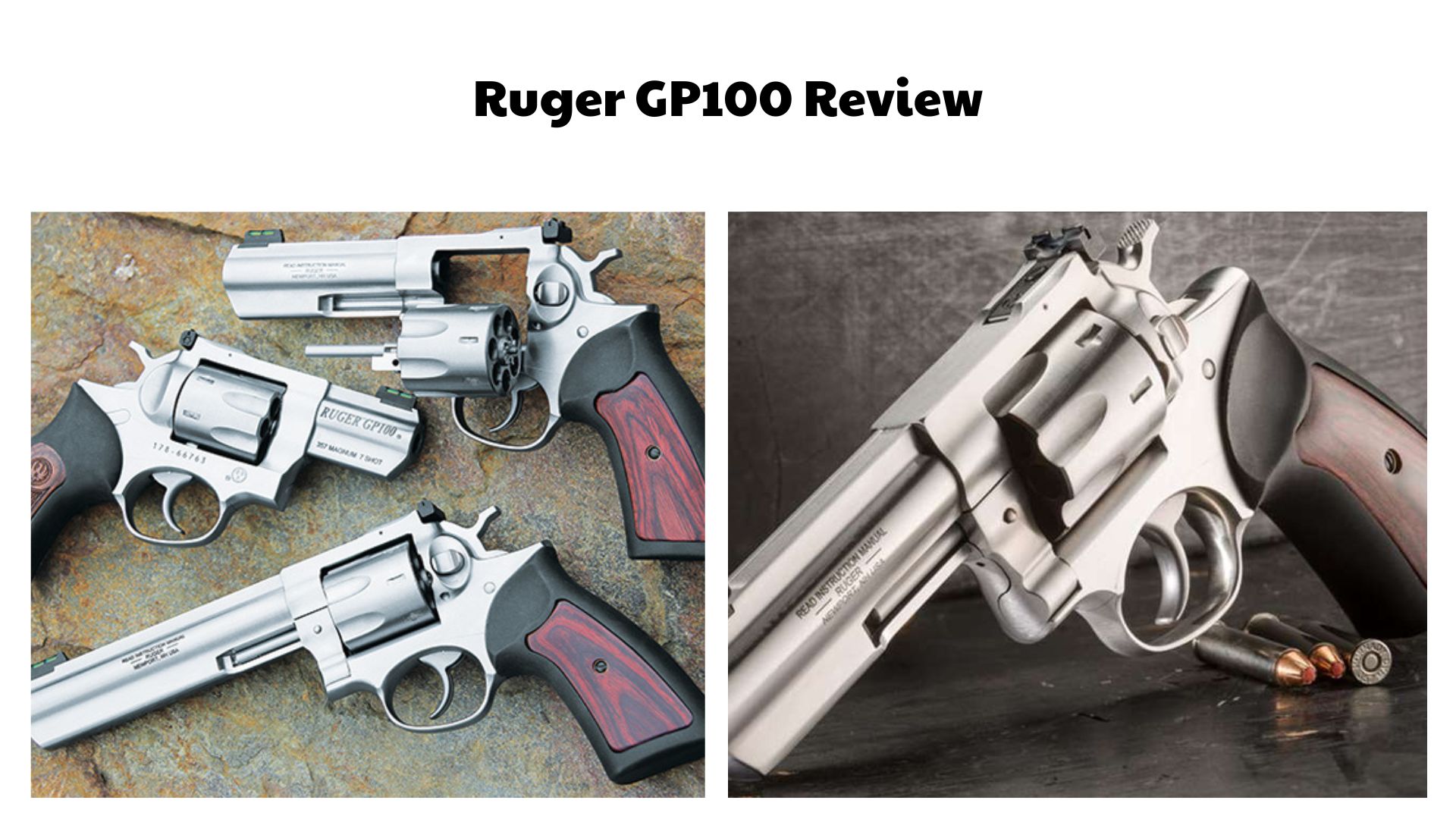

The Ruger GP100 is a heavy-duty, double-action revolver designed with one clear purpose in mind: uncompromising durability under powerful .357 Magnum loads. Since its introduction, it has built a strong reputation among shooters who value reliability over refinement and toughness over aesthetics.
What sets the GP100 apart is its long-standing reputation as a revolver that is essentially “built like a tank.” It is widely regarded as one of the most dependable .357 Magnum revolvers ever produced, capable of enduring tens of thousands of rounds with minimal wear when properly maintained.
Today, the GP100 continues to be trusted for a wide range of applications, including self-defense, range shooting, historically in law enforcement roles, and recreational shooting.
In this review, we will break down its design, specifications, build quality, and real-world performance.
Ruger GP100 Overview
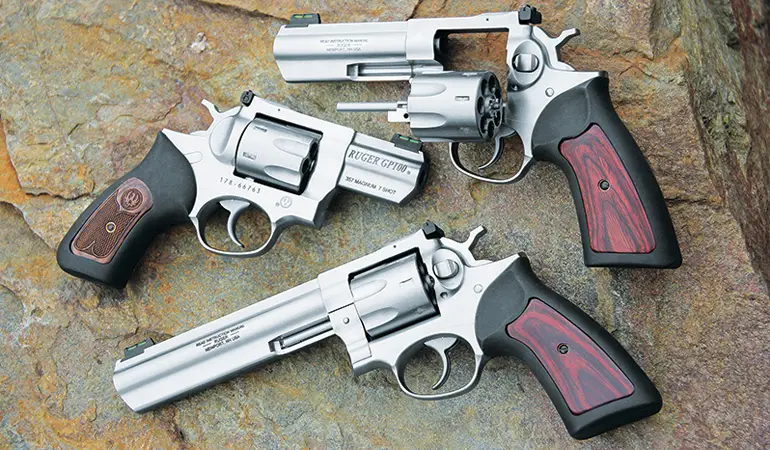
The Ruger GP100 is manufactured by Sturm, Ruger & Co., one of the most recognized firearm producers in the United States. It was introduced in 1985 as the successor to the Ruger Security-Six series.
It was specifically engineered to handle the high pressures of the .357 Magnum cartridge, making it significantly stronger than many earlier revolver designs.
The design philosophy focuses on strength, longevity, and simplicity, ensuring long-term durability under heavy use.
Key Specifications
Caliber Options
The GP100 is chambered primarily in .357 Magnum and .38 Special, with some variations supporting +P loads depending on the model.
Barrel Lengths
Available barrel lengths typically include 2.5”, 3”, 4.2”, 5”, and 6”, allowing users to choose based on concealment, control, or accuracy needs.
Capacity
Most GP100 models hold 6 rounds, while select versions offer a 7-round cylinder for increased capacity.
Frame Construction
The revolver uses a solid steel investment-cast frame, designed for extreme strength and resistance to heavy magnum recoil.
Action Type
The GP100 operates in both double-action and single-action modes, offering flexibility for defensive and precision shooting.
Build Quality and Construction
The Ruger GP100 is widely recognized for its exceptional build quality. It is engineered to withstand high round counts and continuous use with powerful ammunition.
Heavy-Duty Steel Frame Design
The GP100 features a one-piece steel frame design with no side plate, significantly increasing structural rigidity and durability.
This design reduces weak points commonly found in traditional revolver construction and improves long-term reliability under stress.
Triple-Locking Cylinder System
The cylinder locks at three points: front, rear, and bottom. This triple-locking system ensures precise alignment during firing.
It enhances safety, improves accuracy, and reduces mechanical wear even under repeated use with .357 Magnum loads.
Rugged Engineering Philosophy
The GP100 is designed for extreme durability rather than lightweight performance. It is built to handle high round counts and harsh shooting environments.
This makes it especially suitable for users who prioritize long-term reliability and mechanical strength over refinement or reduced weight.
Performance and Shooting Experience
The Ruger GP100 delivers a shooting experience defined by control, stability, and consistency. Built with a heavy steel frame and robust engineering, it is designed to manage powerful .357 Magnum recoil while maintaining accuracy and reliability over long shooting sessions.
Recoil Management
The substantial weight of the GP100 plays a major role in reducing perceived recoil, especially when firing full-power .357 Magnum loads. This added mass helps absorb energy and keeps muzzle rise under control.
Additionally, the factory rubber grips significantly improve handling comfort. They reduce hand fatigue and provide a secure grip, allowing shooters to maintain better control during rapid or repeated firing.
Accuracy Performance
The GP100 is known for delivering strong and consistent accuracy, particularly at typical defensive and range distances of 15–25 yards. Its rigid frame and precise cylinder alignment contribute to tight and repeatable shot placement.
It performs well with both .357 Magnum and .38 Special ammunition, maintaining predictable point-of-impact across different loads. The revolver is also effective in both double-action and single-action modes, offering flexibility between speed shooting and precision targeting.
Reliability in Real Use
Reliability is one of the GP100’s strongest attributes. It has an extremely high track record of dependable operation, even under demanding and prolonged use conditions.
Many long-term users report excellent performance during high-round-count testing with minimal maintenance requirements. Mechanical failures and malfunctions are rare, even when the revolver is subjected to continuous firing with heavy magnum loads.
Trigger System and Feel
The GP100 features a traditional double-action/single-action trigger system that prioritizes durability and safety over ultra-light competition-style tuning.
Factory Trigger Characteristics
The double-action trigger pull is generally heavier compared to some competitors, reflecting its robust internal design. During the pull, shooters may notice a slight “stacking” effect as resistance gradually increases before release.
In single-action mode, the trigger provides a crisp break with a firm and predictable release, supporting accurate slow-fire shooting.
Trigger Improvement Options
While the factory trigger is serviceable and reliable, many users choose to refine it for smoother operation. Common improvement methods include aftermarket spring kits that reduce pull weight while maintaining reliability.
Professional gunsmith polishing can also improve smoothness and reduce friction in the trigger mechanism. Additionally, many shooters report that a natural break-in period through regular use leads to noticeable improvement in trigger feel over time.
Pros of the Ruger GP100
The Ruger GP100 offers several strong advantages that contribute to its reputation as one of the most durable revolvers in its class.
Its most notable strength is its extremely durable, “tank-like” construction, designed to withstand heavy and repeated use with .357 Magnum ammunition.
It is fully capable of handling full-power .357 Magnum loads with ease, making it suitable for both defensive and range applications.
Long-term reliability is another major advantage, with many users reporting decades of dependable service.
The transfer bar safety system provides a simple and safe mechanism for carrying and handling the revolver.
Maintenance is straightforward, and the GP100 is relatively easy to field strip and clean compared to more complex firearm systems.
Finally, the platform offers a wide range of models and barrel lengths, along with strong aftermarket support for grips, springs, and tuning options.
Cons of the Ruger GP100
While the Ruger GP100 is widely praised for its durability and reliability, it does come with several drawbacks that are worth considering depending on the shooter’s preferences and intended use.
One of the most commonly mentioned downsides is the relatively heavy double-action trigger pull straight from the factory, which can feel stiff compared to more refined revolvers.
The overall weight of the GP100 is also higher than many competing models, which improves recoil control but reduces carry comfort for some users.
Compared to brands like Smith & Wesson or Colt, the trigger feel is often described as less refined and more utilitarian in character.
The factory rubber grips, while practical and comfortable, may not appeal to shooters who prefer traditional wood grips for aesthetics or classic styling.
Finally, although extremely durable, the GP100 is often viewed as having a slightly less “premium” finish and feel compared to higher-end revolvers in its class.
Ruger GP100 vs Competitors
vs Smith & Wesson 686
The Ruger GP100 is generally considered more rugged and mechanically robust, with a stronger frame designed for heavy long-term use.
The Smith & Wesson 686, however, is often preferred for its smoother factory trigger and more refined overall shooting feel, making it popular among precision-oriented shooters.
vs Colt Python
Compared to the Colt Python, the GP100 emphasizes practicality, durability, and affordability rather than luxury craftsmanship.
The Colt Python is widely recognized for its superior trigger quality and premium fit and finish, but it also comes at a significantly higher price point and is less focused on heavy-duty endurance use.
Real-World Testing and Longevity
The Ruger GP100 has earned a strong reputation for long-term durability, with many documented cases of tens of thousands of rounds fired without mechanical failure.
It is specifically engineered to handle continuous use of full-power .357 Magnum ammunition without losing structural integrity over time.
The revolver has also been used in training environments, competition shooting, and professional contexts where consistent performance is required.
Across long-term ownership reports, the GP100 consistently demonstrates stable performance with minimal maintenance issues and high reliability.
Best Use Cases for the GP100
The GP100 is well-suited for a variety of practical applications, especially where reliability and strength are more important than lightweight carry or ultra-refined feel.
It is commonly used as a home defense revolver due to its dependability and stopping power.
It also performs very well in training and range shooting scenarios, particularly with .357 Magnum ammunition.
Some users adopt it as a backup duty-style firearm due to its rugged construction and reliability.
It can also be used for short-range handgun hunting with appropriate loads and barrel lengths.
Additionally, it holds appeal as a collectible or “workhorse” revolver platform known for its toughness.
Maintenance and Durability
The Ruger GP100 is designed for straightforward maintenance, making it easy for owners to clean and service without specialized tools.
Its construction provides strong resistance to wear, including frame loosening or timing issues commonly seen in lesser-built revolvers over time.
Stainless steel variants offer improved corrosion resistance, making them suitable for humid or outdoor environments.
Overall, the design supports a long service life with minimal maintenance requirements when properly cared for.
Barrel Length and Model Variations
The GP100 is offered in multiple barrel lengths to accommodate different shooting needs and preferences.
The 2.5-inch version is designed for more compact defensive use and easier handling.
The 4.2-inch model is the most popular all-around configuration, balancing control, accuracy, and portability.
The 5-inch version offers improved sight radius and recoil control while maintaining reasonable balance.
The 6-inch model is optimized for target shooting and handgun hunting, offering maximum accuracy potential.
Some variants also include 7-shot cylinders, providing increased capacity over standard models.
User and Community Feedback Summary
Across firearm communities, the GP100 maintains a strong and consistent reputation for reliability and durability.
It is frequently described as a “built like a tank” revolver, reflecting its heavy-duty engineering approach.
It is highly recommended among users who prioritize long-term dependability over refined trigger feel or lightweight design.
Most criticisms focus on its heavier trigger and overall weight, rather than functional shortcomings.
Despite these minor drawbacks, overall user satisfaction remains very high.
Final Verdict
The Ruger GP100 stands as one of the most durable and dependable .357 Magnum revolvers ever produced.
It is best suited for shooters who value strength, reliability, and long-term performance over refinement or lightweight design.
As a long-term investment firearm, it is capable of providing decades of service even under heavy and repeated use conditions.
Frequently Asked Questions (FAQ) – Ruger GP100
1. Is the Ruger GP100 a good revolver?
Yes, the Ruger GP100 is widely considered one of the most reliable and durable .357 Magnum revolvers ever made. It is built with a heavy-duty steel frame and designed to withstand high round counts without losing accuracy or mechanical integrity, making it an excellent choice for defense, training, and recreational shooting.
2. What makes the GP100 so durable?
The GP100’s durability comes from its solid one-piece steel frame and Ruger’s investment-casting process. Unlike revolvers with side plates, the GP100 has fewer structural weak points. Its triple-locking cylinder system also ensures perfect alignment under pressure, reducing wear over time.
3. Can the Ruger GP100 handle .357 Magnum all day?
Yes, the GP100 is specifically engineered for continuous use with .357 Magnum ammunition. It can handle extended range sessions without mechanical failure or frame loosening, making it ideal for high-volume shooting compared to lighter revolvers.
4. Is the GP100 suitable for beginners?
It can be suitable for beginners, especially those interested in learning revolver fundamentals. However, its heavy weight and stiff double-action trigger may require some adjustment compared to lighter or semi-automatic pistols.
5. How accurate is the Ruger GP100?
The GP100 is very accurate within typical handgun distances of 15–25 yards. Its rigid frame and stable barrel alignment contribute to consistent shot placement, especially in single-action mode where trigger control is easier.
6. Is the GP100 better than the Smith & Wesson 686?
Both revolvers are excellent but serve slightly different purposes. The GP100 is generally stronger and more rugged, while the Smith & Wesson 686 offers a smoother trigger and more refined shooting experience. Choice depends on whether you prioritize durability or trigger feel.
7. How does the GP100 compare to the Colt Python?
The Colt Python is known for its premium finish and exceptionally smooth trigger, but it is significantly more expensive. The GP100 focuses on durability, practicality, and long-term reliability, making it a more utilitarian option.
8. What is the trigger pull weight like?
The double-action trigger pull is relatively heavy out of the box compared to competitors. However, it is smooth and becomes more refined after break-in or minor tuning. The single-action trigger is much lighter and crisper.
9. Does the GP100 have a safety?
The GP100 uses Ruger’s internal transfer bar safety system instead of a manual safety. This prevents the hammer from contacting the firing pin unless the trigger is fully pulled, making it safe for carry with all chambers loaded.
10. Is the GP100 good for concealed carry?
While possible, it is not ideal for concealed carry due to its weight and size. Smaller barrel variants like the 2.5-inch model are more practical, but many users still find it heavy compared to modern compact pistols.
11. What barrel length is best for self-defense?
The 2.5-inch and 4.2-inch barrel versions are most commonly recommended for self-defense. They offer a balance between portability, accuracy, and recoil control.
12. How many rounds does the GP100 hold?
Most models hold 6 rounds of .357 Magnum or .38 Special. Some newer variants offer 7-round cylinders for increased capacity.
13. Can the GP100 shoot .38 Special safely?
Yes, the GP100 can safely fire both .38 Special and .38 Special +P ammunition. Many shooters use .38 Special for reduced recoil during training sessions.
14. Is the GP100 good for home defense?
Yes, it is widely used for home defense due to its reliability, stopping power, and simplicity. Revolvers are often favored for their ease of use under stress.
15. Does the GP100 require a break-in period?
Yes, many users notice smoother trigger operation after several hundred rounds. Mechanical components naturally polish themselves over time, improving overall feel.
16. How heavy is the GP100?
The weight varies depending on barrel length, but it is generally heavier than many competing revolvers. This added weight helps significantly reduce recoil, especially with .357 Magnum loads.
17. Is the GP100 reliable?
Yes, it is considered one of the most reliable revolvers on the market. Its simple internal design and strong frame contribute to extremely low malfunction rates.
18. What is the GP100 made of?
The GP100 is constructed primarily from stainless steel or alloy steel depending on the model. This ensures long-term resistance to wear, corrosion, and high-pressure loads.
19. Can the GP100 be used for hunting?
Yes, especially the 5-inch and 6-inch models. It is suitable for short-range handgun hunting with .357 Magnum ammunition on small to medium game.
20. Is the GP100 good for competition shooting?
It can be used in certain revolver divisions of competition shooting. However, its heavier trigger makes it less ideal than tuned competition revolvers unless modified.
21. How long will a GP100 last?
With proper maintenance, the GP100 can last for decades and tens of thousands of rounds. It is built for long-term service life under heavy use conditions.
22. Does the GP100 rust easily?
Stainless steel models are highly resistant to rust. However, like all firearms, it should still be cleaned and lightly oiled to maintain optimal condition.
23. Is the GP100 easy to clean?
Yes, it is relatively simple to maintain. Its revolver design allows easy access to key components without complex disassembly.
24. What is the best GP100 model?
The 4.2-inch model is often considered the most balanced option, offering a mix of accuracy, control, and usability for both defense and range shooting.
25. Is the GP100 good for recoil-sensitive shooters?
Yes, especially with .38 Special ammunition. The weight of the revolver also helps reduce felt recoil significantly.
26. Does the GP100 have adjustable sights?
Some models come with adjustable rear sights, while others use fixed sights depending on intended use and barrel configuration.
27. Is the GP100 better than semi-automatic pistols?
It depends on use. The GP100 is more reliable mechanically, while semi-autos typically offer higher capacity and faster reloads.
28. Can you dry fire a GP100?
Yes, it is generally safe to dry fire due to its transfer bar system. However, using snap caps is recommended for extended practice.
29. What grips does the GP100 use?
It typically comes with rubber grips, which improve control and recoil absorption. Many aftermarket grip options are also available.
30. Is the GP100 loud?
Yes, like all .357 Magnum revolvers, it produces significant noise and muzzle blast, especially in shorter barrel versions.
31. Is the GP100 good for left-handed shooters?
Yes, revolvers are generally ambidextrous, and the GP100 is easy to operate for both left- and right-handed users.
32. Does the GP100 have aftermarket support?
Yes, there is strong aftermarket support including grips, springs, sights, and tuning components.
33. Can the GP100 be customized?
Yes, users can customize grips, trigger springs, and sights to improve ergonomics and performance.
34. Is the GP100 legal everywhere?
Legality depends on local laws and regulations. In most U.S. states it is legal, but users must always check local firearm laws.
35. What is the main advantage of the GP100?
Its primary advantage is unmatched durability combined with consistent reliability under heavy use.
36. What is the main disadvantage of the GP100?
The main drawbacks are its heavy trigger pull and overall weight compared to more refined revolvers.
37. Is the GP100 good for long-term investment?
Yes, its durability and reputation make it a long-lasting firearm that retains value over time.
38. How safe is the GP100?
It is very safe due to its transfer bar safety system, which prevents accidental discharge if dropped.
39. Does the GP100 require special ammo?
No, it functions with standard .357 Magnum and .38 Special ammunition without issue.
40. Is the GP100 beginner-friendly for training?
Yes, especially for learning revolver fundamentals, trigger control, and manual shooting discipline.
41. Can the GP100 shoot +P ammo?
Yes, it can safely handle +P .38 Special loads due to its strong frame design.
42. Is the GP100 still in production?
Yes, Ruger continues to produce and update GP100 models for modern shooters.
43. Why do people call it “built like a tank”?
This nickname comes from its heavy steel construction, durability, and ability to withstand extreme use without failure.
44. Is the GP100 good for law enforcement use?
Historically, it has been used in law enforcement training and backup roles due to its reliability and simplicity.
45. What is the recoil like on .357 Magnum?
Recoil is strong but manageable due to the GP100’s weight and grip design, especially compared to lighter revolvers.
46. Can the GP100 be carried for duty use?
Yes, though it is heavier than modern duty pistols, it is still viable in certain duty or backup roles.
47. Does the GP100 have timing issues?
It is known for excellent long-term timing stability due to its strong frame and robust internal design.
48. Is the GP100 good for collectors?
Yes, especially certain barrel lengths and older production models are valued by revolver enthusiasts.
49. What makes the GP100 different from other revolvers?
Its combination of heavy-duty construction, triple-locking cylinder system, and long-term durability sets it apart.
50. Is the Ruger GP100 worth buying in 2026?
Yes, it remains one of the best choices for shooters who prioritize reliability, durability, and long-term performance over lightweight or ultra-refined design.
Read more: