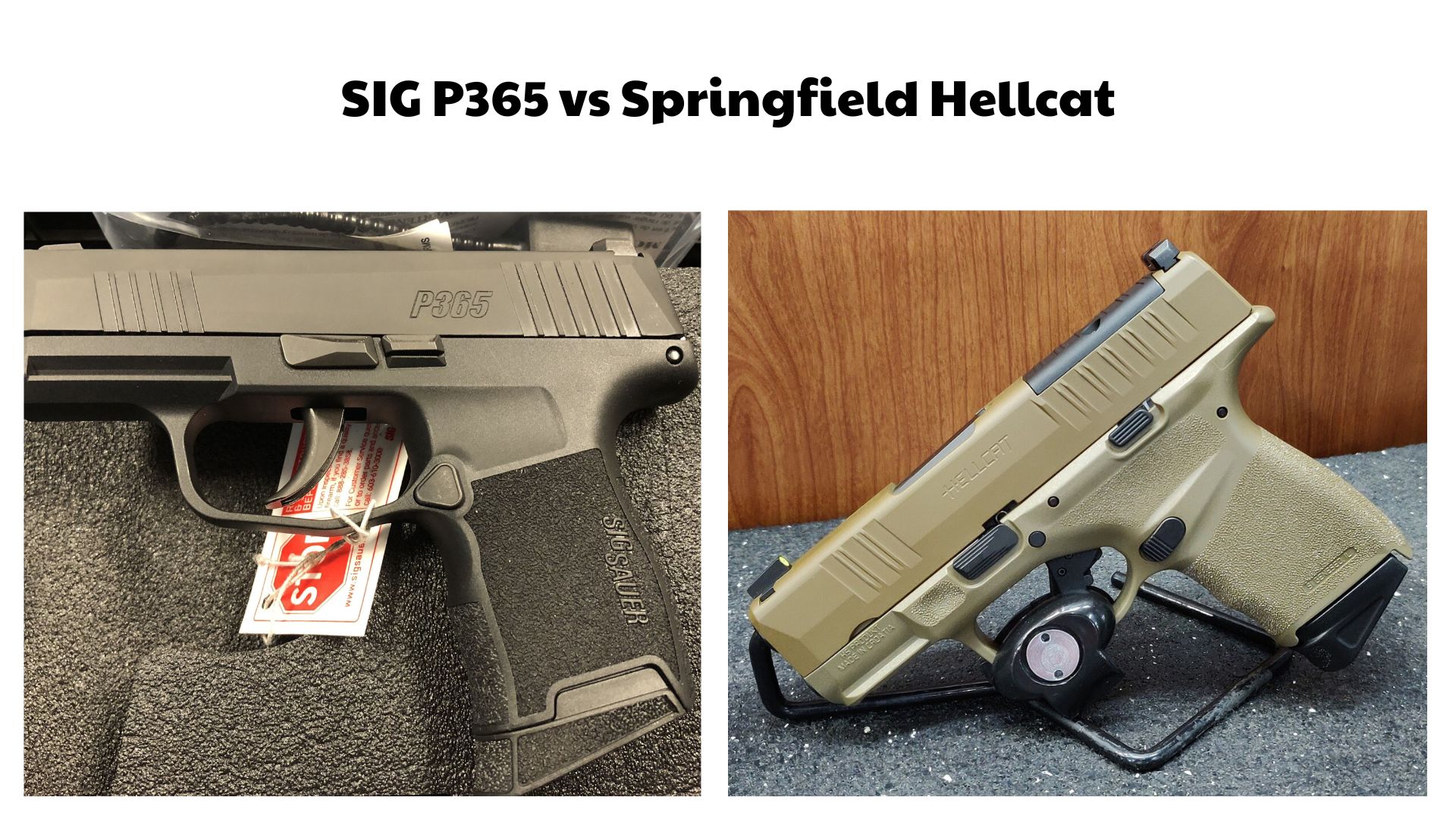

The comparison between the SIG P365 and the Springfield Hellcat is one of the most important rivalries in modern concealed carry handguns. These two pistols are widely recognized as category-defining micro-compact 9mm platforms that reshaped how everyday carry (EDC) firearms are designed, carried, and evaluated.
Before their release, concealed carry pistols often forced shooters to choose between size and capacity. Smaller pistols were easy to conceal but limited in magazine capacity, while larger compact handguns offered better shootability but were harder to carry discreetly. The arrival of the SIG P365 in 2018 changed that equation by introducing a true micro-compact pistol with double-stack-like capacity in a very small footprint.
Shortly after, Springfield Armory responded with the Hellcat in 2019, pushing the category further with slightly higher standard capacity and aggressive ergonomics. Together, these two firearms are credited with starting the “micro 9mm revolution,” where high-capacity, slim-profile pistols became the new standard for concealed carry rather than single-stack designs.
Both pistols are designed primarily for everyday carry, deep concealment, and defensive use. Their core appeal lies in a combination of maximum capacity in minimal size, improved reliability compared to earlier micro pistols, and practical shootability that makes them usable under stress. They are not range toys or competition pistols; they are purpose-built defensive tools.
In the modern concealed carry market, the SIG P365 and Springfield Hellcat sit directly alongside competitors such as the Glock 43X, Smith & Wesson Shield Plus, and similar slimline 9mm platforms. However, what separates them is their focus on stacking capacity into extremely compact frames without sacrificing reliability or controllability.
This raises the central question that drives this entire comparison: between the SIG P365 and Springfield Hellcat, which pistol actually performs better in real-world concealed carry use? The answer depends on factors such as ergonomics, recoil control, trigger feel, capacity, and individual shooter preference, all of which will be explored in detail throughout this guide.
2. SIG P365 Background & Platform Evolution
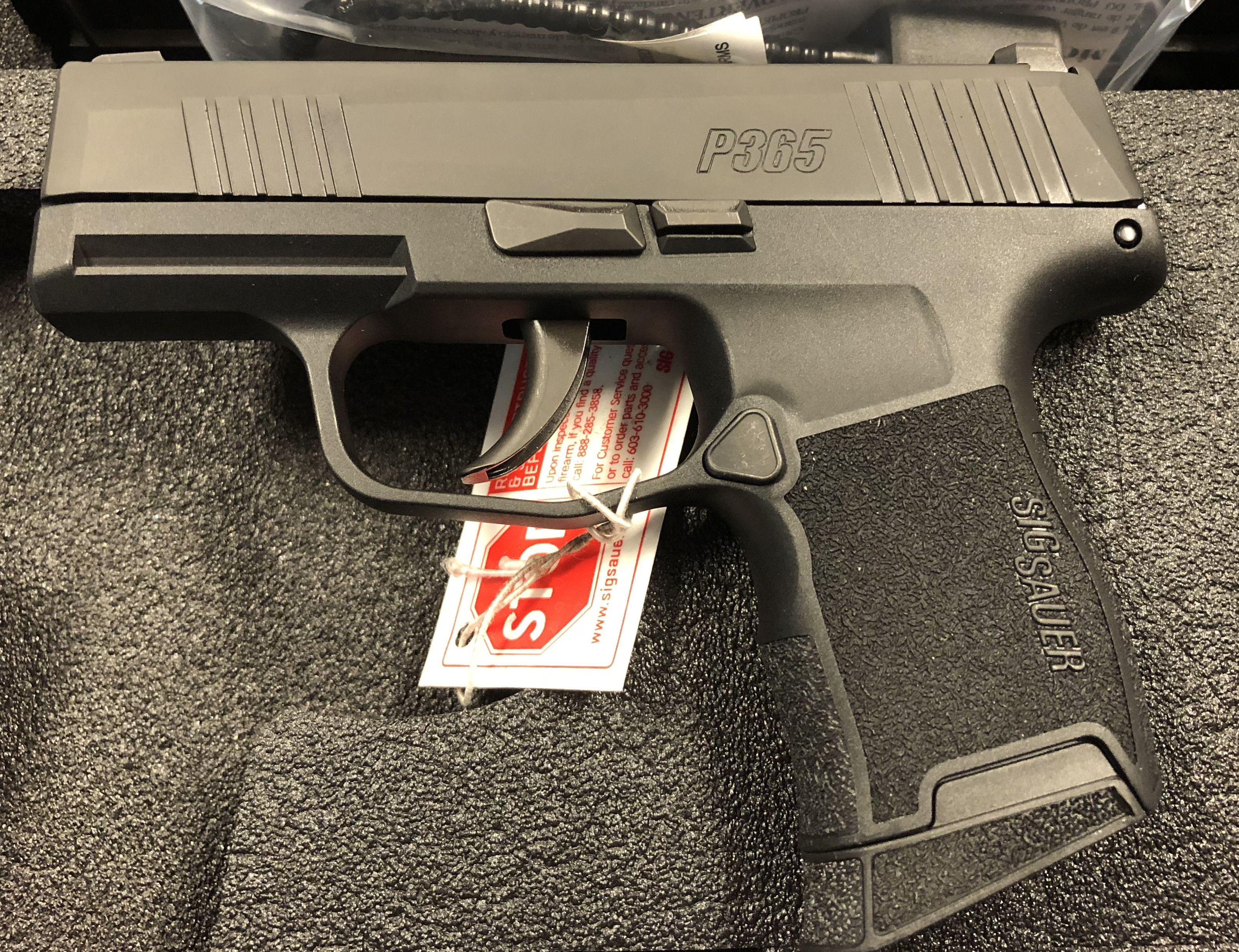
The SIG Sauer P365 was officially launched in 2018 and immediately became one of the most disruptive handgun releases in the concealed carry market. At the time, most subcompact 9mm pistols struggled to balance size and capacity. The P365 changed that by offering a 10+1 capacity in a frame that was significantly smaller than many single-stack competitors.
This innovation was not just incremental; it redefined expectations for what a concealed carry pistol could achieve. The P365 introduced a double-stack-style magazine system in a micro-compact footprint, allowing users to carry more ammunition without increasing overall bulk. This made it extremely appealing for everyday carry users who wanted maximum defensive capability in a minimal package.
Following its release, SIG expanded the platform into a full family of variants. These include the standard P365, the P365 XL with a longer slide and improved sight radius, and the XMacro series which pushes capacity and shootability even further. Optics-ready models also became widely available, reflecting the growing demand for red dot-equipped carry pistols.
One of the strongest advantages of the P365 platform is its aftermarket ecosystem. Over time, grip modules, triggers, slides, and magazines have become widely available, allowing users to customize the pistol to their preferences. This flexibility has helped the P365 remain highly competitive even as newer micro-compact pistols entered the market.
Another key strength is the refinement of its trigger and ergonomics over time. Early production models were already well-received, but SIG continued to improve consistency, smoothness, and overall shootability. Today, the P365 is widely regarded as one of the most balanced micro-compact pistols available, offering a strong combination of concealability and performance.
In terms of industry impact, the SIG P365 effectively set a new standard for concealed carry pistols. It forced other manufacturers to rethink capacity limitations and contributed directly to the development of competing platforms like the Hellcat and Shield Plus. Its influence on the modern handgun market cannot be overstated.
3. Springfield Hellcat Background & Development
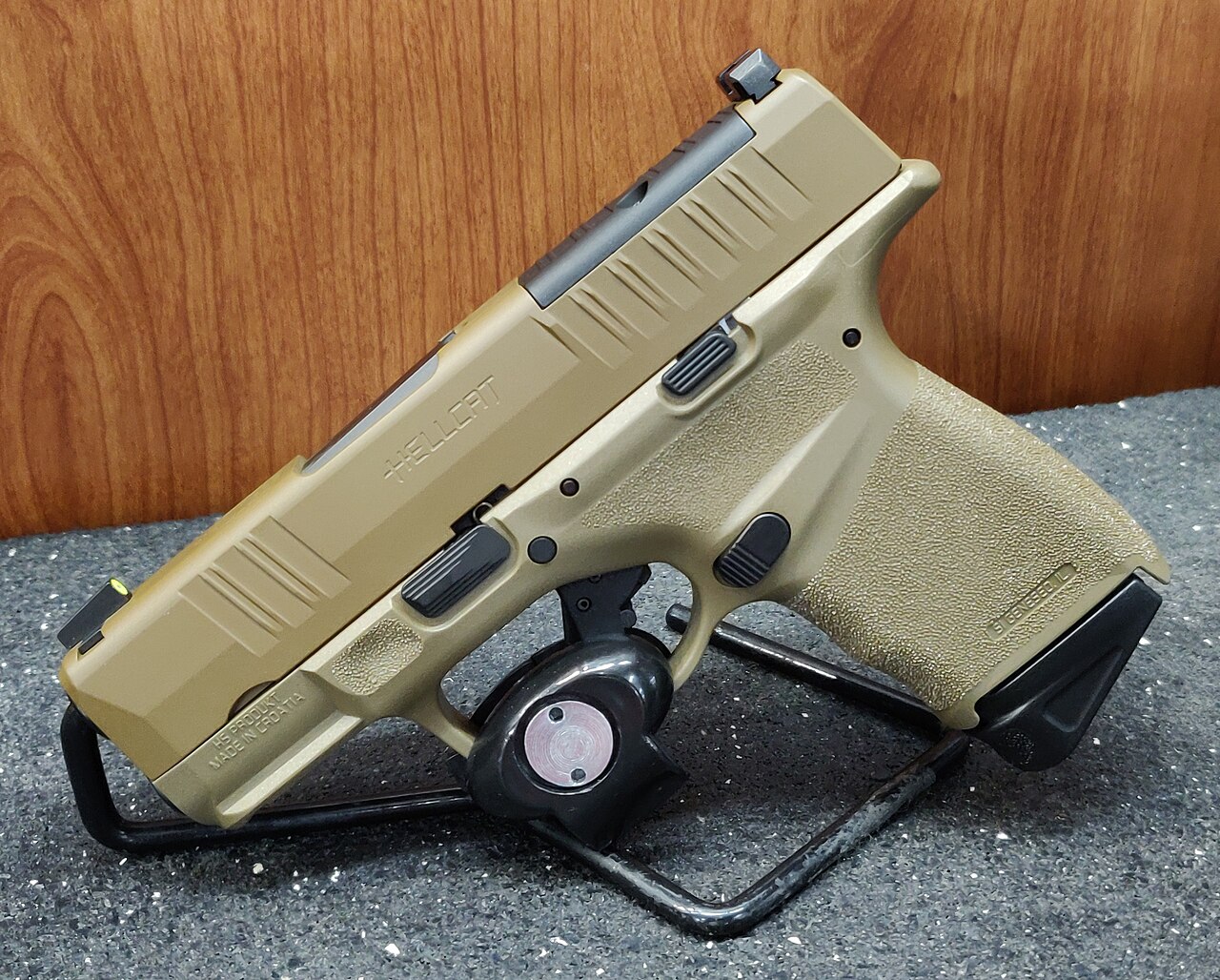
The Springfield Armory Hellcat was introduced in 2019 as a direct response to the success of the SIG P365. Developed in collaboration with HS Produkt in Croatia, the Hellcat was designed with a clear goal: maximize capacity while maintaining a compact, easily concealable frame.
One of its defining features at launch was its 11+1 standard capacity, earning it the reputation as a “capacity king” in the micro-compact category. This slightly higher base capacity compared to competitors became a key marketing and performance advantage, especially for concealed carriers who prioritize defensive ammunition availability.
The Hellcat lineup quickly expanded into multiple configurations. The standard Hellcat offers the smallest footprint and highest concealability, while the Hellcat OSP introduces optics readiness for red dot sights. The Hellcat Pro extends the grip and barrel length for improved shootability, and the Hellcat Pro Comp adds an integrated compensator for reduced muzzle rise and faster follow-up shots.
Unlike more traditional or conservative pistol designs, the Hellcat places strong emphasis on aggressive ergonomics and defensive shooting performance. Its grip texture is notably more aggressive than many competitors, designed to ensure strong retention under stress or adverse conditions such as sweat, rain, or rapid fire scenarios.
This design philosophy positions the Hellcat as a performance-driven concealed carry pistol rather than a purely comfort-focused EDC option. It prioritizes control and defensive usability, even if that means a slightly more aggressive shooting feel compared to smoother competitors like the SIG P365.
In the concealed carry market, the Hellcat established itself as a serious competitor to the P365 almost immediately. It reinforced the industry trend toward high-capacity micro pistols and helped solidify the shift away from older single-stack designs. Today, it remains one of the most popular alternatives in the micro-compact 9mm category.
4. Key Specifications & Technical Overview (Side-by-Side)
When comparing the SIG P365 and Springfield Hellcat, the technical foundation of both pistols is surprisingly similar, yet each platform takes a slightly different engineering approach to achieve its performance goals. Both are chambered in 9mm Luger, the most widely used defensive handgun caliber, offering a strong balance of recoil control, terminal performance, and ammunition availability.
In terms of barrel length, both pistols stay firmly within the micro-compact category, but subtle differences exist across variants. The standard SIG P365 features a shorter barrel compared to extended versions like the P365 XL and XMacro, which improve sight radius and stability. On the Springfield side, the Hellcat also starts with a compact barrel length, while the Hellcat Pro and Pro Comp models extend both barrel and slide length to enhance shootability and recoil management.
Weight and size are key decision factors in this category. Both pistols are extremely lightweight and designed for concealed carry comfort. The P365 tends to feel slightly more compact in overall grip ergonomics, while the Hellcat often feels marginally taller due to its higher-capacity magazine design. Width is nearly identical between the two, staying around the 1-inch class that defines modern micro-compact pistols.
Magazine capacity is where the most noticeable distinction appears:
- SIG P365: 10+1 standard, with extended options including 12+1 and 15+1 magazines depending on configuration
- Springfield Hellcat: 11+1 standard, with extended 13+1 and 15+1 options available
The Hellcat holds a slight advantage in base capacity, while the P365 offers broader modular expansion through its growing ecosystem of magazine and grip configurations. In real-world use, both platforms now achieve similar extended capacities, making this category more about ergonomics and preference than raw numbers.
Both pistols use striker-fired trigger systems, but their shooting feel differs significantly. The SIG P365 is known for a smoother, more refined trigger pull with a cleaner break, while the Hellcat trigger tends to feel slightly heavier and more duty-oriented. Neither is designed for competition shooting, but both are optimized for defensive reliability and consistency under stress.
Optics readiness is another important distinction. The Springfield Hellcat uses the RMSc footprint for red dot compatibility, which has become a widely adopted standard in the micro-compact category. The SIG P365 platform uses its own modular optics system across different variants, with the XMacro and newer models offering improved direct-mount solutions for red dot sights.
Recoil systems in both pistols rely on dual recoil spring assemblies designed to manage the sharp impulse typical of short-barreled 9mm firearms. While the mechanical approach is similar, perceived recoil control differs slightly due to grip design and weight distribution, which will be discussed further in later sections.
5. Size, Ergonomics & Handling Comparison
Ergonomics play a major role in the SIG P365 vs Springfield Hellcat debate, often influencing shooter preference more than raw specifications. While both pistols are extremely compact, they deliver noticeably different handling experiences.
The SIG P365 is often described as more refined in hand feel. Its grip contouring is smoother, with a focus on comfort and natural hand placement. Many shooters find that it fits a wider range of hand sizes without modification, especially in standard and XL configurations. This makes it a very user-friendly platform for both new and experienced concealed carriers.
The Springfield Hellcat, on the other hand, uses a more aggressive grip texture. This design prioritizes control under stress, particularly during rapid fire or adverse conditions such as sweat or moisture. While this enhances weapon retention and stability, it can feel more abrasive compared to the softer grip profile of the P365.
During rapid fire, control differences become more noticeable. The P365 tends to track slightly smoother due to its ergonomic refinement, while the Hellcat offers stronger grip traction that helps prevent slippage during aggressive shooting. Both are highly controllable within their class, but they achieve control through different design philosophies.
Concealability tradeoffs are also important. The P365 generally offers a slightly more compact overall feel, which can make it easier to conceal in tighter clothing setups. The Hellcat, particularly in its standard configuration, may feel marginally taller, though this is often offset by its higher base capacity.
Hand size plays a significant role in user experience. Shooters with smaller hands often prefer the P365 due to its slimmer and more rounded grip geometry. Larger-handed shooters may appreciate the Hellcat’s more aggressive texture and slightly fuller grip options available in extended magazine configurations.
Overall, ergonomics between these two pistols come down to preference: the SIG P365 emphasizes comfort and refinement, while the Springfield Hellcat prioritizes control and defensive readiness under stress.
6. Trigger Performance Comparison
Trigger performance is one of the most discussed differences between the SIG P365 and Springfield Hellcat, especially among concealed carry users who prioritize shooting feel and defensive accuracy.
The SIG P365 features a striker-fired trigger system that is widely regarded as smoother and more refined than many competitors in its class. It offers a relatively flat pull with a clean break and a short, tactile reset. This makes it easier for many shooters to maintain consistency during both slow-fire accuracy drills and rapid follow-up shots.
In contrast, the Springfield Hellcat trigger is slightly heavier and more duty-oriented in feel. While still very functional for defensive use, it prioritizes reliability and safety over refinement. The break is solid and predictable, but not as polished as the SIG system. Some shooters describe it as more “mechanical,” especially in early production models.
Reset speed is comparable between both pistols, though the P365 often feels marginally shorter and more responsive. This can translate into slightly faster shot-to-shot timing for experienced shooters, particularly during controlled pairs or defensive drills.
When it comes to accuracy, trigger feel plays a subtle but important role. The smoother P365 trigger can help reduce shooter-induced movement during the firing cycle, while the Hellcat’s firmer trigger may require slightly more discipline but rewards consistent grip and technique.
Ultimately, trigger preference is highly subjective. Some shooters prefer the refined feel of the SIG P365 for its smoothness and predictability, while others appreciate the Hellcat’s more deliberate, defensive-focused trigger design. In concealed carry use, both are more than capable of delivering reliable performance under stress, which is the most important factor.
7. Recoil & Shootability Analysis
Recoil management is one of the most important factors in evaluating micro-compact pistols, and both the SIG P365 and Springfield Hellcat operate in a category where recoil is inherently “snappy.” This is simply due to their small size, short barrels, and lightweight polymer frames. However, the way each pistol handles recoil energy differs slightly in feel and control.
The SIG P365 is often described as having a slightly softer recoil impulse. This does not mean it has less actual recoil energy, but rather that the grip geometry, weight distribution, and trigger refinement help make the shooting experience feel smoother and more controlled for many users. The result is a pistol that tracks more predictably during rapid fire strings.
The Springfield Hellcat, on the other hand, produces a sharper recoil impulse. This is most noticeable in the standard configuration, where the shorter grip and aggressive design contribute to a more direct “snap” during firing. However, many shooters also find that the Hellcat’s aggressive grip texture provides better purchase, which helps maintain control under stress.
Grip design plays a major role in recoil management for both pistols. The P365 emphasizes ergonomic comfort and natural hand alignment, which helps reduce perceived recoil movement. The Hellcat prioritizes grip traction, ensuring the shooter maintains firm control even during fast-paced defensive shooting scenarios.
Extended magazines significantly improve shootability for both platforms. By adding extra grip length, they allow the shooter to engage more of the hand, particularly the pinky finger, which stabilizes the pistol during recoil. This is especially noticeable when comparing standard flush-fit magazines to 12-, 13-, or 15-round extensions.
In real-world defensive shooting, both pistols perform well within their intended role. The P365 tends to offer slightly smoother shot-to-shot transitions, while the Hellcat often excels in maintaining aggressive control during rapid-fire engagement. Neither platform is difficult to manage with proper training, but both require more recoil discipline than larger compact pistols like the Glock 19.
Overall, shootability comes down to shooter preference: the P365 feels smoother and more refined under recoil, while the Hellcat feels more direct and aggressively controlled.
8. Accuracy & Real-World Performance
Accuracy in the SIG P365 vs Springfield Hellcat comparison should be evaluated in terms of practical defensive shooting rather than benchrest precision. Both pistols are designed for close-quarters engagement distances, typically within 5 to 15 yards, where most defensive encounters occur.
At these distances, both platforms are highly effective and capable of consistent shot placement. Mechanical accuracy between the two is very similar, meaning that differences in performance are often more related to shooter input than inherent firearm precision.
The SIG P365 often demonstrates slightly better shot control for many users due to its smoother trigger and more refined ergonomics. This allows for reduced disruption of sight alignment during the trigger press, which can improve consistency during controlled fire.
The Springfield Hellcat, while slightly less refined in trigger feel, compensates with strong consistency and fast follow-up shot capability. Its aggressive grip texture helps maintain a stable firing platform, especially during rapid defensive shooting scenarios where maintaining grip integrity is critical.
At extended distances of 15 to 25 yards, both pistols remain capable when used by trained shooters. The longer variants of each platform, such as the P365 XL and Hellcat Pro, offer improved sight radius and barrel length, which enhance practical accuracy in these scenarios.
It is important to distinguish mechanical accuracy from real-world defensive performance. On paper, both pistols are capable of tight groupings, but in defensive use, factors such as draw speed, target acquisition, and recoil recovery are far more important than benchrest grouping size.
In practical terms, both the P365 and Hellcat are highly capable defensive tools. The P365 slightly favors precision-oriented control, while the Hellcat emphasizes fast, repeatable defensive shooting performance under pressure.
9. Concealed Carry Performance (EDC Use)
Concealed carry performance is where both the SIG P365 and Springfield Hellcat truly shine, as they were specifically designed for everyday carry (EDC) applications. Their compact dimensions, lightweight construction, and high-capacity magazines make them ideal choices for both new and experienced carriers.
In terms of size and carry comfort, both pistols are suitable for inside-the-waistband (IWB) and appendix carry setups. The slim profile of each firearm allows them to sit close to the body, reducing printing and improving concealment under a wide range of clothing styles.
The Springfield Hellcat has a slight advantage in base magazine capacity, offering 11+1 in its standard configuration. This provides users with a small but meaningful increase in defensive ammunition without significantly increasing overall size. For some users, this makes the Hellcat more appealing as a primary EDC option.
The SIG P365, however, often excels in concealability and ergonomic comfort for a broader range of body types. Its slightly more compact feel and smoother grip profile make it easier to carry discreetly, especially in tighter clothing or professional environments where printing must be minimized.
Printing and holster compatibility are important considerations for both pistols. With proper holster selection and carry positioning, both the P365 and Hellcat can be effectively concealed under light clothing. However, grip length—especially in extended magazine configurations—can influence how noticeable the firearm is under clothing.
Comfort during all-day carry is another critical factor. The P365 is often perceived as slightly more comfortable for extended wear due to its smoother contours. The Hellcat, while still highly carryable, may feel more aggressive against the body due to its grip texture and slightly more angular design.
In terms of usage scenarios, the SIG P365 is frequently chosen as a primary EDC firearm due to its balance of comfort and concealability. The Hellcat, on the other hand, is often selected by users who prioritize maximum capacity in a compact frame or who prefer a more aggressive defensive-oriented design.
Ultimately, both pistols excel in concealed carry roles, but they appeal to slightly different priorities: the P365 focuses on refined carry comfort, while the Hellcat emphasizes capacity and defensive control.
10. Reliability & Ammunition Performance
Reliability is one of the most critical factors when evaluating concealed carry firearms, and both the SIG P365 and Springfield Hellcat have strong reputations in this area. Over time, both platforms have proven themselves as dependable defensive pistols capable of consistent performance under real-world conditions.
In terms of ammunition performance, both pistols generally run well with standard FMJ training ammunition as well as high-quality defensive hollow-point loads. Modern defensive 9mm ammunition is widely optimized, and both the P365 and Hellcat are designed to function reliably with a broad range of bullet weights and profiles.
It is worth noting that early production versions of both platforms experienced minor issues typical of new firearm releases. The SIG P365 initially went through early revisions to refine reliability and durability. Springfield’s Hellcat, being released slightly later, benefited from more mature micro-compact engineering trends and entered the market with fewer widely reported early issues.
Break-in periods can vary slightly depending on the individual firearm. While neither pistol requires extensive break-in, many shooters report improved smoothness and cycling consistency after the first few hundred rounds. This is common in tightly engineered striker-fired systems where components settle with use.
Ammunition sensitivity is generally low for both platforms, but as with any defensive handgun, it is strongly recommended to test carry ammunition before relying on it for self-defense. Different bullet shapes, coatings, and pressures can sometimes affect cycling in compact pistols due to their short slide travel and rapid cycling speeds.
High-round-count durability reports for both pistols are largely positive. The SIG P365 has demonstrated long-term reliability across extensive civilian and law enforcement use, while the Hellcat has also earned a strong reputation for consistent performance under demanding conditions. Neither platform shows systemic durability concerns when properly maintained.
From a defensive trustworthiness standpoint, both pistols are considered reliable enough for everyday carry and duty-adjacent roles. The decision between them is less about whether they are reliable—and more about which design philosophy aligns better with the shooter’s preferences.
11. Variants & Ecosystem Comparison
One of the key differences between the SIG P365 and Springfield Hellcat platforms is the depth and structure of their variant ecosystems. Both families have expanded significantly since their initial release, offering users multiple configurations tailored to different concealed carry needs.
The SIG P365 lineup includes a wide range of options such as the standard P365, P365 XL, P365 X, and XMacro variants. These models vary in grip length, barrel size, capacity, and shootability. Many versions also include optics-ready slides, allowing for easy integration of red dot sights for improved defensive performance.
The Springfield Hellcat family includes the standard Hellcat, Hellcat OSP (optics-ready), Hellcat Pro, and Hellcat Pro Comp. Each variant expands on the original design, increasing grip size, sight radius, or recoil management depending on the configuration. The Pro Comp model adds a built-in compensator for reduced muzzle rise.
Both platforms support modular expansion, but they approach customization differently. The SIG P365 benefits from a highly developed aftermarket ecosystem, allowing users to swap grip modules, slides, triggers, and other components with relative ease. This makes it one of the most customizable micro-compact platforms available.
The Hellcat also supports aftermarket upgrades, particularly in optics, holsters, and magazine extensions, but its modular ecosystem is generally more focused on factory variants rather than extensive frame swapping. Instead, Springfield offers multiple factory configurations to meet different needs.
Red dot compatibility is strong on both platforms. The Hellcat uses the RMSc footprint, which has become a widely adopted standard in micro-optics mounting. The SIG P365 uses its own optics mounting system depending on the model, with newer variants offering improved direct-mount solutions for popular micro red dots.
In terms of customization flexibility, the SIG P365 holds a slight advantage due to its broader aftermarket support and modular design philosophy. However, the Hellcat compensates with purpose-built factory variants that reduce the need for extensive modifications.
12. Capacity Comparison & Magazine Options
Magazine capacity is one of the most frequently discussed differences between the SIG P365 and Springfield Hellcat, particularly in the concealed carry community where every round can matter in a defensive scenario.
The Springfield Hellcat has a slight advantage in base configuration, offering an 11+1 standard capacity. This provides an immediate edge in ammunition availability without requiring extended magazines. For many users, this small increase is a meaningful benefit in a defensive context.
The SIG P365 starts at 10+1 in its original configuration but offers extended magazine options such as 12+1 and 15+1, bringing it closer to or matching Hellcat capacity levels depending on setup. This flexibility allows users to tailor their magazine choice based on concealment needs or shooting preferences.
At higher capacities, both platforms become largely comparable. Extended magazines allow both pistols to reach similar ammunition counts, meaning the real-world difference often comes down to how the pistol is carried rather than raw capacity numbers.
The practical importance of a single-round difference is often debated. In real-world defensive encounters, factors such as shot placement, training, and response time are generally more critical than a one-round advantage. However, some users still prefer the psychological and tactical reassurance of higher base capacity.
Reload efficiency and magazine ergonomics are also important considerations. Both pistols use compact magazine designs that prioritize concealability, but extended magazines improve grip stability and control during reloads and rapid fire sequences. This can indirectly influence shooting performance under stress.
From a tactical standpoint, capacity plays a role in defensive planning, but it should be balanced with concealability and shootability. Both the P365 and Hellcat provide modern high-capacity solutions in a micro-compact frame, which was previously not possible in older generations of concealed carry pistols.
Ultimately, capacity differences between these two pistols are relatively minor in practice. The Hellcat offers a slight advantage in base configuration, while the P365 provides more flexible expansion options through its magazine and platform ecosystem.
13. SIG P365 vs Springfield Hellcat: Direct Performance Comparison
When placed side by side in real-world use, the SIG P365 and Springfield Hellcat deliver extremely close performance levels, but they achieve their results through different design philosophies. Both pistols are optimized for concealed carry and defensive shooting, meaning the comparison is less about superiority and more about nuanced performance differences.
In terms of accuracy under defensive conditions, both pistols are highly capable within the typical 5 to 15 yard engagement range. The SIG P365 often shows a slight edge in controlled accuracy due to its smoother trigger pull and more refined ergonomics, which help reduce shooter disruption during firing. This can translate into tighter, more consistent shot placement for many users.
The Springfield Hellcat, however, offers strong consistency and fast follow-up shot capability. While its trigger feel is slightly more utilitarian, its aggressive grip texture helps maintain a stable firing platform during rapid strings of fire. This makes it particularly effective in dynamic defensive shooting scenarios where speed and control are critical.
Recoil and muzzle flip are similarly competitive between the two platforms. The P365 generally produces a slightly softer and smoother recoil impulse, while the Hellcat tends to feel a bit sharper but more directly controlled. Grip geometry plays a major role in how recoil is perceived, with each pistol distributing recoil forces differently through the shooter’s hand.
Trigger feel and shooting smoothness represent one of the clearest distinctions. The SIG P365 offers a more refined and predictable trigger break, while the Hellcat prioritizes a more robust, defensive-oriented trigger system. Neither is a competition-grade trigger, but both are well-suited for real-world defensive applications.
Concealability tradeoffs are minimal but still present. Both pistols are highly concealable, but the P365 is often perceived as slightly easier to conceal due to its more compact grip geometry. The Hellcat, while still very compact, may print slightly more depending on magazine configuration and body type.
Reliability in modern versions of both pistols is excellent. Early production concerns have largely been addressed, and both platforms are now considered dependable choices for everyday carry. Real-world usage across civilian and defensive training environments supports their long-term reliability reputation.
Overall, performance differences between the SIG P365 and Springfield Hellcat are subtle and largely preference-driven. The P365 leans toward refinement and smooth shooting characteristics, while the Hellcat emphasizes capacity, aggressive control, and defensive readiness.
14. Pros and Cons of SIG P365
Advantages:
- Refined trigger with smooth and predictable break
- Excellent ergonomics for a wide range of hand sizes
- Highly modular platform with extensive aftermarket support
- Smooth shooting characteristics for a micro-compact pistol
- Strong concealability with compact footprint
The SIG P365’s biggest strength lies in its balance of refinement and adaptability. It feels more polished in hand compared to many competitors, and its modular ecosystem allows users to tailor the firearm to specific preferences, including grip size, slide configuration, and optics setup.
Disadvantages:
- Slightly lower base magazine capacity compared to Hellcat
- Often positioned at a higher price point depending on configuration
While the P365 excels in refinement, it does have minor limitations. Its original base capacity is slightly lower than the Hellcat, and depending on variant selection, it can be more expensive than some competing options.
Strength summary: The P365 is strongest in modularity, shooting smoothness, and ergonomic refinement, making it a highly versatile concealed carry platform.
15. Pros and Cons of Springfield Hellcat
Advantages:
- Higher base magazine capacity in standard configuration
- Aggressive grip texture for superior weapon retention
- Strong optics-ready ecosystem (RMSc footprint)
- Excellent defensive shooting focus and control
- Multiple variants including Pro and compensated models
The Springfield Hellcat is designed with a clear emphasis on defensive performance and maximum capacity in a compact frame. Its aggressive grip texture enhances control during stress shooting, and its factory configurations provide a wide range of options for different carry styles.
Disadvantages:
- Snappier recoil feel compared to some competitors
- Trigger feel is slightly heavier and less refined than P365
The Hellcat’s main tradeoff is shooting refinement. While it performs extremely well in defensive contexts, its recoil impulse is slightly sharper and its trigger feel less polished compared to the SIG P365.
Strength summary: The Hellcat excels in capacity, defensive control, and optics integration, making it a strong choice for users prioritizing performance-oriented concealed carry.
16. Which One Shoots Better in Real-World Use?
Determining which pistol “shoots better” between the SIG P365 and Springfield Hellcat is not a simple mechanical answer. In real-world use, performance is shaped by a combination of firearm design, shooter skill, and training consistency. Both pistols are capable defensive tools, but they reward slightly different shooting styles.
From a mechanical standpoint, both platforms are highly capable within the micro-compact category. However, user preference often plays a larger role than raw specifications. Some shooters find the SIG P365 easier to shoot accurately due to its smoother trigger and slightly more refined ergonomics. Others prefer the Hellcat for its aggressive grip texture and strong control during rapid fire.
Beginner shooters often notice differences more strongly than experienced users. A new shooter may perceive the P365 as more forgiving due to its smoother trigger and reduced perceived recoil. Meanwhile, experienced shooters may appreciate the Hellcat’s firm grip and defensive-oriented handling characteristics, especially during stress drills or fast transitions.
Training is a major factor in determining perceived performance. With proper grip technique and trigger discipline, both pistols become highly accurate and controllable. In many cases, differences seen at the range diminish significantly as shooter skill improves.
When comparing range performance versus defensive context, it is important to separate recreational shooting from real-world application. At the range, the P365 may feel slightly smoother and more precise. In defensive scenarios, the Hellcat’s aggressive grip and higher base capacity can offer psychological and practical advantages.
Ultimately, “shoots better” depends on the shooter’s priorities. The P365 favors refinement and smooth control, while the Hellcat emphasizes direct, defensive-focused performance under pressure.
17. Which Is Better for Concealed Carry?
Both the SIG P365 and Springfield Hellcat are designed specifically for concealed carry, but they cater to slightly different carry philosophies. The choice between them often comes down to concealment depth, body type, and carry method preference.
For deep concealment, the SIG P365 often has a slight advantage. Its more compact grip profile and smoother contouring make it easier to conceal under tighter clothing or in environments where minimal printing is critical. This makes it especially popular for users prioritizing discreet everyday carry.
The Hellcat also performs well in concealed carry scenarios, but its slightly more aggressive grip texture and marginally taller profile (in some configurations) can make concealment a bit more dependent on holster setup and clothing choice. However, it compensates with higher base capacity.
Appendix carry suitability is strong for both pistols. The P365’s smoother edges and compact frame often make it more comfortable for long-term appendix carry. The Hellcat, while slightly more aggressive in texture, remains highly effective when paired with a quality holster that manages pressure points.
Body type and hand size also influence concealed carry comfort. Shooters with smaller frames often prefer the P365 for its reduced grip bulk, while users with larger hands may appreciate the Hellcat’s more secure grip surface and extended magazine options.
There is always a tradeoff between daily carry comfort and shooting performance. The P365 leans slightly toward comfort and concealability, while the Hellcat leans toward capacity and defensive control. Both remain excellent choices depending on user priorities.
18. Which Is More Beginner-Friendly?
For new shooters entering the concealed carry world, both the SIG P365 and Springfield Hellcat are viable options, but they present slightly different learning curves.
In terms of recoil control, the SIG P365 is often considered more forgiving. Its smoother trigger and slightly softer recoil impulse can help beginners build confidence during initial training sessions. This can reduce flinching and improve early accuracy development.
The Hellcat, while still manageable, produces a slightly sharper recoil feel. This is not excessive, but it may require a bit more grip discipline and technique refinement from new shooters. However, its aggressive texture helps maintain control during firing, which can be beneficial once proper grip fundamentals are established.
Trigger predictability is another important factor. The P365 generally offers a smoother and more consistent trigger feel, which can make it easier for beginners to develop proper trigger control habits. The Hellcat’s trigger is slightly more firm and duty-oriented, which may feel less refined but remains highly functional.
Ergonomic adaptation also plays a role. The P365 tends to fit a wider range of hand sizes comfortably, while the Hellcat rewards a firm grip and deliberate handling. Both pistols are suitable for beginners, but the P365 may feel slightly more intuitive during the early learning phase.
Overall recommendation depends on training commitment. Beginners who prioritize smooth learning and comfort may prefer the P365, while those focused on defensive readiness and capacity may gravitate toward the Hellcat with proper instruction.
19. Best Use Cases for Each Pistol
The SIG P365 and Springfield Hellcat both excel in concealed carry roles, but each platform is optimized for slightly different user priorities and applications.
The SIG P365 is best suited for users who value refined everyday carry performance. It is ideal for shooters who prioritize smooth recoil management, ergonomic comfort, and modular customization. Its expanding ecosystem also makes it a strong choice for users who enjoy tailoring their firearm setup over time.
The Springfield Hellcat is better suited for users who prioritize capacity and aggressive defensive design. It is particularly appealing to shooters who want maximum ammunition in a compact frame and prefer a more tactile, control-oriented shooting experience. Optics-ready and compensated variants further enhance its defensive capabilities.
For law enforcement backup carry considerations, both pistols are commonly selected due to their compact size and reliability. The P365 may be favored for discreet carry comfort, while the Hellcat may be chosen for its higher base capacity and defensive-oriented ergonomics.
Ultimately, both pistols serve the same mission—effective concealed carry—but approach it from different angles. The P365 emphasizes refinement and versatility, while the Hellcat emphasizes capacity and control under stress.
20. Final Verdict: SIG P365 vs Springfield Hellcat
The comparison between the SIG P365 and Springfield Hellcat ultimately represents one of the most important matchups in the modern concealed carry world. Both pistols have played a major role in shaping the micro-compact 9mm category and continue to set the standard for everyday carry firearms.
In terms of overall refinement, the SIG P365 has a slight edge. Its smoother trigger, more ergonomic grip design, and broader modular ecosystem make it feel more polished in hand for many shooters. It is often favored by users who prioritize comfort, consistency, and a more refined shooting experience in a compact platform.
The Springfield Hellcat, on the other hand, stands out for its emphasis on capacity and aggressive defensive design. With a higher base magazine capacity and a grip texture designed for maximum control under stress, it appeals strongly to shooters who prioritize tactical readiness and secure handling in fast-paced defensive situations.
However, there is no universal winner between these two pistols. The better choice depends entirely on the shooter’s priorities, experience level, and intended use case. Both firearms are highly reliable, highly capable, and well-proven in real-world concealed carry environments.
The SIG P365 leans toward refinement and versatility, making it ideal for users who value smooth shooting dynamics and customization options. The Springfield Hellcat leans toward performance-driven defensive capability, making it ideal for users who prioritize capacity, control, and aggressive handling characteristics.
In conclusion, both the SIG P365 and Springfield Hellcat are elite concealed carry pistols that continue to define modern EDC standards. Rather than competing in terms of superiority, they represent two different but equally effective approaches to solving the same problem: creating a compact, reliable, and highly capable defensive handgun for everyday carry.
FAQ: SIG P365 vs Springfield Hellcat (50+ Questions & Answers)
1. Which is better overall, SIG P365 or Springfield Hellcat?
Both pistols are top-tier micro-compact 9mm handguns, and neither is universally better. The SIG P365 is generally more refined, with smoother ergonomics and trigger feel. The Springfield Hellcat offers slightly higher base capacity and a more aggressive defensive design. The better choice depends on whether you value comfort and refinement (P365) or capacity and grip control (Hellcat).
2. Which pistol is more reliable?
Both the SIG P365 and Hellcat are highly reliable in modern production versions. Early issues have been largely resolved. With proper maintenance and quality ammunition, both pistols perform consistently under high-round-count and defensive conditions.
3. Which has better accuracy?
Accuracy is very close between the two. The P365 often feels slightly more precise due to its smoother trigger and ergonomics. The Hellcat provides strong practical accuracy but relies more on grip control during rapid fire.
4. Which has less recoil?
The SIG P365 generally has a slightly softer recoil impulse. The Hellcat feels a bit snappier but compensates with stronger grip texture and control during firing.
5. Which is easier for beginners?
The SIG P365 is often easier for beginners due to its smoother trigger and more forgiving recoil feel. However, both are suitable for new shooters with proper training.
6. Which is better for concealed carry?
Both are excellent concealed carry pistols. The P365 is slightly easier to conceal due to its compact ergonomics, while the Hellcat offers higher base capacity.
7. Which is more comfortable to carry all day?
The P365 is generally more comfortable for extended carry due to smoother contours. The Hellcat may feel more aggressive against the body but remains very carryable.
8. Which has better capacity?
The Hellcat has a slight advantage in base capacity (11+1 vs 10+1). However, both platforms can reach similar extended capacities with larger magazines.
9. Which has better trigger?
The SIG P365 has a smoother and more refined trigger. The Hellcat trigger is slightly heavier and more duty-focused.
10. Which is better for appendix carry?
Both are excellent for appendix carry. The P365 is often preferred for comfort, while the Hellcat is preferred for grip security.
11. Which prints less under clothing?
The SIG P365 typically prints slightly less due to its more compact grip profile.
12. Which has better aftermarket support?
The SIG P365 has a larger aftermarket ecosystem, including grips, slides, triggers, and modular upgrades.
13. Which is more modular?
The SIG P365 is more modular due to interchangeable grip modules and extensive customization options.
14. Which is better for defensive shooting?
Both are excellent. The Hellcat emphasizes aggressive defensive control, while the P365 emphasizes smooth accuracy and refinement.
15. Which is more durable long-term?
Both pistols are built for long-term durability and have proven reliable over high round counts in civilian and defensive use.
16. Which is better for law enforcement backup carry?
Both are used in backup roles. The P365 is favored for comfort and concealment, while the Hellcat is chosen for higher capacity.
17. Which is easier to shoot fast?
The P365 often feels smoother in rapid fire, while the Hellcat offers strong grip retention during fast shooting.
18. Which has better sights?
Both offer good factory sights, with night sight and optics-ready variants available. Hellcat has strong RMSc optics compatibility.
19. Which is better for optics (red dot)?
Both support optics well. The Hellcat uses RMSc footprint widely, while the P365 has multiple optics-ready configurations.
20. Which is better for small hands?
The SIG P365 is generally more comfortable for smaller hands due to its slimmer grip geometry.
21. Which is better for large hands?
The Hellcat with extended magazines often feels more secure for larger hands due to its aggressive grip texture.
22. Which has less muzzle flip?
Both are similar, but the P365 may feel slightly smoother, while the Hellcat offers stronger grip control.
23. Which is easier to maintain?
Both are simple striker-fired pistols and easy to maintain with basic cleaning routines.
24. Which is better for home defense?
Both can be used for home defense, but compact pistols are typically secondary to full-size handguns in this role.
25. Which has better value for money?
Value depends on preference. The Hellcat offers higher base capacity, while the P365 offers refinement and modularity.
26. Which is lighter?
Both are very close in weight, with minor differences depending on configuration and magazine type.
27. Which is easier to conceal in summer clothing?
The SIG P365 is often slightly easier due to its smoother and more compact profile.
28. Which is better for winter carry?
Both perform equally well in winter carry setups due to thicker clothing reducing printing concerns.
29. Which has better grip texture?
The Hellcat has a more aggressive grip texture, improving control under stress or wet conditions.
30. Which is more beginner forgiving under stress?
The P365 is slightly more forgiving due to smoother trigger and recoil feel.
31. Which has better magazine options?
The SIG P365 has a broader magazine ecosystem with more configuration flexibility.
32. Which is better for speed shooting?
Both perform well; Hellcat excels in grip retention while P365 excels in smooth transitions.
33. Which is better for accuracy at 25 yards?
Both can perform at 25 yards, but the P365 often feels slightly more precise.
34. Which is more beginner-friendly overall?
The SIG P365 is generally more beginner-friendly due to smoother shooting characteristics.
35. Which is more defensive-focused?
The Hellcat is more aggressively designed around defensive use and capacity priority.
36. Which is more comfortable in hot climates?
The P365 may feel slightly more comfortable due to reduced grip aggression.
37. Which is better for training courses?
Both perform well in training environments, but P365 is often preferred for reduced fatigue.
38. Which has better holster availability?
Both have excellent holster support across major manufacturers.
39. Which is more popular globally?
Both are extremely popular, with P365 having slightly broader global adoption.
40. Which is better for everyday carry beginners?
The P365 is often recommended due to ease of shooting and comfort.
41. Which is better for experienced shooters?
Experienced shooters may prefer the Hellcat for capacity and aggressive control.
42. Which is more forgiving in poor grip technique?
The Hellcat’s aggressive texture helps compensate for weaker grip fundamentals.
43. Which is better for follow-up shots?
The P365 tends to offer smoother follow-up shot transitions.
44. Which is better for concealed competition use?
Neither is ideal for competition, but both can be used in defensive-style shooting events.
45. Which is more intuitive to shoot?
The P365 is often considered more intuitive due to ergonomics and trigger smoothness.
46. Which is better for off-duty carry?
Both are widely used for off-duty carry by law enforcement and armed professionals.
47. Which is more future-proof?
The P365 platform may be more future-proof due to its expanding modular ecosystem.
48. Which is better for minimalist carry?
The SIG P365 is slightly better suited for minimalist setups.
49. Which is more durable under abuse?
Both are highly durable and designed for long-term defensive use.
50. Which should you choose in 2026?
If you want refinement, comfort, and modularity → choose SIG P365. If you want capacity, aggressive control, and defensive focus → choose Springfield Hellcat.
Read more: