
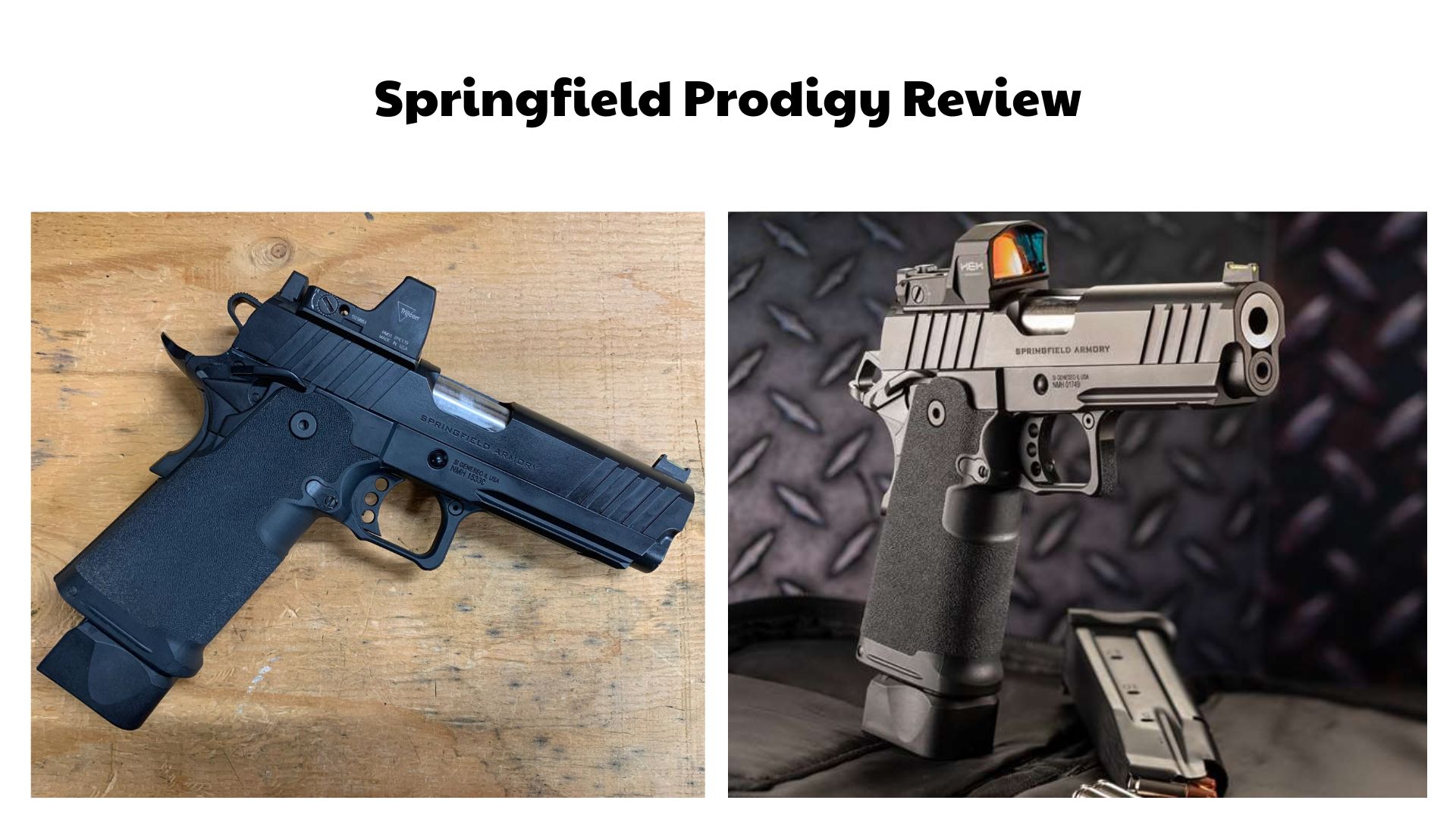

The Springfield Prodigy is a modern double-stack 1911-style pistol designed to combine classic 1911 ergonomics with the high-capacity performance expected from today’s tactical and competition handguns. Built around the increasingly popular 2011 / DS 1911 platform concept, the Prodigy represents Springfield Armory’s entry into the premium double-stack handgun market.
For years, shooters interested in double-stack 1911 pistols often had to spend premium prices on high-end platforms from manufacturers such as Staccato and other boutique 2011 companies. Springfield Armory introduced the Prodigy to offer many of those same performance-oriented features at a more accessible price point.
One of the biggest reasons the Prodigy gained attention so quickly was its ability to deliver a modern tactical handgun experience while still maintaining the crisp trigger and natural ergonomics that made traditional 1911 pistols famous. The platform blends classic single-action controls with modern upgrades such as increased magazine capacity, optics-ready capability, and accessory rail compatibility.
The Springfield Prodigy has also developed a strong reputation for accuracy and shootability. Many shooters praise the pistol for its flat recoil impulse, smooth trigger pull, and competition-ready performance characteristics. Compared to many polymer striker-fired pistols, the Prodigy often feels more refined during rapid fire and precision shooting.
Springfield Armory currently offers the Prodigy in both 4.25-inch and 5-inch configurations. The shorter 4.25-inch model is designed to balance concealment and maneuverability, while the 5-inch version emphasizes maximum stability, sight radius, and competition performance.
The Prodigy is designed for a wide range of users, including competition shooters, tactical enthusiasts, home defense owners, and experienced handgun users looking for a high-performance double-stack 1911 platform without entering the ultra-premium price category.
What Is the Springfield Prodigy?
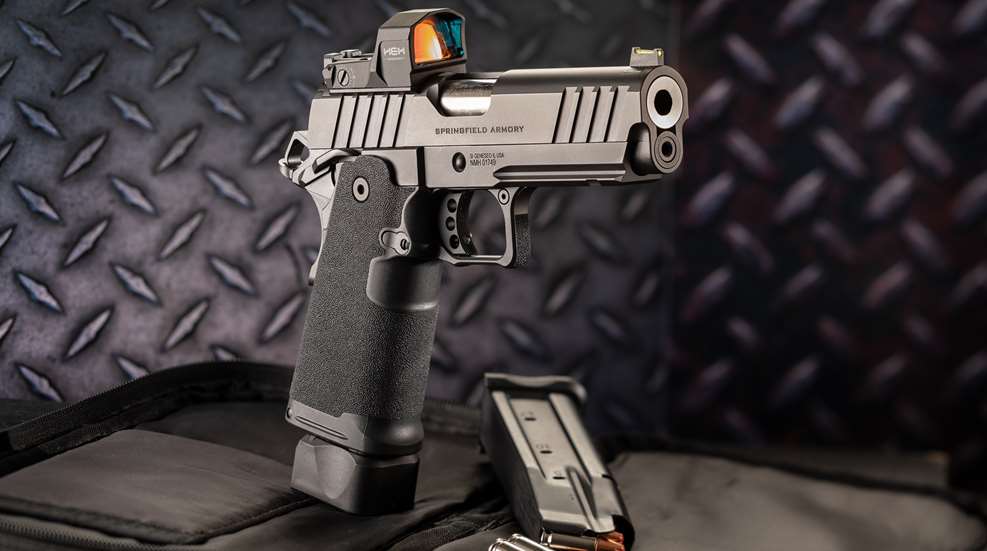
History and Development of the Springfield Prodigy
The Springfield Prodigy was released as Springfield Armory’s first true double-stack 1911 platform. The handgun entered the market during a period when 2011-style pistols were becoming increasingly popular among competitive shooters, tactical users, and firearm enthusiasts.
Springfield Armory designed the Prodigy to compete directly with premium double-stack pistols such as the Staccato series and other high-end 2011-style firearms. The goal was to create a pistol capable of delivering excellent performance while remaining significantly more affordable than many boutique competitors.
A major focus during development was combining classic 1911 handling characteristics with modern tactical features. Springfield incorporated optics-ready slide cuts, accessory rails, double-stack magazines, and modular grip systems to modernize the platform for defensive and competition use.
The Prodigy also reflects the growing popularity of optics-equipped pistols. Springfield’s Agency Optic System (AOS) mounting setup allows shooters to install popular red dot optics without requiring custom slide milling, making the pistol more versatile for modern handgun applications.
Overall, the Springfield Prodigy blends traditional 1911 controls and trigger characteristics with the increased capacity and modularity expected from today’s tactical handguns.
Springfield Prodigy Models Explained
4.25-Inch Prodigy
The 4.25-inch Springfield Prodigy uses a commander-length configuration that balances performance and portability. This version is slightly shorter and lighter than the 5-inch model, making it more practical for defensive carry and faster handling in confined spaces.
Many shooters prefer the 4.25-inch model because it maintains excellent shootability while improving maneuverability and reducing overall carry size. It is also somewhat easier to conceal compared to the larger full-size configuration.
The shorter slide cycles quickly and still delivers strong recoil control thanks to the Prodigy’s steel construction and ergonomic grip design.
5-Inch Prodigy
The 5-inch Springfield Prodigy is the full-size competition-oriented version of the platform. Its longer barrel and slide increase sight radius, improve recoil control, and create a smoother shooting experience during extended range sessions.
The additional weight and length help reduce muzzle movement, making the pistol especially popular among competition shooters and enthusiasts focused on precision shooting performance.
Many users consider the 5-inch model the ideal option for range use, home defense, and practical shooting sports where maximum controllability is a priority.
What Makes the Prodigy Different From Standard 1911 Pistols?
One of the biggest differences between the Springfield Prodigy and a traditional 1911 pistol is its double-stack magazine design. Standard 1911 handguns typically use single-stack magazines with lower ammunition capacity, while the Prodigy supports significantly higher round counts.
The increased magazine capacity gives the Prodigy a major advantage for defensive, duty, and competition applications where minimizing reload frequency is beneficial.
Another key difference is the optics-ready slide system. Traditional 1911 pistols often require custom gunsmith work for optic mounting, while the Prodigy is designed from the factory to support modern red dot optics through Springfield’s AOS mounting system.
The Prodigy also includes an integrated accessory rail, allowing users to mount weapon lights and lasers for tactical and defensive setups.
Unlike many classic 1911 designs, the Prodigy utilizes a 2011-style modular frame system that combines steel upper components with a polymer grip module. This design helps improve capacity, ergonomics, and recoil control while reducing some overall weight.
Compared to many polymer striker-fired pistols, the Prodigy often provides improved recoil management and shooting precision due to its heavier construction, low bore axis characteristics, and refined single-action trigger system.
Springfield Prodigy Specifications
Technical Specifications Overview
The Springfield Prodigy is chambered in 9mm, a widely preferred defensive and competition caliber due to its balance of controllability, capacity, and effectiveness. Springfield offers the pistol in two main barrel lengths: a 4.25-inch commander-style configuration and a 5-inch full-size configuration designed for maximum performance.
Magazine capacity is one of the Prodigy’s strongest features, with standard double-stack magazines typically offering 17-round and 20-round capacities depending on configuration. This gives the pistol a significant advantage over traditional single-stack 1911 designs.
The Prodigy is built using forged steel components for the slide and frame assembly, contributing to its durability and long-term structural strength. It also includes Springfield’s AOS (Agency Optic System), allowing direct mounting of modern red dot optics through modular plate options.
The pistol operates on a single-action trigger system, providing a crisp break and short reset that is highly valued in both competition and defensive shooting environments. Additionally, an integrated accessory rail allows the mounting of lights and lasers for tactical or home defense use.
Weight and overall dimensions vary between the 4.25-inch and 5-inch models, with the larger variant offering increased stability and recoil control at the cost of reduced portability.
Size, Weight, and Handling Characteristics
Compared to polymer striker-fired pistols, the Springfield Prodigy is noticeably heavier due to its steel construction and 1911-style design. This added weight contributes significantly to recoil reduction and improved shooting stability.
The steel frame provides a well-balanced shooting platform, helping absorb recoil energy and reduce muzzle rise during rapid fire. This makes the pistol especially well-suited for competition and precision shooting applications.
Grip width is thicker than traditional single-stack 1911 pistols due to the double-stack magazine design. However, most users find the ergonomics comfortable, especially those with medium to large hands.
The Prodigy offers a competition-ready feel, with a natural point of aim and smooth recoil impulse that supports fast target transitions and accurate follow-up shots.
For everyday carry use, the size and weight may present some limitations, particularly in the 5-inch model. The 4.25-inch version is generally considered more practical for concealed carry applications.
First Impressions of the Springfield Prodigy
Ergonomics and Grip Design
The Springfield Prodigy maintains the classic 1911 grip angle, which many shooters find naturally intuitive and easy to point. This traditional geometry contributes to consistent sight alignment and improved shooting accuracy.
The pistol uses a modern polymer grip module, which helps reduce weight while maintaining structural rigidity. This hybrid design combines traditional steel frame strength with improved ergonomics.
Grip texture is designed to provide solid traction under stress without being overly aggressive. It allows for secure handling during rapid fire and defensive shooting scenarios.
The pistol is generally comfortable for medium and large hands, although shooters with smaller hands may need time to adjust to the double-stack grip circumference.
A beavertail grip safety is included to improve control, reduce slide bite risk, and enhance overall shooting comfort during recoil.
Build Quality and Finish
The Prodigy features a forged slide and frame construction that enhances long-term durability and resistance to wear under high round counts. This level of construction is typically associated with higher-end 1911 platforms.
Fit and finish are generally solid for its price category, with minor variations depending on production batch. Overall, the pistol presents a modern tactical appearance with functional design priorities.
Slide-to-frame fit is tight enough to support accuracy without being overly restrictive, striking a balance between smooth cycling and mechanical precision.
Durability expectations are high, with the pistol designed for sustained use in competition, defensive, and training environments.
The factory coating provides adequate corrosion resistance and surface protection, though some users choose aftermarket refinishing for enhanced durability or aesthetics.
Controls and User Interface
The Springfield Prodigy includes ambidextrous thumb safeties, making it accessible for both left- and right-handed shooters. This is particularly useful in defensive and tactical scenarios.
The pistol uses a traditional 1911-style magazine release, which is familiar to experienced 1911 shooters and allows for fast reloads with practice.
The slide stop is positioned for intuitive operation, although some users may require time to adjust depending on hand size and grip style.
The optics-ready AOS mounting system is one of the Prodigy’s key modern features, enabling users to mount a wide range of red dot sights with adapter plates.
Overall manipulation and reload speed are strong once the shooter becomes familiar with the platform, especially in competition environments.
Springfield Prodigy Trigger Review
Single-Action Trigger Characteristics
The Springfield Prodigy features a single-action 1911-style trigger that is widely praised for its crisp break and predictable feel. This type of trigger is one of the primary reasons 1911-style pistols remain popular among enthusiasts.
The trigger reset is short and tactile, allowing for fast follow-up shots and efficient shooting cadence during rapid fire sequences.
The relatively light trigger pull compared to striker-fired pistols provides an advantage in precision shooting and competition environments.
1911 triggers are highly regarded because they offer minimal take-up, a clean break, and a consistent feel that enhances shooter confidence and accuracy.
Trigger Performance in Real Shooting
In real-world shooting, the Prodigy’s trigger supports fast follow-up shots due to its short reset and predictable break. This improves split times during defensive and competitive shooting drills.
The trigger system contributes significantly to accuracy, especially when engaging targets at medium distances or during precision-focused shooting.
Competitive shooters often appreciate the trigger’s consistency, which allows for repeatable performance across multiple stages.
For defensive use, the trigger provides a balance of speed and control, although proper training is required due to its lighter single-action nature.
Trigger Comparisons
Compared to traditional 1911 triggers, the Prodigy’s trigger is generally similar in feel, though some users report slight variation depending on production unit and break-in period.
When compared to high-end Staccato pistols, the Prodigy trigger is often considered slightly less refined out of the box but still highly capable for its price category.
Compared to striker-fired triggers like Glock or SIG Sauer pistols, the Prodigy offers a significantly lighter and crisper break, which many shooters prefer for precision shooting.
Springfield Prodigy Performance Review
Accuracy and Precision
The Springfield Prodigy delivers excellent accuracy at both defensive and competition distances. Most shooters report strong grouping performance between 7 and 25 yards, with consistent point-of-impact results.
The 5-inch model benefits from a longer sight radius, which enhances precision and target alignment, particularly during slow-fire or precision shooting.
At extended ranges, the Prodigy maintains solid mechanical accuracy due to its steel construction and tight barrel lockup.
Overall, the pistol provides strong practical shooting performance suitable for both defensive use and competitive applications.
Recoil and Shootability
The Prodigy’s heavy steel frame significantly reduces felt recoil compared to polymer-framed pistols. This results in a flatter shooting experience and improved control during rapid fire.
The pistol exhibits fast target transitions due to reduced muzzle rise and stable sight recovery after each shot.
Compared to polymer striker-fired pistols, the Prodigy feels more planted and controlled during extended shooting sessions.
Its recoil management makes it particularly well-suited for competition shooting where speed and accuracy are equally important.
Reliability and Ammo Compatibility
The Springfield Prodigy performs well with both FMJ training ammunition and modern hollow-point defensive loads. However, some early production units reportedly required a break-in period before achieving optimal reliability.
Over time, improvements in manufacturing and user break-in have addressed many early concerns, leading to better consistency across newer models.
Magazine reliability is generally strong when using factory magazines, though as with many double-stack 1911 platforms, maintenance and proper magazine care are important.
Long-term durability expectations are positive due to the pistol’s steel construction and proven 1911 design lineage.
Springfield Prodigy for Concealed Carry
Is the Prodigy Practical for CCW?
The Springfield Prodigy can be used for concealed carry, but its practicality depends heavily on the model and the user’s carry preferences. The 4.25-inch version is generally considered the more realistic option for everyday concealed carry due to its slightly reduced length and improved balance compared to the 5-inch model.
However, even the compact configuration is still a full-featured double-stack 1911, meaning it is thicker and heavier than most modern polymer micro-compact pistols. This makes holster selection and belt support extremely important for comfortable daily carry.
Appendix carry is possible with the Prodigy, especially the 4.25-inch model, but some users may find the width and weight noticeable during extended wear. A rigid, high-quality holster and a sturdy gun belt are strongly recommended to support the platform effectively.
Concealment and Comfort
One of the main challenges with the Prodigy in concealed carry use is grip length, which can contribute to printing under tighter clothing. The double-stack magazine design increases grip width compared to traditional single-stack 1911 pistols, making concealment slightly more difficult.
For all-day carry, comfort depends largely on the user’s body type and clothing choices. Many shooters find the 4.25-inch model manageable, but the 5-inch version is typically better suited for open carry or range use rather than deep concealment.
Compared to compact polymer pistols like Glock 19-sized handguns, the Prodigy is heavier and more substantial. While this improves shooting performance, it can reduce comfort during extended concealed carry periods.
Recommended carry positions include strong-side IWB (inside-the-waistband) and appendix carry for those comfortable with larger steel-frame pistols. OWB carry is also practical when concealment is less of a priority.
Springfield Prodigy Pros and Cons
Major Advantages
One of the most praised features of the Springfield Prodigy is its excellent 1911-style single-action trigger. The crisp break and short reset make it highly effective for both precision shooting and rapid follow-up shots.
The high magazine capacity is another major advantage, giving the Prodigy a significant edge over traditional single-stack 1911 pistols. This makes it more suitable for defensive and competition use.
The pistol’s heavy steel construction contributes to soft recoil and a flat shooting experience, especially in the 5-inch model. This improves control during rapid fire and enhances overall accuracy.
Factory optics-ready capability through the AOS system adds modern flexibility, allowing users to mount red dot optics without permanent slide modification.
Strong ergonomics, natural pointability, and a familiar 1911 grip angle make the Prodigy comfortable for many shooters. It also delivers better shootability than many polymer pistols in its price range.
Finally, the Prodigy is generally more affordable than premium 2011 platforms like Staccato, making it an accessible entry point into the double-stack 1911 market.
Main Drawbacks
The most obvious drawback is weight. The all-steel construction makes the Prodigy significantly heavier than polymer striker-fired pistols, which can impact concealed carry comfort.
The grip circumference is also larger due to the double-stack magazine design. Shooters with smaller hands may find it less comfortable compared to slimmer handguns.
Some early production models experienced break-in-related reliability concerns, although many of these issues have improved in newer manufacturing runs and with proper maintenance.
Compared to striker-fired pistols, the Prodigy requires more maintenance attention due to its 1911-style operating system and tighter tolerances.
Lastly, while more affordable than premium 2011 pistols, the Prodigy is still more expensive than standard polymer duty handguns, which may limit its appeal for budget-focused buyers.
Springfield Prodigy vs Competitors
Springfield Prodigy vs Staccato P
The Springfield Prodigy and Staccato P occupy similar roles as double-stack 1911-style pistols, but they differ significantly in price and refinement. The Staccato P is widely considered a premium benchmark in the 2011 category, while the Prodigy is positioned as a more affordable alternative.
In terms of performance, both pistols offer excellent accuracy, flat recoil, and high-capacity magazines. However, the Staccato P typically has tighter fitment, more refined finishing, and more consistent out-of-the-box performance.
Trigger quality is often slightly more polished on the Staccato, though the Prodigy still delivers a strong 1911-style trigger experience that many shooters find more than adequate for defensive and competition use.
From a value perspective, the Prodigy is considered a strong entry point into the 2011 platform, while the Staccato P targets users willing to pay for premium fit and finish.
For competition use, both perform well, but Staccato generally holds an edge in consistency at the highest performance levels, while Prodigy offers better affordability.
Springfield Prodigy vs Glock 34
The Prodigy and Glock 34 represent very different handgun philosophies. The Prodigy uses a 1911-style single-action trigger, while the Glock 34 uses a striker-fired system with a consistent pull.
In terms of recoil and accuracy, the Prodigy often feels softer and more stable due to its heavier steel frame and low bore axis design. The Glock 34, however, benefits from lighter weight and simplicity.
For competition shooting, both pistols are widely used, but the Prodigy’s trigger system gives it an advantage in precision shooting and split times for some users.
When it comes to maintenance and reliability, the Glock 34 is generally considered simpler and more forgiving, while the Prodigy requires more care typical of 1911-style platforms.
Springfield Prodigy vs SIG Sauer P320 XFive Legion
The SIG Sauer P320 XFive Legion is a competition-focused striker-fired pistol, while the Prodigy is a double-stack 1911 platform. Both are designed for performance shooting but differ significantly in design philosophy.
The XFive Legion is heavier than standard polymer pistols but still differs in recoil feel compared to the steel-frame Prodigy, which generally delivers a flatter shooting experience for many users.
The Prodigy’s single-action trigger provides a distinct advantage in crispness and reset, while the P320 offers a consistent striker-fired pull with modularity benefits.
The P320 has a strong advantage in modularity and factory optics integration, while the Prodigy offers a more traditional 1911 shooting experience.
Springfield Prodigy vs Traditional 1911 Pistols
Compared to traditional single-stack 1911 pistols, the Prodigy offers significantly higher capacity thanks to its double-stack magazine system. This is one of its most important modern advantages.
The Prodigy also provides better compatibility with modern optics and accessories, making it more adaptable to current defensive and competition trends.
In terms of weight, the Prodigy is generally heavier than many traditional 1911 pistols due to its modern construction and magazine design, but this weight helps improve recoil control.
Reliability and maintenance requirements are similar in concept, but the Prodigy incorporates more modern design elements that improve durability while still requiring typical 1911-style care and attention.
Springfield Prodigy Customization and Aftermarket Support
Popular Upgrades
One of the strongest aspects of the Springfield Prodigy platform is its growing customization potential. As a double-stack 1911-style pistol, it benefits from both Springfield factory support and a developing aftermarket ecosystem focused on improving performance and ergonomics.
Red dot optics are one of the most popular upgrades thanks to the factory AOS mounting system. This allows shooters to easily install modern pistol optics for faster target acquisition and improved accuracy.
Extended magazine wells are commonly added by competition shooters to speed up reloads and improve consistency during high-pressure stages.
Trigger tuning and aftermarket trigger kits are also widely used to refine the already strong 1911-style trigger system, improving pull weight, reset, and overall smoothness.
Competition-grade safeties and enhanced control parts are frequently installed to improve manipulation speed and ergonomics during dynamic shooting.
Grip modifications, including stippling and texture enhancements, help improve handling stability, especially under sweat, rain, or extended training sessions.
Recoil spring tuning is another common modification that allows shooters to fine-tune cycling speed and recoil behavior depending on ammunition type and use case.
Best Accessories for the Prodigy
Weapon-mounted lights are essential for home defense and tactical setups, and the Prodigy’s accessory rail supports a wide variety of modern lighting systems.
Competition holsters are widely used among Prodigy owners participating in USPSA, IPSC, and similar shooting sports. These holsters prioritize speed, retention, and smooth draw mechanics.
Magazine carriers are another important accessory, especially for competition shooters who rely on fast reloads and multiple magazine setups during matches.
Red dot optics remain one of the most impactful upgrades, significantly improving target acquisition speed and accuracy under pressure.
Defensive and competition ammunition selection also plays a role in performance optimization, with users often testing different loads to find the most reliable and accurate combination for their specific firearm setup.
Real User Opinions and Community Feedback
What Owners Love About the Prodigy
Many owners praise the Springfield Prodigy for its excellent trigger feel, which delivers a crisp break and fast reset typical of high-quality 1911-style pistols.
The flat recoil impulse is another frequently mentioned advantage, with shooters noting that the pistol tracks smoothly during rapid fire and allows for quick sight recovery.
A major point of appreciation is its affordability relative to other 2011-style pistols, making it an accessible entry point into the double-stack 1911 category.
Strong accuracy performance is consistently reported across different shooting distances, particularly when paired with quality ammunition and optics.
Overall, many users describe the Prodigy as delivering a premium shooting experience at a more approachable price point.
Common Complaints From Users
Some users report early reliability concerns on certain production units, particularly during initial break-in periods. However, many of these issues tend to improve with use and proper maintenance.
The pistol’s weight is another common complaint, especially for concealed carry users who find it heavy compared to polymer striker-fired alternatives.
Magazine tuning and compatibility discussions are also present in the community, as with many double-stack 1911 platforms that require careful magazine maintenance.
Higher maintenance requirements compared to Glock-style pistols are often mentioned, reflecting the more complex nature of 1911-based systems.
Community Reputation Among Enthusiasts
Among firearm enthusiasts, the Springfield Prodigy has built a strong reputation within the 2011 community. It is often viewed as a gateway platform into premium double-stack 1911 pistols.
Competition shooters have responded positively to the Prodigy due to its performance potential, trigger quality, and optics-ready capabilities.
It is also frequently discussed in comparison threads against higher-end models such as Staccato pistols, with ongoing debates about value versus refinement.
Overall, the Prodigy is widely respected as a strong performer in the mid-tier 2011 market.
Is the Springfield Prodigy Worth It in 2026?
How It Competes in the Modern Handgun Market
In 2026, the Springfield Prodigy continues to compete in a growing segment of double-stack 1911-style pistols, which have become increasingly popular among competitive shooters and defensive handgun users.
The rising interest in 2011-style platforms has pushed more shooters toward double-stack 1911 designs due to their combination of capacity, trigger quality, and shootability.
The Prodigy competes directly with brands such as Staccato, Bul Armory, and SIG Sauer’s competition-focused models, offering a more affordable alternative in the premium handgun space.
Its value proposition remains strong, especially for shooters who want 2011 performance without paying top-tier pricing.
Best Use Cases for the Springfield Prodigy
Competition Shooting
The Prodigy is highly effective for competition shooting due to its flat recoil, high capacity, and excellent trigger system, making it well-suited for USPSA and similar disciplines.
Range Training and Recreational Shooting
Its smooth shooting characteristics and accuracy potential make it a favorite for extended range sessions and recreational practice.
Home Defense
With its high capacity, optics compatibility, and rail for weapon lights, the Prodigy is a strong home defense option for users comfortable with its size and weight.
Tactical / Duty Setup
The pistol can also serve in tactical or duty roles where reliability, accuracy, and shootability are prioritized over compact carry size.
Final Verdict on the Springfield Prodigy
Who Should Buy the Springfield Prodigy?
The Springfield Prodigy is best suited for shooters who want a premium 1911-style shooting experience with modern enhancements like optics compatibility and increased capacity.
It is particularly appealing to competition shooters who prioritize performance, consistency, and fast follow-up shots.
Users looking for a modern 2011-style platform with optics-ready capability will also find strong value in the Prodigy.
Traditional 1911 enthusiasts who want higher capacity without sacrificing trigger quality are another key audience for this pistol.
Who Might Prefer Another Option?
Shooters prioritizing lightweight concealed carry may find polymer micro-compacts more practical due to reduced size and weight.
Those who prefer ultra-simple striker-fired systems may also prefer Glock or similar platforms for ease of use and minimal manual controls.
Budget-focused buyers looking for lower-cost polymer pistols may find better value outside the 1911-style category.
Users who want minimal maintenance requirements may also prefer striker-fired designs over 1911-based systems.
Overall Recommendation
Overall, the Springfield Prodigy stands out as one of the best value-oriented 2011-style pistols currently available on the market. It delivers an impressive balance of trigger quality, recoil control, capacity, and modern tactical features.
As an entry point into the double-stack 1911 category, it offers a compelling combination of performance and affordability.
Even in 2026, the Prodigy remains highly competitive and relevant for shooters who prioritize shootability, accuracy, and platform flexibility over ultra-lightweight design.
Frequently Asked Questions About the Springfield Prodigy
1. What is the Springfield Prodigy?
The Springfield Prodigy is a modern double-stack 1911-style pistol (often called a 2011-style handgun). It combines classic 1911 single-action trigger performance with higher magazine capacity, modern optics readiness, and improved ergonomics. It is designed for competition shooting, duty use, home defense, and enthusiast shooters who want 1911 performance with modern features.
2. Is the Springfield Prodigy a true 2011 pistol?
The Prodigy follows the 2011-style concept but is not a pure STI/2011 clone. It uses a modular frame system with a steel upper and polymer grip module. While it delivers similar performance characteristics—high capacity, flat recoil, and single-action trigger—it is Springfield’s interpretation of the DS 1911 platform.
3. What caliber is the Springfield Prodigy?
The Springfield Prodigy is chambered exclusively in 9mm. This caliber was chosen for its balance of controllability, magazine capacity, and effectiveness in both defensive and competition applications.
4. What magazine capacity does the Prodigy have?
The Prodigy typically uses 17-round and 20-round double-stack magazines, depending on configuration. This is a major advantage over traditional 1911 pistols, which usually hold 7–8 rounds.
5. What barrel lengths are available?
Springfield offers the Prodigy in two main barrel lengths: 4.25 inches and 5 inches. The 4.25-inch model is more compact and carry-friendly, while the 5-inch version is optimized for competition and recoil control.
6. Is the Springfield Prodigy good for beginners?
It can be suitable for beginners, but it is better suited for shooters who already understand firearms safety and basic pistol handling. The single-action trigger requires discipline, and the size/weight may be more than a beginner-friendly polymer pistol.
7. Is the Prodigy good for concealed carry?
Yes, but mainly in the 4.25-inch version. The Prodigy is heavier and thicker than most carry pistols, so it is best for users comfortable carrying steel-frame firearms with proper holster and belt support.
8. Can you carry the 5-inch Prodigy?
It is possible, but not ideal for most users. The 5-inch model is better suited for competition, range use, or home defense due to its larger size and weight.
9. Is the Prodigy reliable?
Yes, the Prodigy is generally reliable, especially after break-in. Early production models had mixed reports, but later versions improved significantly. Proper lubrication and quality magazines help ensure consistent performance.
10. Does the Prodigy require a break-in period?
Many 1911-style pistols, including the Prodigy, benefit from a break-in period of several hundred rounds. This allows parts to mate properly and improves reliability and smoothness over time.
11. Is the Springfield Prodigy accurate?
Yes, it is highly accurate due to its single-action trigger, steel construction, and tight barrel lockup. The 5-inch model offers especially strong accuracy at longer distances.
12. How does the recoil feel on the Prodigy?
Recoil is very manageable and often described as “flat.” The heavy steel frame helps absorb recoil energy, making it smoother than many polymer striker-fired pistols.
13. Is the Prodigy better than Glock pistols?
It depends on the user. The Prodigy offers a better trigger and softer recoil, while Glock pistols offer simplicity, lighter weight, and a larger aftermarket ecosystem.
14. Is the Prodigy better than Staccato?
Staccato pistols are generally more refined and expensive. The Prodigy offers similar performance potential at a lower price, but Staccato tends to have better fit, finish, and consistency out of the box.
15. Does the Prodigy have an optics-ready slide?
Yes, it uses Springfield’s AOS (Agency Optic System), which allows mounting of various red dot optics using adapter plates.
16. What optics fit the Prodigy?
The AOS system supports popular red dots like Trijicon RMR, Holosun 507C/508T, and similar footprint optics depending on the mounting plate used.
17. Does the Prodigy have a rail for lights?
Yes, it features an accessory rail for mounting weapon lights and laser systems, making it suitable for home defense and tactical use.
18. Is the Prodigy a duty pistol?
Yes, it can be used as a duty pistol. It offers high capacity, durability, and strong performance characteristics suitable for professional use, though it is more commonly seen in competition roles.
19. Is the Prodigy good for competition shooting?
Yes, it is widely considered a strong competition pistol. Its flat recoil, high capacity, and excellent trigger make it suitable for USPSA, IPSC, and other action shooting sports.
20. How does the trigger feel on the Prodigy?
The trigger is crisp, light, and very 1911-like. It has a short reset and clean break, which improves speed and accuracy during shooting.
21. Does the Prodigy have a safety?
Yes, it features ambidextrous thumb safeties typical of 1911-style pistols. These safeties are engaged manually and are designed for secure carry and handling.
22. Is the Prodigy hammer-fired or striker-fired?
The Prodigy is hammer-fired and uses a single-action trigger system, unlike striker-fired pistols such as Glock or SIG P320.
23. Is the Prodigy heavy?
Yes, it is heavier than polymer pistols due to its steel frame construction. However, this weight helps significantly reduce recoil and improve shooting stability.
24. Can the Prodigy be used for home defense?
Yes, it is an excellent home defense option thanks to its high capacity, rail for lights, accuracy, and controllability under stress.
25. Is the Prodigy good for concealed carry in 2026?
It is still viable, especially the 4.25-inch model, but it is less convenient than modern micro-compact pistols due to its size and weight.
26. What are the main disadvantages of the Prodigy?
The main drawbacks include weight, bulk compared to polymer pistols, potential early reliability concerns, and higher maintenance requirements typical of 1911-style platforms.
27. Does the Prodigy have good ergonomics?
Yes, the Prodigy offers excellent ergonomics with a 1911 grip angle, good texture, and a natural point of aim for most shooters.
28. Is the grip too big for small hands?
Some shooters with smaller hands may find the double-stack grip wide, but most users adapt quickly with proper grip technique and training.
29. Is the Prodigy reliable with hollow points?
Yes, most modern defensive hollow-point ammunition runs reliably, especially after proper break-in and with quality magazines.
30. What is the best use case for the Prodigy?
The best use cases include competition shooting, home defense, and range training. It is less ideal for deep concealed carry but excellent for performance-focused applications.
31–55. Additional FAQs (Extended Insights)
The following questions expand on real-world usage, performance expectations, maintenance, and ownership considerations.
31. How often should the Prodigy be cleaned?
Regular cleaning after every 300–500 rounds is recommended for optimal performance, especially in dusty or high-use environments.
32. Can the Prodigy handle high round counts?
Yes, it is designed for extended use in competition and duty roles, with steel construction supporting long-term durability.
33. Is the Prodigy good for fast shooting?
Yes, its flat recoil and crisp trigger make it highly effective for rapid fire and competitive shooting drills.
34. Does the Prodigy require special magazines?
Yes, it uses proprietary double-stack magazines designed for the 2011-style platform. Quality magazines are important for reliability.
35. Is aftermarket support good for the Prodigy?
Aftermarket support is growing, especially for triggers, sights, optics plates, and competition parts, though still smaller than Glock ecosystems.
36. Can you upgrade the trigger?
Yes, many shooters install aftermarket trigger kits or tuning components to improve pull weight and reset performance.
37. Is the Prodigy good for left-handed shooters?
Yes, ambidextrous safeties make it accessible for left-handed users, improving usability in defensive situations.
38. Is the Prodigy better than polymer pistols for recoil?
Yes, most shooters find it softer shooting due to its heavier steel frame and 1911 geometry.
39. Does the Prodigy rust easily?
No, but like all steel firearms, it requires basic maintenance and lubrication to prevent corrosion.
40. Is the Prodigy a good investment pistol?
It holds value reasonably well within the 2011 market but is primarily a performance firearm rather than a collector investment piece.
41. Is the Prodigy good for tactical training?
Yes, it performs well in tactical drills due to its capacity, recoil control, and optics compatibility.
42. Can the Prodigy be used with suppressors?
Not directly without modifications, but it can be adapted depending on barrel and setup configuration.
43. Is the Prodigy better than a Beretta 92?
The Prodigy offers higher capacity and optics compatibility, while the Beretta 92 offers traditional DA/SA reliability and different handling characteristics.
44. Does the Prodigy have slide bite issues?
The beavertail grip safety helps reduce slide bite risk significantly compared to older 1911 designs.
45. Is the Prodigy good for duty holsters?
Yes, but holster selection is more limited than mainstream polymer pistols, requiring compatible 2011-style holsters.
46. Is the Prodigy good for competition beginners?
Yes, it is a strong entry-level 2011 platform for shooters entering USPSA or similar disciplines.
47. Does the Prodigy shoot flat?
Yes, it is known for a flat shooting profile due to weight distribution and recoil management design.
48. Is the Prodigy better than SIG XFive Legion?
Both are strong competition pistols; the Prodigy offers 1911 trigger feel, while the SIG offers modularity and striker-fired consistency.
49. Can you carry the Prodigy daily?
Yes, but comfort depends heavily on holster quality, belt support, and user tolerance for weight.
50. Why is the Prodigy popular in 2026?
It remains popular due to its balance of affordability, 2011 performance, high capacity, and modern optics-ready features.
51. Is the Prodigy good for accuracy drills?
Yes, its trigger and stability make it excellent for precision and accuracy training.
52. Does the Prodigy need aftermarket tuning?
Not required, but many enthusiasts upgrade components to refine performance further.
53. Is the Prodigy better than traditional 1911s?
In capacity and modern features, yes. Traditional 1911s may still win in simplicity and slimness.
54. Is the Prodigy a “budget Staccato”?
Many users describe it that way due to similar design philosophy at a lower price point, though refinement levels differ.
55. Final ownership perspective?
The Prodigy is best viewed as a high-performance, value-oriented 2011 platform that delivers modern capability with classic 1911 shooting characteristics.