
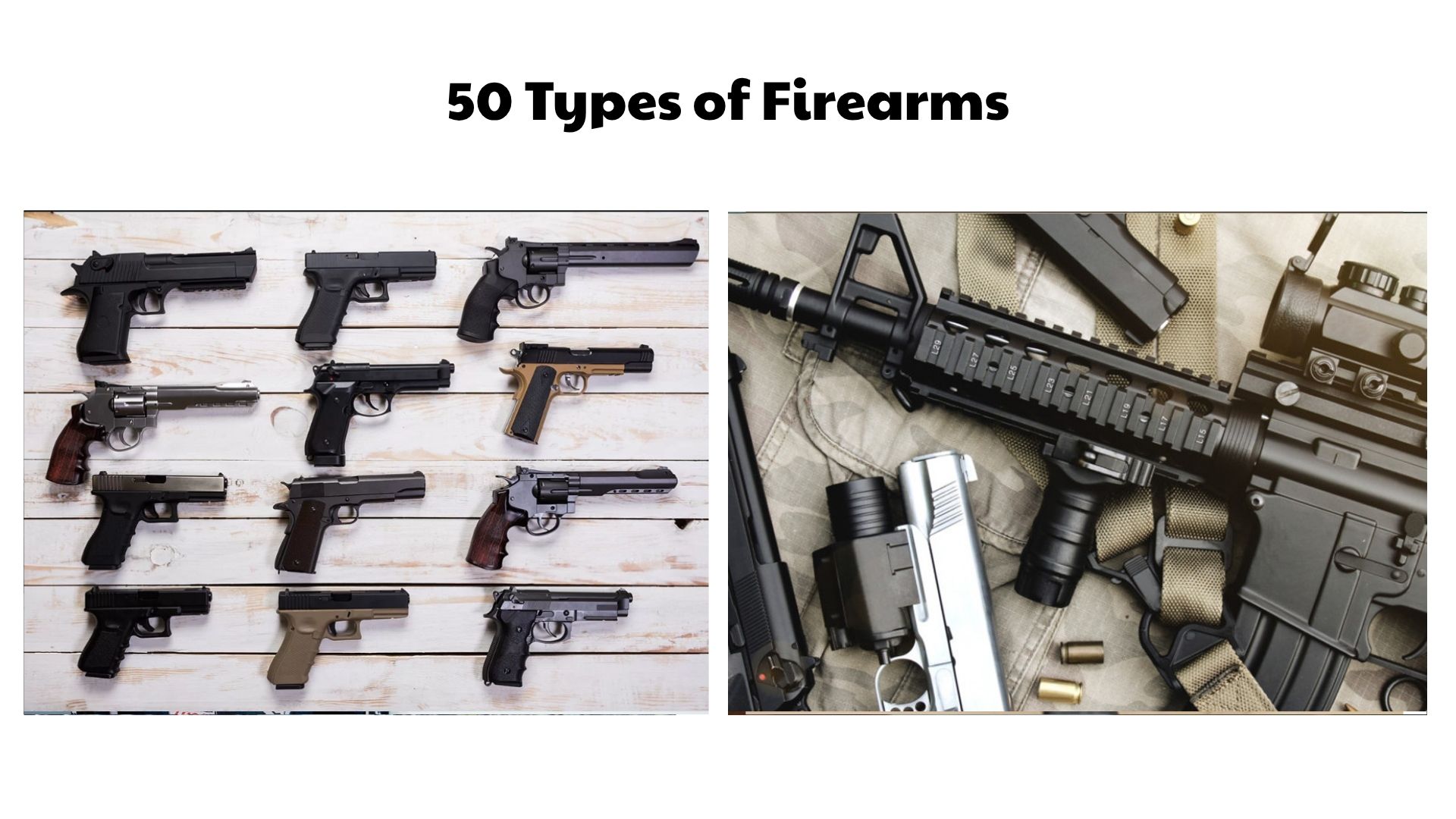

Firearms have evolved over centuries into a wide range of designs, each built for specific purposes such as hunting, sport shooting, personal defense, or military use. Understanding the different types of firearms helps hunters, enthusiasts, and beginners make informed decisions while also appreciating the engineering behind each design. This guide explores 50 types of firearms, breaking them down into clear, easy-to-understand sections. Whether you are a curious reader or an experienced shooter, this article provides a practical overview of how each firearm works, what it is used for, and why it matters. Let’s begin with the first five essential firearm types.
50 Types of Firearms
1. Pistol
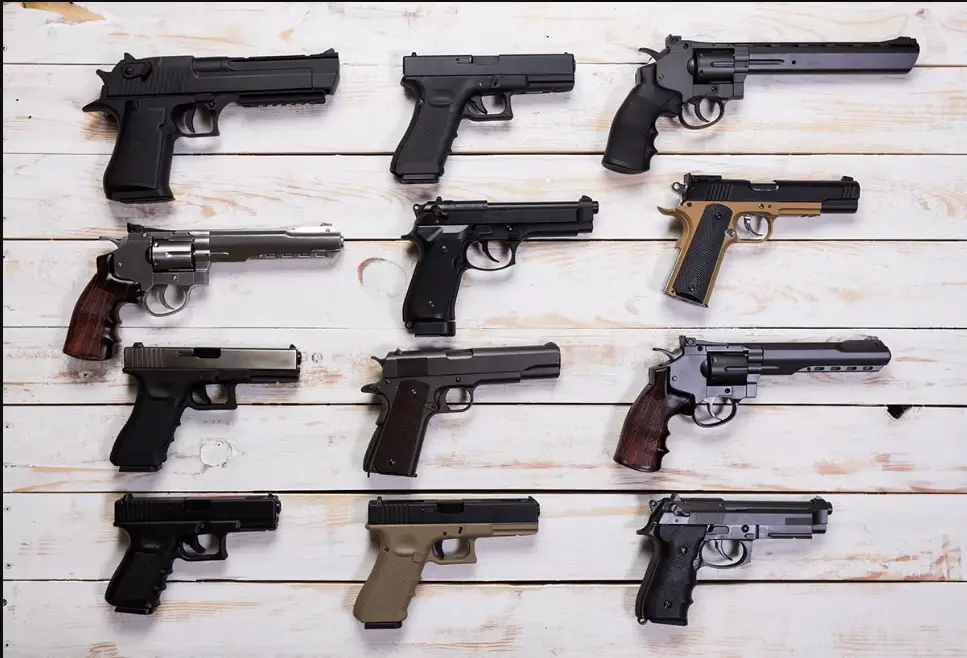
A pistol is one of the most recognizable types of firearms, commonly used for personal defense, law enforcement, and recreational shooting. It is designed to be operated with one hand, making it compact and easy to carry compared to larger firearms such as rifles or shotguns. Most modern pistols are semi-automatic, meaning they automatically chamber the next round after each shot, allowing for quicker follow-up shots. This efficiency is one of the reasons pistols are widely favored among both civilians and professionals.
For hunters, pistols are not typically the primary choice for large game due to their limited range and stopping power. However, they are sometimes used for small game hunting or as backup weapons in the field. The compact size makes them convenient to carry during long treks, especially in environments where mobility matters. Additionally, pistols are often used in target shooting competitions, where precision and control are key factors.
From a design perspective, pistols are built with simplicity and functionality in mind. They usually include a magazine housed in the grip, a trigger mechanism, and a slide that cycles with each shot. While they are easy to handle, proper training is essential to ensure safe and effective use. Overall, the pistol remains one of the most versatile and widely used firearms in the world.
2. Semi-automatic Pistol
The semi-automatic pistol is a refined version of the standard pistol, offering improved efficiency and ease of use. Unlike older designs that required manual reloading after each shot, a semi-automatic pistol automatically chambers a new round using the energy from the previous shot. This allows the shooter to fire multiple rounds quickly without needing to manually cycle the action, making it highly practical in both defensive and sporting scenarios.
Hunters may not rely heavily on semi-automatic pistols for primary hunting purposes, but they can be useful for pest control or as a sidearm in the wilderness. Their reliability and ease of operation make them appealing for individuals who want a straightforward firearm that performs consistently under various conditions. In addition, these pistols are widely used in shooting sports, where speed and accuracy are both critical.
One of the defining characteristics of a semi-automatic pistol is its magazine-fed system, which allows for quick reloading and a higher ammunition capacity compared to revolvers. This feature contributes to its popularity among modern firearm users. While easy to operate, responsible handling and proper maintenance are essential to ensure long-term performance and safety.
3. Machine Pistol
A machine pistol is a specialized firearm that combines the compact size of a pistol with the capability of automatic fire. Unlike standard pistols, which fire one round per trigger pull, machine pistols can fire continuously as long as the trigger is held down. This unique feature places them in a distinct category among types of firearms, often associated with military and tactical applications rather than civilian use.
Due to their rapid rate of fire, machine pistols are not commonly used by hunters. The lack of precision and control during automatic fire makes them unsuitable for ethical hunting practices, where accuracy and clean shots are essential. However, they are sometimes studied and appreciated by firearm enthusiasts for their engineering and historical significance.
The design of a machine pistol typically includes a detachable magazine, a selector switch for semi-automatic or automatic fire, and a compact frame. While they offer high firepower in a small package, they also require significant skill to control effectively. This makes them more suited for trained professionals than casual users.
4. Revolver
The revolver is a classic firearm known for its simplicity, reliability, and timeless design. Unlike semi-automatic pistols, revolvers use a rotating cylinder to hold multiple rounds, usually between five and eight. Each pull of the trigger rotates the cylinder and aligns a new round with the barrel, making the mechanism straightforward and dependable even in harsh conditions.
Hunters often appreciate revolvers for their durability and ease of use, especially in remote environments where maintenance opportunities are limited. While not typically used for large game, revolvers can be effective for small game hunting or as a backup firearm. Their reliability is a major advantage, as they are less prone to malfunctions compared to more complex firearm systems.
Another key feature of revolvers is their versatility in ammunition types. Many models can handle powerful cartridges, making them suitable for a range of applications. Although they generally have a lower ammunition capacity than semi-automatic pistols, their simplicity and consistent performance continue to make them a popular choice among firearm enthusiasts.
5. Single-action Revolver
The single-action revolver is one of the earliest forms of repeating firearms, often associated with historical and western-era use. In this design, the hammer must be manually cocked before each shot, which then allows the trigger to release the hammer and fire the round. This process may seem slower compared to modern firearms, but it provides a high level of control and precision.
For hunters and shooting enthusiasts, single-action revolvers offer a unique experience that emphasizes deliberate shooting and careful aim. They are sometimes used in hunting small game or in recreational shooting activities where accuracy is more important than speed. The manual cocking action encourages shooters to take their time and focus on each shot, which can improve overall shooting discipline.
Despite being considered an older design, single-action revolvers remain popular due to their historical charm and mechanical simplicity. They are often chosen by collectors and hobbyists who appreciate traditional firearms. While not the most practical option for modern tactical use, they continue to hold a respected place in the world of firearms.
6. Double-action Revolver
The double-action revolver builds upon the traditional revolver design by allowing the shooter to fire the weapon in two different ways, making it one of the more versatile types of firearms available today. In double-action mode, pulling the trigger both cocks the hammer and releases it in a single motion, enabling faster shooting compared to single-action revolvers. This feature makes it especially useful in situations where quick response times are important, while still maintaining the reliability that revolvers are known for.
For hunters, the double-action revolver serves as a dependable sidearm rather than a primary hunting tool. It is often carried for protection in remote environments or used for small game where precision at close range is sufficient. The ability to switch between single-action and double-action firing modes also gives shooters flexibility depending on the situation, allowing for either deliberate, precise shots or quicker follow-up shots when needed.
In terms of design, double-action revolvers are straightforward and durable, with fewer moving parts compared to semi-automatic firearms. This simplicity contributes to their long-standing reputation for reliability, even in adverse conditions. While they may not offer the high ammunition capacity of modern pistols, their ease of use and consistent performance continue to make them a practical choice for both beginners and experienced shooters.
7. Derringer
The derringer is a compact, easily concealable firearm that stands out among types of firearms due to its extremely small size and simple construction. Typically featuring one or two barrels, derringers are designed for close-range use and are often associated with personal defense rather than hunting or sport shooting. Their minimalistic design makes them lightweight and easy to carry, which has contributed to their popularity throughout history.
Hunters generally do not use derringers as primary tools because of their limited range, low ammunition capacity, and reduced stopping power. However, they may occasionally be carried as a backup firearm in situations where space and weight are critical considerations. Their simplicity can also be appealing to those who prefer straightforward mechanical designs without the complexity of larger firearms.
Despite their limitations, derringers hold a unique place in firearm history and continue to attract interest from collectors and enthusiasts. Their ease of operation and compact form factor make them an interesting example of how firearms can be adapted for specific purposes, even if those purposes are quite narrow compared to more versatile options.
8. Pocket Pistol
The pocket pistol is designed with portability and concealment in mind, making it one of the most practical types of firearms for everyday carry. These small handguns are typically lightweight and compact enough to fit comfortably in a pocket, which allows users to carry them discreetly without sacrificing accessibility. Most pocket pistols are semi-automatic, offering a balance between size and functionality.
While pocket pistols are not commonly used by hunters as primary firearms, they can serve as a convenient backup option during outdoor activities. Their small size makes them easy to carry alongside larger hunting equipment, providing an additional layer of security when navigating remote areas. However, their shorter barrels and smaller calibers limit their effectiveness for hunting purposes.
From a usability standpoint, pocket pistols are designed to be simple and efficient, often featuring minimal controls to reduce complexity. This makes them accessible to a wide range of users, although proper training is still essential for safe handling. Overall, the pocket pistol represents a practical solution for those who prioritize portability and convenience.
9. Target Pistol
The target pistol is specifically designed for precision shooting, making it a favorite among competitive shooters and enthusiasts who value accuracy above all else. Unlike many other types of firearms, target pistols are optimized for stability, balance, and minimal recoil, allowing shooters to achieve consistent results over repeated shots. These pistols are often used in shooting competitions where precision is the primary objective.
For hunters, target pistols are generally not used in the field, as their design focuses on controlled environments rather than real-world hunting scenarios. However, the skills developed through target shooting—such as steady aim and trigger control—can translate well into hunting situations. This makes target pistols a valuable training tool for improving overall shooting proficiency.
The construction of a target pistol often includes features such as adjustable sights, ergonomic grips, and finely tuned trigger mechanisms. These enhancements contribute to a more controlled shooting experience, allowing users to focus on accuracy and consistency. While they may not be the most versatile firearms, their specialization makes them indispensable in the world of precision shooting.
10. Tactical Pistol
The tactical pistol is a modern evolution of the standard handgun, designed with additional features that enhance performance in dynamic situations. Among the various types of firearms, tactical pistols stand out for their adaptability, often including accessories such as rail systems for mounting lights or optics, threaded barrels, and improved ergonomics. These features make them suitable for a wide range of applications, from professional use to advanced recreational shooting.
Hunters may occasionally use tactical pistols as secondary firearms, particularly in environments where versatility and quick handling are important. While not typically the first choice for hunting, their reliability and customization options make them appealing to those who want a firearm that can adapt to different scenarios. Additionally, tactical pistols are widely used in training and competitive shooting environments.
The design of a tactical pistol emphasizes functionality and user control, with features that enhance accuracy, reduce recoil, and improve handling. Although they may appear complex at first glance, these pistols are built to provide a seamless shooting experience when used correctly. As a result, they have become increasingly popular among firearm enthusiasts who appreciate modern design and performance.
11. Bolt-action Rifle
The bolt-action rifle is one of the most respected and widely used types of firearms in the hunting world, known for its accuracy, reliability, and simplicity. This rifle operates by manually cycling the bolt to chamber a new round after each shot, which may seem slower than semi-automatic systems but provides exceptional control and precision. For hunters, this trade-off is often worthwhile, especially when targeting game at longer distances.
Hunters frequently rely on bolt-action rifles for big game hunting due to their ability to deliver powerful, accurate shots. The manual operation allows shooters to carefully aim and fire each round, reducing the likelihood of wasted shots and ensuring ethical hunting practices. This level of precision makes bolt-action rifles a trusted choice in a variety of hunting environments.
From a design perspective, bolt-action rifles are straightforward and durable, with fewer moving parts than many other firearms. This simplicity contributes to their reliability, even in challenging conditions such as extreme weather or rough terrain. Overall, the bolt-action rifle remains a cornerstone of hunting and shooting sports.
12. Semi-automatic Rifle
The semi-automatic rifle is a versatile firearm that automatically chambers a new round after each shot, allowing for faster follow-up shots compared to manually operated rifles. Among the many types of firearms, semi-automatic rifles are valued for their balance between speed and control, making them suitable for a wide range of applications, including hunting, sport shooting, and personal defense.
For hunters, semi-automatic rifles can be particularly useful when tracking fast-moving game or when multiple shots may be required in quick succession. While they may not always match the precision of bolt-action rifles, their ability to deliver rapid, controlled fire makes them a practical option in certain hunting scenarios. As always, responsible use and adherence to hunting regulations are essential.
These rifles typically feature detachable magazines and a gas or recoil-operated system that cycles the action. This design enhances efficiency and ease of use, making them accessible to both experienced shooters and beginners. Their adaptability and performance have made semi-automatic rifles a popular choice in modern shooting sports.
13. Automatic Rifle
The automatic rifle is a firearm capable of continuous fire as long as the trigger is held down, placing it in a distinct category among types of firearms. Originally developed for military use, automatic rifles are designed to provide sustained firepower in combat situations. Their ability to deliver a high volume of fire sets them apart from semi-automatic and manually operated firearms.
In the context of hunting, automatic rifles are generally not used due to both practical and regulatory reasons. Ethical hunting practices prioritize precision and controlled shooting, which are not aligned with the rapid-fire capability of automatic weapons. However, these rifles are often studied for their historical significance and technological advancements.
The design of an automatic rifle includes mechanisms that manage heat and recoil generated during continuous firing. While effective in their intended role, they require significant training to operate safely and effectively. As such, they are primarily associated with professional and military use rather than civilian applications.
14. Lever-action Rifle
The lever-action rifle is a classic firearm that has been widely used for over a century, particularly in hunting and recreational shooting. It operates באמצעות a lever located beneath the receiver, which the shooter cycles to chamber a new round after each shot. This mechanism provides a balance between speed and simplicity, making it one of the more user-friendly types of firearms.
Hunters often favor lever-action rifles for their quick handling and moderate rate of fire, especially when hunting in dense environments where shots are taken at shorter ranges. Their compact design and smooth operation make them well-suited for situations that require mobility and responsiveness. Additionally, they are commonly used for hunting medium-sized game.
The enduring popularity of lever-action rifles can be attributed to their reliability and ease of use. While they may not offer the same level of customization as modern rifles, their straightforward design and historical appeal continue to attract both new and experienced shooters.
15. Pump-action Rifle
The pump-action rifle is a less common but still notable entry among types of firearms, characterized by its sliding fore-end that the shooter moves back and forth to cycle the action. This motion ejects the spent cartridge and chambers a new round, allowing for relatively quick follow-up shots while maintaining manual control over the firing process.
For hunters, pump-action rifles offer a unique combination of speed and reliability. They are particularly useful in scenarios where multiple shots may be needed in quick succession, such as when hunting fast-moving game. While not as widely used as bolt-action or semi-automatic rifles, they provide an alternative for those who prefer a hands-on approach to firearm operation.
The design of a pump-action rifle emphasizes durability and simplicity, with a mechanism that is easy to understand and maintain. Although they occupy a niche position in the market, pump-action rifles remain a practical choice for shooters who value control and mechanical reliability.
16. Assault Rifle
The assault rifle is one of the most widely discussed types of firearms, known for its selective-fire capability, which allows the shooter to switch between semi-automatic and automatic firing modes. Designed originally for military use, assault rifles are built to provide a balance between firepower, accuracy, and manageable recoil. This combination makes them highly effective in dynamic environments where adaptability is essential. Despite their prominence in military contexts, it is important to note that civilian versions are typically limited to semi-automatic operation due to legal regulations in many regions.
For hunters, assault rifles are generally not the preferred choice, as ethical hunting emphasizes precision and controlled shooting rather than rapid fire. However, some hunters may use semi-automatic variants for specific types of game where quick follow-up shots are necessary. The lightweight design and ergonomic features can make them comfortable to handle during extended periods in the field, although their overall role in hunting remains limited compared to more traditional rifles.
From a design standpoint, assault rifles often feature detachable magazines, intermediate cartridges, and modular components that allow for customization. This adaptability has contributed to their widespread use and continued development. While they are often associated with tactical applications, understanding their function helps provide a clearer picture of how modern firearms have evolved over time.
17. Battle Rifle
The battle rifle represents a class of full-power rifles designed to fire larger, more powerful cartridges than those used in assault rifles. Among the various types of firearms, battle rifles are known for their long-range effectiveness and stopping power, making them historically significant in military use. These rifles are typically semi-automatic or selective-fire and are built to perform reliably in demanding conditions.
Hunters may find certain characteristics of battle rifles appealing, particularly their ability to deliver powerful, accurate shots over longer distances. However, due to their size, weight, and recoil, they are not always the most practical option for extended hunting trips. In some cases, civilian-legal versions of battle rifles are used for large game hunting, where their power can be an advantage when used responsibly.
The design of a battle rifle emphasizes durability and performance, often featuring robust construction and simple operating mechanisms. While they may not be as versatile as lighter rifles, their historical importance and effectiveness in their intended role make them a notable category within the broader spectrum of firearms.
18. Designated Marksman Rifle
The designated marksman rifle, often referred to as a DMR, occupies a unique position among types of firearms by bridging the gap between standard infantry rifles and sniper rifles. It is designed to provide enhanced accuracy and range while still maintaining a semi-automatic firing capability. This allows the shooter to engage targets at intermediate distances with greater precision than a standard rifle.
For hunters, the concept behind a designated marksman rifle aligns closely with the need for accurate, controlled shooting at varying distances. While not commonly labeled as DMRs in civilian contexts, many hunting rifles share similar characteristics, such as improved optics and precision-focused design. These features make them suitable for hunting medium to large game where shot placement is critical.
The design of a DMR typically includes a longer barrel, enhanced optics, and a stable platform for consistent shooting. These elements contribute to improved accuracy without sacrificing the ability to fire multiple rounds quickly if needed. As a result, the designated marksman rifle represents a balanced approach to performance and versatility.
19. Sniper Rifle
The sniper rifle is specifically engineered for extreme accuracy and long-range shooting, making it one of the most precise types of firearms available. These rifles are often bolt-action or semi-automatic and are equipped with high-quality optics that allow the shooter to engage targets at significant distances. Precision is the defining characteristic of a sniper rifle, with every aspect of its design focused on achieving consistent, accurate results.
In the world of hunting, sniper rifles share many similarities with high-end hunting rifles used for long-range shooting. Hunters who pursue game in open terrain may rely on rifles with comparable accuracy and optics, although the term “sniper rifle” is typically reserved for military and tactical contexts. The emphasis on precision aligns closely with ethical hunting practices, where a well-placed shot is essential.
Sniper rifles are built with careful attention to detail, including features such as free-floating barrels, adjustable stocks, and finely tuned triggers. These elements work together to minimize external influences on the shot, ensuring maximum accuracy. While they require skill and experience to use effectively, they represent the pinnacle of precision in firearm design.
20. Anti-materiel Rifle
The anti-materiel rifle is a specialized firearm designed to engage equipment and vehicles rather than individual targets. Among the many types of firearms, it stands out due to its large caliber, long range, and significant power. These rifles are typically used in military applications where the goal is to disable machinery, infrastructure, or other non-personnel targets.
For hunters, anti-materiel rifles are not practical or appropriate tools. Their size, weight, and power far exceed what is needed for hunting purposes, and their use is generally restricted by law. However, they are often studied by enthusiasts who are interested in the engineering and capabilities of high-powered firearms.
The design of an anti-materiel rifle includes features to manage recoil and maintain stability, such as heavy barrels and specialized muzzle devices. While they are not commonly encountered outside of professional contexts, they highlight the diverse range of firearm designs developed for specific roles.
21. Pump-action Shotgun
The pump-action shotgun is one of the most versatile and widely used types of firearms, particularly favored by hunters for its reliability and adaptability. It operates by sliding the fore-end back and forth to eject a spent shell and chamber a new one. This manual action allows the shooter to maintain control while still achieving a relatively fast rate of fire.
Hunters appreciate pump-action shotguns for their ability to handle a variety of ammunition types, including birdshot, buckshot, and slugs. This versatility makes them suitable for hunting different kinds of game, from birds to larger animals. Their dependable operation in various conditions also makes them a trusted choice in the field.
The design of a pump-action shotgun is straightforward and durable, with a mechanism that is easy to maintain. While it requires manual operation, this simplicity often translates into fewer malfunctions and consistent performance. As a result, pump-action shotguns remain a staple in both hunting and shooting sports.
22. Semi-automatic Shotgun
The semi-automatic shotgun offers a more modern approach to shotgun design by automatically cycling the action after each shot. Among types of firearms, this feature allows for faster follow-up shots without requiring manual operation, making it particularly useful in situations where speed is important. This capability has made semi-automatic shotguns increasingly popular among hunters and sport shooters alike.
For hunters, semi-automatic shotguns are especially valuable when pursuing fast-moving targets such as birds. The ability to fire multiple shots quickly can increase the chances of a successful hunt while still maintaining control over each shot. Despite their advantages, proper handling and awareness of surroundings remain essential to ensure safe use.
These shotguns typically use gas or recoil-operated systems to cycle the action, which helps reduce felt recoil and improve shooting comfort. While they may be more complex than pump-action models, their performance benefits often outweigh the added complexity for many users.
23. Break-action Shotgun
The break-action shotgun is a simple and reliable firearm that opens at the hinge between the barrel and the receiver, allowing the shooter to load and unload shells بسهولة. This straightforward design makes it one of the most user-friendly types of firearms, particularly for beginners and those who prefer minimal mechanical complexity.
Hunters often use break-action shotguns for bird hunting and small game, where precision and careful shot placement are more important than rapid fire. The limited capacity, usually one or two shells, encourages deliberate shooting and reinforces safe handling practices. This makes it a popular choice for training and recreational use.
Despite its simplicity, the break-action shotgun is highly effective within its intended range. Its durability and ease of maintenance contribute to its lasting appeal, even in a market filled with more advanced firearm designs.
24. Double-barrel Shotgun
The double-barrel shotgun is a classic firearm featuring two parallel barrels, allowing the shooter to fire two shots in quick succession without reloading. Among types of firearms, it is known for its elegance, balance, and practical design, making it a favorite among traditional hunters.
Hunters value double-barrel shotguns for their reliability and quick second shot, which can be crucial when tracking moving targets such as birds. The two barrels can also be configured with different chokes, providing flexibility in shot spread and range. This versatility makes them suitable for a variety of hunting scenarios.
The design of a double-barrel shotgun emphasizes simplicity and craftsmanship, often featuring high-quality materials and attention to detail. While they may have a lower capacity than other shotguns, their effectiveness and timeless appeal continue to make them a popular choice.
25. Sawed-off Shotgun
The sawed-off shotgun is a modified version of a standard shotgun with a shortened barrel and often a reduced stock, resulting in a more compact firearm. This design places it among the more specialized types of firearms, primarily due to its altered dimensions and handling characteristics. The shorter barrel increases shot spread at close range but reduces overall accuracy and effective distance.
In the context of hunting, sawed-off shotguns are generally not used, as their reduced accuracy and range make them unsuitable for ethical hunting practices. Additionally, their legality is restricted in many regions, limiting their availability and use. However, they are sometimes discussed in historical or technical contexts to illustrate how firearm modifications can impact performance.
The design changes in a sawed-off shotgun significantly affect its handling, making it easier to maneuver in tight spaces but more challenging to control during firing. While they are not practical for most legitimate purposes, they remain an example of how firearm configurations can vary widely depending on intended use.
26. Combat Shotgun
The combat shotgun is a specialized variation designed for military and tactical environments, making it one of the more purpose-driven types of firearms. Built for close-range effectiveness, it typically features durable construction, extended magazine capacity, and the ability to handle a variety of ammunition types. Its design prioritizes reliability and stopping power, which are essential in high-pressure situations where quick response and consistent performance are critical.
For hunters, the combat shotgun is not commonly used in its original configuration, as its features are tailored for tactical scenarios rather than traditional hunting. However, some of its characteristics—such as durability and versatility—can overlap with hunting shotguns, particularly when using similar ammunition types. Hunters who value rugged equipment may appreciate the robust nature of this design, even if they opt for more conventional shotgun models.
From a design perspective, combat shotguns often include features like reinforced stocks, accessory rails, and improved sights to enhance usability. While these additions may not always be necessary in hunting environments, they demonstrate how firearm design can evolve to meet specific operational needs. Overall, the combat shotgun represents a focused approach to close-range effectiveness and reliability.
27. Riot Shotgun
The riot shotgun is closely related to the combat shotgun but is primarily associated with law enforcement use, where it is valued for its ability to manage crowd control and provide a strong deterrent. Among types of firearms, it is recognized for its shorter barrel, which allows for easier handling in confined spaces. This design makes it practical for situations that require mobility and quick maneuvering.
In the context of hunting, riot shotguns are not typically used, as their shorter barrels and configuration are not optimized for accuracy or range. Hunters generally prefer shotguns with longer barrels that provide better control over shot patterns. However, understanding the riot shotgun helps illustrate how firearm designs can be adapted for specific roles beyond traditional hunting applications.
The riot shotgun’s straightforward mechanism, often based on pump-action systems, contributes to its reliability. Its design focuses on ease of use and consistent performance, making it a dependable option in its intended role. While it may not be a common sight in hunting fields, it remains an important category within the broader landscape of firearms.
28. Automatic Shotgun
The automatic shotgun represents a unique category among types of firearms, capable of firing continuously as long as the trigger is held down. This capability distinguishes it from semi-automatic shotguns, which fire one round per trigger pull. Automatic shotguns are designed for specialized applications where rapid fire is necessary, often in military or experimental contexts.
For hunters, automatic shotguns are generally not suitable due to both practical and ethical considerations. Hunting typically requires controlled, deliberate shooting rather than sustained fire. Additionally, regulations in many regions restrict or prohibit the civilian use of fully automatic firearms, further limiting their presence in hunting environments.
The design of an automatic shotgun must address challenges such as recoil management and heat dissipation الناتجة عن rapid firing. These technical considerations make them more complex than other shotgun types. While they are not commonly encountered, they highlight the range of possibilities within firearm engineering and design.
29. Submachine Gun
The submachine gun, often abbreviated as SMG, is a compact firearm that fires pistol-caliber ammunition and is capable of automatic or selective fire. Among the many types of firearms, SMGs are known for their balance of portability and firepower, making them effective in close-quarters situations. Their relatively low recoil compared to larger firearms allows for better control during rapid fire.
Submachine guns are not used in hunting, as their design emphasizes rapid fire rather than precision. Ethical hunting practices require accurate shot placement, which is not the primary strength of an SMG. However, they are widely studied and appreciated for their role in military and law enforcement operations.
The design of a submachine gun typically includes a detachable magazine, compact frame, and simple operating mechanism. These features contribute to ease of use and reliability. While their applications are specialized, they remain an important category within the broader classification of firearms.
30. Compact Submachine Gun
The compact submachine gun is a smaller, more portable version of the standard SMG, designed for situations where space and mobility are critical. This variation is one of the more specialized types of firearms, offering the same general functionality as a traditional submachine gun but in a more streamlined form. Its reduced size makes it easier to carry and maneuver in tight environments.
For hunters, compact submachine guns have little practical application, as their strengths lie in rapid-fire capability rather than precision shooting. However, their design illustrates how firearms can be adapted to meet specific operational needs. Enthusiasts often study these firearms to understand the balance between size, weight, and performance.
The compact design often involves shorter barrels and simplified controls, which can impact accuracy and range. Despite these trade-offs, compact submachine guns remain effective in their intended roles, demonstrating the diversity of firearm design.
31. Personal Defense Weapon
The personal defense weapon, or PDW, is designed to provide a compact yet effective firearm for individuals who require more capability than a standard handgun but less bulk than a full-sized rifle. Among types of firearms, PDWs stand out for their use of specialized ammunition that offers improved penetration and performance while maintaining manageable recoil.
Hunters generally do not use PDWs, as their design is focused on defensive scenarios rather than hunting applications. However, the concept behind PDWs—balancing size and effectiveness—can be seen in some hunting firearms that aim to provide similar advantages in different contexts.
PDWs often feature lightweight construction, ergonomic design, and the ability to mount accessories such as optics. These characteristics make them versatile in their intended role, even if that role does not typically overlap with hunting.
32. Machine Carbine
The machine carbine is a compact automatic firearm that bridges the gap between submachine guns and full-sized rifles. As one of the more specialized types of firearms, it combines the portability of a smaller weapon with the increased power of rifle cartridges. This makes it suitable for situations where both mobility and firepower are required.
In hunting contexts, machine carbines are not commonly used due to their automatic capabilities and the emphasis on precision in hunting practices. However, they are of interest to enthusiasts who study firearm development and the evolution of military equipment.
The design of a machine carbine typically includes features that enhance control and stability, such as improved grips and compact stocks. While not widely encountered outside professional settings, they contribute to the broader understanding of firearm categories.
33. Light Machine Gun
The light machine gun, or LMG, is designed to provide sustained automatic fire while remaining portable enough for individual use. Among types of firearms, LMGs are known for their ability to deliver continuous fire support, often using belt-fed or high-capacity magazine systems. Despite their power, they are lighter and more maneuverable than heavier machine guns.
For hunters, light machine guns are not practical or appropriate tools, as hunting requires controlled, precise shooting rather than sustained fire. Their use is typically limited to military contexts, where their capabilities can be fully utilized.
The design of an LMG includes features to manage heat and recoil, such as heavy barrels and bipods for stability. These elements allow for extended firing periods, highlighting the specialized nature of this firearm category.
34. Medium Machine Gun
The medium machine gun occupies a middle ground between light and heavy machine guns, offering a balance of portability and sustained firepower. Among types of firearms, it is designed to be versatile, often used in mounted or supported roles rather than being carried continuously by a single operator.
Hunters do not use medium machine guns, as their size, weight, and function are not aligned with hunting needs. However, they are important in understanding how firearms are categorized based on their intended roles and capabilities.
The design typically includes a robust construction, cooling systems, and mounting options that enhance stability during firing. While not commonly encountered outside specialized contexts, they play a significant role in the broader classification of firearms.
35. Heavy Machine Gun
The heavy machine gun represents one of the most powerful categories among types of firearms, designed for long-range, sustained fire and the ability to engage heavily protected targets. These firearms are typically mounted on tripods or vehicles due to their size and weight, making them unsuitable for individual carry.
In hunting, heavy machine guns have no practical application, as their capabilities far exceed what is necessary or appropriate for hunting purposes. Their use is generally restricted to military operations, where their power can be effectively utilized.
The design of a heavy machine gun includes features such as large-caliber ammunition, reinforced barrels, and advanced cooling systems to handle prolonged firing. While they are not part of everyday firearm use, they demonstrate the upper limits of firearm power and engineering.
36. General-purpose Machine Gun
The general-purpose machine gun, often abbreviated as GPMG, is designed to fulfill multiple roles on the battlefield, making it one of the most adaptable types of firearms in military contexts. It can be used as a light machine gun when operated with a bipod or as a sustained-fire weapon when mounted on a tripod. This flexibility allows it to provide both mobility and consistent firepower, depending on the situation. The GPMG typically fires full-power rifle cartridges, offering greater range and stopping power compared to lighter automatic weapons.
For hunters, the general-purpose machine gun does not have a practical role, as hunting requires precision and controlled shooting rather than sustained automatic fire. However, understanding this firearm helps illustrate how certain designs prioritize versatility and adaptability in demanding conditions. The concept of balancing mobility with firepower can also be seen in some hunting rifles, though in a very different context.
From a design standpoint, GPMGs are built with durability and performance in mind, often featuring interchangeable barrels to manage heat during prolonged use. While they are not part of civilian hunting equipment, they remain an important example of how firearms can be engineered to meet diverse operational needs.
37. Squad Automatic Weapon
The squad automatic weapon, commonly referred to as SAW, is designed to provide automatic fire support at the small-unit level. Among types of firearms, it plays a critical role in maintaining suppressive fire while allowing other members of a group to maneuver. Typically lighter than larger machine guns, the SAW is built to be carried and operated by a single individual while still delivering sustained fire.
In the context of hunting, squad automatic weapons are not used, as their purpose is fundamentally different from the requirements of ethical hunting. Hunters prioritize accuracy and controlled shot placement, whereas the SAW is designed for volume of fire. Nevertheless, its design highlights how firearms can be tailored for specific roles within a coordinated system.
The SAW often includes features such as belt-fed ammunition systems, bipods for stability, and ergonomic controls for extended use. These elements contribute to its effectiveness in its intended role, even though it falls outside the scope of civilian firearm use.
38. Gatling Gun
The Gatling gun is one of the earliest examples of rapid-fire firearms, distinguished by its rotating barrel system. Among types of firearms, it stands out for its unique mechanical design, which allows multiple barrels to fire in sequence, reducing overheating and enabling a high rate of fire. Originally operated by hand crank, modern versions may use electric power to achieve even greater firing speeds.
For hunters, the Gatling gun is purely of historical and technical interest, as its size, complexity, and rate of fire make it unsuitable for hunting purposes. However, it represents a მნიშვნელოვანი milestone in the evolution of firearms, demonstrating early attempts to achieve sustained firepower before the development of modern automatic weapons.
The design of the Gatling gun emphasizes mechanical ingenuity, with its rotating barrels distributing heat and wear more evenly. While it is not commonly encountered today outside of specialized contexts, it remains an iconic example of innovation in firearm history.
39. Grenade Launcher
The grenade launcher is a specialized firearm designed to launch explosive projectiles, placing it in a distinct category among types of firearms. Unlike traditional firearms that fire bullets, grenade launchers are built to deliver payloads over a distance, often for military or tactical purposes. These devices can be standalone or integrated into other weapon systems.
Hunters do not use grenade launchers, as their purpose and capabilities are entirely unrelated to hunting practices. The emphasis on controlled, precise shooting in hunting contrasts sharply with the explosive nature of grenade launchers. However, they are studied as part of the broader field of firearm and weapon system design.
The design of a grenade launcher includes mechanisms to safely launch and detonate projectiles at a distance. While they are not part of civilian use, they illustrate how firearms can be adapted to perform a wide range of specialized functions.
40. Underbarrel Grenade Launcher
The underbarrel grenade launcher is a compact attachment mounted beneath a rifle, allowing the operator to switch between standard firearm use and launching grenades. Among types of firearms, it represents a hybrid approach, combining two capabilities into a single platform. This design enhances versatility in tactical situations.
For hunters, underbarrel grenade launchers have no practical application, as their functionality is not aligned with hunting needs. However, they demonstrate how firearm systems can be expanded to include additional capabilities, reflecting the ongoing evolution of weapon design.
The attachment typically includes a separate trigger and loading mechanism, ensuring safe and controlled operation. While not commonly encountered outside military contexts, it remains an interesting example of modular firearm design.
41. Automatic Grenade Launcher
The automatic grenade launcher is a powerful system capable of firing multiple grenade rounds in rapid succession. Among types of firearms, it is one of the most specialized, designed for sustained explosive firepower rather than precision shooting. These systems are typically mounted on vehicles or fixed positions due to their size and weight.
In hunting contexts, automatic grenade launchers are entirely inappropriate and are not used. Their purpose is strictly military, focusing on area suppression and target neutralization. Understanding their design helps highlight the wide range of firearm capabilities, even those far removed from civilian use.
The design includes mechanisms for feeding ammunition, managing recoil, and maintaining stability during firing. While highly effective in their intended role, they remain outside the scope of everyday firearm applications.
42. Flare Gun
The flare gun is a unique entry among types of firearms, designed not for combat or hunting but for signaling and safety purposes. It fires flares that produce bright light, making it useful for emergency situations, maritime navigation, and rescue operations. Its primary function is communication rather than offense or defense.
Hunters may carry flare guns as part of their safety equipment, especially when venturing into remote areas. In emergency situations, a flare gun can be used to signal for help or mark a location. This makes it a valuable tool even though it is not used for hunting itself.
The design of a flare gun is simple and reliable, often resembling a break-action pistol. Its ease of use and clear purpose make it an important addition to safety gear, highlighting how firearms can serve non-combat roles.
43. Anti-tank Rifle
The anti-tank rifle is a large-caliber firearm designed to penetrate armored targets, making it one of the most powerful types of firearms ever developed. Originally used in early armored warfare, these rifles were intended to disable vehicles and other heavily protected equipment. Their size and recoil are significant, requiring careful handling and often additional support.
For hunters, anti-tank rifles are not practical or appropriate, as their power far exceeds what is needed for hunting. Their use is typically restricted and limited to historical or specialized contexts. However, they remain an important part of firearm history, illustrating how weapons were adapted to meet evolving challenges.
The design of an anti-tank rifle includes features to manage recoil and improve stability, such as heavy barrels and support systems. While no longer widely used, they represent a مرحلة مهمة في the development of high-powered firearms.
44. Riot Gun
The riot gun is a type of shotgun designed for law enforcement use, particularly in situations that require crowd control or maintaining order. Among types of firearms, it is characterized by its shorter barrel and ease of handling, making it suitable for use in confined spaces. It often shares many features with pump-action shotguns.
Hunters generally do not use riot guns, as their design is not optimized for hunting accuracy or range. However, understanding their function provides insight into how firearms can be adapted for specific roles beyond traditional uses.
The riot gun’s simple and reliable mechanism contributes to its effectiveness in its intended role. While it may not be part of hunting equipment, it remains a relevant category within the broader classification of firearms.
45. Musket
The musket is a historical firearm that played a significant role in early modern warfare, making it one of the most important types of firearms in history. Typically muzzle-loaded and smoothbore, muskets were widely used before the development of rifled barrels. They required the shooter to manually load powder and a projectile through the muzzle, a process that was time-consuming but effective for its time.
For hunters, muskets are occasionally used in historical reenactments or traditional hunting practices, where the focus is on preserving historical methods rather than efficiency. The slow loading process and limited accuracy compared to modern firearms make them less practical, but they offer a unique experience that connects users to the past.
The design of a musket is simple yet historically significant, representing an early stage in the evolution of firearms. While modern firearms have largely replaced them, muskets continue to be appreciated for their role in shaping the development of weapon technology.
46. Blunderbuss
The blunderbuss is a distinctive early firearm known for its flared muzzle, which sets it apart from other historical types of firearms. This wide, funnel-shaped barrel was designed to make loading easier, especially in situations where speed mattered more than precision. The blunderbuss typically fired multiple small projectiles rather than a single bullet, creating a spread pattern that increased the chances of hitting a target at close range. While it may appear unusual by modern standards, it was a practical solution for its time.
For hunters, the blunderbuss is primarily of historical interest rather than a functional tool in modern hunting. Its limited range and lack of accuracy compared to contemporary firearms make it unsuitable for ethical hunting practices. However, it offers insight into how early hunters and users approached the challenges of aiming and firing without advanced technology. In reenactments or traditional demonstrations, it provides a glimpse into the origins of firearm development.
The design of the blunderbuss reflects a focus on simplicity and adaptability, with a smoothbore barrel and basic ignition system. While it has long been replaced by more efficient firearms, its unique appearance and role in history ensure that it remains a memorable example within the broader category of firearms.
47. Arquebus
The arquebus is one of the earliest shoulder-fired firearms, marking a significant step forward in the evolution of types of firearms. Developed in the 15th century, it introduced the concept of handheld gunpowder weapons that could be aimed and fired from the shoulder. Although primitive by modern standards, the arquebus represented a major technological advancement, paving the way for later firearm designs.
Hunters today do not use arquebuses in practical scenarios, but they are sometimes featured in historical reenactments or educational settings. The slow loading process, limited accuracy, and reliance on early ignition systems make them impractical for modern hunting. However, they provide valuable context for understanding how firearms have evolved to meet the needs of hunters and shooters over time.
The arquebus typically used a matchlock mechanism, requiring a lit fuse to ignite the gunpowder. This system was simple but not always reliable, especially in adverse weather conditions. Despite these limitations, the arquebus played a crucial role in shaping the future of firearm design.
48. Matchlock Firearm
The matchlock firearm represents one of the earliest ignition systems used in gunpowder weapons, making it a foundational category among types of firearms. This design used a slow-burning match cord that was brought into contact with gunpowder to ignite it, allowing the weapon to fire. While this may seem rudimentary today, it was a groundbreaking innovation at the time.
For hunters, matchlock firearms are rarely used outside of historical contexts, as their operation is slow and dependent on external factors such as maintaining a lit match. However, they offer a unique perspective on the challenges faced by early hunters, who had to rely on patience and careful preparation to use these weapons effectively.
The design of a matchlock firearm is simple, with minimal moving parts, but it requires careful handling to ensure consistent performance. While it has been replaced by more advanced systems, it remains an important step in the development of reliable firearm ignition mechanisms.
49. Flintlock Firearm
The flintlock firearm marked a major improvement over earlier ignition systems, becoming one of the most widely used types of firearms in the 17th and 18th centuries. It uses a piece of flint striking steel to create sparks, which then ignite the gunpowder. This system was more reliable than the matchlock and did not require a constantly burning match, making it more practical in various conditions.
Hunters during the flintlock era relied on these firearms for both survival and sport, and even today, some hunters choose flintlock rifles for traditional hunting experiences. This approach emphasizes skill, patience, and precision, as the slower loading process requires careful planning and execution. It also connects modern users with historical hunting practices.
The design of flintlock firearms includes a lock mechanism that produces sparks, a powder pan, and a barrel for the projectile. While more advanced systems have replaced it, the flintlock remains a significant milestone in firearm history and continues to be appreciated for its innovation and reliability in its time.
50. Caplock Firearm
The caplock firearm, also known as a percussion firearm, represents the next مرحلة in the evolution of types of firearms, improving upon the flintlock system. Instead of relying on sparks, it uses a small percussion cap that detonates when struck, igniting the main powder charge. This innovation greatly increased reliability and made firearms easier to use in various weather conditions.
For hunters, caplock firearms are still used in certain traditional or regulated hunting seasons, where the challenge of using older technology is part of the experience. These firearms require careful loading and handling, encouraging a disciplined approach to shooting that aligns well with ethical hunting practices.
The design of a caplock firearm is relatively simple yet effective, with a hammer striking the percussion cap to initiate firing. This system paved the way for modern cartridge-based firearms, making it an important link in the chain of firearm development. While no longer the standard, it remains a respected and occasionally used design among enthusiasts.
Conclusion
The world of types of firearms is vast, shaped by centuries of innovation, practical needs, and evolving technology. From early designs like the arquebus and musket to modern systems such as semi-automatic rifles and specialized machine guns, each firearm reflects a specific purpose and historical context. For hunters, understanding these differences is essential, as the right firearm depends on factors like accuracy, range, environment, and ethical considerations. While not all firearms are suitable for hunting, each category contributes to a broader understanding of how these tools have developed over time.
Modern hunters tend to rely on a smaller group of firearms—such as bolt-action rifles, shotguns, and certain semi-automatic platforms—because they offer the balance of precision, reliability, and control needed in the field. At the same time, exploring other types of firearms provides valuable insight into design principles, helping users appreciate why certain features matter and how they influence performance. This knowledge can lead to better decision-making, whether selecting equipment or improving shooting skills.
In the end, firearms are more than just tools—they are products of engineering, history, and human adaptation. By learning about these 50 types of firearms, readers gain a clearer perspective on their roles, capabilities, and limitations. Whether you are a beginner, an enthusiast, or a hunter seeking practical knowledge, this understanding builds a solid foundation for safe, responsible, and informed use.
Frequently Asked Questions (FAQ) – Types of Firearms
1. What are the main types of firearms?
The main types of firearms include pistols, revolvers, rifles, shotguns, submachine guns, machine guns, and historical firearms such as muskets and flintlocks.
2. What is the difference between a pistol and a revolver?
A pistol typically uses a magazine and semi-automatic action, while a revolver uses a rotating cylinder to hold ammunition.
3. What is a semi-automatic firearm?
A semi-automatic firearm fires one round per trigger pull and automatically loads the next round into the chamber.
4. What is an automatic firearm?
An automatic firearm continues firing as long as the trigger is held down and ammunition is available.
5. Are automatic firearms legal for civilians?
In many countries, fully automatic firearms are heavily restricted or illegal for civilian ownership.
6. What is a bolt-action rifle used for?
It is commonly used for hunting and precision shooting due to its high accuracy and reliability.
7. Why are shotguns popular for hunting?
Shotguns are versatile and can fire different types of ammunition suitable for birds, small game, and larger animals.
8. What is a pump-action shotgun?
A pump-action shotgun requires the shooter to manually cycle the fore-end to load the next shell.
9. What is a semi-automatic shotgun?
It automatically cycles a new shell after each shot, allowing faster follow-up shots.
10. What is a double-barrel shotgun?
A shotgun with two barrels that allows two shots before reloading.
11. What is a sawed-off shotgun?
A modified shotgun with a shortened barrel, generally used for close-range and restricted in many regions.
12. What is a submachine gun?
A compact automatic firearm that fires pistol-caliber ammunition.
13. What is a machine pistol?
A pistol capable of fully automatic fire.
14. What is a sniper rifle?
A highly accurate long-range rifle designed for precision shooting.
15. What is a designated marksman rifle?
A rifle designed to engage targets at medium to long range with higher precision than standard rifles.
16. What is a battle rifle?
A rifle that fires full-power cartridges, offering strong stopping power at long range.
17. What is an assault rifle?
A selective-fire rifle that can switch between semi-automatic and automatic modes.
18. What is a light machine gun?
A portable automatic weapon designed to provide sustained fire support.
19. What is a heavy machine gun?
A large-caliber automatic firearm typically mounted due to its weight and recoil.
20. What is a general-purpose machine gun?
A flexible machine gun that can be used in both light and medium support roles.
21. What is a grenade launcher?
A firearm designed to launch explosive grenades over distance.
22. What is a flare gun used for?
It is used for signaling in emergencies or rescue situations.
23. What is a personal defense weapon (PDW)?
A compact firearm designed for close-range defense with improved performance over pistols.
24. What is a machine carbine?
A compact automatic firearm combining features of SMGs and rifles.
25. What is a Gatling gun?
An early rapid-fire weapon using rotating barrels.
26. What is a riot shotgun?
A shotgun designed for law enforcement and crowd control.
27. What is a combat shotgun?
A tactical shotgun designed for military use in close-range combat.
28. What is an anti-materiel rifle?
A large-caliber rifle designed to destroy equipment and vehicles.
29. What is a musket?
An early muzzle-loaded firearm used in historical warfare.
30. What is a flintlock firearm?
A firearm that uses a flint striking mechanism to ignite gunpowder.
31. What is a matchlock firearm?
An early firearm using a burning match cord for ignition.
32. What is a caplock firearm?
A firearm using percussion caps for ignition, improving reliability over flintlocks.
33. What is a lever-action rifle?
A rifle operated by a lever mechanism to chamber the next round.
34. What is a pump-action rifle?
A rifle that uses a sliding fore-end to cycle the action manually.
35. What is the difference between rifle and shotgun?
Rifles fire single bullets with rifled barrels, while shotguns fire multiple pellets or slugs.
36. What is the best firearm for hunting?
It depends on the game, but bolt-action rifles and shotguns are most commonly used.
37. What is a target pistol?
A handgun designed for precision shooting in competitions.
38. What is a tactical pistol?
A modern handgun with accessory rails and improved ergonomics for versatility.
39. What is a pocket pistol?
A small, easily concealable handgun designed for portability.
40. What is a derringer?
A very small handgun with one or two barrels for close-range use.
41. What is a machine gun?
A fully automatic firearm designed for sustained rapid fire.
42. What is a submachine gun used for?
It is used for close-quarters combat and tactical operations.
43. What is the difference between SMG and rifle?
SMGs use pistol ammo and are compact, while rifles use more powerful cartridges and have longer range.
44. What is a hunting firearm?
A firearm used for hunting game, typically rifles or shotguns depending on target size.
45. Are historical firearms still used today?
Yes, but mostly in reenactments, training, or traditional hunting events.
46. What is firearm recoil?
Recoil is the backward force felt when a firearm is discharged.
47. What is firearm caliber?
Caliber refers to the diameter of the bullet or barrel.
48. What is a firearm magazine?
A magazine is a container that holds ammunition for feeding into the firearm.
49. What makes a firearm accurate?
Accuracy depends on barrel quality, ammunition, optics, and shooter skill.
50. What safety rules should be followed when handling firearms?
Always treat every firearm as loaded, keep the muzzle pointed safely, and never place your finger on the trigger until ready to shoot.
51. Why is training important for firearm use?
Training ensures safe handling, improves accuracy, and reduces accidents.
52. Can beginners learn to use firearms safely?
Yes, with proper instruction, supervision, and practice in a controlled environment.
Read more: