
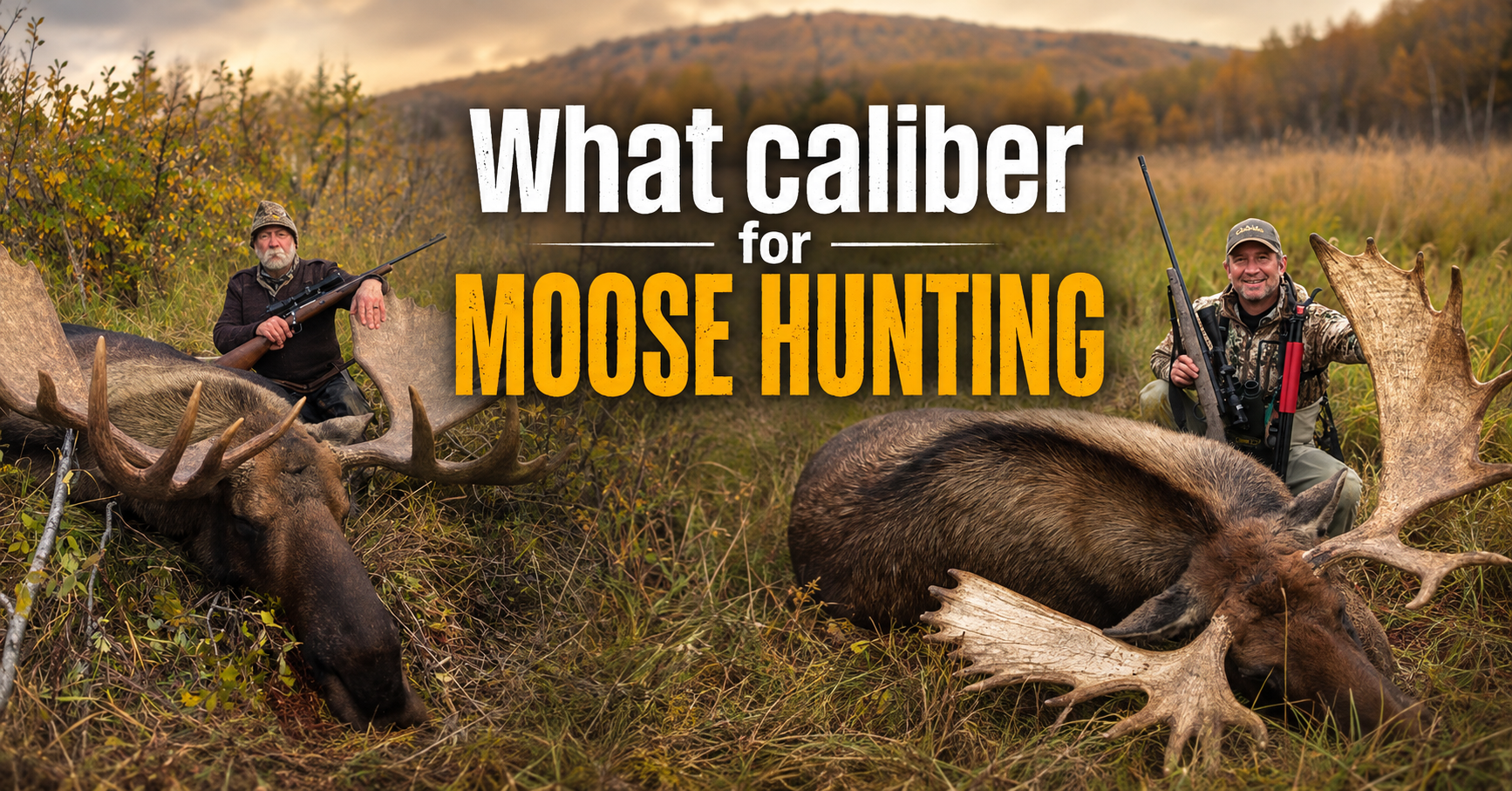

Choosing what caliber for moose hunting involves more than finding a powerful cartridge. Moose are exceptionally large animals with heavy muscles and substantial bones, but successful and humane hunting still depends primarily on accurate shot placement, reliable bullet construction, a responsible shooting distance, and a rifle the hunter can control.
Hunting conditions also vary considerably. A hunter calling moose in dense timber may encounter a close shot, while another hunter may watch a distant opening, marsh, or cutline. Local firearm and ammunition requirements must be checked before making a final decision.
Quick Answer
The .30-06 Springfield is the best all-around moose-hunting cartridge for many hunters. It provides a useful balance of dependable penetration, controlled-expansion hunting loads, practical range, ammunition availability, and recoil that many experienced shooters can manage. The .308 Winchester, .270 Winchester, 7mm-08 Remington, and 6.5 Creedmoor can work with careful bullet and shot selection, while the 7mm Remington Magnum, .300 Winchester Magnum, .300 WSM, .338 Winchester Magnum, and .35 Whelen offer additional margin for certain terrain or larger bulls. Use the most capable legal cartridge you can shoot accurately without flinching.
Moose-Hunting Caliber Comparison
| Cartridge | Best Application | Main Advantages | Important Limitations | Legal Check |
|---|---|---|---|---|
| .30-06 Springfield | Best all-around choice | Broad bullet selection, useful range, proven big-game versatility | Noticeable recoil in lightweight rifles | Confirm centerfire and bullet requirements |
| .308 Winchester | Timber, moderate distances, compact rifles | Manageable recoil, common ammunition, dependable hunting bullets | Less velocity than several larger cartridges | Verify minimum-caliber rules |
| .270 Winchester | Open country and recoil-conscious hunters | Relatively flat trajectory and moderate recoil | Bullet construction and angle selection are especially important | Check minimum caliber or energy requirements |
| 7mm-08 Remington | Moderate recoil at ordinary hunting distances | Efficient bullets and generally comfortable shooting | Less ammunition availability than .308 or .30-06 | Verify legal centerfire requirements |
| 6.5 Creedmoor | Experienced, recoil-sensitive hunters | Moderate recoil and accurate hunting rifles | Less margin on poor angles or heavy bone | May not meet every jurisdiction’s requirements |
| 7mm Remington Magnum | Open country and mixed-distance hunting | Flat trajectory and strong hunting-bullet options | Greater recoil and muzzle blast | Check local firearm restrictions |
| .300 Winchester Magnum | Large bulls, open terrain, and mixed big-game hunts | Strong penetration potential and practical reach | Substantial recoil, blast, and ammunition cost | Confirm local means and methods |
| .300 WSM | Short-action magnum performance | Capable big-game bullets and compact-action availability | Recoil remains substantial; ammunition may be less common | Verify local legality |
| .338 Winchester Magnum | Large bulls, difficult angles, or hunters already proficient with it | Large, heavy bullets and strong penetration potential | Heavy recoil can reduce practical accuracy | Check caliber and firearm regulations |
| .35 Whelen | Timber and moderate-distance hunting | Large-diameter bullets with useful penetration | More curved trajectory and limited ammunition availability | Verify centerfire rules |
| .45-70 Government | Close-range timber hunting | Large-diameter hunting bullets in handy rifles | Trajectory, recoil, and firearm-specific load limits | Check rifle and ammunition restrictions |
| 12-gauge slug | Shotgun-only seasons or locations | Practical where rifles are prohibited | Heavy recoil and relatively limited range | Confirm slug, barrel, and season rules |
Important Safety and Legal Notice
This general guidance was reviewed on August 5, 2026. Moose regulations vary among states, provinces, countries, wildlife management units, public properties, and special permit hunts.
Before hunting, verify:
- Minimum rifle caliber, cartridge, projectile, or muzzle-energy requirements
- Whether rimfire ammunition, shot loads, handguns, or particular firearm types are prohibited
- License, permit, tag, lottery, reporting, and sealing requirements
- Season dates, legal hunting hours, and management-unit boundaries
- Hunter-orange requirements
- Nonlead or certified-ammunition restrictions
- Magazine-capacity and transport requirements
- Public-land and special-hunt rules
- Rules for crossing state, provincial, or international borders with a firearm
- Meat-removal, evidence-of-sex, and salvage requirements
Official rules override general online advice. For example, Maine prohibits .17- and .22-caliber rimfire cartridges and shotgun shot loads for moose. Requirements elsewhere may be more or less restrictive, so never assume another jurisdiction follows the same standard.
Best Overall Moose Caliber: .30-06 Springfield
The .30-06 Springfield is the most balanced general recommendation because it can use a broad selection of controlled-expansion bullets appropriate for large game. It provides enough practical capability for broadside and other responsible shot opportunities without requiring the recoil and muzzle blast of a magnum cartridge.
Factory ammunition is commonly available in several big-game bullet constructions. Heavier-for-caliber bonded, partition-style, monolithic, and controlled-expansion soft-point bullets are frequently chosen for moose because they are designed to expand while retaining enough integrity to penetrate dense tissue.
The .30-06 is not automatically superior to every alternative. A hunter who shoots a .308 Winchester or 7mm-08 significantly better may be more effective with the lower-recoil rifle. A hunter already proficient with a .300 or .338 magnum may reasonably choose the larger cartridge for open terrain or mixed moose-and-bear country.
Why Bullet Construction Is Critical
Moose have large chest cavities, thick muscles, and heavy shoulder bones. An appropriate bullet must reach the vital organs and expand predictably rather than fragmenting immediately or passing through without useful expansion.
Useful big-game designs include:
- Bonded bullets: Designed to resist jacket-and-core separation and preserve penetration
- Partition-style bullets: Use separate bullet sections to combine frontal expansion with a penetrating rear core
- Monolithic copper or copper-alloy bullets: Often provide high weight retention and comply with nonlead requirements
- Controlled-expansion soft points: Traditional hunting designs intended to balance expansion and penetration
- Purpose-built long-range hunting bullets: Designed to expand at lower impact velocities, although they do not make extreme shots automatically ethical
Federal’s big-game bullet guidance notes that bonded bullets are commonly selected for heavy-boned animals such as moose. The correct choice still depends on the cartridge, expected impact distance, firearm accuracy, and manufacturer recommendations.
Avoid Unsuitable Ammunition
- Do not use full-metal-jacket ammunition for ordinary moose hunting.
- Avoid highly frangible varmint bullets intended for small animals.
- Do not assume a match bullet is suitable merely because it is accurate.
- Avoid unidentified handloads or remanufactured ammunition with uncertain components.
- Never use ammunition not specifically compatible with the firearm.
- Do not use lead-core ammunition where certified nonlead projectiles are required.
.308 Winchester for Moose
The .308 Winchester is fully capable of taking moose with an appropriate hunting bullet and responsible shot selection. It is especially practical in timber, along logging roads, and at moderate distances where extreme velocity offers little advantage.
Compared with the .30-06, the .308 commonly comes in shorter, more compact actions and often produces somewhat less recoil in otherwise similar rifles. Its broad ammunition availability also makes practice and load testing easier than with many specialized cartridges.
The .308 has less velocity and load flexibility than the .30-06, but that difference is rarely decisive at ordinary moose-hunting distances. Accuracy and bullet performance remain more important.
Lower-Recoil Moose Calibers
.270 Winchester
The .270 Winchester has a long history as a capable big-game cartridge. It can be used for moose with a robust controlled-expansion bullet, particularly when the hunter waits for a broadside or modest quartering-away presentation.
Its moderate recoil may help some hunters practice more effectively than with a magnum. However, it provides less margin than larger cartridges when the angle requires substantial penetration through heavy muscle or bone.
7mm-08 Remington
The 7mm-08 offers useful penetration and moderate recoil. It is a sensible option for a hunter who prefers a short-action rifle and can obtain suitable heavy-for-caliber hunting ammunition.
The cartridge should be used within a conservative distance and with careful shot selection. Its main practical drawback is that appropriate factory ammunition may be harder to find in remote communities.
6.5 Creedmoor
The 6.5 Creedmoor can take moose where legal when paired with a strong hunting bullet and precise shot placement. Its moderate recoil makes it easier for many hunters to shoot accurately.
It should not be treated as an equal substitute for every larger cartridge under every condition. Quartering-toward shots, heavy shoulder structure, distant impacts, and very large bulls reduce its margin. It is best reserved for disciplined hunters willing to pass marginal opportunities.
6.5×55 Swedish
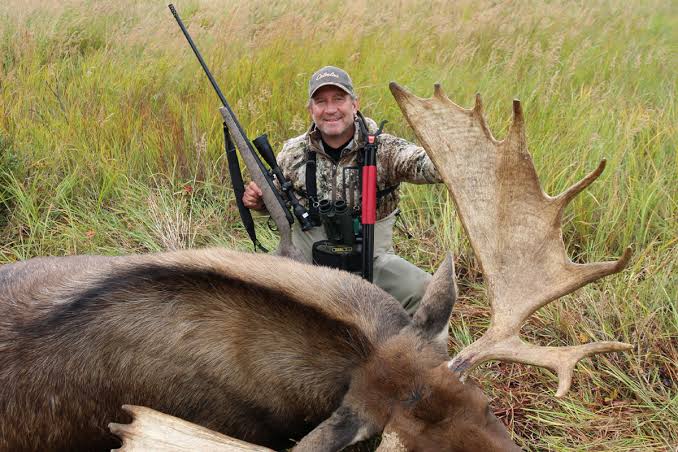
The 6.5×55 has a long history of use on Scandinavian moose with heavy, well-constructed bullets. That history does not automatically make every 6.5mm load suitable. Rifle strength, ammunition pressure, bullet design, and local legal requirements must be considered.
Magnum Calibers for Moose Hunting
7mm Remington Magnum
The 7mm Remington Magnum is useful when open terrain makes trajectory and wind management important. It can carry heavy, high-sectional-density hunting bullets and offers a meaningful capability increase over several non-magnum cartridges.
The trade-offs are increased recoil, muzzle blast, longer barrels, and potentially heavier rifles. Hunters should confirm that the added performance improves rather than reduces their field accuracy.
.300 Winchester Magnum
The .300 Winchester Magnum is one of the most popular larger moose cartridges. It offers controlled-expansion bullets with substantial penetration potential and can be useful when hunting open terrain or combining a moose trip with other large-game opportunities.
Its recoil can cause flinching, particularly in lightweight rifles. A hunter who cannot consistently place shots with the rifle would be better served by a .30-06 or .308.
.300 WSM
The .300 WSM provides magnum-class performance from a short-action cartridge. It can be effective with robust big-game bullets, but ammunition availability may be more limited than for .300 Winchester Magnum or .30-06.
.338 Winchester Magnum
The .338 Winchester Magnum offers heavy bullets and substantial penetration potential. It may appeal to experienced hunters pursuing large bulls in remote country or those who already use the rifle for other large North American game.
It is not necessary for most moose hunts. The Alaska Department of Fish and Game emphasizes choosing a rifle that can be practiced with comfortably, noting that powerful magnums require substantial practice and an appropriately weighted rifle.
Close-Range Timber Cartridges
.35 Whelen
The .35 Whelen uses large-diameter hunting bullets and is well suited to close- and moderate-range timber hunting. It offers strong penetration without requiring a belted magnum cartridge.
Its curved trajectory becomes more important as distance increases, and factory ammunition may be difficult to locate in remote areas.
.45-70 Government
The .45-70 can be effective at close range with a load suitable for the exact firearm. Modern .45-70 ammunition is offered at different pressure levels, and not every load is safe in every rifle.
Follow both firearm and ammunition manufacturer guidance. The cartridge’s substantial trajectory and recoil make accurate range judgment and practice essential.
12-Gauge Slugs
A shotgun slug may be appropriate where rifles are prohibited or during a designated shotgun hunt. Use a slug compatible with the barrel, choke, sights, and manufacturer instructions.
Slug guns can produce heavy recoil, and their practical range is often more limited than a centerfire rifle. Patterning or grouping the exact ammunition is essential.
Do You Need a Magnum for Moose?
No. A magnum cartridge is not required for most moose hunting. Moose are large, but they are routinely and humanely taken with standard cartridges when an appropriate bullet reaches the heart-and-lung area.
A magnum becomes useful only when the hunter can manage its recoil and the hunting conditions justify its advantages. Choosing more power at the expense of accuracy is a poor trade.
The best moose rifle is often the familiar, reliable rifle a hunter can carry safely, operate under pressure, and shoot accurately from realistic field positions.
Shot Placement and Ethical Range
Wait for a clear broadside or modest quartering-away opportunity that exposes the heart-and-lung area. Moose have a large chest, but their long legs and tall body can make inexperienced hunters aim too high or misjudge the location of the vital organs.
Study moose anatomy using an official hunter-education or wildlife-agency resource before the hunt. Maine’s official moose-hunting guide emphasizes that marksmanship and shot placement are the most important factors when choosing among suitable firearms and cartridges.
Avoid low-percentage head and neck shots. These targets are comparatively small, may move suddenly, and leave little room for error. A poor hit can result in severe wounding and a difficult recovery.
Your ethical range is the distance at which you can repeatedly place shots into an appropriately sized vital-zone target from the actual field position and weather conditions. It is not the rifle’s theoretical maximum range.
Consider Recovery Before Taking the Shot
A moose may represent hundreds of pounds of meat that must be cooled and transported promptly. Before firing, consider where the animal is likely to travel and whether it can be recovered legally and safely.
Avoid taking a shot when the moose is:
- Standing in deep water or at the edge of a dangerous water crossing
- Near a steep drop, bog, or obstacle that may prevent recovery
- Across an uncertain property or management-unit boundary
- In dense cover without a clear bullet path or safe backstop
- Too far from a realistic pack-out route for the available team and equipment
Always prepare a meat-removal plan before the hunt. Know the local salvage requirements, carry suitable game bags, and arrange adequate help or transportation.
Firearm Safety for Moose Hunters
Follow the four primary firearm-safety rules throughout the hunt:
- Treat every firearm as if it is loaded.
- Keep the muzzle pointed in a safe direction.
- Keep your finger outside the trigger guard until ready to shoot.
- Be certain of the target and what is in front of and beyond it.
Moose hunting often involves boats, aircraft, vehicles, wet conditions, thick cover, and several people assisting with calling or packing. Unload the firearm before entering a vehicle, boat, or aircraft and whenever crossing an obstacle, as required by law and the firearm manual.
Never use a scope as a substitute for binoculars. Positively identify the animal, confirm that it meets all antler or permit requirements, and verify that no person, structure, road, livestock, or unsafe terrain lies beyond it.
How to Select Your Moose Cartridge
- Check the hunting regulations. Eliminate cartridges and firearm types that are not legal in the unit or season.
- Assess recoil honestly. Choose a cartridge you can shoot accurately without anticipating the shot.
- Consider expected distance. Timber hunting and open-country hunting impose different trajectory requirements.
- Choose the bullet before finalizing the cartridge. Confirm that suitable large-game ammunition is available.
- Consider rifle weight and fit. A properly fitted rifle can be easier to control than a very light rifle in a powerful cartridge.
- Plan for the weather. Rain, snow, and cold can affect grip, equipment, and ammunition storage.
- Test the exact load. Different bullet designs and weights can change accuracy and point of impact.
- Practice from field positions. Include sitting, kneeling, supported standing, and the rest you will carry.
- Establish a personal maximum distance. Base it on repeatable accuracy, not advertising.
Common Caliber-Selection Mistakes
- Choosing a magnum solely because moose are large
- Selecting a light cartridge without considering bullet construction
- Using the cheapest available ammunition instead of an appropriate hunting load
- Assuming a match or target bullet is suitable for big game
- Failing to check whether ammunition is available near the hunting area
- Zeroing with one load and hunting with another
- Practicing only from a bench
- Ignoring rifle fit and total carried weight
- Taking a difficult shot because the cartridge appears powerful
- Assuming a cartridge legal in one state or province is legal everywhere
Moose-Hunt Rifle and Ammunition Checklist
- Reliable, legal rifle in a manageable cartridge
- Controlled-expansion ammunition from the same tested lot when possible
- Firearm manual and knowledge of all operating controls
- Weather-protected ammunition storage
- Properly mounted and verified sights or scope
- Lens cloth and protective covers
- Hearing and eye protection for practice
- Binoculars for identification
- Rangefinder when useful and legal
- Sling that allows safe muzzle control
- Basic field-maintenance supplies
- Current licenses, tags, permits, and regulation summary
FAQs
1. What is the best all-around caliber for moose hunting?
The .30-06 Springfield is the most balanced general choice because of its capable hunting loads, broad availability, practical range, and manageable performance.
2. Is .30-06 powerful enough for moose?
Yes. With a controlled-expansion big-game bullet and accurate placement, the .30-06 is fully suitable for moose.
3. Is .308 Winchester enough for moose?
Yes. The .308 is an effective moose cartridge at responsible distances with an appropriate heavy-duty hunting bullet.
4. Which is better for moose, .308 or .30-06?
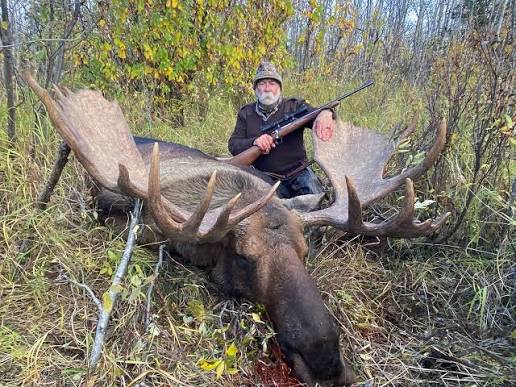
The .30-06 offers greater load flexibility, while the .308 may provide a shorter rifle and somewhat milder recoil. Choose the one you shoot more accurately.
5. Is .270 Winchester good for moose?
Yes, with a robust controlled-expansion bullet and careful shot selection. It offers less margin than larger cartridges on difficult angles.
6. Is 7mm-08 suitable for moose?
Yes. It can be effective with a suitable heavy-for-caliber hunting bullet, moderate distances, and disciplined shot placement.
7. Is 6.5 Creedmoor enough for moose?
It can be where legal, but bullet design and shot selection are critical. It is best used by hunters willing to pass poor angles and unnecessarily distant shots.
8. Is 6.5×55 Swedish good for moose?
It has a long record of use on Scandinavian moose. Use a strong hunting bullet, ensure ammunition is appropriate for the rifle, and verify local requirements.
9. Is 7mm Remington Magnum good for moose?
Yes. It provides a relatively flat trajectory and suitable big-game bullet selection, although recoil and muzzle blast are greater than with non-magnum cartridges.
10. Is .300 Winchester Magnum the best moose caliber?
It is an excellent option for hunters who manage its recoil, but it is not universally best. A well-placed .30-06 or .308 shot is preferable to an inaccurate magnum shot.
11. Is .300 WSM good for moose?
Yes. It is a capable short-action magnum with suitable big-game loads. Confirm ammunition availability before traveling.
12. Is .338 Winchester Magnum necessary for moose?
No. It provides substantial capability but is unnecessary for most hunts. Use it only if you can shoot it comfortably and accurately.
13. Is .35 Whelen suitable for moose?
Yes. It is particularly useful in timber and at moderate distances with a controlled-expansion hunting bullet.
14. Can you hunt moose with a .45-70?
Yes, where legal. Stay within its practical trajectory limits and use a load approved for the exact firearm.
15. Can a 12-gauge slug take a moose?
Yes. A properly matched slug can be effective at limited distances and may be required during shotgun-only hunts.
16. Is .243 Winchester enough for moose?
It has been used successfully, but it provides considerably less margin than standard larger-game cartridges. It is not the best general recommendation, especially for new hunters or difficult presentations.
17. Can .223 Remington be used for moose?
It may be legal in limited jurisdictions, but it offers little margin for error on such a large animal. A more capable centerfire cartridge is the responsible general recommendation.
18. Is .22 LR legal or suitable for moose?
No. It is unsuitable for ordinary moose hunting and is prohibited for moose in many jurisdictions.
19. Do you need a magnum rifle for Alaska moose?
No. Many Alaska moose are taken with standard cartridges. Choose a rifle you can carry, operate, and shoot accurately under field conditions.
20. What bullet type is best for moose?
Use a controlled-expansion big-game bullet that can retain integrity and penetrate heavy muscle. Bonded, partition-style, monolithic, and robust soft-point bullets are common choices.
21. Are copper bullets suitable for moose?
Yes. Monolithic copper or copper-alloy hunting bullets can provide controlled expansion and deep penetration and are useful where nonlead ammunition is required.
22. Are bonded bullets good for moose?
Yes. Bonding is intended to help the core and jacket remain together, which can support penetration through dense tissue and bone.
23. Can full-metal-jacket ammunition be used for moose?
It should generally be avoided and may be prohibited. Use a legal bullet specifically designed for humane big-game hunting.
24. Are match bullets suitable for moose?
Only if the manufacturer explicitly identifies that exact bullet as a hunting design with appropriate terminal performance. Accuracy alone does not make a bullet suitable.
25. What bullet weight should I use for moose?
Heavier-for-caliber big-game bullets are commonly selected, but construction and accuracy matter more than weight alone. Follow the ammunition manufacturer’s game-use guidance.
26. Where should you aim on a moose?
Wait for a clear broadside or modest quartering-away presentation and target the heart-and-lung area based on verified moose anatomy.
27. Are headshots ethical on moose?
They are low-percentage shots with serious wounding risks. The heart-and-lung area provides a substantially larger and more dependable target.
28. How far can you ethically shoot a moose?
Your ethical distance is the range at which you can repeatedly hit the vital zone from a realistic field position under comparable weather and terrain conditions.
29. Do moose drop immediately after a good shot?
Not always. Even a mortally hit moose may remain standing or travel some distance. Observe carefully and be prepared for a safe follow-up when appropriate.
30. Should you shoot a moose more than once?
If the moose remains standing and a safe, high-percentage follow-up is available, another well-placed shot may reduce the chance of loss. Maintain target identification and backstop awareness.
31. Why should you avoid shooting a moose in water?
A moose that dies in deep water can be extremely difficult or dangerous to retrieve. Recovery and mandatory meat salvage should be considered before firing.
32. What caliber has the least recoil for moose?
The 6.5 Creedmoor, 7mm-08, and .270 Winchester are among the moderate-recoil options. Rifle weight, stock fit, and ammunition also affect perceived recoil.
33. What is a good caliber for a youth moose hunter?
Use a legal cartridge that fits the young hunter and can be fired accurately without fear or flinching. A properly fitted 7mm-08, .308, or similar moderate-recoil rifle may be considered under qualified supervision.
34. What caliber is best for timber moose hunting?
The .308, .30-06, .35 Whelen, and .45-70 can all suit timber. A compact, familiar rifle often matters more than a very flat trajectory at close range.
35. What caliber is best for open-country moose?
The .30-06, 7mm Remington Magnum, .300 Winchester Magnum, and similar cartridges provide practical options. Recoil tolerance and proven accuracy should guide the choice.
36. What is the best caliber for Canadian moose?
The .30-06 is a strong general choice, but provincial rules, terrain, and firearm import requirements vary. Verify regulations for the exact province and hunting unit.
37. What is the best caliber for Alaska moose?
The .30-06, .300 Winchester Magnum, and .338 Winchester Magnum are common options. The best choice is the legal rifle you can shoot accurately and carry safely in remote conditions.
38. Is rifle weight important for moose hunting?
Yes. A heavier rifle can reduce felt recoil but is more tiring to carry. A very light magnum may be unpleasant to practice with and harder to control.
39. Should I use a muzzle brake on a moose rifle?
A muzzle brake may reduce recoil but greatly increases noise and blast around the shooter and companions. Hearing protection and careful muzzle awareness are essential.
40. Should I zero with my exact hunting ammunition?
Yes. Different loads can produce different points of impact. Confirm zero and field-position accuracy with the ammunition you will carry.
41. How much ammunition should I bring on a remote hunt?
Bring enough of the tested lot for final zero confirmation, the hunt, and a reasonable reserve. Follow airline, vehicle, border, outfitter, and storage rules.
42. Do public lands have special firearm restrictions?
They may. A wildlife management area, refuge, forest, or special permit hunt can impose stricter rules than the surrounding state or province.
43. Is nonlead ammunition required for moose hunting?
It depends on the jurisdiction and property. Verify whether lead-free or certified nonlead ammunition is required before purchasing or traveling.
44. Can I take a moose rifle across the Canadian border?
Cross-border firearm travel requires current documentation and compliance with Canadian and U.S. laws. Check official border and firearm-agency instructions well before the trip.
45. What should I do after shooting a moose?
Observe its reaction, mark the location, approach cautiously, follow tagging requirements, and begin the legally required recovery and meat-care process as soon as it is safe.
Final Answer
For most hunters deciding what caliber for moose hunting, the .30-06 Springfield is the best overall choice. The .308 Winchester offers a compact, manageable alternative, while the .270, 7mm-08, and 6.5 Creedmoor can work for disciplined hunters using robust bullets and conservative shot selection. The 7mm and .300 magnums provide additional trajectory and penetration capability, while the .338 Winchester Magnum is best reserved for hunters who can manage its recoil. Whatever cartridge you select, use a legal controlled-expansion bullet, practice from field positions, wait for a high-percentage heart-and-lung shot, and plan the complete recovery before pulling the trigger.
Read more: