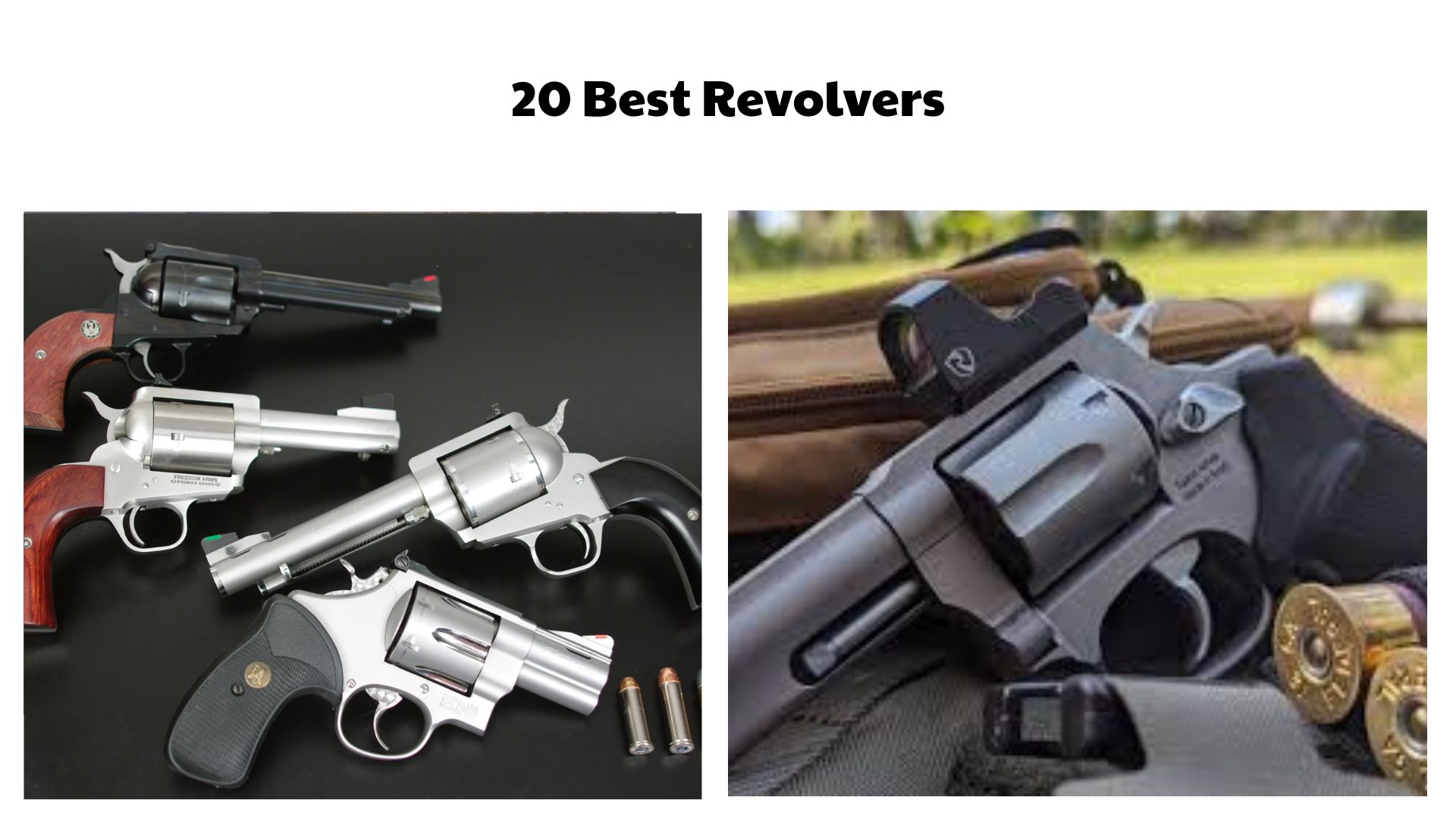

Revolvers have remained one of the most trusted firearm platforms for over a century, known for their mechanical simplicity, reliability, and timeless design. In this expert guide to the Best Revolvers, we explore some of the most respected models ever produced, ranging from modern defensive handguns to legendary wheelguns used in law enforcement, hunting, and sport shooting. Each revolver featured here has been selected based on durability, performance, user reputation, and real-world practicality. Whether you are a collector, a sport shooter, or someone researching defensive options, this guide provides a clear, structured overview of the top-tier revolvers that continue to define the category today.
20 Best Revolvers – Expert Selection Overview
The following review focuses on five of the most iconic and widely respected revolvers in the world. Each model represents a different philosophy of design, from high-capacity defensive revolvers to powerful hunting hand cannons. These firearms are evaluated based on handling, trigger performance, recoil control, build quality, and long-term reliability in real-world use.
1. Smith & Wesson Model 686 Plus
The Smith & Wesson Model 686 Plus is widely regarded as one of the most balanced revolvers ever built, combining durability, accuracy, and versatility in a way that appeals to both professionals and enthusiasts. Chambered in .357 Magnum, it features a robust L-frame design that handles heavy loads without sacrificing shooting comfort. The “Plus” designation refers to its 7-round cylinder capacity, giving it a slight edge over traditional 6-shot revolvers in defensive scenarios. This added capacity may seem small on paper, but in practical use it provides extra confidence in situations where every round matters.
One of the strongest aspects of the 686 Plus is its shooting behavior. The revolver manages recoil exceptionally well for a .357 Magnum platform, thanks to its solid steel construction and well-balanced weight distribution. The double-action trigger pull is smooth and predictable, while the single-action mode offers a crisp break that supports precision shooting. This dual-character trigger system makes it suitable for both rapid defensive shooting and controlled target practice. Many shooters appreciate how the 686 Plus feels “broken-in” even when new, a testament to Smith & Wesson’s machining quality.
From a durability standpoint, the Model 686 Plus is built to last decades under regular use. The stainless-steel frame resists corrosion, making it suitable for outdoor carry, duty use, or long-term storage without extensive maintenance concerns. Its adjustable rear sights also allow shooters to fine-tune accuracy for different ammunition types, including .38 Special and full-power .357 Magnum loads. Overall, the 686 Plus stands as a practical, modern revolver that blends classic revolver reliability with updated performance features.
2. Ruger GP100
The Ruger GP100 is one of the most respected workhorse revolvers in the firearms industry, known for its rugged construction and ability to handle high-volume shooting. Designed with a triple-locking cylinder system, the GP100 ensures tight alignment between cylinder and barrel, improving both safety and accuracy under repeated firing. Chambered primarily in .357 Magnum, it is also compatible with .38 Special, making it flexible for training, defensive use, or general range shooting.
What sets the GP100 apart is its reputation for near-indestructibility. Ruger engineered this revolver to withstand heavy magnum loads without loosening or degrading over time. The solid frame construction and thick forcing cone area contribute to its long service life, even under demanding conditions. Many users in law enforcement training environments and outdoor professions rely on the GP100 because it continues to function reliably even after thousands of rounds.
In terms of handling, the GP100 has a slightly heavier profile compared to some competitors, but this weight actually works in its favor by reducing felt recoil. The grip design is highly customizable, allowing users to adjust ergonomics based on hand size or shooting preference. The trigger system improves noticeably with use, transitioning from a firm factory pull to a smoother, more predictable break over time. This revolver is not about luxury—it is about dependable performance in any environment.
3. Colt Python
The Colt Python is often considered the “premium classic” of revolvers, combining craftsmanship with performance in a way that has earned it legendary status. Originally introduced in the mid-20th century and reintroduced in modern production, the Python is chambered in .357 Magnum and is known for its exceptional smoothness. Its stainless-steel finish and polished construction give it a refined appearance that stands out among tactical-oriented revolvers.
The defining characteristic of the Colt Python is its trigger system. Even among high-end revolvers, the Python’s double-action trigger is often described as one of the smoothest available. The internal mechanics are finely tuned, reducing stacking and producing a consistent pull throughout the cycle. This contributes to excellent shot control, especially during precision shooting or competitive environments. The single-action mode is equally impressive, offering a crisp and predictable break that enhances accuracy at longer distances.
Beyond performance, the Python is also valued for its aesthetic and collector appeal. The ventilated rib barrel, recessed crown, and attention to machining detail make it a standout piece in any firearm collection. However, it is not purely a display firearm; modern iterations are built with reinforced materials to handle continuous use. While it may not be as rugged as some utilitarian models, the Colt Python represents a balance between artistry and functionality.
4. Smith & Wesson Model 29
The Smith & Wesson Model 29 is one of the most iconic revolvers in firearms history, largely popularized by its association with powerful .44 Magnum ammunition. Designed as a large-frame revolver, it was originally intended for hunting and heavy-duty field use. Its reputation as one of the most powerful commercially available revolvers has made it a favorite among big-game hunters and collectors alike.
The Model 29 delivers substantial stopping power, but it also requires skill and control due to its strong recoil characteristics. Shooting .44 Magnum loads generates significant force, making proper grip technique essential. Despite this, the revolver remains manageable thanks to its weight and well-designed grip geometry. Many shooters also opt for lighter .44 Special rounds for practice, which reduce recoil while maintaining accuracy training value.
Durability is another strong point of the Model 29. Its carbon steel frame and precision engineering allow it to withstand high-pressure loads when properly maintained. The revolver’s adjustable sights make it particularly effective for hunting applications where distance accuracy matters. While it is not typically used as a concealed carry firearm due to its size, it excels in field environments where power and reliability are priorities.
5. Colt King Cobra
The Colt King Cobra is a modernized revolver designed to bridge the gap between classic revolver design and contemporary defensive needs. Chambered in .357 Magnum, it offers a compact yet strong platform suitable for concealed carry, home defense, or professional backup use. Its stainless-steel construction gives it both durability and corrosion resistance, making it reliable in various environmental conditions.
One of the standout features of the King Cobra is its smooth trigger system, which has been refined compared to older generations. The double-action pull is consistent and manageable, allowing for controlled rapid firing when necessary. The revolver’s grip design also contributes significantly to recoil management, making .357 Magnum loads more comfortable to shoot than expected in a compact frame.
The King Cobra is also appreciated for its balance between modern ergonomics and traditional revolver aesthetics. It is small enough for practical carry but still large enough to provide a stable shooting platform. This versatility makes it a strong contender for users who want a single revolver capable of handling both defensive and recreational roles without compromise.
6. Ruger LCR
The Ruger LCR (Lightweight Compact Revolver) represents a modern evolution in concealed carry handguns, designed specifically for users who prioritize portability without completely sacrificing stopping power. Chambered in multiple calibers such as .38 Special, .357 Magnum, and even 9mm in certain variants, the LCR stands out due to its ultra-light polymer frame combined with a steel cylinder and barrel assembly. This hybrid construction significantly reduces weight while maintaining the strength required for defensive shooting applications.
From a handling perspective, the Ruger LCR feels noticeably different compared to traditional all-steel revolvers. The reduced weight makes it extremely easy to carry throughout the day, especially in inside-the-waistband or pocket holster setups. However, this lightness also introduces more felt recoil, particularly when using +P or .357 Magnum ammunition. Ruger compensates for this through its patented cam-style trigger system, which creates a smoother double-action pull than many revolvers in its class. The trigger is one of the LCR’s strongest selling points, often described as unusually smooth for such a compact firearm.
In real-world defensive use, the LCR is valued for reliability under stress. With no external safety mechanisms or complex controls, it operates on a simple point-and-shoot principle. This simplicity is intentional and reflects its role as a defensive backup or primary concealed carry option. The fixed sights are minimal but effective for short-range engagements, where most defensive revolver encounters typically occur. While it is not designed for precision target shooting, it excels in scenarios where quick deployment and consistent function are more important than long-distance accuracy.
7. Smith & Wesson 642 Airweight
The Smith & Wesson 642 Airweight is one of the most popular concealed carry revolvers ever produced, built around the idea of extreme portability and rapid accessibility. Constructed using an aluminum alloy frame with a stainless-steel cylinder, it significantly reduces overall weight while maintaining structural integrity. Chambered in .38 Special, it is optimized for defensive ammunition rather than high-power magnum loads, making it manageable for shooters of varying experience levels.
The design philosophy behind the 642 Airweight is simplicity and speed. It features a fully enclosed hammer, which prevents snagging when drawn from concealment. This makes it especially effective for pocket carry or deep concealment scenarios. The double-action-only trigger system eliminates external manipulation, ensuring that the revolver is always ready to fire when needed. While the trigger pull is heavier compared to single-action revolvers, it is intentionally designed to prevent accidental discharge and encourage deliberate firing.
In terms of shooting experience, the lightweight frame means recoil is more noticeable than in heavier steel revolvers. However, most users adapt quickly, especially with standard-pressure or +P defensive ammunition. The grip can be customized with aftermarket options to improve control and comfort. Despite its small size, the 642 Airweight has earned a strong reputation among law enforcement backup carriers and civilian concealed carry users due to its consistent reliability and ease of use under pressure.
8. Smith & Wesson Model 19
The Smith & Wesson Model 19 is a historically significant revolver that played a major role in law enforcement history, particularly during the mid-to-late 20th century. Chambered in .357 Magnum, it was originally designed in collaboration with legendary lawman Bill Jordan, who wanted a powerful yet controllable sidearm for duty use. The result was a medium-frame revolver that balanced stopping power with manageable recoil.
The Model 19 is known for its excellent handling characteristics. Compared to larger magnum revolvers, it offers a lighter and more responsive feel, making it suitable for both duty carry and recreational shooting. The revolver performs exceptionally well with .38 Special rounds, which provide reduced recoil for training, while still retaining full magnum capability when needed. This dual-ammunition flexibility contributed heavily to its popularity among police departments for decades.
From a mechanical standpoint, the Model 19 features a finely tuned double-action/single-action trigger system that delivers smooth operation in both modes. The single-action break is crisp and precise, supporting accurate shot placement, while the double-action pull remains consistent enough for controlled rapid fire. Although newer materials have improved durability in modern revolvers, the Model 19 remains highly respected for its classic balance of performance, shootability, and historical importance in law enforcement firearms evolution.
9. Smith & Wesson Model 66
The Smith & Wesson Model 66 is essentially the stainless-steel counterpart to the Model 19, offering similar performance characteristics with improved corrosion resistance. This makes it particularly suitable for outdoor environments, humid climates, and long-term carry conditions where exposure to moisture can affect firearm longevity. Chambered in .357 Magnum, it retains the same medium-frame platform that made the Model 19 so successful in law enforcement use.
One of the defining advantages of the Model 66 is its durability under environmental stress. The stainless-steel construction ensures that rust and surface degradation are significantly reduced, making it a practical choice for users who spend time in rugged outdoor conditions such as hiking, camping, or field work. Despite its tough exterior, the revolver maintains a refined shooting experience, with smooth trigger mechanics and balanced recoil control.
In practical shooting scenarios, the Model 66 behaves very similarly to the Model 19, with excellent accuracy potential and comfortable handling characteristics. Its weight distribution helps mitigate recoil, especially when firing .38 Special ammunition for extended practice sessions. For users seeking a revolver that combines classic design with modern material resilience, the Model 66 remains one of the most dependable options in the medium-frame revolver category.
10. Smith & Wesson Model 327 TRR8
The Smith & Wesson Model 327 TRR8 is a high-capacity tactical revolver designed with modern defensive applications in mind. Chambered in .357 Magnum, it features an 8-round cylinder, which is significantly higher than traditional revolver capacities. Built on the N-frame platform with scandium alloy construction, it achieves a balance between strength and reduced weight, making it surprisingly portable for its size class.
The TRR8 stands out due to its modular accessory system. It includes integrated Picatinny rails, allowing users to mount optics, lights, or laser systems—something rarely seen in traditional revolvers. This adaptability makes it suitable for home defense setups or tactical applications where situational awareness and target acquisition speed are critical. Despite its advanced features, it still retains the core revolver advantage of mechanical reliability and simplicity.
Shooting performance is strong, though recoil is more pronounced due to the lightweight frame and powerful cartridge. However, the added weight of accessories can help stabilize the firearm during use. The trigger system remains smooth and consistent, supporting both defensive rapid fire and deliberate accuracy shooting. The Model 327 TRR8 represents one of the most modern interpretations of the revolver platform, blending traditional reliability with tactical flexibility.
11. Ruger Super Redhawk
The Ruger Super Redhawk is a heavyweight revolver built specifically for serious power applications such as large game hunting and extreme field use. Chambered in hard-hitting calibers like .44 Magnum, .454 Casull, and even .480 Ruger depending on configuration, it is engineered to handle pressures that exceed standard revolver limits. The extended frame design is one of its defining features, providing additional support for long barrels and heavy recoil management. This is not a compact or lightweight firearm—it is a purpose-built tool for demanding shooting environments where performance matters more than portability.
In real-world shooting, the Super Redhawk delivers a controlled but powerful experience. The added weight plays a major role in absorbing recoil, especially when firing full-power magnum loads. This makes follow-up shots more manageable compared to lighter revolvers in the same caliber class. The grip system is also highly effective, designed to distribute recoil energy across the hand rather than concentrating it in a single point. Many hunters appreciate this revolver because it allows for ethical, accurate shot placement on medium to large game at close to moderate distances.
Durability is one of the strongest attributes of the Super Redhawk. Ruger built this platform with over-engineered tolerances, meaning it is capable of withstanding repeated use under extreme stress conditions without significant mechanical degradation. The triple-locking cylinder system ensures consistent alignment even after heavy firing sessions. Combined with corrosion-resistant finishes and a robust internal structure, this revolver is widely regarded as one of the most reliable hunting handguns ever produced.
12. Ruger Super Redhawk Alaskan
The Ruger Super Redhawk Alaskan is a compact but extremely powerful variation of the Super Redhawk platform, designed specifically for close-range defensive encounters in wilderness environments. It is often chambered in .44 Magnum or .454 Casull and features a shortened barrel, typically around 2.5 inches, making it significantly more compact than traditional hunting revolvers. Despite its size, it maintains the same heavy-duty construction as its larger counterpart.
The primary purpose of the Alaskan model is bear defense and survival situations where stopping power is critical at very short distances. The short barrel design allows for rapid presentation and easier carry in chest holsters, which is common among hikers, hunters, and backcountry professionals. However, the reduced barrel length also results in increased recoil and muzzle blast, making it one of the more physically demanding revolvers to shoot.
Even with its compact form factor, the Alaskan maintains Ruger’s signature strength and durability. The frame is reinforced to handle repeated exposure to high-pressure ammunition, and the cylinder lockup system ensures consistent reliability under stress. While not designed for precision shooting, it excels in emergency defensive scenarios where speed and raw power outweigh accuracy requirements.
13. Kimber K6s
The Kimber K6s is one of the most refined modern compact revolvers available today, designed with concealed carry users in mind who want a balance between power and shootability. Chambered in .357 Magnum, it stands out as one of the smallest six-shot revolvers in its class, offering higher capacity than many competing snub-nose models. The stainless-steel construction gives it a solid, premium feel while maintaining excellent corrosion resistance for everyday carry.
One of the most impressive features of the K6s is its trigger system. Kimber engineered a double-action-only trigger that is unusually smooth for a compact revolver, reducing the stacking effect commonly found in small-frame wheelguns. This allows for more controlled shooting during rapid defensive use. The recoil is manageable for its size, although .357 Magnum loads are still physically noticeable due to the compact frame.
Ergonomically, the K6s is designed with modern carry needs in mind. The rounded edges reduce snagging during draw, and the compact grip profile allows for deep concealment without sacrificing too much control. It is often chosen by users who want a revolver that feels closer to a modern defensive pistol in handling characteristics while retaining the mechanical reliability of a revolver system.
14. Taurus 856
The Taurus 856 is a budget-friendly yet highly practical revolver chambered in .38 Special, designed for concealed carry and general self-defense use. It is a six-shot revolver, which gives it a slight capacity advantage over traditional five-shot snub-nose designs. The frame is constructed from carbon steel or alloy depending on the variant, providing a good balance between weight and durability for everyday carry.
In terms of performance, the Taurus 856 is known for its straightforward functionality. It does not rely on complex systems or premium machining, but instead focuses on reliability and affordability. The double-action trigger is firm but predictable, and it improves slightly with use. While it may not match the refinement of higher-end revolvers, it performs its defensive role effectively when paired with quality ammunition.
The 856 is particularly popular among first-time firearm owners due to its simplicity and ease of maintenance. It is also widely used as a backup firearm due to its compact size and light recoil when using standard .38 Special rounds. Overall, it represents an accessible entry point into revolver ownership without sacrificing core defensive capability.
15. Taurus 692
The Taurus 692 is a versatile and somewhat unique revolver due to its multi-caliber capability. It can be configured to fire both .357 Magnum/.38 Special and 9mm ammunition using interchangeable cylinders. This flexibility makes it an attractive option for shooters who want a single revolver platform capable of adapting to different ammunition availability and shooting preferences.
From a usability standpoint, the 692 offers a full-size frame that provides good recoil control and stable handling. The ability to switch between calibers adds a layer of practicality that is rarely seen in traditional revolver designs. The 9mm configuration, in particular, allows for lower-cost training sessions, while the .357 Magnum setup provides full defensive power when needed.
The revolver also features adjustable sights and a well-balanced grip system, making it suitable for both recreational shooting and defensive use. While it is not as refined as premium-tier revolvers, its adaptability makes it a strong value-oriented option for users who want versatility without investing in multiple firearms.
16. Taurus Judge
The Taurus Judge is one of the most distinctive revolvers in the modern market, primarily due to its ability to chamber both .45 Colt cartridges and .410 bore shotgun shells. This dual-ammunition capability makes it a highly versatile defensive tool, particularly in close-range home defense scenarios. The concept behind the Judge is to provide maximum flexibility in ammunition choice depending on threat level and environment.
In practical use, the Judge performs differently depending on the ammunition used. .45 Colt rounds offer traditional revolver accuracy and penetration, while .410 shotgun shells provide a spread pattern that can be useful at very short distances. However, performance varies significantly depending on barrel length and shell type, making it more situational than conventional revolvers.
The Judge is often chosen for home defense rather than concealed carry due to its size and weight. It is easy to operate and does not require advanced training, making it appealing to users who prioritize simplicity. While it is not a precision-focused revolver, it remains popular for its unique flexibility and psychological deterrence factor.
17. Charter Arms Bulldog
The Charter Arms Bulldog is a compact revolver chambered in .44 Special, designed for users who want moderate stopping power in a small-frame package. Unlike larger .44 Magnum revolvers, the Bulldog focuses on controllability and concealability while still delivering more energy than typical .38 Special revolvers. Its simple five-shot cylinder design contributes to its lightweight and compact profile.
The Bulldog is known for its straightforward mechanical design. It avoids unnecessary complexity, which helps maintain reliability and ease of maintenance. The recoil is more manageable than .44 Magnum revolvers, making it accessible to a wider range of shooters while still offering substantial defensive capability. Its short barrel makes it suitable for concealed carry, especially in backup roles.
While not a premium-tier firearm, the Bulldog has earned a reputation for being a practical “working revolver.” It is commonly used by those who want a simple, powerful, and easy-to-carry handgun without excessive weight or complexity.
18. Heritage Rough Rider
The Heritage Rough Rider is a classic-style single-action revolver chambered in .22 LR and .22 WMR, designed primarily for recreational shooting and training. It closely resembles historical Western revolvers, offering a traditional shooting experience at an affordable price point. The revolver is widely used for plinking, target shooting, and introductory firearm education due to its low recoil and inexpensive ammunition.
From a handling perspective, the Rough Rider emphasizes manual operation, requiring the shooter to cock the hammer before each shot. This reinforces fundamental shooting discipline and control. While it is not designed for defensive use, it plays an important role in teaching firearm basics and providing an enjoyable shooting experience.
Its lightweight frame and simple construction make it easy to maintain and operate. For many users, it serves as a nostalgic entry point into revolver ownership and Western-style shooting traditions.
19. Uberti 1873 Cattleman
The Uberti 1873 Cattleman is a faithful reproduction of the classic Colt Single Action Army revolver, offering an authentic Old West shooting experience. Chambered in various calibers such as .45 Colt, .357 Magnum, and .44-40 depending on model, it is designed for enthusiasts who appreciate historical firearms and traditional craftsmanship.
The revolver operates using a single-action mechanism, requiring manual cocking before each shot. This slows the shooting pace but enhances precision and user engagement. The Uberti Cattleman is often used in cowboy action shooting competitions, where historical accuracy and handling are key elements.
While it lacks modern defensive features, it excels as a collector’s piece and recreational firearm. Its balance, aesthetics, and historical authenticity make it one of the most respected reproductions of a classic revolver design.
20. Colt Single Action Army (Peacemaker)
The Colt Single Action Army, commonly known as the Peacemaker, is one of the most legendary revolvers in firearm history. Introduced in the 19th century, it became widely used in military, law enforcement, and frontier applications. Chambered originally in .45 Colt, it set the standard for revolver design and remains an iconic symbol of American firearms heritage.
The Peacemaker is a single-action revolver, requiring manual hammer cocking for each shot. While this limits firing speed compared to modern double-action revolvers, it offers excellent mechanical simplicity and a deeply historical shooting experience. The revolver’s design has influenced countless firearms and continues to be admired for its balance and craftsmanship.
Today, the Colt Single Action Army is primarily used for collection, historical reenactment, and cowboy action shooting. It represents not just a firearm, but a piece of living history that continues to define the identity of revolvers in popular culture.
Conclusion – Final Expert Verdict on the 20 Best Revolvers
After reviewing the 20 Best Revolvers in this guide, one clear pattern stands out: revolvers remain one of the most reliable and purpose-driven firearm platforms ever created. While modern semi-automatic pistols dominate in capacity and speed, revolvers continue to excel in simplicity, mechanical strength, and long-term dependability. Each model in this list serves a specific role, from ultra-light concealed carry options like the Ruger LCR and Smith & Wesson 642 Airweight, to heavy-duty powerhouses such as the Ruger Super Redhawk and Smith & Wesson Model 29.
What makes revolvers unique is their ability to function consistently under stress with minimal maintenance and fewer mechanical failure points. This is why they remain popular among concealed carriers, outdoor professionals, hunters, and firearm collectors alike. Even entry-level models like the Taurus 856 or Heritage Rough Rider offer dependable performance in their intended roles, while premium designs such as the Colt Python or Smith & Wesson Model 686 Plus demonstrate how refined and precise revolver engineering can be.
Ultimately, choosing the right revolver depends entirely on your intended use. For concealed carry, compact double-action models are ideal. For field or hunting applications, large-frame magnum revolvers deliver unmatched stopping power. For collectors, historical models like the Colt Single Action Army preserve the legacy of firearm evolution. The revolver platform may be traditional, but its continued presence in modern firearm discussions proves one thing clearly: reliability never goes out of style.
FAQ – 20 Best Revolvers (50+ Detailed Questions & Answers)
1. What are the Best Revolvers for beginners?
For beginners, the best revolvers are typically .38 Special models such as the Smith & Wesson 642 Airweight, Taurus 856, and Ruger LCR. These revolvers are simple to operate, have fewer controls than semi-automatic pistols, and are less likely to malfunction due to user error. Their double-action systems allow users to focus on basic trigger control and sight alignment without worrying about safeties or slide operation. Additionally, the recoil from .38 Special ammunition is manageable, making them suitable for learning proper shooting fundamentals.
2. What makes revolvers more reliable than semi-automatic pistols?
Revolvers are often considered more reliable because their mechanical system is simpler. They do not rely on magazine feeding, slide cycling, or complex recoil operations. Instead, each trigger pull rotates the cylinder and aligns a fresh cartridge with the barrel. This reduces the chances of failure due to ammunition or cycling issues. Even under adverse conditions like dirt, dust, or weak ammunition, revolvers tend to continue functioning, making them popular for backup and defensive use.
3. Are .357 Magnum revolvers good for self-defense?
Yes, .357 Magnum revolvers are widely regarded as excellent self-defense firearms. They offer significant stopping power while still maintaining manageable recoil in medium to full-size frames. Models like the Smith & Wesson 686 Plus, Ruger GP100, and Colt King Cobra are especially popular. Many users also choose to practice with .38 Special ammunition and carry .357 Magnum loads for defense, balancing comfort and performance effectively.
4. What is the difference between double-action and single-action revolvers?
A double-action revolver allows the shooter to fire by simply pulling the trigger, which both cocks and releases the hammer. A single-action revolver requires manually cocking the hammer before each shot. Double-action revolvers are faster and more practical for defensive use, while single-action revolvers offer a lighter trigger pull and are often used for sport shooting, historical reenactment, or cowboy action competitions.
5. Are lightweight revolvers harder to shoot?
Yes, lightweight revolvers such as the Ruger LCR or Smith & Wesson Airweight series tend to produce more felt recoil because there is less mass to absorb energy. While they are easier to carry, especially for concealed use, they can be more challenging to control during rapid shooting. Many users adapt by practicing with standard-pressure ammunition before moving to +P defensive loads.
6. What is the most powerful revolver in this list?
The most powerful revolvers in this list include the Ruger Super Redhawk and Smith & Wesson Model 29. These revolvers are capable of firing .44 Magnum and larger calibers, which are commonly used for hunting large game. Their high energy output makes them suitable for outdoor defense scenarios but also increases recoil significantly.
7. Are revolvers still used by law enforcement today?
While most modern law enforcement agencies have transitioned to semi-automatic pistols, revolvers are still used in some roles such as backup weapons or specialized units. Historically, revolvers like the Smith & Wesson Model 19 and Model 66 were standard issue due to their reliability and simplicity. Today, they remain respected but are no longer primary duty weapons in most departments.
8. What is the best revolver for concealed carry?
The best concealed carry revolvers include compact models like the Ruger LCR, Smith & Wesson 642 Airweight, and Kimber K6s. These firearms are lightweight, easy to conceal, and designed for quick deployment. They are typically chambered in .38 Special or .357 Magnum, offering a balance between power and control.
9. Are revolvers good for home defense?
Yes, revolvers are effective for home defense due to their simplicity and reliability. Models like the Taurus Judge, Smith & Wesson 686 Plus, and Ruger GP100 are commonly recommended. They require minimal training to operate under stress, and their failure rate is extremely low compared to more complex firearm systems.
10. What is the advantage of 7- or 8-shot revolvers?
Higher-capacity revolvers like the Smith & Wesson 686 Plus (7 rounds) or 327 TRR8 (8 rounds) provide additional ammunition before needing to reload. This can be important in defensive situations where every extra round increases confidence and flexibility. However, they may be slightly larger or heavier than traditional 5- or 6-shot models.
11. Are revolvers accurate?
Yes, revolvers are generally very accurate due to their fixed barrel design, which does not move during firing. Models like the Colt Python and Smith & Wesson Model 686 are known for exceptional precision. Accuracy depends more on shooter skill and ammunition quality than the revolver platform itself.
12. What is the best revolver caliber overall?
There is no single “best” caliber, but .357 Magnum is widely considered the most versatile. It can also chamber .38 Special rounds, allowing users to train with lower recoil ammunition while maintaining access to defensive power when needed.
13. Are revolvers good for hunting?
Yes, especially large-frame revolvers like the Ruger Super Redhawk or Smith & Wesson Model 29. These firearms are capable of taking medium to large game at short to moderate distances. Their power and simplicity make them reliable in outdoor environments where rifles may be less convenient.
14. Why do revolvers have fewer rounds than pistols?
Revolvers typically have 5 to 8 rounds because each cartridge is stored in a rotating cylinder rather than a detachable magazine. This design prioritizes reliability and simplicity over capacity. While they carry fewer rounds, revolvers compensate with power and dependability.
15. What is the easiest revolver to maintain?
Revolvers like the Ruger GP100 and Smith & Wesson Model 686 Plus are among the easiest to maintain. Their designs allow for simple cleaning without complex disassembly. Regular lubrication and basic cleaning are usually sufficient for long-term reliability.
16. Are revolvers expensive?
Revolvers vary widely in price. Entry-level models like Taurus and Heritage are affordable, while premium revolvers like the Colt Python or Kimber K6s are significantly more expensive due to craftsmanship, materials, and precision engineering.
17. Can revolvers jam?
While revolvers are extremely reliable, they can still experience issues such as cylinder binding or misalignment if poorly maintained or damaged. However, these failures are far less common than malfunctions in semi-automatic pistols.
18. What is the best revolver for recoil control?
Heavier models like the Ruger GP100 and Smith & Wesson Model 686 Plus offer excellent recoil control due to their weight and frame design. Lightweight revolvers tend to have more noticeable recoil.
19. Are revolvers good for target shooting?
Yes, revolvers are excellent for target shooting due to their accuracy and smooth trigger systems. Models like the Colt Python and Smith & Wesson Model 19 are especially popular among enthusiasts for precision shooting.
20. What is the difference between .38 Special and .357 Magnum?
.357 Magnum is a more powerful cartridge with higher velocity and energy compared to .38 Special. However, revolvers chambered in .357 Magnum can also safely fire .38 Special rounds, making them highly versatile for both practice and defense.
21. What makes revolvers still relevant in modern firearms?
Revolvers remain relevant because they prioritize mechanical simplicity and reliability over capacity and speed. In real-world defensive situations, especially under stress, fewer moving parts often mean fewer failure points. Modern revolvers like the Smith & Wesson 686 Plus or Ruger GP100 still perform consistently even under harsh conditions, which is why they continue to be trusted by shooters who value dependability over high magazine capacity.
22. Why do some shooters prefer revolvers over pistols?
Many shooters prefer revolvers because they are intuitive and easy to operate. There is no magazine seating, no slide manipulation, and no external safety on most models. This makes them especially appealing to users who want a straightforward defensive firearm. Additionally, revolvers can reliably fire different types of ammunition, including light target loads and heavy defensive rounds in the same cylinder.
23. Are revolvers good for low-light or emergency situations?
Yes, revolvers are highly effective in emergency situations due to their simplicity. In low-light conditions, there is no need to worry about chamber checks or malfunction clearing procedures. A long double-action trigger pull reduces accidental discharge risk while still allowing immediate fire capability. This makes revolvers a strong choice for home defense scenarios.
24. What is the strongest revolver caliber commonly used?
Among commonly used revolvers, .44 Magnum is considered one of the strongest mainstream calibers. It delivers significant stopping power and is widely used in hunting revolvers such as the Ruger Super Redhawk and Smith & Wesson Model 29. Some specialized revolvers go beyond this, but .44 Magnum remains the standard reference for powerful handgun cartridges.
25. Are revolvers suitable for women or small-handed shooters?
Yes, many revolvers are suitable for small-handed shooters depending on grip size and frame design. Compact models like the Ruger LCR or Smith & Wesson 642 Airweight are designed with ergonomics in mind. Rubberized grips and rounded frames make them easier to handle comfortably while still maintaining control during recoil.
26. How important is revolver trigger quality?
Trigger quality is extremely important in revolvers because it directly affects accuracy and control. A smooth double-action trigger helps maintain consistent shot placement under stress. Premium models like the Colt Python and Smith & Wesson 686 are known for exceptionally smooth triggers, which enhance both precision and shooting comfort.
27. What is the main disadvantage of revolvers?
The main disadvantage is limited ammunition capacity and slower reload speed compared to semi-automatic pistols. Reloading a revolver requires manual cylinder access or speed loaders, which is slower than swapping magazines. However, this trade-off is often accepted in exchange for reliability and simplicity.
28. Can revolvers be used for competitive shooting?
Yes, revolvers are commonly used in competitions such as cowboy action shooting and precision revolver matches. Single-action revolvers like the Uberti 1873 Cattleman are especially popular in historical shooting sports, while double-action revolvers are used in modern defensive shooting competitions.
29. How long does a revolver typically last?
A well-maintained revolver can last decades or even a lifetime. Steel-frame models like the Ruger GP100 or Smith & Wesson Model 19 are built for high round counts. Regular cleaning, lubrication, and proper storage are the key factors in extending revolver lifespan.
30. Do revolvers require a break-in period?
Some revolvers improve with use, particularly in trigger smoothness. While not strictly required, many shooters notice that double-action triggers become smoother after a few hundred rounds. This is especially common in Ruger and Smith & Wesson models.
31. What is the best revolver for recoil-sensitive shooters?
Heavier revolvers such as the Smith & Wesson 686 Plus or Ruger GP100 are best for recoil-sensitive users. Their added weight absorbs energy more effectively, reducing felt recoil. Using .38 Special ammunition in .357 Magnum revolvers also significantly improves shooting comfort.
32. Are revolvers good for concealed carry in hot climates?
Yes, compact revolvers like the Kimber K6s or Ruger LCR are excellent for hot climates because they are small, lightweight, and can be carried comfortably with minimal clothing. Their enclosed design also reduces snagging during draw.
33. What is the role of barrel length in revolvers?
Barrel length affects velocity, accuracy, and recoil control. Longer barrels provide better accuracy and higher bullet velocity, making them ideal for hunting or target shooting. Short barrels improve concealability but reduce ballistic performance and increase muzzle flash.
34. Are revolvers more durable than pistols?
In general, revolvers are extremely durable due to their strong steel construction and simple mechanics. However, modern pistols are also highly durable. Revolvers tend to outperform in environments where reliability under neglect or harsh conditions is more important than capacity.
35. What is a snub-nose revolver used for?
Snub-nose revolvers are short-barreled firearms designed primarily for concealed carry and close-range defense. They prioritize portability and quick access over long-range accuracy. Examples include the Smith & Wesson 642 Airweight and Taurus 856.
36. Can revolvers fire +P ammunition safely?
Many modern revolvers are rated for +P ammunition, especially those built on stronger frames like the Smith & Wesson J-frame or Ruger LCR. However, users should always verify manufacturer specifications before using higher-pressure loads.
37. What is cylinder gap and why does it matter?
The cylinder gap is the small space between the cylinder and barrel. While necessary for rotation, it allows some gas escape during firing, which can slightly reduce velocity and increase muzzle blast. This is normal in all revolvers.
38. Are revolvers good for suppressor use?
Revolvers are generally not ideal for suppressor use because gas escapes from the cylinder gap, reducing suppression efficiency. Some specialized designs exist, but semi-automatic pistols are typically better suited for suppressed shooting.
39. What is the best revolver for hunting?
The Ruger Super Redhawk and Smith & Wesson Model 29 are among the best hunting revolvers. They are chambered in powerful calibers like .44 Magnum and offer strong accuracy and stopping power at short to medium distances.
40. Are revolvers beginner-friendly for training?
Yes, revolvers are excellent for beginners because they simplify the learning process. There is no magazine insertion, slide operation, or complex safety manipulation. This allows new shooters to focus on fundamentals such as grip, trigger control, and sight alignment.
41. What is the difference between fixed and adjustable sights?
Fixed sights are simple and durable but cannot be adjusted for windage or elevation. Adjustable sights allow shooters to fine-tune accuracy based on ammunition type or shooting distance, making them more versatile for target shooting and hunting.
42. Are revolvers good for survival situations?
Yes, revolvers are often considered reliable survival firearms due to their ability to function in harsh environments with minimal maintenance. Their simplicity makes them ideal for situations where cleaning and repair resources are limited.
43. What is the safest way to carry a revolver?
The safest way is typically with all chambers loaded, provided the revolver has an internal safety system and proper holster coverage. Modern double-action revolvers are designed to prevent accidental discharge when carried correctly.
44. Can revolvers shoot different bullet weights?
Yes, revolvers can safely fire a variety of bullet weights as long as they are within the correct caliber specification. This flexibility allows users to choose between lighter practice rounds and heavier defensive loads.
45. What is the role of grip design in revolvers?
Grip design significantly affects recoil control and shooting comfort. Ergonomic grips reduce hand fatigue and improve stability, especially during rapid firing. Many revolvers allow grip customization for better fit.
46. Are revolvers considered outdated technology?
No, revolvers are not outdated. While they are based on older mechanical principles, modern revolvers incorporate advanced materials, improved metallurgy, and refined trigger systems. They remain highly relevant in specific use cases.
47. What is the best revolver for all-around use?
The Smith & Wesson 686 Plus and Ruger GP100 are often considered the best all-around revolvers due to their balance of power, durability, and versatility. They can handle both defensive and recreational shooting effectively.
48. Are revolvers good for long-term storage?
Yes, revolvers are excellent for long-term storage because they are less sensitive to magazine spring fatigue and internal wear. Properly lubricated and stored, they can remain functional for many years.
49. What maintenance does a revolver require?
Revolvers require basic cleaning of the barrel, cylinder chambers, and forcing cone area. Light lubrication of moving parts ensures smooth operation. Compared to semi-automatic pistols, maintenance is generally simpler and less frequent.
50. Why do revolvers still have a strong following today?
Revolvers maintain a strong following because they represent reliability, tradition, and simplicity. Many shooters appreciate their mechanical honesty and consistent performance. Even in a modern firearms landscape, revolvers continue to hold a respected and practical place.
Read more: