


The EAA MKA 1923 is a modern 12-gauge semi-automatic bullpup shotgun designed to deliver compact handling without sacrificing barrel length or ballistic performance. Its bullpup configuration places the action and magazine behind the trigger, allowing a shorter overall length while maintaining a full-length barrel for effective velocity and shot pattern consistency.
Purpose: home defense, tactical use, and competition shooting
The shotgun is primarily designed for home defense, tactical applications, and competitive shooting such as 3-Gun matches. Its detachable magazine system and semi-automatic operation provide faster reloads and cycling compared to traditional pump-action shotguns, making it well-suited for high-speed scenarios.
Background of European American Armory (EAA) and Turkish manufacturing (Husan Arms)
Imported by European American Armory (EAA), the MKA 1923 is manufactured in Turkey, a country known for producing affordable yet feature-rich firearms. Turkish OEM manufacturers have become major players in the global shotgun market, and the MKA 1923 reflects this trend with its tactical design and competitive pricing.
Why bullpup shotguns are gaining popularity in modern firearm design
Bullpup shotguns are increasingly popular because they reduce overall weapon length without shortening the barrel. This improves maneuverability in tight environments while retaining ballistic performance. They also allow magazine-fed systems and modern ergonomics similar to AR-platform rifles, appealing to tactical shooters and home defense users.
Design and Build Overview
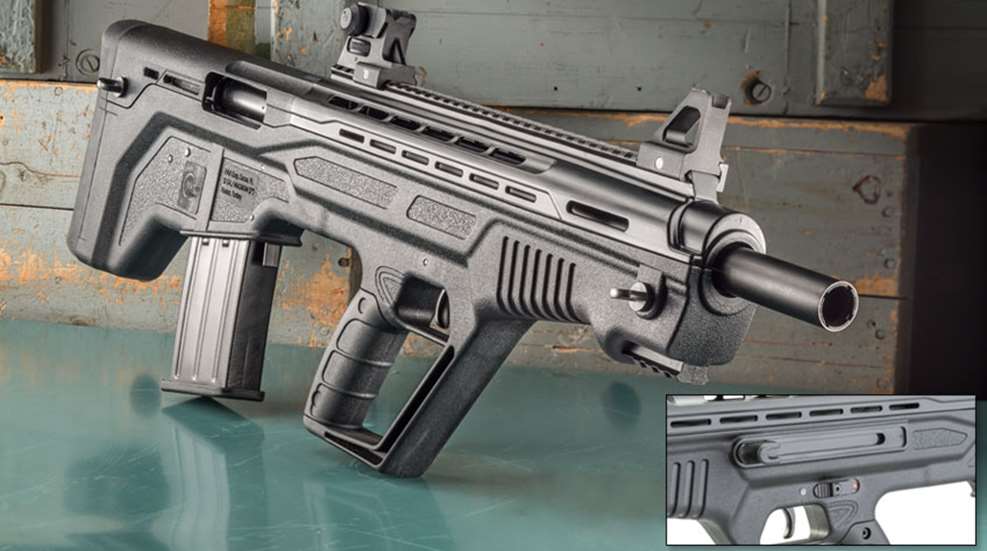
Bullpup configuration and compact layout advantages
The bullpup design relocates the action and magazine behind the trigger group, resulting in a compact firearm with a full-length barrel. This configuration improves maneuverability in close quarters, enhances balance, and allows faster target transitions compared to traditional shotgun layouts.
Overall length vs barrel length (20-inch barrel, ~29.5″ OAL)
The EAA MKA 1923 features a 20-inch barrel while maintaining an overall length of approximately 29.5 inches. This combination provides the ballistic advantages of a full-size shotgun in a significantly shorter platform, making it easier to handle in confined spaces without sacrificing performance.
Polymer lower receiver and aluminum upper rail system
The firearm uses a polymer lower receiver to reduce weight and manufacturing cost, paired with an aluminum upper receiver and Picatinny rail system for strength and optics mounting. This hybrid construction balances durability with modern tactical functionality.
Weight distribution and rear-heavy balance
Due to its bullpup configuration, the MKA 1923 is rear-heavy. This improves shouldered stability and reduces muzzle rise during rapid fire, although it may feel unusual for shooters unfamiliar with bullpup platforms.
Ergonomics of pistol grip and trigger placement
The pistol grip is AR-style, offering familiarity for modern users. However, the trigger operates via a linkage system, resulting in a heavier and less crisp pull compared to traditional shotgun triggers.
Action System and Operating Mechanism
Semi-automatic gas-operated system
The EAA MKA 1923 uses a gas-operated semi-automatic system that harnesses expanding gases from fired shells to cycle the action automatically. This allows faster follow-up shots and reduced perceived recoil compared to manual systems.
Dual gas ring system (light vs heavy loads)
The shotgun features a dual gas ring system designed to accommodate both light and heavy loads. This tuning capability helps improve reliability across a variety of ammunition types, including target loads, buckshot, and magnum shells.
Manual gas adjustment process and field stripping requirement
Adjusting the gas system typically requires partial disassembly or field stripping. Users must manually switch or adjust gas rings depending on ammunition type, which provides flexibility but reduces convenience in the field.
Reliability across different shell types (2¾” and 3” shells)
The MKA 1923 is compatible with both 2¾-inch and 3-inch shells. However, reliability depends on ammunition quality, gas settings, and break-in condition, with heavier loads generally cycling more consistently.
Cycling behavior and break-in period considerations
Most users report a break-in period of approximately 50–100 rounds. During this time, the shotgun may experience inconsistent cycling with light loads, but performance typically improves as components settle.
Magazine and Feeding System
Detachable box magazine design (5-round steel mags)
The MKA 1923 uses detachable steel box magazines, commonly with a 5-round capacity. Steel construction enhances durability, though it adds weight compared to polymer alternatives.
Reloading speed and tactical advantages
The magazine-fed system allows for rapid reloads, significantly faster than tube-fed shotguns. Users can also pre-load different magazines with specific ammunition types for tactical flexibility.
Compatibility and proprietary magazine concerns
One limitation is that the magazines are generally proprietary, meaning they are not widely compatible with other shotgun platforms. This can affect availability and cost depending on the market.
Feeding reliability and common user observations
Feeding reliability is generally strong when using quality magazines and appropriate ammunition. However, some users report occasional inconsistencies with worn magazines or low-powered loads.
Controls and Ergonomics
Left-side safety and bolt controls
The safety and bolt controls are positioned on the left side of the firearm, allowing quick access for right-handed shooters and efficient manipulation during firing sequences.
Non-reciprocating charging handle design
The charging handle is non-reciprocating, reducing the risk of injury or interference during firing. It also allows safer manual operation when clearing malfunctions.
Bolt catch placement behind magazine well
The bolt catch is located near the magazine well, providing AR-style handling familiarity. With training, it allows faster reloads and smoother manipulation under stress.
Trigger characteristics and heavy pull weight (~11 lbs)
A common criticism of the MKA 1923 is its heavy trigger pull, often reported around 10–12 lbs. This is due to the extended linkage system required in bullpup designs, resulting in a longer and less refined trigger feel.
Suitability for right-handed vs left-handed shooters
The design is primarily optimized for right-handed users. Left-handed shooters may find the control placement and ejection characteristics less comfortable, although basic operation remains possible.
Barrel, Chokes, and Accuracy
Threaded barrel system and choke tube options
The MKA 1923 features a threaded barrel system that supports interchangeable choke tubes, allowing users to adjust shot spread based on intended use.
Included choke set (IC, Modified, Full)
Most configurations include Improved Cylinder, Modified, and Full choke tubes. These options provide flexibility for close-range spread, balanced mid-range performance, and tighter long-range patterns.
Pattern performance with buckshot and slug ammunition
Buckshot performance is effective at defensive distances, while slugs offer improved accuracy at longer ranges when paired with appropriate choke settings. Pattern consistency depends heavily on ammunition selection.
Effective range for defensive use
The effective defensive range is typically 0–25 yards for buckshot and can extend beyond 75 yards for slugs with proper optics and shooter proficiency.
Role of optics and Picatinny rail accuracy enhancement
A full-length Picatinny rail allows mounting of red dot sights and optics, significantly improving target acquisition speed and accuracy. This modernizes the shotgun platform for tactical and competitive use.
Sights and Optics Compatibility
Adjustable rear iron sight system
The EAA MKA 1923 is equipped with an adjustable rear iron sight system designed for basic target acquisition without optics. These sights provide elevation and windage adjustments, allowing shooters to zero the firearm for different distances. While functional, they are generally considered secondary to optic setups in tactical use.
Front post sight with protective wings
The front sight features a simple post design protected by side wings. This helps prevent damage during handling or transport while maintaining a clear sight picture. The setup is durable but basic, reflecting the shotgun’s tactical rather than precision-oriented design philosophy.
Full-length top Picatinny rail (optic-ready design)
A full-length Picatinny rail runs along the top of the receiver, allowing users to mount a wide range of optics. This includes red dot sights, reflex sights, and low-power magnified optics. The rail significantly enhances modularity and modern tactical usability.
Recommended use of red dot optics for tactical shooting
Most users prefer mounting a red dot sight for faster target acquisition, especially in close-quarters scenarios. Red dot optics improve speed, accuracy, and low-light performance, making them ideal for home defense and competitive shooting applications.
Recoil Management and Shooting Experience
Weight-assisted recoil reduction (~9–10 lbs loaded)
When fully loaded, the MKA 1923 weighs approximately 9–10 pounds, which naturally helps reduce felt recoil. The added mass absorbs part of the energy generated by 12-gauge shells, making the firearm more manageable during extended shooting sessions.
Gas system recoil mitigation
The gas-operated system further reduces recoil by redirecting expanding gases to cycle the action. This softens the recoil impulse compared to pump-action shotguns, allowing for faster follow-up shots and improved shooter comfort.
Real-world shooting comfort with buckshot and slugs
In practical use, the shotgun handles buckshot and slug loads with moderate recoil. Buckshot loads feel more manageable, while slugs produce a sharper recoil impulse. Overall, the platform remains controllable even during rapid fire sequences.
Muzzle flip and stability in rapid fire
The bullpup design contributes to reduced muzzle rise due to its rear-heavy balance. This helps maintain stability during rapid fire, allowing shooters to stay on target more effectively compared to traditional shotgun layouts.
One-handed shooting capability in emergencies
In emergency situations, the weight distribution and recoil characteristics allow for limited one-handed firing. While not ideal or recommended for extended use, the platform can remain controllable in short defensive bursts if necessary.
Reliability and Performance
Performance with light, heavy, and magnum loads
The MKA 1923 performs best with medium to heavy loads, including buckshot and magnum shells. Light target loads may not cycle reliably without proper gas adjustment. Ammunition selection plays a significant role in overall performance consistency.
Common issues with light target loads
One frequently reported issue is inconsistent cycling with low-powered or light target shells. This is due to insufficient gas pressure to fully operate the semi-automatic system, especially before the firearm is fully broken in.
Break-in requirements (50–100 rounds recommended)
Most users experience improved reliability after a break-in period of approximately 50–100 rounds. During this phase, internal components smooth out, leading to more consistent cycling and reduced malfunctions.
Reported durability concerns (springs, disassembly complexity)
Some users have noted concerns regarding internal springs and the complexity of the disassembly process. While generally durable under normal use, the design is more mechanically complex than traditional pump-action shotguns, increasing maintenance demands.
Field reliability in defensive scenarios
In defensive scenarios, the shotgun is generally considered reliable when properly maintained and fed with appropriate ammunition. Its performance improves significantly with correct gas settings and regular cleaning.
Maintenance and Field Stripping
Complex disassembly process
Field stripping the MKA 1923 is more complex than traditional shotguns due to its bullpup layout and gas system. Users must follow a specific sequence to safely disassemble the firearm for cleaning and inspection.
Gas ring switching requirements
Adjusting between light and heavy loads requires manual gas ring changes or adjustments. This process typically involves partial disassembly, making ammunition switching less convenient in dynamic environments.
Cleaning difficulty compared to traditional shotguns
Compared to pump-action shotguns, the MKA 1923 requires more detailed cleaning. The gas system and compact internal layout demand careful maintenance to ensure long-term reliability.
Charging handle spring durability concerns
Some users have reported wear or durability concerns with the charging handle spring over extended use. Regular inspection and maintenance are recommended to avoid functional issues.
Maintenance recommendations for longevity
To maintain reliability, users should clean the gas system regularly, inspect springs and moving parts, and avoid excessive use of underpowered ammunition. Proper lubrication and routine maintenance significantly extend service life.
Advantages of the EAA MKA 1923
Compact bullpup design with full-length barrel
The bullpup configuration provides a compact overall footprint while maintaining a full-length barrel, offering both maneuverability and ballistic efficiency.
High magazine capacity and quick reload system
The detachable magazine system allows for fast reloads, giving it a significant advantage over tube-fed shotguns in tactical and competitive environments.
Strong recoil control for a 12-gauge platform
Between the gas system and heavy weight when loaded, recoil is noticeably reduced, improving shooter comfort and follow-up shot speed.
Tactical versatility (home defense + range + 3-Gun)
The shotgun is versatile enough for home defense, range training, and competitive shooting disciplines, making it a multi-role platform.
Optics-ready platform with rail system
The full-length Picatinny rail system allows easy integration of modern optics, enhancing accuracy and usability in low-light or fast-paced scenarios.
Disadvantages and Limitations
Heavy trigger pull affecting precision shooting
The heavy trigger pull is one of the most common criticisms, reducing precision and making slow, deliberate shooting more challenging.
Proprietary magazine system
The use of proprietary magazines can limit availability and increase costs, especially in regions with restricted import supply.
Maintenance complexity
The design requires more advanced maintenance compared to traditional shotguns, particularly due to its gas system and bullpup layout.
Sensitivity to light loads
Light target ammunition may not cycle reliably without proper adjustment, limiting versatility in some training environments.
Ergonomic limitations for some shooters
The bullpup layout may feel unfamiliar or awkward to shooters accustomed to traditional shotgun designs, especially in trigger feel and balance.
Build quality varies depending on expectations
While generally solid for its price range, expectations should be aligned with its mid-tier manufacturing category rather than premium tactical firearms.
Ideal Use Cases
Home defense applications
The compact size, fast cycling, and magazine-fed system make the MKA 1923 well-suited for home defense situations where maneuverability and quick response are critical.
Tactical training and competition shooting
Its design lends itself well to tactical drills and competitive shooting formats such as 3-Gun, where reload speed and handling efficiency are important.
Close to mid-range defensive scenarios
The shotgun performs best in close to mid-range engagements, where buckshot and slugs can be effectively deployed with proper aiming.
Not ideal for hunting or long-duration carry use
Due to its weight, magazine system, and tactical design, it is less suitable for hunting or prolonged field carry compared to traditional sporting shotguns.
Final Verdict on EAA MKA 1923
Balanced summary of strengths vs weaknesses
The EAA MKA 1923 offers a strong combination of compact design, magazine-fed speed, and recoil control, but it is offset by a heavy trigger, maintenance complexity, and sensitivity to lighter ammunition.
Value-for-money positioning in bullpup shotgun market
In its price range, the MKA 1923 provides a feature-rich platform that competes well with other tactical shotguns, particularly for users seeking modern ergonomics on a budget.
Comparison to traditional semi-auto shotguns
Compared to traditional semi-auto tube-fed shotguns, it excels in reload speed and compactness but falls short in trigger quality and simplicity of maintenance.
Who should and should not buy it
The MKA 1923 is best suited for tactical enthusiasts, home defense users, and competitive shooters who value modularity and speed. It is less ideal for users seeking a simple, low-maintenance, or traditional hunting shotgun.
FAQ – EAA MKA 1923 Review
1. What is the EAA MKA 1923 used for?
The EAA MKA 1923 is primarily designed for tactical and defensive applications. It is widely used for home defense, range training, and competitive shooting such as 3-Gun matches. Its magazine-fed system and semi-automatic action make it faster to reload and cycle than traditional pump-action shotguns, which is why it is often chosen by shooters who want modern tactical capability in a compact platform.
2. Is the EAA MKA 1923 good for home defense?
Yes, the MKA 1923 is considered a viable home defense shotgun due to its compact bullpup design, fast semi-automatic cycling, and detachable magazine system. The short overall length makes it easier to maneuver in tight indoor spaces. However, users must be trained properly because its controls and heavier trigger require familiarity under stress.
3. How does the bullpup design benefit the MKA 1923?
The bullpup configuration allows the shotgun to maintain a full-length 20-inch barrel while reducing overall length significantly. This improves maneuverability in confined spaces such as hallways or vehicles while still preserving ballistic performance and shot consistency.
4. What type of action does the MKA 1923 use?
The shotgun uses a gas-operated semi-automatic action. Gas from fired shells cycles the bolt automatically, allowing rapid follow-up shots without manual pumping. This system increases speed and reduces recoil compared to manual shotguns.
5. How reliable is the EAA MKA 1923?
Reliability is generally good when the shotgun is properly maintained and used with appropriate ammunition. Heavier loads such as buckshot and magnum shells cycle more consistently. Light target loads may require gas adjustment or may not cycle reliably, especially during the break-in period.
6. Does the MKA 1923 require a break-in period?
Yes, most users report a break-in period of 50–100 rounds. During this time, internal components smooth out and the gas system becomes more consistent. After break-in, cycling reliability typically improves significantly.
7. What magazines does the MKA 1923 use?
The shotgun uses detachable box magazines, typically made of steel. Standard magazines usually hold 5 rounds, although higher-capacity aftermarket options may exist depending on regional availability.
8. Are the magazines interchangeable with other shotguns?
No, the magazines are generally proprietary to the MKA 1923 platform. This means they are not widely compatible with other shotgun models, which can affect availability and cost over time.
9. How fast is reloading on the MKA 1923?
Reloading is significantly faster than tube-fed shotguns because users can simply swap magazines. This allows for tactical reloads in seconds, especially with proper training.
10. What is the trigger like on the MKA 1923?
The trigger is often described as heavy, typically around 10–12 lbs. This is due to the mechanical linkage required in bullpup designs. While functional, it is not as crisp or light as traditional shotgun triggers.
11. Is the MKA 1923 suitable for beginners?
It can be used by beginners, but it is not the easiest shotgun to start with. The heavier trigger, maintenance complexity, and bullpup ergonomics may require additional training compared to pump-action shotguns.
12. How does recoil feel on the MKA 1923?
Recoil is moderate and manageable due to the gas system and heavier weight when loaded. Buckshot loads feel smoother, while slugs produce sharper recoil but remain controllable for most shooters.
13. Can the MKA 1923 shoot 3-inch shells?
Yes, the shotgun is designed to handle both 2¾-inch and 3-inch shells. However, cycling performance depends on gas settings and ammunition quality.
14. What type of ammunition works best?
The MKA 1923 performs best with medium to heavy loads such as buckshot and magnum shells. Light target loads may require adjustment and may not cycle reliably in all conditions.
15. Does the shotgun support optics?
Yes, it features a full-length Picatinny rail that supports red dot sights, reflex optics, and low-power scopes, making it highly adaptable for tactical use.
16. Are iron sights included?
Yes, the shotgun typically includes basic front and rear iron sights. However, most users prefer upgrading to optics for improved speed and accuracy.
17. Is the MKA 1923 accurate?
Accuracy is solid for a shotgun platform, especially at close to mid-range distances. With slugs and optics, it can extend effective accuracy significantly beyond typical buckshot ranges.
18. What is the effective range?
The effective range is approximately 0–25 yards for buckshot and can extend beyond 75 yards for slugs, depending on shooter skill and setup.
19. How difficult is cleaning the MKA 1923?
Cleaning is more complex than traditional shotguns due to the gas system and bullpup layout. Regular maintenance is required to ensure reliability.
20. Does it require special maintenance?
Yes, users must maintain the gas system, clean internal components regularly, and inspect springs and moving parts to ensure long-term reliability.
21. Is the MKA 1923 ambidextrous?
It is partially ambidextrous but not fully. Right-handed users will find it more natural, while left-handed shooters may need adaptation due to control placement.
22. How heavy is the shotgun?
Unloaded weight varies by configuration, but it becomes approximately 9–10 lbs when loaded, which helps reduce recoil but increases carry weight.
23. Is it good for competition shooting?
Yes, especially for 3-Gun competitions. Its fast reload system and semi-automatic action make it competitive in speed-based shooting disciplines.
24. Can it be used for hunting?
It is not ideal for hunting due to its tactical design, magazine system, and weight. Traditional hunting shotguns are generally more suitable.
25. What are common issues with the MKA 1923?
Common issues include sensitivity to light loads, heavy trigger pull, and occasional magazine-related feeding problems if magazines are worn or low quality.
26. Is the gas system adjustable?
Yes, it uses a dual gas ring system that can be adjusted for light or heavy loads, though adjustment typically requires partial disassembly.
27. How durable is the shotgun?
Durability is generally good for its price range, though it is not considered a premium-duty military firearm. Proper maintenance significantly extends its lifespan.
28. What are its biggest advantages?
Its biggest advantages include compact size, fast reload capability, reduced recoil, and optics-ready modular design.
29. What are its biggest disadvantages?
The main disadvantages are heavy trigger pull, proprietary magazines, and more complex maintenance compared to traditional shotguns.
30. Is it worth buying?
It is worth buying for users who want a tactical, magazine-fed shotgun with modern ergonomics. However, those seeking simplicity or hunting use may prefer traditional designs.
31. Does the MKA 1923 jam often?
Jamming is not common when the shotgun is properly maintained and used with suitable ammunition. Most issues occur with light loads or poorly maintained magazines.
32. Can it be used in low-light conditions?
Yes, especially when equipped with a red dot sight or tactical light mounted on the Picatinny rail system.
33. Is it easy to learn?
Basic operation is straightforward, but mastering reloads, gas settings, and maintenance requires practice.
34. How does it compare to pump shotguns?
It is faster in firing and reloading but more complex to maintain. Pump shotguns are simpler but slower in operation.
35. Does it work with all 12-gauge shells?
It supports most 2¾-inch and 3-inch shells, but performance varies depending on load strength.
36. Is it legal in most regions?
Legality depends on local firearm laws. In many regions it is legal, but magazine capacity restrictions may apply.
37. How long does it last?
With proper care, it can last many thousands of rounds, though longevity depends heavily on maintenance practices.
38. Is it good for tactical training?
Yes, it is widely used for tactical drills due to its AR-style controls and magazine-fed system.
39. Does it have aftermarket support?
Aftermarket support exists but is more limited compared to mainstream shotgun platforms like Mossberg or Remington.
40. Can it be customized?
Yes, it supports optics, chokes, and some accessory upgrades, though customization is somewhat limited by its proprietary design.
41. Is it beginner-friendly for home defense?
It can be used for home defense by beginners, but training is recommended due to its unique layout and trigger characteristics.
42. How loud is it?
Like all 12-gauge shotguns, it is very loud and requires hearing protection during use at the range.
43. Does it require lubrication?
Yes, regular lubrication of moving parts and the gas system is necessary for reliable operation.
44. What makes it unique?
Its combination of bullpup design, detachable magazines, and gas-operated semi-automatic function makes it unique in the shotgun market.
45. Is it better than AR-style shotguns?
It depends on preference. It offers similar tactical advantages but differs in trigger feel, maintenance, and magazine ecosystem.
46. Does it have recoil pads?
Yes, it typically includes a recoil pad to improve shooting comfort and reduce shoulder impact.
47. Can it be used one-handed?
In emergencies, it can be fired one-handed briefly, but it is not designed for sustained one-handed operation.
48. What is the learning curve like?
The learning curve is moderate, requiring users to adapt to bullpup ergonomics and gas system management.
49. Is it reliable for defense use?
Yes, when properly maintained and loaded with appropriate ammunition, it is considered reliable for defensive applications.
50. What is the biggest drawback overall?
The biggest drawback is the heavy trigger combined with maintenance complexity, which can affect ease of use for some shooters.
51. Should I choose it over a pump shotgun?
You should choose it if you prioritize speed, compactness, and magazine-fed operation. A pump shotgun is better if you want simplicity and lower maintenance.
Read more: