
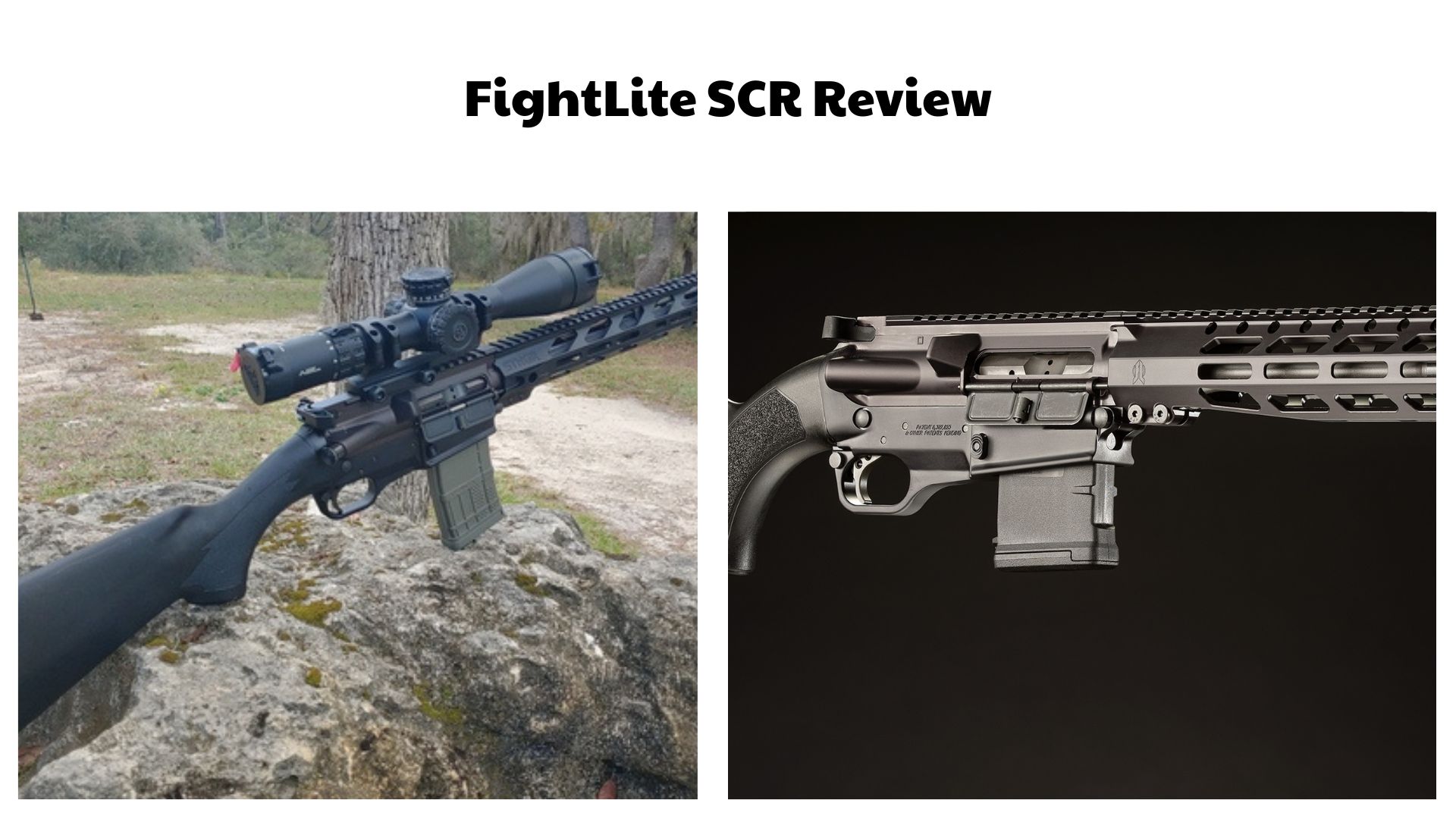

The FightLite SCR (Sport Configurable Rifle) is a semi-automatic rifle platform designed as a legal and functional alternative to traditional AR-15 rifles in restrictive jurisdictions. Instead of following the standard AR layout with a pistol grip and buffer tube, the SCR reconfigures the system into a more traditional sporting rifle format while retaining AR-15 upper receiver compatibility. This hybrid approach allows shooters to maintain modern semi-auto performance while complying with stricter firearm regulations.
Purpose: 50-state compliant AR-style rifle alternative
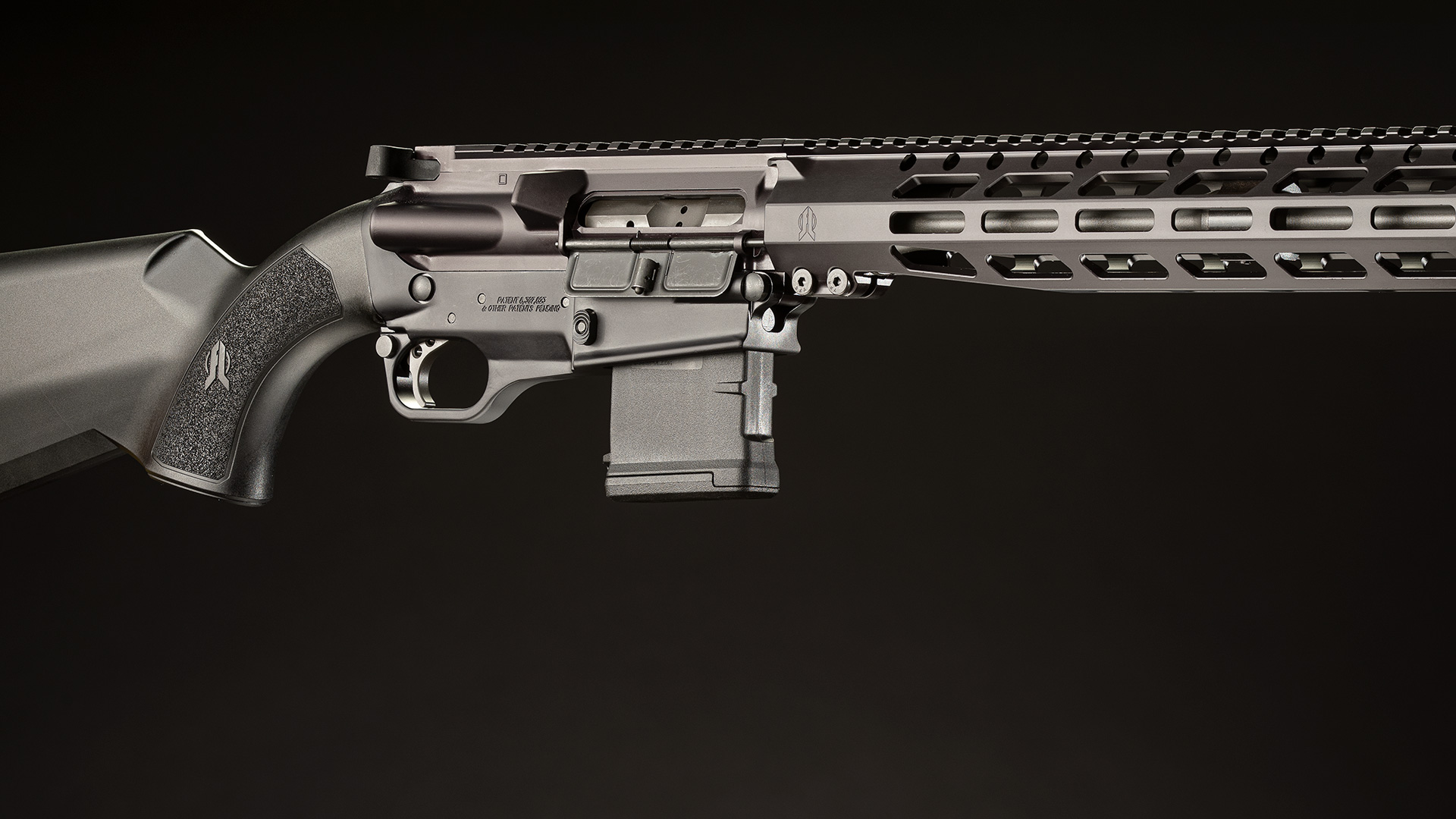
The primary purpose of the SCR is to provide a rifle that can be legally owned and used in all 50 U.S. states, including those with “assault weapon” restrictions. By removing banned features such as a pistol grip and adjustable stock configuration, the SCR remains compliant while still offering semi-automatic performance, detachable magazines, and AR upper modularity.
Hybrid design between traditional hunting rifle and AR-15 system
The SCR blends two distinct firearm philosophies: the ergonomics of a traditional hunting rifle and the modularity of the AR-15 platform. While the upper receiver, barrel, and gas system follow AR-15 standards, the lower receiver and stock are redesigned to resemble a classic bolt-action or sporting rifle layout. This makes it more familiar to hunters while preserving modern tactical functionality.
Why the SCR was created for restrictive firearm states
The SCR was developed specifically in response to increasing firearm regulations in certain U.S. states. Many AR-15 features—such as pistol grips, collapsible stocks, and flash hiders—are restricted under these laws. The SCR was engineered to bypass these limitations by redesigning the lower receiver architecture while keeping AR functionality intact.
Market position as a “featureless AR” solution
In the market, the SCR is often categorized as a “featureless AR” alternative. It appeals to shooters who want AR-15 performance but must comply with legal restrictions. It is especially popular among hunters, sport shooters, and residents of states like California, New York, and New Jersey where standard AR configurations are limited.
Design Philosophy and Concept
Traditional stock meets modern AR platform
The SCR replaces the AR-15’s pistol grip and buffer tube assembly with a fixed, traditional-style rifle stock. This creates a more conventional shooting experience similar to bolt-action or hunting rifles while still maintaining semi-automatic capability. The result is a platform that feels familiar to traditional shooters but performs like a modern rifle system.
Replacement of pistol grip with traditional rifle-style stock
Instead of the vertical pistol grip found on standard AR-15 rifles, the SCR uses a straight or gently curved rifle-style stock. This changes the shooter’s wrist angle significantly, promoting a more upright and traditional shooting posture. While this reduces tactical ergonomics, it increases compliance and comfort for long-range or supported shooting positions.
Remington 870-style ergonomics influence
The stock and overall handling of the SCR are often compared to classic shotgun and hunting rifle designs, particularly platforms like the Remington 870 in terms of shoulder placement and grip angle. This makes the SCR more intuitive for shooters transitioning from traditional firearms rather than modern AR platforms.
“Classic rifle feel” with modern semi-auto capability
One of the key design goals of the SCR is to deliver a “classic rifle feel” while maintaining semi-automatic fire and AR-level modularity. This combination appeals to shooters who want modern performance without the aggressive styling or regulatory concerns associated with AR-15-style rifles.
50-state legal compliance design
Designed to avoid “assault weapon” feature restrictions
The SCR is engineered to comply with firearm regulations that classify certain AR-style features as restricted. By removing the pistol grip, adjustable stock, and other regulated features, the platform avoids classification as an “assault weapon” in many jurisdictions.
Detachable magazine retention without AR pistol grip
Despite its compliance-focused design, the SCR still retains the ability to use detachable magazines, which is a key advantage over many other compliant rifle platforms. This allows faster reloads and tactical flexibility while staying within legal boundaries.
Importance for states with strict firearm regulations
The SCR is especially important for shooters in states with strict firearm laws, where standard AR-15 rifles may be heavily restricted or banned. It provides an option for legal ownership of a modern semi-automatic rifle without requiring major compromises in functionality or performance.
Modular AR upper compatibility
Uses standard AR-15 upper receivers
One of the SCR’s most important features is its compatibility with standard AR-15 upper receivers. This means users can install a wide variety of uppers without modifying the lower receiver, including different barrel lengths and gas system configurations.
Supports caliber and barrel swaps via upper changes
Because the upper receiver is interchangeable, users can change calibers simply by swapping the upper assembly. Common configurations include .223/5.56 NATO, .300 Blackout, and other AR-compatible calibers, depending on upper availability and build configuration.
AR magazine compatibility retained
The SCR maintains compatibility with standard AR-15 magazines, which is a significant advantage over other compliance-focused rifles. This ensures wide availability of magazines and accessories, making the platform practical for long-term ownership and use.
Receiver and Mechanical System
SCR proprietary lower receiver design
The SCR features a proprietary lower receiver that differs significantly from standard AR-15 lowers. It eliminates the buffer tube system entirely and replaces it with an internal recoil mechanism housed within the stock structure. This design is what allows the rifle to use a traditional stock layout.
Rear-mounted recoil system inside stock
Instead of a buffer tube extending from the rear of the receiver, the SCR integrates its recoil system into the stock. This internal spring system performs the same function as a standard AR buffer assembly but is hidden within the rifle’s traditional-style stock.
Crossbolt safety system instead of AR-style selector
The SCR replaces the standard AR-15 selector switch with a crossbolt-style safety, similar to those found on many hunting rifles and shotguns. This reinforces the traditional rifle feel while maintaining functional safety operation.
Bolt carrier and operating system
The SCR uses a modified bolt carrier designed specifically to work with its unique recoil system. While it maintains AR-15 compatibility at a basic level, the carrier is adapted to function without a buffer tube, changing how recoil energy is managed within the system.
Reduced mass compared to standard AR buffer systems
Due to the absence of a traditional buffer tube and associated components, the SCR often exhibits a different weight distribution and reduced rear mass compared to standard AR rifles. This affects handling and recoil impulse characteristics.
Lightweight cycling characteristics and recoil behavior
The modified cycling system produces a smooth and controlled recoil impulse. While not dramatically different in energy, the feel is often described as more linear and less “springy” compared to traditional AR buffer systems.
Internal recoil system differences
The SCR’s internal recoil system replaces the standard AR buffer tube assembly entirely. This is one of the most significant engineering differences between the SCR and conventional AR platforms.
No traditional buffer tube
Unlike standard AR-15 rifles, the SCR does not require a buffer tube extending from the receiver. This allows the use of a fixed traditional stock without modification or compromise.
Spring system routed into stock structure
The recoil spring system is integrated into the stock itself, routing recoil forces internally rather than externally. This compact engineering solution enables compliance while maintaining semi-automatic functionality.
Impact on recoil impulse and muzzle movement
The internal recoil system changes how recoil energy is transferred to the shooter. Many users report a slightly different recoil feel compared to AR-15 rifles, with a smoother but more rear-focused impulse depending on configuration and ammunition.
Ergonomics and Handling
Traditional rifle stock feel
The SCR provides a traditional rifle stock feel that differs significantly from standard AR platforms. This improves familiarity for shooters accustomed to hunting rifles and bolt-action firearms.
Improved cheek weld compared to AR buffer tube
Because the SCR uses a fixed stock rather than a buffer tube, it offers a more consistent and comfortable cheek weld. This improves sight alignment and shooting stability, especially during extended use.
More natural shoulder positioning for hunters
Hunters often prefer the SCR because its stock geometry allows a more natural shoulder position, similar to traditional sporting rifles. This makes it easier to transition between standing, kneeling, and prone positions in the field.
Familiar manual-of-arms for bolt and mag operation
Although the SCR uses an AR upper, its lower receiver controls mimic traditional rifle handling. Magazine insertion and bolt operation remain familiar to AR users, while the overall feel is closer to a conventional hunting rifle platform.
Control placement and usability challenges
Despite its ergonomic benefits, the SCR introduces some usability challenges due to its non-standard layout compared to AR-15 rifles.
Crossbolt safety location near trigger guard
The crossbolt safety is positioned near the trigger guard, similar to traditional hunting rifles. While intuitive for some users, it can be slower to manipulate compared to AR-style thumb safeties.
Magazine release reach limitations
The magazine release is less ergonomically optimized than AR platforms, requiring a different hand position and potentially slowing reload speed until the user becomes familiar with the system.
Charging handle ergonomics differences from AR-15
Charging handle operation remains similar in function but feels different in practice due to the altered stock and receiver geometry. Users often require an adjustment period when transitioning from standard AR platforms.
Shooting stance and comfort
The SCR performs well in supported shooting positions such as bench rest or prone shooting. Its traditional stock design enhances stability and comfort during long shooting sessions.
Better supported prone and bench shooting
In prone and bench positions, the SCR feels more stable than standard AR rifles due to its fixed stock and improved cheek weld. This makes it particularly effective for precision shooting and hunting applications.
Reduced “tactical AR” ergonomics but improved hunting feel
While it sacrifices some of the fast-handling characteristics of tactical AR platforms, the SCR gains a more natural and traditional hunting rifle feel, making it better suited for field use and regulated environments.
Performance and Accuracy
Accuracy results (1–1.5 MOA typical)
The FightLite SCR is generally capable of producing solid accuracy results, with most builds averaging around 1 to 1.5 MOA depending on barrel quality, ammunition, and upper receiver configuration. With match-grade components and quality ammunition, some setups can achieve consistent sub-MOA performance. However, the platform’s accuracy is largely influenced by the AR-15 upper used, meaning the SCR lower itself does not limit precision in most cases.
Consistent sub-MOA potential with quality ammo
When paired with a high-quality barrel and precision ammunition, the SCR can deliver sub-MOA groups at 100 yards. This performance level makes it suitable for hunting and precision recreational shooting. The consistency of results depends heavily on the shooter’s setup, including optics, barrel twist rate, and ammunition selection.
Performance depends heavily on upper receiver build
Because the SCR uses standard AR-15 uppers, its performance is directly tied to the quality of the upper receiver assembly. Premium barrels, properly tuned gas systems, and quality triggers in the upper all contribute more to accuracy and reliability than the SCR lower itself.
Barrel and ammunition compatibility
The SCR is compatible with a wide range of AR-15 calibers, including .223 Remington, 5.56 NATO, .300 Blackout, and other AR-compatible cartridges. This versatility allows users to configure the rifle for different roles such as hunting, target shooting, or training simply by swapping upper receivers.
Gas system tuning via upper configuration
Gas system performance is managed at the upper receiver level. Adjustable gas blocks are often recommended to optimize cycling behavior and reduce over-gassing. Proper tuning improves recoil control and extends component longevity, especially when switching between different ammunition types.
Real-world shooting behavior
In practical use, the SCR delivers a smooth and linear recoil impulse due to its modified recoil system. Shooters often describe the recoil as softer in feel compared to standard AR-15 rifles. However, some configurations may exhibit slightly stronger cycling forces depending on gas setup and ammunition pressure.
Slight over-gassing tendency in some builds
Certain SCR configurations, especially when paired with non-adjustable gas systems, may exhibit over-gassing. This can result in more aggressive ejection patterns and increased felt recoil. Proper tuning with an adjustable gas block helps mitigate this issue and improves overall shooting comfort.
Reliability and Durability
Long-term reliability testing results
Field reports and user testing indicate that the SCR can reliably cycle hundreds to thousands of rounds without major malfunctions when properly configured. Reliability is primarily influenced by the AR upper assembly rather than the SCR lower itself.
Reliability depends on upper receiver configuration
Since the SCR is built around AR-15 upper compatibility, reliability is heavily dependent on the quality and tuning of the upper receiver. Well-built uppers with proper gas system tuning tend to perform consistently, while poorly configured builds may experience cycling issues.
Over-gassing and ejection behavior
Some SCR setups exhibit strong ejection patterns due to over-gassing, especially when using high-pressure ammunition. This is not unique to the SCR platform but is more noticeable in setups without adjustable gas regulation. Ejection consistency improves significantly with tuning.
Adjustable gas blocks recommended
To optimize reliability and reduce wear, many users recommend installing an adjustable gas block on the upper receiver. This allows fine-tuning of gas flow, improving cycling smoothness and reducing excessive bolt speed or recoil impulse.
Maintenance considerations
Maintenance of the SCR largely follows standard AR-15 upper procedures, including cleaning the bolt carrier group, barrel, and gas system. The lower receiver requires less frequent maintenance due to its simplified design, though periodic inspection of internal recoil components is still recommended.
Weight, Balance, and Build Quality
Lightweight platform design
The FightLite SCR is considered a lightweight rifle platform, with typical configurations ranging from approximately 5.9 to 6.5 pounds depending on the upper receiver and accessories installed. This makes it competitive with many lightweight AR carbines and hunting rifles.
Approx. 5.9–6.5 lbs depending on build
Weight varies depending on barrel length, optic setup, and accessories. Even with a standard optic and loaded magazine, the SCR remains relatively easy to carry, making it suitable for extended field use and hunting applications.
Lighter than many traditional AR carbines
In some configurations, the SCR can be lighter than standard AR carbines due to the elimination of buffer tube assemblies and certain lower receiver components. This contributes to reduced fatigue during long shooting sessions or field carry.
Balance and center-of-gravity characteristics
The SCR exhibits a slightly rear-weighted balance due to the internal recoil system housed in the stock. This weight distribution improves stability when shooting from supported positions such as prone or bench rest, but may feel different compared to front-balanced tactical AR rifles.
Rear-weighted feel due to stock recoil system
The integration of the recoil system into the stock shifts the center of gravity toward the rear. This can make the rifle feel more planted when shouldered, though it may require adjustment for shooters accustomed to standard AR ergonomics.
Improved stability in supported shooting positions
The rear-biased balance enhances stability in supported shooting positions, particularly for hunting or precision shooting. This helps reduce movement during trigger press and improves overall shot consistency.
Materials and construction quality
The SCR uses a combination of polymer and aluminum components, with a durable stock assembly and standard AR-compatible upper interface. While not positioned as a premium tactical rifle, it is built for functional durability and long-term field use.
Polymer stock with aluminum upper compatibility
The stock is typically constructed from high-strength polymer, while the upper receiver compatibility remains aluminum-based AR-15 standard. This combination provides a balance of weight savings and structural integrity.
Durable but purpose-built rather than premium tactical finish
The SCR prioritizes function over high-end tactical aesthetics. While durable and reliable, its finish and materials are more utilitarian than premium-grade military or competition-focused rifles.
Advantages of the FightLite SCR
The FightLite SCR offers several key advantages that make it a unique platform in the modern rifle market.
Legal in restrictive states (50-state compliance)
One of the biggest advantages of the SCR is its compliance with restrictive firearm laws across all 50 U.S. states. Its featureless design allows ownership in regions where standard AR-15 rifles may be restricted or banned.
Standard AR upper compatibility
The SCR retains full compatibility with AR-15 upper receivers, allowing users to customize caliber, barrel length, and performance characteristics without changing the lower receiver.
Lightweight and easy to handle
Its lightweight design makes it easy to carry and maneuver, especially during long hunting trips or extended range sessions.
Traditional rifle ergonomics
The rifle-style stock provides a more traditional shooting experience, making it comfortable for users familiar with hunting rifles rather than tactical AR platforms.
Modular caliber adaptability
Users can switch calibers simply by changing the upper receiver, offering significant flexibility for different shooting applications.
Strong accuracy potential
When paired with quality components, the SCR is capable of strong accuracy performance suitable for hunting, target shooting, and general recreational use.
Disadvantages and Limitations
Despite its strengths, the SCR has several limitations that should be considered before purchase.
Non-standard lower receiver system
The proprietary lower receiver is not compatible with standard AR-15 lower parts, which limits interchangeability and aftermarket support.
Limited aftermarket trigger options
Trigger customization options are more limited compared to traditional AR platforms, reducing flexibility for performance tuning.
Ergonomic compromises vs AR platform
While more traditional in feel, the SCR sacrifices some of the fast-handling ergonomics of standard AR-15 rifles, particularly in tactical scenarios.
Crossbolt safety learning curve
The crossbolt safety system requires adaptation for users accustomed to AR-style selector switches, which may slow operation initially.
Magazine release accessibility issues
The magazine release is less intuitive than AR-15 designs and may require repositioning of the shooting hand, affecting reload speed.
Proprietary lower parts
Certain internal components are proprietary to the SCR platform, which can limit replacement options and increase dependence on manufacturer support.
Ideal Use Cases
Hunting rifle applications in AR-restricted states
The SCR is particularly well-suited for hunting in states where AR-15 rifles are restricted. Its traditional stock and compliance design make it a practical legal alternative.
Civilian shooters in compliance-heavy regions
For civilians in restrictive jurisdictions, the SCR provides access to AR-level performance while remaining compliant with local laws.
Lightweight field rifle setups
Its lightweight configuration makes it ideal for field use, especially for long-distance carrying during hunting or outdoor shooting activities.
Recreational shooting and training platforms
The SCR is also suitable for general recreational shooting and training, especially for users who prefer traditional rifle ergonomics.
Not ideal for pure tactical AR enthusiasts
Shooter focused purely on tactical AR performance may find the SCR less suitable due to its ergonomic compromises and non-standard control layout.
Final Verdict on FightLite SCR
Summary of hybrid AR-traditional rifle concept
The FightLite SCR successfully blends AR-15 modularity with traditional rifle ergonomics, creating a unique hybrid platform that serves a specific legal and functional niche.
Best alternative for restrictive firearm environments
It stands out as one of the best AR alternatives for shooters in restrictive states, offering compliance without completely sacrificing performance or modularity.
Trade-offs between ergonomics and compliance
The SCR achieves legal compliance by changing core AR ergonomics, resulting in trade-offs in handling speed and control familiarity compared to standard AR-15 rifles.
Who should consider buying it
The SCR is ideal for hunters, compliance-restricted shooters, and those who want AR performance in a traditional rifle format.
Who should avoid it in favor of standard AR-15 platforms
Users seeking maximum tactical performance, fastest handling ergonomics, and full AR customization may prefer a standard AR-15 platform instead of the SCR.
FAQ – FightLite SCR Review
1. What is the FightLite SCR?
The FightLite SCR (Sport Configurable Rifle) is a semi-automatic rifle designed as a compliant alternative to the AR-15. It retains AR-15 upper receiver compatibility but replaces the traditional pistol grip and buffer tube system with a fixed, traditional-style rifle stock. This makes it suitable for jurisdictions with strict firearm regulations while maintaining modern semi-auto functionality.
2. What does SCR stand for?
SCR stands for “Sport Configurable Rifle.” The name reflects its modular nature, allowing users to configure the rifle with different AR-15 upper receivers, calibers, and barrel setups while maintaining a compliant lower receiver design.
3. Is the FightLite SCR an AR-15?
Technically, the SCR is not a standard AR-15, but it is AR-15 compatible in its upper receiver design. The lower receiver is completely different, removing the buffer tube and pistol grip. This hybrid structure allows it to function like an AR while avoiding legal classification issues in restrictive states.
4. Why was the SCR designed?
The SCR was designed to provide firearm owners in restrictive states with a legal alternative to AR-15 rifles. Many jurisdictions ban specific AR features, so FightLite engineered a platform that maintains AR functionality while eliminating those restricted features.
5. Is the SCR legal in all 50 states?
The SCR is designed to comply with firearm laws across all 50 states, but legality can still depend on local regulations, magazine restrictions, and specific state interpretations. It is widely accepted as a “featureless” rifle platform in restrictive jurisdictions.
6. What makes the SCR “compliant”?
The SCR is compliant because it removes regulated AR-15 features such as the pistol grip, adjustable stock, flash hider (depending on configuration), and buffer tube assembly. Instead, it uses a fixed traditional rifle stock and crossbolt safety system.
7. Does the SCR use standard AR magazines?
Yes, the SCR is compatible with standard AR-15 magazines. This is one of its biggest advantages, as it allows users to use widely available and affordable magazine options without modification.
8. Can you use standard AR-15 uppers on the SCR?
Yes, the SCR is designed to accept most standard AR-15 upper receivers. This includes different barrel lengths, calibers, and gas system configurations, making it highly modular.
9. What calibers does the SCR support?
The SCR supports any caliber available in AR-15 upper configurations, including .223 Remington, 5.56 NATO, .300 Blackout, and other specialty AR-compatible cartridges depending on upper design.
10. Does the SCR require a special bolt carrier?
Yes, the SCR uses a modified bolt carrier system designed to function without a traditional buffer tube. This adaptation is necessary for the internal recoil system integrated into the stock.
11. How does the SCR recoil system work?
Instead of a buffer tube, the SCR uses an internal recoil spring system housed inside the stock. This system performs the same function as a traditional AR buffer assembly but is relocated to allow the rifle to maintain a fixed stock design.
12. Does the SCR have a buffer tube?
No, the SCR does not use a buffer tube. This is one of its defining design differences compared to standard AR-15 rifles.
13. What replaces the buffer tube in the SCR?
The buffer tube is replaced by an internal recoil spring system integrated into the stock. This allows the rifle to maintain semi-automatic operation without requiring a rear-mounted buffer extension.
14. Is the SCR lighter than a standard AR-15?
In many configurations, the SCR is comparable or slightly lighter than a standard AR-15 due to its simplified lower receiver design. However, total weight depends heavily on the upper receiver used.
15. How accurate is the FightLite SCR?
The SCR is typically capable of 1–1.5 MOA accuracy with quality barrels and ammunition. Because accuracy is largely determined by the AR upper receiver, premium components can push it into sub-MOA performance.
16. Is the SCR good for hunting?
Yes, the SCR is widely used for hunting, especially in states where AR-15 rifles are restricted. Its traditional stock design, lightweight build, and accuracy potential make it suitable for field use.
17. Can the SCR be used for home defense?
Yes, it can be used for home defense, though its ergonomics are more traditional than tactical. It still offers semi-automatic capability and detachable magazines, which are important for defensive use.
18. How reliable is the SCR platform?
The SCR is generally reliable when paired with a properly configured AR upper receiver. Reliability is mostly dependent on the upper’s gas system and overall build quality rather than the SCR lower itself.
19. Does the SCR require a break-in period?
Most SCR rifles do not require a strict break-in period, but new AR uppers may benefit from initial cycling to ensure smooth operation and proper gas system tuning.
20. What is the trigger like on the SCR?
The SCR uses a crossbolt safety system and proprietary trigger setup. The trigger feel is often described as more similar to a traditional hunting rifle than a tactical AR trigger, though quality varies by configuration.
21. Can you replace the SCR trigger?
Trigger upgrades are more limited compared to standard AR-15 platforms due to the proprietary lower receiver design. Some aftermarket options exist, but compatibility is not as extensive.
22. Why is the SCR trigger different from AR triggers?
The SCR trigger differs because the lower receiver eliminates the pistol grip and uses a different internal geometry. This changes how the fire control group is implemented compared to standard AR systems.
23. Is the SCR ambidextrous?
The SCR is partially ambidextrous depending on configuration, but it is not fully optimized for left-handed or ambidextrous operation like some modern AR platforms.
24. How is the magazine release on the SCR?
The magazine release is functional but not as ergonomically optimized as AR-15 designs. It may require more deliberate hand movement to operate efficiently.
25. Is the SCR magazine release easy to use?
It is easy to use once learned, but it is less intuitive and slower compared to standard AR magazine release systems, especially for users transitioning from AR platforms.
26. What is the safety system on the SCR?
The SCR uses a crossbolt safety system similar to traditional hunting rifles instead of the AR-15 thumb selector. This enhances compliance and traditional rifle ergonomics.
27. How does the SCR compare to a standard AR-15?
The SCR offers similar performance potential but differs significantly in ergonomics and handling. It is more traditional in feel but less optimized for tactical speed and modern AR manipulation.
28. Is the SCR better than featureless AR builds?
In many cases, the SCR is considered a cleaner and more purpose-built solution than featureless AR builds, which often involve awkward grip modifications and compliance accessories.
29. What is the SCR stock made of?
The stock is typically made from high-strength polymer designed to house the internal recoil system while maintaining durability and compliance requirements.
30. Is the SCR stock comfortable to shoot?
Yes, the stock is generally comfortable, especially for users familiar with traditional rifles. It provides a stable cheek weld and natural shoulder positioning.
31. Does the SCR have recoil advantages?
Recoil is generally smooth due to the internal recoil system and lightweight design. It feels different from standard AR buffer systems but remains manageable.
32. How does recoil compare to AR-15 rifles?
Recoil is similar overall but can feel slightly more linear and rear-focused depending on upper configuration and gas system tuning.
33. Is the SCR good for long-range shooting?
Yes, the SCR can perform well at longer distances when paired with a quality upper receiver and optics. Its accuracy potential makes it suitable for mid-to-long range shooting.
34. What is the effective range of the SCR?
Effective range depends on the upper receiver and caliber, but with .223/5.56 setups, it is typically effective out to 300–500 yards with proper optics and ammunition.
35. Can the SCR shoot sub-MOA groups?
Yes, with high-quality barrels, ammunition, and optics, the SCR platform can achieve sub-MOA performance in ideal conditions.
36. What is the typical accuracy of the SCR?
Most builds average between 1 and 1.5 MOA, depending on configuration and shooter skill.
37. Is the SCR suitable for beginners?
It can be used by beginners, but the non-standard ergonomics may require additional training compared to standard AR-15 rifles.
38. Is the SCR good for competitive shooting?
It can be used in certain competitions, but it is not as optimized for speed-based tactical competitions as standard AR-15 platforms.
39. Can you customize the SCR?
Yes, but customization is mainly focused on the AR upper receiver. Lower receiver modifications are more limited due to proprietary design.
40. What parts of the SCR are proprietary?
The lower receiver, stock assembly, and internal recoil system are proprietary components specific to the SCR platform.
41. Can you change the SCR lower receiver?
No, the SCR lower is not interchangeable with standard AR-15 lowers, as it is a unique compliance-based design.
42. Is the SCR compatible with AR pistol grips?
No, the SCR is specifically designed without a pistol grip to maintain legal compliance in restrictive states.
43. Why doesn’t the SCR have a pistol grip?
The pistol grip is removed to avoid classification as an “assault weapon” in states with feature-based firearm restrictions.
44. Does the SCR use a different bolt carrier?
Yes, it uses a modified bolt carrier system designed to function without a buffer tube.
45. How hard is it to clean the SCR?
Cleaning is relatively straightforward for the upper receiver, similar to an AR-15, but the lower receiver has unique components that require familiarity.
46. Is maintenance easier than a standard AR?
Upper receiver maintenance is similar, but overall maintenance can be slightly more complex due to proprietary lower components.
47. What are common issues with the SCR?
Common issues include learning curve with ergonomics, limited aftermarket support, and dependence on upper receiver tuning for optimal reliability.
48. Is the SCR worth buying in restricted states?
Yes, it is one of the most practical AR alternatives for restricted states due to its compliance and modular design.
49. What is the biggest disadvantage of the SCR?
The biggest disadvantage is the compromise in ergonomics compared to standard AR-15 platforms, particularly in speed and control placement.
50. What is the biggest advantage of the SCR?
Its biggest advantage is offering AR-15 modularity and performance potential in a legally compliant, traditional rifle format.
51. Is the SCR better than a Mini-14?
The SCR offers greater modularity and AR upper compatibility compared to the Mini-14, but both serve similar compliance-focused markets.
52. Who should buy the FightLite SCR?
It is best suited for hunters, shooters in restrictive states, and users who want AR performance in a traditional rifle configuration.
53. Who should avoid the SCR?
Users who prioritize tactical AR ergonomics, fast manipulation, and full aftermarket support may prefer a standard AR-15 instead.
54. Is the SCR still in production?
Yes, the SCR remains in production and continues to be offered as a compliance-focused alternative in the modern rifle market.
55. Is the FightLite SCR a good AR alternative in 2026?
Yes, in 2026 the SCR remains a strong AR alternative for compliance-restricted environments, offering modularity and performance while meeting legal requirements in restrictive states.
Read more: