
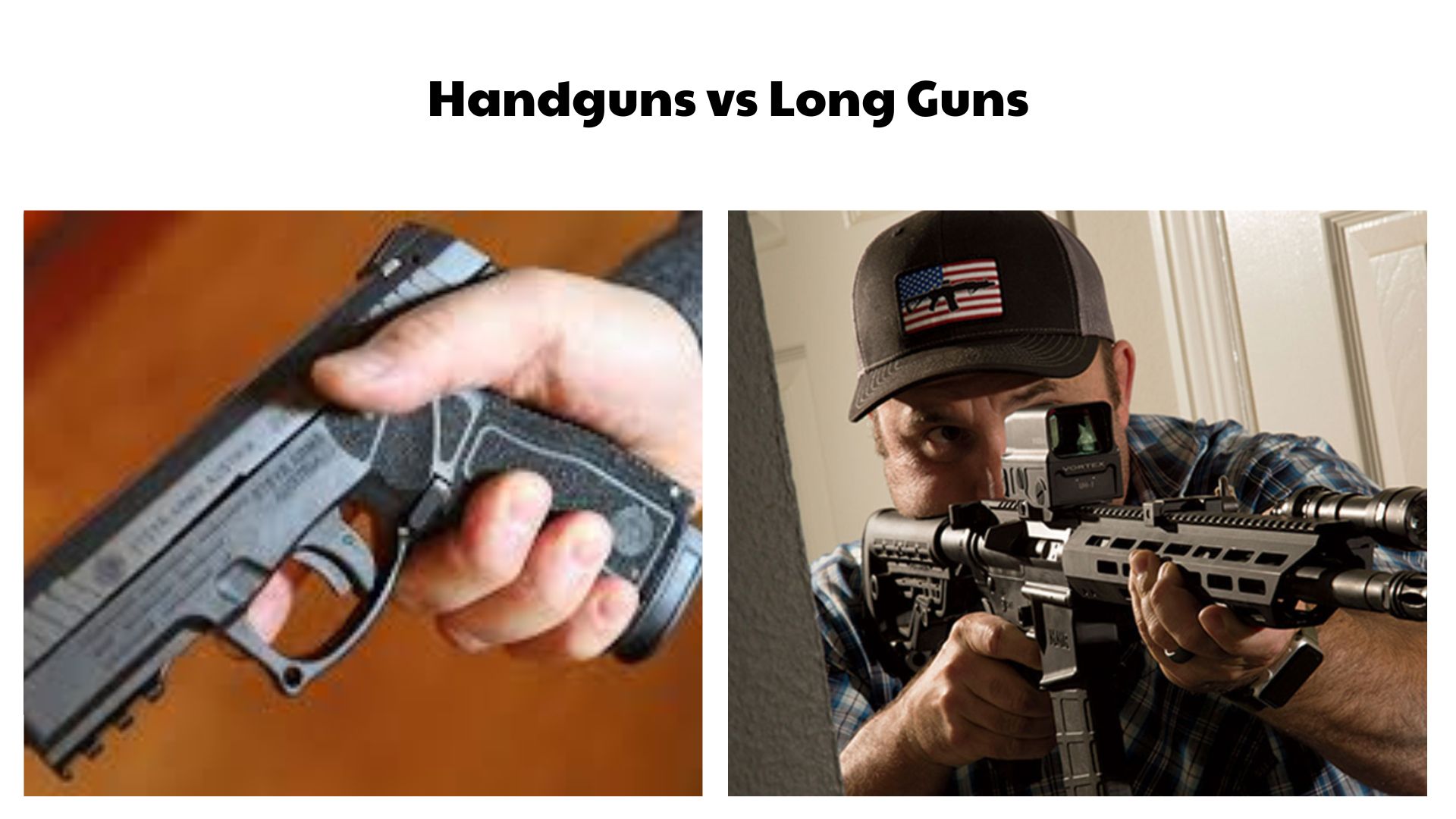

Choosing between handguns vs long guns for home defense is a practical decision that directly affects how quickly and effectively you can respond to a threat inside your home. Handguns are compact and easy to access, making them ideal for fast movement in tight spaces. Long guns such as rifles and shotguns offer greater stability, accuracy, and stopping power, but require more space and careful handling indoors.
The debate is not about which firearm is universally better, but which one fits your home layout, skill level, and defensive needs. Key factors like speed, safety, maneuverability, and stopping power all play a role in this choice. Each platform solves different problems, and understanding those differences is essential for making a responsible home defense decision.
What Is a Handgun in Home Defense?
A handgun is a compact firearm designed to be operated primarily with one hand, although modern defensive shooting almost always uses a two-handed grip for better control and accuracy. In the context of handguns vs long guns, handguns are valued for their portability, fast access, and ease of movement inside confined spaces such as hallways, bedrooms, and staircases.
Handguns are commonly used in civilian self-defense and concealed carry because they can be stored discreetly and deployed quickly when needed. In a home defense scenario, this accessibility becomes a major advantage, especially when reaction time is limited.
Definition and Common Types (Semi-Auto Pistols, Revolvers)
There are two primary categories of handguns used in home defense: semi-automatic pistols and revolvers.
Semi-automatic pistols are the most popular modern choice. They use a magazine-fed system, allowing multiple rounds to be fired before reloading. They are widely used due to higher capacity, faster reloads, and compatibility with common defensive ammunition.
Revolvers use a rotating cylinder to hold ammunition. They are mechanically simple and highly reliable, though they typically offer lower capacity and slower reload speed compared to semi-automatics. Some users prefer revolvers for their straightforward operation and reduced mechanical complexity.
Both types can be effective for home defense when used properly, but semi-automatic pistols dominate modern defensive setups due to capacity and ergonomics.
Designed for Portability and Close-Range Engagement
Handguns are specifically designed for portability. Their compact size makes them easy to store in quick-access safes, bedside drawers, or holsters. This allows for rapid deployment in emergency situations where every second matters.
In terms of engagement distance, handguns are optimized for close-range encounters. Most home defense situations occur at short distances, often within a few meters. While handguns are capable of accurate shooting at longer ranges, their primary strength lies in close-quarters usability and quick target engagement.
The ability to maneuver easily in tight indoor environments is one of the main reasons handguns remain a core option in home defense planning.
Role in Civilian Self-Defense and Concealed Carry
Handguns play a central role in civilian self-defense. They are the most common type of firearm carried for personal protection due to their compact size and concealability. Many individuals who carry firearms outside the home also choose handguns for home defense because of familiarity and consistency in training.
This overlap between concealed carry and home defense creates a practical advantage. Users who train with a handgun in daily carry situations often develop muscle memory that carries over into home defense scenarios.
Handguns also offer flexibility. They can be used while moving through the home, while calling emergency services, or in situations where one hand may be occupied. This versatility makes them a practical “first-access” defensive tool.
Common Defensive Calibers (9mm, .45 ACP, etc.)
Handguns are available in a wide range of calibers, but a few are most commonly used in home defense.
9mm is the most popular defensive caliber. It offers a balance of manageable recoil, high magazine capacity, and effective stopping power with modern ammunition design. It is widely available and commonly used in law enforcement and civilian defense.
.45 ACP is known for delivering larger projectiles and strong terminal performance. It typically has lower capacity and more recoil compared to 9mm, but many users value its impact characteristics.
Other calibers such as .40 S&W also exist, offering a middle ground between 9mm and .45 ACP. However, 9mm has become the dominant choice due to advancements in bullet technology and overall controllability.
Choosing the right caliber depends on recoil tolerance, training level, and intended use. In home defense, shot placement and control often matter more than raw caliber size.
What Is a Long Gun for Home Defense?
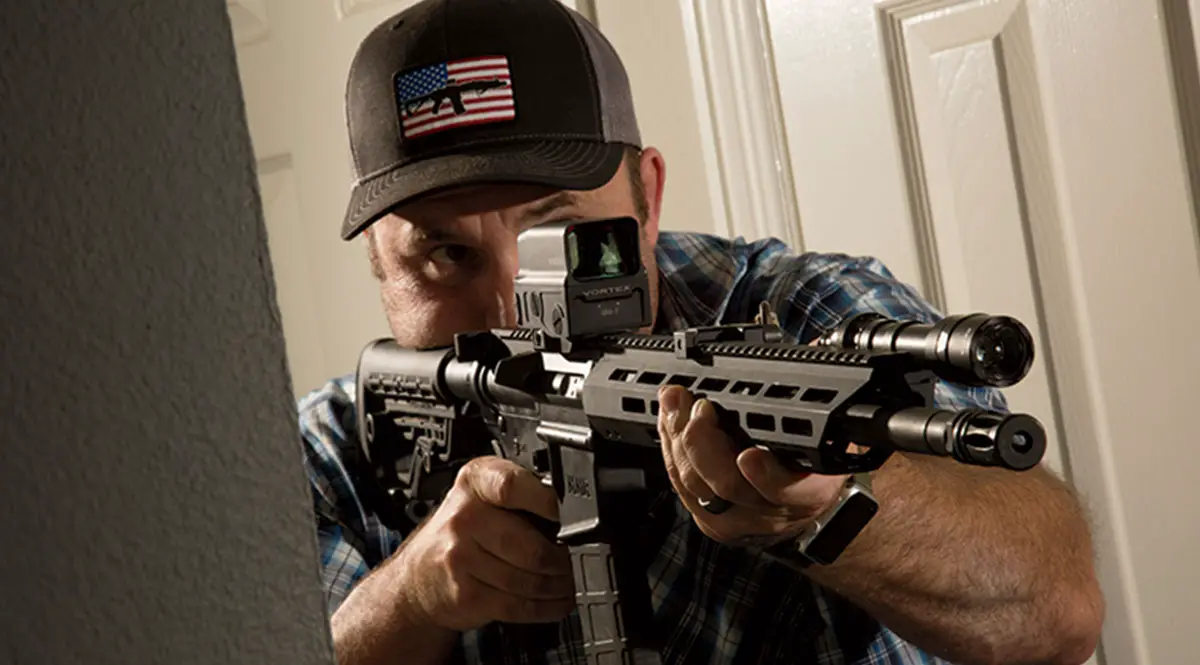
A long gun is a firearm designed to be fired from the shoulder, providing increased stability, control, and accuracy compared to handguns. In the discussion of handguns vs long guns, long guns include rifles and shotguns, both of which are widely used in defensive and tactical applications.
Long guns are generally chosen for their superior handling during rapid fire, improved accuracy under stress, and greater stopping power. While they require more space to maneuver indoors, they are often considered highly effective defensive tools when properly trained and staged.
Definition: Rifles (AR-15 Style) and Shotguns
Long guns used in home defense fall into two main categories: rifles and shotguns.
Rifles, especially AR-15 style platforms, are among the most common modern defensive firearms. They fire small-caliber, high-velocity rounds and are known for low recoil, high accuracy, and large magazine capacity. These characteristics make them highly controllable even under stress.
Shotguns fire multiple projectiles (buckshot) or a single large projectile (slug). They are known for significant stopping power at close range. However, they also produce more recoil and typically have lower ammunition capacity compared to rifles.
Both platforms are effective, but they serve slightly different roles depending on user preference and home environment.
Designed for Shoulder Firing and Increased Stability
The defining feature of a long gun is shoulder firing. By placing the stock against the shoulder, the shooter gains a stable shooting platform that improves accuracy and reduces recoil impact.
This stability makes long guns easier to shoot accurately compared to handguns, especially under stress. The extended sight radius also helps with target acquisition and precision, which is valuable in low-light or high-pressure situations.
Because of this design, long guns are often considered easier to learn for beginners in terms of accuracy, even though they require more space to operate indoors.
Common Defensive Platforms
In modern home defense, the most common long gun platforms include AR-15 style rifles and tactical shotguns.
The AR-15 platform is widely used due to its modular design, low recoil, and high capacity. It allows users to customize optics, lights, and accessories for home defense needs.
Tactical shotguns, such as pump-action or semi-automatic models, remain popular for their simplicity and stopping power. They are often chosen for close-range defensive situations where impact force is a priority.
Both platforms have strong defensive reputations, but they differ significantly in handling, recoil, and ammunition capacity.
Typical Home-Defense Configurations (Short-Barrel, Tactical Setups)
Long guns used in home defense are often configured specifically for indoor use. Standard hunting setups are less common, as they are typically too long and unwieldy for confined spaces.
Short-barrel rifles (SBRs) or compact AR-style pistols are popular because they reduce overall length while maintaining rifle performance. These configurations improve maneuverability in hallways and rooms.
Shotguns may be configured with shorter barrels, tactical stocks, and reduced overall length to improve handling inside the home. Accessories such as weapon-mounted lights are also commonly added to assist in low-light identification.
The goal of these configurations is to balance the natural advantages of long guns with the spatial limitations of indoor environments.
In practice, both handguns and long guns can be highly effective for home defense when properly selected, configured, and trained with. The key difference lies in how each platform performs under real-world conditions.
Handgun vs Long Gun – Key Differences
The comparison between handguns vs long guns becomes most important when we move from theory to real-world home defense situations. Both platforms are effective, but they behave very differently under stress, in confined spaces, and during fast-moving defensive encounters. Understanding these differences helps clarify not only what each firearm can do, but also what limitations must be considered in a home environment.
Stopping Power & Effectiveness
Stopping power refers to how effectively a firearm can neutralize a threat. In general, long guns outperform handguns in this category. Rifles produce higher bullet velocity, which results in better energy transfer on impact. This often translates into more consistent terminal performance compared to handgun rounds.
Shotguns also deliver significant stopping power at close range, especially with buckshot loads that spread multiple projectiles. This can increase the likelihood of effective target engagement in close-quarters situations.
Handguns, while effective in defensive use, typically generate lower energy compared to long guns. This means they may require more precise shot placement or multiple hits to achieve similar outcomes. Under stress, accuracy can decrease, which further highlights the importance of understanding these limitations.
In real-world home defense, stopping power must be balanced with controllability. A more powerful firearm is not always better if it cannot be controlled effectively under pressure.
Maneuverability Inside the Home
Maneuverability is one of the strongest advantages of handguns. Their compact size allows users to move easily through tight hallways, doorways, and staircases without obstruction. This makes them highly practical in confined indoor environments.
Handguns also offer the advantage of one-handed operation, which can be important when opening doors, moving family members, or communicating with emergency services.
Long guns, by comparison, have longer barrels and overall length, which can make movement inside a home more challenging. Corners, furniture, and narrow spaces may require additional awareness and careful handling.
While training can significantly improve long gun maneuverability, the physical size difference remains an important factor in indoor environments.
Accuracy & Ease of Use
Long guns are generally easier to shoot accurately. The shoulder stock provides stability, and the two-handed grip improves control. The longer sight radius also helps with precise aiming, especially in stressful situations.
Handguns require more skill to achieve consistent accuracy. They rely on proper grip strength, trigger control, and sight alignment, all of which become more difficult under stress. Small errors in technique can have a larger impact on shot placement.
Stress shooting further amplifies these differences. In high-pressure scenarios, fine motor skills tend to degrade. Long guns provide a more forgiving shooting platform, while handguns require more disciplined training to maintain accuracy.
However, both platforms are highly dependent on training. Familiarity and repetition often matter more than the firearm type itself.
Recoil & Control
Recoil management plays a major role in defensive shooting. Handguns produce moderate recoil depending on caliber, which can affect follow-up shot speed and accuracy.
Rifles, especially AR-15 style platforms, generally have low recoil. This makes them easier to control during rapid fire and improves shot consistency. Shotguns, on the other hand, produce heavier recoil, particularly with full-power loads.
Better recoil control typically leads to faster target reacquisition and improved performance under stress. This is one reason many users find rifles easier to handle in defensive scenarios compared to handguns or shotguns.
Overpenetration Risk
Overpenetration is an important consideration in home defense due to the risk of bullets passing through walls and potentially endangering others.
Handguns present a moderate risk depending on caliber and ammunition type. Some rounds may penetrate multiple interior walls.
Rifles, due to higher velocity, can also penetrate walls significantly. However, modern defensive ammunition can influence this behavior. The risk is not simply about firearm type but also about ammunition selection and home layout.
Shotguns vary widely. Buckshot can penetrate multiple surfaces, while birdshot behaves differently but is generally less effective for defense. The structure of the home, including wall materials and room layout, plays a major role in this factor.
Capacity & Reloading
Firearm capacity affects how many rounds are available before reloading becomes necessary.
Handguns typically have lower capacity compared to rifles but are easier and faster to reload with practice. Magazine changes are straightforward and efficient.
Rifles often offer higher capacity, commonly ranging from 20 to 30 rounds or more. This can be advantageous in extended defensive situations where multiple threats are possible.
Shotguns generally have the lowest capacity and slower reload process. Reloading individual shells takes more time and requires more manual handling.
Capacity is not just about quantity but also about maintaining control and readiness during high-stress encounters.
Speed of Deployment
Handguns are typically faster to access, especially when stored in quick-access safes, bedside drawers, or holsters. This makes them highly suitable for immediate response scenarios.
Long guns require more storage space and preparation but can become highly effective once shouldered and ready. If already staged in a defensive position, they may be just as fast in actual engagement readiness.
Home storage setup plays a key role in determining deployment speed. Accessibility must always be balanced with safety, especially in households with multiple occupants.
One-Handed Operation
Handguns provide the advantage of one-handed use, which can be critical in real-life defensive situations. This allows the user to perform additional tasks such as calling emergency services, moving family members, or opening doors while maintaining firearm control.
Long guns require two hands for effective operation. This limits multitasking ability but increases stability and control during firing.
In dynamic home defense scenarios, the ability to operate a firearm with one hand can significantly impact flexibility and response options.
Noise, Flash, and Indoor Use
Both handguns and long guns produce significant noise indoors, but long guns—especially rifles and shotguns—can produce louder reports and greater muzzle flash depending on ammunition type.
Handguns are still extremely loud in enclosed spaces, and both platforms can cause disorientation due to sound pressure and flash.
This can have psychological and physiological effects during home defense situations, including temporary hearing disruption or visual impairment in low light. These factors are important to consider when evaluating indoor firearm use.
Legal and Practical Considerations
Legal factors also influence the choice between handguns vs long guns. Firearm storage laws vary depending on region, and safe storage requirements may affect how quickly a firearm can be accessed in an emergency.
Transportation and access regulations also play a role, especially for individuals who move firearms between locations or store them in different parts of the home.
Liability and proportional force principles are important considerations in defensive firearm use. Understanding legal responsibilities is essential for any homeowner who chooses to keep a firearm for protection.
Ultimately, legal awareness, safe storage, and responsible handling are just as important as the mechanical differences between firearm types.
Shotgun vs Rifle vs Handgun (Long Gun Breakdown)
When comparing handguns vs long guns for home defense, it is useful to break long guns into two main categories: shotguns and rifles. While both are highly effective defensive tools, they behave very differently in real-world indoor environments. Understanding these differences helps clarify when each platform may be more suitable depending on the user’s home layout, training level, and defensive expectations.
This breakdown focuses on practical performance rather than theory, highlighting how each platform functions under stress, in confined spaces, and during fast defensive encounters.
Shotgun Advantages in Home Defense
Shotguns have long been associated with home defense due to their reputation for power and simplicity. One of their most well-known advantages is high stopping power. At close range, shotgun loads such as buckshot deliver multiple projectiles simultaneously, increasing the likelihood of effective target impact. This can be particularly useful in close-quarters defensive situations where engagement distances are short.
Another advantage is psychological deterrence. The sound of racking a shotgun or the visual presence of a large firearm can have a strong impact on an intruder’s decision-making. While no defensive plan should rely solely on intimidation, this factor is often discussed in real-world defensive scenarios.
Shotguns also provide a spread pattern at close range. This means that slight aiming errors may still result in effective hits, which can be helpful under stress when fine motor control is reduced. However, this spread is not as wide as often portrayed in movies, especially at typical indoor distances.
Overall, shotguns are valued for their immediate impact potential and straightforward operation, making them a traditional choice for home defense.
Shotgun Disadvantages
Despite their strengths, shotguns also come with several limitations. One of the most significant is heavy recoil. Depending on the load, recoil can be substantial, which may slow down follow-up shots and affect control for less experienced shooters.
Limited capacity is another drawback. Most shotguns hold fewer rounds compared to rifles or modern handguns. This means reloading may be required sooner in a defensive situation, and reload speed is generally slower because shells must be inserted individually or in small groups.
Shotguns also have slower reload mechanics overall. Under stress, this can become a disadvantage compared to magazine-fed systems found in rifles and handguns.
Finally, maneuvering a shotgun indoors can be more difficult due to its length and handling characteristics. Tight hallways, door frames, and corners require careful movement and awareness to avoid obstruction.
Rifle (AR-15 Style) Advantages
Rifles, particularly AR-15 style platforms, are among the most popular modern choices for home defense. One of their biggest advantages is high accuracy and control. The shoulder-fired design provides stability, making it easier to place accurate shots even under stress.
Low recoil is another key benefit. Compared to shotguns and many handguns, rifles are significantly easier to control during rapid fire. This improves follow-up shot speed and overall shooting consistency.
Rifles also offer large magazine capacity, typically ranging from 20 to 30 rounds or more depending on configuration. This provides extended defensive capability without frequent reloading, which can be critical in high-stress or uncertain situations.
Another important advantage is effective performance under stress. The combination of low recoil, stable shooting platform, and simple manual operation makes rifles highly controllable even when fine motor skills degrade due to adrenaline.
For many users, these characteristics make rifles one of the most balanced options for defensive use in a controlled home environment.
Rifle Disadvantages
Despite their performance advantages, rifles are not without drawbacks in home defense scenarios. One of the most commonly discussed concerns is overpenetration risk. Due to higher velocity projectiles, rifle rounds may pass through interior walls more readily depending on ammunition type and construction materials. This makes ammunition selection and situational awareness especially important.
Length is another factor. Even compact AR-style rifles can be challenging to maneuver in tight indoor spaces compared to handguns. Doorways, corners, and narrow hallways require more careful handling and awareness of barrel position.
Noise and muzzle blast are also significant considerations. Rifles tend to produce a louder report and more visible flash indoors, which can be disorienting in confined environments. This is especially true in low-light conditions where sensory disruption is already high.
However, many of these disadvantages can be reduced with proper training, appropriate configurations, and defensive planning. Compact rifle setups and mounted accessories can improve usability in indoor environments.
In summary, shotguns and rifles both offer strong defensive capabilities but excel in different areas. Shotguns prioritize raw impact and simplicity, while rifles emphasize control, accuracy, and capacity. When viewed alongside handguns in the broader handguns vs long guns discussion, each platform fills a distinct role depending on the user’s environment and defensive needs.
Real-World Home Defense Scenarios
Understanding handguns vs long guns becomes much clearer when applied to real-world home defense environments. Firearm performance is not only about specifications on paper but also how the weapon behaves in actual living spaces. Different homes create different challenges, and these scenarios often determine which platform is more practical.
Apartment vs House vs Rural Property Differences
In apartment living, space is limited, and walls are shared with neighbors. This makes maneuverability and overpenetration concerns especially important. Handguns often become more practical in these environments due to their compact size and ease of movement in tight hallways and doorways. Quick access is also a major advantage, as defensive encounters may occur at very close distances.
In a standalone house, users typically have more interior space and greater flexibility. Long guns become more viable here, especially if the user can establish a defensive position. Hallways and entry points can be covered more effectively with a stable shoulder-fired platform like a rifle or shotgun.
In rural properties, distances may be longer, and threats may not always occur inside the home. This can shift the advantage toward long guns, particularly rifles, due to their accuracy and effective range. Storage and response time also become less constrained compared to apartment living.
Night-Time Response Considerations
Most home defense incidents occur at night or in low-light conditions. This significantly changes how firearms are used. Visibility is reduced, reaction time is shorter, and stress levels are higher.
Handguns offer fast access in these situations, especially when stored in bedside safes or quick-access holsters. However, their shorter sight radius can make target identification more difficult in low light.
Long guns, when equipped with weapon-mounted lights, can improve target identification and accuracy. The stability of a shoulder-fired platform also helps maintain control in stressful, low-visibility environments. However, their size can make movement through dark hallways more challenging.
Family Protection Scenarios
When family members are present, home defense becomes more complex. The primary concern is identifying threats accurately while minimizing risk to others in the home.
Handguns allow easier movement between rooms and better control in tight spaces where family members may be present. Their compact size makes them easier to keep close while checking rooms or guiding loved ones to safety.
Long guns provide stronger control over a fixed defensive position, such as guarding a hallway or entry point. However, their length requires more awareness to avoid accidental obstruction or unsafe muzzle direction in confined spaces.
Single Defender vs Multiple Occupants
A single defender scenario often favors simplicity and mobility. Handguns are commonly chosen here due to ease of access and one-handed operation capability. This allows the defender to multitask, such as calling emergency services while maintaining control of the firearm.
In homes with multiple capable occupants, defensive strategies may include coordinated response or layered defense. In these cases, long guns may be staged in specific areas for stronger coverage, while handguns remain available for mobility and backup use.
Ultimately, the number of occupants influences how firearms are stored, accessed, and deployed rather than determining a single best platform.
Common Myths About Long Guns vs Handguns
The debate around handguns vs long guns is often shaped by misconceptions. Online discussions, movies, and informal advice can sometimes distort how these firearms actually perform in real-world situations. Clearing up these myths helps create a more realistic understanding of home defense.
“Shotguns Are Always the Best Home Defense Weapon”
One of the most persistent myths is that shotguns are automatically the best choice for home defense. While shotguns do offer high stopping power at close range, they also come with significant trade-offs. Heavy recoil, limited capacity, and slower reload speed can reduce their practicality in dynamic situations.
Effectiveness in home defense depends on many factors, including training, familiarity, and home layout. A shotgun can be highly effective, but it is not universally superior to rifles or handguns in every situation.
“Handguns Are Too Weak to Stop Threats”
Another common misconception is that handguns lack sufficient power for defensive use. In reality, handguns are widely used by law enforcement and civilians for self-defense. Modern ammunition has significantly improved performance and effectiveness.
The key limitation of handguns is not raw power alone but the requirement for precise shot placement. Under stress, accuracy becomes more difficult, which is why training is essential for effective use.
“Long Guns Are Impossible to Use Indoors”
Some believe long guns are too large and impractical for indoor environments. While it is true that they require more spatial awareness, they are far from unusable inside homes.
With proper training and configuration, such as shorter barrels and mounted lights, long guns can be effectively used in hallways, rooms, and defensive positions. Many experienced users successfully train with long guns specifically for home defense scenarios.
Reality vs Internet Debates (Reddit-Style Arguments)
Online discussions often simplify complex topics into absolute statements. In reality, home defense is situational. A setup that works perfectly in one home may be impractical in another.
Internet debates tend to exaggerate extremes—either claiming one platform is unbeatable or completely ineffective. Real-world experience shows that both handguns and long guns have strengths and limitations, and effectiveness depends heavily on context and training.
The most reliable approach is to evaluate firearms based on practical performance rather than generalized opinions or online arguments.
Training and Skill Level Matter More Than Weapon Type
Regardless of whether you choose handguns or long guns, training is the most important factor in home defense effectiveness. A well-trained user with a handgun will often outperform an untrained user with a long gun. Skill development directly impacts accuracy, reaction time, and decision-making under pressure.
Importance of Consistent Practice
Regular training builds familiarity and muscle memory. This includes drawing from storage, acquiring targets, and safely handling the firearm under controlled conditions. Consistent practice ensures that responses become more automatic during high-stress situations.
Without regular training, even the most capable firearm becomes significantly less effective in real-world scenarios.
Stress Shooting Limitations
Stress has a major impact on human performance. Under adrenaline, fine motor skills decrease, perception narrows, and reaction time changes. This affects both handgun and long gun users equally, but manifests differently depending on the platform.
Long guns may be easier to stabilize, while handguns may be easier to maneuver. However, both require training under realistic conditions to perform effectively when stress is high.
Weapon Familiarity Over Theoretical Advantage
Theoretical performance differences between firearms matter less than familiarity. A user who understands their firearm deeply will respond more effectively than someone relying solely on perceived advantages of a platform.
Familiarity includes knowing how the firearm feels, how it cycles, how it is stored, and how it behaves under recoil. This level of understanding is what translates into real-world performance.
Safe Handling Under Pressure
Safe firearm handling is critical in home defense. This includes muzzle awareness, trigger discipline, and proper identification of targets before engagement. Under stress, mistakes are more likely if training is insufficient.
Both handguns and long guns require disciplined handling habits. The platform does not eliminate the need for safety awareness; it reinforces the importance of it.
In the end, the debate between handguns vs long guns is incomplete without considering training. Skill level ultimately determines how effectively any firearm performs in a real defensive scenario.
Expert Verdict – Which Is Better for Home Defense?
In the ongoing discussion of handguns vs long guns, there is no single winner that fits every home or every shooter. Both platforms are widely used in defensive scenarios, and both have proven effectiveness when used correctly. The real question is not which one is universally better, but which one performs better in a specific situation.
Long Guns Dominate in Accuracy and Stopping Power
Long guns, including rifles and shotguns, generally outperform handguns in terms of raw performance. The shoulder-fired design provides better stability, which improves accuracy under stress. This makes it easier to place shots consistently, even in high-pressure situations where fine motor control may degrade.
Rifles also deliver higher velocity rounds, which improves energy transfer and terminal effectiveness. Shotguns, on the other hand, offer significant close-range impact through multiple projectiles. In both cases, long guns tend to provide a higher level of stopping power compared to handguns.
For users prioritizing maximum effectiveness in a controlled defensive position, long guns often represent the stronger option.
Handguns Dominate in Accessibility and Mobility
Handguns excel in speed and accessibility. Their compact size allows for quick storage and rapid deployment, especially in bedside safes or quick-access systems. This makes them highly practical for immediate response scenarios where time is critical.
Mobility is another major advantage. Handguns can be used effectively in tight spaces such as hallways, staircases, and small rooms. They also allow for one-handed operation, which is important in real-life situations where the user may need to perform additional tasks such as calling emergency services or guiding family members.
In environments where movement and fast access are more important than raw power, handguns often become the more practical choice.
Context Determines the Best Choice
The most important factor in the handguns vs long guns debate is context. Home layout, number of occupants, training level, and access speed all influence which firearm is more suitable.
A small apartment may favor a handgun due to space limitations and close-quarters movement. A larger home may benefit from a long gun staged in a defensive position. Rural environments may favor rifles due to longer engagement distances and different threat considerations.
Training also plays a major role. A well-trained user will always outperform an untrained user, regardless of firearm type. Familiarity, confidence, and safe handling often matter more than theoretical advantages.
Hybrid Approach (Primary + Secondary Firearm Concept)
Many experienced users adopt a layered defense strategy rather than choosing only one platform. In this approach, a handgun is often kept as the primary quick-access tool, while a long gun is staged for defensive positioning.
This hybrid concept allows flexibility. The handgun provides immediate response capability, while the long gun offers enhanced performance if the situation escalates or allows time for deployment.
This approach reflects a practical understanding of real-world scenarios, where conditions can change rapidly and no single firearm covers every possible need.
Final Recommendation
Choosing between handguns vs long guns ultimately comes down to balancing environment, training, and personal comfort. There is no universal solution, but there are clear guidelines that can help narrow the decision.
For Tight Homes: Handgun May Be More Practical
In smaller living spaces such as apartments or compact homes, handguns often provide the most practical solution. Their compact size allows for easier movement through tight hallways, doorways, and confined rooms.
Fast access is also a major advantage in these environments. When defensive distances are short and reaction time is limited, a handgun can be brought into action more quickly and with fewer spatial constraints.
For Planned Defensive Positions: Long Gun Advantage
In larger homes or environments where a defensive position can be established, long guns offer a significant advantage. Their stability, accuracy, and stopping power make them highly effective when holding a fixed area such as a hallway or entry point.
Rifles, in particular, provide excellent control and low recoil, making them suitable for sustained defensive readiness. Shotguns can also be effective in close-range defensive setups where immediate impact is prioritized.
Best Solution: Choose Based on Environment, Training, and Comfort Level
The most reliable approach is not to choose a firearm based on general opinion, but based on personal circumstances. Home layout, accessibility, and potential threat scenarios all influence which platform will perform better in practice.
Training and familiarity are equally important. A firearm that you understand well and can operate confidently under stress will always outperform one chosen purely for theoretical advantages.
Comfort and confidence also matter. A defensive firearm should feel natural to use, not complicated or unfamiliar. The best setup is the one you can access quickly, handle safely, and operate effectively when needed.
In the end, there is no perfect answer in the handguns vs long guns discussion. There is only the best fit for your home, your skills, and your defensive needs. A thoughtful, realistic approach will always outperform a one-size-fits-all solution.
Frequently Asked Questions (FAQ) – Handguns vs Long Guns for Home Defense
1. What is better for home defense: a handgun or a long gun?
There is no absolute “better” option in the handguns vs long guns debate. Handguns are better for quick access, mobility, and use in tight indoor spaces. Long guns, such as rifles and shotguns, generally offer superior accuracy, recoil control, and stopping power. The best choice depends on your home layout, training level, and how quickly you can access the firearm in an emergency.
2. Why do professionals often recommend long guns for home defense?
Many professionals prefer long guns because they are easier to shoot accurately under stress. The shoulder support and longer sight radius improve control, while rifles like the AR-15 platform offer low recoil and high capacity. These factors make long guns effective in situations where precision and stopping power are critical.
3. Are handguns still effective for home defense?
Yes, handguns are widely used and effective in home defense. Their main advantage is accessibility. They can be stored in a bedside safe or quick-access location and deployed faster than most long guns. While they may require more training for accuracy, modern defensive ammunition makes them a reliable choice for close-range encounters.
4. Do long guns have too much recoil for home defense?
Not necessarily. Rifles such as AR-15 style firearms have relatively low recoil, making them easy to control. Shotguns, however, can produce heavier recoil depending on the load. Proper training and stance significantly reduce recoil issues for most users.
5. Is a shotgun still a good home defense weapon?
Yes, shotguns remain effective due to their stopping power at close range. Buckshot can deliver multiple projectiles, increasing the chance of stopping a threat quickly. However, they also have limitations such as heavier recoil, lower capacity, and slower reload speed compared to rifles and handguns.
6. What makes AR-15 rifles popular for home defense?
AR-15 style rifles are popular because they combine low recoil, high accuracy, and large magazine capacity. They are easy to control under stress and can be customized with lights and optics for home environments. These features make them practical for many defensive situations.
7. Are handguns easier to use in small apartments?
Yes, handguns are generally more practical in small apartments. Their compact size makes them easier to maneuver in narrow hallways and tight rooms. They also allow faster movement and less risk of obstruction compared to long guns in confined spaces.
8. Can long guns be used safely indoors?
Yes, long guns can be used safely indoors with proper training. While their size requires more awareness in tight spaces, they are not impractical. Many users train specifically for indoor movement with rifles or shotguns, including cornering and room clearing techniques.
9. What is the biggest advantage of handguns?
The biggest advantage of handguns is accessibility. They can be stored in compact safes or holsters and retrieved quickly. This speed of deployment makes them ideal for immediate response situations where time is critical.
10. What is the biggest advantage of long guns?
The biggest advantage of long guns is accuracy and control. The shoulder-fired design improves stability, making it easier to shoot accurately under stress. They also typically offer higher stopping power and greater ammunition capacity.
11. Do handguns require more training than long guns?
Handguns often require more training to achieve consistent accuracy because they are less stable than long guns. However, both platforms require regular practice to be effective in real-world defensive situations.
12. Which is faster to deploy: handgun or long gun?
Handguns are usually faster to deploy because they are easier to store in quick-access locations. Long guns take longer to retrieve unless they are already staged for immediate use.
13. Are long guns harder to store in a home?
Yes, long guns require more space and secure storage solutions. They are typically stored in safes or locked cabinets, which can slow down access compared to handguns kept in bedside safes.
14. Do handguns have enough stopping power?
Yes, modern handgun ammunition is effective for self-defense. However, stopping power is generally lower compared to rifles or shotguns. Shot placement and training play a critical role in effectiveness.
15. Are long guns too powerful for home defense?
No, but they require responsible use. While long guns are more powerful, proper ammunition selection and awareness of overpenetration risks are important considerations in indoor environments.
16. What is overpenetration in home defense?
Overpenetration refers to a bullet passing through a target and continuing through walls or other objects. It is a concern in home defense because it may pose risks to other occupants or neighbors depending on ammunition type and home layout.
17. Are handguns safer than long guns?
Safety depends on handling, not just firearm type. Long guns may offer better stability, while handguns offer easier control in tight spaces. Safe handling practices are more important than the platform itself.
18. Which is better for beginners?
Many beginners find long guns easier to shoot accurately due to stability and recoil control. However, handguns are often more practical for everyday accessibility and storage.
19. Can I rely only on a handgun for home defense?
Yes, many people rely solely on handguns for home defense. However, training is essential to ensure accuracy and confidence under stress.
20. Can I rely only on a long gun for home defense?
Yes, some users choose a long gun as their primary home defense tool. However, accessibility and storage considerations must be carefully planned to ensure quick deployment.
21. Are shotguns still relevant in modern home defense?
Yes, shotguns remain relevant, especially for close-range defensive scenarios. Their ability to deliver significant stopping power in a short distance makes them effective inside homes. However, modern rifles and handguns have gained popularity due to improved ergonomics, capacity, and controllability.
22. Is a handgun enough to defend an entire house?
A handgun can be enough for home defense, especially in smaller homes or apartments. Its mobility allows the user to move room to room if needed. However, effectiveness depends heavily on training, situational awareness, and safe handling under stress.
23. Do long guns make clearing a house safer?
Long guns can improve accuracy and control, but clearing a house alone is inherently risky regardless of firearm type. Many experts recommend defensive positioning rather than active room clearing. Long guns are better suited for holding a defensive position than moving through unknown spaces.
24. What is easier to learn: handgun or long gun?
Most beginners find long guns easier to learn due to their stability and shoulder support. Handguns require more precise control of grip and trigger technique, which can take more practice to master effectively.
25. Are handguns more likely to miss under stress?
Yes, handguns are more sensitive to small errors in grip and trigger control. Under stress, accuracy can decrease significantly. This is why consistent training is essential for effective handgun use in defensive situations.
26. Do long guns increase confidence in home defense?
Many users report increased confidence when using long guns due to their stability and perceived power. However, confidence should always be supported by proper training and not just the type of firearm used.
27. Are handguns better for moving through tight spaces?
Yes, handguns are significantly better for movement in tight indoor environments. Their compact size allows easier navigation through doorways, hallways, and corners without the risk of the barrel obstructing movement.
28. Do long guns require more storage space?
Yes, long guns require more physical storage space and secure locking systems. This can affect how quickly they are accessed compared to handguns stored in compact safes or bedside drawers.
29. Can recoil affect defensive accuracy?
Absolutely. Recoil influences how quickly a shooter can regain sight alignment for follow-up shots. Rifles typically have lower recoil, while shotguns and some handguns can produce more noticeable recoil effects.
30. Are handguns better for quick reaction situations?
Yes, handguns are generally better for immediate response due to their fast accessibility. In situations where seconds matter, quick deployment can be a significant advantage.
31. Do long guns require more training to use effectively indoors?
Long guns do require specific training for indoor environments, especially for maneuvering in tight spaces. However, once trained, users often find them highly controllable and effective in defensive positions.
32. Are handguns more affected by shooter stress?
Yes, because handguns require finer motor skills for accurate shooting, stress can have a greater impact on performance. Training helps reduce this effect but does not eliminate it entirely.
33. Is a rifle too powerful for home defense?
No, rifles are not “too powerful,” but their ammunition characteristics require responsible selection. Many defensive loads are designed to reduce overpenetration while maintaining effectiveness.
34. Are shotguns easier to aim than handguns?
Shotguns can feel easier to aim at close range due to their point-and-shoot nature and spread pattern. However, they still require proper technique for effective use beyond very short distances.
35. Do handguns have more mechanical complexity?
Handguns, especially semi-automatics, have more moving parts than shotguns but are generally reliable when maintained properly. Simplicity varies depending on design and quality.
36. Can long guns be used in small apartments?
Yes, but they require careful handling and awareness of space constraints. Compact rifle configurations are often preferred if a long gun is used in smaller living environments.
37. Do handguns require less maintenance?
Handguns generally require regular cleaning and inspection but are not necessarily lower maintenance than long guns. Both platforms need proper care to ensure reliability.
38. Are long guns more accurate for inexperienced shooters?
Yes, long guns are typically more forgiving for beginners due to shoulder support and improved stability. This makes it easier to achieve consistent shot placement.
39. Can handguns be used effectively in complete darkness?
Yes, but effectiveness depends on training and use of tools like weapon lights or flashlights. Proper target identification is critical in low-light situations.
40. Are long guns louder indoors than handguns?
Generally, yes. Long guns, especially rifles and shotguns, can produce louder reports and greater muzzle blast in enclosed spaces, which may be disorienting.
41. Do handguns require faster follow-up shots?
Yes, because handguns have more recoil and less stability, follow-up shots may require more skill and control compared to rifles.
42. Are long guns better for defending fixed positions?
Yes, long guns are well-suited for holding defensive positions such as hallways or entry points due to their stability and accuracy.
43. Can handguns be easier to misuse under stress?
Without proper training, handguns can be more prone to user error under stress due to their reliance on fine motor control and grip consistency.
44. Do long guns reduce reaction time?
Long guns may take slightly longer to deploy but can improve reaction effectiveness once shouldered due to better accuracy and control.
45. Are handguns better for concealed movement inside the home?
Yes, handguns are easier to keep close and concealed while moving through a home, especially when checking rooms or guiding others.
46. Do long guns improve shooting confidence?
Many users feel more confident with long guns due to reduced recoil and increased stability, which can improve performance under stress.
47. Is training more important than firearm type?
Yes, training is the most important factor in home defense effectiveness. A well-trained shooter will outperform an untrained user regardless of firearm type.
48. Can both handguns and long guns be used together?
Yes, many defensive setups use a layered approach where a handgun provides quick access and a long gun is staged for defensive positioning.
49. Do home layouts affect firearm performance?
Yes, the size, layout, and structure of a home significantly influence which firearm is more practical for defense and movement.
50. What is the most important takeaway in home defense firearm choice?
The most important takeaway is that there is no universal “best” firearm. Effectiveness depends on training, environment, and comfort. Both handguns and long guns are capable defensive tools when used correctly.
Read more: