
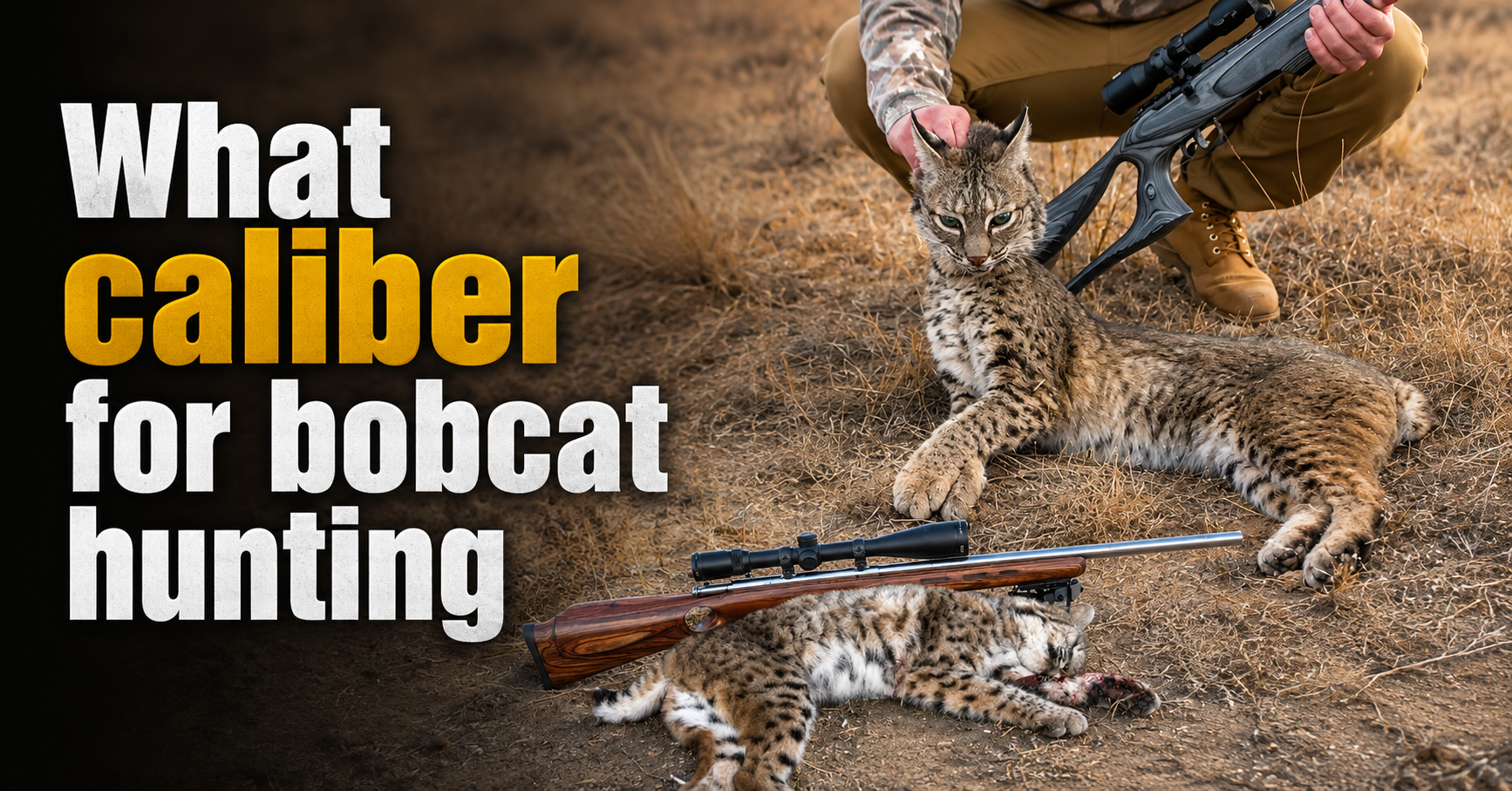

If you are wondering what caliber for bobcat hunting makes the most sense, the answer depends on local law, expected distance, terrain, ammunition construction, your demonstrated accuracy, and whether preserving the pelt matters. Bobcats are relatively small, secretive predators with a limited vital area, so precise shooting and positive identification are more important than selecting the most powerful cartridge available.
For many lawful rifle-hunting situations, the .223 Remington is the most practical general-purpose choice. The .204 Ruger, .22 Hornet, and selected .17-caliber centerfires can also be suitable. Rimfire cartridges require more restrictive distances and careful legal verification, while a properly patterned shotgun may be preferable in dense cover.
Quick Answer: What Caliber for Bobcat Hunting?
The .223 Remington is usually the most versatile starting point for bobcat hunting where centerfire rifles are legal. It offers manageable recoil, broad rifle compatibility, and numerous hunting-specific ammunition choices. The .204 Ruger is a low-recoil alternative for open terrain, while the .22 Hornet fits more moderate distances and hunters who want less cartridge than a full-size centerfire varmint round.
The .17 HMR and .22 WMR may be legal in some jurisdictions, but they are not universal recommendations. They require close, controlled opportunities, suitable hunting ammunition, favorable angles, and proven accuracy. In brush where shots appear quickly and at short distance, a 12- or 20-gauge shotgun with a legal, carefully patterned predator load may be the more responsible tool.
No caliber compensates for poor identification, a questionable angle, an unsafe background, or a shot beyond the hunter’s demonstrated ability. Verify bobcat seasons, firearm rules, ammunition restrictions, tagging requirements, and legal shooting hours with the wildlife agency responsible for the exact hunting area.
Bobcat Cartridge and Firearm Comparison
| Option | Typical Application | Advantages | Important Limitations | Legal Check |
|---|---|---|---|---|
| .223 Remington | General-purpose rifle hunting | Manageable recoil, common rifles, broad hunting-load selection | Projectile choice and impact conditions can affect pelt damage | Confirm centerfire-rifle legality and ammunition restrictions |
| .204 Ruger | Open ground and low-recoil shooting | Light recoil and a relatively flat trajectory | More specialized ammunition and potentially significant bullet sensitivity | Confirm centerfire and lead-free requirements |
| .22 Hornet | Moderate-distance hunting | Mild recoil and less cartridge than larger centerfires | More limited ammunition availability and less reach than faster centerfires | Confirm that centerfire rifles are permitted |
| .17 Remington or similar centerfire | Experienced predator hunters | Low recoil and specialized predator-hunting use | Small bore requires disciplined maintenance and careful ammunition selection | Verify minimum-caliber and centerfire rules |
| .22 WMR | Close, controlled opportunities | Low recoil and moderate report | More limited margin for distance, angle, and placement | Rimfire use may be restricted or season-dependent |
| .17 HMR | Very limited close-range use by proficient hunters | Low recoil and precise target shooting capability | Not a forgiving option for marginal angles or uncertain distance | Confirm rimfire and minimum-caliber legality |
| .22-250 Remington | Open country and mixed coyote-bobcat hunting | Useful trajectory characteristics in open terrain | Often more cartridge than necessary and can increase pelt damage | Confirm centerfire and ammunition rules |
| .243 Winchester | Hunters using one rifle for larger game and predators | Versatile rifle chambering | Generally more power, recoil, and pelt-damage potential than needed | Check firearm, ammunition, and season-overlap restrictions |
| 12- or 20-gauge shotgun | Dense woods and close calling stands | More forgiving on a close moving target when properly patterned | Limited range and substantial dependence on choke-load performance | Verify legal shot material, size, capacity, and season rules |
Important Legal and Safety Notice
Regulatory information was reviewed on August 4, 2026. Bobcat classifications and hunting rules vary dramatically by jurisdiction. A bobcat may be treated as a furbearer, nongame animal, protected species, or specially regulated predator depending on location.
For example, the California Department of Fish and Wildlife states that bobcat hunting has been prohibited in California since 2020. In contrast, other states maintain regulated seasons or different rules for private and public land. Missouri’s official bobcat regulations demonstrate that permissible firearms can also change during overlapping deer or elk season portions.
Before selecting a caliber, verify:
- Whether bobcat hunting is currently legal.
- Season opening and closing dates.
- Required licenses, permits, tags, seals, or harvest reports.
- Legal firearm types and minimum or maximum caliber restrictions.
- Rimfire, centerfire, shotgun, handgun, muzzleloader, and airgun rules.
- Magazine-capacity restrictions.
- Legal ammunition and shot materials.
- Night-hunting and artificial-light rules.
- Electronic-call and thermal-optic restrictions.
- Public-land or wildlife-management-area rules that are stricter than statewide regulations.
- Pelt tagging, registration, transportation, and possession requirements.
Official regulations override general online guidance. Check the current regulation booklet again immediately before hunting because emergency orders and land-specific restrictions can change during a season.
Why the .223 Remington Is the Most Practical General Choice
The .223 Remington offers a useful balance for hunters who want one practical bobcat rifle rather than a highly specialized setup. Recoil is generally manageable, rifles and hunting loads are widely represented, and many hunters already use the chambering for predator or varmint hunting.
Its versatility is also its main complication. Ammunition sold in .223 Remington varies substantially in construction and intended purpose. A load made for target shooting, defensive use, larger game, or rapid varmint expansion may behave differently on a bobcat. Select factory ammunition specifically identified by its manufacturer as appropriate for lawful predator or varmint hunting, then confirm that it functions safely and groups consistently in the individual rifle.
The .223 Remington is not automatically pelt friendly. Exit size and hide damage can change with projectile construction, impact velocity, angle, bone contact, distance, and individual animal size. Hunters interested in retaining fur should discuss local pelt preparation standards with an experienced taxidermist or fur handler rather than relying on a cartridge label alone.
When the .204 Ruger Makes Sense
The .204 Ruger is a specialist predator cartridge valued for low recoil and useful trajectory characteristics. Reduced recoil can make it easier for a practiced shooter to maintain a stable sight picture, but that does not make the cartridge automatically more accurate or humane. Accuracy still depends on the rifle, optic, ammunition, support, conditions, and shooter.
This option is most attractive in open terrain where a hunter may need to account for distance and wind while still prioritizing modest recoil. It is less compelling for someone who cannot obtain hunting ammunition consistently or who has not tested how the selected bullet performs and groups in the rifle.
Light, rapidly expanding projectiles can react dramatically to vegetation and bone. Never attempt to shoot through grass, limbs, or brush. Wait until the animal and the entire safe path to it are unobstructed.
Is the .22 Hornet Good for Bobcat Hunting?
The .22 Hornet can be a sensible moderate-distance choice where legal. It produces relatively mild recoil and occupies a practical space between common rimfires and faster .22-caliber centerfires.
Its limitations should shape the hunt. The .22 Hornet provides less margin for distance and wind than faster centerfire options, and factory ammunition may be less available locally. Hunters should establish a conservative personal distance through practice rather than using an advertised velocity or another shooter’s experience as permission to attempt a longer shot.
What About .17-Caliber Centerfire Cartridges?
Centerfire .17-caliber cartridges have a long history in specialized predator hunting. Their low recoil and small projectiles can appeal to hunters concerned about hide damage, but results are highly dependent on projectile design and impact conditions.
These cartridges are better suited to experienced shooters who understand their rifle, maintain the bore according to manufacturer instructions, and have reliable access to suitable hunting ammunition. They should not be selected simply because the bullet diameter is small. A small projectile still requires precise placement and an appropriate shot presentation.
Are .17 HMR and .22 WMR Enough for Bobcats?
Both cartridges are discussed frequently for bobcats, but neither should be treated as a universal answer.
.22 WMR
The .22 WMR may be suitable at conservative distances where rimfire hunting is legal and the hunter can place an appropriate hunting projectile accurately from a stable position. Its limited margin compared with centerfire cartridges makes poor angles, wind, distance-estimation errors, and marginal placement more consequential.
.17 HMR
The .17 HMR offers low recoil and can be very accurate in a compatible rifle, but its light projectile provides little room for error on a bobcat. It is not the preferred starting point for a beginner who has access to a legal, manageable centerfire rifle. If used where lawful, the hunter should restrict opportunities to close, unobstructed, high-percentage presentations within a distance repeatedly demonstrated during practice.
.22 LR
The .22 LR is generally a poor default recommendation for intentional bobcat hunting. Even where technically legal, its limited margin increases the risk of an unrecovered animal when distance, angle, wind, or placement is imperfect. Legal does not necessarily mean suitable for every hunting situation.
When a .22-250 or .243 May Be More Than You Need
The .22-250 Remington can be useful for hunters who regularly pursue coyotes and bobcats in open country. It provides more capability at distance than many bobcat-only situations require, but greater velocity can complicate efforts to preserve the hide.
The .243 Winchester is commonly owned as a deer and predator rifle. It can be used for bobcats where legal, but it is generally more cartridge than necessary for a small predator. Increased recoil and pelt-damage potential provide little benefit when a milder legal option is available and the expected distance is moderate.
A hunter who already shoots a .243 accurately should not assume that purchasing a smaller caliber will immediately produce better results. Familiarity and verified accuracy matter, but the selected ammunition must still be lawful, compatible with the rifle, and suitable for the intended species.
Shotgun Options for Dense Bobcat Cover
A shotgun can be preferable when calling bobcats in thick timber, brush, or broken terrain where opportunities are close and brief. Either a 12 gauge or a properly fitted 20 gauge may work, provided the chosen load and shot material are legal.
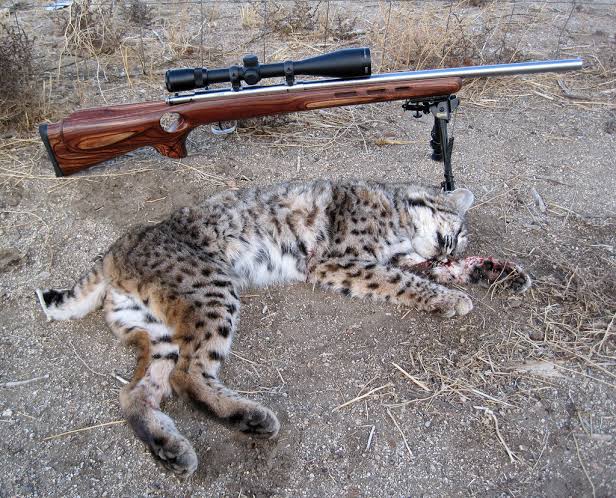
Gauge alone does not determine field performance. Choke, shell, shot size, shot material, barrel, and distance interact to produce the pattern. Pattern the exact combination on paper at realistic distances and use a target that represents a bobcat’s limited vital area. The goal is an even, adequately dense pattern without relying on isolated pellets at the edge.
Do not assume that a popular predator load is legal everywhere. Some jurisdictions restrict shot size, require nontoxic shot, limit shell capacity, or impose special rules during overlapping turkey, deer, or waterfowl seasons.
Caliber Selection by Hunting Situation
| Hunting Situation | Practical Starting Option | Why | Main Caution |
|---|---|---|---|
| Mixed woodland and field edges | .223 Remington | Balanced availability, recoil, and versatility | Choose appropriate hunting ammunition and a safe backstop |
| Open terrain with wind exposure | .204 Ruger or .223 Remington | Low recoil and practical centerfire performance | Do not exceed demonstrated distance or ignore wind |
| Moderate-distance calling | .22 Hornet | Mild recoil with more capability than common rimfires | Confirm ammunition availability and legal status |
| Dense brush and close opportunities | Patterned 12- or 20-gauge shotgun | Useful for close, quickly appearing animals | Pattern density and legal shot rules are critical |
| Short-range rimfire-only opportunity | .22 WMR, if legal and proven | Low recoil and moderate report | Restricted range and limited margin for error |
| One rifle for deer and predators | Existing legal deer rifle with suitable ammunition | A familiar rifle may be preferable to unfamiliar equipment | Greater recoil and pelt damage may result |
Bullet Construction Matters as Much as Caliber
Caliber describes bullet diameter, not complete terminal behavior. Two loads in the same chambering can perform differently because their projectiles were designed for different purposes.
For bobcat hunting, evaluate:
- Manufacturer-stated use: Choose ammunition identified for lawful hunting of appropriately sized predators or varmints.
- Rifle compatibility: Use only the exact cartridge marked for the firearm and permitted by its manual.
- Accuracy: Confirm consistent grouping from the actual rifle under realistic field positions.
- Expansion characteristics: Rapid expansion may reduce penetration in some conditions but can also damage a pelt.
- Impact angle: Quartering angles and major bone contact change projectile behavior.
- Environmental rules: Some lands require nonlead ammunition or nontoxic shotgun pellets.
- Reliability: Verify feeding, extraction, point of impact, and function without altering the firearm.
Avoid using full-metal-jacket ammunition for hunting merely to reduce pelt damage. It may be illegal, can produce unpredictable wound performance, and may increase ricochet or pass-through concerns. Follow the wildlife agency’s rules and the ammunition manufacturer’s intended-use guidance.
How Far Should You Shoot at a Bobcat?
There is no universal ethical distance. A responsible limit is the shortest of:
- The distance allowed by local law and land rules.
- The range at which the hunter can positively distinguish a bobcat from protected or nontarget animals.
- The range at which the chosen firearm and load produce verified, repeatable accuracy.
- The distance at which wind, vegetation, light, angle, and the backstop remain acceptable.
- The distance at which the hunter can make a humane decision without guessing.
Bobcats often appear briefly and blend closely with brush. If the body position, species, foreground, or background is uncertain, do not shoot. Waiting or allowing the animal to leave is a responsible outcome.
Positive Identification: Bobcat Versus Lynx and Domestic Cat
Positive identification is essential because bobcats can be confused with Canada lynx, domestic cats, and other wildlife in poor light or partial cover. The Smithsonian’s National Zoo bobcat profile describes characteristic facial ruffs, ear tufts, spotted or striped coloring, and a short tail. Regional appearance varies, and a partial view may conceal key features.
In areas where bobcats and Canada lynx overlap, consult the local wildlife agency’s identification materials before hunting. Do not fire at eyeshine, sound, movement, or a silhouette that cannot be identified completely.
Firearm Safety for Bobcat Hunters
The four primary firearm-safety rules apply on every stand and during every movement between stands:
- Treat every firearm as if it is loaded.
- Keep the muzzle pointed in a safe direction.
- Keep your finger outside the trigger guard until ready to shoot.
- Be certain of the target and what is in front of and beyond it.
The national hunter-education firearm-safety guide emphasizes positive target identification and an adequate backstop. A mechanical safety is only a device and never replaces safe muzzle and trigger discipline.
- Load and unload according to the firearm manufacturer’s instructions.
- Use eye and hearing protection during practice and whenever practical in the field.
- Keep the chamber status known and communicate it clearly with hunting partners.
- Never rest a loaded firearm against a tree, vehicle, fence, or other unstable surface.
- Unload before crossing obstacles or entering a vehicle, following local transport law.
- Never fire toward roads, buildings, livestock, people, vehicles, water, or hard surfaces.
- Use a light only where legal and never use illumination to justify shooting at an unidentified animal.
Ethical Shot Selection and Recovery
Select a clear, unobstructed presentation that exposes the vital area and provides a safe background. Broadside or slightly quartering-away opportunities are generally easier to evaluate than steeply quartering, frontal, running, or partially obscured presentations.
Do not attempt to shoot through brush. Small twigs and grass can obscure the animal, interfere with identification, and deflect or destabilize a projectile.
After a shot:
- Maintain safe muzzle control and observe the animal’s direction of travel.
- Mark the exact shooting position and the animal’s location at the shot.
- Listen and watch without rushing blindly into cover.
- Approach cautiously while complying with local firearm and recovery rules.
- Make every reasonable legal effort to recover the animal.
- Obtain landowner permission before crossing a property boundary.
- Complete required tagging, sealing, registration, or harvest reporting promptly.
Common Caliber-Selection Mistakes
- Choosing only by bullet diameter: Consider projectile construction, rifle fit, recoil, accuracy, terrain, and legal status.
- Selecting the fastest cartridge available: Additional velocity may add noise and pelt damage without improving a close-range hunting situation.
- Using a marginal rimfire too far: Establish conservative limits through practice and choose a centerfire when greater margin is needed and legal.
- Assuming a light bullet cannot damage fur: Impact velocity, expansion, bone contact, and angle all affect the result.
- Using target ammunition for hunting: Select a legal hunting load supported by the ammunition manufacturer for the intended application.
- Failing to pattern a shotgun: Gauge and choke labels cannot show how a particular shell performs in an individual barrel.
- Copying another hunter’s distance: Personal limits must reflect your own verified ability and field conditions.
- Ignoring overlapping-season restrictions: Legal firearms and shooting hours may change during deer, turkey, or other season portions.
- Prioritizing the pelt over humane recovery: Avoiding hide damage is secondary to legal, accurate, and humane shot selection.
Pre-Hunt Caliber and Equipment Checklist
- Confirm bobcat hunting is open and legal in the exact unit or property.
- Carry every required license, permit, tag, and land-access document.
- Verify that the firearm type, caliber, ammunition, shot material, and magazine capacity are legal.
- Read the firearm and ammunition manufacturer instructions.
- Inspect the firearm and optic for damage or loose components.
- Confirm zero with the exact hunting load.
- Practice from sitting, kneeling, supported, and other realistic safe positions.
- Pattern a shotgun with the exact choke and shell combination.
- Set a conservative personal distance before entering the field.
- Review bobcat and protected-species identification.
- Identify safe shooting directions and backstops around each stand.
- Carry navigation, communication, first aid, water, lighting, and weather protection.
- Share the location and return plan with a responsible person.
- Know the tagging, sealing, reporting, and recovery requirements.
FAQs
1. What is the best overall caliber for bobcat hunting?
The .223 Remington is the most practical general answer where legal because it combines manageable recoil, common rifle availability, and numerous hunting-specific loads. It is not automatically best for every terrain or hunter.
2. Is a .223 too powerful for a bobcat?
It is capable of causing substantial pelt damage, but whether it is excessive depends on ammunition construction, impact conditions, angle, and the hunter’s priorities. It remains a common general-purpose predator chambering.
3. Is a .204 Ruger good for bobcats?
Yes, it can be a suitable low-recoil centerfire option in open terrain. Hunters must use appropriate hunting ammunition, verify accuracy, and recognize that light, fast bullets can be sensitive to intervening vegetation and impact conditions.
4. Is a .22 Hornet enough for bobcats?
It can be suitable at moderate distances where legal. Its mild recoil is useful, but hunters should account for ammunition availability, wind, and its more limited reach compared with faster centerfires.
5. Can you hunt bobcats with a .22 Magnum?
The .22 WMR may be legal and suitable for close, controlled opportunities in some jurisdictions. Its limited margin requires precise placement, a favorable presentation, and a conservative distance.
6. Can a .17 HMR be used for bobcat hunting?
It may be legal in some locations, but it is not a forgiving beginner choice. If permitted, use should be limited to close, unobstructed opportunities within a distance the hunter has repeatedly mastered.
7. Is a .22 LR suitable for bobcats?
It is generally not the preferred cartridge for intentional bobcat hunting. Even where legal, its limited margin can increase the chance of wounding and failed recovery.
8. Is a .22-250 too much for a bobcat?
It provides more capability than many bobcat-only situations require. It may suit open-country hunters who also pursue coyotes, but pelt damage can be greater depending on the load and impact.
9. Can you use a .243 for bobcats?
It may be legal and effective, particularly for someone already using a familiar deer rifle. However, it generally produces more recoil and pelt-damage potential than a smaller predator cartridge.
10. Can you hunt bobcats with a shotgun?
Yes, where shotguns are legal. A properly patterned 12 or 20 gauge can be useful in thick cover and at close distances.
11. Is a 12 gauge or 20 gauge better for bobcats?
Either can work. The better choice is the shotgun that fits the hunter, produces a suitable pattern with a legal load, and can be handled accurately and safely.
12. What shot size should be used for bobcats?
Use a predator-hunting shot size allowed by the relevant wildlife agency and land rules. Pattern it with the exact shotgun and choke because legal shot-size limits and field performance vary.
13. What choke is best for bobcat hunting?
There is no universally best choke. Test legal hunting shells through manufacturer-approved chokes and select the combination that produces an even, adequate pattern at realistic distances.
14. Are centerfire rifles always legal for bobcats?
No. Some jurisdictions restrict firearm types generally or during overlapping seasons. Public land may also impose rules that differ from private land.
15. Are rimfire rifles legal for bobcat hunting?
Legality varies by state, season, and property. Some rules permit rimfires, some restrict them, and others change allowable firearms during deer or elk seasons.
16. Is bobcat hunting legal in every state?
No. California currently prohibits recreational bobcat hunting, while other states manage bobcats through seasons, licenses, permits, tagging, or reporting. Check the responsible wildlife agency.
17. Do bobcat hunters need a tag?
Some jurisdictions require tags, pelt seals, registration, harvest reports, or special furbearer permits. Requirements may apply even when no conventional carcass tag is used.
18. Can bobcats be hunted at night?
Only where current law expressly permits it. Night-hunting, artificial-light, thermal-optic, and public-land rules vary widely and may require additional permits.
19. Can thermal optics be used for bobcat hunting?
That depends on local law, season, land designation, and equipment restrictions. Thermal imaging does not remove the requirement for positive species identification and a safe background.
20. Can electronic calls be used for bobcats?
Electronic calls are legal in some jurisdictions and prohibited or restricted in others. Check species-specific rules rather than relying on general predator regulations.
21. Does caliber determine pelt damage?
Not by itself. Bullet construction, velocity, impact angle, bone contact, distance, and animal size all influence entry, expansion, and exit damage.
22. Which caliber causes the least pelt damage?
No cartridge guarantees minimal damage. Mild centerfires and carefully selected hunting bullets may help in some conditions, but humane performance and reliable recovery must take priority.
23. Should full-metal-jacket ammunition be used to protect the pelt?
No. It may be illegal for hunting and can create unreliable terminal performance, excessive pass-through, and ricochet concerns. Use lawful hunting ammunition supported for the application.
24. Are varmint bullets appropriate for bobcats?
Some manufacturer-designated varmint or predator loads may be appropriate, but designs vary widely. Confirm intended use, legal status, accuracy, and compatibility with the firearm.
25. Is nonlead ammunition required for bobcat hunting?
It may be required by state law, federal refuge rules, or property-specific regulations. Verify ammunition-material requirements for the exact hunting area.
26. How much recoil is appropriate for a beginner?
The appropriate level is one that permits safe handling and consistent accuracy without flinching. A qualified instructor can help assess firearm fit and recoil tolerance.
27. Does a heavier rifle reduce felt recoil?
All else being equal, greater firearm weight can moderate movement, but stock fit, shooting position, cartridge, and recoil-pad design also matter. A heavy rifle may be harder to carry.
28. What scope magnification is needed for bobcats?
Use enough magnification for positive identification and precise aiming without sacrificing field of view. Dense cover generally favors lower magnification than open terrain.
29. Should a rifle be zeroed with the hunting load?
Yes. Different loads can produce different points of impact. Confirm zero and grouping with the exact lawful ammunition intended for the hunt.
30. How accurate should a hunter be before hunting bobcats?
The hunter should place every practice shot consistently within a target representing the bobcat’s vital area from realistic positions and within the chosen personal distance.
31. Can a bullet be fired through grass or brush?
No responsible shot should rely on a projectile passing through vegetation. Brush can conceal nontargets, obscure anatomy, and alter a bullet’s path or behavior.
32. What is the safest shot angle on a bobcat?
A clear broadside or slightly quartering-away presentation is generally easier to evaluate than a running, steeply angled, frontal, or partially obscured animal.
33. How can a hunter distinguish a bobcat from a lynx?
Study official regional identification guides. Tail markings, leg proportions, feet, coat pattern, and habitat can help, but do not shoot unless the complete identification is certain.
34. What should a hunter do after shooting a bobcat?
Observe the direction of travel, mark important locations, approach safely, make every reasonable legal recovery effort, and complete required tagging or reporting.
35. Can a hunter cross private property to recover a bobcat?
Do not assume recovery rights permit trespassing. Contact the landowner and follow local wildlife-agency or law-enforcement guidance.
36. Is hunter education required for bobcat hunting?
Requirements depend on age, jurisdiction, and license type. Even when not legally required, hunter education provides essential instruction in firearm safety, wildlife identification, ethics, and regulations.
37. Is the most powerful legal caliber the most ethical choice?
No. Ethical selection balances sufficient capability with accuracy, recoil control, safe background considerations, pelt impact, and the hunter’s proven ability.
38. Where should current bobcat regulations be checked?
Use the official state or provincial wildlife agency, the current hunting regulation booklet, and any applicable federal refuge, forest, public-land, or wildlife-management-area rules.
39. Do regulations change during deer or turkey season?
They can. Some jurisdictions restrict firearm types, shot sizes, shooting hours, or permit requirements when seasons overlap. Check every applicable season section.
40. When should a beginner seek professional instruction?
Seek qualified help when firearm operation, safe loading, zeroing, recoil management, field positions, shotgun patterning, species identification, or local regulations are unclear.
Final Answer
For hunters asking what caliber for bobcat hunting, the .223 Remington is the strongest general-purpose starting point where centerfire rifles are lawful. The .204 Ruger works well for hunters prioritizing low recoil and open-country use, while the .22 Hornet is a practical moderate-distance alternative. The .22 WMR and .17 HMR demand closer opportunities and stricter limitations, and a patterned 12- or 20-gauge shotgun may be better in dense cover.
Choose the option you can handle safely and shoot accurately with lawful hunting ammunition. Confirm the firearm and load in practice, establish a conservative personal distance, positively identify the animal, wait for a clear high-percentage presentation, and know what lies beyond it.
Most importantly, verify the current bobcat season, license, tag, firearm, ammunition, shooting-hour, land-access, and reporting rules with the official wildlife agency. A legal caliber is only one part of a responsible, humane, and conservation-minded hunt.