
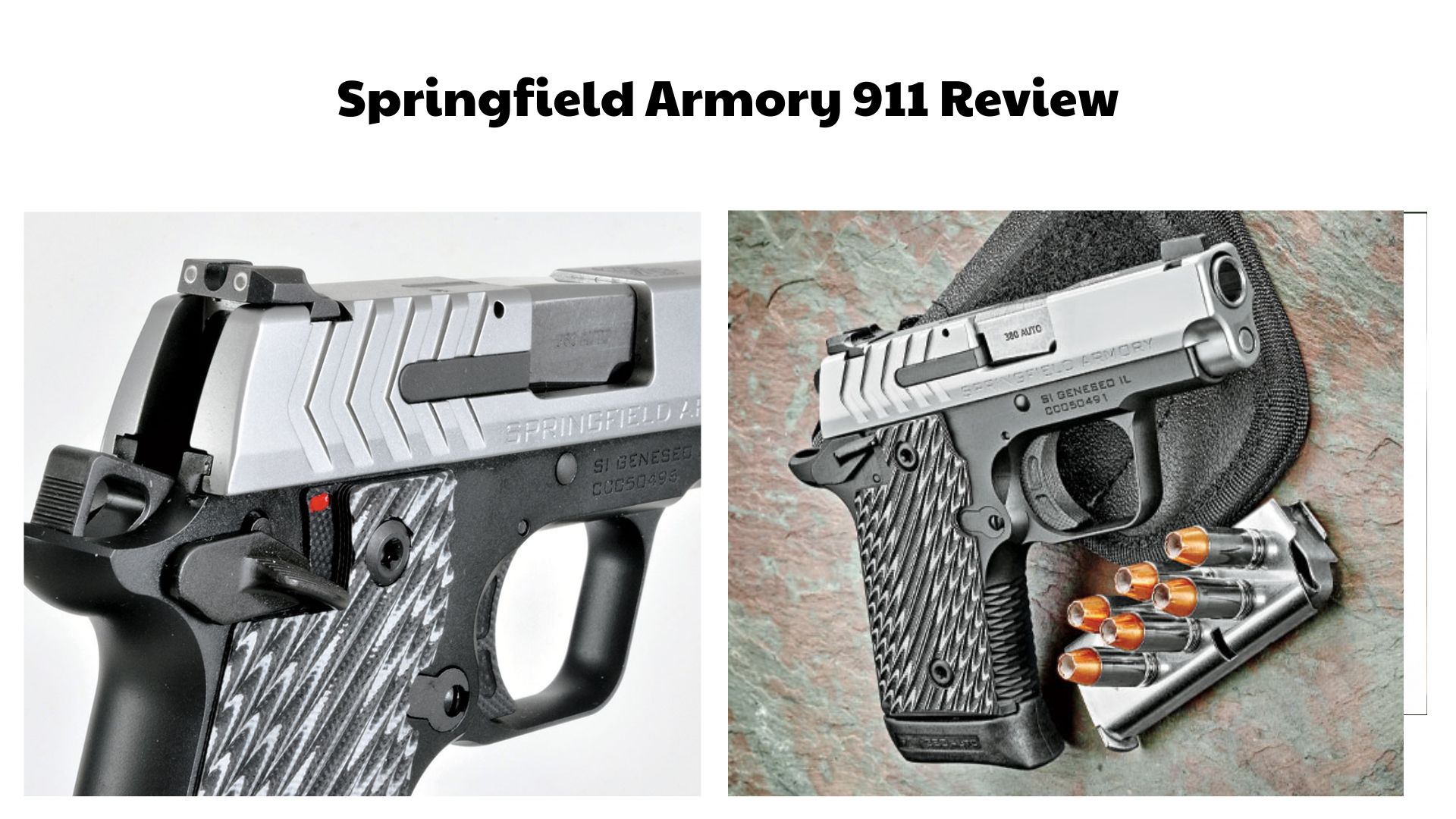

The Springfield Armory 911 is a micro-compact defensive pistol designed specifically for deep concealment and everyday carry. It blends modern defensive requirements with classic 1911-inspired ergonomics in a highly compact platform.
Available in both .380 ACP and 9mm variants, the 911 is built for users who prioritize maximum concealability without completely sacrificing shootability. Its ultra-small footprint makes it especially well-suited for pocket carry, ankle carry, or backup defensive roles.
The design is heavily inspired by the classic 1911 platform, incorporating familiar controls and handling characteristics into a modern pocket-sized handgun. This gives shooters a traditional feel in a much smaller, easier-to-carry package.
Introduced in the late 2010s, the Springfield 911 was developed to compete in the growing micro-compact concealed carry market. It sits alongside popular defensive pistols such as the Glock 43, Sig P238/P938, Ruger LCP series, and Smith & Wesson Shield.
The model is known for its premium fit and finish, crisp single-action trigger, and 1911-style ergonomics, making it a standout option among high-end pocket pistols.
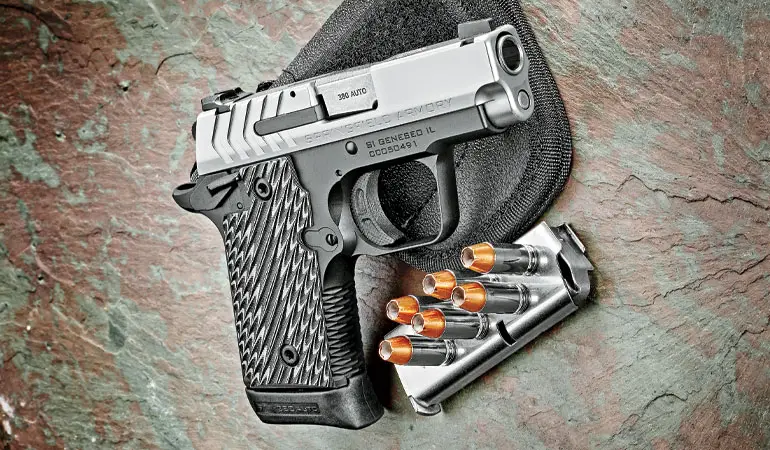
Key Specifications
- Caliber: .380 ACP / 9mm options
- Action: Single-action, hammer-fired
- Barrel Length: ~2.7″ (.380 ACP) / ~3.0″ (9mm)
- Overall Length: Approximately 5.5″–5.9″
- Width: ~0.9″–1.1″ ultra-slim profile
- Weight: ~12.6–15.3 oz unloaded
- Capacity: 6+1 flush magazine / 7+1 extended magazine
- Frame: 7075-T6 aluminum alloy frame
- Slide: Stainless steel with corrosion-resistant finish
- Sights: Tritium night sights or fiber optic options
- Safety: Ambidextrous thumb safety (1911-style)
These specifications highlight the Springfield 911’s role as a highly compact, premium defensive pistol designed for users who need maximum concealment while still retaining a refined shooting experience and quality construction.
Design & Build Quality
1911-Inspired Micro Platform
The Springfield Armory 911 is essentially a compact reinterpretation of the classic 1911 platform, scaled down into a micro-compact defensive handgun. It retains the familiar ergonomics and control layout that 1911 shooters appreciate, while adapting them for deep concealment use.
Despite its small size, the pistol maintains a premium fit-and-finish that is often associated with higher-end firearms. Attention to detail in machining, slide fit, and control placement contributes to its refined feel.
The design also emphasizes smooth, snag-free edges, making it easier to draw from pocket holsters or concealed carry positions without catching on clothing.
Slim Concealed Carry Design
The 911 features an ultra-compact footprint that makes it suitable for both pocket carry and inside-the-waistband (IWB) carry. Its small dimensions allow it to disappear under light clothing, making it ideal for deep concealment scenarios.
The thin profile is one of its strongest advantages, significantly improving concealability in everyday carry situations. This makes it especially appealing for users who prioritize discretion.
A lightweight aluminum frame further enhances carry comfort, reducing fatigue during extended daily use compared to heavier steel-framed pistols.
Ergonomics and Grip
The grip is equipped with either G10 or rubber grip panels, depending on configuration. These materials improve traction and control despite the pistol’s small size.
The short grip is intentionally designed for maximum concealment, though it may feel limited for users with larger hands. Extended magazines help improve grip length and overall handling.
The pistol also benefits from a 1911-inspired grip angle, which promotes a natural point-of-aim and intuitive shooting posture for experienced shooters.
Materials and Durability
The Springfield 911 uses a 7075-T6 aluminum alloy frame, providing a strong yet lightweight foundation that supports daily carry without excessive bulk.
Its stainless steel slide adds durability and corrosion resistance, making it suitable for long-term concealed carry in various environments.
Overall, the 911 is engineered for long-term defensive reliability, combining lightweight construction with durable materials to ensure consistent performance over time.
Magazine Capacity & Flexibility
The Springfield Armory 911 is designed with a strong emphasis on deep concealment, and its magazine system reflects that priority. Capacity is intentionally limited to keep the pistol as compact and discreet as possible.
- Standard 6-round flush magazine: Optimized for maximum concealment, making it ideal for pocket carry and minimal printing.
- 7-round extended magazine: Provides additional capacity and a slightly improved grip surface for better control.
- Trade-off design: The platform prioritizes size reduction over firepower, making it more suitable for close-range defensive use.
- Purpose-built role: Best suited for deep concealment rather than high-volume shooting scenarios.
Trigger Performance
Single-Action 1911-Style Trigger
One of the defining features of the Springfield 911 is its single-action, 1911-style trigger system. It delivers a short, crisp trigger pull with a relatively light and predictable break.
The trigger uses a G10 pivoting trigger shoe, which enhances tactile feedback and improves overall control during firing. Factory pull weight typically ranges around 6–7 lbs, depending on break-in and specific model variation.
Shooting Feel
The trigger reset is clean and tactile, allowing for controlled follow-up shots when properly trained. This is one of the most praised aspects of the platform, especially compared to other micro-compact pistols.
However, like many tightly fitted compact firearms, the 911 may require a break-in period before the trigger achieves its smoothest and most refined performance.
Shooting Performance & Accuracy
Recoil Management
Due to its lightweight frame, the Springfield 911 produces noticeably snappier recoil, particularly in the 9mm variant. The .380 ACP version is generally more manageable and comfortable for extended shooting sessions.
Effective recoil control depends heavily on proper grip technique and training, especially given the pistol’s compact size.
Accuracy
The 911 is designed for defensive engagement distances, performing best within 5 to 15 yards. Within this range, it is capable of consistent and reliable shot placement.
Its short barrel naturally limits long-range precision, but high-quality sights help improve fast target acquisition and practical defensive accuracy.
Reliability
Overall reliability is strong when using quality ammunition. While early production models received mixed feedback, later manufacturing improvements significantly enhanced consistency.
The platform performs best when properly maintained and broken in, ensuring smooth cycling and dependable operation in defensive scenarios.
Controls & Features
- Ambidextrous thumb safety: The Springfield 911 uses a 1911-style safety system, allowing both right- and left-handed users to engage or disengage the safety comfortably.
- Loaded chamber indicator: Some models include a visible or tactile indicator to confirm whether a round is chambered, improving situational awareness.
- Low-profile design: All external controls are designed to be snag-free, making the pistol ideal for pocket and deep concealment carry.
- No accessory rail: The compact frame does not include a rail for lights or lasers, prioritizing size reduction over modular accessories.
- Simple field stripping: The pistol is designed for easy disassembly, allowing straightforward cleaning and maintenance.
Pros and Cons
Pros
- Extremely compact and highly suitable for deep concealment carry
- Premium 1911-style trigger provides a refined shooting experience
- Lightweight construction makes it comfortable for all-day pocket carry
- High-quality build for a micro-compact defensive pistol
- Good practical accuracy within typical self-defense distances
Cons
- Lower magazine capacity compared to modern micro-9mm pistols
- Noticeably snappy recoil, especially in the 9mm version
- Higher price point compared to budget pocket pistols
- Limited accessory compatibility due to lack of rail system
- Some variability in reliability depending on ammunition type and break-in
Comparison with Competitors
Springfield 911 vs Sig P938
Both the Springfield 911 and Sig P938 are compact, 1911-inspired micro pistols designed for concealed carry. They share similar dimensions, single-action triggers, and overall handling characteristics.
The Sig P938 generally benefits from stronger aftermarket support, giving users more customization options such as grips, holsters, and upgrades. However, the Springfield 911 offers different grip textures and finish options that appeal to users seeking a slightly more refined or modern aesthetic.
Springfield 911 vs Glock 43
The Glock 43 is known for its simplicity, consistency, and widespread reliability reputation. It is easier to maintain and has a more modern striker-fired system.
In contrast, the Springfield 911 provides a superior trigger feel and classic 1911 ergonomics, which many shooters prefer for precision shooting. However, the Glock 43 is generally considered more practical for modern defensive use due to its simplicity and larger ecosystem.
Springfield 911 vs Ruger LCP II
The Ruger LCP II is lighter, smaller, and more affordable, making it a strong entry-level pocket carry option.
However, the Springfield 911 offers a significantly better trigger system, improved shooting control, and more refined ergonomics. While the LCP II excels in budget-friendly concealment, the 911 provides a more premium shooting experience at a higher cost.
Best Use Cases
The Springfield Armory 911 is designed for very specific concealed carry roles where size, discretion, and ease of concealment matter more than capacity or modularity.
- Deep concealment everyday carry (EDC): Ideal for users who need a firearm that can disappear under light clothing or be carried discreetly throughout the day.
- Pocket carry backup handgun: Its compact size allows it to function effectively as a secondary or emergency defensive firearm.
- Lightweight summer carry: Excellent choice for hot climates where larger pistols become uncomfortable or harder to conceal.
- Law enforcement/security backup: Suitable as a compact secondary weapon for professionals who already carry a primary duty firearm.
- Minimalist concealed carry setups: Designed for users who prefer simple, lightweight, and low-profile defensive options.
Aftermarket Support & Accessories
While not as extensive as mainstream striker-fired pistols, the Springfield 911 still has a functional and growing ecosystem of accessories tailored to concealed carry users.
- Holsters: Available in pocket, IWB (inside-the-waistband), and appendix carry configurations from multiple manufacturers.
- Aftermarket ecosystem: Smaller than Glock or SIG platforms, but gradually expanding over time.
- Extended magazines: Improve grip length and handling while slightly increasing capacity.
- Night sights: Tritium and upgraded sight systems are available for improved low-light performance.
- Accessory options: Limited laser grips and compact add-ons exist, though customization remains relatively minimal.
Who Should Buy the Springfield 911?
The Springfield 911 is best suited for a specific type of concealed carrier who values discretion and traditional handgun design over modern high-capacity features.
- Shooters who want a 1911-style pocket pistol in a micro-compact format
- Users who prioritize deep concealment over magazine capacity
- Fans of single-action trigger systems and classic firearm ergonomics
- Individuals looking for a backup gun or lightweight EDC option
- Shooters who are comfortable using manual thumb safeties as part of their carry routine
Who Should Avoid It?
While the Springfield Armory 911 is a well-built and highly specialized concealed carry pistol, it is not the ideal choice for every shooter. Its design priorities naturally create limitations in certain use cases.
- Users wanting high-capacity micro-9mm pistols: The 911’s limited magazine capacity makes it less suitable for those who prioritize maximum firepower in a compact platform.
- Beginners sensitive to recoil: Especially in the 9mm variant, the lightweight frame produces snappier recoil that may be challenging for new shooters.
- Shooters preferring striker-fired simplicity: Those who want a no-safety, no-hammer system may find the 911’s single-action and manual safety less convenient.
- Users needing modern features: The lack of an optics-ready slide or accessory rail limits its adaptability compared to newer concealed carry pistols.
Final Verdict
The Springfield Armory 911 is a premium micro-compact pistol that blends modern concealed carry requirements with classic 1911-inspired design. It stands out for its excellent concealability, refined trigger system, and high-quality construction for its size category.
However, its strengths come with trade-offs. The limited magazine capacity and lack of modern modular features place it behind newer micro-compact platforms in terms of versatility and scalability.
Overall, the 911 performs best in specialized concealed carry roles where discretion and compact size are more important than capacity or modularity.
Final recommendation: The Springfield 911 is a refined but specialized pocket carry handgun best suited for users who value deep concealment, premium feel, and 1911-style shooting characteristics over modern high-capacity features.
Frequently Asked Questions (FAQ) – Springfield Armory 911
1. What is the Springfield Armory 911 designed for?
The Springfield 911 is designed primarily for deep concealment and everyday carry. It is a micro-compact defensive pistol that prioritizes small size, lightweight construction, and ease of concealment over high capacity or tactical modularity. It is best suited for close-range personal defense situations where discretion is important.
2. Is the Springfield 911 good for concealed carry?
Yes, the 911 is specifically built for concealed carry. Its ultra-slim profile and short overall length make it easy to carry in pockets, inside-the-waistband holsters, or appendix positions. It is especially popular among users who want a firearm that remains nearly invisible under light clothing.
3. What calibers does the Springfield 911 come in?
The Springfield 911 is available in both .380 ACP and 9mm. The .380 ACP version is softer shooting and easier to control, while the 9mm version provides more stopping power at the cost of increased recoil.
4. Is the 9mm version harder to shoot?
Yes, the 9mm version produces noticeably more recoil due to the pistol’s lightweight frame. While still controllable with proper technique, it is snappier than the .380 ACP variant and may require more practice for new shooters.
5. How many rounds does the Springfield 911 hold?
Standard capacity is 6+1 rounds with a flush magazine, and 7+1 rounds with an extended magazine. This limited capacity is a trade-off for its extremely compact and concealable design.
6. Is 6+1 capacity enough for self-defense?
Many defensive scenarios are resolved with very few rounds, so 6+1 can be sufficient for close-range personal defense. However, users should be aware that it is significantly lower than modern micro-compact pistols that often hold 10–15+ rounds.
7. Is the Springfield 911 reliable?
Overall reliability is good when using quality ammunition. Early production models had mixed feedback, but later improvements helped stabilize performance. Like many compact pistols, it performs best after a proper break-in period.
8. Does the 911 require a break-in period?
Yes, many users report smoother operation after the first few hundred rounds. This break-in helps polish internal contact surfaces and improves trigger and cycling consistency.
9. What type of trigger does the 911 have?
It uses a single-action, 1911-style trigger system. This provides a short, crisp pull with a clean break, which is one of the most appreciated features of the firearm.
10. Is the trigger good for accuracy?
Yes, the trigger helps improve accuracy because of its short travel and clean break. It allows for better shot control compared to many double-action or heavier striker-fired triggers in similar-sized pistols.
11. Does the Springfield 911 have a safety?
Yes, it features an ambidextrous manual thumb safety similar to a traditional 1911. This allows the user to safely carry the firearm cocked and locked.
12. Is the safety difficult to use?
No, most users familiar with 1911-style pistols find it intuitive. However, new shooters may need training to build the habit of engaging and disengaging the safety during draw and firing.
13. Can the 911 be carried without using the safety?
No, the design is intended for use with the manual safety engaged. Unlike striker-fired pistols, it is not designed for safety-less carry modes.
14. Is the Springfield 911 good for beginners?
It can be used by beginners, but it is not ideal. The manual safety, snappy recoil (in 9mm), and smaller grip require more training compared to modern striker-fired pistols.
15. How does recoil feel on the 911?
Recoil is noticeable due to its lightweight frame. The .380 ACP version is more manageable, while the 9mm version feels sharper and requires a firm grip and proper shooting technique.
16. Is the 911 accurate?
Yes, within its intended range of 5–15 yards, the 911 is accurate and consistent. Its short barrel limits long-range precision, but it performs well for defensive scenarios.
17. What is the effective range of the 911?
The effective defensive range is typically within 15 yards. It is optimized for close-quarters encounters rather than long-distance shooting.
18. Does the Springfield 911 have a rail for accessories?
No, the 911 does not include an accessory rail. This design choice helps maintain its slim, snag-free profile for concealed carry.
19. Can I mount a flashlight or laser on it?
Not directly on the frame. However, some users rely on rail-mounted holsters or alternative carry setups, though options are limited compared to modern pistols with integrated rails.
20. Is the Springfield 911 optics-ready?
No, the 911 does not come with an optics-ready slide. It uses traditional iron sights instead of red dot compatibility.
21. What type of sights does it use?
Depending on the model, it may come with tritium night sights or fiber optic sights, both of which improve visibility in different lighting conditions.
22. Is the 911 easy to conceal?
Yes, it is one of the easiest pistols to conceal due to its slim profile and short barrel. It is especially effective in pocket or minimalist carry setups.
23. Can it be carried in a pocket?
Yes, pocket carry is one of its intended use cases. However, a proper pocket holster is recommended for safety and trigger protection.
24. Is it comfortable for all-day carry?
Yes, its lightweight aluminum frame makes it comfortable for extended daily carry, especially compared to heavier steel-framed pistols.
25. Does the 911 print under clothing?
It has minimal printing due to its slim design, making it suitable for discreet concealed carry under light or fitted clothing.
26. What is the frame made of?
The frame is constructed from 7075-T6 aluminum alloy, which provides a strong yet lightweight structure for daily concealed carry use.
27. Is the slide durable?
Yes, the stainless steel slide is corrosion-resistant and designed for long-term durability under defensive use conditions.
28. Does the Springfield 911 rust easily?
No, it has corrosion-resistant finishes on both the frame and slide, making it suitable for everyday concealed carry in various environments.
29. Is the 911 better than Glock 43?
It depends on priorities. The Glock 43 offers simplicity and reliability, while the 911 provides a better trigger and 1911-style ergonomics but less capacity and modern features.
30. Is the 911 better than Sig P938?
They are very similar. The Sig P938 generally has stronger aftermarket support, while the 911 offers slightly different ergonomics and styling options.
31. Is it better than Ruger LCP II?
The 911 offers a better trigger and shooting experience, while the LCP II is lighter, cheaper, and more minimal for deep concealment.
32. Is the Springfield 911 expensive?
Yes, it is priced in the premium micro-compact category, making it more expensive than budget pocket pistols but comparable to other high-end concealed carry firearms.
33. Is it worth the price?
It is worth it for users who value build quality, trigger performance, and 1911-style shooting in a micro-compact format. However, it may not be ideal for budget-focused buyers.
34. Is the grip comfortable?
The grip is comfortable for its size but may feel small for users with larger hands. Extended magazines can improve grip length and control.
35. Can it be customized?
Customization is limited compared to striker-fired pistols, but grips, sights, and magazines can be upgraded.
36. Does it have good aftermarket support?
Aftermarket support exists but is more limited than Glock or SIG platforms. Holsters and basic upgrades are widely available, but advanced customization is limited.
37. Is it good for summer carry?
Yes, it is ideal for summer carry due to its lightweight design and minimal printing under light clothing.
38. Is it good for winter carry?
It can be used in winter carry setups, but many users prefer larger capacity pistols during colder months due to heavier clothing allowing better concealment.
39. How difficult is it to maintain?
Maintenance is relatively simple. Field stripping is straightforward, and cleaning requirements are similar to most compact pistols.
40. Does it require special ammunition?
No, it works with standard .380 ACP or 9mm ammunition, though high-quality defensive ammo is recommended for reliability.
41. Is it loud when firing?
Yes, especially in 9mm, it produces noticeable muzzle blast due to its short barrel.
42. Is it good for self-defense?
Yes, it is designed specifically for self-defense at close range, particularly in concealed carry situations.
43. What is its biggest weakness?
Its biggest weaknesses are low capacity, limited modern features, and snappy recoil in the 9mm version.
44. What is its biggest strength?
Its biggest strength is extreme concealability combined with a high-quality trigger system.
45. Does it work well for appendix carry?
Yes, its slim profile makes it suitable for appendix carry with proper holster selection.
46. Is it outdated?
It is not outdated, but it is more specialized. It lacks modern features like optics mounting and high capacity found in newer micro-compacts.
47. Can it be used for competition shooting?
It is not designed for competition, but it can be used recreationally in short-range shooting or concealed carry practice drills.
48. Is it good for law enforcement use?
It is more commonly used as a backup firearm rather than a primary duty weapon due to its size and capacity limitations.
49. How long does it last?
With proper care, the Springfield 911 can last many years of defensive use thanks to its durable materials and solid construction.
50. What is the final takeaway?
The Springfield 911 is a premium micro-compact pistol designed for deep concealment, offering excellent trigger quality and build craftsmanship, but with trade-offs in capacity and modern tactical features.