
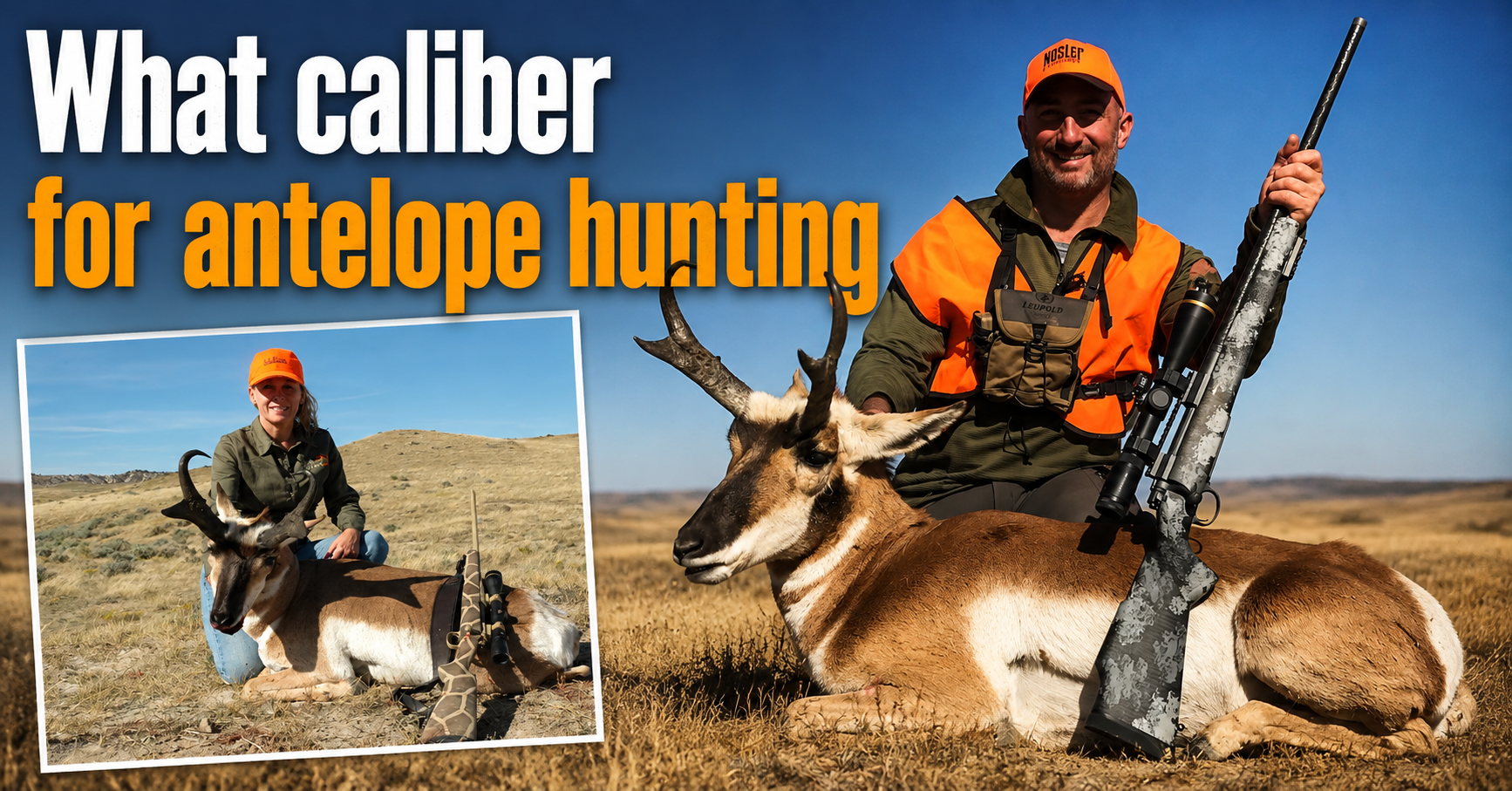

For North American hunters, “antelope” usually means pronghorn. Pronghorn live primarily in open grassland, sagebrush, and high-desert country where wind and limited cover can make accurate shooting more challenging. However, their relatively light body construction means hunters do not need a heavy magnum rifle to harvest one responsibly.
The best caliber is a legal centerfire cartridge that fires an expanding hunting bullet, handles typical open-country conditions, and produces recoil the hunter can manage during frequent practice. Rifle fit, bullet construction, wind judgment, and field accuracy matter more than owning the fastest cartridge.
Quick Answer
The .243 Winchester, 6mm Creedmoor, .25-06 Remington, 6.5 Creedmoor, and .270 Winchester are excellent starting choices for pronghorn hunting. The .243 Winchester works especially well for recoil-sensitive hunters, while the 6.5 Creedmoor provides mild recoil and useful wind performance. The .25-06 and .270 Winchester offer flatter trajectories with somewhat more recoil.
The 7mm-08 Remington and .308 Winchester are also effective, particularly for hunters who want one rifle for pronghorn, deer, and larger game. A .22-caliber centerfire may be legal in some states, but other states require at least .24 caliber, making a .243 or larger cartridge the more legally versatile choice.
Use an expanding hunting bullet approved for pronghorn-sized game, confirm its point of impact at realistic distances, and establish an ethical range based on field-position accuracy rather than advertised ballistics.
Important Safety and Legal Notice
Regulations were reviewed on August 3, 2026. Minimum caliber, cartridge length, bullet construction, muzzleloader requirements, hunter-orange rules, and legal weapon seasons vary by jurisdiction.
For example, current Wyoming firearm regulations specify minimum firearm and cartridge requirements that can make some small centerfire cartridges illegal. In contrast, the North Dakota 2026 pronghorn regulations allow centerfire rifles of .22 caliber or larger.
Nevada permits centerfire rifles beginning at .22 caliber while also establishing maximum caliber and case-length restrictions. Oregon lists .22 caliber as its minimum centerfire caliber for pronghorn. These examples demonstrate why a hunter cannot rely on one nationwide caliber rule.
Check the current regulation booklet, physical license, wildlife unit, season type, public-land rules, and any emergency orders before hunting. Official requirements override general online guidance.
Antelope Hunting Caliber Comparison
| Cartridge | Typical Hunting Bullet Range | Recoil Level | Primary Strength | Main Limitation |
|---|---|---|---|---|
| .243 Winchester | Approximately 85–105 grains | Low | Easy to practice with and widely available | Requires an appropriate big-game bullet and careful wind judgment |
| 6mm Creedmoor | Approximately 90–108 grains | Low | Streamlined bullets and useful open-country ballistics | Hunting ammunition may be less available than .243 Winchester |
| .257 Roberts | Approximately 100–120 grains | Low to moderate | Balanced recoil and pronghorn-appropriate performance | Limited rifle and ammunition availability |
| .25-06 Remington | Approximately 100–120 grains | Moderate | Flat trajectory and strong open-country utility | Often performs best in a longer barrel |
| 6.5 Creedmoor | Approximately 120–143 grains | Moderate | Good balance of recoil, accuracy, and wind performance | Not as flat initially as some faster cartridges |
| .260 Remington | Approximately 120–140 grains | Moderate | Efficient 6.5mm hunting performance | Less factory ammunition selection than 6.5 Creedmoor |
| .270 Winchester | Approximately 120–150 grains | Moderate | Flat trajectory and broad big-game versatility | More recoil than the smaller 6mm options |
| 7mm-08 Remington | Approximately 120–150 grains | Moderate | Useful for pronghorn, deer, and larger game | Trajectory depends considerably on bullet and load |
| .308 Winchester | Approximately 125–165 grains | Moderate to substantial | Excellent availability and versatile hunting use | More recoil and drop than many dedicated pronghorn options |
What Caliber for Antelope Hunting Should You Choose?
1. .243 Winchester: Practical Low-Recoil Choice
The .243 Winchester is one of the most practical pronghorn cartridges for beginners, smaller-framed hunters, and anyone who benefits from reduced recoil. It can fire controlled-expansion bullets designed for deer-sized game while remaining comfortable enough for frequent practice.
Bullet selection is important. Lightweight varmint bullets may expand too rapidly and are not automatically suitable for pronghorn. Select a load the manufacturer identifies for medium game. Hornady, for example, describes its 100-grain .243 Winchester InterLock ammunition as using a controlled-expansion hunting bullet.
The .243 Winchester’s primary advantages are manageable recoil, common ammunition, and adequate performance without excessive meat damage when the bullet is placed correctly.
2. 6mm Creedmoor: Streamlined 6mm Performance
The 6mm Creedmoor can launch streamlined 6mm hunting bullets while maintaining relatively mild recoil. It is well suited to hunters who want a dedicated open-country rifle and are willing to confirm ammunition availability before traveling.
Its ballistic potential should not be interpreted as permission to take distant shots without practice. The hunter must still verify wind drift and drop from the actual rifle at the elevation and temperature expected during the hunt.
3. .257 Roberts: Mild and Effective
The .257 Roberts has a long history as a mild-recoiling deer and pronghorn cartridge. It can provide an effective balance of bullet weight and velocity without requiring magnum recoil.
Its disadvantage is availability. Rifles and factory hunting loads may be harder to find than comparable .243 Winchester or 6.5 Creedmoor options. Hunters already owning an accurate .257 Roberts have little reason to replace it solely for pronghorn hunting.
4. .25-06 Remington: Classic Open-Country Cartridge
The .25-06 Remington is a traditional pronghorn choice because it combines useful bullet weights with a relatively flat trajectory. It can simplify trajectory management at ordinary field distances, although hunters must still use a rangefinder and verify their zero.
Its higher velocity can increase meat damage if a rapidly expanding bullet strikes heavy shoulder tissue at close range. Choose a controlled-expansion hunting bullet and wait for a high-percentage shot.
5. 6.5 Creedmoor: Best All-Around Balance for Many Hunters
The 6.5 Creedmoor offers manageable recoil, widely available hunting ammunition, and bullets that can retain velocity efficiently in windy country. It is a sensible choice for hunters who want one rifle for pronghorn and deer without moving to a more powerful cartridge.
Do not confuse target ammunition with hunting ammunition. Some 6.5 Creedmoor loads use match bullets intended primarily for paper or steel. Select a load specifically identified for hunting and verify the manufacturer’s recommended impact-velocity range.
6. .260 Remington: Capable Alternative to 6.5 Creedmoor
The .260 Remington provides similar practical hunting performance to other moderate-capacity 6.5mm cartridges. It is effective for pronghorn when paired with a suitable hunting bullet and an accurate rifle.
Its main drawback is factory ammunition availability. Hunters should obtain enough of the exact load used for sight-in, practice, and hunting before traveling.
7. .270 Winchester: Flat-Shooting and Versatile
The .270 Winchester is a proven open-country hunting cartridge. It offers a flat trajectory and enough versatility for hunters who may also pursue mule deer, elk, or other larger game with appropriate ammunition.
It creates more recoil than the .243 Winchester and similar 6mm cartridges. A hunter who shoots a lighter cartridge more accurately should not move to the .270 solely for additional velocity.
8. 7mm-08 Remington: Balanced Multi-Species Option
The 7mm-08 Remington combines moderate recoil with hunting bullets suitable for pronghorn, deer, and larger animals. It is a useful choice for hunters who want a short-action rifle with more bullet weight than the typical 6mm load.
For pronghorn, use an expanding bullet appropriate for relatively light-bodied game. The heaviest, toughest bullet available may not provide any practical benefit for this application.
9. .308 Winchester: Common and Dependable
The .308 Winchester is more powerful than necessary for pronghorn, but it remains an effective and practical option. Ammunition and rifles are widely available, and many hunters already own a .308 they shoot accurately.
Compared with faster 6mm, .25-caliber, or .270-caliber options, the .308 may require more trajectory correction at longer distances. That is not a disadvantage when the hunter has verified the trajectory and stays within a responsible range.
Are .22-Caliber Centerfire Cartridges Suitable?
Cartridges such as the .223 Remington and .22-250 Remington may be legal for pronghorn in some states. North Dakota, Nevada, and Oregon currently permit centerfire rifles beginning at .22 caliber. Other jurisdictions impose a .24-caliber minimum or additional cartridge and bullet requirements.
Legal does not automatically mean appropriate for every hunter or situation. Small-caliber cartridges require careful bullet selection, favorable shot angles, disciplined range limits, and precise placement. Many .22-caliber loads contain varmint bullets that are not designed for medium game.
A .243 Winchester or larger cartridge offers greater legal flexibility when traveling between states and provides a broader selection of bullets designed for deer-sized animals.
Do You Need a Magnum for Pronghorn?
No. Pronghorn are relatively light-bodied, and common non-magnum cartridges can provide ample performance at responsible hunting distances. Faster cartridges such as the .257 Weatherby Magnum, 6.5 PRC, .270 Weatherby Magnum, or similar options can produce flat trajectories, but they also bring tradeoffs:
- More recoil and muzzle blast
- Higher ammunition cost
- Greater barrel heat during practice
- Potentially greater meat damage at close range
- Less common ammunition in rural stores
- A temptation to shoot farther than demonstrated skill supports
A magnum is reasonable only when the hunter already shoots it accurately, understands its trajectory, and accepts its recoil and ammunition requirements. It is not necessary for a successful pronghorn hunt.
How to Select an Antelope Hunting Bullet
Use a Hunting Bullet
Select an expanding bullet the manufacturer identifies for deer, pronghorn, or medium game. Suitable categories include conventional soft points, bonded bullets, controlled-expansion polymer-tip bullets, and expanding monolithic copper bullets.
Avoid Unsuitable Varmint Bullets
Varmint bullets are often designed for rapid fragmentation in small animals. Their availability in .22- and .24-caliber cartridges does not make them suitable for pronghorn.
Do Not Assume Match Means Hunting
A highly accurate match bullet may not provide predictable terminal performance. Use a hunting bullet unless its manufacturer expressly approves the specific match-style design for the intended animal and impact velocity.
Consider Lead-Free Requirements
Some properties or jurisdictions require non-lead ammunition. Expanding copper-alloy hunting bullets can be effective, but they may have different bullet weights, seating characteristics, and impact-velocity requirements than lead-core designs.
Confirm Actual Accuracy
The most theoretically advanced bullet is not useful if the rifle does not group it consistently. Test multiple hunting loads and choose the one that balances accuracy, construction, availability, and recoil.
Choosing a Caliber by Hunting Situation
| Hunting Situation | Useful Starting Options | Reason |
|---|---|---|
| New or recoil-sensitive hunter | .243 Winchester or 6mm Creedmoor | Low recoil supports practice and accurate placement |
| Dedicated open-country rifle | .25-06 Remington or 6mm Creedmoor | Useful trajectory with pronghorn-appropriate bullets |
| One rifle for pronghorn and deer | 6.5 Creedmoor, .270 Winchester, or 7mm-08 | Balanced performance across common medium game |
| One rifle for pronghorn through elk | .270 Winchester, 7mm-08, or .308 Winchester | Broader bullet selection for multiple species |
| Hunter already owns an accurate rifle | Any legal cartridge from .243 through .30 caliber | Familiarity often matters more than a small ballistic advantage |
| Traveling between several western states | .243 Winchester or larger | More likely to satisfy different minimum-caliber rules |
Recoil Matters More Than Many Hunters Expect
Pronghorn country often requires shooting from sitting, kneeling, prone, or improvised field supports. Anticipating recoil can cause flinching, poor trigger control, and inconsistent follow-through.
Choose a cartridge that permits regular practice without discomfort. A well-placed shot from a .243 Winchester is more responsible than a poorly placed shot from a magnum. Rifle weight, stock fit, shooting position, hearing protection, and recoil-pad design also influence perceived recoil.
Wind and Open-Country Shooting
Pronghorn habitat can be windy, and wind estimation is often more difficult than calculating bullet drop. No caliber eliminates wind drift. A streamlined bullet may reduce drift, but the hunter must still recognize changing wind direction and speed between the rifle and animal.
If wind conditions exceed your experience, move closer, wait for improved conditions, or decline the shot. A ballistic application cannot measure every gust across uneven terrain.
What Is an Ethical Range for Antelope Hunting?
There is no universal ethical range. It depends on the rifle, ammunition, sighting system, wind, field position, animal presentation, and shooter’s demonstrated accuracy.
Open terrain may create the possibility of longer shots, but stalking often shortens the distance considerably. A hunter should establish a personal limit by practicing from realistic positions—not only from a solid bench.
Your limit ends where you cannot consistently place every first shot inside a vital-area-sized target under comparable wind and time pressure. The bullet must also remain within its manufacturer’s intended expansion range at that distance.
How to Test an Antelope Rifle
- Confirm legality: Review the current state, unit, season, and property regulations.
- Select hunting ammunition: Compare two or three expanding medium-game loads.
- Check the firearm manual: Use only the exact cartridge marked and approved for the rifle.
- Test accuracy: Fire multiple groups over more than one range session.
- Confirm the first shot: Record where the first shot from a cold barrel lands.
- Verify distance: Confirm point of impact at each realistic hunting distance.
- Practice in wind: Learn how changing wind affects the actual combination.
- Use field positions: Practice prone, sitting, kneeling, and from a stable field rest.
- Set a personal limit: Stop at the distance where repeatable accuracy declines.
Shot Selection and Recovery
Wait for a clear, high-percentage presentation with an unobstructed path to the vital area. Broadside and modest quartering-away opportunities generally provide a more predictable path than steep quartering angles.
Do not shoot through grass, brush, or at an animal partially obscured by terrain. Positively identify the pronghorn, confirm that it matches the license, and know what lies beyond it.
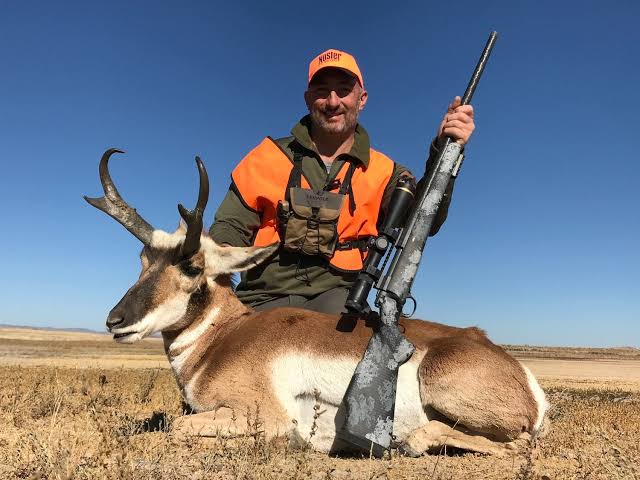
After the shot, watch the animal carefully and mark its last location. Approach cautiously, follow the agency’s tagging procedure, and make every reasonable legal recovery effort. Do not cross private property without permission during recovery.
Firearm Safety
Follow the four primary firearm-safety rules:
- Treat every firearm as if it is loaded.
- Keep the muzzle pointed in a safe direction.
- Keep your finger outside the trigger guard until ready to shoot.
- Be certain of the target and what is in front of and beyond it.
These principles are reinforced by the Hunter-Ed firearm-safety guide.
- Unload the rifle before entering a vehicle or crossing an obstacle.
- Use eye and hearing protection during practice.
- Keep ammunition separate from cartridges that look similar but are incompatible.
- Never depend on a mechanical safety to prevent negligent handling.
- Do not fire toward roads, buildings, vehicles, livestock, people, or an unsafe horizon.
- Use a stable rest without allowing the barrel to contact a hard surface.
Common Caliber-Selection Mistakes
- Buying a magnum to compensate for limited practice: More velocity does not correct poor wind judgment or trigger control.
- Selecting by caliber diameter alone: Cartridge design, bullet construction, recoil, and accuracy all matter.
- Using varmint ammunition: A light, rapidly fragmenting bullet may not be suitable for pronghorn.
- Assuming .223 is legal everywhere: Some states establish a larger minimum caliber or additional cartridge requirements.
- Ignoring ammunition availability: An uncommon cartridge can become a problem during travel.
- Trusting factory trajectory figures alone: Barrel length, elevation, temperature, and sight height affect actual results.
- Practicing only from a bench: Field accuracy is usually lower than bench-rest accuracy.
- Changing ammunition before the hunt: A different load can shift point of impact significantly.
- Taking a rushed shot at a moving animal: Wait for a stable, identifiable target and safe background.
- Confusing maximum range with ethical range: A bullet’s ability to travel does not establish a responsible shot distance.
What Not to Do
- Do not hunt without checking the current weapon and ammunition regulations.
- Do not use rimfire ammunition for pronghorn.
- Do not assume every centerfire .22-caliber load is legal or suitable.
- Do not use full-metal-jacket ammunition for hunting unless expressly legal and appropriate, which is uncommon.
- Do not take shots beyond your demonstrated field ability.
- Do not fire at unidentified movement or an animal on the horizon.
- Do not shoot through brush or tall grass.
- Do not trespass while hunting or recovering an animal.
- Do not allow caliber discussions to replace practice and hunter education.
- Do not abandon a reasonable, safe, and lawful recovery effort.
Final Answer
For most hunters asking what caliber for antelope hunting, the .243 Winchester and 6.5 Creedmoor are the strongest all-around starting choices. The .243 offers low recoil and common hunting ammunition, while the 6.5 Creedmoor provides a balanced combination of recoil, bullet efficiency, and multi-species versatility.
The 6mm Creedmoor and .25-06 Remington are useful dedicated open-country choices. The .270 Winchester, 7mm-08 Remington, and .308 Winchester are better suited to hunters who want one rifle for pronghorn and larger game.
Select a legal cartridge, use an expanding hunting bullet, verify actual trajectory and wind drift, and stay within the distance where you can consistently make an accurate first shot from a realistic field position.
FAQs
1. What is the best caliber for antelope hunting?
The .243 Winchester and 6.5 Creedmoor are excellent general choices. The better option is the legal cartridge the hunter shoots most accurately under field conditions.
2. Is .243 Winchester enough for antelope?
Yes. With a suitable expanding big-game bullet, the .243 Winchester is effective for pronghorn while producing relatively mild recoil.
3. Is 6.5 Creedmoor good for antelope?
Yes. It combines moderate recoil, useful hunting-bullet selection, and efficient open-country performance.
4. Is .25-06 good for antelope?
Yes. The .25-06 Remington is a classic pronghorn cartridge with a relatively flat trajectory and appropriate bullet weights.
5. Is .270 Winchester too much for antelope?
No. It is more powerful than necessary but remains practical, especially for hunters who also pursue deer or elk.
6. Can you hunt antelope with a .308?
Yes. The .308 Winchester is effective with an expanding hunting bullet, although it may produce more recoil and drop than smaller dedicated pronghorn cartridges.
7. Is 7mm-08 good for antelope?
Yes. It provides moderate recoil and versatile hunting performance for pronghorn, deer, and larger game.
8. Can you use a .223 for antelope?
Only where legal and with a suitable medium-game hunting bullet. Some states permit .22-caliber centerfires, while others require at least .24 caliber.
9. Is .22-250 legal for antelope?
It may be legal in states allowing .22-caliber centerfire rifles, but other jurisdictions prohibit it through minimum-caliber, cartridge-length, or bullet requirements.
10. Can you hunt antelope with a rimfire rifle?
No responsible recommendation supports rimfire cartridges for pronghorn. Big-game regulations generally require a centerfire rifle or another expressly authorized weapon.
11. Is 6mm Creedmoor better than .243 Winchester?
It may handle certain streamlined bullets more efficiently, while .243 Winchester usually offers broader ammunition availability. Both are capable with suitable hunting loads.
12. Is .257 Roberts still good for antelope?
Yes. It provides mild recoil and effective pronghorn performance, but factory rifles and ammunition may be difficult to find.
13. Is .257 Weatherby Magnum necessary?
No. It offers high velocity and a flat trajectory, but common non-magnum cartridges can harvest pronghorn responsibly with less recoil and expense.
14. Is 6.5 PRC good for antelope?
It is capable, but its extra velocity and recoil are not required. Use it only if you already shoot it accurately and understand its trajectory.
15. Is .30-06 too powerful for antelope?
It is more powerful than necessary but can be used effectively with an appropriate hunting bullet. Careful shot selection can reduce unnecessary meat damage.
16. Can I use the same rifle for antelope and deer?
Yes. The .243 Winchester, 6.5 Creedmoor, .270 Winchester, 7mm-08, and .308 Winchester can all serve both purposes with appropriate ammunition.
17. What caliber works for antelope and elk?
The .270 Winchester, 7mm-08, and .308 Winchester are practical multi-species options. Use species-appropriate bullets and follow each state’s rules.
18. What bullet weight is best for .243 antelope hunting?
Many hunters begin with approximately 85- to 105-grain hunting bullets. Construction and accuracy matter more than choosing one exact weight.
19. What bullet weight is best for 6.5 Creedmoor?
Approximately 120- to 143-grain expanding hunting bullets are common. Select the weight that groups accurately and performs within the intended impact-velocity range.
20. What bullet weight is best for .270 Winchester?
Approximately 120- to 150-grain hunting bullets can work. Lighter medium-game designs are common, but the rifle’s accuracy should decide the final choice.
21. What bullet weight is best for .308 Winchester?
Approximately 125- to 165-grain expanding hunting bullets are practical for pronghorn. Very heavy bullets usually provide no necessary advantage.
22. Are varmint bullets suitable for antelope?
Generally no. Many varmint bullets are designed to fragment rapidly and may not provide the controlled penetration expected from a medium-game hunting bullet.
23. Can I use match ammunition?
Only if the bullet manufacturer expressly identifies the specific design as suitable for hunting. Target accuracy alone does not guarantee appropriate terminal performance.
24. Are copper bullets good for antelope?
Yes. Expanding copper bullets can provide controlled expansion and penetration when matched to the rifle and expected impact velocity.
25. Do I need lead-free ammunition?
That depends on the state, federal property, or individual hunt area. Verify both wildlife-agency and land-management rules.
26. How far can you shoot an antelope with a .243?
The ethical distance is where the hunter can consistently place a first shot in the vital-area target and the bullet remains within its intended expansion range.
27. What is the average antelope shooting distance?
Distances vary widely with terrain, cover, hunting pressure, and stalking decisions. Do not plan a hunt around a presumed average.
28. Is 300 yards ethical for antelope?
It can be for a practiced hunter with verified ballistics, a stable position, manageable wind, and a clear presentation. For another hunter, it may be too far.
29. Is 400 yards too far for antelope?
It is beyond many hunters’ demonstrated field ability. Attempting it requires extensive practice, reliable wind judgment, verified ballistics, and adequate bullet performance.
30. Do antelope require a flat-shooting rifle?
No, but a relatively flat trajectory can simplify corrections. Accurate range measurement and verified ballistics remain necessary with every cartridge.
31. How important is wind drift?
Very important. Open pronghorn country can expose the bullet to changing crosswinds, and wind errors often exceed distance-estimation errors.
32. Should I zero my antelope rifle at 100 or 200 yards?
Either can work when the hunter understands the resulting trajectory. Confirm the zero and point of impact at every realistic hunting distance.
33. Do I need a rangefinder?
A rangefinder is highly useful because open terrain can make distance difficult to estimate. It does not replace wind judgment or field practice.
34. What scope magnification is best?
Moderate variable magnification is generally sufficient. Prioritize reliable adjustments, adequate field of view, eye relief, and familiarity over extreme magnification.
35. Should I use a bipod?
A bipod can provide a stable prone rest when vegetation and terrain permit. Shooting sticks, a pack, or another safe field rest may work better in tall grass.
36. How much recoil is too much?
Recoil is excessive when it causes discomfort, flinching, reduced practice, or inconsistent field accuracy. Choose a cartridge you can shoot confidently.
37. Are lightweight rifles good for antelope?
They are convenient to carry but may feel less stable and produce more perceived recoil. Balance portability against practical shooting performance.
38. Must I wear hunter orange?
Requirements vary. Colorado, for example, requires specified fluorescent orange or pink clothing for firearm pronghorn hunters. Check the current local rule.
39. Can I shoot an antelope on the skyline?
No. Never fire when the animal is silhouetted against the horizon because there may be no safe backstop.
40. What should a beginner choose?
A properly fitting .243 Winchester or 6.5 Creedmoor is a sensible starting point. Complete hunter education, use suitable hunting ammunition, and practice from field positions.
Read more: