
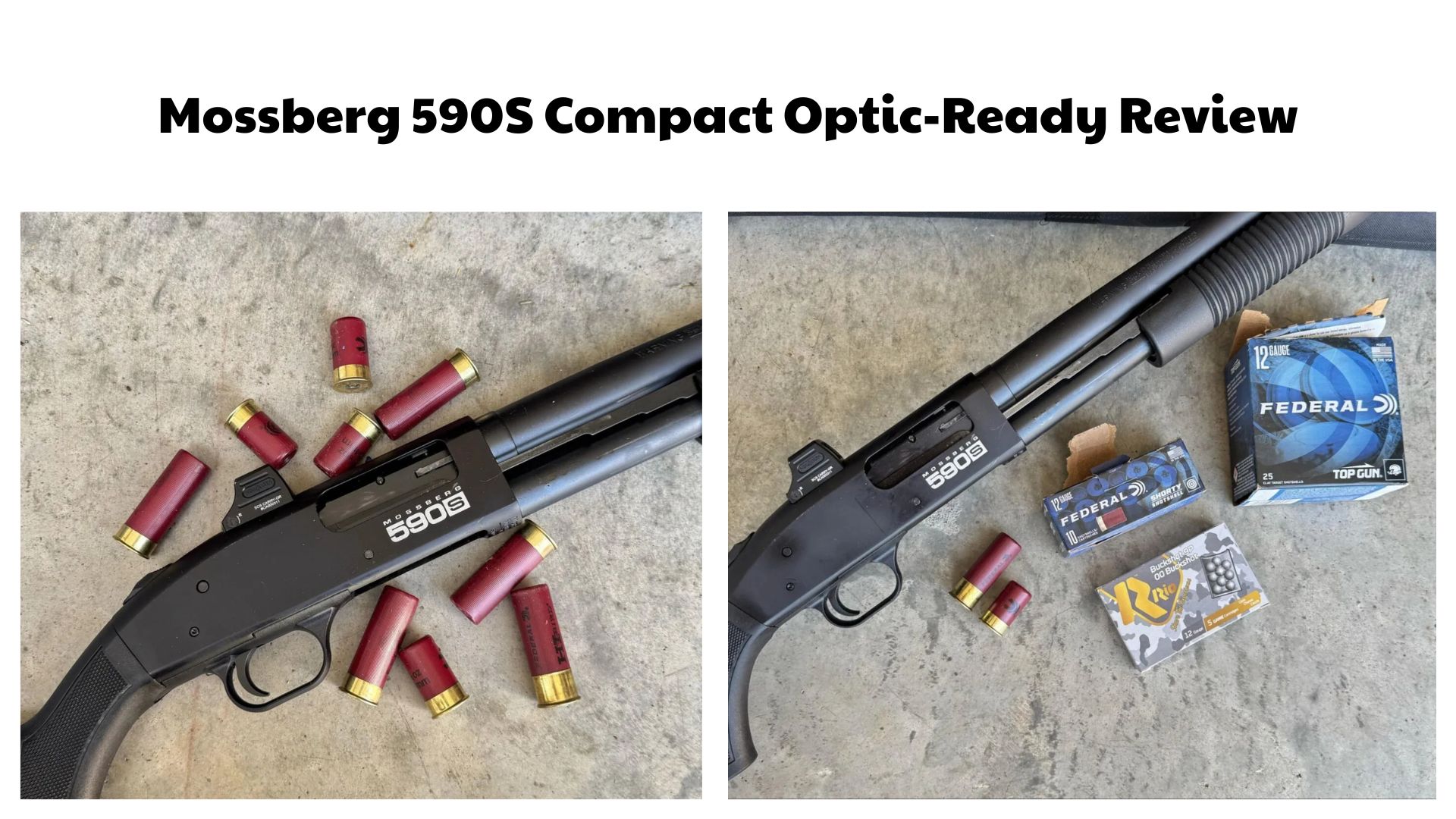

The Mossberg 590S Compact Optic-Ready is a 12-gauge pump-action shotgun built for home defense, training, and close-range practical use. It combines the proven Mossberg 590 action with two modern upgrades: native short-shell compatibility and a factory optic-ready receiver cut. In this Mossberg 590S Compact Optic-Ready Review, we will cover its specifications, design, handling, capacity, loading system, sights, controls, recoil, reliability, best use cases, accessories, maintenance, and comparisons with similar defensive shotguns. The short version is simple: this shotgun is compact, versatile, easy to configure, and unusually flexible because it can run 1.75-inch mini shells, standard 2.75-inch shells, and 3-inch shells without an adapter.
Quick Verdict
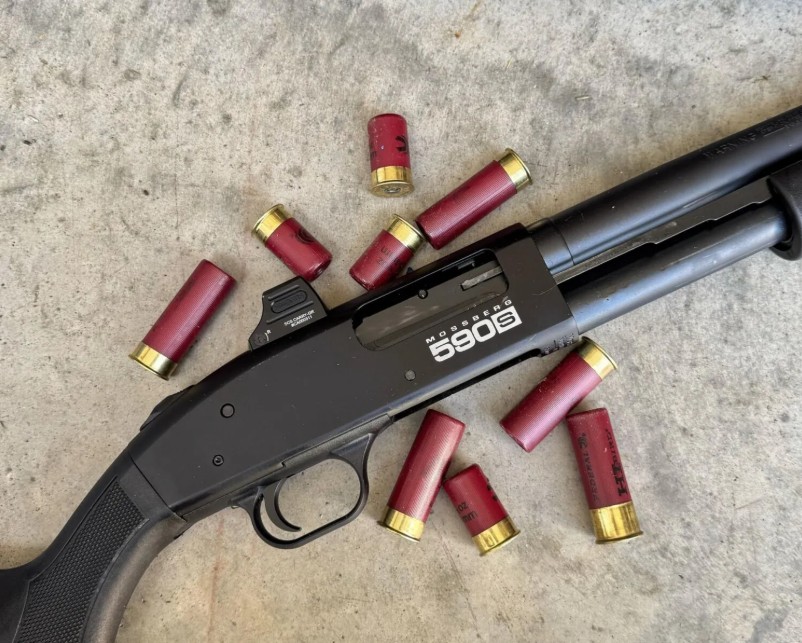
The Mossberg 590S Compact Optic-Ready is one of the most practical defensive pump shotguns in Mossberg’s current lineup. It keeps the classic 590 strengths, including dual extractors, twin action bars, steel-to-steel lockup, and an ambidextrous tang safety. Then it adds a short length of pull, a compact 18.5-inch barrel, an optic-ready Shield RMSc footprint, and the 590S short-shell system.
The biggest selling point is flexibility. With 3-inch shells, it behaves like a traditional hard-hitting 12-gauge. With 2.75-inch shells, it works like a normal defensive shotgun. With 1.75-inch mini shells, it offers higher capacity and softer recoil. Mossberg lists capacity as 5+1 with 3-inch shells, 6+1 with 2.75-inch shells, and 9+1 with 1.75-inch shells.
It is not the softest shotgun in the world, and it is not as compact as a bullpup. But for buyers who want a traditional pump shotgun with modern optics capability and excellent shell flexibility, the 590S Compact Optic-Ready is a strong choice.
What Is the Mossberg 590S Compact Optic-Ready?
The Mossberg 590S Compact Optic-Ready is a 12-gauge pump-action defensive shotgun. It belongs to Mossberg’s 590S family, which was designed to cycle 1.75-inch mini shells, 2.75-inch standard shells, and 3-inch magnum shells without needing a separate adapter.
This matters because traditional pump shotguns often have trouble feeding mini shells reliably unless an adapter is installed. The 590S solves that with internal design changes, including a redesigned elevator, bolt slide, and an energy-absorbing bumper. Mossberg highlights those parts as the core of the 590S system.
The “Compact” part refers mainly to the stock and handling dimensions. This model has a 12- to 13-inch adjustable length of pull, which is shorter than many standard shotgun stocks. That makes it easier for smaller shooters, newer shooters, and people wearing heavy clothing or body armor to shoulder the gun correctly.
The “Optic-Ready” part refers to the receiver cut. The shotgun is cut for a Shield RMSc footprint, allowing compatible micro red-dot sights to mount low on the receiver. The Mag Shack review also identifies the optic cut and short-shell cycling system as the two standout features of this model.
Key Specifications
| Feature | Mossberg 590S Compact Optic-Ready Specification |
|---|---|
| Gauge | 12 Gauge |
| Action | Pump-action |
| Chamber | 3-inch chamber |
| Shell Compatibility | 1.75-inch, 2.75-inch, and 3-inch shells |
| Barrel Length | 18.5 inches |
| Choke | Cylinder bore |
| Capacity | 5+1, 6+1, or 9+1 depending on shell length |
| Sights | Bead sight; optic-ready receiver cut |
| Optic Footprint | Shield RMSc footprint |
| Length of Pull | Adjustable 12–13 inches |
| Overall Length | 37.75 inches |
| Weight | 6.75 pounds |
| Stock | Black synthetic stock with spacer system |
| Finish | Matte blue barrel finish |
| Primary Use | Security / defensive shotgun |
Mossberg’s official listing gives the model number as SKU 51607 and lists the shotgun with an 18.5-inch barrel, cylinder bore, 37.75-inch overall length, 6.75-pound weight, bead sight, optic-ready receiver, and 12- to 13-inch adjustable length of pull.
Design and Build Quality
The Mossberg 590S Compact Optic-Ready has a practical, no-nonsense defensive shotgun design. It is not polished like a sporting over-under, and it is not meant to be. It is built around function, durability, and adaptability.
The action is based on the Mossberg 590 family, which has a long reputation for hard use. Standard features include dual extractors, twin action bars, steel-to-steel lockup, and an ambidextrous top-mounted safety. These are classic Mossberg features and remain important because they help with reliability, strength, and left- or right-handed use.
The biggest mechanical difference from a standard 590 is the 590S feeding system. The redesigned elevator and bolt slide allow the shotgun to handle short shells without an aftermarket adapter. This is what gives the 590S its unique identity.
The receiver is optic-ready from the factory. That is a major advantage because many defensive shotguns require aftermarket rails or gunsmithing to mount a red dot. A direct optic cut keeps the sight lower and cleaner than a tall rail-mounted setup.
The overall build quality is exactly what most Mossberg 590 buyers expect: rugged, simple, and serviceable. This is not a delicate shotgun. It is built to be used, trained with, cleaned, and used again.
Ergonomics and Handling
The compact stock is one of the most important parts of this shotgun. Many defensive shotguns come with a length of pull that is too long for smaller shooters or for people using modern squared-up shooting techniques. A shorter stock can make the shotgun easier to mount, easier to control, and easier to run from confined spaces.
The 590S Compact Optic-Ready uses a 12- to 13-inch adjustable length of pull. This is a smart feature. It allows the shooter to set the stock shorter or slightly longer depending on body size, clothing, and preference. American Cop has noted that long shotgun stocks can make proper technique harder and that shorter stocks are often easier to manage.
The shotgun’s 18.5-inch barrel keeps overall length manageable. It is still a full shotgun, not a tiny firearm, but it is compact enough for home-defense storage and movement around tight indoor spaces.
The tang safety is another ergonomic advantage. It sits on top of the receiver and can be operated by many right- and left-handed shooters. This is one reason Mossberg pump guns are popular with left-handed users.
Capacity and Loading System
Capacity is one of the headline features of the 590S Compact Optic-Ready. Because it can run different shell lengths, capacity changes depending on the shells used.
| Shell Length | Listed Capacity | Practical Benefit |
|---|---|---|
| 3-inch shells | 5+1 | Maximum power option, heavier recoil |
| 2.75-inch shells | 6+1 | Standard defensive shotgun capacity |
| 1.75-inch mini shells | 9+1 | Higher capacity and softer recoil |
Mossberg lists those capacities directly for the 590S Compact Optic-Ready. This flexibility is useful because the shooter can choose a load based on recoil tolerance, storage needs, range use, or defensive preference.
The loading system is still a traditional tube-fed pump-action setup. Shells are loaded into the magazine tube through the loading port. The pump cycles shells from the tube, onto the elevator, and into the chamber.
The ability to mix shell lengths is one of the most interesting parts of the 590S design. Mossberg states that the gun cycles 1.75-inch, 2.75-inch, and 3-inch shells interchangeably. Even so, serious users should still test their chosen load combinations before relying on them.
Barrel, Sights, and Controls
The shotgun uses an 18.5-inch cylinder-bore barrel. Cylinder bore means there is no tight choke constriction. This is common on defensive shotguns because it works well with buckshot, slugs, and close-range use.
The standard sight system is a bead sight. A bead is simple, durable, and fast at close range. It is not as precise as rifle sights or a red dot, but it works for traditional shotgun pointing.
The optic-ready receiver is the modern upgrade. It is cut for the Shield RMSc footprint, which supports compact red-dot optics. American Rifleman’s new-for-2024 coverage notes that Mossberg added optic-ready models to the 590S line and specifically identified the 590S Compact Optic-Ready.
The controls are classic Mossberg. The safety is on top of the receiver. The action release is behind the trigger guard. The pump forend is easy to reach, and the action is familiar to anyone who has used a Mossberg 500 or 590.
Optic-Ready System
The optic-ready cut is a major advantage over older defensive shotguns. A red dot can help shooters focus on the target, track the gun during recoil, and aim more precisely with slugs. It can also be helpful in low light when paired with proper illumination.
The Shield RMSc footprint is a compact optic pattern used by several micro red dots. Buyers should confirm the exact optic fit before purchasing. Some optics may need specific screws, plates, or hardware even when they share the same general footprint.
A shotgun optic should be rugged. Twelve-gauge recoil is harder on optics than many handgun or rimfire applications. Choose an optic with a good recoil rating and test it at the range before trusting it.
Recoil and Shooting Experience
The Mossberg 590S Compact Optic-Ready is still a 12-gauge pump shotgun. Recoil depends heavily on shell selection. With full-power 3-inch shells, recoil can be stout. With standard 2.75-inch buckshot, recoil is manageable but still serious. With 1.75-inch mini shells, recoil becomes noticeably softer.
This is one of the reasons the 590S system is useful. Mini shells can make training more comfortable, increase capacity, and allow smaller or recoil-sensitive shooters to practice more confidently. Firearms News describes the 590S as a high-capacity defensive pump shotgun and emphasizes its ability to use short shells as part of its appeal.
The compact stock also helps recoil management because it allows a more controlled body position. A stock that is too long can force the shooter into a stretched-out posture. A shorter stock lets the shooter keep the gun tighter to the body and control the pump stroke more efficiently.
The gun weighs 6.75 pounds, so it is not extremely heavy. That is good for handling, but lighter shotguns usually recoil more than heavier ones. The best way to manage recoil is to choose suitable ammunition, use a proper stance, mount the gun firmly, and train regularly.
Accuracy and Patterning
Shotgun “accuracy” is really two separate topics: patterning with shot and precision with slugs. With buckshot or birdshot, the shotgun throws a pattern that must be tested at realistic distances. With slugs, the shotgun fires one projectile and can be aimed more like a rifle at short to moderate distances.
The bead sight is adequate for close-range work, but an optic can make slug shooting and precise buckshot placement easier. The optic-ready receiver is especially useful for shooters who want a clear aiming point rather than relying only on a bead.
Every defensive shotgun should be patterned. Different buckshot loads can spread very differently from the same barrel. A load that patterns tightly from one shotgun may pattern wider from another. Pattern testing is not optional if the shotgun is being considered for home defense.
Reliability
Reliability is the reason many people choose a Mossberg pump shotgun. The 590 series has a strong reputation, and the 590S keeps the major reliability features: dual extractors, twin action bars, and steel-to-steel lockup.
The short-shell system is the key area buyers care about. Reviewers have generally focused on the 590S’s ability to cycle different shell lengths without an adapter. GunMade’s review concluded that the 590S Compact Optic-Ready is reliable, offers higher-than-standard capacity, and is easily customizable for defensive or range use.
As with any pump shotgun, reliability also depends on the shooter. Short-stroking the pump can cause problems. The action must be run firmly and completely. This is especially important under stress. A pump shotgun rewards good technique and punishes lazy technique.
Pros and Cons
Pros
- Cycles 1.75-inch, 2.75-inch, and 3-inch shells without an adapter.
- Higher capacity with mini shells.
- Optic-ready receiver cut with Shield RMSc footprint.
- Compact 12- to 13-inch adjustable length of pull.
- Proven Mossberg 590-style pump-action design.
- Ambidextrous tang safety works well for right- and left-handed shooters.
- 18.5-inch barrel is practical for home-defense use.
- Dual extractors and twin action bars support reliability.
- Large aftermarket support for Mossberg 500/590 accessories.
- Flexible shell selection for recoil control and capacity.
Cons
- Still has 12-gauge recoil with full-power loads.
- Bead sight is simple but not as precise as ghost rings or a red dot.
- Mini-shell defensive load selection is more limited than standard 2.75-inch loads.
- Pump guns require more user technique than semi-automatic shotguns.
- Tube loading is slower than magazine-fed platforms.
- Shield RMSc optic footprint may limit optic choices compared with a rail.
- Not as compact overall as bullpup shotguns like the KelTec KSG.
Best Use Cases
Home Defense
The 590S Compact Optic-Ready is built mainly for home defense and security use. Its compact stock, 18.5-inch barrel, optic-ready receiver, and flexible shell capacity all support that role.
The key advantage is adaptability. A user can choose softer-shooting mini shells for lower recoil, standard buckshot for traditional defensive use, or slugs for specific range needs. The shotgun should still be patterned and tested with the chosen load.
Range Training
This shotgun is also useful for range training. Mini shells can make range sessions more comfortable and less expensive depending on availability. The higher capacity with short shells also means less frequent loading.
Recoil-Sensitive Shooters
The 590S Compact model is more approachable than many full-size 12-gauge defensive shotguns. The shorter stock helps fit, and mini shells reduce recoil. It is still a 12-gauge, but it gives the shooter more load options.
Optic-Equipped Defensive Shotgun Builds
Buyers who already plan to add a red dot should pay close attention to this model. The factory optic cut is cleaner than many aftermarket solutions and keeps the optic lower on the receiver.
Comparison With Similar Shotguns
| Shotgun | Main Strength | Best For |
|---|---|---|
| Mossberg 590S Compact Optic-Ready | Short-shell compatibility, optic cut, compact stock | Home defense and adaptable 12-gauge use |
| Mossberg 590A1 | Heavy-duty military-style build | Buyers who want maximum ruggedness |
| Remington 870 Tactical | Classic pump shotgun design | Traditional pump-shotgun users |
| Benelli SuperNova Tactical | Strong action and modern stock design | Shooters who want a durable tactical pump |
| KelTec KSG | Bullpup compactness and dual tubes | Users wanting maximum capacity in minimum length |
| KelTec KS7 | Lightweight bullpup design | Users wanting a compact, lighter bullpup shotgun |
| Mossberg 940 Pro Tactical | Semi-auto speed and optic-ready design | Users wanting less manual cycling effort |
Mossberg 590S Compact Optic-Ready vs Mossberg 590A1
The 590A1 is the heavier-duty classic. It is known for rugged construction and a military-style reputation. The 590S Compact Optic-Ready is more modern in function because it cycles mini shells without an adapter and comes optic-ready.
Choose the 590A1 if you want the traditional heavy-duty Mossberg pump experience. Choose the 590S Compact Optic-Ready if shell flexibility, higher mini-shell capacity, shorter length of pull, and red-dot mounting matter more.
Mossberg 590S Compact Optic-Ready vs Mossberg 590S Optic-Ready 20-Inch
Mossberg also lists 20-inch 590S optic-ready models. The 20-inch version offers higher tube capacity with all shell lengths, including up to 13+1 with mini shells.
The Compact Optic-Ready model gives up some capacity for a shorter 18.5-inch barrel and shorter adjustable length of pull. For home defense, many users will prefer the compact model. For maximum tube capacity, the 20-inch model has the advantage.
Mossberg 590S Compact Optic-Ready vs KelTec KS7
The KelTec KS7 is a lightweight bullpup 12-gauge shotgun. Its main advantage is compact overall length. Because the action is placed behind the trigger, the KS7 can have a full-length barrel in a very short package.
The Mossberg 590S Compact Optic-Ready is longer, but it uses a more traditional pump layout. Many shooters find traditional pump guns easier to load, inspect, maintain, and operate. The Mossberg also has the major advantage of cycling 1.75-inch mini shells without an adapter.
Choose the KS7 if compact size is the top priority. Choose the 590S Compact if you prefer conventional controls, easier accessory support, and broad shell-length flexibility.
KelTec KS7 vs KelTec KSG
The KelTec KS7 and KelTec KSG are both bullpup pump-action shotguns, but they are not the same tool. The KS7 is lighter and simpler. It uses a single magazine tube and is easier to understand. The KSG uses dual magazine tubes, which gives it much higher capacity but also adds complexity.
The KS7 is better for users who want a lighter bullpup shotgun with fewer controls to manage. The KSG is better for users who want maximum capacity in a short package and are willing to train with the tube selector and loading system.
Compared with both, the Mossberg 590S Compact Optic-Ready is more traditional. It does not match the KSG’s bullpup capacity, but it has simpler handling, classic Mossberg controls, broad aftermarket support, and native short-shell compatibility.
Maintenance and Cleaning
The 590S Compact Optic-Ready should be maintained like a defensive pump shotgun. Always follow Mossberg’s official manual. Before cleaning, unload the shotgun completely, open the action, inspect the chamber and magazine tube, and remove all ammunition from the cleaning area.
Routine maintenance should include cleaning the bore, wiping the bolt and receiver area, inspecting the elevator, checking the magazine tube, and lightly lubricating moving parts according to the manual.
The 590S feeding system has parts designed specifically for short-shell cycling, so owners should pay attention to the elevator and related feeding surfaces. Keep those areas clean and free of heavy fouling.
Do not over-lubricate the action. Too much oil can attract dust, unburned powder, and debris. A defensive shotgun should be clean, lightly lubricated, and tested with the ammunition it will use.
Accessories and Upgrade Options
Red-Dot Optic
A compact red dot is the most obvious upgrade. The receiver is already cut for the Shield RMSc footprint, so compatible optics can mount low and cleanly. Choose a rugged optic that can handle 12-gauge recoil.
Weapon Light
A light is one of the most useful home-defense shotgun accessories. Positive identification is critical. The exact mounting solution depends on the forend and accessory setup.
Side Saddle or Shell Carrier
A side saddle or receiver-mounted shell carrier adds spare ammunition directly to the shotgun. This is useful because tube-fed shotguns run dry and reload slower than detachable-magazine firearms.
Sling
A sling can help with retention and carrying. For defensive use, a simple two-point sling is usually more practical than an overly complicated setup.
Stock and Recoil Pad Options
The compact adjustable stock is already useful, but some shooters may still prefer aftermarket stock systems. Recoil pads can also help with comfort during longer sessions.
Forend Upgrades
Some owners may want a forend that accepts M-LOK accessories. Mossberg’s broader 590S lineup includes models with M-LOK furniture, and the aftermarket is strong for Mossberg pump guns.
Who Should Buy the Mossberg 590S Compact Optic-Ready?
This shotgun is a good fit for buyers who want a modern defensive pump shotgun with proven Mossberg handling, red-dot capability, and unusual ammunition flexibility. It is especially appealing for home-defense users who like the idea of using mini shells for lower recoil and higher capacity.
It is also a smart choice for smaller-framed shooters or anyone who dislikes long shotgun stocks. The 12- to 13-inch adjustable length of pull makes the shotgun easier to fit than many standard defensive models.
Who Should Avoid It?
Buyers who dislike pump shotguns may prefer a semi-auto like the Mossberg 940 Pro Tactical. Pump guns require manual cycling, and short-stroking can cause issues if the shooter does not train.
Buyers who want the smallest possible overall length may prefer a bullpup like the KelTec KS7 or KSG. The Mossberg is compact for a traditional shotgun, but it is still longer than a bullpup.
Buyers who want maximum simplicity and do not care about optics or mini shells may save money with a basic Mossberg 500 or 590 model.
Final Verdict
The Mossberg 590S Compact Optic-Ready is a smart evolution of the defensive pump shotgun. It keeps the classic strengths of the Mossberg 590 platform and adds features that genuinely matter: short-shell compatibility, a compact adjustable stock, and a factory optic cut.
Its biggest advantage is versatility. The ability to run 1.75-inch, 2.75-inch, and 3-inch shells without an adapter gives the owner more control over recoil, capacity, and use case than a standard pump shotgun.
It is not perfect. It still recoils like a 12-gauge with full-power loads, and a pump shotgun requires practice. But for home defense, range training, and buyers who want a rugged optic-ready 12-gauge with serious flexibility, the Mossberg 590S Compact Optic-Ready is easy to recommend.
55 Mossberg 590S Compact Optic-Ready FAQs
1. What is the Mossberg 590S Compact Optic-Ready?
The Mossberg 590S Compact Optic-Ready is a 12-gauge pump-action shotgun designed for defensive and security use. It has an 18.5-inch barrel, compact adjustable stock, optic-ready receiver cut, and the ability to cycle 1.75-inch, 2.75-inch, and 3-inch shells without a separate mini-shell adapter.
2. What makes the 590S different from a regular Mossberg 590?
The main difference is short-shell compatibility. A standard Mossberg 590 is designed around standard 2.75-inch and 3-inch shells. The 590S adds redesigned feeding components that allow it to cycle 1.75-inch mini shells as well. This gives the shooter more capacity and softer recoil options.
3. What gauge is the Mossberg 590S Compact Optic-Ready?
It is a 12-gauge shotgun. Twelve gauge is the most common defensive and sporting shotgun gauge in the United States. It offers wide ammunition availability, strong terminal performance, and many load choices, but recoil can be significant with full-power loads.
4. What shell lengths can the 590S Compact Optic-Ready use?
The 590S Compact Optic-Ready can use 1.75-inch mini shells, 2.75-inch standard shells, and 3-inch shells. Mossberg designed the 590S system to cycle these shell lengths without requiring a separate adapter. Owners should still test their chosen loads before relying on them.
5. What is the capacity of the Mossberg 590S Compact Optic-Ready?
Capacity depends on shell length. Mossberg lists it as 5+1 with 3-inch shells, 6+1 with 2.75-inch shells, and 9+1 with 1.75-inch mini shells. This flexible capacity is one of the shotgun’s biggest advantages.
6. Is the Mossberg 590S Compact Optic-Ready good for home defense?
Yes. It is designed with home defense and security use in mind. The 18.5-inch barrel, compact adjustable stock, optic-ready receiver, ambidextrous safety, and flexible ammunition capacity make it a strong defensive shotgun. Training and safe storage are still essential.
7. Is the 590S Compact Optic-Ready reliable?
The 590S is based on the proven Mossberg 590 action and includes classic reliability features such as dual extractors, twin action bars, and steel-to-steel lockup. Reviews of the 590S Compact Optic-Ready generally report strong reliability, but every owner should test their specific gun with chosen ammunition.
8. Does the 590S need a mini-shell adapter?
No. That is one of the main reasons to buy the 590S. It is designed to cycle 1.75-inch mini shells without an aftermarket adapter. This makes it simpler and more flexible than older pump shotguns that require separate parts for mini-shell use.
9. What optic footprint does the 590S Compact Optic-Ready use?
The receiver is cut for the Shield RMSc footprint. This footprint supports several compact red-dot optics. Buyers should verify screw length, optic fit, and recoil durability before installing an optic on a 12-gauge shotgun.
10. Does the shotgun come with a red dot?
The Compact Optic-Ready model is cut for an optic, but it does not necessarily include one. Mossberg offers other 590S packages with factory optic combos. Check the exact model number and package details before buying.
11. What is the barrel length?
The Mossberg 590S Compact Optic-Ready has an 18.5-inch barrel. This is a common defensive shotgun barrel length because it keeps the gun relatively compact while staying within standard shotgun length requirements.
12. What is the length of pull?
The length of pull is adjustable from 12 to 13 inches. This shorter range is one of the best features of the Compact model. It helps the shotgun fit smaller shooters and supports a more controlled defensive shooting stance.
13. How much does the shotgun weigh?
Mossberg lists the shotgun at 6.75 pounds. That weight keeps it handy, but it also means recoil can be noticeable with full-power 12-gauge loads. Mini shells and reduced-recoil loads can make the gun more comfortable to shoot.
14. What kind of choke does it have?
The shotgun uses a cylinder bore. Cylinder bore is common on defensive shotguns because it works well at close distances and can handle many buckshot and slug loads. Always check ammunition compatibility and pattern your chosen load.
15. Can the 590S Compact shoot slugs?
Yes, cylinder-bore defensive shotguns are commonly used with appropriate rifled slugs. Slugs should be tested for point of impact, recoil, and reliability. A red dot can make slug aiming much easier than a simple bead sight.
16. Can it shoot buckshot?
Yes. Buckshot is one of the most common defensive shotgun load types. Pattern testing is important because different buckshot loads can spread differently from the same barrel. Choose a load that patterns responsibly at your expected distances.
17. Can it shoot birdshot?
Yes. Birdshot can be used for range practice and certain sporting uses, but it is not usually the preferred defensive load compared with quality buckshot or slugs. Use ammunition appropriate for the purpose and follow local laws.
18. Is recoil heavy?
Recoil depends on ammunition. Full-power 3-inch shells can recoil heavily. Standard 2.75-inch buckshot is still stout. Mini shells are much softer and make the shotgun more approachable. Proper stance and stock fit also make a major difference.
19. Is the 590S Compact good for smaller shooters?
Yes, it is better suited to smaller shooters than many full-size shotguns because of its short adjustable length of pull. The ability to use lower-recoil mini shells also helps. It is still a 12-gauge shotgun, so proper training remains important.
20. Is the Mossberg tang safety useful?
Yes. The tang safety is mounted on top of the receiver and is easy to see and operate for many shooters. It is especially helpful for left-handed users because it is more ambidextrous than many cross-bolt safeties.
21. What sights does the 590S Compact Optic-Ready have?
It has a bead sight and an optic-ready receiver cut. The bead is simple and durable. The optic cut allows the shooter to add a compatible micro red dot for a clearer aiming system.
22. Is a red dot worth adding?
A red dot can be very useful on a defensive shotgun. It provides a clear aiming point, helps with slug accuracy, and can improve target focus. The optic must be rugged enough for 12-gauge recoil and properly installed.
23. What is the best red dot for the 590S Compact?
The best red dot is a durable micro optic that fits the Shield RMSc footprint or can be mounted correctly with compatible hardware. Look for strong recoil resistance, clear brightness settings, reliable battery life, and a secure mounting system.
24. Is the 590S Compact better than the 590A1?
It depends on priorities. The 590A1 is known for heavy-duty ruggedness. The 590S Compact offers short-shell compatibility, a shorter stock, and optic-ready features. If you want maximum traditional durability, choose the 590A1. If you want flexibility, choose the 590S Compact.
25. Is the 590S Compact better than the KelTec KSG?
The KelTec KSG is shorter overall and has dual magazine tubes with high capacity. The 590S Compact has a more traditional layout, simpler controls, and broader Mossberg familiarity. The KSG wins on compact capacity. The Mossberg wins on conventional handling and short-shell flexibility.
26. Is the 590S Compact better than the KelTec KS7?
The KS7 is lighter and shorter because of its bullpup layout. The Mossberg is more traditional and easier for many shooters to load, inspect, and maintain. Choose the KS7 for compactness. Choose the Mossberg for conventional controls and shell-length flexibility.
27. Is the 590S Compact better than a semi-auto shotgun?
A pump shotgun is usually simpler and more tolerant of varied ammunition, but it requires manual cycling. A semi-auto can be faster and softer shooting, but may be more ammunition-sensitive. The better choice depends on training, budget, recoil preference, and intended use.
28. Can beginners use the 590S Compact?
Beginners can use it with proper instruction, but a 12-gauge pump shotgun is not always the easiest first firearm. Mini shells and the compact stock help, but new shooters still need training in recoil control, loading, unloading, and safe storage.
29. Is the 590S Compact legal everywhere?
No firearm is automatically legal everywhere. Laws vary by country, state, and locality. Buyers should check current laws regarding shotgun ownership, magazine capacity, transportation, storage, and defensive use before purchasing.
30. Does the 590S Compact have an accessory rail?
The main optic interface is the receiver cut, not a long top rail. Accessory mounting depends on the forend and aftermarket parts. Many Mossberg-compatible accessories exist, but buyers should verify fit for the 590S model.
31. Can I add a weapon light?
Yes, with the correct mounting setup. A weapon light is useful for home defense because identification is critical. The exact mount may require an aftermarket forend, clamp, or rail section. Always confirm that the light does not interfere with pump operation.
32. Can I add a side saddle?
Yes, many users add a side saddle or shell carrier to defensive shotguns. Make sure the carrier fits the receiver and does not interfere with the optic, action, or controls. Test the shotgun after installation.
33. Can I change the stock?
Yes, Mossberg shotguns have strong aftermarket support. However, the factory compact adjustable stock is one of this model’s best features. Change the stock only if another option fits your body and use case better.
34. Can I add a sling?
Yes. A sling is useful for carrying and retaining a defensive shotgun. A simple two-point sling is often the most practical choice. Make sure the sling does not block the pump stroke or loading port.
35. Is the bead sight enough?
The bead sight is enough for traditional close-range shotgun use, but a red dot offers more precision. If you plan to use slugs or want a clearer aiming reference under stress, an optic is worth considering.
36. How should I pattern the shotgun?
Patterning means shooting your chosen load at realistic distances to see how wide the pellets spread and where they hit. Use safe range procedures and test several distances. Patterning helps you understand exactly how your shotgun and ammunition behave.
37. What ammunition is best for home defense?
Many users choose quality buckshot for defensive shotguns, while some use slugs for specific roles. Mini shells may reduce recoil and increase capacity, but load selection is more limited. Choose ammunition that patterns well, functions reliably, and complies with local law.
38. Are mini shells good for defense?
Mini shells can reduce recoil and increase capacity, which makes them attractive. However, they generally carry less payload than full-size shells. If considering them for defense, test reliability, patterning, penetration, and point of impact carefully.
39. Can I mix shell lengths in the tube?
Mossberg states that the 590S can cycle 1.75-inch, 2.75-inch, and 3-inch shells interchangeably. Even so, any mixed-shell setup should be thoroughly tested before serious use. Consistency is often better for defensive planning.
40. How do I clean the 590S Compact?
Follow Mossberg’s official manual. Unload the shotgun completely, clean the bore, wipe the bolt and receiver area, inspect the elevator and magazine tube, and apply light lubrication to moving parts. Avoid over-lubricating the action.
41. How often should I clean it?
Clean it after range sessions or whenever it becomes dirty, wet, or exposed to dust. A defensive shotgun should be inspected regularly even if it has not been fired. Magazine tubes, chambers, and actions should stay clean and lightly lubricated.
42. Is the 590S Compact hard to maintain?
No. It is a pump shotgun with a straightforward mechanical design. The 590S feeding system is more specialized than a basic 590, but routine cleaning is still simple. Owners should avoid unnecessary disassembly beyond the manual.
43. What are the main weaknesses?
The main weaknesses are 12-gauge recoil, pump-action training requirements, slower tube reloads, and the limited optic footprint compared with a full rail. It is also longer than bullpup shotguns, though easier for many people to operate.
44. What are the main strengths?
The main strengths are shell-length flexibility, optic readiness, compact stock fit, proven Mossberg controls, higher mini-shell capacity, and strong defensive-shotgun practicality. It is a modern update to a familiar pump-action platform.
45. Is the 590S Compact good for left-handed shooters?
Yes. Mossberg’s top-mounted tang safety is one of the better shotgun safety designs for left-handed users. The action release and loading system still require practice, but the safety layout is very left-hand friendly.
46. Is it good for hunting?
This model is primarily configured for defensive and security use. It has a short cylinder-bore barrel and compact stock, so it is not ideal for most hunting compared with field shotguns. Some hunting use may be possible where legal, but it is not the main purpose.
47. Is it good for clay shooting?
It can be used informally, but it is not optimized for clay sports. A longer barrel, appropriate choke system, and sporting stock are usually better for trap, skeet, or sporting clays. The 590S Compact is mainly a defensive shotgun.
48. Does the 590S Compact accept chokes?
The Compact Optic-Ready model is listed with a cylinder bore. Some other Mossberg models have interchangeable chokes, but this specific defensive configuration is not mainly built around choke changes. Check the exact barrel before buying choke accessories.
49. Is the 590S Compact too short?
For many defensive users, the short stock is a benefit. A 12- to 13-inch length of pull can improve control. Very tall shooters with long arms may prefer a longer stock, but many people shoot defensive shotguns better with a shorter length of pull.
50. Is the 590S Compact too light?
At 6.75 pounds, it is handy but not extremely heavy. Lighter shotguns carry and move well, but recoil more with heavy loads. Mini shells or reduced-recoil loads can help balance comfort and performance.
51. Should I buy the 18.5-inch or 20-inch 590S?
Choose the 18.5-inch Compact if you want easier handling and shorter overall length. Choose the 20-inch model if you want higher magazine capacity. Both can be useful, but the compact model is usually better for tighter spaces.
52. What should I buy with the shotgun?
Useful accessories include a compatible red dot, weapon light, sling, side saddle, extra ammunition, cleaning kit, safe storage solution, and training. The most important purchase after the shotgun is quality practice ammunition and time on the range.
53. Is the Mossberg 590S Compact Optic-Ready worth it?
Yes, if you want a defensive pump shotgun with real modern features. The optic cut and short-shell cycling system make it more flexible than many older pump guns. It is especially worthwhile for buyers who plan to use mini shells or a red dot.
54. Who should avoid the 590S Compact Optic-Ready?
People who dislike pump-action shotguns, cannot tolerate 12-gauge recoil, or want the smallest possible overall length may prefer another platform. A semi-auto shotgun, 20-gauge shotgun, or bullpup may be a better fit depending on the user.
55. What is the final verdict on the Mossberg 590S Compact Optic-Ready?
The Mossberg 590S Compact Optic-Ready is a versatile, modern, and highly practical defensive pump shotgun. It offers classic Mossberg reliability, native mini-shell compatibility, useful capacity options, a compact adjustable stock, and a factory optic cut. For home defense and serious range training, it is one of Mossberg’s most interesting 12-gauge options.
Read more:
- GUNNR HEIMDALL 6-24×50 HPVO Rifle Scope Review: Specs, Glass, Turrets, Pros, Cons, and Buyer’s Guide