
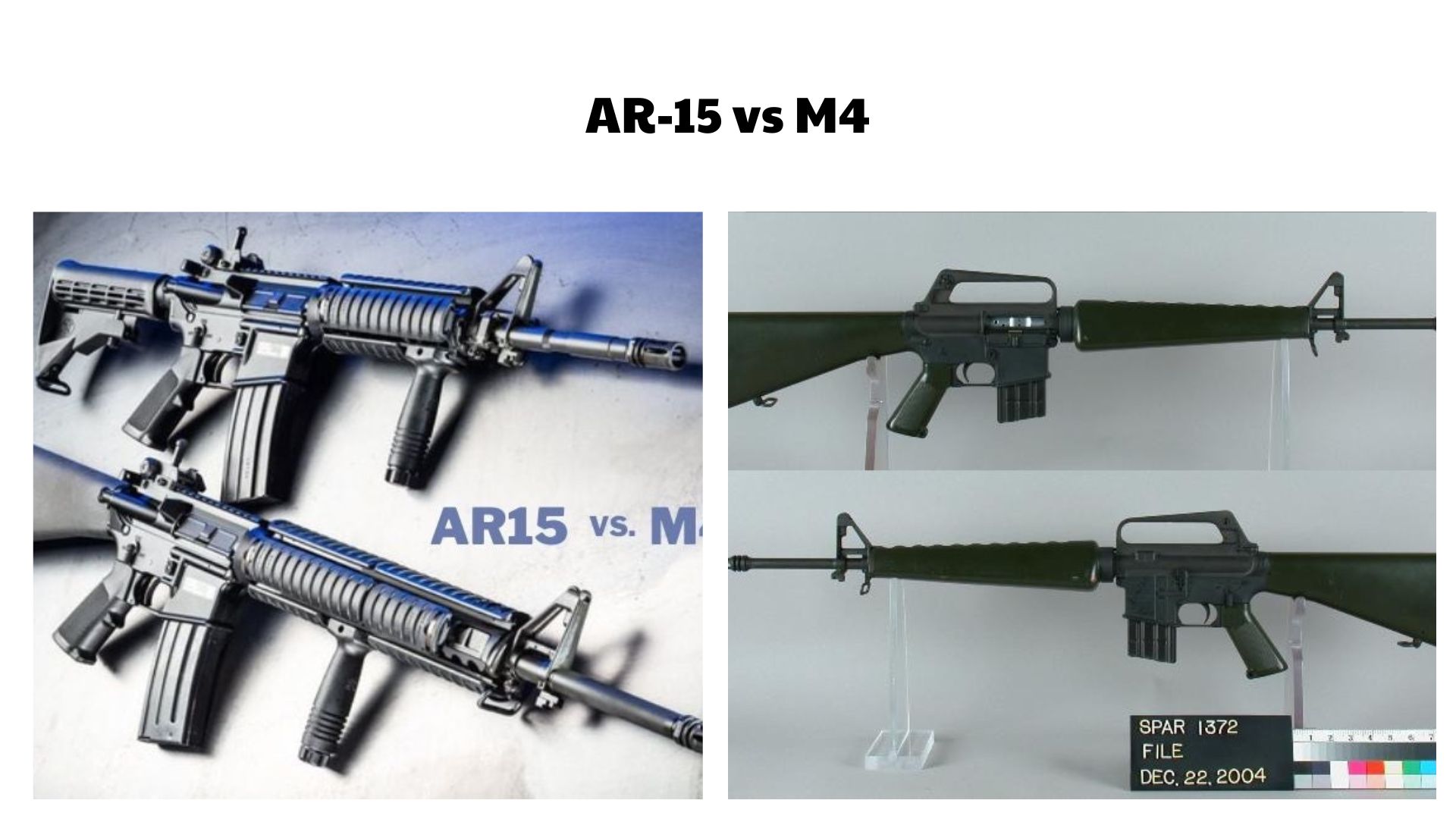

The AR-15 and M4 platforms are closely related rifles that are often confused due to their shared design lineage. Both belong to the same AR family of firearms and share many internal components, controls, and operating principles.
However, despite their similarities, they differ in important ways including military designation, barrel length, intended operational role, and overall configuration. These differences influence how each platform performs in real-world scenarios.
Understanding the AR-15 vs M4 comparison is important for civilians, law enforcement personnel, and firearm enthusiasts who want to make informed decisions about performance, handling, and intended use.
History and Development of AR-15 and M4 Platforms
Origins of the AR-15 Platform
The AR-15 was originally developed by ArmaLite as a lightweight, modular semi-automatic rifle designed for improved handling and reduced weight compared to traditional battle rifles.
Over time, the design was refined and became widely adopted in civilian markets, where it gained popularity due to its versatility, accuracy, and extensive customization options.
Today, the AR-15 serves as the foundation for many modern AR-style rifles and remains one of the most widely used civilian rifle platforms.
Origins of the M4 Carbine
The M4 Carbine is a military evolution of the AR platform, developed to provide a more compact and maneuverable rifle for modern combat environments.
It was adopted by the U.S. Armed Forces as a standard-issue carbine, replacing older M16 variants in many roles due to its shorter length and improved handling in close-quarters situations.
The M4 is specifically optimized for military use, balancing compact size with effective firepower for a wide range of operational scenarios.
Relationship Between AR-15, M4, and M16
The AR-15, M4, and M16 all share a common design lineage and are closely related in terms of internal mechanics and operating systems.
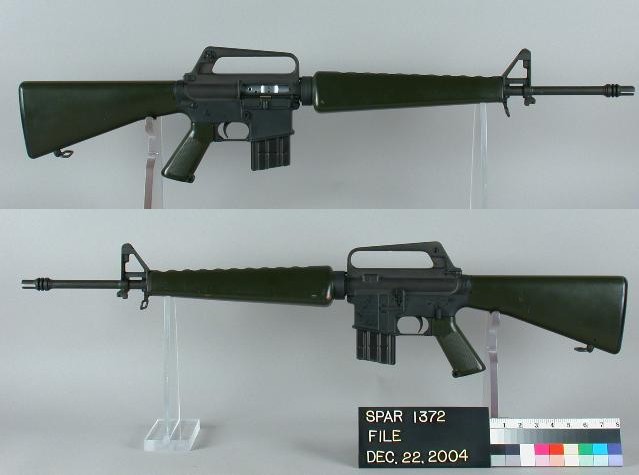
The AR-15 is typically a civilian semi-automatic rifle, while the M4 is the military select-fire carbine version designed for tactical operations. The M16 is the full-length military rifle variant, offering longer barrel length and extended range performance.
Despite their differences in configuration and role, all three platforms share a high degree of parts compatibility and design consistency.
Design and Structural Differences
Barrel Length Comparison
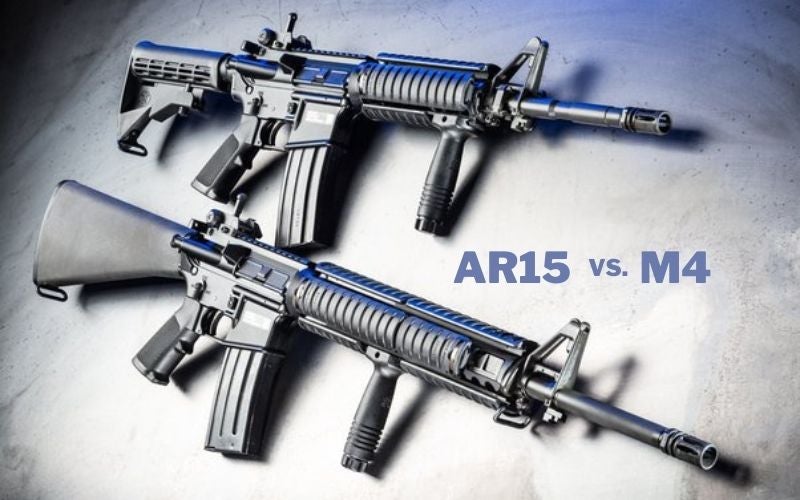
One of the primary differences between the AR-15 and M4 is barrel length. The AR-15 typically features a 16-inch barrel, which is considered the civilian standard configuration.
The M4, in contrast, uses a shorter 14.5-inch barrel, which enhances maneuverability in close-quarters environments but slightly reduces muzzle velocity.
This difference impacts overall handling, ballistic performance, and effective range depending on the application.
Overall Size and Weight Differences
The M4 is designed to be more compact, making it ideal for close-quarters combat and situations where mobility is critical.
The AR-15, with its slightly longer barrel, offers improved stability and a longer sight radius, which can benefit accuracy at distance.
Weight distribution between the two platforms is similar, but the shorter M4 feels more front-light and easier to maneuver in tight spaces.
Receiver and Internal Similarities
Both the AR-15 and M4 share the same fundamental AR-platform architecture, including compatible upper and lower receivers.
This high level of compatibility allows for significant parts interchangeability between the two platforms, especially in civilian configurations.
However, there are minor differences in components such as buffer systems and gas system tuning to accommodate different barrel lengths and operational requirements.
Operating Systems and Functionality
Gas System Design (Direct Impingement)
Both the AR-15 and M4 typically use a direct impingement gas system, where gas from the fired cartridge is directed through a gas tube into the bolt carrier group to cycle the action.
This system helps reduce overall weight and contributes to a smoother recoil impulse compared to some piston-driven designs.
Because of their shared operating principle, both platforms exhibit similar cycling behavior under comparable conditions.
Differences in Gas System Optimization
While both platforms use similar gas systems, the M4 is specifically tuned for its shorter barrel and higher gas pressure characteristics.
AR-15 rifles may feature different gas system lengths, including carbine, mid-length, and rifle-length configurations, allowing for more flexibility in recoil management and reliability tuning.
These differences in gas system optimization can influence recoil impulse, component wear, and overall reliability depending on the setup.
Performance Comparison
Accuracy Differences
The AR-15 generally offers slightly better accuracy than the M4, largely due to its longer barrel and higher muzzle velocity. These factors contribute to improved stability and consistency, especially at extended ranges.
The M4, while still highly accurate within its intended role, is optimized more for combat effectiveness and maneuverability rather than precision shooting at distance.
Despite these differences, both platforms are considered highly accurate within their expected engagement ranges and are capable of reliable performance in practical scenarios.
Velocity and Ballistics
Because of its shorter barrel, the M4 experiences a slight reduction in muzzle velocity compared to the AR-15. This reduction can affect ballistic performance, particularly at longer distances.
The AR-15 retains higher velocity and better energy retention over distance, which can improve terminal performance and shot consistency in longer-range applications.
These ballistic differences are primarily a result of barrel length and gas system tuning rather than fundamental platform design.
Effective Range
The AR-15 is generally more effective beyond 300 yards due to its improved velocity and longer sight radius in many configurations.
The M4 is optimized for engagements within 0–300 yards, making it highly effective in close to mid-range combat scenarios.
In real-world use, this distinction reflects the difference between civilian precision shooting applications and military combat requirements.
Maneuverability and Tactical Use
M4 Advantages in Close Quarters
The M4’s shorter barrel provides a significant advantage in close-quarters environments, where mobility and speed are critical.
It is easier to handle in confined spaces such as buildings, vehicles, and urban environments, making it ideal for tactical operations.
For this reason, the M4 is widely adopted as a standard-issue rifle for CQB (close-quarters battle) military operations.
AR-15 Versatility in Civilian Use
The AR-15 offers greater versatility for civilian users due to its wide range of configurations and barrel length options.
It can be adapted for hunting, sport shooting, home defense, and even long-range precision shooting depending on the build.
This flexibility makes the AR-15 one of the most adaptable rifle platforms available today.
Reliability and Durability
M4 Military Reliability Standards
The M4 is designed to meet strict military reliability standards, ensuring performance under extreme battlefield conditions.
It is extensively tested for durability, sustained fire capability, and environmental resilience in harsh operational environments.
This makes it a trusted platform for military and tactical applications worldwide.
AR-15 Civilian Reliability
The AR-15 is highly reliable when properly maintained and assembled with quality components.
However, its performance can vary depending on manufacturing quality, parts selection, and maintenance habits.
This means there is a wider variation in reliability between budget builds and premium AR-15 configurations.
Customization and Modularity
AR-15 Customization Flexibility
The AR-15 platform is known for its extensive aftermarket ecosystem, making it one of the most customizable rifles ever developed.
Users can easily upgrade or modify components such as optics, barrels, triggers, stocks, and handguards to suit specific needs.
This modularity is one of the primary reasons for its popularity among civilian shooters.
M4 Configuration Constraints
The M4, being a military-issued platform, is subject to configuration standards that limit its modularity compared to civilian AR-15 rifles.
Many components are standardized for duty use, ensuring consistency across military units but reducing customization flexibility.
As a result, the M4 is less adaptable than civilian AR-15 builds in terms of aftermarket modification.
Legal and Ownership Differences
AR-15 Civilian Ownership
The AR-15 is widely available in civilian markets as a semi-automatic rifle, although legal restrictions vary depending on region and national laws.
In the United States, it is one of the most commonly owned modern sporting rifles, subject to state and federal regulations.
M4 Military Classification
The M4 is classified as a select-fire military weapon system, capable of both semi-automatic and automatic or burst fire modes depending on configuration.
Because of this, it is not typically available for civilian ownership and is heavily regulated under federal firearm laws.
This legal distinction is one of the key differences separating the AR-15 from the M4 despite their shared design lineage.
Ammunition and Compatibility
Shared Caliber Platform
Both the AR-15 and M4 platforms are commonly chambered in 5.56 NATO and .223 Remington, making them highly compatible with widely available ammunition standards.
This shared caliber system contributes to logistical simplicity, allowing users and military forces alike to access consistent and standardized ammunition across both platforms.
Ballistic Performance Differences
The M4 experiences slightly reduced muzzle velocity due to its shorter barrel length, which can affect long-range ballistic performance and energy retention.
The AR-15, particularly in its standard 16-inch or longer configurations, provides improved ballistic efficiency, resulting in better velocity retention and more consistent performance at extended distances.
Pros and Cons Summary
AR-15 Advantages
The AR-15 offers several key advantages that make it highly popular among civilian users:
Highly customizable platform with extensive aftermarket support.
Better long-range accuracy potential due to barrel length options.
Wide civilian availability and legal accessibility in many regions.
AR-15 Disadvantages
Despite its strengths, the AR-15 has some limitations:
Performance can vary significantly depending on build quality and components.
Requires regular maintenance to ensure optimal reliability, especially in direct impingement configurations.
M4 Advantages
The M4 platform is designed with military requirements in mind, offering distinct benefits:
Compact and highly maneuverable design, ideal for close-quarters environments.
Military-proven reliability under harsh and demanding conditions.
Optimized for combat environments and rapid deployment scenarios.
M4 Disadvantages
The M4 also has certain trade-offs compared to the AR-15:
Reduced muzzle velocity compared to longer-barreled AR-15 configurations.
Less customization flexibility due to military-standardized components.
AR-15 vs M4 – Which Should You Choose?
Choose AR-15 If You Want
The AR-15 is the better choice if you are looking for:
A highly customizable civilian rifle platform with extensive upgrade options.
Better long-range shooting performance and accuracy potential.
Flexible configurations suitable for sport shooting, hunting, or home defense.
Choose M4 If You Want
The M4 is more suitable if you prefer:
A compact, tactical-style rifle with excellent maneuverability.
Military-style handling characteristics and proven combat design.
Optimized performance for close-quarters engagements.
Final Verdict
The AR-15 is widely regarded as the more versatile civilian platform due to its modular design, customization options, and adaptability across multiple use cases.
The M4, on the other hand, is optimized for military use, focusing on compact size, reliability, and effectiveness in close-quarters combat situations.
Although both platforms share the same core design DNA, they serve different roles and are optimized for different operational environments.
Ultimately, the best choice between AR-15 and M4 depends on intended use, legal restrictions, and personal preference, as both rifles excel in their respective domains.
AR-15 vs M4 – 55 Frequently Asked Questions (FAQ)
1. What is the AR-15?
The AR-15 is a lightweight, semi-automatic rifle platform designed for civilian use. It is highly modular and widely used for sport shooting, hunting, and home defense due to its accuracy and customization options.
2. What is the M4?
The M4 is a military carbine based on the AR platform. It is used by armed forces worldwide and is designed for close-quarters combat, offering a shorter barrel and improved maneuverability.
3. Are AR-15 and M4 the same?
No. While they share the same AR-family design, the AR-15 is a civilian semi-automatic rifle, while the M4 is a military select-fire carbine with different barrel length and configuration.
4. What is the main difference between AR-15 and M4?
The main differences are barrel length, intended use, and fire control system. The AR-15 typically has a 16-inch barrel and semi-auto function, while the M4 has a 14.5-inch barrel and military select-fire capability.
5. Why is M4 shorter than AR-15?
The M4 is shorter to improve maneuverability in close-quarters environments such as buildings, vehicles, and urban combat situations.
6. Which is more accurate, AR-15 or M4?
The AR-15 is generally more accurate due to its longer barrel, which increases muzzle velocity and improves stability over longer distances.
7. Is the M4 accurate?
Yes, the M4 is very accurate within its intended range of 0–300 yards, but it is optimized more for combat effectiveness than precision shooting at long range.
8. Why does barrel length matter?
Barrel length affects muzzle velocity, bullet stability, and effective range. Longer barrels generally provide higher velocity and better long-range accuracy.
9. What caliber do AR-15 and M4 use?
Both commonly use 5.56 NATO or .223 Remington ammunition, which is widely available and standardized across many platforms.
10. Is 5.56 the same as .223?
They are very similar but not identical. 5.56 NATO is typically loaded to higher pressure than .223 Remington, so compatibility should always be checked carefully.
11. Which rifle has more recoil?
The M4 can feel slightly sharper due to its shorter barrel and gas system tuning, but both AR-15 and M4 have relatively low recoil compared to larger rifles.
12. Why does AR-15 have less recoil?
The AR-15 has an inline recoil system and efficient gas operation that helps distribute recoil forces more evenly into the shooter’s shoulder.
13. Is the AR-15 good for beginners?
Yes, the AR-15 is often recommended for beginners due to its low recoil, ease of use, and ergonomic design.
14. Is the M4 good for beginners?
The M4 is also manageable for beginners but is primarily designed for trained military users in tactical environments.
15. Which is easier to shoot?
The AR-15 is generally easier to shoot accurately due to its longer barrel, lower recoil, and improved ergonomics.
16. Which is better for home defense?
The AR-15 is often preferred for home defense due to better accuracy and control, though the M4’s compact size can also be useful in tight spaces.
17. Is M4 better for close quarters?
Yes, the M4 is designed specifically for close-quarters battle (CQB), making it more maneuverable in confined environments.
18. Can AR-15 be used for close quarters?
Yes, the AR-15 can be used in close quarters, but its longer barrel may make it slightly less maneuverable than the M4.
19. Which rifle is more popular?
The AR-15 is more popular in civilian markets, while the M4 is widely used in military service.
20. Why is AR-15 so popular?
The AR-15 is popular because it is highly customizable, accurate, lightweight, and available in many configurations for different uses.
21. Why is M4 so popular in military use?
The M4 is popular in military use because it is compact, reliable, and effective in a wide range of combat scenarios.
22. Which rifle is lighter?
The AR-15 is generally lighter depending on configuration, though weight differences between standard models are not significant.
23. Which rifle is heavier?
The M4 can feel slightly heavier at the front due to its compact barrel and attachments used in military configurations.
24. Can AR-15 shoot long distance?
Yes, the AR-15 is effective at longer distances, often exceeding 300 yards with good accuracy depending on setup.
25. Can M4 shoot long distance?
The M4 can shoot at longer distances but is optimized for shorter engagement ranges up to around 300 yards.
26. Which rifle is more reliable?
Both are highly reliable, but the M4 is designed for battlefield durability, while AR-15 reliability depends more on build quality and maintenance.
27. Does AR-15 jam easily?
Modern AR-15 rifles are reliable, but they require proper maintenance to avoid malfunctions caused by fouling or poor-quality ammunition.
28. Does M4 jam easily?
The M4 is designed to operate reliably under harsh conditions, though like all firearms it can malfunction without proper maintenance.
29. Which is more durable?
The M4 is generally considered more durable in extreme combat environments due to military-grade specifications.
30. Is AR-15 durable?
Yes, AR-15 rifles are durable when properly built and maintained, especially premium models.
31. Which rifle is more customizable?
The AR-15 is far more customizable with a vast aftermarket ecosystem for parts and upgrades.
32. Can M4 be customized?
The M4 can be customized, but military configurations limit modification compared to civilian AR-15 platforms.
33. Which rifle is more expensive?
AR-15 rifles vary widely in price depending on configuration, while M4s are typically military-issued and not sold commercially in full configuration.
34. Is AR-15 expensive?
AR-15 prices range from budget models to high-end builds, making it accessible to many users.
35. Why is M4 not sold to civilians?
The M4 is a select-fire military weapon system and is heavily restricted under federal firearms laws in many countries.
36. Can civilians own M4?
In most cases, civilians cannot own a true M4 with select-fire capability due to legal restrictions.
37. What is select-fire?
Select-fire refers to a firearm that can switch between semi-automatic, burst, and fully automatic firing modes.
38. Does AR-15 have full auto?
Civilian AR-15 rifles are semi-automatic only and do not include full-auto capability.
39. Which rifle is better for hunting?
The AR-15 is often preferred for hunting small to medium game due to its accuracy and adaptability.
40. Can M4 be used for hunting?
While possible in theory, the M4 is not commonly used for hunting due to its military design and limited civilian availability.
41. Which rifle is better for sport shooting?
The AR-15 is widely used in sport shooting due to its precision, low recoil, and customization options.
42. Which rifle is better for training?
The AR-15 is preferred for training due to its ergonomic design and wide availability in civilian markets.
43. What is the effective range of AR-15?
The effective range of an AR-15 can exceed 300 yards depending on barrel length, ammunition, and optics setup.
44. What is the effective range of M4?
The M4 is typically effective within 0–300 yards, optimized for close to mid-range combat scenarios.
45. Which rifle has better ergonomics?
The AR-15 generally has better ergonomics due to adjustable stocks, grips, and ambidextrous controls.
46. Is M4 comfortable to use?
The M4 is designed for combat efficiency and is comfortable for trained users, especially in tactical environments.
47. Which rifle is more modern?
The AR-15 platform is more modern in terms of civilian development and customization evolution.
48. Is M4 outdated?
No, the M4 is still widely used by modern military forces and remains highly effective.
49. Which rifle is better overall?
Neither is universally better. The AR-15 is better for civilian versatility, while the M4 excels in military applications.
50. Can AR-15 replace M4?
In civilian contexts, the AR-15 serves a similar role, but it cannot fully replace the M4 in military applications due to select-fire capability.
51. Can M4 replace AR-15?
The M4 is not typically used in civilian markets, so it does not replace the AR-15 in civilian roles.
52. Which rifle is more accurate at 100 yards?
The AR-15 is generally more accurate at 100 yards due to longer barrel configurations and better velocity retention.
53. Which rifle is better for defense?
The AR-15 is commonly recommended for home defense due to its controllability and precision.
54. What is the biggest advantage of AR-15?
The biggest advantage of the AR-15 is its combination of accuracy, modularity, and widespread availability.
55. What is the biggest advantage of M4?
The biggest advantage of the M4 is its compact design and proven reliability in military combat environments.
Read more: