


The AR-15 and AK-47 platforms are two of the most influential rifle systems in modern firearms history. Both have shaped military doctrines, civilian shooting culture, and law enforcement practices across the world.
The AK-47, designed in the Soviet Union after World War II, became a symbol of rugged reliability and simplicity. In contrast, the AR-15 evolved in the United States with a strong emphasis on modularity, precision, and lightweight construction.
Because both rifles are widely adopted and highly effective in different environments, they are frequently compared in terms of performance, reliability, cost, ergonomics, and real-world usability. Understanding their differences provides insight into two fundamentally different engineering philosophies.
History and Development of AR and AK Platforms

Origins of the AK Platform
The AK platform was developed around the AK-47 by Mikhail Kalashnikov in the post-World War II Soviet Union. The primary goal was to create a reliable, easy-to-produce rifle that could function effectively in harsh battlefield conditions.
Its design prioritizes simplicity, ruggedness, and ease of maintenance, making it one of the most widely produced rifles in the world.
Origins of the AR Platform
The AR platform originated from early ArmaLite rifle designs and eventually evolved into the AR-15. It was later refined and popularized in the United States for both military and civilian use.
The AR design philosophy focuses on modularity, accuracy, and lightweight construction, allowing users to customize and adapt the platform extensively based on specific needs.
How They Became Global Icons
The AK platform became widely distributed across military forces, insurgent groups, and civilian markets due to its durability and ease of use in harsh environments.
The AR platform, on the other hand, became dominant in civilian ownership and law enforcement applications, particularly in the United States, due to its precision and customization ecosystem.
Both rifles have also become cultural and geopolitical symbols, representing different philosophies of firearm design and military strategy.
Design Philosophy Differences
AK Philosophy – Simplicity and Durability
The AK platform is designed with a focus on simplicity and durability. It is engineered to function reliably in extreme environments such as mud, sand, and cold weather conditions.
Loose manufacturing tolerances allow the rifle to continue operating even when dirty or poorly maintained, making it highly dependable in combat situations.
It also requires minimal maintenance compared to more precision-oriented firearm systems.
AR Philosophy – Precision and Modularity
The AR platform is built around precision and customization. Its design allows for tight manufacturing tolerances, which contribute to improved accuracy and consistent performance.
The modular nature of the AR system enables users to easily swap components such as barrels, handguards, triggers, and optics, creating a highly adaptable firearm platform.
This flexibility has made it one of the most widely customized rifle systems in the world.
Operating Systems and Mechanics
AK Gas Piston System
The AK platform uses a long-stroke gas piston system where gas pressure drives a piston connected to the bolt carrier group. This design is known for its mechanical strength and reliability in adverse conditions.
However, the moving mass of the system contributes to a more noticeable recoil impulse compared to lighter cycling systems.
AR Direct Impingement System
The AR platform typically uses a direct impingement system, where gas is directed through a tube into the bolt carrier group to cycle the action.
This design reduces weight and contributes to a smoother recoil feel, allowing for faster follow-up shots and better control during rapid fire.
However, it also requires more frequent cleaning to maintain reliability due to carbon buildup in the action.
Hybrid and Modern Variants
Modern firearm development has introduced improvements to both platforms.
AK variants now include enhanced gas systems and improved ergonomics, while some AR models adopt piston-driven systems to increase reliability in harsh environments.
These hybrid innovations aim to combine the strengths of both traditional designs.
Accuracy Comparison
AR Accuracy Advantages
The AR platform is widely recognized for its superior accuracy, especially at medium to long ranges. This advantage comes from tighter manufacturing tolerances, which improve consistency between components such as the barrel, bolt, and receiver.
Additionally, AR rifles typically feature higher-quality barrels and more consistent sight alignment systems, allowing for more precise shot placement.
Overall, the AR platform delivers superior long-range precision, making it a preferred choice for competitive shooting and precision-focused applications.
AK Accuracy Characteristics
The AK platform is designed primarily for combat effectiveness rather than precision shooting. Its design prioritizes reliability and functionality over tight mechanical tolerances.
While it is fully capable at short to mid-range distances, its inherent design characteristics result in slightly reduced precision compared to AR platforms.
Looser manufacturing tolerances allow for reliable operation under harsh conditions, but they can also reduce shot-to-shot consistency.
Real-World Shooting Performance
In real-world applications, the AR platform excels in precision shooting scenarios such as competition, target shooting, and controlled engagements.
The AK platform, on the other hand, performs extremely well in combat-style environments where reliability and fast target acquisition are more important than sub-MOA precision.
Reliability and Durability
AK Reliability in Extreme Conditions
The AK platform is renowned for its exceptional reliability in extreme environments. It can function effectively in dirt, mud, sand, and even under minimal maintenance conditions.
This forgiving mechanical design makes it one of the most dependable rifle systems ever developed for harsh operational environments.
AR Reliability Factors
The AR platform is highly reliable when properly maintained and cleaned. Its performance is excellent under controlled conditions and regular maintenance schedules.
However, the direct impingement system can be more sensitive to dirt and carbon buildup in the gas system compared to piston-driven designs.
Modern Improvements in Both Platforms
Modern advancements have significantly improved both rifle systems. AR platforms now benefit from enhanced coatings, improved materials, and piston-driven variants that increase reliability in adverse conditions.
Similarly, modern AK designs feature improved manufacturing standards, better ergonomics, and upgraded components that enhance overall performance and consistency.
Recoil and Shooting Experience
AK Recoil Characteristics
The AK platform produces a more noticeable recoil impulse due to its heavier bolt carrier group and long-stroke piston system.
This movement contributes to a stronger “kick” feel during firing, especially in rapid-fire sequences.
AR Recoil Characteristics
The AR platform is known for its softer recoil due to its inline design, where the recoil force is directed straight back into the shoulder.
This results in easier follow-up shots, improved control, and faster target transitions during rapid fire.
Ergonomics and Handling
AR Ergonomics Advantages
The AR platform offers highly refined ergonomics, including adjustable stocks, pistol grips, and ambidextrous controls in modern variants.
Its straight-line recoil system enhances control and reduces muzzle climb, making it easier to handle during sustained firing.
AK Ergonomics Limitations
While the AK platform is functional and robust, it has more limited ergonomics compared to modern AR designs.
The safety selector and magazine release are less intuitive, and many variants feature fixed stock configurations that reduce adjustability.
Some configurations may also feel heavier or less balanced depending on the model.
Customization and Modularity
AR Platform Customization Strength
The AR platform has one of the largest aftermarket ecosystems in the firearms industry. Users can easily modify or upgrade nearly every component.
Common upgrades include barrels, optics, triggers, handguards, and stocks, allowing full customization based on user preference or mission requirements.
This modular design makes the AR platform a true multi-role firearm system.
AK Customization Options
AK customization has traditionally been more limited compared to the AR platform, although aftermarket support has grown significantly in recent years.
Some modifications require more specialized fitting due to variations in manufacturing standards between different AK models.
Modern AK variants are improving modularity, offering more accessory rails and compatibility with optics and attachments.
Ammunition and Cost Considerations
AR Ammunition Types
The AR platform most commonly uses 5.56 NATO and .223 Remington ammunition. These calibers are widely available in most markets and are known for their balance of speed, recoil control, and effective range.
One of the key advantages of AR ammunition is its relatively lightweight nature, allowing users to carry more rounds with less overall weight compared to larger rifle calibers.
AK Ammunition Types
The AK platform most commonly uses the 7.62×39mm cartridge, which is known for its strong barrier penetration and effectiveness at short to medium ranges.
This caliber is also often considered affordable and widely available, particularly in regions where AK-style rifles are common, making it a cost-effective option for many shooters.
Cost of Ownership
When comparing overall cost, AR platforms typically require a higher initial investment, especially when factoring in customization options such as optics, triggers, and furniture upgrades.
AK platforms are often cheaper upfront, though pricing can vary significantly depending on manufacturer quality, import restrictions, and model variations.
Maintenance and Field Care
AR Maintenance Requirements
The AR platform requires more regular cleaning and maintenance due to its direct impingement gas system, which introduces carbon fouling directly into the bolt carrier group.
This design makes the system more sensitive to dirt buildup, meaning consistent cleaning is important to maintain optimal reliability.
AK Maintenance Simplicity
The AK platform is widely known for its simplicity and ability to function reliably even under minimal maintenance conditions.
Its loose tolerances and robust mechanical design allow it to operate effectively in harsh environments such as dust, mud, and extreme weather with less frequent cleaning.
Civilian Use and Applications
Home Defense Use Cases
For home defense applications, the AR platform is often preferred due to its superior accuracy, lower recoil, and better control in confined indoor environments.
The AK platform can also be used for home defense, but its higher recoil and greater potential for over-penetration may be considerations depending on ammunition choice and environment.
Hunting Applications
The AR platform is well-suited for hunting small to medium game due to its precision, lightweight design, and adaptability with different calibers and configurations.
The AK platform is typically more suitable for medium game at shorter ranges, where its power and penetration characteristics are advantageous.
Tactical and Training Use
The AR platform dominates in training environments and competitive shooting due to its accuracy, ergonomics, and modularity.
The AK platform is often preferred in rugged field environments where reliability and simplicity are more important than fine precision.
Pros and Cons Summary
AR Advantages
The AR platform offers several key advantages:
Superior accuracy and precision capabilities.
Lightweight construction and high modularity.
Low recoil for improved control and faster follow-up shots.
AR Disadvantages
Despite its strengths, the AR platform has some drawbacks:
Requires more frequent maintenance and cleaning.
More sensitive to dirt and environmental fouling compared to AK platforms.
AK Advantages
The AK platform provides distinct benefits:
Extreme reliability in harsh environments.
Simple mechanical design with fewer moving parts.
Effective performance under adverse conditions.
AK Disadvantages
The AK platform also has limitations:
Lower accuracy compared to AR platforms.
Heavier recoil impulse during firing.
More limited ergonomics and customization options.
AR vs AK – Which Should You Choose?
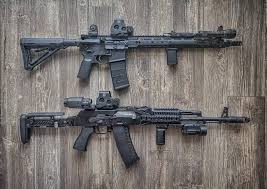
Choose AR If You Want
The AR platform is the better choice if you prioritize:
Precision shooting and long-range accuracy.
High customization and modular flexibility.
Lightweight handling and reduced recoil.
Choose AK If You Want
The AK platform is more suitable if you prioritize:
Maximum reliability in all environments.
Simplicity and durability under stress.
Lower maintenance requirements and rugged performance.
Final Verdict
Both the AR and AK platforms are iconic rifle systems with proven effectiveness across decades of use worldwide.
The AR platform excels in accuracy, ergonomics, and modularity, making it ideal for precision-focused shooting and customizable applications.
The AK platform excels in reliability, simplicity, and rugged durability, making it ideal for harsh environments and low-maintenance operation.
Ultimately, the best choice depends on the user’s intended purpose, environment, and personal preference, as both systems offer unique strengths that suit different needs.
AR vs AK – 55 Frequently Asked Questions (FAQ)
1. What is an AR-15?
The AR-15 is a lightweight, modular rifle platform originally developed in the United States. It is designed for accuracy, customization, and ease of use, making it one of the most popular civilian rifles in the world.
2. What is an AK-47?
The AK-47 is a gas-operated assault rifle developed in the Soviet Union. It is famous for its extreme reliability, simple design, and ability to function in harsh environments with minimal maintenance.
3. Which is better, AR or AK?
Neither platform is universally better. The AR is generally superior in accuracy, ergonomics, and modularity, while the AK is superior in reliability and simplicity. The best choice depends on the user’s needs.
4. Why is the AR more accurate than the AK?
The AR platform typically has tighter manufacturing tolerances, better barrel alignment, and a more consistent sighting system, all of which contribute to improved accuracy at longer distances.
5. Why is the AK considered more reliable?
The AK uses looser tolerances and a robust gas piston system that allows it to function even when dirty, damaged, or poorly maintained, making it highly reliable in harsh conditions.
6. Which rifle is easier to maintain?
The AK is easier to maintain because it requires less frequent cleaning and can operate reliably even with minimal upkeep compared to the AR platform.
7. Is the AR hard to clean?
The AR is not difficult to clean, but it does require more frequent maintenance due to carbon buildup in its direct impingement gas system.
8. Is the AK easy to clean?
Yes, the AK is known for its simple design, which makes field stripping and cleaning very straightforward compared to many modern rifles.
9. Which rifle has less recoil?
The AR generally has less felt recoil due to its inline recoil system and lighter bolt movement, allowing for faster follow-up shots.
10. Why does the AK have more recoil?
The AK has more recoil due to its heavier bolt carrier group and long-stroke piston system, which creates a stronger rearward impulse when firing.
11. Which is better for beginners?
The AR is often recommended for beginners due to its lower recoil, better ergonomics, and easier handling characteristics.
12. Is the AK good for beginners?
The AK can be used by beginners, but its heavier recoil and less intuitive controls may require more training to master effectively.
13. Which rifle is more customizable?
The AR platform is far more customizable, offering a massive aftermarket ecosystem for barrels, stocks, triggers, optics, and accessories.
14. Can AK rifles be customized?
Yes, AK rifles can be customized, but the aftermarket is smaller and modifications often require more specialized fitting compared to AR platforms.
15. Which is more expensive, AR or AK?
AR rifles often have higher customization costs, while AK rifles may be cheaper upfront but vary depending on build quality and manufacturer.
16. What ammo does the AR use?
The AR commonly uses 5.56 NATO and .223 Remington ammunition, which is lightweight, widely available, and effective for a range of applications.
17. What ammo does the AK use?
The AK typically uses 7.62×39mm ammunition, known for its strong penetration and effectiveness at short to medium ranges.
18. Which ammo is cheaper?
AK ammunition (7.62×39mm) is often slightly cheaper in many markets, though prices fluctuate depending on supply and region.
19. Which rifle is better for home defense?
The AR is often preferred for home defense due to its accuracy, low recoil, and controllability in confined spaces.
20. Is AK good for home defense?
The AK can be used for home defense, but its higher recoil and potential for over-penetration may be concerns depending on ammunition choice.
21. Which is better for long range shooting?
The AR is better suited for long-range shooting due to its superior accuracy and flatter trajectory compared to the AK.
22. Can AK shoot long range?
The AK is effective at short to medium ranges but becomes less precise at longer distances compared to AR platforms.
23. Which rifle is lighter?
The AR is generally lighter than most AK variants, especially in standard 5.56 configurations.
24. Which rifle is heavier?
The AK is typically heavier due to its robust steel construction and long-stroke piston system.
25. Which rifle is more durable?
The AK is widely considered more durable in extreme environments due to its simple and rugged design.
26. Can AR rifles survive harsh conditions?
Yes, AR rifles can perform well in harsh conditions if properly maintained, though they are generally more sensitive to fouling than AKs.
27. Which rifle is more modern?
The AR platform is generally considered more modern due to its ongoing development and widespread modular upgrades.
28. Is AK outdated?
No, the AK is not outdated. It remains widely used and has modern variants with improved ergonomics and performance.
29. Which rifle is more popular worldwide?
The AK platform is one of the most widely distributed rifles globally, while the AR platform dominates civilian ownership in the United States.
30. Why is the AK so popular?
The AK is popular because of its simplicity, low production cost, and ability to function reliably in extreme conditions.
31. Why is the AR so popular?
The AR is popular due to its accuracy, modular design, and ease of customization for different shooting purposes.
32. Which rifle is better for competition shooting?
The AR is preferred in competition shooting due to its precision, low recoil, and consistent performance.
33. Can AK be used in competitions?
Yes, AK rifles can be used in competitions, but they are generally less common due to lower precision and ergonomics.
34. Which rifle is easier to shoot fast?
The AR is easier to shoot rapidly due to its lower recoil and better control during follow-up shots.
35. Which rifle has better ergonomics?
The AR has better ergonomics with adjustable stocks, pistol grips, and ambidextrous controls.
36. Are AK ergonomics bad?
AK ergonomics are not necessarily bad, but they are less refined compared to modern AR designs.
37. Which rifle is better for tactical use?
The AR is often preferred for tactical applications due to its precision, modularity, and accessory compatibility.
38. Is AK good for tactical use?
The AK is effective in tactical scenarios that prioritize durability and reliability over precision shooting.
39. Which rifle is easier to modify?
The AR is significantly easier to modify due to its standardized parts and large aftermarket ecosystem.
40. Are AK parts interchangeable?
AK parts are less standardized than AR parts, so compatibility can vary between manufacturers and models.
41. Which rifle lasts longer?
Both rifles can last a long time, but the AK’s robust design gives it an edge in harsh environments with minimal maintenance.
42. Do AR rifles break easily?
No, AR rifles are durable, but they require proper maintenance to ensure consistent reliability.
43. Which rifle is more accurate at 100 yards?
The AR is generally more accurate at 100 yards due to tighter tolerances and better barrel consistency.
44. Can AK hit targets at 100 yards?
Yes, the AK can easily hit targets at 100 yards, but with less precision than an AR platform.
45. Which rifle is better for hunting?
The AR is often preferred for hunting small to medium game due to its accuracy and adaptability.
46. Can AK be used for hunting?
Yes, the AK can be used for hunting, especially medium game at shorter distances.
47. Which rifle is more comfortable to shoot?
The AR is generally more comfortable due to reduced recoil and better ergonomic design.
48. Which rifle is more rugged?
The AK is considered more rugged and resistant to environmental stress.
49. Which rifle is easier to repair?
The AK is easier to field repair due to its simple mechanical design.
50. Which rifle is more precise?
The AR is more precise due to superior barrel alignment and tighter tolerances.
51. Can AR rifles be used in extreme cold?
Yes, AR rifles can function in extreme cold but require proper lubrication and maintenance.
52. Can AK rifles work in sand and mud?
Yes, AK rifles are well known for functioning reliably in sand, mud, and dirty environments.
53. Which rifle is better overall?
Neither rifle is objectively better; AR excels in precision and modularity, while AK excels in reliability and simplicity.
54. What is the biggest advantage of AR?
The biggest advantage of the AR platform is its accuracy combined with extensive customization options.
55. What is the biggest advantage of AK?
The biggest advantage of the AK platform is its unmatched reliability in harsh and unpredictable conditions.
Read more: