
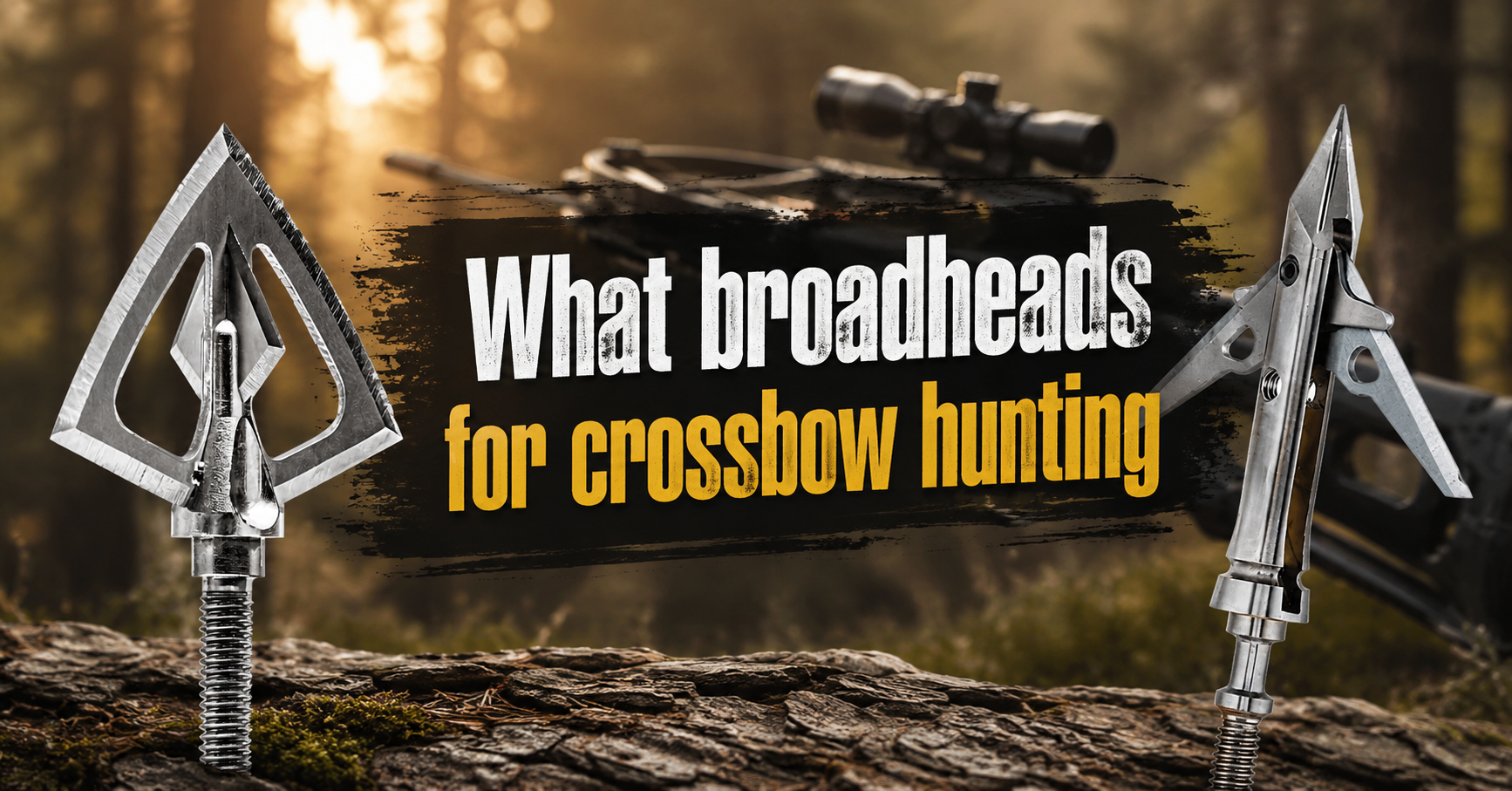

What broadheads for crossbow hunting should you use? Start with a razor-sharp, crossbow-rated broadhead that is approved for your exact crossbow, arrow system and shooting speed. Both fixed-blade and mechanical broadheads can work, but the most suitable choice is the one that remains secure during launch, groups consistently from your setup and meets the hunting regulations where you will be hunting.
For many crossbows, 100-grain broadheads are the standard starting point. Some manufacturers also approve 125- or 150-grain heads, but changing broadhead weight changes the total arrow weight, balance and point of impact. Your crossbow owner’s manual—not a general online recommendation—should determine the acceptable arrow, nock and broadhead combination.
Quick Answer
Choose a compact fixed-blade broadhead when you prioritize simple construction, blade strength and reliable penetration. Choose a crossbow-rated mechanical broadhead when you want a lower-profile head in flight and your crossbow manufacturer approves that design for the bow’s speed. Hybrid broadheads combine fixed and expandable blades but still require manufacturer approval and accuracy testing. Match the broadhead’s grain weight to your practice points, shoot the actual hunting setup into a broadhead-rated target and verify current local regulations before hunting.
Key Takeaways
- Use only a broadhead rated for crossbows and for the speed of your specific model.
- Follow the crossbow manufacturer’s arrow, nock, minimum-weight and broadhead instructions.
- Fixed, mechanical and hybrid heads can all be suitable when legal, compatible and accurate.
- One hundred grains is common, but some approved systems use 125- or 150-grain heads.
- Practice points and broadheads should have the same listed grain weight.
- Never assume a field-point zero is automatically correct for hunting broadheads.
- Use a broadhead wrench, a protective quiver and a target specifically rated for broadheads.
Important Safety and Legal Notice
Crossbow and broadhead rules vary by country, state, province, species, season and land-management area. Regulations may address whether crossbows are legal, which seasons allow them, minimum broadhead width, blade count, expandable blades, arrow length, total arrow weight and hunter-education requirements. Check the current regulation booklet issued by the wildlife agency where the hunt occurs. Federal properties may also have location-specific rules in addition to state law. Regulatory guidance was reviewed on August 2, 2026, but official regulations should be checked again immediately before hunting.
A crossbow can cause fatal injury well beyond an ethical hunting distance. Keep every part of your hand below the finger guard and outside the string path, keep the crossbow pointed in a safe direction, keep your finger away from the trigger until ready to shoot, identify the target positively and know what lies beyond it. Never dry-fire a crossbow, and never rely solely on its mechanical safety. Follow the complete owner’s manual for loading, cocking, uncocking, transport and maintenance.
Crossbow Broadhead Comparison
| Broadhead Type | How It Works | Main Advantages | Main Limitations | Best Starting Use |
|---|---|---|---|---|
| Fixed blade | Blades remain exposed and locked in position during flight and impact. | Simple construction, no deployment mechanism and reusable models may be resharpened or fitted with replacement blades. | Exposed blade surface can increase aerodynamic steering or planing, especially if the arrow, insert or broadhead is not aligned. | Hunters prioritizing structural simplicity and willing to test or tune every hunting arrow. |
| Mechanical or expandable | Blades remain folded or retained during flight and deploy on impact. | Compact flight profile and often a point of impact closer to matching practice points. | Requires a reliable retention and deployment system rated for the crossbow’s acceleration and speed. | Fast crossbows whose manufacturer approves a specific mechanical design. |
| Hybrid | Uses one or more fixed cutting surfaces together with expandable blades. | Combines an initial fixed cut with additional deployed cutting width. | More components, greater complexity and possible compatibility or legal restrictions. | Hunters whose crossbow manufacturer and wildlife regulations permit the exact model. |
Fixed-Blade Broadheads for Crossbows
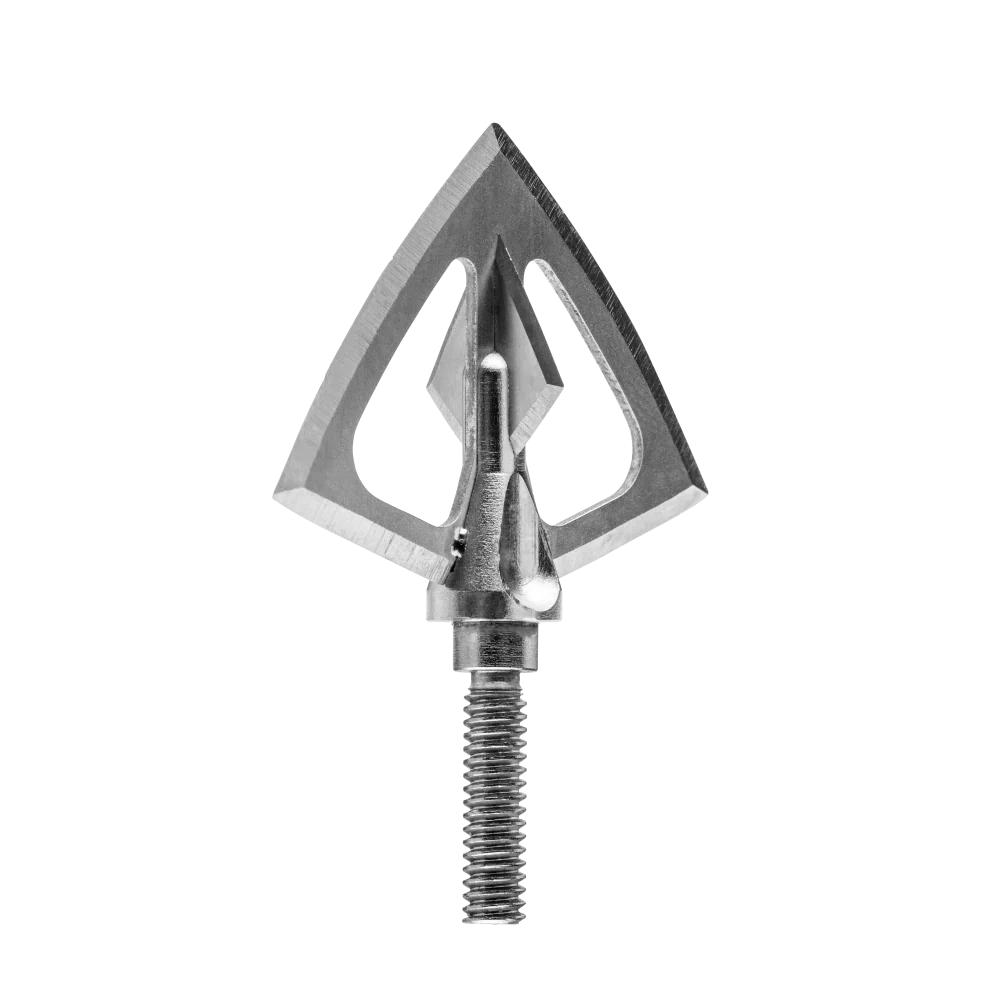
A fixed-blade broadhead has no blade-deployment mechanism. Its cutting edges remain exposed from the time the arrow is loaded until impact. This simplicity appeals to hunters who want fewer moving components and a head that can begin cutting immediately.
Fixed broadheads are not automatically accurate from every crossbow. The exposed blades act as small steering surfaces. If the broadhead, insert, shaft or nock is not straight, or if the head has excessive surface area for the arrow system, the arrow may drift away from the field-point group. Barnett notes that some large fixed heads can plane and advises against fixed heads exceeding a particular cutting diameter in its own crossbows. That limit is manufacturer-specific and should not be applied to another brand without checking its manual.
Fixed-blade advantages
- No blade must deploy after contact.
- Compact fixed heads can provide consistent structural support.
- Some models allow blade replacement or resharpening.
- The hunter can inspect the complete cutting structure before loading.
- They are available in two-, three- and four-blade designs.
Fixed-blade limitations
- They may group differently from field points.
- Larger exposed blades can magnify planing at high crossbow speeds.
- Arrow and broadhead alignment becomes especially important.
- A sight adjustment or different broadhead design may be required.
- They must be transported and handled with particular care because the blades remain exposed.
Who should consider a fixed broadhead?
A compact fixed head is a reasonable starting point for a hunter who values simple construction, uses a manufacturer-approved arrow of adequate total weight and is prepared to test every broadhead-equipped hunting arrow. Fixed heads are also useful when local regulations restrict expandable designs.
Mechanical Broadheads for Crossbows
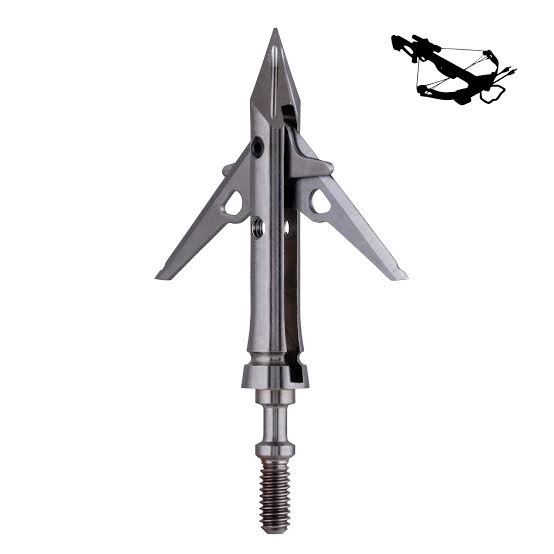
Mechanical broadheads carry their blades in a folded, swept-back or otherwise retained position during flight. The blades deploy when the head strikes the animal. Because less blade surface is exposed in flight, a compatible mechanical broadhead may land closer to the impact point of an equal-weight field point.
Only use a mechanical broadhead explicitly rated for crossbows and the speed range of your bow. Crossbows subject the head’s blade-retention system to rapid acceleration. An unsuitable model may open prematurely, fail to remain secure or behave unpredictably. Ravin’s current manuals, for example, tell users to select crossbow-rated heads appropriate for the speed of the bow, and some Ravin models require mechanical broadheads rather than permitting every design.
Mechanical advantages
- Lower aerodynamic profile while the blades remain closed.
- Often easier to group near equal-weight practice points.
- Available in multiple cutting diameters and deployment designs.
- Some models include a non-sharpened practice head.
- Can reduce the tuning demands associated with large exposed fixed blades.
Mechanical limitations
- The retention and deployment system must function correctly.
- Not every model is rated for high-speed crossbows.
- A large cutting diameter may demand more from the arrow’s available momentum.
- Blades, collars, clips or retainers may need replacement after practice or impact.
- Some hunting jurisdictions restrict mechanical broadheads.
Who should consider a mechanical broadhead?
A crossbow-rated mechanical is a practical option when the owner’s manual approves it, the blades remain securely retained during practice and the broadhead groups consistently at every intended hunting distance. It is not automatically superior merely because it has a wider advertised cut.
Hybrid Broadheads
Hybrid broadheads use both fixed and expandable cutting surfaces. A small fixed blade or fixed tip begins the cut, while additional blades deploy during impact. The design attempts to combine fixed-blade simplicity at initial contact with additional cutting width.
Hybrid heads also combine the inspection requirements of both systems. Check the fixed blades for sharpness and alignment, then inspect the moving components and retention system. Confirm that the complete head is rated for the speed and arrow system of the crossbow.
What Grain Broadhead Should You Use?
Crossbow hunter-education material presents approximately 90 to 125 grains as a common general range and instructs hunters to match practice-point weight to broadhead weight. Manufacturer recommendations are more important than that general range because some crossbow systems are engineered around 100 grains while others approve heavier heads.
| Broadhead Weight | Typical Role | Possible Advantage | Important Caution |
|---|---|---|---|
| 100 grains | Most common starting weight for modern crossbow packages | Often matches the supplied practice points and the manufacturer’s intended arrow balance | Do not assume every crossbow uses a 100-grain system |
| 125 grains | Heavier-front setup when approved | Increases total arrow weight and moves the balance forward | Changes trajectory, point of impact and possibly scope calibration |
| 150 grains | Manufacturer-approved heavy-head systems | Can increase total arrow mass and front weight | Must be approved for the arrow and crossbow; not a universal upgrade |
TenPoint currently recommends a 100-grain broadhead for its standard arrow designs because those arrows were engineered around a 100-grain point. It notes that 125- and 150-grain heads may be used in some setups but require shooting tests to establish accuracy. Excalibur has offered systems designed around both 100- and 150-grain points. These differences show why one universal grain recommendation is unreliable.
Do not consider broadhead weight by itself
The complete projectile includes the shaft, insert, nock, vanes, lighted-nock components when used and the field point or broadhead. Adding a heavier broadhead changes the total arrow weight, trajectory and front-of-center balance. Never reduce shaft weight to compensate unless the crossbow manufacturer explicitly approves the resulting combination.
Manufacturers establish minimum arrow weights to prevent equipment damage and unsafe dry-fire-like conditions. The minimum is not universal. Barnett’s general support information and Ravin’s model manuals, for example, specify different approved arrow systems and warn against underweight arrows.
Crossbow-Rated Broadheads Matter
A package marked “crossbow” should indicate that the blade-retention, ferrule and overall design are intended for the acceleration produced by crossbows. However, the label alone does not prove compatibility with every crossbow speed or arrow diameter.
Check four separate sources:
- The crossbow owner’s manual: Look for allowed broadhead types, maximum diameter, grain weight and required arrow model.
- The arrow instructions: Confirm insert thread, minimum total weight and approved nock.
- The broadhead manufacturer: Confirm the head is rated for your crossbow’s advertised or measured speed.
- The current hunting regulations: Confirm that its blade design and cutting width are legal for the species and season.
Ravin states that both fixed and expandable broadheads work in certain current models but recommends expandable heads rated for the crossbow’s speed. Its R18 manual is more restrictive and directs users to mechanical crossbow-rated broadheads. Model-specific instructions therefore override brand-wide assumptions.
Cutting Diameter: Bigger Is Not Automatically Better
Cutting diameter describes the width of the cut produced when the blades are open. A wider design can create a larger cut, but it also increases blade surface and may require more force to push through the target. With fixed heads, a larger profile may also increase aerodynamic steering.
Choose cutting diameter by balancing:
- Crossbow manufacturer restrictions
- Broadhead speed rating
- Total arrow weight
- Blade angle and exposed surface area
- Expected game size
- Legal minimum or maximum dimensions
- Demonstrated accuracy from the actual setup
Barnett currently warns that fixed-blade heads exceeding 1 3/16 inches are not recommended in its crossbows because large blade surfaces may fly erratically. A current Ravin R470 manual provides a different model-specific maximum. These are equipment restrictions, not universal hunting rules.
Two, Three or Four Blades?
Two-blade broadheads
Two-blade heads generally present less blade surface and may use a simple cut-on-contact profile. Their exact strength and flight depend on ferrule construction, blade thickness, alignment and overall shape.
Three-blade broadheads
Three-blade heads create three cutting paths and are common in both fixed and mechanical designs. Hunter-education material notes that a compact three-blade fixed head may fly more predictably than some wider two-blade profiles, but the result still depends on the specific design and arrow combination.
Four-blade broadheads
Four-blade designs may use four full blades or two primary blades with smaller bleeder blades. Additional blades increase total cutting surface, but they also add drag through the target and may complicate sharpening or replacement.
Blade count alone does not determine accuracy, penetration or suitability. Select the complete design rather than choosing only by the number printed on the package.
Cut-on-Contact, Chisel and Trocar Tips
| Tip Style | General Design | Potential Advantage | Consideration |
|---|---|---|---|
| Cut-on-contact | The sharpened leading edge begins cutting immediately. | Simple entry profile and commonly paired with compact fixed blades. | The exposed edge must remain protected and extremely sharp. |
| Chisel tip | A solid leading point contacts the target before the main blades. | Durable tip structure in many designs. | Tip strength does not compensate for a dull or poorly aligned blade. |
| Trocar tip | A multi-sided pointed tip leads the ferrule. | Commonly used on fixed and mechanical heads. | Actual performance depends on the entire broadhead and arrow system. |
Broadhead Selection by Hunting Situation
| Hunting Situation | Reasonable Starting Direction | Primary Selection Priority |
|---|---|---|
| Whitetail deer at ordinary woods distances | Compact fixed or crossbow-rated mechanical | Reliable grouping, sharp blades and legal cutting width |
| Large-bodied deer, elk or moose where crossbows are legal | Structurally robust fixed head or approved moderate-cut mechanical | Arrow-system compatibility, structural strength and adequate total arrow weight |
| Black bear or wild hog where legal | Durable fixed or approved mechanical with tested retention | Sharpness, strength and conservative shot selection |
| Turkey | Legal turkey-appropriate fixed or mechanical head | Local broadhead rules, selected shot method and extensive practice |
| Very fast crossbow | Head specifically rated for the bow’s speed | Blade retention, ferrule strength and verified point of impact |
| Jurisdiction restricting expandable heads | Legal fixed-blade broadhead | Current wildlife regulations and broadhead tuning |
No broadhead compensates for poor accuracy or a low-percentage shot. Use positive target identification, wait for a clear path to the vital area and stay within the distance at which you can consistently place every hunting arrow under realistic conditions. Hunter-education guidance emphasizes razor-sharp broadheads and clear, close shot opportunities rather than relying on equipment to correct poor shot selection.
How to Test a Crossbow Broadhead Before Hunting
- Read the crossbow manual. Confirm the approved arrow, nock, minimum total weight, broadhead type and grain weight.
- Inspect every arrow. Look for cracked carbon, bent components, damaged vanes, loose inserts and damaged nocks.
- Weigh or verify the components. Make sure the hunting arrows and heads are consistent with the approved setup.
- Start with matching field points. Sight in using field points of the same grain weight as the broadheads.
- Use a broadhead-rated target. A field-point-only target may be damaged or may not stop the broadhead safely.
- Install the broadhead safely. Use the installation wrench or tool provided for the head.
- Begin at close range. Confirm that the arrow strikes safely before moving farther away.
- Shoot the actual hunting head or supplied practice head. Do not rely only on marketing claims about field-point accuracy.
- Compare groups. Record horizontal and vertical differences from the field-point zero.
- Test every hunting arrow. One arrow may group differently because of shaft, insert, nock or broadhead alignment.
- Adjust or change the setup. Follow the crossbow manufacturer’s tuning process rather than forcing an inconsistent combination.
- Install fresh hunting blades. Do not hunt with blades dulled during target testing.
TenPoint and Excalibur both instruct users to sight in with field points matching the broadhead weight and then test the actual fixed-blade hunting setup. TenPoint also recommends checking shafts and installed heads for wobble.
Do Field Points and Broadheads Fly the Same?
They may have similar points of impact, but you should never assume they are identical. Field points have very little aerodynamic surface. A fixed broadhead exposes blades to the air, and even a mechanical head has a different shape and weight distribution.
Mechanical heads often land closer to field-point impact because their blades remain folded during flight. Fixed heads may require arrow alignment, broadhead tuning, a sight adjustment or a different head. Barnett explicitly states that broadhead-equipped arrows may require optic adjustment.
Troubleshooting Broadhead Accuracy
| Problem | Possible Causes | What to Check | Safer Next Step |
|---|---|---|---|
| Broadheads group together but away from field points | Different aerodynamics or changed total arrow balance | Point weight, sight setting and broadhead alignment | Adjust the sight for the verified hunting group or follow the manufacturer’s tuning process |
| Fixed heads scatter in several directions | Planing, bent insert, broadhead wobble, inconsistent arrows or oversized blades | Spin each completed arrow and inspect every component | Replace damaged components or try a smaller-profile approved head |
| One hunting arrow always misses the group | Damaged shaft, insert, nock, vane or broadhead | Inspect and spin the complete arrow | Remove that arrow from hunting use until the fault is corrected |
| Mechanical blades open during flight | Incorrect retainer, damaged mechanism or head not rated for the bow’s speed | Retention components and manufacturer speed rating | Stop using the head and contact the manufacturer |
| Mechanical blades do not stay closed while loading | Worn collar, clip, band or blade-retention feature | Product instructions and replacement components | Replace the damaged parts or the complete head |
| Broadhead loosens after shooting | Insert or threads are damaged, dirty or improperly tightened | Threads, insert bond and approved installation method | Remove the arrow from service until repaired |
| Arrow drops more after changing heads | Heavier broadhead or total-arrow change | Actual grain weight and scope calibration | Re-zero using the approved hunting combination |
| Arrow strikes target at an angle | Poor flight, damaged vane, alignment issue or target movement | Arrow components and group consistency | Do not hunt until straight, repeatable flight is restored |
Broadhead Sharpness and Maintenance
A hunting broadhead must be extremely sharp. A dull blade can reduce cutting efficiency even when the arrow hits the intended area. Replace disposable blades according to the manufacturer’s instructions. Resharpen reusable fixed blades only with the method and angle specified for that model.
Do not run a finger along a blade to test sharpness. Handle the head with a broadhead wrench or protective tool, keep sharpening strokes directed away from the body and keep every hunting arrow inside a protective quiver. Hunter-education guidance identifies careless broadhead handling as a common source of archery injuries.
Inspect before every hunt
- Blade sharpness and edge damage
- Ferrule straightness
- Tip damage
- Loose or missing screws
- Mechanical blade-retention components
- Rust or corrosion
- Damaged arrow insert or threads
- Shaft cracks and nock damage
- Secure fit inside the quiver hood
Inspect after impact
Do not automatically reuse a broadhead that has passed through an animal, struck bone, hit soil or contacted a tree. Clean it safely, examine every component and replace damaged blades, ferrules, screws or retention parts. When the manufacturer does not approve reuse after impact, replace the complete head.
Broadhead Safety in the Field
- Keep broadheads covered in a secure quiver during transport.
- Do not carry an uncovered broadhead in a pocket or loose equipment bag.
- Use a wrench or installation tool when attaching or removing a broadhead.
- Keep hands below the crossbow’s finger guards and outside the string path.
- Never climb a tree stand with a loaded crossbow.
- Haul unloaded equipment separately after attaching the full-body fall-arrest system.
- Use a broadhead target with a safe backstop during practice.
- Do not shoot at an animal unless the target and background are positively identified.
- After a shot, remember that the broadhead may remain in the animal while field dressing.
Hunter-education materials advise covering broadheads during transport and warn hunters that a broadhead may remain inside a harvested animal. Treat every wound channel carefully while field dressing and use protective gloves.
Ethical Range and Shot Selection
A manufacturer’s advertised crossbow speed or target-range accuracy does not establish an ethical hunting distance. Your range should be limited by your demonstrated ability to place broadhead-equipped arrows precisely under field conditions.
Consider:
- The size of your verified broadhead group
- Animal movement and reaction time
- Wind and vegetation
- Light and visibility
- Shooting angle and body position
- Range-estimation accuracy
- Whether the arrow path and background are clear
- Your ability to make a responsible recovery
Wait for a high-percentage opportunity that provides a clear path to the vital area. Avoid steep, obscured, moving or otherwise marginal shots. Mark the animal’s position and direction of travel after the shot, and make every reasonable legal recovery effort without trespassing or entering unsafe terrain.
Common Broadhead Selection Mistakes
| Mistake | Why It Causes Problems | Better Approach |
|---|---|---|
| Choosing by cutting diameter alone | A very large head may affect flight or reduce penetration efficiency | Balance diameter with strength, compatibility and accuracy |
| Assuming every 100-grain head is compatible | Blade retention and speed ratings differ | Confirm the exact broadhead with the crossbow manufacturer |
| Changing from 100 to 125 grains without testing | Total weight, balance and point of impact change | Re-test and re-zero the complete hunting setup |
| Using vertical-bow mechanicals in a fast crossbow | The blades may not remain securely retained during launch | Use a model explicitly rated for crossbows and the bow’s speed |
| Practicing only with field points | Broadheads may group differently | Test the hunting broadhead in a suitable target |
| Hunting with the broadhead used for repeated practice | Target use can dull or damage blades | Install fresh blades or a verified sharp hunting head |
| Ignoring arrow minimum weight | An underweight arrow can damage the crossbow and create a serious hazard | Follow the exact manual for total arrow weight |
| Using damaged carbon arrows | A cracked shaft may fail during launch | Inspect and remove damaged arrows from service |
| Assuming the broadhead is legal everywhere | Width and expandable-blade rules vary | Read the current official hunting regulations |
| Believing equipment corrects poor shot placement | No head guarantees recovery after a marginal hit | Practice and wait for a high-percentage shot |
What Not to Do
- Do not use a broadhead that your crossbow manual prohibits.
- Do not shoot an arrow below the manufacturer’s minimum total weight.
- Do not use a mechanical head that is not rated for crossbows and the bow’s speed.
- Do not hunt without testing the actual broadhead-equipped arrows.
- Do not handle exposed blades with bare fingers.
- Do not use damaged, rusted, loose or dull broadheads.
- Do not shoot broadheads into a field-point-only target.
- Do not dry-fire a crossbow to uncock it.
- Do not climb with a loaded crossbow.
- Do not shoot at unidentified movement or through obstructing vegetation.
- Do not take a shot beyond your proven ability.
- Do not trespass while tracking or recovering game.
Final Answer
What broadheads for crossbow hunting should you choose? Use a razor-sharp fixed, mechanical or hybrid broadhead that is legal, rated for crossbows and approved for the speed, arrow and nock system specified in your crossbow’s manual. A 100-grain head is the most common starting point, but some manufacturer-approved systems use 125 or 150 grains.
Choose a compact fixed head for simple construction and dependable blade position, or a crossbow-rated mechanical when lower-profile flight and easier field-point matching are priorities. Match practice-point weight to broadhead weight, test every hunting arrow in a broadhead-rated target and install fresh sharp blades before hunting. Accuracy, safe handling, conservative shot selection and a responsible recovery plan matter more than brand name or advertised cutting diameter.
FAQs
1. What broadhead is best for a crossbow?
There is no universal best broadhead. The correct head is legal, crossbow-rated, approved by your crossbow manufacturer and consistently accurate from your specific arrow setup.
2. Should I use fixed or mechanical broadheads in a crossbow?
Either can work. Fixed heads offer simple construction, while mechanical heads usually have a lower flight profile. Use the type your crossbow manual approves and your setup groups accurately.
3. Are mechanical broadheads good for crossbows?
Yes, when the head is rated for crossbows and the speed of the bow. Inspect the blade-retention system and test the exact hunting setup before the season.
4. Are fixed broadheads accurate from crossbows?
They can be very accurate, but exposed blades may make alignment and tuning more important. Compact heads generally create less aerodynamic surface than large fixed designs.
5. Do crossbows require special broadheads?
Many do. At minimum, use a head rated for crossbow acceleration and speed. Some models restrict the broadhead type, diameter or approved arrow combination.
6. Can I use compound-bow broadheads in a crossbow?
Only when the broadhead manufacturer and crossbow manufacturer approve the head for that use. Do not assume a vertical-bow mechanical can withstand crossbow acceleration.
7. What grain broadhead should I use for a crossbow?
One hundred grains is the most common starting point. Use 125 or 150 grains only when your crossbow and arrow manufacturer approve the heavier setup.
8. Can I use a 125-grain broadhead instead of 100 grains?
Possibly, but the heavier head changes total arrow weight, balance, trajectory and point of impact. Confirm compatibility and re-zero the crossbow.
9. Are 150-grain broadheads suitable for crossbows?
They are suitable for some manufacturer-designed systems, including certain Excalibur combinations. They are not a universal choice for every crossbow.
10. Should field points match broadhead weight?
Yes. Use field points with the same listed grain weight as the hunting broadhead, then verify the broadhead’s actual point of impact.
11. Will broadheads shoot exactly like field points?
Not necessarily. Mechanical heads may land closer to field-point impact, while fixed heads can require additional alignment, tuning or a sight adjustment.
12. Why do my fixed broadheads fly differently?
Possible causes include blade planing, broadhead wobble, a bent insert, damaged vanes, inconsistent arrows or a fixed head with too much exposed surface for the setup.
13. Why do broadheads hit lower than field points?
The hunting arrow may be heavier, or its aerodynamic drag may differ. Confirm the component weights and adjust the sight only after establishing a repeatable broadhead group.
14. Why does one broadhead arrow miss the group?
That arrow may have a damaged shaft, misaligned insert, bent ferrule, damaged nock or inconsistent vane. Remove it from hunting use until the fault is identified.
15. Do large fixed broadheads plane more?
They can. Greater exposed blade area gives moving air more surface to influence. Barnett specifically cautions against oversized fixed heads in its crossbows.
16. Is a wider cutting diameter always better?
No. A wider cut may increase tissue damage, but the larger blade area may also affect flight or demand more from the arrow during penetration. Accuracy and structural reliability come first.
17. Are two-blade broadheads better for penetration?
A compact two-blade design can present less cutting resistance, but penetration also depends on sharpness, blade angle, arrow weight, impact angle and structural integrity.
18. Are three-blade broadheads good for crossbows?
Yes, when the head is compact, properly aligned and approved for the crossbow. Some three-blade fixed designs may fly well, while oversized versions may plane.
19. What is a hybrid broadhead?
A hybrid head combines fixed cutting surfaces with blades that deploy on impact. It requires inspection of both the fixed blades and the moving components.
20. What does crossbow-rated mean?
It means the manufacturer designed or approved the head for crossbow launch forces. Check whether the rating also covers the speed of your particular bow.
21. Can a mechanical broadhead open during flight?
Premature opening is possible when the head is damaged, incorrectly assembled, fitted with the wrong retainer or not rated for the crossbow’s speed. Stop using any head that does not remain securely closed.
22. Do mechanical broadheads always open on impact?
No product has a guaranteed result in every impact. Inspect and assemble the head exactly as directed, and replace worn retention or deployment components.
23. Should I use a practice mechanical broadhead?
Use the matching practice head when the manufacturer provides one, but still confirm that your hunting heads are assembled correctly and consistent in weight.
24. Can I shoot a hunting broadhead into a regular target?
Only when the target is specifically rated for broadheads and for your crossbow’s speed. A field-point target may be damaged or fail to stop the arrow safely.
25. How far should I practice with crossbow broadheads?
Practice at every distance you may ethically use while hunting, beginning close to confirm safe impact. Your hunting limit should remain inside the distance where every shot is consistently accurate.
26. Do I need to tune a crossbow for fixed broadheads?
You may need to align or sort arrows and heads, check for wobble and make sight adjustments. Follow the crossbow manufacturer’s fixed-head tuning process.
27. Should fixed blades align with the vanes?
Some manufacturers recommend blade-to-vane alignment as part of their tuning procedure. Follow the instructions for the particular arrow and head rather than treating alignment as universal.
28. How sharp should a hunting broadhead be?
It should be razor-sharp and free from rolled, chipped or corroded edges. Replace or correctly resharpen dull blades before hunting.
29. Can broadheads be reused after shooting an animal?
Some fixed heads can be reused after careful inspection, cleaning and blade replacement or sharpening. Replace any head with a bent ferrule, damaged tip, loose components or uncertain deployment function.
30. How should broadheads be installed safely?
Use the supplied installation tool or a broadhead wrench that covers the blades. Keep your hands behind the cutting edges and follow the manufacturer’s tightening instructions.
31. How should broadheads be transported?
Keep them fully enclosed in a secure quiver. Do not carry uncovered heads in pockets, backpacks or vehicle compartments.
32. Can I use lighted nocks with broadheads?
Only when the crossbow manufacturer approves that nock for the model. A lighted nock adds weight and may change the complete arrow specifications.
33. Does a heavier broadhead increase penetration?
A heavier head increases total arrow mass and front weight, but penetration is influenced by the entire arrow, blade shape, sharpness, impact angle and target. A heavier head is not automatically better.
34. Can I use the lightest arrow for maximum speed?
Do not go below the crossbow manufacturer’s minimum total arrow weight. An underweight arrow can create a dry-fire-like condition and damage the crossbow.
35. What broadhead should I use for whitetail deer?
A compact fixed blade or approved mechanical can work well when it is legal, sharp and accurate. Choose according to your crossbow manual and demonstrated grouping.
36. What broadhead should I use for elk?
Where crossbows are legal for elk, prioritize a strong, sharp head, an approved arrow of adequate total weight and conservative shot selection. Verify species-specific equipment rules.
37. What broadhead should I use for bear or hogs?
Use a structurally sound fixed or approved mechanical head that your crossbow shoots accurately. Do not use cutting diameter as a substitute for sharpness, arrow compatibility or careful shot selection.
38. Are mechanical broadheads legal everywhere?
No. Broadhead regulations vary by jurisdiction and may change. Check the current official regulation booklet for the exact species, season and hunting area.
39. What should I do after changing broadhead brands?
Recheck total weight, inspect arrow compatibility, shoot the new heads into a broadhead target and re-zero the optic if necessary. Do not carry an untested head into the field.
40. When should I replace a broadhead?
Replace it when the ferrule bends, the tip is damaged, blades cannot be restored, threads loosen, corrosion weakens the head or a mechanical retention system becomes unreliable.
Read more: