
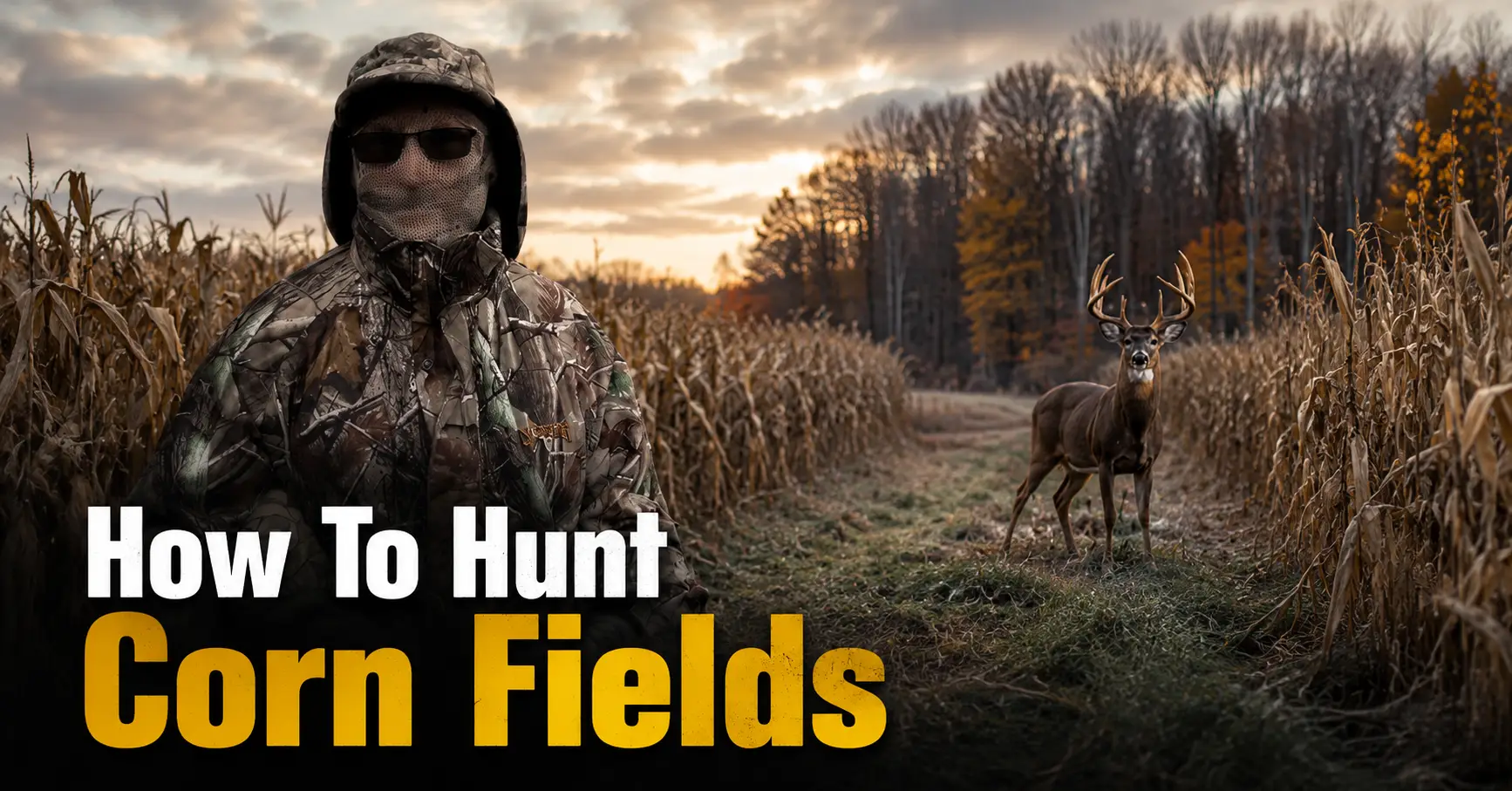

This guide is designed for beginner and developing white-tailed deer hunters. It explains how to scout standing and harvested corn, coordinate with a farmer, locate end rows and waterways, plan a wind-safe entry, select a setup with a known backstop, avoid farm machinery, and handle recovery and property responsibilities ethically.
Quick Answer
To hunt corn fields, first verify current hunting laws and obtain clear landowner permission. Scout field corners, end rows, waterways, fence gaps, staging cover, and fresh trails that connect corn to secure bedding. Choose a setup that keeps your scent away from likely movement and gives you a known earthen backstop; corn stalks are not a backstop. Coordinate around harvest activity, plan a screened exit before the hunt, and take only a clearly legal opportunity within your practiced ability.
Important Legal and Safety Notice Before You Hunt
Regulations vary by country, state, province, county, species, season, land type, and hunting method. Confirm all current requirements with the official wildlife agency and property owner.
- Verify licenses, permits, tags, season dates, legal hours, bag limits, harvest reporting, and transport rules.
- Confirm legal firearms, bows, ammunition, equipment, blinds, tree stands, trail cameras, and baiting rules.
- Obtain private-land permission and clarify exact boundaries, parking, guests, recovery, and neighboring properties.
- Ask about planting, spraying, irrigation, livestock, harvest, grain hauling, and machinery schedules.
- Use required blaze orange or other visibility clothing.
- Identify the target and everything in front of and beyond it. Never shoot toward roads, buildings, people, livestock, machinery, vehicles, or unknown movement.
- Use a full-body harness and lifeline for elevated stands; raise an unloaded weapon with a haul line.
- Complete hunter education and hunt with an experienced ethical mentor when possible.
Why Corn Fields Change Deer Behavior
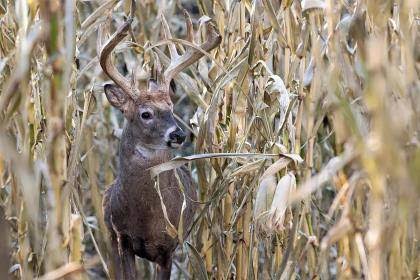
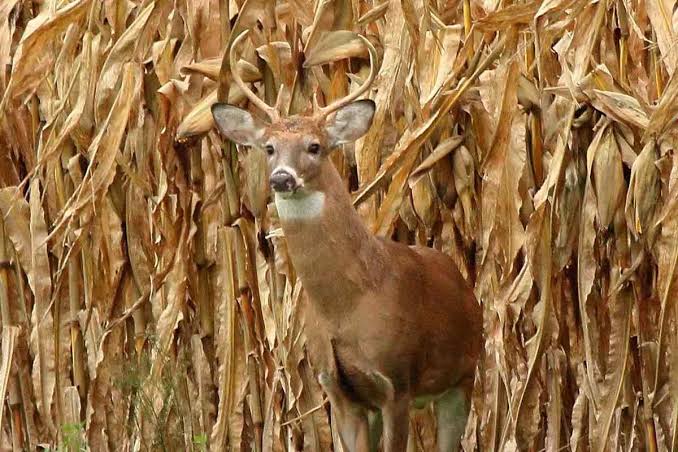
Standing corn differs from a normal open food plot because it provides vertical cover. Deer can use rows as hidden travel corridors, rest in weedy low spots, feed on ears or spilled grain, and move between interior water, timber edges, and neighboring crops.
That creates three practical problems for hunters:
- Limited daylight exposure: deer may have little reason to leave standing corn before dark.
- Unclear location: tracks can be abundant without revealing which interior rows or features are active during legal light.
- Safety and access: dense rows reduce visibility, hide people and machinery, and make a known background harder to confirm.
Standing Corn, Partial Harvest, and Cut Corn
| Corn Condition | How Deer May Use It | Main Hunting Challenge | Scouting Priority |
|---|---|---|---|
| Green or immature corn | Seasonal food, shade, travel, and limited cover | Crop preference changes quickly | Fresh browsing, water, nearby beans or forage, and edge trails |
| Mature standing corn | Food, dense cover, bedding, and hidden movement | Deer may remain inside during legal light | Waterways, corners, end rows, low spots, and staging cover |
| Partially harvested corn | Concentrated cover in remaining strips and feeding on cut sections | Pattern changes every time more rows are removed | New edges, tracks, remaining cover, and combine direction |
| Freshly harvested corn | Waste grain, exposed travel, and short-term adjustment | Machinery, dust, changing pressure, and limited cover | Fresh tracks, field corners, staging trails, and leftover grain |
| Disked or tilled field | Reduced food and cover, with travel shifting elsewhere | Old sign becomes irrelevant | Neighboring crops, mast, cover, and alternate travel corridors |
| Snow-covered stubble | Visible tracks and access to remaining grain | Cold, drifting, icy roads, and exposed movement | Fresh trail direction, sheltered edges, and safe recovery routes |
A harvest date is not a permanent pattern. Recheck the field after every major equipment pass, weather event, tillage operation, or change in nearby food.
Corn-Field Features Worth Scouting
End Rows
Turning areas may have wider spacing, disturbed soil, spilled grain, and more visible tracks. They are also major machinery zones, so placement must be coordinated with the farmer.
Grassed Waterways
Drainage strips may create interior travel corridors and clearer observation lanes. They can be wet, steep, or affected by unpredictable air movement.
Inside Corners
Where timber or brush projects into the field, deer may travel a shorter exposed distance between secure cover and corn.
Fence Gaps and Low Crossings
Look for worn soil, tracks, hair, and concentrated trails. Never alter a fence or assume a crossing provides legal entry.
Weedy Low Spots
Areas too wet or uneven to plant may provide bedding, browse, water, and an interior route. They can also hide ditches and unsafe footing.
Hedgerows and Shelterbelts
Linear cover can connect corn to bedding, but it may hide roads, buildings, livestock, and neighbors. Confirm the complete background.
Missing Rows and Equipment Lanes
Skipped planting, utility access, and equipment paths can reveal tracks and travel. Farm operations always have priority.
Staging Cover
Brush or young timber beside the corn can hold deer before they enter the crop or after harvest. Fresh rubs, scrapes, and browse help confirm use.
What You Need Before You Start
Legal and Permission Documents
- Current license, permits, and tags
- Official regulations and property rules
- Written or documented landowner permission
- Boundary, reporting, and recovery information
Farm and Navigation Information
- Offline property map and compass
- Marked roads, homes, barns, livestock, and neighboring parcels
- Approved parking, entry, and exit routes
- Current harvest and machinery schedule
Safety Equipment
- Required visibility clothing
- First aid kit and emergency communication
- Headlamp and backup power
- Full-body harness and lifeline for elevated stands
Observation Tools
- Binoculars
- Legal wind indicator
- Weather forecast and field notes
- Rangefinder where legal and useful
Hunting Equipment
- Legal, maintained firearm or bow
- Safe case and transport equipment
- Landowner-approved blind or stand
- Haul line for elevated setups
Recovery and Meat Care
- Clean gloves and tools
- Game bags and cooling plan
- Approved removal route
- Reporting and transport supplies
How to Hunt Corn Fields: Step-by-Step Guide
1
Verify Regulations for the Exact Species
Check licenses, tags, legal hours, seasons, bag limits, methods, baiting rules, stands, cameras, harvest reporting, disease rules, and transport. Agricultural rules for deer, doves, and waterfowl are not interchangeable.
2
Obtain Detailed Landowner Permission
Clarify where you may park, walk, hunt, set equipment, bring a guest, and recover game. Ask about crop ownership, tenants, neighbors, livestock, farm dogs, workers, and no-hunt areas.
3
Learn the Corn and Harvest Schedule
Ask whether the corn is for grain, silage, livestock, or another purpose; when harvest may begin; which direction equipment works; and where trucks, wagons, or combines enter.
4
Map the Complete Safety Zone
Mark roads, buildings, yards, barns, livestock, workers, neighboring properties, public trails, utility lines, ditches, and potential earthen backstops. Remove unsafe shot directions before selecting a stand.
5
Scout the Corn Perimeter and Interior Features
Using approved routes, inspect end rows, waterways, corners, fence gaps, low spots, hedgerows, tracks, droppings, browse, rubs, scrapes, and trails. Do not damage stalks or enter chemically treated areas.
6
Connect Corn Use to Secure Cover
Determine whether deer are bedding inside the crop, entering from timber, crossing from another field, or using a staging area. Several connected clues are more reliable than one large track.
7
Choose a Wind-Safe Entry Route
Plan a route that keeps scent away from likely deer locations and avoids crossing the destination trail. Test air at the parking area, approach, field edge, and setup.
8
Plan the Exit Before You Hunt
Choose a screened route that does not require crossing the feeding area. If a landowner-approved vehicle pickup is part of the plan, arrange it before the hunt rather than improvising after dark.
9
Select a Setup With a Known Backstop
Choose a legal location where every likely opportunity ends in safe ground. Corn stalks, hedges, fog, darkness, or distance do not make a safe background.
10
Install Equipment Without Interfering With Farming
Get approval before leaving a blind, stand, camera, marker, or trimming. Keep all equipment away from machinery lanes, field entrances, waterways, fences, irrigation, and harvest routes.
11
Observe With Binoculars and Recheck Conditions
Use optics to identify movement. Monitor wind, temperature, machinery, livestock, vehicles, workers, and other hunters. End the hunt when the environment becomes uncertain or unsafe.
12
Take Only a Legal and Ethical Opportunity
Act only after identifying the legal animal, confirming the unobstructed path and complete background, and judging the opportunity within your practiced range. Pass on movement hidden by rows or stalks.
13
Follow Recovery and Boundary Rules
Complete required tagging and reporting. Stop at any property boundary, protect crops during recovery, and obtain permission before entering neighboring land.
14
Care for the Harvest and the Farm
Use clean gloves and tools, cool edible meat promptly, follow disease and transport rules, remove all trash, close gates as directed, and tell the landowner when you leave.
Wind, Thermals, Entry, and Exit in Corn Country
Dense corn can slow air near the ground, while timber edges, waterways, low spots, roads, barns, and temperature changes redirect it. A forecast arrow is only the starting point.
Field-Edge Wind
Air moving across open ground can tumble when it reaches tall corn or a tree line. Check scent direction at the expected height of deer movement, not only at your face.
Evening Cooling
Cooling air may settle into low rows, ditches, creek bottoms, and waterways. A setup that is safe in midafternoon can become poor near sunset.
Morning Warming
Sunlight may lift air along a warm edge, while shaded corn or low ground remains cool. Cloud cover and strong regional wind can change the timing.
Entry Rules
- Do not cross the field when deer may already be present.
- Stay on approved rows, edges, or lanes and avoid crop damage.
- Move slowly enough to hear machinery and other users.
- Never rely on corn for visual concealment from people or equipment.
Exit Rules
- Use a route screened from the feeding or bedding area.
- Leave according to legal-hour and weapon-handling rules.
- Do not drive into planted ground without explicit permission.
- Carry reliable lighting and maintain awareness of ditches, wire, machinery, and livestock.
How to Hunt Around Corn Harvest Safely
Harvest may create fresh food and reveal travel, but the farm is an active workplace. The farmer and machinery always have priority.
- Confirm the day’s plan directly with the landowner or operator.
- Do not place a stand, blind, camera, or vehicle where a combine, tractor, truck, grain cart, or wagon may travel.
- Never assume an operator can see a person in tall corn, dust, darkness, or mirrors.
- Stay away from moving machinery, headers, augers, grain bins, power takeoffs, and unloading areas.
- Rescout after the equipment leaves; do not assume the previous trail still controls movement.
- Expect the remaining strips and new edges to change after every pass.
- Leave immediately if plans change or the safe separation becomes uncertain.
Corn-Field Setup Options
Staging-Cover Setup
A position inside brush or young timber may intercept deer before they reach the corn and provide an easier exit than a visible field edge.
End-Row Setup
End rows may show tracks and waste grain, but they are also turning areas for machinery. Use them only when harvest is complete or the farmer has approved safe placement.
Waterway Setup
A grass or drainage corridor can create interior movement and a clear opening. Verify footing, water conditions, wind, equipment use, and the complete background.
Field-Corner Setup
Corners can collect trails from several directions. Select the side that protects wind and exit rather than automatically choosing the closest tree.
Field-Edge Tree Stand
Where legal, an elevated view can improve observation. Use a full-body harness and lifeline, inspect equipment, and eliminate all unsafe shot directions.
Ground Blind
A blind can work on treeless edges when the landowner approves it. Anchor and mark it as required, and never place it where machinery, livestock, or workers could contact it.
Best Time, Place, and Conditions for Corn-Field Hunting
| Condition | Potential Opportunity | Main Risk | Responsible Response |
|---|---|---|---|
| Standing mature corn | Food and secure cover in one place | Limited visibility and little daylight edge movement | Focus on connected waterways, staging cover, and legal observation. |
| Fresh harvest | Waste grain and newly exposed routes | Machinery, dust, workers, and rapid pattern changes | Coordinate with the farmer and hunt only after the work area is safe. |
| Partial harvest | Movement may concentrate along remaining strips | New equipment passes can erase the pattern | Rescout each change and keep equipment out of farm routes. |
| Light rain | Quieter dry stalks | Mud, crop damage, cold, and poor recovery conditions | Follow wet-weather access restrictions and carry appropriate gear. |
| Strong wind | May cover some noise and create sheltered edges | Falling limbs, blind instability, and difficult shooting | Avoid hazardous trees and stay within practiced limits. |
| Snow after harvest | Fresh tracks and visible travel | Cold, drifting, icy roads, and hidden ditches | Shorten the plan and carry winter emergency equipment. |
| Heavy hunting pressure | Deer may use overlooked rows or staging cover | Other hunters and unsafe crowding | Increase visibility, communicate, and choose a backup location. |
Helpful Tips for Better Results
- Ask the farmer about corn stage and harvest before every hunt.
- Scout end rows, waterways, corners, and secure staging cover.
- Use binoculars instead of a firearm scope to identify movement.
- Keep multiple legal setups for different winds and harvest stages.
- Check wind at ground level and near low waterways.
- Plan the exit before choosing the stand.
- Do not overhunt the most obvious field entry.
- Mark roads, homes, barns, workers, livestock, and neighboring parcels on the map.
- Practice from the actual position and distance you expect to use.
- Pass whenever target identity, legality, background, path, range, or recovery is uncertain.
Common Mistakes to Avoid
- Assuming corn is only a food source: standing corn may also be bedding and travel cover.
- Entering without an exit plan: deer may surround the edge after sunset.
- Using stalks as a backstop: vegetation does not stop a projectile.
- Hunting near active machinery: never depend on the operator seeing you.
- Ignoring partial harvest: each cut can create a completely new edge.
- Walking through planted rows: use approved routes and protect the crop.
- Setting a blind in an equipment lane: coordinate every structure with the farmer.
- Assuming scattered grain is legal bait: verify species-specific rules.
- Using a riflescope for identification: observe with binoculars.
- Crossing a property line during recovery: obtain permission first.
Troubleshooting Common Problems
| Problem | Possible Cause | What to Do |
|---|---|---|
| Deer never leave standing corn | Food, cover, water, and low pressure are all inside the field | Scout waterways, low spots, connected cover, and harvest changes rather than forcing an interior hunt. |
| Deer appear only after legal light | Pressure, exposed edge, or setup too close to the destination | Move to a legal staging route with a safe wind and better exit. |
| Fresh trails disappear after harvest | Cover and food distribution changed | Rescout new edges, waste grain, remaining strips, and routes to adjacent cover. |
| Wind swirls near a waterway | Cooling air and edge turbulence | Move to a simpler edge or higher setup with more stable airflow. |
| Machinery arrives unexpectedly | Farm schedule changed | Unload and leave by the safe route. Do not remain near the work zone. |
| You cannot identify the background | Standing corn, terrain, fog, distance, or neighboring property | Do not shoot. Relocate to a position with a visible backstop. |
| Unknown grain is concentrated on the ground | Spill, livestock feed, harvest residue, or possible bait | Stop hunting until the wildlife agency and landowner clarify legality. |
| Another hunter is on the opposite edge | Shared permission or communication failure | Do not hunt toward each other. Communicate safely and use a backup location. |
| Game crosses a boundary | Normal movement after the opportunity | Stop at the line and follow local permission or agency procedures. |
Ethical Hunting and Conservation in Corn Country
Responsible corn-field hunting protects wildlife, people, farm operations, crops, and private-property relationships.
- Obey seasons, limits, methods, legal hours, tags, and reporting rules.
- Take only opportunities with a clear target, unobstructed path, safe background, and realistic recovery.
- Respect farm workers, neighbors, livestock, buildings, machinery, crops, fences, roads, and drainage.
- Do not waste edible game or leave trash, cartridges, broadhead packaging, flagging, or damaged vegetation.
- Close gates exactly as directed and report damage or unsafe conditions.
- Use the harvest responsibly and cool meat promptly.
- Support habitat and wildlife management through lawful participation.
When to Get More Training or Professional Guidance
Seek help when you have not completed hunter education, are new to firearms or bows, cannot identify property boundaries, are unsure about agricultural baiting rules, cannot confirm a safe background, or need lawful recovery or meat-care assistance.
Reliable sources include the official wildlife agency, certified hunter education instructors, conservation officers, landowners, farm managers, experienced ethical mentors, and legal tracking services where available.
After the Hunt: Follow-Up, Gear Care, and Learning
- Complete tagging and harvest reporting accurately and on time.
- Use the landowner-approved route for recovery and equipment removal.
- Clean mud, crop residue, moisture, and dust from boots, optics, stands, blinds, and tools.
- Unload, transport, clean, and store firearms or bows according to law and manufacturer instructions.
- Record corn stage, harvest activity, wind, trails, sightings, pressure, and access conditions.
- Tell the landowner when you leave and report any problem.
- Update backup setups after every significant harvest change.
Recommended Hunting Gear and Tools to Consider
You do not need premium gear to hunt responsibly. Select dependable equipment based on the law, field condition, weather, access, hunting method, safety needs, and skill.
- Legal hunting firearm or bow used according to manufacturer instructions
- Required visibility clothing
- Binoculars for safe identification
- Offline property map, compass, GPS or phone, and backup power
- Legal wind indicator
- Supportive boots and weather-appropriate clothing
- Headlamp, first aid kit, water, food, and emergency communication
- Full-body harness, lifeline, and haul line for elevated stands
- Landowner-approved blind or stand
- Clean gloves, game bags, and cooling equipment
Final Thoughts
The best way to learn how to hunt corn fields is to follow the crop as it changes. Standing corn can hide food, bedding, and movement; partial harvest creates temporary strips and edges; and cut corn may expose waste grain and new trails. Each stage requires fresh scouting.
Begin with legal access and farmer communication, then solve the wind, entry, exit, machinery schedule, backstop, and recovery before choosing a stand. Stay flexible, protect the crop, respect wildlife and private property, and pass every opportunity that is not clearly legal, safe, ethical, and within your practiced ability.
Frequently Asked Questions
1. What does corn-field hunting mean?
It usually means hunting legal game in or around standing, partially harvested, or cut corn. This guide focuses mainly on white-tailed deer because corn can provide food, concealment, bedding cover, and travel routes.
2. Do I need a hunting license to hunt corn fields?
Usually yes. Verify the current license, tags, permits, season dates, legal hours, bag limits, weapon rules, reporting, and property-specific requirements with the official wildlife agency.
3. Do I need landowner permission?
Yes on private land. Obtain clear permission and discuss parking, field access, guests, stands, blinds, trail cameras, machinery, livestock, crop protection, recovery, and neighboring boundaries.
4. Is standing corn good deer habitat?
Standing corn can provide food and dense cover, allowing deer to feed, travel, and sometimes bed without leaving the field. Actual use depends on crop maturity, water, nearby cover, pressure, weather, and harvest timing.
5. Is harvested corn better than standing corn?
Neither is always better. Standing corn offers cover and hidden movement, while harvested corn exposes waste grain and travel routes. Harvest can create a short-term shift that requires immediate rescouting.
6. How soon after harvest should I scout?
Coordinate with the farmer and scout only when machinery has left and access is safe. Fresh tracks, field-edge trails, leftover grain, waterways, and staging cover can reveal the new pattern.
7. Can I hunt while a combine is operating?
Do not hunt near active machinery unless the landowner has explicitly coordinated a safe plan. Operators may not see you, and dust, noise, debris, traffic, and rapidly changing field conditions create serious risks.
8. Where do deer enter corn fields?
Common entry areas include field corners, fence gaps, end rows, waterways, drainage ditches, hedgerows, logging roads, low spots, and trails connecting secure cover to the crop.
9. What are end rows?
End rows are the rows at the turning area on a field edge. They may have wider spacing, disturbed soil, spilled grain, and concentrated deer or equipment movement.
10. Why are grass waterways important?
Grassed waterways or drainage strips can cut through corn and provide quieter travel, visibility, and cover connections. They may also be wet, used by machinery, or affected by unstable wind.
11. What is staging cover near corn?
Staging cover is brush, young timber, weeds, or another small feeding area between bedding and the main corn field where deer may pause before entering open ground.
12. Should I hunt directly on the corn edge?
Sometimes, but a setup inside adjacent cover may intercept earlier movement and provide a better exit. Choose based on fresh sign, wind, legal access, background, and hunting pressure.
13. How far inside the woods should I hunt?
There is no universal distance. Start where concentrated trails and staging sign intersect a safe setup, and avoid pushing so deep that you disturb bedding or lose a reliable exit.
14. Can deer live inside standing corn?
Deer can spend extended periods in large standing fields when food, cover, water, and low disturbance are available. That is why edge-only hunting may produce limited daylight movement.
15. How do I scout standing corn safely?
Stay on landowner-approved edges, waterways, lanes, and rows; avoid damaging plants; carry navigation; and never enter when machinery, chemicals, flooding, poor visibility, or uncertain permission make it unsafe.
16. Can I walk corn rows to hunt deer?
Only where legal, explicitly permitted, and safe. Dense corn limits visibility and makes target identification, other-user awareness, and a safe background difficult, so beginners should favor controlled edge or staging setups.
17. How does wind behave in standing corn?
Tall corn can slow and redirect air near the ground, while field edges, tree lines, buildings, terrain, and temperature changes create additional turbulence. Check wind repeatedly at the approach and setup.
18. Do evening thermals matter around corn?
Yes. Cooling air can settle toward low rows, ditches, waterways, and creek bottoms. A wind that was safe earlier may begin carrying scent toward a deer entry route near sunset.
19. What is the safest shooting direction near corn?
A direction with a clearly visible earthen backstop and no road, building, machinery, livestock, person, trail, or neighboring property beyond it. Corn plants are concealment, not a backstop.
20. Can I shoot through corn stalks?
No ethical opportunity should depend on shooting through obstructing vegetation. Wait for a clear, legal target, known background, and unobstructed path within your practiced ability.
21. Can I shoot across a harvested field?
Only when legal and when the target, distance, entire background, property boundary, roads, homes, livestock, people, and machinery are positively known. Open distance does not automatically make a field safe.
22. Why should I use binoculars?
Binoculars let you identify movement without pointing a firearm at an unknown object. A riflescope should never be used as a general observation tool.
23. What is the best wind for a corn-field setup?
The best wind carries scent away from expected bedding, staging cover, and entry trails while keeping a safe and legal shot direction. A nearly perfect wind that often swirls is less useful than a stable conservative wind.
24. What is the best time of day?
Early and late movement is common, but legal hours, crop stage, pressure, weather, breeding activity, and local deer behavior determine actual timing. Midday movement can occur when deer remain inside standing corn.
25. How does rain affect corn-field hunting?
Light rain may quiet dry stalks, but wet soil, mud, cold, fog, poor blood-trail visibility, flooding, and crop damage can make access or recovery unsafe. Follow the landowner’s wet-weather restrictions.
26. How does snow affect corn hunting?
Fresh snow can reveal tracks and field entry points, but wind-driven snow, cold exposure, drifting, icy roads, and hidden ditches require conservative planning.
27. What happens when corn is partially harvested?
Remaining strips can concentrate cover and movement, while cut sections expose grain and tracks. The pattern can change each time the combine removes more rows.
28. Should I ask the farmer when harvest will occur?
Yes. Farmers can explain expected timing, safe parking, equipment routes, weather delays, and areas that must remain clear. Plans may change quickly, so confirm again before hunting.
29. Where should I park?
Park only where the landowner directs. Never block gates, field entrances, grain access, equipment lanes, livestock routes, residences, or emergency access.
30. Can I place a blind in corn?
Only with permission and where legal. It must not damage crops or interfere with machinery, irrigation, drainage, workers, or harvest. Mark and anchor it as required, and remove it on schedule.
31. Can I use a tree stand on a corn edge?
Yes where legal and where a suitable approved tree exists. Use a full-body harness and lifeline, inspect the stand, and raise an unloaded firearm or covered bow with a haul line.
32. What if deer enter the corn before I can leave?
Use the exit planned before the hunt. Avoid crossing the feeding route or open field, and coordinate any permitted pickup strategy with the landowner before the hunt rather than improvising.
33. How often should I hunt the same corn field?
Avoid repeated pressure when wind or access is poor. Rotate legal setups, protect the best entry trails, and rescout when crop or harvest conditions change.
34. What if I find a pile of corn or grain?
Do not hunt until the landowner and wildlife agency clarify whether it is a normal agricultural result or prohibited bait. Baiting rules vary by species and jurisdiction.
35. Are deer rules the same as dove or waterfowl rules in corn fields?
No. Federal and state migratory-bird baiting rules can differ from deer regulations and from each other. Verify the exact species and agricultural practice before hunting.
36. What if a deer crosses onto neighboring land?
Stop at the property boundary and follow local recovery rules. Obtain permission before entering neighboring land, even when recovering legally taken game.
37. What should I do after a legal harvest?
Follow tagging and reporting requirements, recover responsibly, use clean gloves and tools, cool edible meat promptly, follow disease and transport rules, and use a landowner-approved removal route.
38. How can I protect the farmer’s crop?
Use approved lanes and edges, avoid wet fields, do not drive in planted rows, never cut plants or fences without permission, remove trash, and report damage immediately.
39. What is the biggest beginner mistake?
Choosing a visible field edge without solving permission, crop stage, wind, entry, exit, harvest activity, safe background, and recovery first.
40. Can corn-field tactics guarantee success?
No. Results depend on regulations, crop condition, harvest, weather, pressure, deer behavior, access, skill, patience, and ethical decisions.
Read more: How to Hunt Before a Storm: A Safe, Legal, Beginner-Friendly Field Guide