
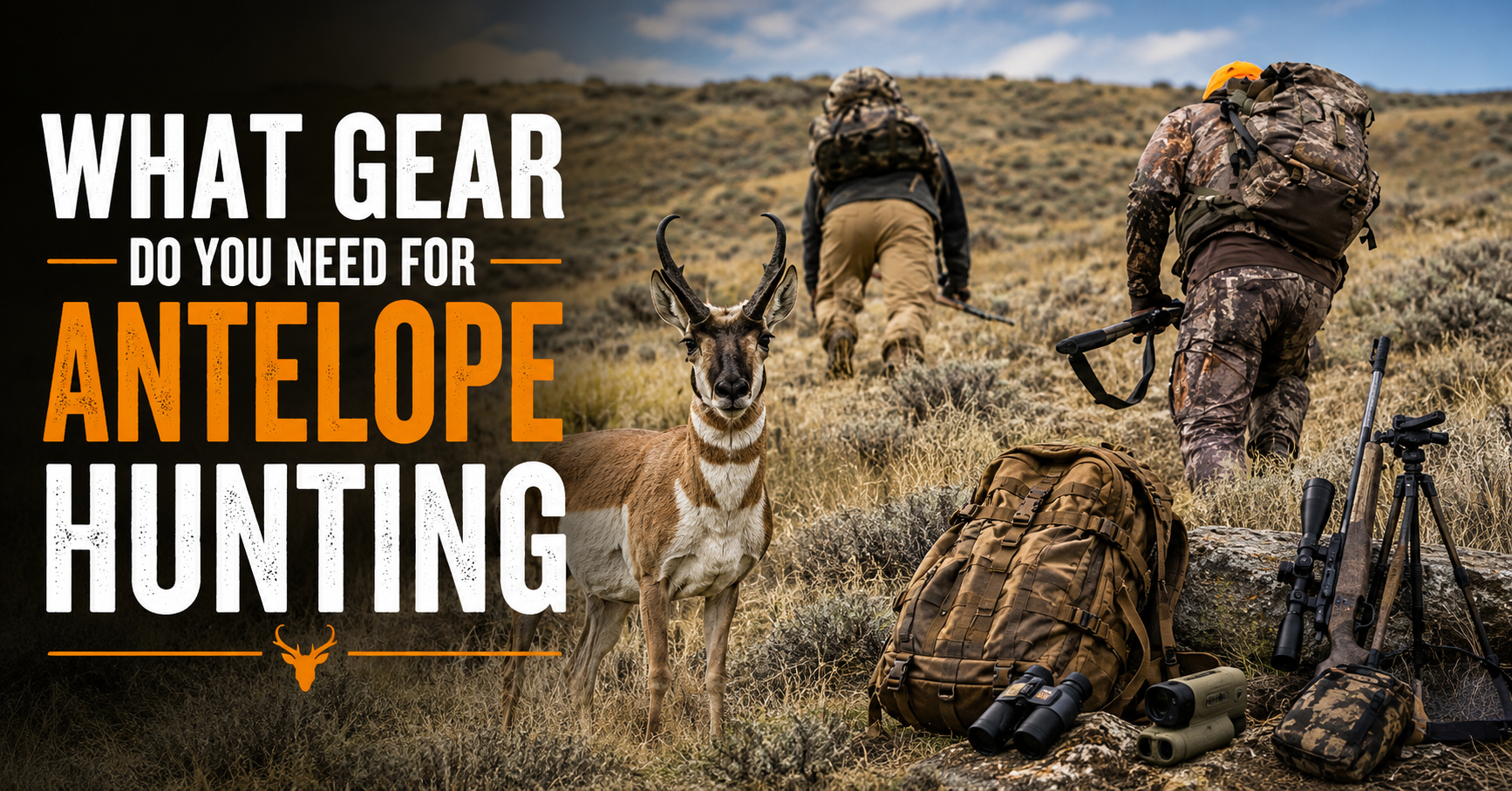

If you are asking what gear do you need for antelope hunting, you are probably preparing for a North American pronghorn hunt. The core kit includes your license and tag, a legal and practiced rifle or archery system, binoculars, a rangefinder where legal, dependable shooting support, sun and wind protection, water, navigation, communication, field-dressing tools, breathable game bags, and a rapid cooling plan.
Pronghorn live in exposed country where distance can be deceptive, wind can change quickly, private parcels may be mixed with public land, and early-season heat can threaten both hunters and meat. The most useful gear helps you identify the correct animal, stay inside legal boundaries, make an ethical shot within your demonstrated ability, and recover the entire harvest without waste.
Pronghorn are not true antelope, although “antelope” is the common hunting term in the United States. If your trip involves an African or Asian antelope species, use the destination country’s rules, species-specific equipment requirements, airline and firearm-import procedures, and outfitter packing list instead of treating this North American checklist as universal.
Quick Answer: What Gear Do You Need for Antelope Hunting?
You need the correct license, pronghorn tag or permit, identification, hunter-education proof, current regulations, and legal-access information. Carry a lawful, zeroed rifle and compatible big-game ammunition or a tuned bow or crossbow with legal arrows and broadheads, plus binoculars, an optional spotting scope, a rangefinder where allowed, and a stable field rest. Add required hunter orange, wind and sun protection, layered clothing, broken-in boots, plenty of water, map and compass, offline GPS, emergency communication, first aid, headlamps, knives, game bags, a hauling pack, coolers, and ice. Verify the exact unit, season, sex, weapon, tagging, evidence-of-sex, access, vehicle, and salvage rules before leaving.
Important Legal and Safety Notice
Legal information checked August 27, 2026. Pronghorn hunting regulations vary by state, management unit, tag type, season, weapon, sex, age or horn classification, public or private land, residency, and emergency order. A general gear list cannot tell you whether your tag is valid on a particular parcel or whether a specific firearm, bow, broadhead, decoy, blind, electronic device, or vehicle use is legal.
Read the wildlife agency’s current regulations and your physical or electronic license. The Wyoming Game and Fish Department regulations, for example, establish season dates, limitations, hunt-area descriptions, and special archery provisions. The Colorado Parks and Wildlife big-game page directs hunters to its current brochure and license details. These are examples of official sources, not nationwide rules.
Public-land ownership does not guarantee legal public access. Private inholdings and parcels can interrupt public ground, and motorized travel may be restricted to designated routes. Obtain landowner permission before crossing or hunting private property. Confirm road status, travel-management rules, fire restrictions, and temporary closures with the land manager.
Antelope Hunting Gear at a Glance
| Gear category | Priority | Why it matters | What to check |
|---|---|---|---|
| License, tag, ID, and regulations | Required | Proves eligibility and defines the legal animal, unit, method, and season | Tag holder, sex, hunt code, boundaries, dates, legal hours, and reporting |
| Land-access documents and maps | Required where applicable | Prevents trespass and unlawful vehicle use | Public access, private permission, easements, closed roads, and travel plan |
| Legal, practiced hunting system | Essential | Supports accurate and humane shot placement | Weapon and projectile rules, fit, zero or tune, compatibility, and proficiency |
| Binoculars | Essential | Locates animals and confirms sex, horn features, behavior, and background | Harness fit, lens condition, focus, weather protection, and low-light clarity |
| Rangefinder | Highly useful where legal | Reduces distance-estimation errors in open terrain | Electronic-device law, battery, ranging mode, and field verification |
| Spotting scope and tripod | Optional to highly useful | Allows detailed evaluation from far away without unnecessary walking | Habitat, hunt goal, weight, tripod stability, and optical condition |
| Shooting support | Essential for many hunters | Creates a stable position above grass or uneven ground | Height, terrain, weapon compatibility, practice, and safe muzzle direction |
| Layered clothing and required orange | Essential | Manages sun, heat, wind, rain, cold mornings, visibility, and abrasion | Forecast, season, state orange rule, fit, noise, and ventilation |
| Water and heat-safety supplies | Essential | Supports exertion in dry, exposed country | Route, reliable water sources, treatment, capacity, and emergency reserve |
| Map, compass, offline GPS, and communication | Essential | Maintains boundaries and supports emergency response | Downloaded maps, private parcels, charged power, coverage, and check-in plan |
| Field-care and hauling kit | Essential | Enables legal salvage, clean meat handling, and fast cooling | Evidence of sex, tagging, game bags, pack route, cooler space, and processor |
| Blind, decoy, or stalking accessories | Method-specific | Supports an approved archery or firearm strategy | Season, device legality, placement, land rules, visibility, and removal |
Legal Documents and Mapping Tools
Keep your identification, hunting license, pronghorn tag or permit, hunter-education card, landowner permission, access permit, and current regulation pages in a waterproof pouch. If your state uses an app, download the license and reporting instructions for offline use, but carry any physical tag the law requires.
Mark the legal hunt-area boundary, public parcels, private inholdings, walk-in access, easements, closed areas, roads, gates, camps, water, vehicle, and emergency exits. Compare the mapping app with the official legal description because a convenient map layer may not be the controlling boundary.
The U.S. Forest Service warns on some hunting pages that private land is interspersed with public land and hunters must avoid trespass. Its Umpqua National Forest guidance is one example of why a land-ownership map and written permission belong in the gear list. Check the agency responsible for the exact land you will enter.
Eight rules to verify before packing
- Tag species, sex, horn or age classification, hunt code, and unit.
- Opening and closing dates, legal hours, and quota or closure status.
- Legal firearm, caliber, cartridge, ammunition, bow, crossbow, arrow, and broadhead rules.
- Required fluorescent orange or other visibility requirements.
- Decoy, blind, electronic device, trail-camera, and communication restrictions.
- Public access, private permission, camping, parking, road, and off-highway vehicle rules.
- Tagging, evidence-of-sex, reporting, inspection, and transport requirements.
- Mandatory edible-meat salvage and carcass-disposal rules.
Optics: The Most Important Pronghorn-Specific Gear
Pronghorn rely heavily on eyesight and often occupy terrain with long views. Binoculars let you locate animals, confirm the correct sex or legal classification, watch for hidden animals behind the target, study the background, and plan a route without crossing unnecessary ground. Use a chest harness that protects the lenses and keeps the binoculars available without swinging during a crawl.
Binoculars
Choose magnification and objective size based on stability, field of view, weight, and the terrain. Higher magnification is not automatically better if the image shakes or the narrow view makes scanning difficult. Test focus, diopter, eyecups, and clarity before the trip. Use a tripod adapter if you plan long glassing sessions.
Spotting scope
A spotting scope can help evaluate distant horn features and avoid hiking toward the wrong animal. It is most useful in large basins and flat country with extended views. It may be optional on a short guided hunt, a blind hunt at a known water source, or a trip where a partner already carries one.
Rangefinder
Open ground can make distance look shorter or longer than it is. A rangefinder helps the hunter decide whether the shot is inside a proven limit and allows archery hunters to pre-range landmarks near a blind. Confirm that the device is legal, learn its modes, carry a spare battery, and test it on grass, brush, and animals before the season.
Tripod
A stable tripod can support binoculars, a spotting scope, or a compatible shooting rest. Select enough stability for prairie wind without carrying more weight than the hunt requires. Practice changing from observation to a safe shooting position without pointing the firearm at partners.
Rifle and Ammunition Gear
There is no universal best pronghorn rifle or caliber. The appropriate system depends on local law, the shooter’s accuracy and recoil tolerance, firearm fit, expected distance, wind, terrain, projectile construction, ammunition availability, and safe background. A “flat-shooting” label does not remove the need to measure distance, understand wind uncertainty, and stay within demonstrated ability.
- A legal, reliable rifle that fits the hunter
- Lawful big-game ammunition compatible with the firearm
- A securely mounted, properly zeroed scope or suitable sights
- Scope caps, lens cloth, and safe weather protection
- A comfortable sling that maintains muzzle control
- A practiced bipod, tripod, shooting sticks, or pack rest
- Eye and hearing protection
- A secure case and transport system that complies with local law
Verify zero with the exact hunting ammunition. Confirm point of impact from realistic positions and in wind, but do not use a public-land hunt as a practice range. Carry only compatible ammunition and inspect each cartridge. Do not make untested scope, mount, or ammunition changes immediately before departure.
Archery and Crossbow Gear
Archery pronghorn hunting may involve a ground blind near water, spot-and-stalk, or a decoy where lawful. Each approach creates a different packing list. A blind hunter prioritizes shade, water, a chair, pre-ranged landmarks, and quiet organization. A spot-and-stalk hunter prioritizes mobility, kneeling protection, concealment, and wind awareness.
- A legal, tuned bow or crossbow within manufacturer specifications
- Properly spined arrows or compatible bolts
- Sharp, legal broadheads matched to the complete arrow system
- Secure quiver and protective broadhead storage
- Rangefinder where lawful
- Release aid, finger protection, or cocking device as appropriate
- Small repair kit with only manufacturer-approved components
- A safe discharge target or manufacturer-approved decocking method for a crossbow
Practice from the chair, kneeling position, blind window, or uneven ground you expect to use. Confirm clearance for limbs, strings, broadheads, and the blind. Never dry-fire a bow or crossbow, and do not rely on expensive equipment to extend your ethical range.
Firearm Safety in Open Country
The International Hunter Education Association standards reinforce four basic firearm safety rules:
- Treat every firearm as if it is loaded.
- Keep the muzzle pointed in a safe direction.
- Keep your finger outside the trigger guard until ready to shoot.
- Be certain of the target and what is beyond it.
Open terrain is not automatically a safe backstop. A bullet can travel beyond the animal across flat ground, and roads, ranch buildings, livestock, vehicles, or other hunters may be difficult to see. Change position or pass the shot unless the target and entire danger area are safe.
Use binoculars—not the riflescope—to inspect distant animals or unidentified objects. Unload before entering a vehicle and whenever required by law. Maintain muzzle control while crawling, crossing fences, changing rests, and working around a partner. A mechanical safety does not make poor handling acceptable.
Shooting Support and Wind-Management Tools
Prairie vegetation may be too high for a prone position, while a standing position may be unstable in wind. A compact bipod, tripod, or shooting sticks can create a reliable seated, kneeling, or supported-standing position. Select a support that fits the weapon and the height of likely cover.
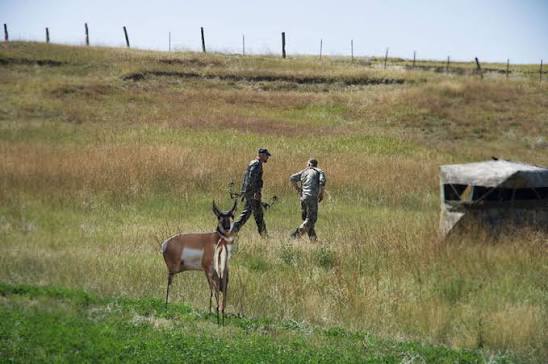
Carry a legal wind indicator if useful, but treat any reading as a local observation rather than certainty along the entire bullet or arrow path. Practice in varied winds and establish conservative limits. When wind, animal movement, range, or rest stability exceeds those limits, wait or move closer.
Clothing for Sun, Wind, Heat, and Cold Mornings
Many pronghorn seasons occur when afternoons are warm but mornings can be cold and windy. Use lightweight layers that vent during a stalk and insulate during glassing. Pack a rain shell even in dry country because exposed weather can change quickly.
- Required fluorescent orange or other legal visibility garment
- Moisture-managing base layer
- Light insulating midlayer
- Wind-resistant outer layer and breathable rain shell
- Durable pants that resist grass, sage, rock, and cactus abrasion
- Broken-in boots appropriate to rolling, rocky, or flat terrain
- Spare socks and blister-treatment supplies
- Sun hat, sunglasses, sunscreen, and lip protection
- Light gloves plus warmer gloves when forecast
- Warm hat and compact insulation for early or late hours
- Gaiters where seeds, dust, mud, snow, or cactus fragments are a problem
Camouflage is optional; quiet movement, legal visibility, wind planning, and using terrain are more important. For an archery blind, dark clothing may reduce movement visibility inside, but use hunter orange whenever the law requires it outside or during setup and recovery.
Knee, Hand, and Eye Protection for Stalking
Low approaches may cross sharp rock, cactus, dry grass, or abrasive soil. Lightweight knee pads, durable gloves, and eye protection can make a controlled crawl safer. They are optional when terrain permits an upright approach but valuable in low, exposed country.
- Flexible knee pads that do not slide or restrict circulation
- Leather or puncture-resistant gloves for cactus and wire hazards
- Clear or tinted protective glasses
- Compact tweezers or multitool for surface cactus spines
- Small pad or folded foam for long glassing sessions
Do not crawl with a finger near the trigger or a muzzle pointed toward a partner. Keep broadheads covered and control every sharp edge. Never cross a fence with a loaded firearm; unload and use the hunter-education method appropriate to the fence and group.
Water, Food, and Heat-Safety Gear
Dry wind can hide sweat loss, and water sources shown on a map may be seasonal, privately controlled, or reserved for livestock and wildlife. Carry enough water for the planned route plus a delay and do not count on an unverified stock tank. A filter does not make every chemically contaminated or algae-affected source safe.
- Water bottles or reservoir with measured capacity
- Backup container in the vehicle
- Appropriate filter or treatment for verified natural sources
- Food that tolerates heat and can be eaten without elaborate preparation
- Electrolyte replacement appropriate to personal needs and label directions
- Sun shelter or umbrella for a stationary blind where practical and legal
- Cooling towel and extra water for first aid
Physical activity and heat exposure can produce dangerous heat stress. The CDC heat-stress guidance emphasizes planning for heat combined with exertion. Stop, seek shade, cool down, and get help for concerning symptoms such as confusion, collapse, severe headache, or worsening illness.
Navigation, Communication, and Vehicle Gear
Carry a paper map and compass as independent backups to a phone or GPS. Download ownership, topographic, and unit maps before losing service. Mark the vehicle, legal parking, camp, gates, private boundaries, water, recovery route, and emergency exits.
A phone may not have service on open rangeland despite a clear horizon. Add a satellite communicator or personal locator beacon for remote hunts, test it, and leave a check-in plan with a reliable contact. Carry a primary headlamp, backup light, spare power, first aid, emergency shelter, and signaling tools even on a day hunt.
Vehicle kit
- Full-size spare tire, jack, and tools suited to the vehicle
- Tire-pressure gauge and legal recovery equipment
- Extra water, food, warm layers, and sleeping insulation
- Paper road map and land-manager motor-vehicle-use map
- Battery jump pack and basic repair supplies
- Fire extinguisher and shovel where appropriate and lawful
- Coolers, clean ice, and meat transport supplies
Stay on legal routes, respect seasonal closures, close gates as directed, avoid wet-road damage, and never use a vehicle to harass or unlawfully pursue wildlife. Park without blocking ranch, fire, or public access.
Field-Dressing, Recovery, and Meat-Care Gear
Pronghorn meat can warm rapidly under sun and hide. Begin the legal tagging and field-care process promptly, move meat into shade, expose it to clean airflow, and transport it to ice or refrigeration. The Nevada Department of Wildlife field-care guidance notes the importance of prompt field dressing, shade, quartering, and air circulation in warm weather.
Field-care checklist
- Two sharp, controllable knives with secure sheaths
- Compact sharpener or safely stored replacement blades
- Cut-resistant glove for the non-knife hand and disposable food-safe gloves
- Breathable game bags sized for every required portion
- Clean tarp or ground barrier
- Utility cord for load control and hanging bags where suitable
- Tagging tools, waterproof pen, and reporting instructions
- Pack frame or load-hauling pack
- Coolers, ice or frozen bottles, and cleanable containers
- Processor contact, hours, route, and backup cooling plan
Preserve evidence of sex naturally attached exactly as the regulation requires. Do not remove the head, sex evidence, tag, or other required part until you understand the rule. Keep meat away from hair, digestive contents, dust, dirty water, fuel, and direct sunlight. Do not delay field care for lengthy photographs.
Method-Specific Gear
Rifle spot-and-stalk
- Binoculars, rangefinder, and optional spotting scope
- Stable shooting support practiced above grass height
- Wind and distance notes or verified ballistic reference for the exact load
- Light day pack that can expand for a first meat load
- Knee pads, gloves, and eye protection for low approaches
Archery ground blind
- Legal portable blind with stakes and tie-downs
- Quiet chair, bow holder, and clear shooting lanes
- Extra water, shade, ventilation, and food for long sits
- Rangefinder and pre-ranged landmarks
- Dark interior layers that do not conflict with orange law
- Removal plan for blind, stakes, flagging, and all litter
Confirm setback, water-source, public-use, placement-date, and unattended-property rules. Do not block wildlife, livestock, or other lawful users from water.
Archery spot-and-stalk or decoy
- Compact legal decoy with a safe carrying method
- Bright visibility panel for transport if appropriate
- Rangefinder and wind indicator where legal
- Knee pads, gloves, quiet clothing, and minimal pack
- Clear partner communication and defined safe shooting sectors
A decoy can hide the hunter from animals but may also hide the hunter’s human outline from other hunters. Never use one near roads, buildings, blind corners, or active firearm hunters without a carefully controlled plan. Check whether decoys are legal for the season and property.
Useful Extras, Not True Essentials
- Tripod adapter for binoculars
- Glassing pad or folding stool
- Trekking poles for pack-outs
- Power bank or small solar charger
- Compact weather meter for observation and training
- Camera adapter for a spotting scope
- Small pack scale for dividing loads
- Camp shoes and comfort items for a multi-day base camp
- Taxidermy supplies specified by the chosen professional
You do not need the most expensive equipment to hunt responsibly. Reliable fit, legal use, field practice, simple maintenance, and a complete recovery plan create more value than a long list of premium products.
How to Reduce Pack Weight
- Pack legal documents, water, safety, navigation, communication, and field-care gear first.
- Match optics to the terrain and share a spotting scope and tripod with a partner.
- Use layered clothing with multiple functions instead of several bulky jackets.
- Carry one verified ammunition load or tuned arrow system rather than experimental options.
- Leave vehicle-repair, cooler, and base-camp gear at the vehicle while retaining essentials on your body.
- Remove duplicate comfort items but keep independent backups for light, navigation, fire, and communication.
- Reserve pack space and safe carrying capacity for meat and required parts.
Do not save weight by removing water, required hunter orange, first aid, emergency shelter, tag materials, game bags, a map and compass, or a dependable cooling plan.
Common Beginner Mistakes
- Planning around gear before the tag: confirm the unit, sex, season, and method before buying specialized equipment.
- Assuming visible land is accessible: verify ownership, legal access, easements, and road restrictions.
- Using the riflescope to identify animals: glass with binoculars to maintain safe muzzle direction.
- Chasing magnification: choose optics that remain stable and provide a useful field of view.
- Practicing only from a bench: train with the actual support and positions you can use safely in the field.
- Underestimating wind: adopt conservative limits and move closer instead of trusting a guess.
- Carrying too little water: calculate the route and include delays, recovery, and changing weather.
- Leaving all cooling gear in distant camp: keep coolers and ice ready at the closest legal vehicle access.
- Wearing new boots: break them in and test socks, insoles, and pack weight before the hunt.
- Forgetting evidence-of-sex rules: read them before field dressing, not after cutting.
- Using a decoy without a hunter-safety plan: control visibility, location, partner movement, and firearm seasons.
- Counting on cell service: carry offline navigation and appropriate emergency communication.
What Not to Do
- Do not hunt without the correct license, tag, unit, season, and access permission.
- Do not shoot until the animal’s species, legal sex or class, target, and background are certain.
- Do not point a firearm at anything you are only trying to identify.
- Do not take a shot beyond your proven accuracy or through uncertain wind and brush.
- Do not shoot toward a road, building, vehicle, livestock, hunter, skyline, or unsafe flat background.
- Do not trespass, cross private land without permission, or drive off legal routes.
- Do not pursue wildlife with a motor vehicle where prohibited or damage wet roads and habitat.
- Do not use an unapproved decoy, electronic device, blind, weapon, projectile, or communication method.
- Do not cross a fence or enter a vehicle with a loaded firearm.
- Do not continue when heat illness, lightning, wildfire, injury, lost navigation, or darkness makes the plan unsafe.
- Do not leave edible meat, required sex evidence, tags, or other legally required parts in the field.
- Do not delay cooling for photographs, scouting another herd, or searching for a larger animal after harvest.
Printable Antelope Hunting Gear Checklist
Documents and legal information
- Photo identification
- Hunting license and pronghorn tag or permit
- Hunter-education card
- Landowner permission and access permits
- Current regulations and emergency updates
- Unit map and official legal description
- Tagging, sex-evidence, reporting, and salvage instructions
- Motor-vehicle-use map and fire restrictions
Hunting system and optics
- Legal, zeroed rifle or tuned bow or crossbow
- Compatible legal ammunition, arrows, bolts, and broadheads
- Binoculars and protective harness
- Rangefinder where lawful
- Spotting scope and tripod if useful
- Practiced shooting support
- Eye and hearing protection
- Safe case, sling, quiver, and sharp-point covers
Clothing and personal protection
- Required hunter orange
- Base, insulation, wind, and rain layers
- Broken-in boots and spare socks
- Sun hat, sunglasses, sunscreen, and lip protection
- Gloves, knee pads, gaiters, and eye protection as terrain requires
- Blister kit and personal medications
Water, navigation, and emergencies
- Water capacity plus emergency reserve
- Food and appropriate electrolyte replacement
- Paper map and compass
- Phone or GPS with offline maps
- Satellite communicator, beacon, or suitable radio
- First aid kit and emergency shelter
- Headlamp, backup light, and spare power
- Fire and signaling tools that comply with restrictions
Recovery and meat care
- Knives, sheaths, sharpener, and protective gloves
- Breathable game bags and clean tarp
- Utility cord and legal marking materials
- Load-hauling pack
- Tagging tools and waterproof pen
- Coolers, ice, and clean transport containers
- Processor contact and backup cooling plan
Final departure check
- Tag, unit, sex, season, legal hours, and weapon confirmed
- Access, private boundaries, roads, parking, and closures confirmed
- Zero or tune and field-position accuracy confirmed
- Optics, rangefinder, maps, lights, and communicator tested
- Weather, heat, lightning, and wildfire conditions checked
- Trip plan and overdue procedure left with a reliable contact
- Water, pack weight, recovery route, ice, and cooler space verified
Final Answer
What gear do you need for antelope hunting? For a North American pronghorn hunt, begin with the correct tag, current regulations, land-access documents, and a lawful rifle or archery system that you have practiced with. Add binoculars, a rangefinder where legal, optional spotting scope, stable shooting support, required hunter orange, adaptable layers, sun and wind protection, broken-in boots, abundant water, offline navigation, emergency communication, first aid, game bags, knives, a hauling pack, coolers, and ice. Pack a blind, decoy, tripod, knee pads, or other specialized equipment only when the hunting method and terrain require it. The right kit supports positive identification, a safe background, conservative shot selection, legal access, clean recovery, rapid cooling, and respect for the animal and habitat.
FAQs
1. Is a pronghorn really an antelope?
No. Pronghorn are a distinct North American species, but hunters commonly call them antelope. This article uses the common search term while focusing on pronghorn hunting.
2. What are the absolute essentials for antelope hunting?
Carry legal documents, a practiced hunting system, binoculars, rangefinder where legal, shooting support, appropriate clothing, water, navigation, communication, first aid, tagging tools, game bags, knives, a hauling pack, and cooling supplies.
3. Do I need a special antelope tag?
Yes, most jurisdictions require a species- and hunt-specific tag, permit, or license. It may also specify the unit, sex, season, and legal weapon.
4. Are most pronghorn tags issued through a draw?
Many are limited and awarded through a draw, while some states offer leftover, landowner, youth, or over-the-counter opportunities. Check the current official application and license rules.
5. What rifle should I use for antelope hunting?
Use a legal rifle that fits you, handles the expected terrain, and produces repeatable accuracy with a suitable big-game projectile. No model is best for every hunter.
6. What caliber is best for pronghorn?
There is no universal best caliber. Consider state law, recoil, projectile construction, firearm fit, wind, expected distance, ammunition availability, and your demonstrated accuracy.
7. Do I need a high-magnification riflescope?
No. Choose useful magnification, field of view, eye relief, weight, and reliable adjustments. Too much magnification can make finding the animal and holding steady more difficult.
8. How should I zero my rifle?
Use a zero that you understand and have verified with the exact hunting ammunition. Confirm impact at relevant distances and do not copy another hunter’s zero without testing.
9. How much ammunition should I bring?
Bring enough of one verified legal load for a zero check, the hunt, and a reasonable reserve. Keep cartridges dry, protected, and separated from incompatible ammunition.
10. Can I hunt pronghorn with a bow?
Yes where the season and equipment rules permit it. Use a tuned bow, legal broadheads, correctly matched arrows, and a conservative range based on field-position accuracy.
11. Can I use a crossbow?
Crossbow legality can depend on the season, hunter eligibility, draw weight, projectile, and unit. Check the current regulations and follow the manufacturer’s cocking and decocking instructions.
12. Do I need binoculars?
Yes. Binoculars are essential for locating and identifying pronghorn without pointing a firearm at distant animals, vehicles, livestock, or people.
13. What binocular magnification is best?
The best choice balances stability, field of view, image quality, weight, and terrain. Test several options; a shaky high-magnification view may reveal less than a stable lower-magnification one.
14. Do I need a spotting scope?
It is useful for evaluating animals across large open areas but is not always essential. Partners can share one to reduce weight.
15. Is a rangefinder necessary?
It is highly useful because open terrain can distort distance. It does not make a distant shot ethical; use it to confirm whether the opportunity is within your proven limit.
16. What shooting rest works best?
A bipod, tripod, shooting sticks, or backpack can work if it matches the grass height and has been practiced. Choose the most stable legal position you can establish safely.
17. How far should I shoot at a pronghorn?
Only as far as you can repeatedly place the hunting projectile under similar wind, position, and time pressure. Legal equipment and a rangefinder do not define your ethical limit.
18. How much does wind matter?
Wind can materially change bullet and arrow impact, and it may differ along the path. Practice in wind, use conservative limits, and move closer or pass when uncertain.
19. What clothes should I wear?
Use light, breathable layers with sun, wind, rain, and cold-morning protection. Include required hunter orange, durable pants, broken-in boots, and spare socks.
20. Is camouflage necessary?
No. It may help with archery movement concealment, but terrain use, wind, quiet movement, and legal visibility are more important.
21. Do I need hunter orange?
Requirements vary by state, season, and weapon. Read the current regulation and carry a compliant garment even when you think the season may exempt you.
22. What boots are best for antelope country?
Choose broken-in boots with fit, traction, and support matched to the terrain and pack load. Heavy mountain boots may be unnecessary on flat ground, while light shoes may be inadequate in rock or cactus.
23. Should I bring knee pads?
They are useful for crawling over rock, dry ground, and cactus but optional when terrain allows an upright stalk. Select quiet pads that stay in place.
24. How much water should I carry?
Carry enough for temperature, exertion, distance, recovery, and a delay, plus a vehicle reserve. Do not depend on an unverified map source or livestock tank.
25. Do I need a water filter?
Only when reliable natural water is part of the plan. A filter does not remove every chemical or toxin, so verify the source and treatment limitations.
26. What backpack size do I need?
A compact day pack that expands or has a load shelf can work for many hunts. Fit, load control, water capacity, and room for a first meat load matter more than a universal volume.
27. Can one person pack out a pronghorn?
Often, but distance, heat, terrain, animal size, pack capacity, and fitness determine what is safe. Plan multiple trips or partner help instead of overloading.
28. How many game bags should I carry?
Carry enough breathable bags for all edible portions required by law, plus a spare. Size them for separated, manageable loads with good airflow.
29. How quickly should pronghorn meat be cooled?
Begin legal field care and cooling promptly, especially in warm weather. Use shade, clean airflow, separated loads, coolers, and ice as soon as practical.
30. Does pronghorn meat taste bad if handled slowly?
Poor field care can harm any game meat. Keep the meat clean, cool it quickly, prevent contamination, and avoid long exposure to heat or direct sun.
31. What knife do I need?
A sharp, controllable knife with a secure sheath is more useful than an oversized blade. Carry a second knife or sharpener and protective gloves.
32. Do I need a ground blind?
It is mainly useful for certain archery strategies, particularly near legal water access. Confirm placement, timing, public-use, and removal rules before setting one.
33. Are antelope decoys legal?
They are legal in some seasons and places but may be restricted elsewhere. Check current rules and use an especially cautious visibility plan around firearm hunters.
34. Is a decoy safe during rifle season?
It can create serious mistaken-identity risk. Avoid use near roads, other hunters, buildings, or low visibility, and follow agency guidance and all legal restrictions.
35. Can I hunt public land without crossing private property?
Only if there is legal public access. A public parcel can be landlocked, and crossing private land without permission may be trespass.
36. Can I drive off-road to retrieve a pronghorn?
Only where the land manager and wildlife rules expressly allow it. Many areas restrict motorized travel to designated routes, including during recovery.
37. Do I need a satellite communicator?
It is strongly advisable where cellular service is unreliable. Test it, confirm the subscription, and leave a clear check-in and overdue plan.
38. What should be in the first aid kit?
Include bleeding control, wound care, blister supplies, medications, sun and eye protection, and tools for common environmental injuries. Add only specialized items you are trained to use.
39. What vehicle gear should I bring?
Carry a full-size spare, jack, tools, extra water, warm gear, maps, a jump pack, legal recovery equipment, and coolers with ice. Stay on approved routes.
40. Can I hunt antelope alone?
Solo hunting is possible where lawful but increases medical, navigation, vehicle, and recovery risk. Beginners benefit from a reliable partner, mentor, or qualified guide.
41. How can I make my pack lighter?
Share a spotting scope, tripod, shelter, and repair kit; match optics to the terrain; and remove duplicate comfort items. Keep water, safety, navigation, communication, and recovery gear.
42. Where should I verify current antelope hunting rules?
Use the official state wildlife agency, then check the land manager, physical tag, current unit brochure, emergency closures, private-access conditions, and local firearm or vehicle laws.
Read more: