
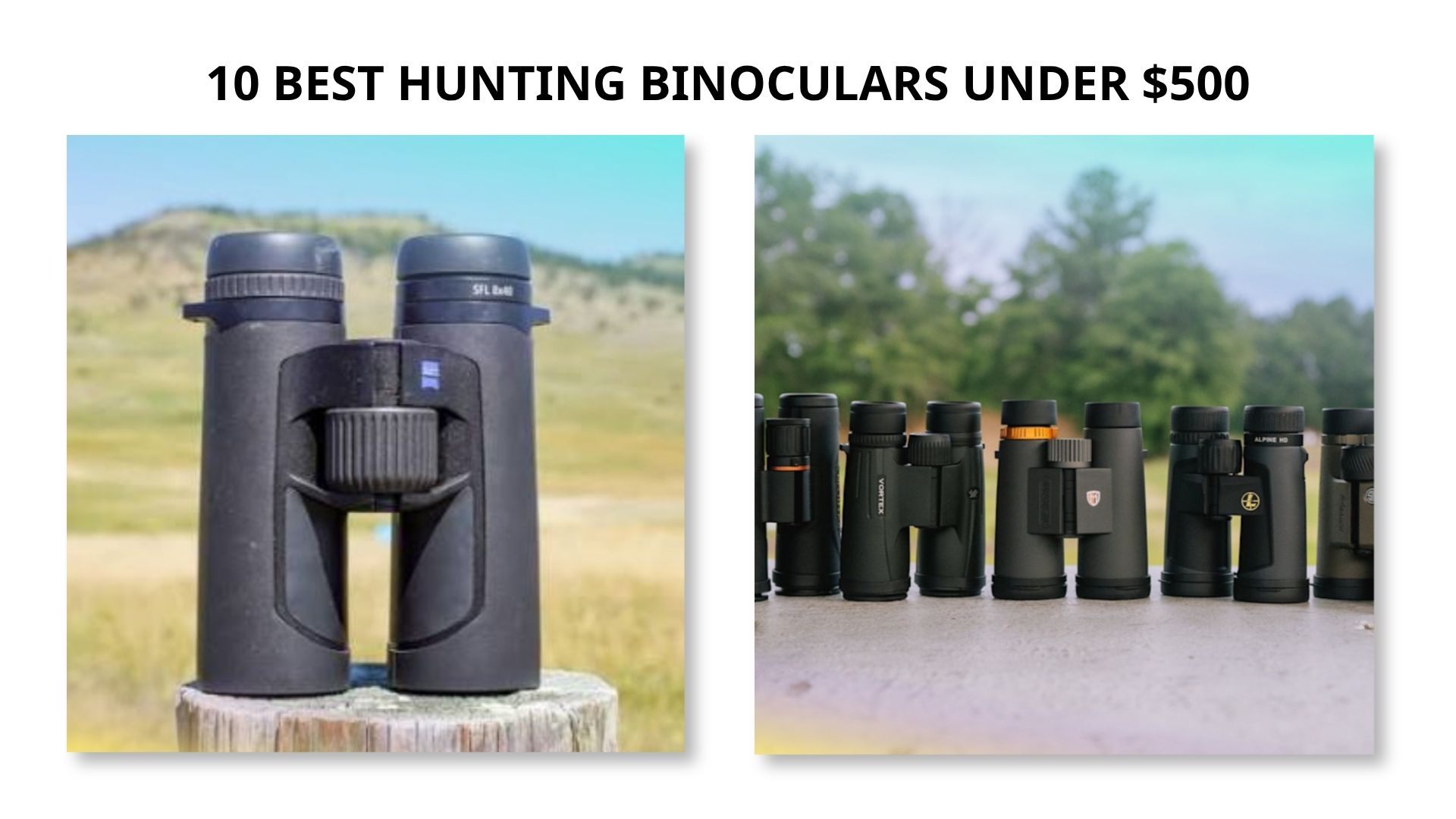

The best hunting binoculars under $500 occupy a useful middle ground: they can deliver clearer detail, better glare control, stronger weather protection, and more comfortable ergonomics than bargain optics without requiring the four-figure investment associated with elite glass.
This guide compares ten specific models for deer hunting, elk hunting, timber, backcountry glassing, wet weather, beginners, youth users, and backup duty. The goal is not to spend as close to $500 as possible. It is to select the configuration and optical system that best match your terrain, eyes, carry method, and observation habits.
Quick Picks
- Best Overall: Leupold BX-3 Alpine HD 10×42 Binoculars
- Best Value: Vortex Diamondback HD 10×42 Binoculars
- Best for Timber: Leupold BX-1 McKenzie HD 8×42 Binoculars
- Best Budget Option: Vortex Triumph HD 10×42 Binoculars
- Best for Wet Weather: Bushnell H2O 7×50 Waterproof Binoculars
Best Hunting Binoculars Under $500 Comparison Table
| Product | Best For | Configuration | Typical Price Tier | Key Features | Important Notes | Check Details |
|---|---|---|---|---|---|---|
| Leupold BX-3 Alpine HD 10×42 Binoculars | Best Overall | 10×42 | Upper-midrange; verify current price remains below $500 | 10×42 format, HD optical system, magnesium housing, tripod-ready design, included harness | A strong all-around upgrade for hunters who want better glare control, low-light performance, and field ergonomics without entering four-figure pricing. | Check Current Price |
| Vortex Diamondback HD 10×42 Binoculars | Best Value | 10×42 | Midrange | HD optical system, dielectric prism coating, argon purging, rubber armor, GlassPak harness | One of the safest value choices for a first serious hunting binocular; premium models still provide better edge detail and glare control. | Check Current Price |
| Athlon Optics Argos G2 UHD 10×42 Binoculars | Best UHD-Style Value | 10×42 | Midrange | UHD optical system, dielectric-coated prisms, phase correction, rubber-armored roof-prism body | A competitive specification set for buyers who compare optical features carefully rather than buying by brand recognition alone. | Check Current Price |
| Leupold BX-1 McKenzie HD 8×42 Binoculars | Best for Timber | 8×42 | Entry to midrange | 8×42 configuration, HD optical system, rubber armor, twist-up eyecups, compact roof-prism form | The 8x view is steadier and easier to scan in woodland, though it provides less apparent reach than 10x. | Check Current Price |
| Vortex Crossfire HD 10×42 Binoculars | Best Mid-Budget Workhorse | 10×42 | Entry to midrange | HD optical system, fully multi-coated lenses, weather sealing, rubber armor, tripod adaptability | A durable utility choice; compare its live price with the Diamondback HD before buying. | Check Current Price |
| Vortex Triumph HD 10×42 Binoculars | Best Budget Option | 10×42 | Budget | HD optical system, fully multi-coated lenses, nitrogen purging, rubber armor, GlassPak harness | A credible first binocular or backup package from an established brand; optical refinement is naturally limited at the price. | Check Current Price |
| Bushnell Trophy XLT 10×42 Bone Collector Binocular Bundle | Best Bundle | 10×42 | Budget to midrange | 10×42 roof-prism binocular, rubber armor, hunting finish, bundled harness | Convenient for a buyer who wants a binocular and carry system together; verify bundle contents and seller. | Check Current Price |
| Bushnell H2O 7×50 Waterproof Binoculars | Best for Wet Weather | 7×50 | Budget to midrange | 7×50 format, waterproof and fog-resistant design, BaK-4 prisms, fully multi-coated optics | Bright and steady for marshes and boats, but bulkier and lower-powered than standard 10×42 hunting binoculars. | Check Current Price |
| Vortex Bantam HD 6.5×32 Youth Binoculars | Best for Youth and Small Hands | 6.5×32 | Midrange youth optic | Youth-oriented 6.5×32 design, narrow IPD range, long eye relief, HD optics, weather sealing | Designed for younger users and small faces; direct adult supervision remains essential around all hunting equipment. | Check Current Price |
| Vortex Copperhead HD 10×42 Binoculars | Best Backup Binocular | 10×42 | Budget | HD optical system, fully multi-coated lenses, rubber armor, weather sealing, simple controls | A useful spare when discounted; compare live pricing with Triumph, Crossfire, and Diamondback models. | Check Current Price |
How We Chose These Binoculars
The shortlist emphasizes useful hunting configurations, established optics brands, clear product identity, specific Amazon.com product pages, weather-ready construction, adjustable eyecups, diopter control, practical carry weight, and meaningful differences between use cases.
We also considered what buyers below $500 actually need: a steadier image, better low-light comfort, less glare, reliable focus, tripod compatibility, a suitable harness, and honest warranty support. Models were not ranked by magnification or price alone.
We did not personally field-test every individual unit in every environment. The reviews combine current manufacturer and retailer information with configuration-based field analysis and responsible-use guidance. Optical comfort is personal, so side-by-side testing remains valuable.
Best Hunting Binoculars Under $500 Reviews
1. Leupold BX-3 Alpine HD 10×42 Binoculars
Best Overall
The Leupold BX-3 Alpine HD 10×42 is our best overall hunting binocular under $500 because it combines a practical all-purpose configuration with a lightweight magnesium housing, improved optical coatings, a tripod-ready design, and a useful harness package. It is positioned for hunters who glass often enough to appreciate a step above entry-level optics but still want to keep the total purchase below the premium European tier.
Key Features
- 10x magnification with 42mm objective lenses
- HD optical system with coatings intended to improve contrast, glare control, and low-light viewing
- Magnesium housing that balances rigidity and carry weight
- Tripod-mount compatibility for longer glassing sessions
- Included binocular harness and interchangeable eyecup system
Pros
- Well-rounded optical and mechanical package for the price class
- Useful for deer, elk, pronghorn, scouting, and mixed-terrain hunting
- Harness and tripod capability reduce the need for immediate accessory purchases
- Backed by an established hunting-optics brand
Cons
- Costs considerably more than good entry-level 10×42 binoculars
- Ten-power viewing can still feel shaky without support
- Current price must be checked because promotions can change
Field Notes
This model makes the most sense for hunters who spend meaningful time behind binoculars at first and last legal light, across field edges, or in broken western terrain. The 10×42 format provides useful reach while remaining portable enough for chest carry. For extended basin glassing, a tripod can reveal more usable detail than simply buying more magnification.
Safety and Legal Notes
Use binoculars, not a riflescope, to identify unknown movement. Keep every firearm pointed in a safe direction while glassing, and confirm species, background, legal shooting hours, land boundaries, and local equipment rules before making any hunting decision.
Best For
Hunters seeking the strongest overall balance of optics, durability, accessories, and price below the $500 ceiling.
2. Vortex Diamondback HD 10×42 Binoculars
Best Value
The Vortex Diamondback HD 10×42 remains a dependable value choice because it offers a useful HD optical system, dielectric prism coating, weather-sealed construction, tripod adaptability, and an included GlassPak harness. It is suitable as a first serious binocular for deer, elk, and general public-land scouting.
Key Features
- 10×42 all-purpose hunting configuration
- HD optical system with fully multi-coated lenses
- Dielectric prism coating for improved light transmission and color fidelity
- Argon purging, O-ring seals, and rubber armor
- Twist-up eyecups, center focus, right-eye diopter, tripod adaptability, and GlassPak harness
Pros
- Excellent feature-to-price balance
- Easy to find accessories and tripod adapters
- Harness improves comfort and protects the binocular
- Broadly useful from farmland to open western country
Cons
- Image quality is not as refined as the best models near $500
- Some users may prefer 8x in dense timber
- Focus feel can vary slightly between individual samples
Field Notes
For a hunter moving up from discount compact binoculars, the Diamondback HD usually provides a noticeable improvement in brightness, focus control, and weather readiness. It is light enough for regular chest carry and stable enough for many handheld situations, though a tripod remains valuable for distant detail.
Safety and Legal Notes
Optical clarity does not replace legal identification or a safe background. If antler points, species, sex, property boundaries, or nearby people cannot be confirmed, do not proceed.
Best For
Most budget-conscious deer and elk hunters who want a proven 10×42 package with a harness.
3. Athlon Optics Argos G2 UHD 10×42 Binoculars
Best UHD-Style Value
The Athlon Argos G2 UHD 10×42 is designed for hunters who want an ambitious optical feature set at a moderate price. Its UHD-positioned glass, dielectric-coated prisms, and phase-correction approach aim to improve color, contrast, and resolution over basic entry-level binoculars.
Key Features
- 10x magnification and 42mm objectives
- UHD optical system intended to reduce color fringing and improve detail
- Dielectric-coated and phase-corrected roof prisms
- Rubber-armored body with weather-ready construction
- Center focus, adjustable eyecups, diopter control, and tripod compatibility with an appropriate adapter
Pros
- Strong optical specification for the price class
- Good fit for open fields and western scouting
- Comfortable step up from basic budget glass
- Useful choice for buyers comparing contrast and color control
Cons
- Resale value and accessory availability may trail larger brands
- Ten-power shake still limits unsupported detail
- Hands-on comparison is recommended because ergonomics are personal
Field Notes
The Argos G2 UHD is most appealing when side-by-side testing shows that its focus, eye relief, and color control suit your eyes. Small differences in eyecup shape and focus resistance become important during an hour-long glassing session, so do not select only by the UHD label.
Safety and Legal Notes
No optical label guarantees a correct identification. Stabilize the binocular, wait for adequate legal light, and stop when the image remains uncertain.
Best For
Value-focused hunters who want a feature-rich 10×42 for frequent scouting and general big-game use.
4. Leupold BX-1 McKenzie HD 8×42 Binoculars
Best for Timber
The Leupold BX-1 McKenzie HD 8×42 is the better choice for hunters who value steadiness, a wider-feeling view, and quick animal acquisition over maximum magnification. Eight-power binoculars are often more comfortable in timber, brush, hardwood ridges, and mixed farmland.
Key Features
- 8x magnification with 42mm objective lenses
- HD optical system in a roof-prism body
- Rubber-armored exterior for secure handling
- Twist-up eyecups, center focus, and diopter adjustment
- Full-size objective geometry without excessive magnification
Pros
- Easier to hold steady than most 10x or 12x models
- Fast scanning in timber and brush
- Comfortable configuration for long handheld sessions
- Useful for whitetail, turkey, and general wildlife observation
Cons
- Less apparent reach in large western basins
- Buyers should verify exact accessories on the current listing
- Not as compact as 8×32 alternatives
Field Notes
An 8×42 can reveal more practical detail than a shaky 10x when the hunter is standing, breathing hard, or wearing gloves. It is especially useful for identifying movement through branches and following animals that enter and leave cover.
Safety and Legal Notes
Never swing a firearm toward movement to find out what it is. Keep the firearm controlled separately and use binoculars for identification.
Best For
Whitetail and turkey hunters, woodland scouts, and users who prefer a steady handheld image.
5. Vortex Crossfire HD 10×42 Binoculars
Best Mid-Budget Workhorse
The Vortex Crossfire HD 10×42 is a practical workhorse for occasional hunters, families, and anyone who wants a recognizable brand without paying for higher-tier glass. It offers straightforward controls, weather-ready construction, and a familiar 10×42 configuration.
Key Features
- 10×42 configuration for general hunting
- HD optical system and fully multi-coated air-to-glass surfaces
- Rubber armor and weather-sealed construction
- Twist-up eyecups, center focus, and right-eye diopter
- Tripod adaptability
Pros
- Simple controls and broad usability
- Reasonable durability for regular field use
- Good loaner, backup, or occasional-hunter option
- Established service and accessory ecosystem
Cons
- Diamondback HD may be a better buy when the price gap is small
- Optical contrast and edge quality are below higher tiers
- Ten-power configuration is not ideal for every timber hunter
Field Notes
The Crossfire HD should be evaluated against current sale prices. If it is meaningfully cheaper than the Diamondback HD, it can free budget for a harness, tripod adapter, navigation tool, first-aid kit, or quality rain gear.
Safety and Legal Notes
Do not spend the entire field budget on optics while neglecting navigation, first aid, water, weather protection, communication, and a trip plan.
Best For
Occasional hunters, backup use, loaner use, and buyers prioritizing rugged utility over premium resolution.
6. Vortex Triumph HD 10×42 Binoculars
Best Budget Option
The Vortex Triumph HD 10×42 is the budget recommendation for hunters who need a complete, usable package rather than anonymous ultra-cheap glass. It combines an HD optical system, weather-sealed body, tripod adaptability, and an included GlassPak harness.
Key Features
- 10x magnification and 42mm objectives
- HD optical system with fully multi-coated lenses
- Nitrogen-purged, O-ring-sealed construction
- Rubber armor, adjustable eyecups, center focus, and diopter control
- Tripod adaptable and supplied with a GlassPak harness
Pros
- Low entry cost from an established optics company
- Harness is included
- Suitable for beginners, guests, vehicles, and backup kits
- More realistic choice than generic extreme-power listings
Cons
- Less contrast, edge sharpness, and low-light detail than midrange models
- Narrower-feeling view can slow scanning
- Frequent glassers may outgrow it
Field Notes
The Triumph HD works well for daytime field-edge scanning, basic scouting, and learning proper binocular technique. It should not be expected to match a binocular costing several times more when glare, dim timber, or fine distant detail becomes challenging.
Safety and Legal Notes
Do not make a legal or ethical hunting decision from a vague image. If species, antler requirements, background, or other details are uncertain, do not proceed.
Best For
Beginners, occasional hunters, vehicle storage, guest use, and low-cost backup duty.
7. Bushnell Trophy XLT 10×42 Bone Collector Binocular Bundle
Best Bundle
The Bushnell Trophy XLT 10×42 Bone Collector bundle is appealing to first-time buyers because it packages a familiar hunting binocular with a harness. The primary value is convenience and a ready-to-carry setup rather than class-leading optical performance.
Key Features
- 10x magnification with 42mm objective lenses
- Roof-prism design and rubber-armored housing
- Hunting-oriented finish
- Center focus and adjustable eyecups
- Bundle includes a binocular harness according to the specific listing
Pros
- Simplifies first-time setup
- Useful 10×42 configuration
- Harness reduces neck fatigue and swinging
- Good gift or guest-hunter package
Cons
- Bundle contents can vary by seller
- Older optical design may trail newer coated systems
- Hunting styling does not improve optical performance
Field Notes
Confirm that the seller includes every advertised accessory. Adjust the harness over the clothing layers you will use and practice retrieving the binocular quietly before the season.
Safety and Legal Notes
Loose harness straps can catch on branches, tree stands, boat hardware, and vehicle controls. Fit and route all straps so they do not interfere with movement or safety equipment.
Best For
New hunters, gift buyers, and anyone who wants a straightforward binocular-plus-harness package.
8. Bushnell H2O 7×50 Waterproof Binoculars
Best for Wet Weather
The Bushnell H2O 7×50 is a specialized choice for marshes, boats, blinds, rainy climates, and stationary observation. Its 7x magnification is easy to hold steady, while the 50mm objective lenses provide a generous exit pupil.
Key Features
- 7x magnification and 50mm objective lenses
- Manufacturer-listed waterproof and fog-resistant construction
- BaK-4 prisms and fully multi-coated optics
- Large, easy-to-grip body
- Suitable for boating, marsh scouting, and fixed-position wildlife observation
Pros
- Steady handheld image
- Comfortable eye placement and bright-looking view
- Good fit for wet environments
- Useful for waterfowl scouting and general boating
Cons
- Bulky for long mountain hikes
- Less reach than 10x or 12x models
- Large body may not fit small hands
Field Notes
This model is better for a boat, blind, camp, or vehicle than for an ounce-conscious backcountry hunt. Use a suitable tether or floating strap only when it does not create an entanglement hazard.
Safety and Legal Notes
Wear an appropriate personal flotation device, follow boating rules, check weather and water conditions, and never shift weight or stand unsafely to obtain a better view.
Best For
Waterfowl scouts, boat users, wet-weather hunters, and people who prefer a steady seven-power image.
9. Vortex Bantam HD 6.5×32 Youth Binoculars
Best for Youth and Small Hands
The Vortex Bantam HD 6.5×32 is the most appropriate option for a young hunter or small-framed user. Its lower magnification reduces shake, the wider view helps locate wildlife, and the chassis is designed to close more narrowly than many adult binoculars.
Key Features
- 6.5x magnification and 32mm objective lenses
- Youth-oriented interpupillary-distance range
- Long eye relief and adjustable eyecups
- HD optical system with protective coatings
- Rubber armor, weather sealing, and tripod adaptability
Pros
- Easier for young users to stabilize
- Fits smaller faces and hands better than many adult models
- Wide view supports learning and wildlife location
- Useful beyond toy-level nature observation
Cons
- Less apparent reach than 8x or 10x models
- Children may eventually outgrow the configuration
- Adult fitting and supervision are mandatory
Field Notes
A youth binocular should produce one clean circular image, allow easy focus-wheel access, and feel manageable around the neck or in a harness. An adult should set the diopter, check strap length, and supervise every field session.
Safety and Legal Notes
Children must remain under direct adult supervision around firearms, bows, knives, vehicles, boats, stands, and rough terrain. Never allow a child to look at the sun through binoculars.
Best For
Young hunters, small-framed users, family wildlife observation, and supervised outdoor education.
10. Vortex Copperhead HD 10×42 Binoculars
Best Backup Binocular
The Vortex Copperhead HD 10×42 is a straightforward utility binocular suited to truck storage, camp use, a hunting partner, or backup duty. It uses the familiar 10×42 format and established Vortex control layout without trying to compete with premium glass.
Key Features
- 10×42 general-purpose configuration
- HD optical system and fully multi-coated lenses
- Rubber-armored exterior
- Weather-sealed body
- Adjustable eyecups, center focus, and diopter adjustment
Pros
- Simple and familiar controls
- Useful as a second binocular
- Established manufacturer support
- Good value when heavily discounted
Cons
- Overlaps with several nearby Vortex product lines
- Not the best value when priced close to the Diamondback HD
- Basic optical performance compared with upper-midrange models
Field Notes
Buy this model by current value, not by name alone. If it is substantially discounted, it can be a dependable spare. If the price approaches a Diamondback HD, the higher-tier optical package may be the better long-term purchase.
Safety and Legal Notes
Secure binoculars in a padded case during vehicle, boat, ATV, or aircraft transport. Loose equipment can become a projectile or interfere with controls.
Best For
Backup kits, vehicles, camps, guest hunters, and buyers who find a meaningful discount.
How to Choose the Best Hunting Binoculars Under $500
Set a Real Budget Below the $500 Ceiling
A $500 maximum should include more than the binocular alone. Consider whether you also need a chest harness, tripod adapter, compact tripod, lens-cleaning kit, rain cover, or protective case. A $350 binocular with the right support system may be more useful than a $499 binocular carried on an uncomfortable neck strap.
Amazon and other retailers change prices frequently. Verify that the exact configuration remains below $500 before ordering, and compare the total cost after accessories and taxes.
Choose 8x or 10x for Most Hunting
An 8×42 binocular is steadier, usually offers a wider field, and works well in timber, brush, river bottoms, and mixed farmland. A 10×42 provides more apparent reach and is popular for elk, mule deer, pronghorn, clear-cuts, and open fields.
Do not assume that higher power automatically reveals more detail. If the image shakes, a stable 8x can outperform a handheld 10x or 12x.
Understand Objective Lens Size
The second number is the objective diameter in millimeters. A 10×42 has 42mm front lenses. Larger objectives can provide a more forgiving exit pupil and better dim-light comfort, but glass quality, coatings, prism design, and eye position also matter.
A 42mm binocular is the safest all-around choice. A 32mm model saves weight, while a 50mm model is brighter-looking but heavier and bulkier.
Compare Optical Quality, Not Only HD Labels
HD, ED, UHD, and similar terms are not universal certifications. Compare center sharpness, edge sharpness, color fringing, contrast, glare resistance, focus feel, and viewing comfort.
A useful side-by-side test is to view dark branches against a bright sky, textured objects in shade, and distant signs near sunset. Better binoculars should make detail easier to see and reduce eye strain.
Check Prism Type and Coatings
Roof-prism binoculars are compact and common in hunting. Dielectric coatings and phase correction can improve brightness, color, and resolution, but implementation quality varies.
Fully multi-coated optics generally indicate that multiple anti-reflective layers are applied to air-to-glass surfaces. Avoid vague listings that do not identify the optical system clearly.
Evaluate Field of View
A wider field makes it easier to locate animals and follow movement. This is particularly valuable in timber, marshes, and when scanning quickly.
Compare field-of-view figures only when the units and distance match. Brands may list feet at 1,000 yards, meters at 1,000 meters, or angular degrees.
Check Eye Relief, Eyecups, and Diopter
Eye relief is critical for eyeglass wearers. Twist eyecups down and confirm that the full field remains visible. The diopter compensates for differences between your eyes and should be calibrated before the hunt.
Black shadows or a tunnel-like view usually mean that eye position, eyecup height, or interpupillary distance is incorrect.
Match Weight to the Way You Hunt
Backcountry hunters should track every ounce, but extremely small binoculars often sacrifice low-light comfort. Stand hunters may accept more weight for larger objectives and steadier handling.
A chest harness distributes weight better than a thin neck strap, limits swinging, protects lenses, and keeps the binocular accessible.
Prioritize Weather Sealing and Grip
Rain, snow, condensation, dust, and temperature changes are normal hunting conditions. O-ring seals and internal gas purging help resist water entry and internal fogging within the manufacturer’s stated limits.
Rubber armor improves grip and minor-impact protection, but no binocular is indestructible or maintenance-free.
Decide Whether You Need a Tripod
A tripod can increase usable detail, reduce fatigue, and make identification more reliable. It is valuable for 10x and especially important for long 12x observation.
Confirm the binocular accepts a standard adapter or brand-specific stud, and make sure the tripod head can support the load smoothly.
Match the Binocular to the Hunt
Whitetail and turkey hunters often benefit from 8×42. Western elk and mule deer hunters commonly choose 10×42. Waterfowl scouts may prefer waterproof 7×50 or 8×42 models. Youth users need lower power, lighter weight, and a narrower interpupillary-distance range.
Tree-stand, saddle, and boat users should check that the harness does not interfere with a safety harness, PFD, bow, firearm sling, or emergency movement.
Compare Warranty, Seller, and Exact Variation
Binoculars contain aligned optical systems that are difficult to repair at home. Read the actual warranty terms and service procedure rather than relying on a vague lifetime-warranty claim.
Marketplace pages may combine sizes, colors, bundles, and reviews. Confirm the exact model, ASIN, seller, included accessories, and return policy.
Understand Safety and Legal Limits
Binoculars support observation but do not determine whether a shot is lawful or ethical. Hunters remain responsible for seasons, licenses, tags, legal shooting hours, equipment rules, land boundaries, public-land restrictions, and blaze-orange requirements.
Use binoculars to identify unknown subjects instead of pointing a firearm-mounted optic. Follow the four basic firearm safety rules, secure storage, lawful transport, and manufacturer instructions.
Understand What $500 Cannot Guarantee
A binocular under $500 can provide very good practical performance, but it cannot guarantee low-light identification, hunting success, legal compliance, or a safe shot. Fog, vegetation, distance, glare, fatigue, heat shimmer, and poor technique can defeat expensive optics.
When identification remains uncertain, move to a safer viewing position, stabilize the optic, wait for better conditions, consult a qualified guide, or stop.
Important Hunting, Outdoor, and Firearm Safety Tips Before You Buy
- Use binoculars to identify unknown movement. Never point a firearm-mounted optic at a person, animal, building, road, or object merely to determine what it is.
- Treat every firearm as loaded, keep the muzzle pointed in a safe direction, keep your finger away from the trigger until ready, and know the target and what lies beyond it.
- Follow local seasons, licenses, tags, legal equipment rules, shooting hours, blaze-orange requirements, land-access rules, storage laws, transport laws, and manufacturer instructions.
- Carry navigation, first aid, water, weather protection, communication, a light source, and a trip plan. Optics do not replace emergency preparation.
- Stop walking before raising binoculars, especially near cliffs, roots, roads, fences, water, and unstable ground.
- Use a full-body safety harness with elevated stands, and make sure a binocular harness does not interfere with it.
- Wear an appropriate personal flotation device and follow boating rules when glassing from a boat or kayak.
- Never look directly at the sun through binoculars. Magnified sunlight can cause permanent eye injury.
- Practice with the focus, diopter, eyecups, harness, and tripod before hunting season.
- Contact a wildlife agency, land manager, qualified guide, firearms instructor, optics professional, or local authority when legal or technical requirements are unclear.
Common Mistakes to Avoid
- Spending the full $500 without budgeting for a harness or tripod: Support and carry accessories may improve real-world performance more than a small optical upgrade.
- Buying only by magnification: Higher power narrows the view and amplifies shake.
- Assuming every HD or UHD label is equivalent: These are manufacturer terms, not one universal standard.
- Ignoring eye relief and eyecup comfort: Poor fit causes blackouts, a reduced field, and eye strain.
- Choosing 10x for dense timber without testing 8x: A wider, steadier 8x view may be more useful.
- Waiting until opening day to set the diopter: Calibrate and practice at home.
- Using a riflescope for identification: This violates safe muzzle discipline; use binoculars.
- Trusting an Amazon variation without checking the exact model: Pages may combine configurations, bundles, and reviews.
- Cleaning grit with a shirt: Dry debris can scratch lens coatings.
- Assuming waterproof means maintenance-free: Binoculars still need drying, inspection, and proper storage.
- Leaving optics loose in a vehicle or boat: They can become damaged, stolen, or interfere with controls.
- Buying near $500 merely because it is near the limit: Choose the model that fits your terrain, eyes, and carry system, not the most expensive option.
A final mistake is believing that a binocular near the top of the budget must be the best match. Fit, eye relief, field of view, carry weight, terrain, and stabilization often matter more than the last increment of optical performance.
Troubleshooting Common Problems
| Problem | Possible Cause | What to Do |
|---|---|---|
| Two images will not merge | Incorrect interpupillary distance or internal misalignment | Adjust the hinge slowly. If double vision remains after an impact, stop use and contact the manufacturer. |
| One eye is sharp and the other is blurry | Diopter is not calibrated | Set the center focus for one eye, then adjust the diopter for the other according to the manual. |
| Black shadows appear | Eye relief or eyecup height is incorrect | Change eyecup position and move the binocular slightly closer or farther from the eyes. |
| Image shakes too much | Magnification is high, arms are unsupported, or the user is fatigued | Brace elbows, sit down, use a tree or pack as support, or mount the binocular on a tripod. |
| View is dim at dawn or dusk | Small exit pupil, dirty lenses, poor coatings, or inadequate light | Clean correctly, stabilize the view, compare another optic, and stop when legal light or confident identification is gone. |
| Exterior lenses fog | Warm breath or rapid temperature change | Improve airflow, avoid breathing onto eyepieces, and use only approved anti-fog methods. |
| Internal fogging appears | A seal may have failed | Dry the exterior and contact the manufacturer. Do not disassemble the binocular. |
| Focus wheel becomes stiff | Cold temperature, debris, or mechanical damage | Allow gradual temperature adjustment, remove exterior grit, and seek service if stiffness continues. |
| Neck or shoulder pain | Poor strap adjustment or excessive weight | Use a fitted chest harness, redistribute gear, or choose a lighter binocular. |
| Details look soft at long range | Heat shimmer, haze, hand shake, focus error, or optical limits | Stabilize the view, refocus, change position, glass earlier, or use a spotting scope. |
| Lens caps keep falling off | Caps are stretched or mismatched | Use model-specific replacements or a protective harness with a secure lid. |
| Price is now above $500 | Retail pricing or seller changed | Wait for a sale, compare another authorized seller, or select the next-best model that remains within budget. |
When to Get Professional Help
Contact the manufacturer or a qualified optics repair professional for persistent double images, internal fogging, a damaged focus mechanism, loose internal parts, cracked lenses, damaged coatings, or a hinge that no longer holds its position. Do not open a sealed binocular at home.
Consult an eye-care professional if several properly adjusted binoculars cause headaches, dizziness, eye pain, or difficulty merging the image. Seek guidance from a hunting guide, wildlife agency, or land manager when species identification, access, boundaries, seasons, legal equipment, or shooting-hour rules are unclear.
For firearm handling, storage, transport, or training questions, contact a qualified firearms instructor, licensed dealer, or appropriate local authority. Call emergency services for injuries, falls, exposure, boating accidents, missing persons, or any firearm incident.
Maintenance and Care Tips
- Blow or brush loose grit from lenses before wiping.
- Use approved optical cleaning solution and a clean microfiber cloth.
- Dry rain, snow, mud, and condensation before long-term storage.
- Do not store a wet binocular in a sealed case.
- Inspect the focus wheel, hinge, eyecups, diopter, lens caps, harness stitching, and tripod adapter before each season.
- Use a padded case during vehicle, ATV, boat, airline, and pack transport.
- Avoid prolonged dashboard heat and rapid temperature changes.
- Rinse salt or corrosive residue only as permitted by the manufacturer, then dry completely.
- Record the model, ASIN, seller, receipt, warranty information, and serial number when available.
- Follow the manufacturer’s service, cleaning, and storage instructions.
Final Verdict
The Leupold BX-3 Alpine HD 10×42 is the best hunting binocular under $500 overall for buyers who want a meaningful optical and mechanical upgrade while staying below the premium tier. The Vortex Diamondback HD 10×42 remains the strongest value for most deer and elk hunters.
Timber hunters who prioritize a steady, wide view should consider the Leupold BX-1 McKenzie HD 8×42. Buyers on a strict budget can begin with the Vortex Triumph HD 10×42, while wet-weather and boat users may prefer the steady Bushnell H2O 7×50.
Verify the live price before ordering, test fit and eye relief when possible, and reserve part of the budget for a harness or tripod if your hunting style benefits from support. The right choice should improve observation comfort and responsible identification without replacing legal knowledge, firearm safety, field preparation, or sound judgment.
Frequently Asked Questions
1. What are the best hunting binoculars under $500?
The Leupold BX-3 Alpine HD 10×42 is our best overall choice, while the Vortex Diamondback HD 10×42 offers stronger value at a lower price.
2. Can you get good hunting binoculars for less than $500?
Yes. The under-$500 range includes capable weather-sealed optics with useful coatings, good ergonomics, tripod compatibility, and established warranty support.
3. Should I spend the full $500?
Not automatically. Leave room for a harness, tripod adapter, cleaning tools, and other essential field gear.
4. What is the best budget hunting binocular?
The Vortex Triumph HD 10×42 is a practical low-cost package with a harness and weather-ready construction.
5. What is the best value hunting binocular under $500?
The Vortex Diamondback HD 10×42 offers one of the best combinations of optical features, durability, accessories, and price.
6. Are $500 binoculars much better than $100 binoculars?
They can provide better contrast, glare control, edge sharpness, low-light detail, focus feel, and viewing comfort, but the improvement varies by model and user.
7. Are binoculars over $500 worth it?
They may be worthwhile for frequent glassing, demanding low-light use, and users sensitive to optical flaws. Many hunters can be well served below $500.
8. What magnification is best for hunting?
Eight-power and ten-power are the most useful choices. Eight-power is steadier and wider; ten-power provides more apparent reach.
9. Are 8×42 or 10×42 binoculars better?
Choose 8×42 for timber, steadiness, and quick scanning. Choose 10×42 for open country and more distant observation.
10. Is 12x too powerful for hunting?
It can be too shaky handheld. Twelve-power binoculars are most useful with a tripod in open country.
11. What do 10×42 binocular numbers mean?
The binocular magnifies the image ten times and has 42mm objective lenses.
12. What objective size is best for hunting?
Forty-two millimeters is the common all-around choice. Thirty-two millimeters saves weight, while 50mm improves dim-light comfort at the cost of bulk.
13. What is exit pupil?
Exit pupil is objective diameter divided by magnification. A 10×42 has a 4.2mm exit pupil.
14. Does a larger exit pupil improve low-light viewing?
It can make eye placement and dim-light viewing more comfortable, but glass quality, coatings, and available light also matter.
15. What is field of view?
It describes how wide an area you can see at a stated distance. A wider field helps locate animals and follow movement.
16. Is a wide field of view important for deer hunting?
Yes, especially in timber, brush, and when following moving deer.
17. What does HD mean on binoculars?
HD is a manufacturer term rather than one universal certification. Evaluate the complete optical system.
18. What is ED glass?
Extra-low-dispersion glass is intended to reduce color fringing and improve contrast, but design and coatings also matter.
19. What does UHD mean?
UHD is a brand-specific term generally suggesting an upgraded optical system. It does not guarantee identical performance between companies.
20. Are fully multi-coated lenses important?
Yes. Multiple anti-reflective layers can improve light transmission and contrast, but coating quality still varies.
21. What are phase-corrected prisms?
Phase coatings help roof-prism binoculars preserve resolution and contrast by correcting phase shifts in light.
22. Are roof-prism binoculars better for hunting?
They are compact, streamlined, and common for hunting. Porro-prism models can offer good value but are usually bulkier.
23. What eye relief is good for glasses?
Many eyeglass wearers prefer about 15mm or more, but frame shape and eyecup design make hands-on testing important.
24. Why do I see black shadows through binoculars?
Eye position, eyecup height, or interpupillary distance is incorrect.
25. How do I adjust the diopter?
Follow the manufacturer’s instructions. Typically, focus one eye with the center wheel and match the other eye with the diopter.
26. Why do binoculars cause headaches?
Possible causes include misalignment, incorrect diopter, inadequate eye relief, or vision issues. Stop use and seek professional advice if symptoms recur.
27. What are the best binoculars for whitetail hunting?
An 8×42 is excellent in timber and mixed farmland. A 10×42 works well for large fields and clear-cuts.
28. What are the best binoculars for elk hunting?
A good 10×42 is the standard versatile choice. Add a tripod for extended western glassing.
29. What are the best binoculars for mule deer hunting?
A 10×42 provides useful reach and portability. Supported 12x binoculars can work for specialized open-country glassing.
30. What are the best binoculars for bow hunting?
An 8×32, 8×42, or compact 10×42 with quiet controls and a secure harness is practical.
31. What are the best binoculars for turkey hunting?
Eight-power binoculars provide a steady, wide view for scanning field edges and timber.
32. What are the best binoculars for waterfowl hunting?
A waterproof 7×50 or 8×42 works well. Ensure the carry system does not interfere with a PFD or boat handling.
33. What are the best binoculars for backcountry hunting?
Choose a durable 8×42 or 10×42 with moderate weight, a quality harness, and tripod compatibility.
34. Are compact binoculars good for hunting?
They save weight but provide less low-light comfort. Test small objectives before relying on them at dawn or dusk.
35. Do I need waterproof binoculars?
Weather sealing is strongly recommended for rain, snow, condensation, and temperature changes.
36. What is the difference between waterproof and fogproof?
Waterproofing limits water entry; fogproofing usually refers to reducing internal condensation. Exterior lenses can still fog.
37. Can waterproof binoculars be submerged?
Only if the manufacturer provides a specific submersion rating. Waterproof does not automatically mean safe for prolonged underwater use.
38. Do I need a binocular harness?
A harness improves comfort, reduces swinging, protects the optic, and keeps it accessible.
39. Can a binocular harness interfere with a tree-stand harness?
Yes. Test the complete system at ground level and follow the stand-harness instructions.
40. Should hunting binoculars be tripod adaptable?
Tripod compatibility is valuable for 10x and highly useful for long glassing sessions.
41. Can any binocular mount to a tripod?
No. Some use a standard threaded adapter, a proprietary stud, or a clamp.
42. Are rangefinding binoculars available under $500?
Some discounted or entry models may appear near this price, but quality, legality, electronics, and warranty should be checked carefully.
43. Can binoculars replace a spotting scope?
They can cover moderate distances, but a spotting scope provides more magnification for detailed long-range evaluation.
44. What are the best hunting binoculars for low light under $500?
Choose quality 8×42 or 10×42 optics with good coatings and glare control. The Leupold BX-3 Alpine HD and Diamondback HD are sensible examples.
45. Can normal binoculars see in complete darkness?
No. Standard optical binoculars require available light.
46. Are night-vision binoculars legal for hunting?
Rules vary by species and jurisdiction. Check with the relevant wildlife agency before use.
47. How should I clean binocular lenses?
Blow or brush away grit first, then use approved lens solution and a clean microfiber cloth.
48. Can I clean binoculars with my shirt?
It is not recommended because fabric can carry abrasive grit and oils.
49. How do I prevent binocular fogging?
Keep them near ambient temperature, avoid breathing on eyepieces, improve airflow, and use approved anti-fog products.
50. What should I do about internal fogging?
Internal fogging may indicate seal failure. Contact the manufacturer and do not open the binocular.
51. How should binoculars be stored?
Store them clean, dry, protected, and ventilated away from extreme heat and moisture.
52. Can I leave binoculars in a truck?
Short-term storage is common, but heat, cold, theft, vibration, and condensation can damage optics. Use a padded case.
53. How do I avoid counterfeit or misleading Amazon listings?
Confirm the exact ASIN, seller, model, configuration, warranty eligibility, return policy, and manufacturer details.
54. Can I use a riflescope to identify an animal?
No. Use binoculars to identify unknown movement so the firearm remains pointed in a safe direction.
55. When should I contact an optics professional?
Seek help for persistent double images, internal fogging, focus failure, damaged coatings, loose prisms, or repeated eye strain.