
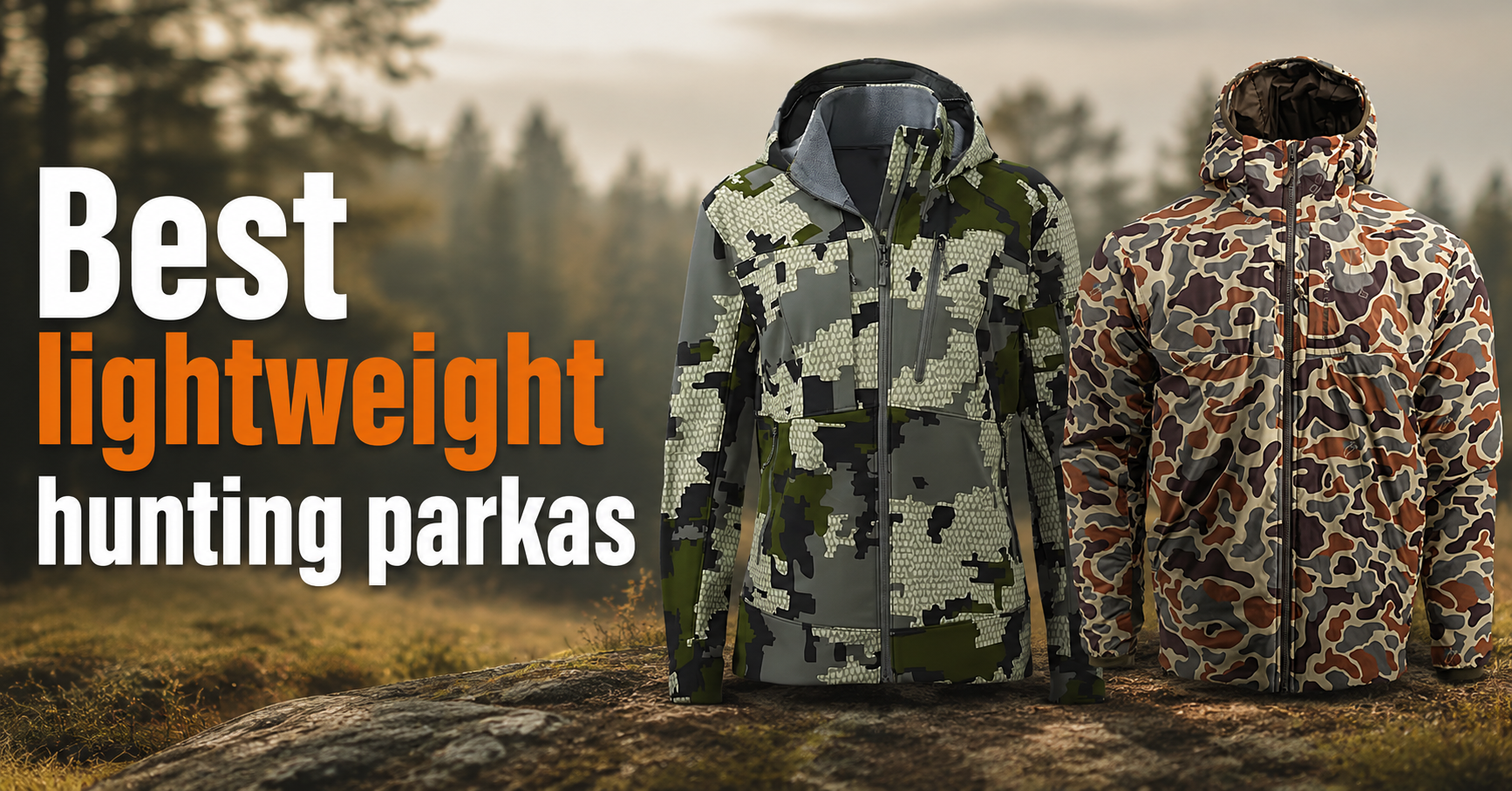

A parka that feels comfortable beside the truck can become too warm, bulky, or restrictive halfway up a ridge. The opposite problem appears after the walk ends: a highly breathable jacket may not provide enough wind protection or insulation for several motionless hours in a treestand.
The best lightweight hunting parkas balance mobility, warmth, wind protection, moisture management, quiet fabric, useful coverage, and enough room for a practical layering system. However, “lightweight” is relative. An active-hunting softshell and a modular 3-in-1 cold-weather parka solve very different problems, even when both appear under the same Amazon search term.
Eight unique, relevant products from the supplied list qualified for individual review. Duplicate HOT SHOT color variations, a jacket-and-bib set, a military shell that could not be validated as a suitable lightweight hunting option on Amazon.com, and two camouflage nets were excluded.
Quick Picks
- Best Overall Lightweight Outer Layer: KUIU Guide PRO Hooded Jacket – Wind Resistant, Water Repellent, & Soft-Shell Hunting Jacket — A quiet, articulated softshell with pit vents, raised pockets, adjustable coverage, and a micro-fleece interior.
- Best for Active Cold Weather: KUIU Axis Hybrid Hooded Jacket – Waterproof Paneling, Wind Resistant, Fleece-Lined Soft Shell for Active Cold Weather Hunting — Combines stretch, ventilation, fleece warmth, and targeted weather panels for hunters who keep moving.
- Best for Quiet Treestand Hunting: SITKA Stratus Jacket – 100% Windproof, Ultra-Quiet, Removable Hood, Safety Harness Port, Micro-Grid Fleece — Designed around wind protection, quiet fabric, hearing-friendly hood details, and elevated-stand layering.
- Best Modular Cold-Weather System: Guide Gear Steadfast 4-in-1 Hunting Jacket Parka, Waterproof Insulated Cold-Weather Thinsulate Coat — A separable shell-and-liner system for changing conditions and long stationary hunts.
- Best Quiet Insulated Parka: HOT SHOT Men’s 3-in-1 Insulated Camo Hunting Parka, Waterproof Jacket, Versatile Camouflage Hunting Clothes for Men — Uses zoned insulation, a quiet brushed shell, removable hood, and separable inner and outer jackets.
- Best for Pocket Organization: NEW VIEW Camo Hunting Jackets for Men, Warm Fleece Lined Hunting Jacket with Hood, Quiet Water Resistant Hunting Clothes — Provides nine pockets, a detachable hood, fleece lining, quiet zippers, and a safety-harness opening.
Disclosure: Gunscorner.com may earn a commission from qualifying purchases made through affiliate links, at no additional cost to you.
How the Supplied Products Were Validated
The original list contained 15 Amazon links. Eight distinct products matched the practical intent closely enough to review as lightweight parkas, insulated hunting jackets, or hooded softshell alternatives.
- B08DRWDT98 was excluded because it resolves to the same HOT SHOT 3-in-1 parka family as B08DSKBP9R, with a different camouflage variation.
- B0B321F5VX and B096BPVK5C were also duplicate HOT SHOT parka variations rather than separate jacket designs.
- B0F1F763RJ was excluded because it is a jacket-and-bib hunting suit rather than one parka.
- B0DKY9J5BX was excluded because it is a military-style ECWCS waterproof shell, its exact Amazon.com listing could not be reliably retrieved, and it was not a close enough match for a lightweight hunting-parka comparison.
- B07PHBYNVM and B075SVTGJZ were excluded because they are camouflage netting products rather than clothing.
The eight retained products range from active softshells to heavily insulated modular parkas. They should not be interpreted as eight interchangeable versions of the same garment.
Best Lightweight Hunting Parkas Comparison
| Product | Primary Field Role | Warmth Approach | Weather Approach | Quietness | Mobility or Venting | Main Trade-Off | Amazon |
|---|---|---|---|---|---|---|---|
| KUIU Guide PRO Hooded Jacket | Mountain hunting and mobile layering | Micro-fleece interior with room for light underlying layers | Wind-resistant softshell with K-DWR treatment | Soft interior and quiet outer construction | Pit vents, articulation, raised pockets, adjustable hem | Not a heavily insulated stationary-hunt parka | Check Price |
| KUIU Axis Hybrid Hooded Jacket | Active hunting in cold, damp terrain | Fleece-lined softshell | Targeted waterproof panels with wind-resistant bonded fabric | Designed for active hunting rather than maximum treestand silence | Stretch fabric, pit zips, articulated sleeves | Waterproof protection is limited to specific panels | Check Price |
| SITKA Stratus Jacket | Mid-to-late-season treestand hunting | Micro-grid fleece with additional Polartec Alpha Direct panels | WINDSTOPPER membrane for wind protection | Ultra-quiet face fabric | Removable hood and safety-harness pass-through | Less suitable for strenuous climbs than active softshells | Check Price |
| Guide Gear Steadfast 4-in-1 Parka | Cold, wet and variable stationary hunts | Removable 150-gram Thinsulate liner | PU-coated outer shell described as weather protective | Micro-tricot shell may be quieter than hard rain shells | Shell and liner can be worn separately | Complete system is bulkier than a true lightweight softshell | Check Price |
| HOT SHOT Men’s 3-in-1 Insulated Camo Hunting Parka | Quiet, cold-weather big-game and blind hunting | Zoned polyfill in the body, sleeves and collar | Seam-sealed separable outer shell and liner | Brushed micro-tricot exterior | Removable hood and separable jacket components | High insulation amounts reduce warm-weather versatility | Check Price |
| Guide Gear Guide Dry Steadfast Insulated Parka | Cold-weather hunting with simpler construction | 150-gram 3M Thinsulate insulation | Seller-described weather-resistant design | Hunting-oriented fabric construction | Adjustable waist, cuffs and removable hood | Less adaptable than a fully separable 3-in-1 or 4-in-1 system | Check Price |
| NEW VIEW Camo Hunting Jacket | Layered treestand, saddle and general big-game use | Fleece-lined softshell with a roomy layering cut | Water-resistant and wind-resistant seller claims | Quiet fabric and quieter zipper design | Detachable hood, adjustable openings and harness port | Baggy cut may feel bulky on smaller-framed hunters | Check Price |
| NOMAD Harvester VX3 Jacket | Late-season insulated hunting and short approaches | Seller-described cold-weather insulation | Wind-resistant construction | Quiet outer material | Layerable cut and full-zip design | Insulation weight and detailed weather specifications are not clearly stated | Check Price |
No universal temperature rating can reliably describe these jackets. Warmth depends on activity, wind, humidity, underlying layers, fit, exposure time, food intake, individual metabolism, and whether the garment becomes damp.
1. Best Overall: KUIU Guide PRO Hooded Jacket – Wind Resistant, Water Repellent, & Soft-Shell Hunting Jacket
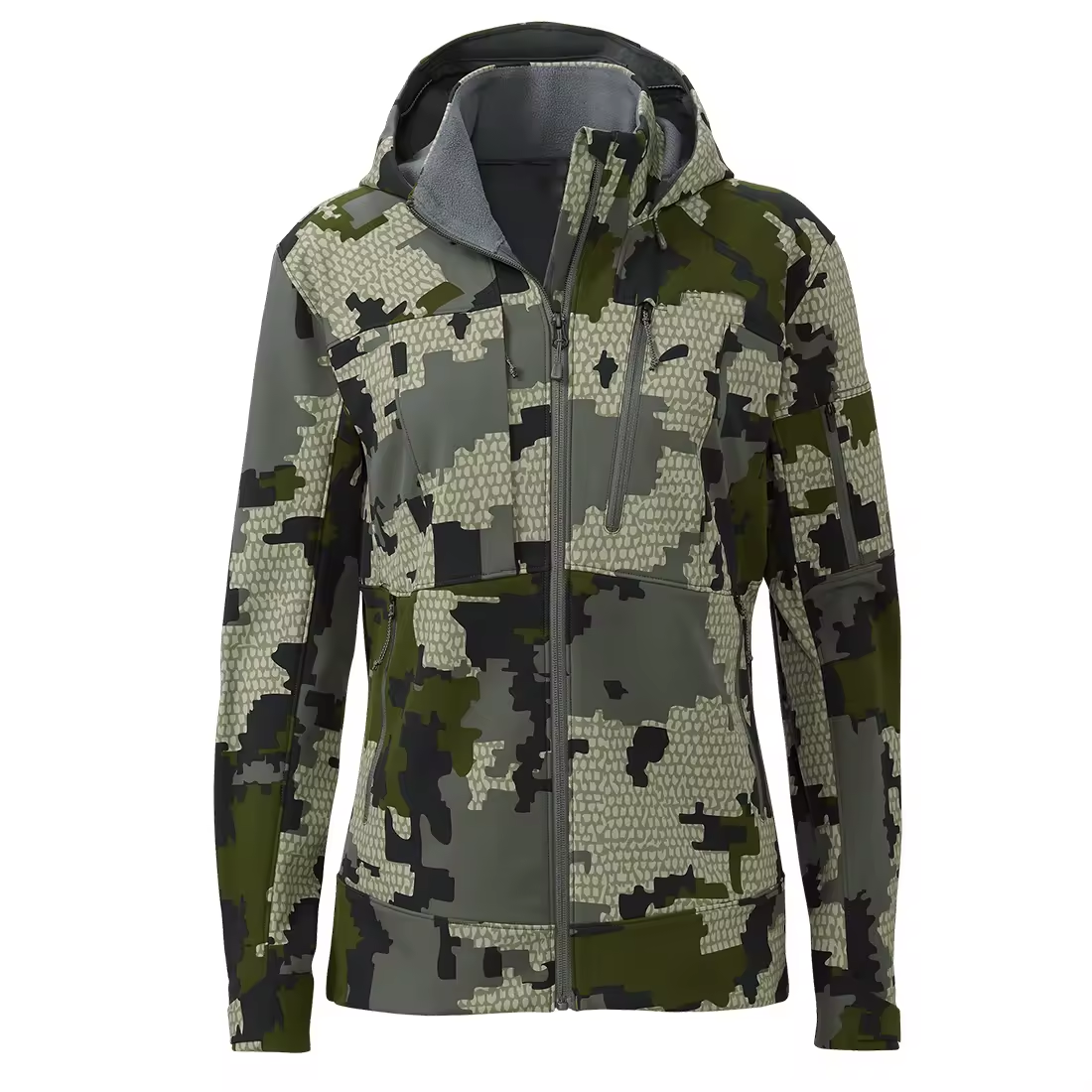
The KUIU Guide PRO is the strongest overall choice for hunters who interpret “lightweight parka” as a versatile hooded outer layer rather than a heavy insulated coat. Its construction prioritizes mobility, wind resistance, ventilation, quietness and compatibility with a backpack.
The jacket uses Primeflex quick-drying softshell fabric, K-DWR water repellency and a micro-fleece interior. Zippered pit vents help manage heat, while raised hand pockets remain easier to reach above many backpack hip belts. The hood, hem and articulated cut are designed around active mountain hunting and layering.
This combination makes the Guide PRO useful for cool mornings, wind-exposed ridges, mobile elk or mule-deer hunting, scouting and still-hunting. It is less appropriate as the only insulation for a long, motionless late-season sit.
Best Use Case
Choose it for active hunters who need wind protection, stretch and rapid ventilation but plan to carry a separate puffy or heavier insulation layer for extended stops.
Fit and Layering
The listing describes a tailored fit intended for a base layer and light fleece. Hunters planning to wear a thick puffy beneath it should check KUIU’s current measurements carefully rather than automatically ordering their usual casual-jacket size.
Pros
- Pit vents allow heat to escape during climbs and pack-outs.
- Raised pockets remain more accessible above a backpack belt.
- Micro-fleece interior adds light warmth without heavy parka bulk.
- Articulated construction supports climbing, glassing and bow movement.
- Quiet face fabric suits archery and close-range big-game hunting.
- Adjustable hood and hem help control drafts.
Cons
- It does not provide heavy stationary-hunt insulation.
- K-DWR treatment should not be confused with a fully waterproof rain shell.
- The tailored cut may limit bulky layering if the size is chosen too closely.
- Hunters facing prolonged rain still need dedicated waterproof protection.
2. Best for Active Cold Weather: KUIU Axis Hybrid Hooded Jacket – Waterproof Paneling, Wind Resistant, Fleece-Lined Soft Shell for Active Cold Weather Hunting
The Axis Hybrid is built for hunters who remain active in cold, damp conditions and need more weather protection than a standard softshell. Instead of placing a waterproof membrane across the entire jacket, KUIU uses waterproof panels in the hood, shoulders and arms—areas that commonly contact falling moisture, snow-covered vegetation or wet ground.
The remaining construction uses wind-resistant, high-stretch Primeflex softshell material with a fleece lining. Pit zips, articulated sleeves and adjustable cuffs, hood and hem provide temperature and fit control. Amazon positions the jacket for layered use during active cold-weather hunts.
The hybrid design is useful because a fully waterproof jacket can trap heat and perspiration during hard movement. The limitation is equally important: waterproof panels do not turn the entire jacket into a substitute for a rain shell.
Best Use Case
It best suits mountain hunters, spot-and-stalk hunters, snow-country scouting and anyone moving repeatedly between exposed ridges, brush, wet vegetation and short stationary periods.
Weather Considerations
The product page presents a suggested activity range, but temperature guidance should never be treated as a guarantee. Wind, pace, base layers and exposure time can change comfort dramatically.
Pros
- Waterproof panels protect common high-exposure areas.
- Fleece lining provides more warmth than an unlined shell.
- Stretch construction supports climbing and unrestricted movement.
- Pit zips help prevent overheating during demanding approaches.
- Adjustable cuffs, hood and hem improve weather control.
Cons
- Only selected panels are described as waterproof.
- It is designed for active use rather than maximum warmth during long sits.
- Fleece-lined softshell material is less compressible than a minimalist puffy.
- The layered fit still requires careful sizing around bulky insulation.
3. Best for Quiet Treestand Hunting: SITKA Stratus Jacket – 100% Windproof, Ultra-Quiet, Removable Hood, Safety Harness Port, Micro-Grid Fleece
The SITKA Stratus focuses on a problem that lightweight insulation alone does not solve: wind can remove body heat quickly during a motionless treestand sit. Its WINDSTOPPER membrane is paired with a quiet micro-grid fleece exterior, making the jacket more suitable for close-range whitetail hunting than a noisy hard-shell parka.
The removable hood includes hearing ports, while additional Polartec Alpha Direct panels provide targeted warmth. A pass-through opening is designed to work with an elevated-stand safety harness without requiring the tether to route awkwardly around the jacket.
The Stratus is best understood as a windproof mid-to-late-season system piece. It can work alone in moderate conditions or over insulating layers when temperatures fall. Hunters making long, steep approaches may find it warmer and less ventilated than the two KUIU options.
Best Use Case
Choose the Stratus for whitetail treestands, elevated blinds and other stationary hunts where quiet fabric and wind protection are more important than minimum packed size.
Safety-Harness Note
A harness port does not replace a properly fitted full-body fall-arrest system. Inspect the harness, tether, lifeline and stand before every hunt, remain connected throughout ascent and descent, and follow each manufacturer’s instructions.
Pros
- Windproof membrane addresses a major source of stationary heat loss.
- Quiet micro-grid fleece is suitable for close-range archery hunting.
- Removable hood includes openings intended to preserve hearing.
- Harness pass-through supports safer elevated-stand layering.
- Targeted Polartec Alpha panels add warmth without lining every area equally.
Cons
- It is less breathable for hard climbs than a vented active softshell.
- Windproof construction does not make it a dedicated rain jacket.
- The jacket may require extra insulation during very long late-season sits.
- The Amazon title is a parent listing, so the exact color and size must be verified.
4. Best Modular System: Guide Gear Steadfast 4-in-1 Hunting Jacket Parka, Waterproof Insulated Cold-Weather Thinsulate Coat
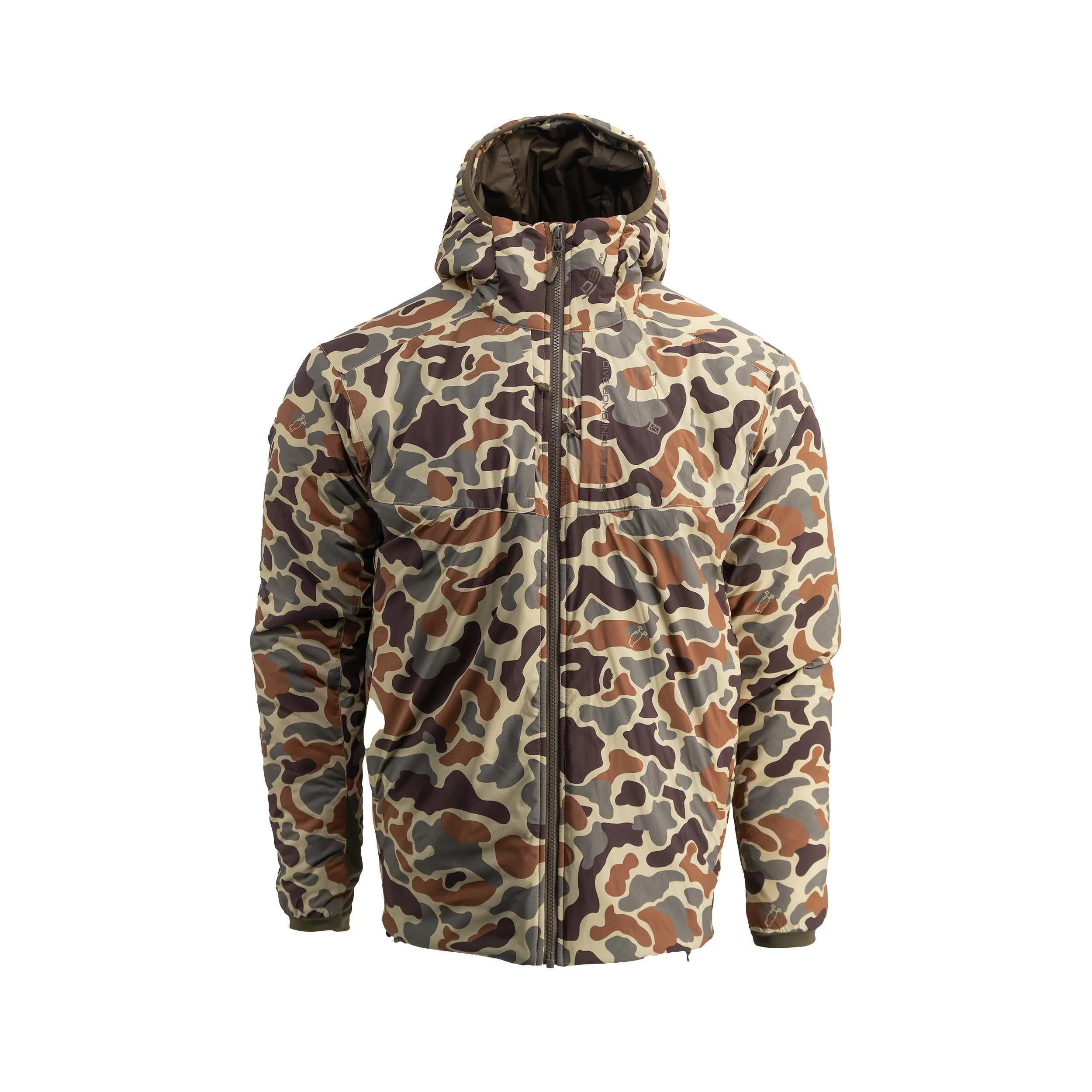
The Guide Gear Steadfast 4-in-1 is less of a minimalist lightweight jacket and more of a configurable cold-weather system. Its principal advantage is the ability to separate the outer shell and insulated liner, allowing each piece to be used independently or together.
The listing specifies a 150-gram Thinsulate liner, a polyester micro-tricot shell with polyurethane coating, a reversible camouflage-and-solid liner and a zip-off hood with a visor. The shell can be worn without insulation, while the liner can function separately when heavy weather protection is unnecessary.
This flexibility is useful during variable seasons, but the complete system should not be confused with an ultralight backcountry parka. Multiple layers, zippers, attachment points and pockets generally increase total bulk.
Best Use Case
This parka is best for treestand hunters, ground-blind hunters, cold-weather camp use and vehicle-supported hunts where modularity is more important than minimum carry weight.
Weather Considerations
The seller uses strong waterproof and extreme-weather language. Buyers should confirm the current seam, zipper and membrane details before relying on the parka during prolonged precipitation.
Pros
- Outer shell and insulated liner can be used separately.
- 150-gram Thinsulate liner provides a clearly stated insulation level.
- Reversible liner adds camouflage and solid-color flexibility.
- Zip-off hood allows the coverage to be adjusted.
- Micro-tricot face is more hunting-oriented than a stiff expedition shell.
Cons
- The complete 4-in-1 system is bulkier than a lightweight softshell.
- Multiple components require more drying, inspection and storage.
- Seller waterproof claims do not establish performance in every storm.
- The system may be unnecessarily warm during active approaches.
5. Best Quiet Insulated Parka: HOT SHOT Men’s 3-in-1 Insulated Camo Hunting Parka, Waterproof Jacket, Versatile Camouflage Hunting Clothes for Men
The HOT SHOT 3-in-1 parka combines a seam-sealed outer shell with a separate insulated inner jacket. It is one of the warmest-looking systems in the reviewed group based on the stated insulation amounts, although those insulation levels also make it less suitable for sustained high-output movement.
The listing specifies zoned synthetic insulation: 200 grams in the body, 150 grams in the sleeves and 80 grams in the collar. A brushed polyester micro-tricot exterior is intended to remain quiet and resist burrs. The system includes a removable hood, reinforced high-wear panels and attachment points that connect the liner to the outer jacket.
Three other supplied ASINs appeared to be variations of this same parka family, so only the first verified version receives a full review.
Best Use Case
This parka is suited to cold treestand sessions, ground blinds, predator stands and waterfowl or big-game hunts where the approach is short and quiet insulation is more useful than minimum pack weight.
Layering Strategy
Use the shell alone in mild wet conditions, the inner jacket alone during dry cold, or both for colder stationary hunts. Avoid beginning a strenuous approach while fully layered if overheating is likely.
Pros
- Clearly stated zoned insulation concentrates more fill around the torso.
- Separate shell and liner provide three practical wearing configurations.
- Brushed micro-tricot exterior is intended to reduce hunting noise.
- Reinforced panels protect commonly worn areas.
- Removable hood allows more control over hearing and coverage.
Cons
- The high insulation amounts make the full system less appropriate for strenuous hiking.
- Three-layer configurations increase packing and maintenance complexity.
- Hand-wash-only care is less convenient after muddy hunts.
- The exact Amazon variation may have limited seller or size availability.
6. Best Simple Insulated Parka: Guide Gear Men’s Guide Dry Steadfast Insulated Parka; Hunting Clothing, Camo Jacket
The Guide Dry Steadfast offers a more straightforward alternative to the 4-in-1 version. It uses 150-gram 3M Thinsulate insulation and includes a removable hood, adjustable waistband and adjustable wrist cuffs.
Storage consists of two vertical chest pockets, two waist pockets and two cargo-style pockets. The listing offers Mossy Oak Country DNA and Realtree Edge patterns, although the exact pattern associated with the selected ASIN should be confirmed before ordering.
The simpler design is easier to understand and manage than a multi-piece system, but it cannot separate into as many independent layers.
Best Use Case
Choose it for straightforward cold-weather deer hunting, blinds, short-access public land and hunters who prefer one insulated outer garment rather than coordinating several detachable pieces.
Storage Considerations
Six pockets provide useful organization, but hunters should avoid loading them with bulky objects that interfere with bow movement, firearm mounting or a safety-harness strap.
Pros
- 150-gram 3M Thinsulate insulation is clearly identified.
- Removable hood supports changing weather and hearing needs.
- Adjustable waistband and cuffs help control drafts.
- Six pockets provide organized field storage.
- Simpler construction requires less component management than a 4-in-1 system.
Cons
- It provides fewer independent wearing configurations than modular parkas.
- No verified total garment weight is stated.
- Seller weather-resistance language does not replace a dedicated rain-shell specification.
- The insulated design may be too warm during demanding approaches.
7. Best for Pocket Organization: NEW VIEW Camo Hunting Jackets for Men, Warm Fleece Lined Hunting Jacket with Hood, Quiet Water Resistant Hunting Clothes
The NEW VIEW jacket targets hunters who want a roomy, fleece-lined hooded softshell with substantial storage. Its nine-pocket arrangement includes hand-warmer, chest, arm, front and rear storage locations.
The listing describes a water-resistant polyester-blend softshell, fleece lining, quieter fabric and zippers, detachable hood, adjustable cuffs, drawstring hem and a rear safety-harness port. The fit is intentionally roomy to accommodate additional cold-weather layers.
This is a useful configuration for treestand and saddle hunters, but the buyer must test the harness opening with the exact full-body harness or saddle system. A garment feature cannot confirm compatibility with every safety setup.
Best Use Case
It suits tree-based whitetail hunting, cold-weather layering, general big-game use and hunters who prefer to keep gloves, calls, navigation tools and small accessories on their body.
Fit Considerations
The baggy cut may support insulation underneath, but excess fabric can bunch beneath a harness, catch on branches or feel cumbersome during active stalking. Compare actual garment measurements rather than choosing solely by letter size.
Pros
- Nine pockets provide extensive storage options.
- Fleece lining adds light-to-moderate warmth.
- Detachable hood and adjustable openings support changing conditions.
- Quiet zippers and fabric are intended for close-range hunting.
- Rear harness opening is useful for elevated-hunting layering.
Cons
- The roomy fit may feel bulky during active hunting.
- No verified total weight or insulation weight is stated.
- Water-resistant construction is not a substitute for full rain protection.
- Nine loaded pockets can interfere with mobility and equipment handling.
8. NOMAD Men’s Harvester VX3 Jacket – Insulated, Wind-Resistant, and Quiet Hunting Jacket for Cold-Weather Performance
The NOMAD Harvester VX3 is included as a late-season insulated hunting jacket rather than a traditional long-cut parka. Its listing emphasizes insulation, wind resistance, quiet material, reinforced stitching, utility pockets and compatibility with a base-layer system.
The product page does not clearly state the insulation type, insulation weight, waterproof rating, hood configuration or total garment weight. That limits direct technical comparison, even though its intended use is relevant to cold-weather hunting.
The Harvester VX3 is therefore most appropriate for buyers who value quiet late-season construction and NOMAD’s hunting-specific design but are willing to verify the current specifications before ordering.
Best Use Case
It is suited to short-to-moderate approaches, treestands, ground blinds and late-season hunts where quiet wind-resistant insulation matters more than ultralight packing.
Specification Check
Confirm the current hood design, insulation, pocket layout, selected camouflage, size measurements and seller before purchase because the available Amazon description is less detailed than those of the higher-ranked products.
Pros
- Insulated construction is intended for cold-weather hunting.
- Wind-resistant material helps during exposed stationary periods.
- Quiet fabric is relevant to archery and close-range hunting.
- Reinforced stitching supports repeated field use.
- Layerable design can work over a base layer or light midlayer.
Cons
- The insulation material and weight are not clearly specified.
- No verified total jacket weight is provided.
- Detailed moisture-protection information is limited.
- Current Amazon availability may vary by size and camouflage pattern.
Which Parka Fits Your Hunting Style?
Mountain and Backcountry Hunters
The KUIU Guide PRO Hooded Jacket is the most pack- and movement-oriented option. Its pit vents, raised pockets and articulated design matter more during long climbs than maximum insulation.
Active Hunters in Snow and Wet Vegetation
The KUIU Axis Hybrid Hooded Jacket provides targeted waterproof protection around the hood, shoulders and arms without sealing the entire garment behind a fully waterproof membrane.
Treestand Bowhunters
The SITKA Stratus Jacket is the clearest specialist option because of its quiet surface, windproof membrane, removable hearing-port hood and harness pass-through.
Long, Cold Stationary Hunts
The Guide Gear Steadfast 4-in-1 Parka and HOT SHOT 3-in-1 Insulated Parka provide the strongest modular warmth options. Both are more appropriate when the approach is short or when components can be carried separately.
Hunters Wanting Simpler Cold-Weather Gear
The Guide Gear Guide Dry Steadfast Insulated Parka avoids some of the complexity of separable multi-piece systems while retaining a removable hood and adjustable fit.
Hunters Carrying Many Small Accessories
The NEW VIEW Camo Hunting Jacket provides the most extensive pocket system, although carrying fewer essential items is often safer and quieter than filling every pocket.
Seven Questions to Ask Before Choosing a Lightweight Hunting Parka
- Will you walk hard or sit still? Active hunters need ventilation and stretch; stationary hunters need wind protection and insulation.
- Is the parka insulation, a shell or both? Softshell, insulated liner and rain-shell constructions serve different purposes.
- How much layering room is needed? Test the jacket over the exact base layers, fleece, puffy, bib straps and harness you expect to use.
- Does the fabric match the hunting method? Quiet fleece and brushed fabrics suit close archery hunting, while more durable shells may be better in abrasive terrain.
- Can heat escape? Pit zips, front zippers and removable liners help prevent sweat during variable activity.
- Does the hood preserve awareness? Check peripheral vision, hearing and compatibility with hats, optics, harnesses and backpack collars.
- What happens when the forecast worsens? Water-repellent softshells should not replace a verified rain layer during prolonged precipitation.
Safety and Legal Reminders
A hunting parka cannot replace judgment, emergency preparation or training. Check the forecast, terrain and access conditions; share a trip plan; carry navigation, communication, lighting, water, food, first aid and suitable emergency insulation.
- Follow current hunting licenses, seasons, tags, land-access and hunter-visibility requirements.
- Do not cover required fluorescent orange or pink with a camouflage parka.
- Test shoulder mobility before hunting with a firearm, bow or crossbow.
- Keep pockets, drawcords and loose fabric away from triggers, bowstrings and moving equipment.
- Use a properly fitted full-body fall-arrest harness in elevated stands.
- Do not climb with a loaded firearm or uncovered broadhead.
- Unload before crossing fences, difficult terrain or entering a vehicle.
- Leave when weather, cold, wet clothing, fatigue or reduced coordination makes continuing unsafe.
Four Basic Firearm-Safety Rules
- Treat every firearm as if it is loaded.
- Keep the muzzle pointed in a safe direction.
- Keep your finger outside the trigger guard until ready to shoot.
- Be certain of the target and what lies beyond it.
Common Parka Buying and Field Mistakes
- Assuming every parka is lightweight: A modular parka may feel light only when its insulated liner is removed.
- Buying solely by insulation amount: Wind protection, fit and moisture control can matter as much as fill weight.
- Using a softshell as a storm shell: Water repellency does not guarantee protection during prolonged rain.
- Wearing the full parka during a steep approach: Sweat can make the stationary portion of the hunt colder.
- Choosing a tight shoulder fit: Restricted mounting or drawing movement can make the jacket unsuitable.
- Ignoring total pocket bulk: Loaded pockets can interfere with a harness, backpack or shooting position.
- Failing to test the hood: A hood that blocks hearing or peripheral vision may need adjustment or removal.
- Assuming a harness port fits every system: Test the garment with the exact harness while safely on the ground.
- Leaving detachable liners compressed: Long-term compression may reduce loft and create persistent creasing.
- Ordering an Amazon parent listing without checking the variation: Size, color, pattern and features can differ among child ASINs.
Troubleshooting Fit and Performance
| Problem | Possible Cause | Practical Response |
|---|---|---|
| You sweat heavily on the walk | Too much insulation, poor ventilation or excessive pace | Carry the insulated layer, open vents and add warmth before stopping. |
| You become cold after reaching the stand | Damp base layers, insufficient wind protection or compressed insulation | Change damp layers when possible, add a wind-blocking shell and leave if safe warmth cannot be restored. |
| The jacket restricts firearm or bow movement | Incorrect size, tight shoulders or too many underlying layers | Try a different size or cut; do not force an unsafe movement pattern. |
| The hood blocks hearing | Poor adjustment, excessive hood volume or multiple overlapping hoods | Adjust or remove it while retaining adequate weather protection. |
| Water stops beading on the fabric | Dirt, oil or worn DWR treatment | Clean the garment and restore repellency only according to its care instructions. |
| The removable liner bunches | Loose attachment points or incorrect assembly | Reconnect all approved tabs and zippers before wearing; contact the manufacturer if components are damaged. |
| The fabric seems noisy in cold weather | Shell stiffness or friction between layers | Test the complete system before the hunt and select a quieter outer layer for close archery use. |
| The harness tether does not route cleanly | Incompatible port location or excessive layering | Do not improvise; follow the harness and jacket instructions or choose another garment. |
| The zipper separates | Damaged teeth, overloaded fabric or slider failure | Stop forcing it and contact the manufacturer or a qualified clothing-repair service. |
| The jacket feels colder than expected | Wind, poor fit, moisture, inadequate lower-body layers or unrealistic expectations | Evaluate the full layering system rather than judging the parka alone. |
Cleaning, Drying and Storage
- Follow the exact care label for each jacket and removable component.
- Remove liners, hoods and detachable accessories when the instructions require separate washing.
- Empty pockets and close zippers and hook-and-loop tabs before cleaning.
- Do not use bleach, fabric softener, high heat or dry cleaning unless specifically permitted.
- Clean blood, mud, oils and plant material promptly.
- Dry every shell and liner completely before storage.
- Inspect seams, coatings, cuffs, drawcords, zippers and harness openings before each season.
- Store insulated liners loosely rather than compressed for months.
- Repair punctures using a manufacturer-approved method.
- Replace components that cannot be restored safely.
FAQs
1. What is a lightweight hunting parka?
It is a hooded hunting outer layer that provides useful weather protection or insulation without the bulk of a traditional expedition coat. The term may include softshells, insulated jackets and modular shell-and-liner systems.
2. Which reviewed parka is best overall?
The KUIU Guide PRO is the strongest all-around lightweight outer layer because it combines quiet fabric, wind resistance, ventilation, mobility and backpack-compatible pockets.
3. Which option is warmest?
The HOT SHOT 3-in-1 and Guide Gear modular parkas list substantial synthetic insulation. Actual warmth still depends on fit, wind, moisture and activity.
4. Which parka is best for active hunting?
The KUIU Axis Hybrid and Guide PRO are the most movement-focused choices because they provide stretch and pit ventilation.
5. Which jacket is best for treestand hunting?
The SITKA Stratus is the specialist treestand choice because it combines quiet material, wind protection, a harness pass-through and a removable hearing-oriented hood.
6. Which reviewed option is best for rain?
The Guide Gear 4-in-1 and HOT SHOT parkas make the strongest shell claims, while the Axis Hybrid uses waterproof panels. Carry a dedicated rain shell when prolonged heavy precipitation is expected.
7. Is a softshell parka waterproof?
Usually not completely. Softshells generally emphasize breathability, stretch and wind resistance while handling light moisture through a DWR treatment or selected membrane panels.
8. Is more insulation always better?
No. More insulation can cause overheating during movement and increase packed bulk. Match insulation to activity and exposure time.
9. What does 150-gram insulation mean?
It describes the insulation weight used over a defined fabric area, not the total jacket weight or a guaranteed temperature rating.
10. Do hunting parkas have reliable temperature ratings?
Most do not have standardized ratings. Individual comfort changes with wind, humidity, layers, movement and metabolism.
11. Should I size up for layers?
Use the manufacturer’s measurements and account for the exact layers you will wear. Excessive sizing can create drafts and loose fabric.
12. How should a hunting parka fit across the shoulders?
It should allow a controlled firearm mount, full bow draw and overhead movement without lifting the hem or binding under the arms.
13. Should a parka extend below the waist?
Additional length can improve coverage while sitting, but it may interfere with a backpack belt, saddle bridge or harness if the cut is excessive.
14. Is a removable hood useful?
Yes. It allows the hunter to balance wind and rain protection against hearing, peripheral vision and equipment compatibility.
15. Are quiet fabrics important?
They are especially important for bowhunting and close-range treestand hunting. Noise matters less during some long-range or open-country hunts.
16. Can a parka replace a puffy jacket?
A heavily insulated parka may replace a puffy, but an active softshell usually needs a separate insulation layer during long stops.
17. Can a puffy replace a parka?
A puffy supplies insulation but may lack wind, rain, abrasion and pocket features. Many hunters pair it with a protective shell.
18. What is a 3-in-1 hunting parka?
It normally includes an outer shell and removable inner jacket that can be worn separately or together.
19. What is a 4-in-1 parka?
The label usually refers to additional reversible or independently wearable configurations. Verify the exact combinations because brands use the term differently.
20. Are modular parkas lightweight?
Individual components can be relatively light, but the complete system is normally bulkier than a single softshell.
21. Should I wear the insulated liner during the approach?
Not when it causes overheating. Carry it and add it before becoming stationary.
22. What is the best parka for mountain hunting?
The KUIU Guide PRO is the most appropriate for mobile mountain hunting, while the Axis Hybrid adds targeted moisture protection for cold, damp terrain.
23. What is the best parka for whitetail hunting?
The SITKA Stratus is ideal for wind-exposed treestands, while the warmer HOT SHOT and Guide Gear parkas suit colder stationary hunts.
24. Do I need camouflage?
No. A solid outer layer can work when concealment comes from a blind, vegetation or another garment. Required hunter-orange rules take priority.
25. Can camouflage cover hunter orange?
No. Required visibility garments must remain exposed in the manner specified by current regulations.
26. How many pockets should a hunting parka have?
Enough to organize essential items without creating bulk or interfering with equipment. More pockets are not automatically better.
27. Are safety-harness ports universal?
No. Port shape and position may not work with every harness, saddle or layering configuration. Test compatibility safely at ground level.
28. Can a harness port replace a lifeline?
No. Use a full-body harness and appropriate lifeline exactly as their manufacturers instruct.
29. How do I keep from sweating in a parka?
Remove insulation before hard movement, open ventilation, slow the pace and add layers before stopping.
30. How do I restore water repellency?
Clean the jacket and apply only a treatment approved by the garment manufacturer. A worn coating cannot repair damaged seams or membranes.
31. How should an insulated liner be stored?
Store it clean, fully dry and loosely hung or folded rather than tightly compressed.
32. Can I wash all parka components together?
Only when the care label permits it. Outer shells and insulated liners may require different processes.
33. What should I do when a zipper fails?
Stop forcing it and seek manufacturer support or professional outdoor-clothing repair.
34. Why were only eight products reviewed?
The remaining links were duplicate parka variations, a jacket-and-bib set, an unsuitable or unverifiable military shell, and two camouflage nets.
35. Was a cheapest product selected?
No. Comparable current prices and featured-offer availability could not be verified reliably across the exact variations.
36. What should I verify before ordering?
Confirm the ASIN, size, camouflage, seller, hood, insulation, care instructions, return terms and current availability.
37. Can a lightweight parka prevent hypothermia?
No garment guarantees safety. Carry emergency protection, manage moisture and seek help when severe shivering, confusion or loss of coordination appears.
38. When should I contact the manufacturer?
Contact the brand when seams separate, membranes delaminate, insulation shifts permanently, a harness port is unclear or a zipper repeatedly fails.
Conclusion
After comparing all eight valid supplied products, the KUIU Guide PRO Hooded Jacket – Wind Resistant, Water Repellent, & Soft-Shell Hunting Jacket is the strongest overall choice for mobile hunters. Its quiet face, micro-fleece interior, pit vents, raised pockets and articulated cut provide a useful balance of protection and movement. Its main limitation is that it is not heavily insulated enough to serve as the only layer during long, frigid sits.
For active cold-weather hunts involving snow, wet vegetation and repeated climbing, the KUIU Axis Hybrid Hooded Jacket provides the most purposeful mix of stretch, fleece warmth, ventilation and targeted waterproof paneling. Its trade-off is incomplete waterproof coverage.
For quiet treestand use, the SITKA Stratus Jacket is the specialist recommendation. Hunters prioritizing maximum modular warmth should instead consider the Guide Gear Steadfast 4-in-1 Parka or the HOT SHOT 3-in-1 Insulated Camo Hunting Parka.
A lowest-priced recommendation could not be confirmed from reliable, comparable current offers. Amazon prices, sellers, sizes, patterns and availability change, so verify the exact variation before ordering. Follow current hunting and visibility regulations, test the jacket with your equipment, manage perspiration during approaches and carry separate emergency and weather protection when conditions require it.
Read more: