
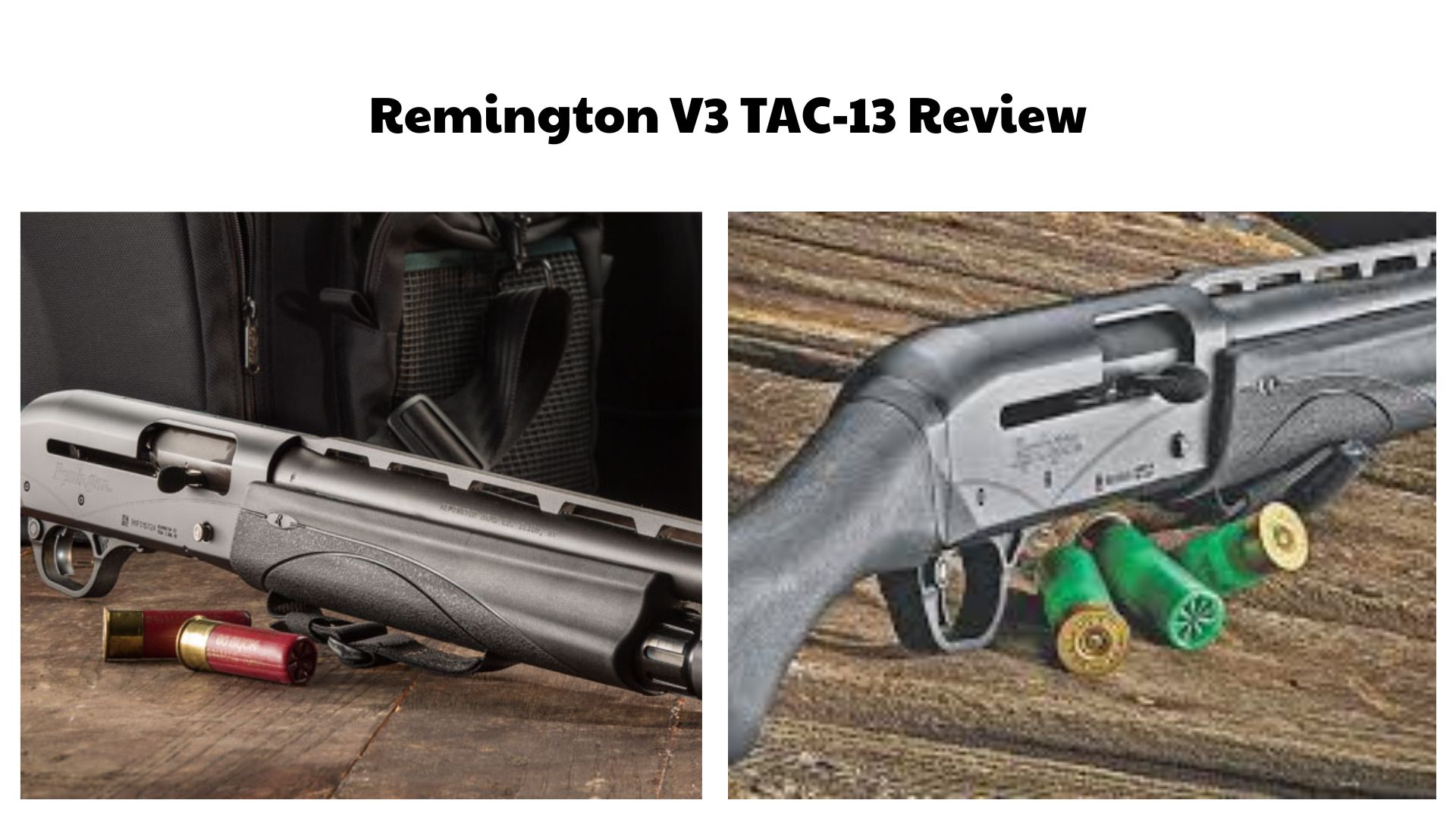

The Remington V3 TAC-13 is a compact semi-automatic firearm built on Remington’s advanced V3 gas-operated shotgun platform, designed specifically for close-quarters defensive use. Classified as a non-NFA firearm under U.S. federal law, it avoids shotgun and short-barreled shotgun (SBS) regulations thanks to its 13-inch barrel and compliant overall length configuration. This unique classification allows it to deliver full 12-gauge performance in an extremely compact package without requiring tax stamps or NFA registration.
Featuring a bird’s-head style grip with Raptor grip variants, the TAC-13 is engineered for maximum maneuverability in tight environments such as homes and vehicles. Its standout feature is the V3 gas system, which significantly reduces recoil impulse and makes the platform surprisingly controllable for its size and power level. Unlike traditional sporting shotguns, the TAC-13 is purpose-built for defensive applications rather than hunting or competition.
This review examines the Remington V3 TAC-13 in detail, covering its design, legal classification, performance characteristics, recoil system, reliability, ergonomics, advantages, limitations, and real-world defensive practicality to determine how it performs as a modern compact defensive firearm.
Remington V3 TAC-13 Overview and History
Origins of the V3 Platform
The V3 TAC-13 is derived from Remington’s V3 gas-operated semi-automatic shotgun family, which was originally developed to improve reliability, cycling consistency, and recoil reduction compared to earlier models such as the 1100 and 11-87. The V3 system introduced a more efficient gas operation design that made semi-automatic shotguns softer shooting and more dependable across a wider range of loads. The TAC-13 adapts this proven system into an ultra-compact defensive configuration.
Development of the TAC-13 Concept
The TAC-13 was engineered as a compact defensive firearm that intentionally avoids traditional shotgun classification by removing the shoulder stock and shortening the barrel while maintaining legal overall length. It builds on the broader TAC-series philosophy, influenced by earlier compact designs like the TAC-14, but elevates the concept by incorporating a semi-automatic gas system. The goal was to create a highly portable, fast-handling defensive tool optimized for confined spaces.
Why the TAC-13 Became Popular
The TAC-13 gained popularity due to its combination of semi-automatic performance and extremely compact form factor. Unlike pump-action compact firearms, it offers faster follow-up shots and reduced shooter fatigue. Its recoil mitigation through the V3 gas system also makes it more controllable than many competing compact 12-gauge platforms. These advantages have made it particularly attractive for home defense users and vehicle-based defensive setups.
Federal Classification and Legal Status
Why It Is Not a Shotgun
The Remington V3 TAC-13 is not legally classified as a shotgun because it does not include a shoulder stock, which is a defining feature of a shotgun under U.S. federal law. Instead, it falls into a category defined as a “firearm,” which allows it to function as a smoothbore 12-gauge platform without meeting shotgun classification requirements. This distinction is critical in understanding its legal positioning.
Barrel Length and Overall Length Compliance
With its 13-inch barrel and carefully engineered overall length exceeding federal minimum requirements, the TAC-13 avoids classification as a short-barreled shotgun (SBS) under the National Firearms Act (NFA). This allows it to be purchased without the additional tax stamp or regulatory process required for SBS firearms, making it more accessible while maintaining compact performance characteristics.
State Law Considerations
Despite its federal classification, the TAC-13’s legality can vary significantly at the state and local levels. Some jurisdictions impose stricter rules on firearm configurations, barrel lengths, or smoothbore weapons. As a result, potential owners must verify compliance with local regulations before purchase or possession to ensure legal ownership in their specific area.
Design and Build Quality
Compact Semi-Auto Construction
The TAC-13 is built on an aluminum receiver platform integrated with Remington’s V3 gas system architecture, providing a balance of strength and reduced weight. The firearm uses durable synthetic components designed for harsh defensive environments, prioritizing reliability over aesthetic refinement. Its compact chassis is specifically optimized for maneuverability in confined spaces such as hallways and vehicles.
Bird’s Head Grip Ergonomics
Instead of a traditional stock, the TAC-13 uses a bird’s-head style grip or Raptor grip variant to maintain compact legality while offering improved recoil control compared to a bare pistol grip. This design changes the recoil vector and handling dynamics, making the firearm easier to stabilize during firing, though it still requires proper technique for effective control. The trade-off is increased compactness at the cost of reduced shoulder-based stability.
Weight, Balance, and Handling Characteristics
Due to its short barrel and compact design, the TAC-13 has a forward-heavy balance that influences handling behavior. This makes it highly maneuverable in tight environments but places greater emphasis on grip strength and control during firing. Recoil management is heavily dependent on shooter technique, as there is no shoulder stock to absorb energy.
V3 Gas Operating System Explained
How the V3 Gas System Works
The V3 gas system uses a dual-piston, self-regulating design that automatically adjusts to different load pressures. This allows the firearm to cycle a wide range of 12-gauge ammunition without manual adjustment. The system redirects gas pressure efficiently to reduce felt recoil and improve cycling smoothness, especially in semi-automatic operation.
Recoil Reduction Advantages
One of the most significant advantages of the V3 system is its ability to deliver one of the softest-shooting experiences in the compact 12-gauge category. It significantly reduces muzzle rise and felt recoil compared to pump-action or inertia-driven compact platforms. This improvement directly enhances control during rapid follow-up shots in defensive scenarios.
Reliability and Cycling Performance
The TAC-13 generally demonstrates consistent cycling performance with defensive-grade ammunition, particularly full-power loads. Compared to inertia systems, the V3 gas system is more tolerant of varying load pressures, although it still requires routine cleaning to maintain optimal function. Proper maintenance ensures long-term reliability and smooth operation under stress.
Introduction
The Remington V3 TAC-13 is a compact semi-automatic firearm built on Remington’s advanced V3 gas-operated shotgun platform, designed specifically for close-quarters defensive use. Classified as a non-NFA firearm under U.S. federal law, it avoids shotgun and short-barreled shotgun (SBS) regulations thanks to its 13-inch barrel and compliant overall length configuration. This unique classification allows it to deliver full 12-gauge performance in an extremely compact package without requiring tax stamps or NFA registration.
Featuring a bird’s-head style grip with Raptor grip variants, the TAC-13 is engineered for maximum maneuverability in tight environments such as homes and vehicles. Its standout feature is the V3 gas system, which significantly reduces recoil impulse and makes the platform surprisingly controllable for its size and power level. Unlike traditional sporting shotguns, the TAC-13 is purpose-built for defensive applications rather than hunting or competition.
This review examines the Remington V3 TAC-13 in detail, covering its design, legal classification, performance characteristics, recoil system, reliability, ergonomics, advantages, limitations, and real-world defensive practicality to determine how it performs as a modern compact defensive firearm.
Remington V3 TAC-13 Overview and History
Origins of the V3 Platform
The V3 TAC-13 is derived from Remington’s V3 gas-operated semi-automatic shotgun family, which was originally developed to improve reliability, cycling consistency, and recoil reduction compared to earlier models such as the 1100 and 11-87. The V3 system introduced a more efficient gas operation design that made semi-automatic shotguns softer shooting and more dependable across a wider range of loads. The TAC-13 adapts this proven system into an ultra-compact defensive configuration.
Development of the TAC-13 Concept
The TAC-13 was engineered as a compact defensive firearm that intentionally avoids traditional shotgun classification by removing the shoulder stock and shortening the barrel while maintaining legal overall length. It builds on the broader TAC-series philosophy, influenced by earlier compact designs like the TAC-14, but elevates the concept by incorporating a semi-automatic gas system. The goal was to create a highly portable, fast-handling defensive tool optimized for confined spaces.
Why the TAC-13 Became Popular
The TAC-13 gained popularity due to its combination of semi-automatic performance and extremely compact form factor. Unlike pump-action compact firearms, it offers faster follow-up shots and reduced shooter fatigue. Its recoil mitigation through the V3 gas system also makes it more controllable than many competing compact 12-gauge platforms. These advantages have made it particularly attractive for home defense users and vehicle-based defensive setups.
Federal Classification and Legal Status
Why It Is Not a Shotgun
The Remington V3 TAC-13 is not legally classified as a shotgun because it does not include a shoulder stock, which is a defining feature of a shotgun under U.S. federal law. Instead, it falls into a category defined as a “firearm,” which allows it to function as a smoothbore 12-gauge platform without meeting shotgun classification requirements. This distinction is critical in understanding its legal positioning.
Barrel Length and Overall Length Compliance
With its 13-inch barrel and carefully engineered overall length exceeding federal minimum requirements, the TAC-13 avoids classification as a short-barreled shotgun (SBS) under the National Firearms Act (NFA). This allows it to be purchased without the additional tax stamp or regulatory process required for SBS firearms, making it more accessible while maintaining compact performance characteristics.
State Law Considerations
Despite its federal classification, the TAC-13’s legality can vary significantly at the state and local levels. Some jurisdictions impose stricter rules on firearm configurations, barrel lengths, or smoothbore weapons. As a result, potential owners must verify compliance with local regulations before purchase or possession to ensure legal ownership in their specific area.
Design and Build Quality
Compact Semi-Auto Construction
The TAC-13 is built on an aluminum receiver platform integrated with Remington’s V3 gas system architecture, providing a balance of strength and reduced weight. The firearm uses durable synthetic components designed for harsh defensive environments, prioritizing reliability over aesthetic refinement. Its compact chassis is specifically optimized for maneuverability in confined spaces such as hallways and vehicles.
Bird’s Head Grip Ergonomics
Instead of a traditional stock, the TAC-13 uses a bird’s-head style grip or Raptor grip variant to maintain compact legality while offering improved recoil control compared to a bare pistol grip. This design changes the recoil vector and handling dynamics, making the firearm easier to stabilize during firing, though it still requires proper technique for effective control. The trade-off is increased compactness at the cost of reduced shoulder-based stability.
Weight, Balance, and Handling Characteristics
Due to its short barrel and compact design, the TAC-13 has a forward-heavy balance that influences handling behavior. This makes it highly maneuverable in tight environments but places greater emphasis on grip strength and control during firing. Recoil management is heavily dependent on shooter technique, as there is no shoulder stock to absorb energy.
V3 Gas Operating System Explained
How the V3 Gas System Works
The V3 gas system uses a dual-piston, self-regulating design that automatically adjusts to different load pressures. This allows the firearm to cycle a wide range of 12-gauge ammunition without manual adjustment. The system redirects gas pressure efficiently to reduce felt recoil and improve cycling smoothness, especially in semi-automatic operation.
Recoil Reduction Advantages
One of the most significant advantages of the V3 system is its ability to deliver one of the softest-shooting experiences in the compact 12-gauge category. It significantly reduces muzzle rise and felt recoil compared to pump-action or inertia-driven compact platforms. This improvement directly enhances control during rapid follow-up shots in defensive scenarios.
Reliability and Cycling Performance
The TAC-13 generally demonstrates consistent cycling performance with defensive-grade ammunition, particularly full-power loads. Compared to inertia systems, the V3 gas system is more tolerant of varying load pressures, although it still requires routine cleaning to maintain optimal function. Proper maintenance ensures long-term reliability and smooth operation under stress.
Reliability and Maintenance
Cleaning and Field Stripping
The Remington V3 TAC-13 requires more maintenance than traditional pump-action platforms due to its semi-automatic gas operating system. While field stripping remains relatively straightforward, the gas system introduces additional components that must be kept clean for optimal performance. Regular inspection and cleaning of the gas ports, piston areas, and bolt assembly are essential to ensure consistent cycling and prevent performance degradation over time.
Long-Term Durability
Built on Remington’s proven V3 engineering platform, the TAC-13 is designed for durability under defensive use conditions. When properly maintained, it delivers strong long-term performance and reliability even under frequent firing schedules. The underlying design benefits from modern materials and improved gas system efficiency, contributing to its overall structural integrity and service life.
Maintenance Considerations
Ongoing maintenance is critical for sustaining the TAC-13’s performance. Regular lubrication of moving parts and thorough carbon removal from the gas system are required to maintain smooth cycling. Compared to pump-action firearms, the TAC-13 is more sensitive to neglect, meaning reliability can decrease if cleaning routines are not consistently followed.
Pros and Cons of the Remington V3 TAC-13
Pros
- Extremely soft recoil for a compact 12-gauge platform thanks to the V3 gas system
- Semi-automatic cycling provides faster follow-up shots in close-quarters scenarios
- Highly compact and maneuverable design ideal for confined environments
- Proven reliability of the V3 gas operating system when properly maintained
- Strong defensive stopping power with full 12-gauge ammunition
Cons
- Requires consistent maintenance of the gas system for optimal reliability
- Less stable and controllable than traditional stocked shotguns
- Limited sighting options compared to modern tactical platforms with rails and optics
- Non-traditional ergonomics create a learning curve for new users
Price and Value Analysis
Why It Costs More Than Pump Firearms
The Remington V3 TAC-13 is priced higher than pump-action firearms due to its advanced gas-operated V3 system and semi-automatic engineering complexity. Unlike simpler mechanical pump designs, it incorporates precision gas regulation components that improve recoil control and cycling speed. Its compact defensive specialization also adds to manufacturing complexity and overall cost.
Is It Worth It?
The TAC-13 offers strong value for experienced defensive firearm users who can take advantage of its semi-automatic speed and recoil reduction. It represents a premium compact defensive option that prioritizes performance over simplicity. However, it is less ideal for beginners or users who prefer low-maintenance platforms, as it demands consistent upkeep and familiarity with semi-automatic shotgun systems.
Final Verdict
The Remington V3 TAC-13 stands out as one of the most advanced and controllable compact semi-automatic defensive firearms available today. It combines the proven V3 gas system with a highly compact design to deliver an effective close-quarters defensive tool.
Its key strengths include excellent recoil control, fast semi-auto cycling, compact maneuverability, and strong reliability when properly maintained. However, these benefits come with trade-offs in the form of increased maintenance requirements, non-traditional ergonomics, and limited versatility compared to full-stock shotguns.
Overall, the TAC-13 is best suited for experienced home defense users, tactical firearm enthusiasts, and vehicle-defense owners who prioritize performance and compact power over simplicity.
55 FAQs – Remington V3 TAC-13 Review
1. What is the Remington V3 TAC-13?
The Remington V3 TAC-13 is a compact semi-automatic firearm built on Remington’s V3 gas-operated shotgun platform. It is designed for close-quarters defensive use rather than hunting or sporting applications. Its defining features include a 13-inch barrel, bird’s-head style grip, and classification as a “firearm” under U.S. federal law instead of a traditional shotgun. This allows it to remain compact while still delivering full 12-gauge power.
2. Is the V3 TAC-13 considered a shotgun?
No. Under U.S. federal law, the V3 TAC-13 is not classified as a shotgun because it does not have a shoulder stock. Instead, it is categorized as a “firearm.” This distinction is important because it affects how it is regulated, particularly in relation to the National Firearms Act (NFA). However, state laws may differ, so local legal compliance is always necessary.
3. What makes the TAC-13 different from the TAC-14?
The TAC-13 is semi-automatic and uses the V3 gas system, which significantly reduces recoil and improves cycling speed. The TAC-14, by contrast, is a pump-action firearm based on the Remington 870 platform. The TAC-13 offers faster follow-up shots and smoother shooting, while the TAC-14 provides simpler mechanics and lower maintenance requirements.
4. How does the V3 gas system work?
The V3 gas system uses a dual-piston, self-regulating mechanism that automatically adjusts gas pressure based on ammunition load. This allows the firearm to cycle reliably with different shell types while reducing felt recoil. Excess gas is vented efficiently, making the system softer shooting compared to traditional semi-auto shotgun designs.
5. Is the TAC-13 reliable?
Yes, the TAC-13 is generally reliable when properly maintained. The V3 platform is known for consistent cycling with defensive ammunition. However, because it is a gas-operated system, it requires regular cleaning and lubrication to maintain reliability. Neglecting maintenance can lead to cycling issues over time.
6. What type of ammunition does it use?
The TAC-13 uses standard 12-gauge shotgun shells, including buckshot, slugs, and some birdshot loads. It performs best with full-power defensive loads. Light target loads may cycle inconsistently depending on conditions and break-in status, especially in early use.
7. Is recoil heavy on the TAC-13?
Recoil is noticeably reduced compared to pump-action firearms of similar size, but it is still significant due to the compact platform and lack of a shoulder stock. The bird’s-head grip helps redirect recoil rather than absorb it, making technique and stance critical for control.
8. Is the TAC-13 good for beginners?
It is not ideal for beginners. While manageable with training, the non-traditional grip and lack of a stock create a learning curve. New shooters may find pump-action or full-stock shotguns easier to control and more intuitive for aiming and recoil management.
9. What is the effective range of the TAC-13?
The effective defensive range is typically within 5 to 25 yards depending on ammunition type. Buckshot is most effective at close range, while slugs extend usability to mid-range distances. It is not designed for precision shooting at longer distances.
10. Can the TAC-13 be used for home defense?
Yes, it is commonly used for home defense due to its compact size and powerful stopping capability. It is especially effective in tight spaces such as hallways and small rooms where maneuverability is critical. However, recoil management must be considered in defensive planning.
11. Can it be used in vehicles?
Yes, its compact form makes it suitable for vehicle storage and defensive use. Many users choose it as a “truck gun” due to its short length and powerful close-range capability. Proper storage and legal compliance are essential depending on jurisdiction.
12. Does the TAC-13 require a break-in period?
Some units may benefit from a short break-in period, especially when using lighter loads. During initial use, cycling may be more consistent with full-power defensive ammunition. After break-in and cleaning, performance typically stabilizes.
13. How often should it be cleaned?
Regular cleaning is recommended after every range session or after extended storage. The gas system should be cleaned frequently to prevent carbon buildup. Compared to pump-action firearms, it demands more maintenance attention.
14. What are the main advantages of the TAC-13?
Its main advantages include compact size, reduced recoil compared to similar platforms, semi-automatic speed, and strong defensive stopping power. It is also highly maneuverable in tight environments, making it suitable for close-quarters defensive roles.
15. What are the disadvantages?
The main disadvantages include higher recoil than stocked shotguns, limited sighting options, increased maintenance requirements, and a learning curve due to its non-traditional ergonomics. It is less versatile than full-size shotguns.
16. Can optics be mounted on it?
The TAC-13 has limited optics mounting capability compared to railed platforms. Most users rely on bead sights or add laser aiming devices. Some aftermarket modifications allow accessory mounting, but it is not optics-focused by design.
17. Is it legal in all states?
No, legality varies by state. While federally classified as a “firearm,” some states restrict or prohibit such configurations. It is essential to check local laws before purchase or possession.
18. How does it compare to pump-action TAC firearms?
It offers faster follow-up shots and reduced recoil compared to pump-action TAC firearms. However, pump-action models are simpler, require less maintenance, and are generally more tolerant of varied ammunition.
19. Is the TAC-13 loud?
Yes, like all 12-gauge firearms, it produces significant noise and muzzle blast. The compact barrel increases perceived concussion, making hearing protection essential during use.
20. What is the capacity?
Capacity typically depends on configuration but is generally limited compared to full-length shotguns due to its compact design. Most setups prioritize maneuverability over extended capacity.
21. Can it shoot slugs effectively?
Yes, slugs perform well within defensive ranges. They offer improved penetration and accuracy compared to buckshot at longer close-range distances, making them a viable defensive option.
22. Does it support mini-shells?
Mini-shell compatibility varies depending on the model and may require adapters for reliable cycling. Even with adapters, performance can be inconsistent compared to standard shells.
23. How does the grip affect recoil?
The bird’s-head grip changes the recoil angle rather than reducing recoil force. It helps control upward muzzle rise but requires proper technique to maintain stability during rapid fire.
24. Is it suitable for tactical training?
Yes, it is often used in defensive shooting training scenarios. It helps users develop close-quarters handling skills, recoil control techniques, and situational awareness under stress.
25. Can it be modified or customized?
Yes, aftermarket support includes grips, forends, lights, and sling mounts. However, customization is more limited compared to full-size shotgun platforms due to its compact design.
26. How durable is the TAC-13?
It is built on a proven V3 platform with strong durability when properly maintained. The combination of aluminum receiver and synthetic components provides good structural resilience under defensive use.
27. Does it require special maintenance tools?
No special tools are required for basic maintenance. Standard cleaning kits for 12-gauge shotguns are sufficient for field stripping and routine upkeep.
28. Is it good for small-framed shooters?
It can be used by smaller shooters, but recoil may be challenging. Proper training and stance are necessary to manage the firearm effectively.
29. Can it be fired one-handed?
Technically it can, but it is not recommended. The recoil and lack of stock make one-handed firing difficult and unsafe for controlled accuracy.
30. What makes it different from pump firearms?
The key difference is semi-automatic operation. The TAC-13 cycles automatically using gas pressure, allowing faster follow-up shots compared to manual pump-action systems.
31. Is it good for recoil-sensitive users?
It is better than some compact pump options, but still not ideal for recoil-sensitive users. Even with gas reduction, 12-gauge recoil remains significant in such a compact platform.
32. How accurate is it?
It is accurate for close-range defensive use but not designed for precision shooting. Its effectiveness depends more on pattern spread than pinpoint accuracy.
33. Does it require a sling?
A sling is recommended for retention and control, especially due to the lack of a stock. It helps stabilize the firearm during movement or transitions.
34. What is the learning curve like?
The learning curve is moderate to steep depending on user experience. Shooters must adapt to non-traditional handling, recoil management, and aiming techniques.
35. How does it perform in low light?
Performance in low light depends on accessories. Without optics or lights, it relies on basic sighting methods, but laser or light upgrades significantly improve usability.
36. Is it suitable for hunting?
No, it is not designed for hunting. Its compact design and limited accuracy range make it unsuitable for ethical or effective hunting applications.
37. How does it compare to AR-style shotguns?
AR-style shotguns often offer better ergonomics and optics compatibility. The TAC-13, however, provides a more compact footprint and traditional shotgun power.
38. Is it easy to store?
Yes, its compact size makes it easy to store in safes, vehicles, or small defensive storage locations.
39. Does it have recoil pads?
It does not use a traditional stock recoil pad. Recoil management relies primarily on grip technique and gas system mitigation.
40. What is the trigger like?
The trigger is consistent and reliable but not match-grade. It is designed for defensive use rather than precision shooting.
41. Can it be used for competition shooting?
It is not designed for competitive shooting. Its strengths are defensive applications rather than speed or precision competition environments.
42. How does weather affect performance?
It performs well in various environmental conditions, but like all gas systems, it benefits from proper cleaning after exposure to dirt, moisture, or debris.
43. Is it expensive to maintain?
Maintenance costs are relatively low, but time investment is higher due to the need for regular cleaning of the gas system.
44. Does it have safety features?
Yes, it includes standard manual safety controls designed for defensive firearm use. Operation is simple and consistent.
45. What makes it “compact defensive firearm”?
It is classified this way due to its short barrel, lack of stock, and overall design intended for defensive rather than sporting use. It prioritizes maneuverability in tight spaces.
46. Is it good for confined spaces?
Yes, it excels in confined spaces such as hallways, rooms, and vehicles due to its compact length and maneuverability.
47. How does it compare to pistols?
It offers significantly greater stopping power than pistols but is less concealable and requires two-handed operation for effective control.
48. Can it be used under stress?
Yes, but training is essential. Stress conditions highlight the importance of mastering recoil control and handling techniques.
49. Is it beginner-friendly?
It is not beginner-friendly due to recoil and handling complexity. It is better suited for experienced shooters.
50. What is its main purpose?
Its main purpose is close-quarters defensive use, particularly in home defense or vehicle-based scenarios where compact size and stopping power are essential.
51. How does it compare to full-stock shotguns?
Full-stock shotguns provide better recoil control and accuracy, while the TAC-13 offers superior compactness and maneuverability.
52. Does it overheat?
Overheating is not typically an issue in normal defensive use, though extended firing sessions may require cooling periods like any firearm.
53. Is it easy to reload?
Reloading is straightforward but slower than magazine-fed systems. It requires manual shell insertion into the magazine tube.
54. What accessories are most useful?
Weapon lights, lasers, and slings are among the most practical accessories, improving usability in low-light and defensive situations.
55. Is it worth buying?
It is worth buying for experienced users seeking a compact, powerful defensive firearm. However, it is not ideal for beginners or those wanting a low-maintenance platform.
Read more: