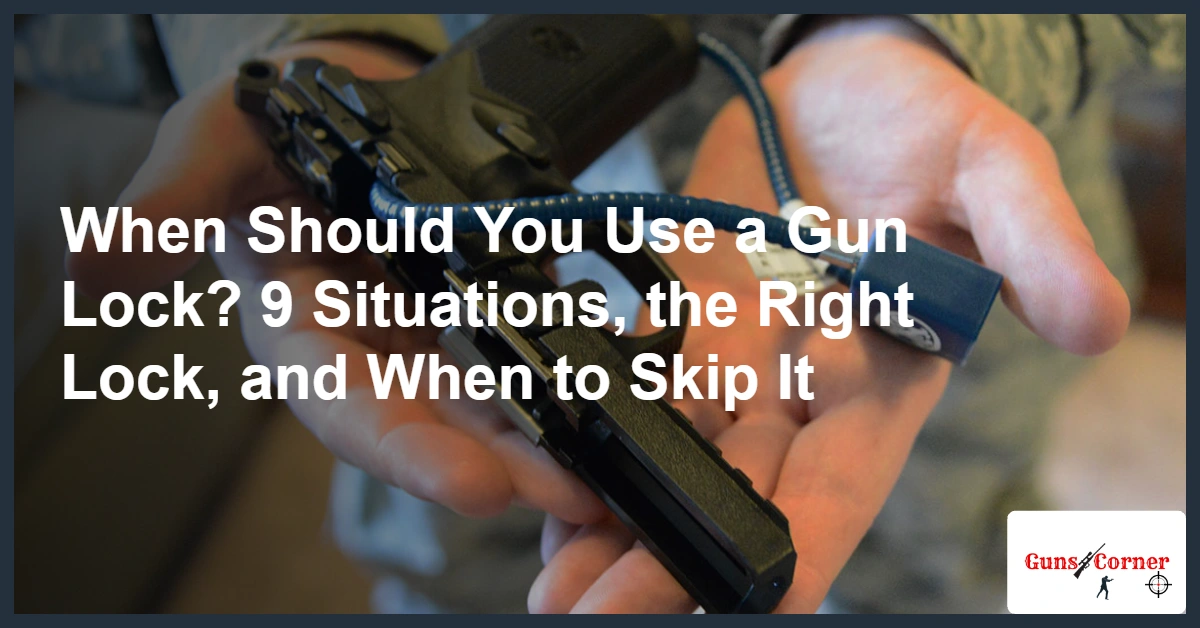

When should you use a gun lock? Use one any time a firearm is unloaded and out of your direct control, unless it is already locked inside a safe that only you can open. That covers more moments than most owners think: a rifle in the closet, a shotgun riding to the deer lease, a pistol at a relative’s house over the holidays.
The one place a gun lock does not belong is on a loaded gun you keep ready for self-defense. That gun needs a quick-access safe instead.
This guide walks through the nine situations where a lock earns its place, the times it is the wrong tool, and which type of lock fits each job.
When Should You Use a Gun Lock? The Two-Question Test
Most of the confusion about gun locks goes away if you ask two questions every time you set a firearm down.
First: is the gun in your hands, on your body, or inside a locked container that only you can open? If yes, you’re covered. If no, keep going.
Second: is the gun unloaded? Cable locks and chamber locks only work on an empty gun with the action open, and a trigger lock should never go on a loaded one. If the gun is unloaded and nobody is watching it, that’s exactly when you should use a gun lock.
So the rule is short. Unattended plus unloaded equals locked. A loaded gun that has to stay ready goes in a quick-access safe, not under a cable.
The reason this matters is access. A lock is not built to stop a determined thief with tools. It is built to stop a curious kid, a careless guest, or a family member in a bad moment from turning an unattended gun into a working one in a few seconds. That is a narrower job than a safe, and it is the job you’re matching to the situation.
9 Situations Where You Should Use a Gun Lock
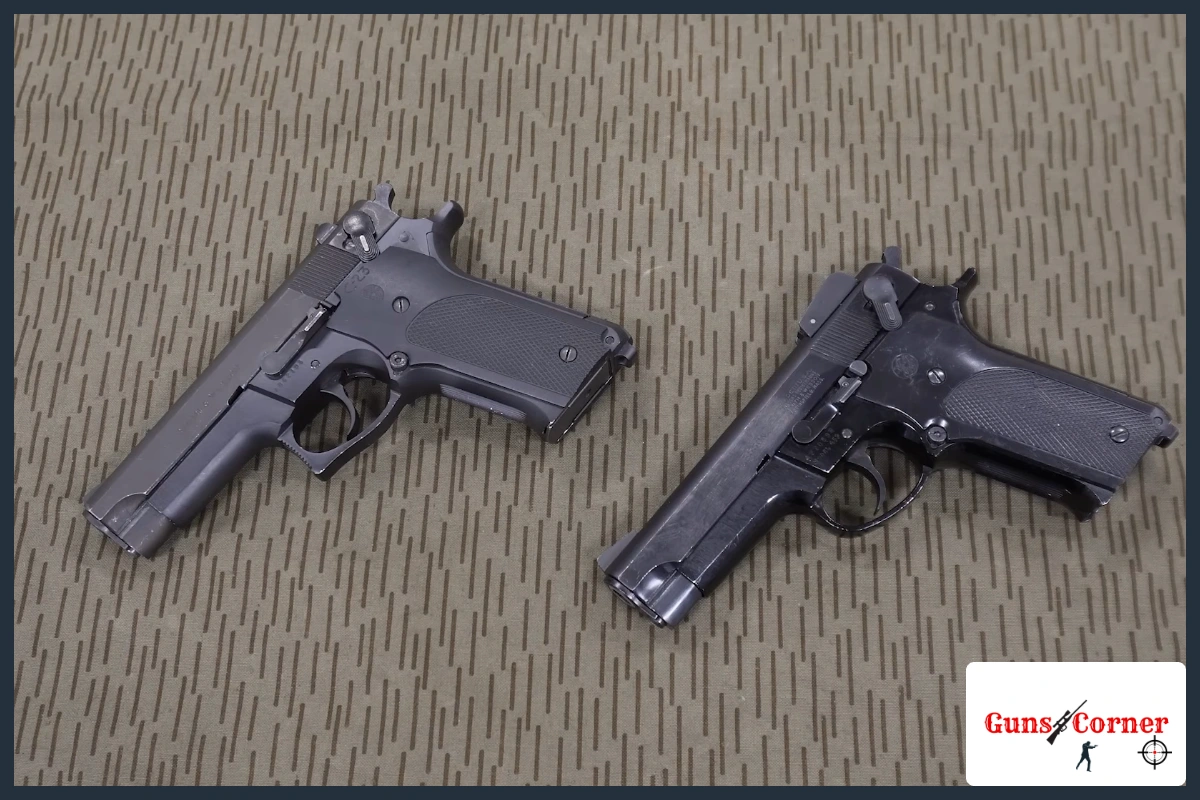
Each of these comes up in ordinary gun ownership. Some are obvious. A few catch even experienced hunters off guard.
1. Any Gun Stored Outside a Safe
If a firearm lives in a closet, under a bed, in a gun cabinet with a flimsy latch, or on a wall rack, lock it. Glass-front cabinets and decorative racks keep guns organized, but most of them don’t keep anyone out.
Say you own a safe that holds six long guns and you have eight. The two that don’t fit still need protection. A cable lock on each, with the ammunition stored somewhere else, is a cheap and honest fix until you buy a bigger safe.
2. Children Live in or Visit Your Home
Kids find things. That includes the shotgun behind the coat rack and the pistol you were sure was too high to reach. If children live with you, every gun that isn’t in a safe should be unloaded and locked.
Visiting kids count too. Grandchildren at Thanksgiving, a neighbor’s teenager feeding the dog, your child’s friends after school. Their parents assume your guns are secured. A lock is the minimum that makes that true.
3. Someone in the House Is Going Through a Hard Time
This one is uncomfortable to talk about, and it matters. If anyone in your home is in crisis, depressed, abusing alcohol or drugs, or showing signs of dementia, limit their access to firearms right away.
A lock with the key kept on your body is one layer. Moving the guns out of the house for a while, to a trusted friend or a storage option allowed in your state, is a stronger one. Project ChildSafe, the safety program run by the National Shooting Sports Foundation, points out that secure storage can keep a gun away from a person who may pose a danger to themselves or others. Time and distance save lives in those moments.
4. Guests, Roommates, Contractors, or a House-Sitter
Anyone who will be in your home without you is a reason to lock up. That includes a plumber working alone in the basement, a dog sitter for a long weekend, or a roommate whose friends come and go.
You don’t need to distrust these people to lock your guns. You just can’t vouch for everyone they bring along, and you won’t be there to supervise.
5. Inside a Safe That Others Can Open
A safe only protects against people who don’t have the code. If your spouse, an adult child, or a hunting buddy knows the combination, everything inside is open to them and anyone who learns it.
When a teenager in the house has been trusted with the code, or the code has been shared more widely than you’d like, an individual lock on a specific gun adds a second step. It is also a good stopgap while you change the combination.
6. Driving to the Range, the Lease, or the Gunsmith
Transport is one of the most common reasons to use a gun lock. A cased, unloaded rifle with a cable through the action can’t be fired if the case gets opened at a gas station, a parking lot, or a motel.
Hunting season makes this more important, not less. The Project ChildSafe Hunt S.A.F.E. campaign notes that hunting season is when more firearms come out of storage and get transported, and every extra handling is another chance for a mistake. Transport laws vary a lot by state, so check your state wildlife agency or state police before you travel, especially across state lines.
7. Hunting Camp, a Cabin, or a Hotel Room
Camp is where good habits slip. Rifles lean in corners, people come in tired, and someone’s nephew wants to look at the new scope.
When guns come off the shoulder after the last hunt of the day, unload them outside, verify the chamber is empty, and run a lock through each action before they go inside. In a hotel room, the same rule applies because housekeeping and maintenance staff have keys.
8. Long-Term Storage and Guns You Rarely Shoot
The grandfather’s shotgun, the rifle you only take out for elk every few years, the pistol that hasn’t left its box since you bought a newer one. Guns you don’t handle often are the ones you’re least likely to notice are missing or moved.
Lock them, write down the serial numbers, and keep a photo of each one. If they’re not in a safe, consider whether they should be.
9. A New Gun, a Loaned Gun, or a Gun Going to a New Owner
Most new handguns come with a lock in the box, and that isn’t an accident. Under federal law at 18 U.S.C. § 922(z), licensed dealers, manufacturers, and importers generally have to provide a secure gun storage or safety device when they sell or transfer a handgun to a non-licensee. Use it from day one.
The same thinking applies when you lend a gun to a friend for hunting season or pass one down. Hand it over unloaded and locked, with the key separate, and make sure the transfer follows your state’s rules.
When a Gun Lock Is the Wrong Tool
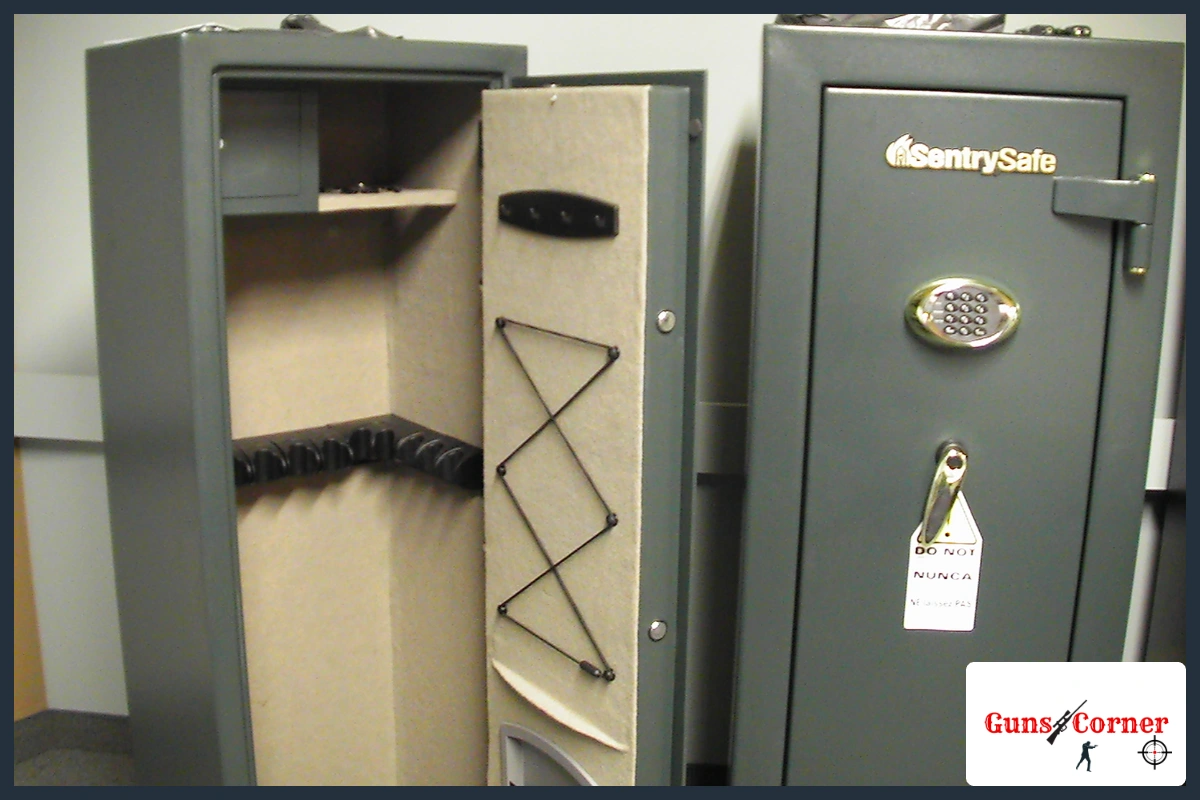
A lock is useful, but it isn’t the answer to every storage question. Here’s where it falls short.
A loaded gun kept for home defense. Cable locks need an open, empty action, so they can’t secure a loaded gun at all. Trigger locks technically fit over a loaded gun’s trigger guard, but putting one on or taking one off means working parts inside the trigger guard of a live firearm. That conflicts with one of the most basic safety rules.
If a gun has to stay loaded, store it in a quick-access lockbox or safe instead.
Your only protection against theft. A locked gun can still be carried out of the house and the lock cut off later. Braided steel cables can be cut with bolt cutters. If theft is your main worry, a bolted-down safe does that job and a lock does not.
A replacement for talking to your kids. Locks buy time. Kids still need to know what to do if they find a gun anywhere, including at someone else’s house: don’t touch it, leave the area, and tell an adult.
A gun the lock doesn’t actually fit. A cable that slides back out of a small ejection port, or a trigger lock that still lets the trigger move, gives a false sense of security. If it doesn’t fit snugly, get a lock made for that gun.
Which Type of Gun Lock Fits Which Situation
“Gun lock” covers several different devices, and each one assumes something about the state of the firearm. Picking the right one for the situation matters as much as deciding to lock at all.
| Lock type | How it works | Gun must be unloaded? | Best for | Main weakness |
|---|---|---|---|---|
| Cable lock | A steel cable runs through the open action and magazine well, so the action can’t close and a magazine can’t seat | Yes | Storage outside a safe, transport, camp, guns with kids in the home | Can be cut; some small actions don’t hold the cable well |
| Trigger lock | Two halves clamp around the trigger guard and block the trigger | Yes, always use it on an empty gun | Guns whose action can’t take a cable, display guns | Doesn’t stop loading; loose fits may allow trigger movement |
| Chamber lock | A plug fills the chamber so no round can be loaded | Yes | Long-term storage of a specific caliber | Must match the chamber; slow to remove |
| Magwell lock | Locks into the magazine well, blocking magazines; common on AR-style rifles | Yes | Semi-auto rifles in storage | Usually fits only certain models |
| Quick-access lockbox or safe | Locks the whole gun inside a container opened by key, code, or fingerprint | No | A loaded gun kept ready for defense | Costs more; small boxes must be bolted down or cabled to something solid |
For most hunters and shooters, the cable lock is the workhorse. It shows anyone at a glance that the action is open and empty, it fits most rifles, shotguns, and pistols, and it’s often free. Trigger locks make sense for the odd gun a cable won’t fit, as long as you only ever install them on an unloaded firearm.
How to Put a Cable Lock On the Right Way
A lock installed wrong is just jewelry. Follow the instructions printed on your lock’s packaging, and use this sequence as the general pattern.
- Point the muzzle in a safe direction and keep your finger off the trigger the whole time.
- Remove the magazine or empty the tube or cylinder.
- Open the action and check the chamber by sight and by feel. On a revolver, swing the cylinder out and check every chamber.
- Route the cable through the open action. On most semi-auto pistols it goes through the ejection port and out the magazine well. On a revolver it passes through the frame opening with the cylinder swung out. On pump and semi-auto shotguns and many rifles it goes through the ejection port and out the bottom of the action. On break-action guns and some bolt and lever guns, check the lock instructions, since routing varies.
- Lock it and tug on it. The action should not close, and the cable should not slide back out.
- Store the ammunition separately and put the key or combination somewhere only you can reach.
Where to Keep the Key or Combination
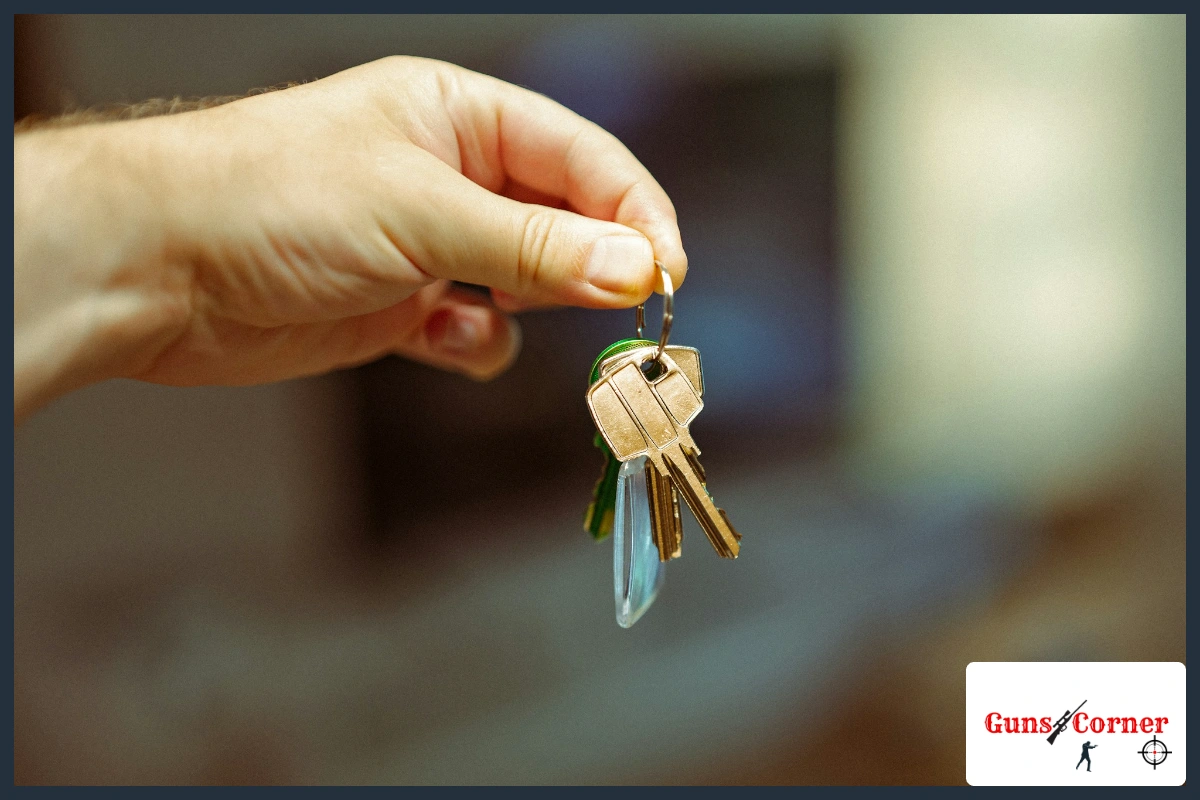
A lock is only as good as its key. Plenty of guns are “locked” with the key hanging on a nail beside the closet door.
Keep keys on your personal key ring, in a small lockbox of their own, or inside your safe if you have one. Don’t store them in the same case or drawer as the gun. Don’t hide them somewhere a curious kid would look first, like the top of the gun cabinet or a sock drawer.
Combination locks remove the key problem, but the code becomes the weak spot. Don’t use a birthday, the last digits of a phone number, or the same code as your safe.
Gun Lock Mistakes That Defeat the Purpose
Most of the failures with gun locks come from habits, not hardware.
- Locking a gun that still has a round in the chamber. Always unload and verify first. A trigger lock on a loaded gun is a hazard, not a safety step.
- Leaving the lock in the box. The lock that came with the gun does nothing in a drawer. Install it the day the gun comes home.
- Storing ammunition right next to the locked gun. Keep it in a separate container, ideally locked as well.
- Using one lock for the whole collection. Each unattended gun needs its own lock or a spot inside a safe.
- Never checking the fit. Cables fray and trigger locks loosen. Tug on each one when you take a gun out or put it away.
- Forgetting the key when you travel. Pack the key or note the code before you leave for the range or the lease, not after you arrive.
Do You Legally Have to Use a Gun Lock?
At the federal level, there’s no general rule that requires owners to put a lock on their guns at home. What federal law does require is on the sales side. Licensed dealers, manufacturers, and importers generally must provide a secure storage or safety device with each handgun they sell to a non-licensee, with some exceptions such as handguns sold to law enforcement or listed as curios or relics.
The same section of federal law gives an owner who uses one of those devices some protection from certain civil lawsuits if a third party later misuses the handgun. Those protections come with conditions, so read them as a reason to lock up, not as legal advice.
State and local law is a different story. Many states and some cities have child-access or safe-storage laws that apply when a minor or a prohibited person could reach a gun, and the details differ a lot. Check your state attorney general’s office or state police website for the current rules where you live and anywhere you plan to travel or hunt.
A Quick Decision Checklist
Use this table when you’re not sure what a specific situation calls for.
| Situation | Use a gun lock? | Better or added step |
|---|---|---|
| Unloaded rifle in a bedroom closet | Yes | Move it into a safe when you can |
| Loaded pistol kept for home defense | No | Quick-access lockbox or safe |
| Shotgun in a case on the drive to a hunt | Yes | Keep ammunition in a separate container |
| Guns at hunting camp overnight | Yes | Unload outside before bringing them in |
| Guns in a safe only you can open | Optional | Change the code if it’s been shared |
| Family member in crisis at home | Yes, at minimum | Store the guns outside the home for a while |
| Lending a gun to a friend | Yes | Follow your state’s transfer rules |
The Bottom Line on When to Use a Gun Lock
So when should you use a gun lock? Any time a gun is unloaded and out of your hands, unless it’s already inside a safe that only you can open. Lock it in storage, on the road, at camp, and whenever kids, guests, or someone in crisis could reach it. Skip the lock on a loaded defensive gun and use a quick-access safe instead.
Here’s a next step you can do today: walk through your house and count every gun that isn’t in a safe. Each one needs its own lock. If you’re short, Project ChildSafe works with law enforcement agencies to hand out free firearm safety kits with a cable lock, and says it has distributed more than 42 million free gun locks since 1998. Its website has a locator for participating agencies by state and city.
Frequently Asked Questions
Should a gun with a lock on it still go in a safe?
Yes, if you have room. A lock stops the gun from being fired, while a safe stops it from being taken. Using both gives you protection against misuse and theft, which is why many owners keep a cable lock on rifles stored in a safe that other family members can open.
Does a cable gun lock fit all guns?
No. Most locks fit common rifles, shotguns, and pistols, but some small pistols, certain lever actions, and some older designs don’t hold a standard cable securely. Check the packaging for compatibility, or ask the manufacturer for a lock made for your model.
Are the free gun locks from police departments any good?
For their intended job, yes. They’re simple cable locks designed to block the action and show at a glance that the gun is unloaded. They won’t stop someone with bolt cutters, so pair them with a safe if theft is a concern.
Do I need a gun lock if I live alone?
Not every day, but you will need one more often than you think. Visitors, repair work, travel, and lending a gun all create moments when a lock matters. It’s worth having one for each gun so you’re ready when those moments come up.