
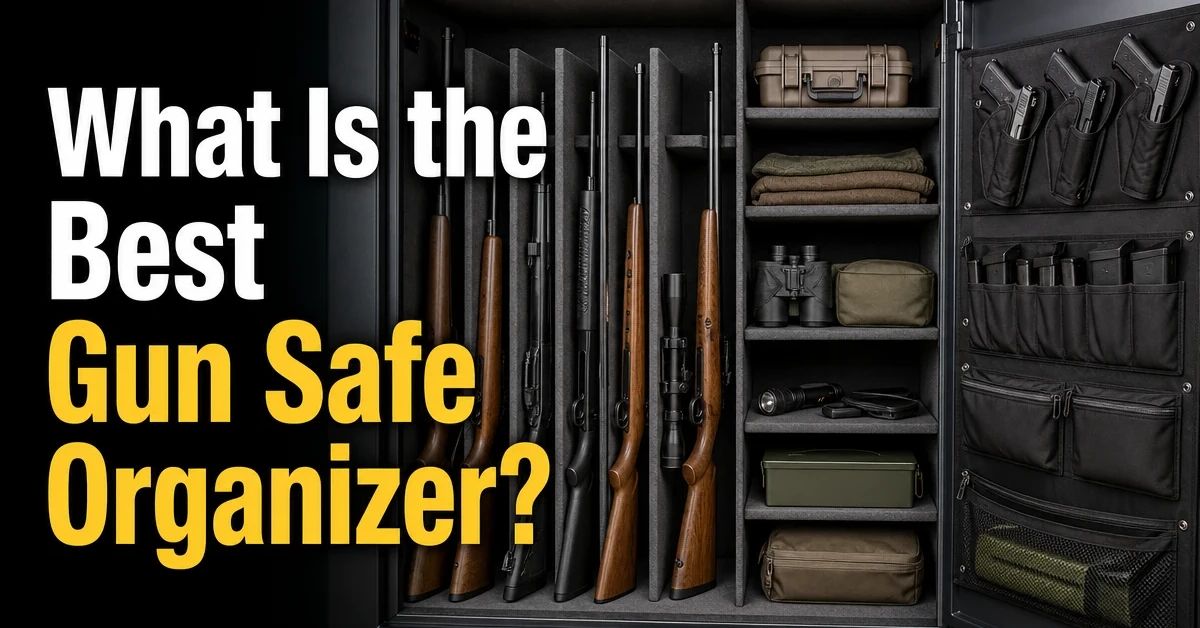

The best gun safe organizer is a secure, adjustable system that keeps firearms upright, prevents contact and movement, and leaves ammunition and accessories separated and easy to inspect. For most safes, adjustable rifle rods or dividers work well for long guns, while padded shelves, handgun racks, and small bins improve organization. Choose only accessories compatible with your safe, firearm dimensions, and manufacturer instructions.
What Makes the Best Gun Safe Organizer?
No single organizer is best for every safe. The right choice depends on the safe’s interior dimensions, door layout, firearm collection, shelf spacing, and how often you need access.
| Organizer type | Best use | Main advantage | Important limitation |
|---|---|---|---|
| Adjustable rods or dividers | Rifles and shotguns | Uses space efficiently and adapts to different firearms | Must be sized and installed securely |
| Padded long-gun rack | Regularly accessed firearms | Simple, protective separation | May reduce available capacity |
| Handgun rack or hanger | Handguns | Keeps pistols visible and accessible inside the locked safe | Must fit the handgun and avoid interfering with the door |
| Adjustable shelf or bin | Optics, cases, magazines, and cleaning supplies | Creates organized secondary storage | Should not obstruct firearms or overload shelves |
| Door-panel organizer | Light accessories | Uses otherwise wasted door space | Can affect door clearance and safe balance |
How to Choose a Gun Safe Organizer
Measure the safe before buying
Measure usable interior height, width, depth, shelf clearance, door clearance, and the distance between the barrel area and the safe floor. Do not rely only on the safe’s advertised external dimensions.
Open and close the door slowly after installation. Confirm that the organizer does not contact the locking mechanism, hinges, shelves, or door seal.
Match the organizer to your firearms
Long guns with scopes, extended magazines, suppressors, bipods, or unusual stocks may require more vertical and lateral clearance than standard rifles. Handgun racks must support the firearm without pressing on controls or interfering with holsters and cases.
Use padded or non-abrasive contact surfaces where firearms rest. Avoid accessories that can scratch finishes, trap moisture, or place pressure on delicate optics.
Prioritize adjustability
Adjustable dividers, rods, and shelves usually provide more long-term value than fixed compartments because firearm collections and equipment often change. Modular systems can also make it easier to separate hunting rifles, shotguns, handguns, and accessories without overcrowding.
Check weight and attachment methods
Verify the organizer’s stated weight capacity and the safe manufacturer’s guidance before attaching shelves, hooks, or door panels. Heavy equipment placed high on a door can affect balance, and overloaded shelves may deform or fail.
Do not drill into a safe, remove protective panels, or alter the locking mechanism unless the safe manufacturer specifically permits the work or a qualified professional performs it.
Best Organizer Setup for Common Gun Safe Contents
For rifles and shotguns
Use adjustable rods, padded dividers, or a dedicated long-gun rack. Keep firearms separated enough that stocks, barrels, scopes, and bolt handles do not rub against one another.
Store long guns in a stable position recommended by the safe manufacturer. Confirm that each firearm is unloaded and that the organizer cannot allow a firearm to fall when another one is removed.
For handguns
A padded shelf, handgun rack, or compatible hanger can make pistols easier to identify without stacking them. Keep handguns secured inside the locked safe and position them so the door closes fully without contact.
For ammunition and magazines
Use separate, stable storage for ammunition and magazines. Follow ammunition-manufacturer instructions and local law. Avoid allowing loose ammunition, tools, or metal objects to contact firearm controls or optics.
For optics and hunting accessories
Small bins or adjustable shelves are useful for scope covers, binoculars, electronic accessories, cleaning supplies, and hunting documents. Store moisture-sensitive equipment in a clean, dry arrangement and inspect it periodically.
Safety Rules for Organizing a Gun Safe
Before rearranging a safe, remove firearms from the work area and verify their condition according to the manufacturer’s instructions. Treat every firearm as loaded, keep the muzzle pointed in a safe direction, keep your finger outside the trigger guard, and be certain of the target and what lies beyond it whenever handling a firearm.
California’s Department of Justice also emphasizes that child-safety precautions apply even when children do not live in the home, because visiting relatives, neighbors, or guests may be present. A locked safe and responsible storage practices help prevent unauthorized access.
- Keep firearms unloaded when they are not being used, consistent with the manufacturer’s instructions and applicable law.
- Keep keys, combinations, and access codes restricted to authorized adults.
- Do not store a firearm where accessories can press the trigger or controls.
- Keep moisture, solvents, and abrasive materials away from firearm finishes.
- Inspect organizers regularly for loose fasteners, damaged padding, rust, or overloading.
- Follow the safe and organizer manufacturer’s installation instructions.
California Department of Justice firearm safety guidance provides an authoritative example of safe-storage and handling principles. Storage laws differ by jurisdiction, so check your state and local requirements.
Common Gun Safe Organizer Mistakes
- Buying before measuring: An organizer that fits one safe may block the door or shelves in another.
- Overcrowding firearms: Tight storage can cause contact damage and make safe removal awkward.
- Ignoring optics: Scoped rifles often need more clearance than bare firearms.
- Overloading the door: Excess weight can affect clearance and door operation.
- Using unpadded metal contact points: These may scratch finishes or damage equipment.
- Storing loose accessories everywhere: Uncontrolled items can interfere with firearms and locking components.
- Modifying the safe without approval: Drilling or altering the safe may compromise its protection or warranty.
- Assuming organization replaces secure storage: An organizer improves access and space use but does not replace a locked, properly installed safe.
How to Organize a Gun Safe Efficiently
- Unload and clear the work area. Follow safe handling procedures and keep ammunition separate while organizing.
- Measure the interior. Record usable dimensions and identify fixed shelves, hinges, and locking components.
- Group equipment by purpose. Separate long guns, handguns, ammunition, optics, and maintenance supplies.
- Place frequently used items where they are easy to inspect. Avoid burying a commonly used firearm behind rarely accessed equipment.
- Keep heavy items low and stable. Do not exceed shelf or organizer capacity.
- Check clearances. Close the door slowly and confirm that nothing touches the lock, seal, or firearm controls.
- Inspect periodically. Look for moisture, rust, loose hardware, damaged padding, and changing storage needs.
Is a Gun Safe Organizer Worth It?
An organizer is worthwhile when it prevents firearms from leaning together, improves visibility, protects finishes, or creates usable space for accessories. It is less useful when it forces firearms into an overcrowded arrangement or adds weight that the safe cannot safely support.
For a small collection, a padded shelf and a few adjustable dividers may be sufficient. A larger collection may benefit from a modular system with separate long-gun, handgun, and accessory zones.
Final Answer: What Is the Best Gun Safe Organizer?
The best gun safe organizer is a properly fitted, adjustable, padded system that securely separates firearms and keeps accessories from interfering with safe operation. Adjustable rods or dividers are often practical for rifles and shotguns, while handgun racks, shelves, and small bins serve specialized needs.
Measure first, verify compatibility, avoid overloading, follow manufacturer instructions, and keep firearms secured from unauthorized access. Always follow current local storage laws and official firearm-safety guidance.
FAQs
1. Are gun safe organizers universal?
No. Safe interiors, shelf layouts, door panels, and locking mechanisms vary. Check measurements and compatibility before purchasing.
2. What is the best organizer for scoped rifles?
An adjustable padded divider or rod system is often practical because it can accommodate different scope widths and firearm profiles. Confirm that the scope does not contact nearby firearms or the safe door.
3. Can I store ammunition in the same safe?
Whether ammunition may be stored in the same safe depends on applicable law, manufacturer guidance, and your storage plan. Keep it stable, dry, and separated from firearm controls and moving parts.
4. Should firearms be stored loaded in a gun safe?
Follow applicable law and manufacturer guidance, but unloaded storage is generally the safer choice when firearms are not in use. Secure access remains essential either way.
5. Can I drill holes to install an organizer?
Do not drill into a safe unless the manufacturer specifically authorizes it or a qualified professional confirms that the modification is safe. Unapproved drilling can damage protection, locking components, or warranty coverage.
6. How often should a gun safe organizer be inspected?
Inspect it periodically and whenever you add equipment. Check for loose hardware, damaged padding, rust, moisture, blocked clearances, and excessive weight.