
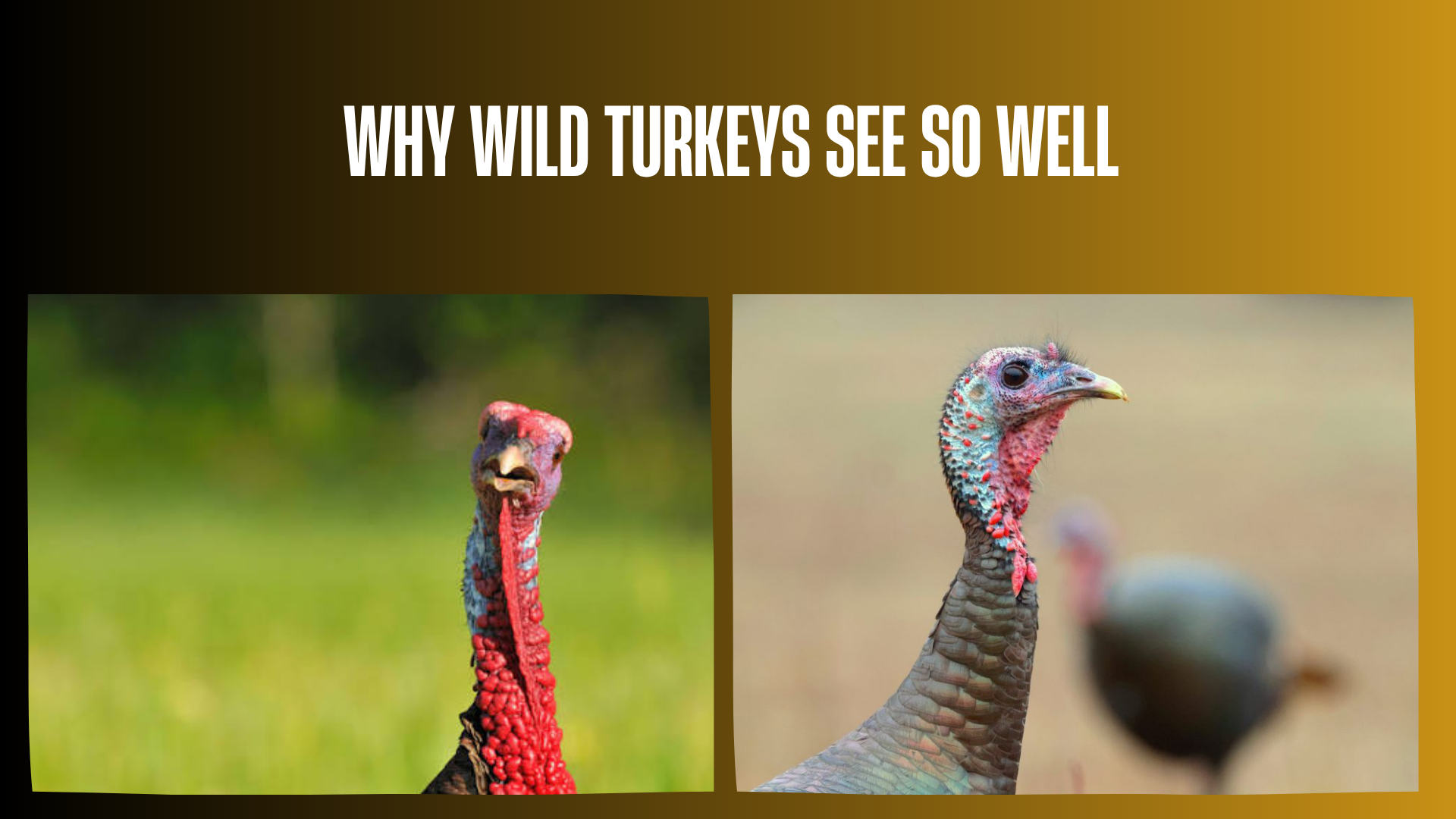

Quick Answer: Why Wild Turkeys See So Well
Why wild turkeys see so well is explained by seven advantages working together: side-mounted eyes, a field of view of roughly 270 degrees, independent monocular viewing, frequent head turns, strong daylight and color vision, sensitivity extending into ultraviolet-A wavelengths, and rapid attention to movement. Those traits help turkeys find food, communicate through color, and detect predators. Their vision is excellent in daylight but not magical: head position affects what they see, depth judgment differs from ours, and low-light performance is not their main strength. Hunters should respond with patience and concealment while never compromising positive target identification or turkey-hunting safety.
Turkey Vision at a Glance
| Visual Feature | What It Does | Why It Helps a Turkey | What Hunters Should Understand |
|---|---|---|---|
| Eyes on the sides of the head | Expands peripheral coverage | Helps monitor a broad area for food and danger | A bird need not face a hunter squarely to detect movement |
| About a 270-degree field of view | Covers most of the surroundings at once | Reduces large blind areas | A small head turn can bring more of the scene into view |
| Monocular vision | Each eye views much of its own side | Supports wide environmental surveillance | Head movement helps the bird inspect and range objects |
| Multiple cone classes | Supports detailed daylight color vision | Helps with food selection, signals, and hazard detection | Natural-looking color alone does not hide movement |
| Retinal oil droplets | Filter light reaching cone receptors | May improve separation of spectral information | Turkey color perception is not identical to human vision |
| UV-A sensitivity | Extends sensitivity below the human visible range | Adds visual information humans do not normally perceive | Some materials may contrast differently to a turkey |
| Fast movement detection | Directs attention to visual change | Supports rapid predator response | Sudden motion is often more revealing than imperfect camouflage |
The 7 Reasons Wild Turkeys Have Such Effective Vision
1. Side-Mounted Eyes Create a Very Wide View
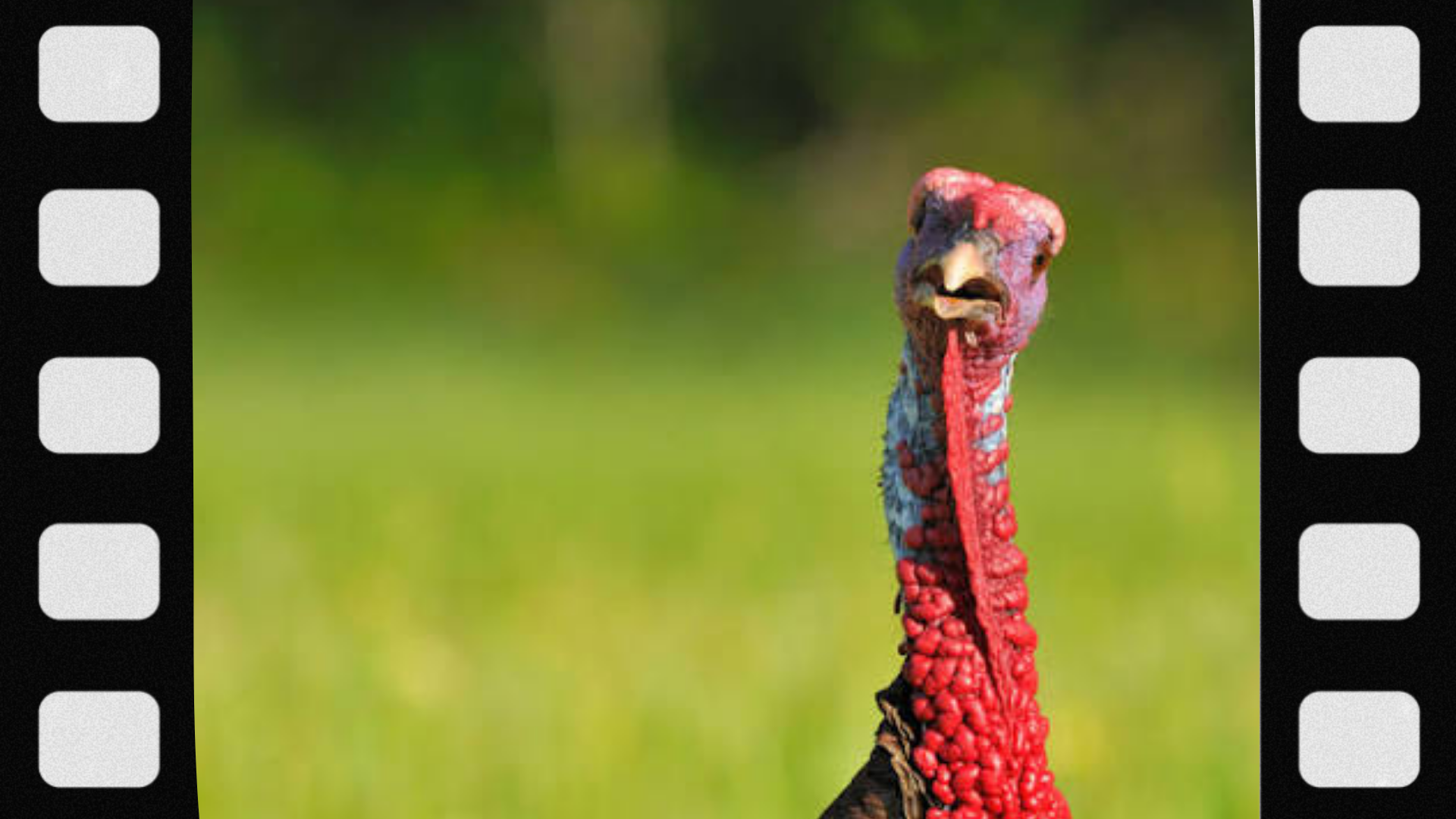
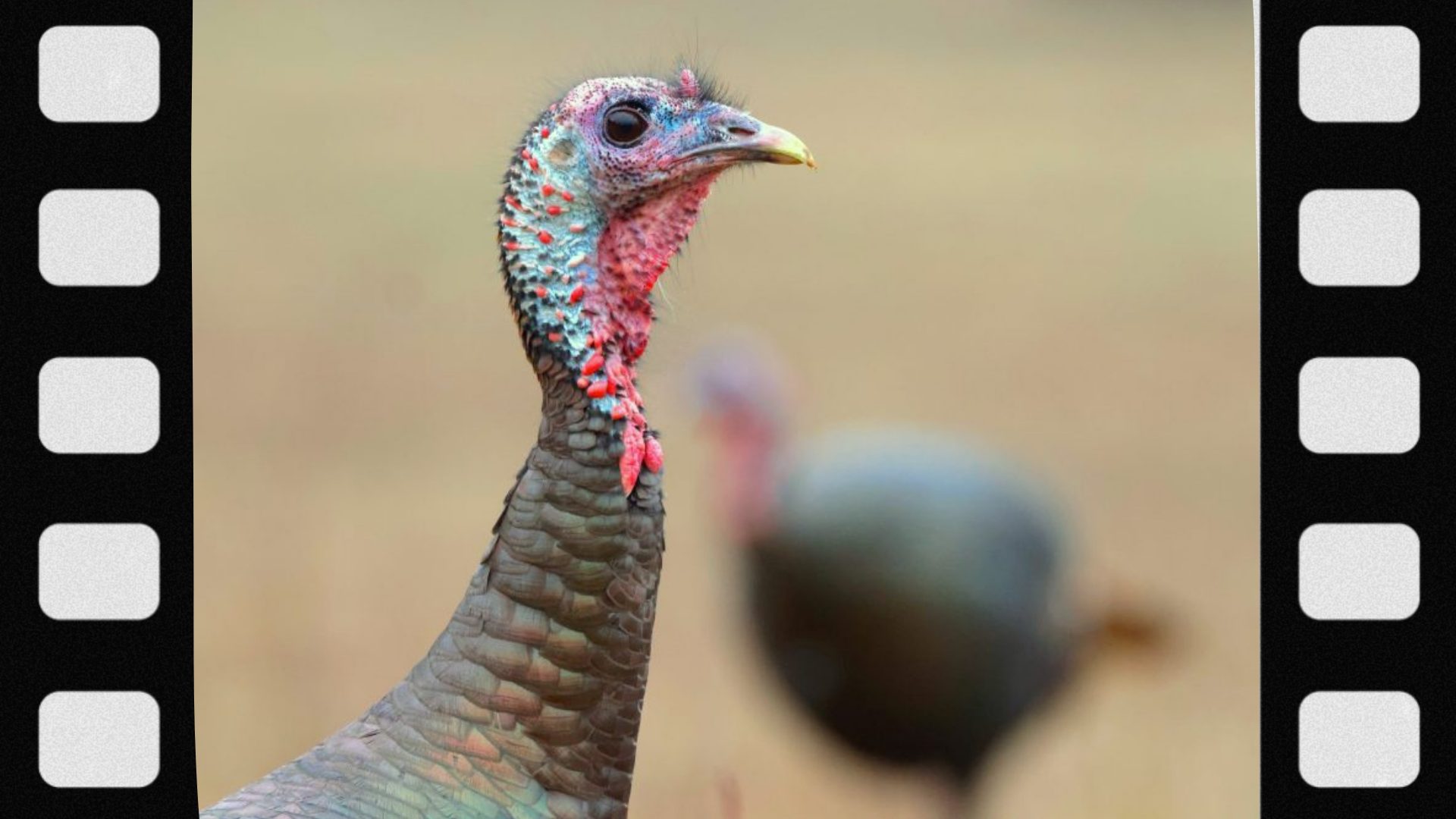
Human eyes point mainly forward. That arrangement gives us a large overlapping binocular zone, which is useful for precise depth perception, but it leaves much of the space behind us unseen. A turkey’s eyes sit on opposite sides of its head. Each eye covers a broad portion of the environment, creating extensive peripheral awareness.
The National Wild Turkey Federation describes a turkey’s visual field as about 270 degrees. That figure should be understood as an approximate field around a normally positioned head, not a perfectly sharp panoramic photograph. Visual quality and binocular overlap vary across the field. Even so, the coverage is far broader than a human’s forward-focused view.
This design fits a bird that spends much of its day on the ground. While scratching, feeding, walking, or displaying, a turkey benefits from monitoring multiple directions for coyotes, bobcats, raptors, people, and other disturbances.
2. Each Eye Can Survey Its Own Side
Turkey vision is commonly described as monocular and periscopic. In practical terms, the bird can gather substantial information from each side rather than depending on a large binocular overlap straight ahead. This helps explain why a turkey that appears to be looking elsewhere can still respond to a hunter’s movement.
Monocular viewing involves a tradeoff. A wide lateral field benefits surveillance, while forward-facing binocular vision makes immediate stereoscopic distance judgment easier. Turkeys compensate behaviorally by changing head position and looking from more than one angle. Their system is different from ours, not simply better in every category.
A hunter should avoid using the phrase “the turkey’s bad side.” Head angle, terrain, vegetation, and movement all change what the bird can see. Waiting for the head to pass behind a tree may briefly block a line of sight, but it does not make all movement automatically safe or ethical.
3. Head Turns Expand Coverage and Help Judge Distance
Wild turkeys frequently raise, lower, bob, and turn their heads. Those movements are part of visual sampling. A slight turn can sweep the remaining area around the bird, while views from different angles provide information about distance and object shape. This is one reason a feeding flock can appear casual yet remain remarkably alert.
Head movement also directs a high-detail portion of the visual system toward something interesting. When a turkey hears a call, footstep, leaf scrape, or unfamiliar noise, it commonly looks toward the source. Hearing therefore steers vision, and vision evaluates what produced the sound.
For hunters, this means a turkey approaching a call is likely inspecting the expected source. A poorly placed setup, visible silhouette, moving hand, or uncovered equipment may become conspicuous as the bird changes viewing angle.
4. Their Retinas Are Built for Daylight and Color
Wild turkeys are active mainly during daylight, and their visual system reflects that lifestyle. Cone photoreceptors support color discrimination and detailed vision in brighter conditions, while rod photoreceptors are more important in dim light. Turkey retinas contain several photoreceptor types that collect different bands of light.
A peer-reviewed study of the domestic turkey, the same species as the wild turkey, identified four types of single cones sensitive to long, medium, short, and violet wavelengths, as well as double cones and a rod class. The findings support a color system richer than the three-cone system normally used by humans. Readers can review the study record through PubMed.
Color vision matters in a turkey’s daily life. It can help distinguish foods and surroundings, while the bare head and iridescent feathers of adult males provide conspicuous social and breeding signals. It would be inaccurate, however, to say turkeys see every color as brighter or that one color automatically frightens them. Contrast, context, motion, familiarity, and lighting all contribute.
5. Cone Oil Droplets Refine Spectral Information
Many bird cone cells contain tiny colored oil droplets. These droplets act as spectral filters before light reaches the visual pigment. By narrowing or shifting the wavelengths available to particular receptors, they can reduce overlap between channels and support finer color discrimination, although filtering also reduces the amount of light reaching the receptor.
The turkey study documented different oil-droplet properties among cone types. This is an important reason not to imagine turkey vision as merely a sharper copy of human vision. The bird samples and filters the light environment differently.
A camouflage pattern may match human expectations yet present different contrast to a turkey. Still, oil droplets do not make fabric transparent or allow a turkey to see through solid cover. Shape, movement, lighting, background, and distance remain central.
6. Turkeys Are Sensitive to Ultraviolet-A Light
Humans normally do not see ultraviolet light. The 1999 retinal study predicted that turkeys have considerable sensitivity in the ultraviolet-A range, approximately 315 to 400 nanometers. This conclusion came from measured visual pigments, oil droplets, and the transmission of light through the eye’s optical media.
UV-A sensitivity may make some natural features or manufactured materials appear different to a turkey than to a person. Feathers, plants, coatings, and fabrics can reflect ultraviolet wavelengths in ways that are invisible to human eyes. This does not mean every detergent makes a hunter “glow,” nor does it prove that a particular UV treatment improves hunting success. Such claims require measurements of the actual material under relevant light.
The careful takeaway is that human color matching is incomplete. Clean hunting clothes according to the manufacturer’s instructions, avoid unnecessary glossy or reflective surfaces, and do not depend on unverified UV products as a substitute for stillness and good setup.
7. Their Behavior Makes the Hardware More Effective
Good eyes would matter less without vigilant behavior. Wild turkeys repeatedly scan, pause, stretch their necks, coordinate in groups, and react quickly to changes. Several birds in a flock create multiple viewing angles. One alert bird can influence the rest before every individual identifies the disturbance.
Movement is especially informative because natural scenes contain relatively stable trunks, rocks, and vegetation along with predictable wind-driven motion. A hand rising, a face turning, or a rigid shape shifting against the background can be more meaningful than a small mismatch in camouflage color.
Calling focuses this system. A turkey that heard a call has an expectation about where another bird should be. As it approaches, it may search that area for a hen, gobbler, or other visual confirmation. If the expected source looks wrong or moves unnaturally, the bird may stop, putt, angle away, or leave.
Turkey Vision Claims: Evidence, Reasonable Inference, and Myth
| Common Claim | Best Interpretation | Confidence |
|---|---|---|
| Turkeys see color | Supported by retinal anatomy and turkey behavior | Strong |
| Turkeys can detect UV-A | Supported by measured photoreceptors and predicted spectral sensitivity in domestic turkeys | Strong |
| Turkeys have about a 270-degree field of view | Widely reported by turkey biologists and conservation educators | Reasonable approximate value |
| A small head turn gives nearly complete coverage | Consistent with wide lateral vision and normal scanning behavior | Reasonable |
| Turkey eyesight is exactly three or four times better than human eyesight | A popular comparison without a single universal metric; acuity, field, color, motion, and low-light vision are different measurements | Do not treat as a precise fact |
| All laundry brighteners make hunters glow | Possible UV reflectance varies by fabric, dye, detergent, light, and observer; the blanket statement is unproven | Overstated |
| Perfect camouflage makes movement invisible | False; movement and outline can still reveal a hunter | False |
| Turkeys see perfectly in darkness | False; their strongest visual performance is associated with daylight | False |
Turkey Vision vs. Human Vision
The fairest comparison is not “better” versus “worse.” Each visual system emphasizes different tasks.
| Capability | Wild Turkey | Human |
|---|---|---|
| Eye placement | Mainly lateral | Mainly forward-facing |
| Peripheral coverage | Very broad | Narrower |
| Binocular overlap | More limited and affected by head position | Large forward overlap |
| Immediate stereoscopic depth cues | Supplements them with head movement and other cues | Strong in the forward field |
| Color receptor system | Four single-cone spectral classes reported, plus double cones | Normally three cone classes |
| UV-A sensitivity | Supported by turkey retinal research | Normally blocked from conscious vision |
| Daylight ecological priority | Foraging, communication, predator surveillance, and flight | Detailed forward tasks, recognition, and hand-eye coordination |
Statements that turkeys have eyesight “three times better” or “eight times better” than humans compress several unrelated abilities into one number. Visual acuity, color discrimination, visual field, motion sensitivity, contrast, depth perception, and dim-light performance are not interchangeable. Without a clearly defined test, an exact multiplier is more slogan than measurement.
How Light, Weather, and Terrain Affect What a Turkey Sees
Bright Daylight
Good illumination supports cone-based detail and color discrimination. Direct sun can also create sharp contrast and highlight reflective equipment, skin, or movement. A hunter’s silhouette against the sky may be conspicuous even when clothing colors blend with nearby vegetation.
Cloud, Rain, and Fog
Overcast conditions soften shadows, while rain or fog can reduce contrast and viewing distance. That does not switch off turkey vision. Birds may rely more heavily on hearing when visibility is restricted, and wet vegetation can make movement and sound patterns different. Do not assume poor weather provides safe cover for careless motion.
Dawn and Dusk
Turkeys can move during twilight, especially near roosting time, but their visual system is primarily adapted to daytime. Hunters often have even greater identification difficulty in low light. Legal shooting hours vary, and sufficient light for a silhouette is not necessarily sufficient for positive identification or a safe shot.
Open Fields
Open terrain gives a turkey long sight lines and many opportunities to inspect a calling location. Background matching, a low profile, and setting up before the bird appears become especially important. Distance does not make sudden movement invisible.
Timber and Broken Cover
Trees and terrain can interrupt lines of sight, but gaps appear as the bird walks and turns its head. A hunter who plans around only one visible window may be exposed from another angle. Identify safe shooting lanes in advance rather than trying to rearrange equipment as a bird approaches.
What Turkey Hunters Can Apply Responsibly
Set Up Before the Bird Enters View
Choose a legal location with a safe field of fire, a solid backstop, and enough room to position equipment without last-second movement. Sit where your outline is broken by a tree or natural background, but never use a setup that hides other hunters, blocks your escape route, or directs a shot toward a road, trail, building, or occupied area.
Control Motion More Than You Chase Perfect Color
Camouflage can reduce contrast and break up a recognizable human outline, but stillness does much of the work. Turn the head slowly, keep exposed hands controlled, and have essential gear within easy reach. No pattern compensates for waving, rapid adjustment, or standing against an open skyline.
Cover Bright Skin and Reflective Surfaces When Safe
A face or hand can create contrast, especially when it moves. A face covering and gloves may help where they are comfortable, lawful, and compatible with safe equipment use. Dull or cover reflective items without obstructing controls, sights, vision, hearing, or manufacturer-required ventilation. Never alter safety equipment for concealment.
Use a Blind Correctly
A blind can conceal gross movement, but windows create contrast and turkeys may notice new structures. Follow the blind maker’s instructions, secure it for weather, maintain a safe shooting direction, and do not crowd firearm or bow limbs against fabric. A blind does not excuse poor target identification.
Expect the Turkey to Inspect the Calling Location
Calling can direct both hearing and vision toward the hunter. Before calling, assume an unseen bird might approach silently from any safe route. Avoid unnecessary motion after each call, scan with your eyes first, and move the whole setup only when it is safe and no bird or hunter is approaching.
Do Not Depend on a “Blind Spot”
A bird’s exact line of sight changes with every head movement. Trying to time rushed actions around a supposed blind spot can create unsafe gun handling and poor shot decisions. Let a bird move behind solid cover if a necessary adjustment can be made safely; otherwise, allow the opportunity to pass.
Practice Before the Season
Practice mounting or drawing safely, operating equipment, and holding a stable position under controlled conditions. Know the effective range you can demonstrate on the target type and shooting position you will actually use. Pattern a shotgun with a lawful load or tune archery equipment according to manufacturer and hunter-education guidance.
Turkey Vision Never Overrides Hunting Safety
The same camouflage and calling that interact with a turkey’s vision can create risk among hunters. Turkey hunters may be concealed, imitate birds, and use decoys that resemble legal game. Never shoot at a sound, movement, color patch, fan, or partial shape. Positively identify the entire bird, confirm that it is legal, and know what lies in front of and beyond it.
Follow the four universal firearm-safety principles: treat every firearm as if it is loaded; keep the muzzle pointed in a safe direction; keep your finger outside the trigger guard until ready to shoot; and be certain of the target and what is beyond it. A mechanical safety cannot correct an unsafe muzzle direction or an unidentified target.
- Do not stalk turkey sounds; another hunter may be making them.
- Do not wear exposed red, white, blue, or black in a way that could be confused with a gobbler’s head or body. This is a hunter-identification issue, not a claim that those colors magically alarm turkeys.
- Carry decoys and harvested birds concealed in a bag. Use hunter orange as required and as recommended when moving.
- Choose a position with a shoulder-width tree or other substantial protection behind you when agency guidance recommends it.
- If another hunter approaches, speak clearly in a normal human voice. Do not wave or make turkey sounds.
- Never use a scope or firearm-mounted sight to inspect an unknown shape. Use binoculars only when doing so is safe.
- Unload as required before crossing obstacles, entering vehicles, or handling a bird, and follow the firearm manufacturer’s instructions.
State rules differ on shooting hours, legal birds, licenses, tags, hunter orange, methods, loads, bait, electronic devices, public-land access, and reporting. Check the current official regulations for the exact state, season, and property before hunting. The Indiana Department of Natural Resources, MassWildlife, and other state agencies publish turkey-specific safety guidance; your own wildlife agency controls locally.
Common Mistakes About Turkey Eyesight
- Thinking a turned head means you are unseen: Side-mounted eyes cover a broad area, and the head can turn quickly.
- Moving because the turkey is feeding: Feeding birds still scan and may coordinate vigilance within a flock.
- Trusting camouflage more than stillness: A matching pattern can still move unnaturally against the background.
- Using one universal acuity multiplier: Field of view, color, movement detection, and fine detail are separate abilities.
- Assuming UV detergent claims apply to every fabric: Actual reflectance depends on the material, product, and illumination.
- Believing darkness makes any shot acceptable: Low light increases identification and backstop uncertainty and may fall outside legal hours.
- Making a rushed gun movement to beat the bird: Safe muzzle control and positive identification come first.
- Trying to stalk a gobble: A concealed hunter may be calling, making this a serious safety error.
- Displaying a decoy while walking: Carry it fully covered so another person cannot mistake it for a live bird.
- Treating a blind as invisibility: Window contrast, noise, unsafe angles, and equipment movement still matter.
Final Answer: Why Wild Turkeys See So Well
Why wild turkeys see so well is the result of a broad visual field, laterally placed eyes, active head scanning, specialized cone photoreceptors, colored oil droplets, UV-A sensitivity, and behavior tuned to notice change. Their vision serves feeding, social communication, flight, and constant predator surveillance. It is especially effective in daylight and across a wide area, although it differs from human vision in depth cues and should not be described with an unsupported universal “times better” number.
For hunters, understanding turkey vision should encourage earlier setup, less movement, realistic concealment, and greater patience. It must also reinforce safety: identify the whole bird, confirm legality, use a safe backstop, never stalk sounds, carry decoys covered, and follow current wildlife-agency rules. A missed opportunity is always preferable to an uncertain or unsafe shot.
FAQs
1. How far can a wild turkey see?
There is no single scientifically useful maximum distance. Detection depends on object size, movement, contrast, light, weather, terrain, and the bird’s attention. Turkeys can monitor open terrain effectively, but distance claims without test conditions should be treated cautiously.
2. What is a wild turkey’s field of view?
Turkey-biologist and conservation sources commonly describe it as roughly 270 degrees with the head in one position. A small head turn lets the bird scan nearly all the space around it.
3. Can a turkey see behind itself?
Its wide lateral field covers much of the rear area, and head turns quickly fill remaining gaps. A hunter should never assume that facing away makes a turkey unable to detect movement.
4. Do wild turkeys have binocular or monocular vision?
They rely heavily on monocular vision because each side-mounted eye surveys a broad area. There is some overlap depending on head and eye position, but it is smaller than the forward binocular field humans use.
5. How do turkeys judge distance?
They use multiple depth cues, including changes in viewing angle as the head moves. Motion parallax, object size, overlap, texture, and limited binocular information can all contribute.
6. Can wild turkeys see color?
Yes. Turkey retinas include multiple cone classes that respond to different wavelength ranges. Color is relevant to food, surroundings, feather displays, and head signals.
7. Can turkeys see ultraviolet light?
Research on domestic turkeys found visual pigments and ocular transmission consistent with considerable sensitivity in the UV-A range. Domestic and wild turkeys belong to the same species, making the finding highly relevant to wild turkey vision.
8. Do laundry brighteners make hunters glow to turkeys?
Some brighteners and fabrics can reflect UV, but “glow” is an oversimplification. Appearance depends on the specific material, detergent, amount, illumination, background, and viewing system. No product replaces careful movement control.
9. What colors can turkeys see?
Their receptor system covers long, medium, short, and violet wavelengths and extends into UV-A. Their color experience cannot be mapped perfectly onto human color labels.
10. Are turkeys color-blind?
No. They have a sophisticated color-vision system. Calling them color-blind contradicts both retinal evidence and the role of colorful visual signals in turkey behavior.
11. Is turkey eyesight really three times better than human eyesight?
That popular statement lacks one universal definition of “better.” Turkeys clearly exceed humans in peripheral coverage and UV sensitivity, but acuity, color, depth, contrast, motion, and night vision require different tests.
12. Can turkeys see better than eagles?
They have different visual specializations. Raptors are famous for long-distance resolution used to locate prey, while turkeys emphasize broad surveillance, daylight color, and rapid threat detection. A simple overall ranking is misleading.
13. Can turkeys see well at night?
Their strongest vision is adapted to daylight. They can function in twilight and reach or leave roosts around low light, but they are not specialized nocturnal birds and should not be described as seeing perfectly in darkness.
14. Can a turkey see through a ground blind?
No. It cannot see through opaque fabric, but it may see through open windows, notice a silhouette, or detect movement and contrast inside. Set window configurations and safe shooting lanes before the bird arrives.
15. Can turkeys see movement inside a blind?
Yes, especially when movement crosses a bright window or creates a changing silhouette. Dark clothing, controlled windows, and slow, limited motion may help, provided they do not interfere with safe equipment use.
16. Does camouflage hide a hunter from a turkey?
Camouflage can reduce outline and contrast when it matches the setting, but it does not create invisibility. Movement, exposed skin, skyline position, reflective gear, and sound can still direct the bird’s attention.
17. What movement do turkeys notice most?
There is no ranked list that applies everywhere. Sudden, isolated motion against a stable background is generally conspicuous. Large motions, repeated head turns, and moving hands are common ways hunters reveal themselves.
18. Why do turkeys bob their heads?
Head movements change the viewing angle, expand the scanned area, stabilize visual information while walking, and help judge distance. They are normal tools for gathering information.
19. Why does a turkey stretch its neck and stare?
The bird may be improving its line of sight and focusing on a sound, shape, movement, another turkey, or possible danger. The behavior shows attention but does not identify the cause by itself.
20. Can turkeys recognize individual people?
Wild turkeys can learn from repeated experiences and discriminate among visual situations, but claims about recognizing particular humans require context. Avoid assuming either complete recognition or complete forgetfulness.
21. Does rain reduce a turkey’s eyesight?
Heavy rain, mist, and low contrast can reduce viewing conditions, but turkeys still use vision and may rely more on hearing. Bad weather does not make careless movement or an uncertain shot safe.
22. Does sunlight help turkeys spot hunters?
Bright light supports daylight vision and can reveal contrast, shine, skin, or movement. Direction matters: backlighting may silhouette a hunter, while glare and deep shadows can change visibility for both bird and person.
23. Should turkey hunters avoid red, white, and blue?
Yes, many wildlife agencies advise avoiding exposed red, white, blue, and sometimes black because these colors occur on a gobbler and can contribute to hunter misidentification. This is primarily a human safety measure.
24. Should turkey hunters wear orange?
Requirements vary by state, season, and activity. Many agencies recommend orange while moving and when carrying a decoy or harvested bird. Check current local rules and conceal orange only where lawful and safely seated.
25. What matters more to a turkey: camouflage or stillness?
Both can matter, but even excellent camouflage fails when it moves conspicuously. A safe setup made before the bird arrives, a broken outline, and controlled movement are more dependable than chasing a supposedly perfect pattern.
Read more: