
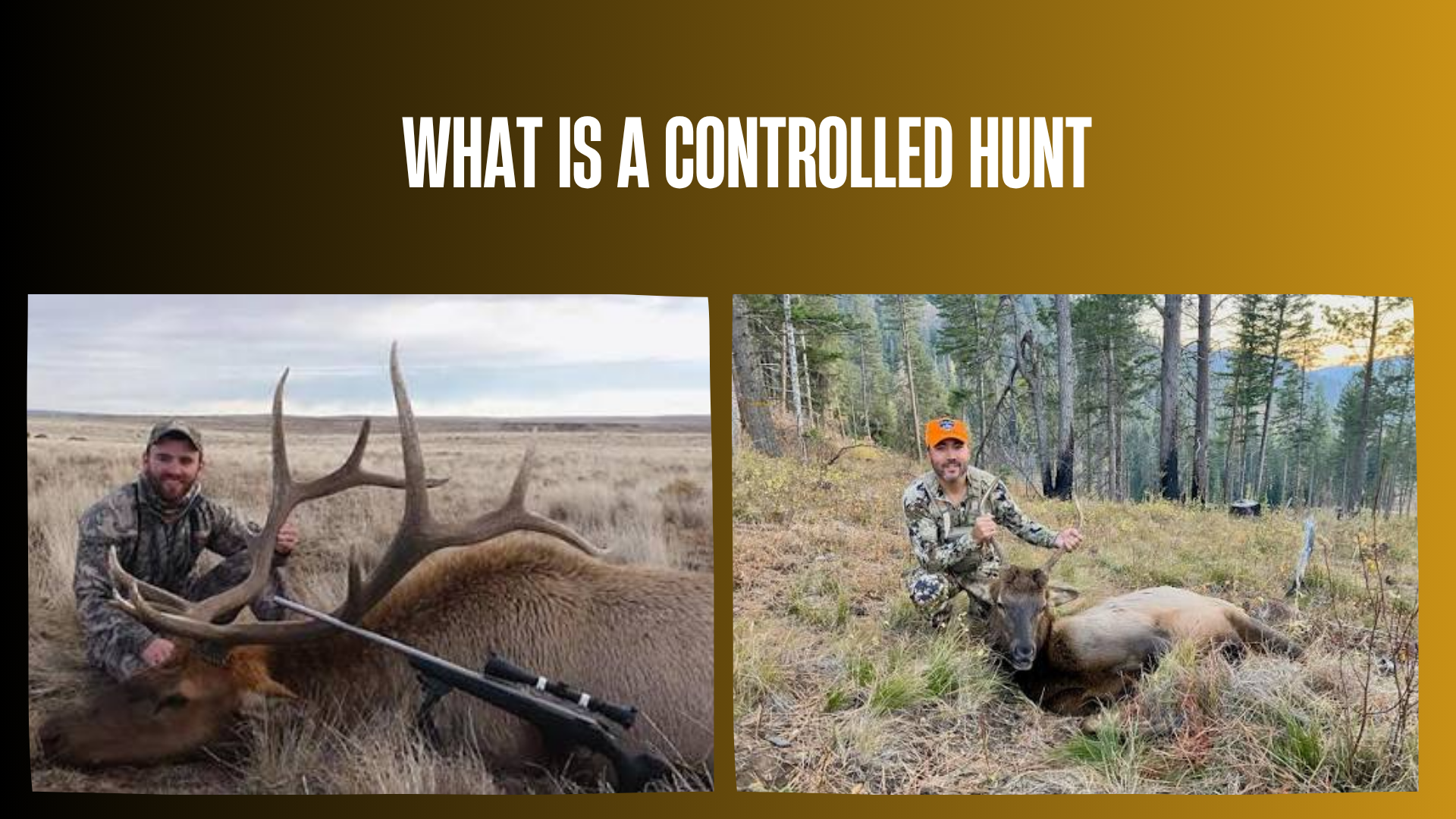

If you have seen a special hunt listing and wondered, what is a controlled hunt? A controlled hunt is a hunting opportunity in which a wildlife agency or land manager limits participation or places special controls on the hunt. Limits may apply to the number of tags, hunters, dates, locations, species, sex or age class, hunting method, access, or check-in procedures.
In many western states, “controlled hunt” means a limited number of tags issued through a drawing. Elsewhere, it may describe a site-specific hunt with reservations, assigned zones, restricted days, orientations, or another selection process. The term is not nationally uniform, so the official hunt notice—not the label alone—determines what permission a successful applicant receives.
Quick Answer: What Is a Controlled Hunt?
A controlled hunt is a regulated hunting opportunity with participation or conditions more limited than an ordinary general-season hunt. Hunters commonly must apply in advance, select an exact hunt code, and be chosen through a random draw, preference-point system, lottery, reservation, or other agency process. A successful draw may still require the hunter to buy a license or tag, complete an orientation, obtain access permission, check in, and follow rules unique to that hunt. Always read the current official regulations for the exact species, unit, season, method, and property before applying or hunting.
Controlled Hunts at a Glance
| Feature | What It Often Means | What to Verify |
|---|---|---|
| Limited participation | Only a set number of hunters or tags | Quota, eligibility, residency allocation, and party rules |
| Advance application | Hunter applies before a published deadline | Time zone, fee, license prerequisite, and submission status |
| Selection | Random draw, weighted draw, points, reservation, or other system | How choices are considered and whether points are used |
| Specific hunt code | One code combines species, area, dates, and method | Map, boundary description, season, weapon, and legal animal |
| Extra conditions | Check-in, orientation, assigned area, reporting, or access schedule | Every condition in the hunt notice and permit |
| Management purpose | Control harvest, crowding, safety, damage, or site access | Agency objective and how it changes hunter expectations |
Important Legal and Safety Notice
Controlled-hunt systems change by state, province, tribe, federal refuge, military installation, municipality, park, and private program. Application windows, fees, drawing methods, point rules, tag deadlines, transfer restrictions, weapon rules, quotas, and access procedures can change between seasons. Information in this guide was reviewed on September 14, 2026, but readers must use the latest official regulation booklet and agency notices for the year they apply.
Do not assume that winning an application alone authorizes hunting. Confirm whether you also need a base hunting license, species tag, habitat stamp, federal duck stamp, hunter-education certificate, access permit, landowner permission, vehicle pass, orientation, check-in, or harvest report. Carry every required document and identification.
Follow the four primary firearm-safety rules whenever firearms are involved:
- Treat every firearm as if it is loaded.
- Keep the muzzle pointed in a safe direction.
- Keep your finger outside the trigger guard until ready to shoot.
- Be certain of the target and what is beyond it.
Controlled access does not create a private shooting range. Other hunters, staff, landowners, workers, livestock, vehicles, roads, buildings, trails, and non-hunting visitors may still be present. Positively identify the legal animal and maintain a safe backstop.
What Is a Controlled Hunt, Exactly?
The clearest broad definition is a hunt in which the responsible authority deliberately controls opportunity beyond ordinary statewide or unit-wide general-season rules. The control may be numerical, geographical, temporal, procedural, or a combination of those.
For example, Idaho Fish and Game describes a controlled hunt as one with a limited number of tags obtained in a random drawing. The Oklahoma Department of Wildlife Conservation offers controlled hunts for several species in places where unrestricted public hunting could create safety concerns or overharvest, with participants selected by random drawing. Massachusetts controlled public hunts may occur during regular seasons while limiting days, locations, or participant numbers.
Those examples show why a hunter cannot import one state’s definition into another. “Controlled” may mean a limited-entry tag, a property access permit, a special management hunt, or several permissions combined. The official agency’s current rules define the term for that program.
Why Do Wildlife Agencies Use Controlled Hunts?
To match harvest with wildlife objectives
Agencies estimate population status, habitat conditions, recruitment, survival, previous harvest, disease concerns, and management goals. Limiting tags or specifying the legal animal can help direct harvest. A controlled hunt does not mean the population is “too large” in every case; it may protect a small population, offer a particular opportunity, or distribute harvest more precisely.
To manage crowding and hunter distribution
Some areas cannot safely or sustainably accommodate unrestricted numbers. Limiting participants can spread hunters among units, dates, parking areas, or assigned zones. Fewer hunters may improve the experience, but it does not guarantee solitude or success.
To address site-specific safety
Properties near roads, neighborhoods, airports, reservoirs, parks, farms, or active facilities may need check-in, assigned sectors, shorter hunt periods, restricted methods, or close supervision. Special safety controls supplement—not replace—ordinary firearm and archery rules.
To reduce localized wildlife damage
A land manager may use carefully targeted hunting to address crop damage, habitat impacts, vehicle conflicts, or other local concerns. The goal, eligible animal, and timing can be narrower than a recreational general season. Hunters should understand the management purpose rather than treating every special hunt as a trophy opportunity.
To create structured access
Refuges, municipal lands, military properties, private access programs, and other sites may open only through a controlled process. Selection can verify hunter education, schedule users, communicate boundaries, protect sensitive areas, and collect harvest data.
To provide specialized opportunities
Some programs reserve opportunities for youth, beginning hunters, people with disabilities, veterans, families, or mentored participants. Eligibility, supervision, age, documentation, and companion rules vary. Never assume a “special” label means the same thing as “controlled.”
How a Controlled-Hunt Application Usually Works
- Find the official program. Start with the current wildlife-agency or land-manager website, not a forum, old screenshot, or commercial odds page.
- Confirm eligibility. Check age, residency, hunter education, license prerequisites, species restrictions, prior-harvest limits, and any program-specific qualifications.
- Read the hunt listing. Match the hunt code to the species, legal animal, dates, unit or property, weapon, quota, access, and special notes.
- Study the map and legal boundary. A familiar unit number may contain a smaller controlled-hunt area. Written boundary descriptions may control when a map is only illustrative.
- Understand the selection system. Learn whether it is random, weighted, based on preference or bonus points, first-come, assigned by reservation, or chosen through another method.
- Rank choices deliberately. Agencies process first, second, and later choices differently. A backup choice may affect points or future eligibility.
- Submit before the exact deadline. Confirm the time zone, payment, successful transaction, party details, and account contact information.
- Check results through the official account. Do not rely only on an email or text that could be delayed, filtered, or fraudulent.
- Complete post-draw steps. Buy or claim the tag by the deadline, accept the permit, attend orientation, submit forms, or reserve a date if required.
- Recheck immediately before hunting. Look for emergency closures, fire restrictions, access changes, disease rules, weather hazards, and hunt-specific instructions.
This sequence is a planning framework, not a universal application rule. A particular agency may combine, omit, or reorder steps.
Controlled Hunt vs. General Season
| Factor | Controlled Hunt | General Season |
|---|---|---|
| Participation | Limited by tag, hunter, property, date, or permit quota | Usually broader eligibility, though tag caps may still apply |
| Access | Often requires advance application or reservation | May use an over-the-counter or generally available license/tag |
| Area | Exact unit, subunit, property, zone, or assigned sector | Often a broader legal area |
| Dates | Hunt-specific and sometimes only a few days | Published general season for the applicable category |
| Rules | May add orientation, check-in, reporting, method, or access limits | Standard season and land rules still apply |
| Opportunity | Application does not guarantee selection | Opportunity may be more predictable, subject to tag availability |
“General” does not mean unrestricted. General seasons still have licenses, legal weapons, units, dates, shooting hours, bag limits, and land rules. Likewise, a controlled tag does not waive statewide law.
Controlled Hunt vs. Draw Hunt, Limited-Entry Hunt, and Lottery Hunt
These terms often overlap but are not perfect synonyms:
- Draw hunt: Participation or tags are allocated through a drawing. Many controlled hunts are draw hunts, but some controlled opportunities use reservations or other selection methods.
- Limited-entry hunt: Only a restricted number of hunters or tags may participate. Selection may use a draw, points, auction, first-come process, or another rule.
- Lottery hunt: A random selection determines who receives access or a permit. “Lottery” may refer to the draw itself rather than the tag that must later be purchased.
- Quota hunt: The agency limits a total number of permits, participants, or harvested animals. The quota may be allocated in advance or administered through check stations and closures.
- Reservation hunt: Hunters book a date, blind, zone, or property. Availability may be drawn, first-come, or assigned after selection.
- Special hunt: A broad label that may describe eligibility, location, method, purpose, or season. It is not automatically a controlled hunt.
- Managed hunt: Often a site-specific program with explicit management goals and operating procedures. Definitions vary by agency.
Always follow the official program’s terms. A commercial website may call an opportunity a “draw hunt” while the agency uses “controlled,” “limited quota,” “special permit,” or another name.
How Are Hunters Selected?
Pure random drawing
Every valid application may have an equal chance, subject to residency, hunt choice, party, or other rules. Past failure may not improve future odds unless the program separately awards points.
Preference-point system
Applicants with more points may receive priority before those with fewer. Some systems allocate all tags by preference; others reserve a portion for random selection. Applying for, drawing, buying, returning, or failing to use a tag can affect points differently.
Bonus or weighted-point system
Points may create additional chances without guaranteeing selection. A new applicant can sometimes draw ahead of someone with more points. The mathematical treatment varies, so do not interpret “ten points” without the official rules.
First-come or reservation process
Some controlled access is allocated when booking opens rather than by lottery. System time, queue rules, payment, identity verification, and confirmation requirements matter.
Eligibility-based selection
Youth, mentored, mobility-accessible, landowner, military, resident, or local programs may apply eligibility filters before or instead of a general drawing. Supporting documents and companion qualifications may be required.
Agency assignment
A manager may assign zones, dates, parking locations, or hunt periods after applicants are selected. Winning the overall opportunity may not let the hunter choose every operational detail.
What Information Is Hidden Inside a Hunt Code?
A hunt code is not merely an application number. It may represent a precise combination of species, sex or age class, weapon, season dates, management unit, property, residency class, or special restriction. Similar-looking codes can describe materially different hunts.
| Hunt-Code Element | Question to Answer | Common Mistake |
|---|---|---|
| Species | What species does the permit cover? | Assuming one application includes multiple species |
| Legal animal | Antlered, antlerless, either sex, age-defined, or another class? | Reading the unit but missing the animal restriction |
| Area | Whole unit, part of unit, named property, or assigned zone? | Using a general unit map for a smaller hunt boundary |
| Dates | What exact start, end, weekdays, and daily hours apply? | Confusing regular season with permit dates |
| Method | Archery, muzzleloader, shotgun, rifle, crossbow, or other legal method? | Assuming any statewide-legal method is allowed |
| Notes | Are there access, orientation, check-in, or reporting conditions? | Ignoring footnotes linked to the code |
Application Fees, Licenses, and Tag Costs
Programs may charge an application fee, license fee, tag fee, permit fee, transaction fee, access fee, or several of these. Some fees are nonrefundable even when the applicant is unsuccessful. A hunting license may be required before applying; elsewhere, it may be purchased only after selection. Nonresident fees and allocations can differ from resident provisions.
Read the official fee table and refund policy before submitting. Confirm whether a card will be charged at application, draw, or tag issuance; whether declined payment invalidates the award; and whether automatic tag purchase is enabled. Do not assume a preference-point purchase is the same as an application for a hunt.
Budget also for travel, lodging, required equipment, meat care, access, and a possible scouting trip. A successful application does not mean the hunt will be inexpensive or logistically possible.
Group and Party Applications
Some agencies allow multiple hunters to apply as a group. The system may average, round, reduce, or otherwise handle points; a party may be skipped if too few tags remain; and every member may need identical hunt choices and valid prerequisites. A mistake by one member can affect the group.
Before joining a party, confirm who is the leader, which hunt code is entered, whether each member’s customer number is correct, how tags are allocated, and what happens if someone withdraws. Do not assume a party permit allows members to transfer tags or hunt separately.
Drawing Odds and Preference Points
Published draw odds describe past applications under past quotas and rules. They are not a promise. Odds can change when tag numbers, applicants, eligibility, choice processing, point pools, or resident allocations change. A small sample can also create misleading percentages.
Compare like with like: the same hunt code, applicant category, point level, choice position, and year. Learn whether reported odds are first-choice odds, total success, or a simplified estimate. The agency’s raw draw report and current rules are more reliable than a commercial forecast.
Points are not a savings account or a guaranteed reservation unless the regulation explicitly creates that outcome. Agencies may modify systems. Apply only for hunts you are prepared to accept, and understand how declining, returning, exchanging, or not buying a tag affects points.
What Happens After You Draw?
- Verify the award in your official account and confirm the exact hunt code.
- Buy, claim, print, download, or accept the tag or permit by the stated deadline.
- Complete any orientation, proficiency test, waiver, background access step, or property briefing.
- Reserve the assigned date, blind, parking area, or check-in time if required.
- Study the legal boundary and download offline maps without treating phone maps as legally definitive.
- Confirm firearm, ammunition, archery, hunter-orange, vehicle, camping, baiting, and access rules.
- Plan travel and lodging that comply with property hours and road restrictions.
- Practice from field positions with the legal equipment and ammunition.
- Prepare a game-recovery and meat-cooling plan appropriate to weather and terrain.
- Check emergency orders, wildfire closures, disease-transport rules, and weather immediately before departure.
If you cannot participate, consult the official surrender, return, exchange, refund, and point-restoration rules before the deadline. Giving the permit to a friend or simply failing to appear may be prohibited or carry future consequences.
Controlled-Hunt Day Checklist
| Category | Bring or Confirm | Why It Matters |
|---|---|---|
| Documents | License, tag, controlled-hunt permit, ID, stamps, access pass, and orientation proof | Selection alone may not satisfy legal requirements |
| Boundaries | Official map, written description, assigned zone, closure areas, and offline navigation | Prevents trespass and hunting outside the permit |
| Safety | Hunter orange where required, eye and hearing protection, first aid, light, and communication | Reduces foreseeable field risks |
| Equipment | Legal method, correct ammunition or arrows, manufacturer-compliant gear | Hunt-specific rules may be narrower than statewide rules |
| Access | Check-in time, parking, gate code, vehicle limits, escort, and closure information | Late or incorrect access can invalidate participation |
| Recovery | Tagging tools, permitted recovery equipment, coolers, help, and property-boundary contacts | Supports lawful recovery and meat care |
| Reporting | Check-out, harvest report, biological sample, or unsuccessful-hunt report requirements | Some obligations apply even without a harvest |
Safety in a Controlled Hunt
Limited participation can reduce crowding, but it cannot eliminate hazards. Learn the assigned boundary, safe zones of fire, access route, neighboring zones, buildings, roads, and the location of staff or other groups. Attend every briefing and ask for clarification before loading a firearm or nocking an arrow.
Keep the firearm unloaded during transport and at check stations as required. Follow range commands, property instructions, and manufacturer procedures. Wear required fluorescent clothing and consider additional visibility during access, recovery, and low light even when not mandated.
Do not shoot toward a zone boundary merely because another hunter is supposed to remain outside it. Positively identify the species and legal animal, confirm the target is within your area and time, and know what is beyond it. Stop immediately if people, vehicles, livestock, structures, or uncertainty enter the field of fire.
Share a trip plan and carry communication, first aid, navigation, water, light, and weather protection. Controlled properties may have locked gates or limited staff hours, making self-reliance and punctual check-out important.
Ethics and Wildlife Management
A controlled tag creates an opportunity, not an obligation to take an unsafe or low-confidence shot. Hunt within your practiced ability, choose a high-percentage presentation, and be willing to finish the hunt without harvesting. Follow fair-chase principles and every property rule.
Some hunts emphasize antlerless harvest, population reduction, disease sampling, or removal from a specific zone. Respect the stated management objective. Do not substitute personal trophy expectations for the legal animal and instructions.
After a shot, mark the location, observe the animal, follow the program’s wait and recovery guidance, and make every reasonable lawful effort to recover game. Obtain permission before crossing any boundary. Tag and report promptly, preserve required evidence, collect samples if instructed, and cool edible meat without unnecessary delay.
Common Controlled-Hunt Mistakes
- Applying by unit name instead of exact code. Similar codes may have different dates, legal animals, or weapons.
- Missing the time zone. “Midnight” or “5 p.m.” must be read in the agency’s stated zone.
- Assuming payment means submission. Save the official confirmation and verify application status.
- Ignoring choice order. First and later choices may be processed under different rules.
- Misreading historical odds. Last year’s percentage may not apply to this year’s quota or point pool.
- Forgetting post-draw action. An award can be lost if the hunter does not buy, accept, schedule, or orient by the deadline.
- Confusing a permit with a license or tag. Several documents may be required simultaneously.
- Using the regular-season map. Controlled boundaries can include only part of a familiar unit.
- Skipping footnotes. Access, method, disease, or reporting rules are often placed in notes.
- Failing to plan recovery. Short hunt windows and restricted gates can make recovery logistics critical.
What Not to Do
- Do not apply for a hunt you are not eligible or prepared to accept.
- Do not falsify residency, disability status, hunter education, party information, points, or identity.
- Do not transfer, loan, alter, duplicate, or sell a permit unless the agency explicitly authorizes the exact action.
- Do not enter early, remain late, bypass check-in, cross assigned zones, or use closed roads.
- Do not assume a controlled permit authorizes baiting, motorized retrieval, thermal optics, suppressors, electronic calls, or any other method.
- Do not shoot at unidentified movement or toward an unsafe backstop.
- Do not exceed the legal animal, bag limit, weapon, date, or area printed for the hunt.
- Do not trespass to scout or recover game.
- Do not ignore mandatory reporting when no animal was harvested.
- Do not rely on an old booklet, saved web page, or social-media post when current official rules are available.
How Beginners Can Choose a Suitable Controlled Hunt
Start with logistics rather than draw odds. Choose a species and method for which you have training and suitable equipment. Then evaluate travel distance, terrain, physical demands, legal access, hunt length, weather, lodging, recovery, meat care, and whether a mentor can accompany you.
Read past harvest and draw data as context, not a prediction. A hunt with better historical odds may have difficult access, low animal density, short dates, or an objective that does not match your expectations. A famous low-odds hunt is not automatically better for learning.
Look for agency clinics, mentored hunts, youth programs, staffed check stations, accessible opportunities, or properties with clear maps and orientations. Contact the responsible office with concise questions before the deadline. Staff can explain the rule; they cannot choose your personal risk tolerance or guarantee wildlife.
Questions to Ask Before Applying
- What exact species, legal animal, dates, area, and weapon does the hunt code authorize?
- Is a hunting license required before application, after selection, or both?
- How are first, second, and later choices processed?
- How do points, party applications, and residency affect selection?
- What fees are charged, and which are refundable?
- What must a selected hunter do before the award expires?
- Are orientation, proficiency, check-in, escort, or assigned-zone requirements involved?
- What roads, parking areas, methods, and equipment are permitted?
- What harvest, check-out, sample, or unsuccessful-hunt reports are mandatory?
- What happens to points or eligibility if the tag is returned or unused?
Final Answer: What Is a Controlled Hunt?
A controlled hunt is a hunting opportunity whose participation or conditions are specially limited by a wildlife agency or land manager. It often involves a fixed quota of tags allocated through a drawing, but it can also control dates, zones, access, legal animals, methods, orientations, check-in, and reporting. The meaning is program-specific rather than universal.
Use the official current hunt notice to identify the exact code, eligibility, application process, map, deadline, fees, post-draw steps, and field rules. Winning a draw does not waive the need for licenses, tags, permission, safety, ethical shot selection, or lawful recovery. Apply carefully, prepare for the management objective and terrain, and verify updates again immediately before hunting.
FAQs
1. Is a controlled hunt the same as a draw hunt?
Often, but not always. Many controlled hunts allocate limited tags through a draw. Other programs use reservations, eligibility screening, first-come booking, assigned access, or a combination of controls.
2. Is a controlled hunt the same as a limited-entry hunt?
The terms frequently overlap. “Limited entry” emphasizes restricted participation, while “controlled” may also describe special dates, zones, methods, check-in, or management procedures. Use the agency’s definition.
3. Is a controlled hunt a cull?
Not necessarily. Some controlled hunts address population or damage objectives, while others protect opportunity, manage safety, reduce crowding, or provide special access. An agency cull may use staff or contractors and is not automatically a public hunt.
4. Are controlled hunts only for deer?
No. Agencies may offer them for elk, pronghorn, bear, turkey, waterfowl, deer, or other legal species. Species and availability vary by jurisdiction and year.
5. Are controlled hunts only on public land?
No. They can occur on public, municipal, federal, tribal, military, private, or cooperatively managed land. The permit does not automatically grant access across unrelated private property.
6. Does a controlled hunt guarantee a tag?
No. An application usually competes for limited opportunity. Even after selection, the hunter may have to purchase or claim the tag and complete other requirements by a deadline.
7. Does drawing a controlled hunt guarantee an animal?
No. Weather, access, wildlife distribution, hunter effort, management objectives, and individual behavior affect the hunt. A permit provides legal opportunity under stated conditions, not guaranteed success.
8. Do controlled hunts have better success rates?
Some do because participation is limited or timing differs, but this is not universal. Compare official harvest reports for the exact hunt and understand that past results do not predict an individual outcome.
9. How do I apply for a controlled hunt?
Use the official agency application system, choose the exact hunt code, satisfy prerequisites, submit payment and information before the deadline, and save confirmation. Procedures differ, so read the current guide first.
10. Do I need a hunting license before applying?
That depends on the program. Some require a valid license before application; others require it after selection. A license fee may be nonrefundable, so verify before paying.
11. What is a controlled-hunt application fee?
It is a charge to enter the selection process. It may be separate from license, tag, permit, transaction, or point fees and may not be refunded if unsuccessful.
12. What is a hunt code?
It is the agency’s identifier for a specific combination of species, legal animal, area, dates, method, and restrictions. Entering the wrong code can result in a valid award for the wrong hunt.
13. What are controlled-hunt preference points?
They are records used by some agencies to prioritize or weight applicants in future drawings. Rules for earning, using, losing, averaging, or restoring points are unique to each system.
14. What are bonus points?
Bonus points commonly add chances in a drawing rather than giving absolute priority. A hunter with fewer points may still draw. The agency’s draw formula controls.
15. Can I buy a preference point without applying for a hunt?
Some programs allow a point-only application or purchase; others do not. There may be license prerequisites and a specific period. Verify the current official rules.
16. Can nonresidents apply for controlled hunts?
Often yes, but eligibility, fees, quotas, odds, deadlines, and license prerequisites may differ. Some hunts are resident-only or cap nonresident awards.
17. Can youth apply for controlled hunts?
Many agencies offer youth eligibility or youth-only opportunities, but minimum age, hunter education, mentor, weapon, and supervision rules vary. Confirm the participant’s age on the hunt date, not only the application date.
18. Can a hunting party apply together?
Some systems permit group applications. Party size, point treatment, tag allocation, hunt choices, and the effect of one invalid member differ. Every participant should review the final submission.
19. Can I change my application after submitting it?
Possibly, but only within agency rules and deadlines. Editing may require withdrawal and resubmission or may be prohibited. Confirm that any change is officially accepted.
20. What happens if my payment card fails?
The award or application may be rejected, delayed, or subject to a short correction window, depending on the system. Keep account and payment details current and monitor official notices.
21. How do I check controlled-hunt results?
Log in to the official agency account or use its published result method. Email and text alerts are convenient but should not be the sole source because they can fail or be spoofed.
22. How long do I have to claim a controlled-hunt tag?
The deadline is program-specific and can be short. Check the award notice immediately and record every purchase, orientation, scheduling, and document deadline.
23. Can I transfer a controlled-hunt permit?
Usually only if the agency provides a specific lawful transfer, donation, youth, medical, or family process. Never loan, sell, or alter a tag based on an informal agreement.
24. Can I return a controlled-hunt tag?
Some agencies allow surrender or return under strict deadlines and conditions. Refunds, point restoration, and future eligibility may differ. Follow the official process before hunting or altering the tag.
25. Can I hunt the general season after drawing a controlled hunt?
It depends on species, tag type, harvest, and state rules. A controlled tag may replace, restrict, or coexist with other opportunity. Do not assume a second hunt is legal.
26. Can I use any legal weapon in a controlled hunt?
No. The hunt code may be narrower than statewide law, such as archery-only, muzzleloader-only, shotgun-only, or another method. Verify ammunition, projectile, magazine, and equipment details too.
27. Are baiting or electronic calls allowed?
Only where both general law and hunt-specific property rules permit them. Disease orders and land-manager restrictions may be stricter than statewide seasons.
28. Do I need to attend an orientation?
Some site-specific hunts require a briefing, safety meeting, proficiency check, or online course. Missing it may cancel participation even when the hunter drew successfully.
29. Do controlled hunts have assigned zones?
Some do. A permit may assign a compartment, blind, field, parking area, or time slot. Stay within the official boundary and clarify whether recovery can cross it.
30. Must I check in and check out?
Many controlled properties require one or both. Check station hours, documents, weapon condition, vehicle information, harvest inspection, and exit procedures may be specified.
31. Is hunter orange required on a controlled hunt?
Requirements depend on jurisdiction, season, method, and property. A controlled permit does not waive fluorescent-clothing law, and a property may impose additional visibility rules.
32. What happens if weather or wildfire closes the area?
Safety closures generally override the permit. Refunds, rescheduling, replacement opportunity, or points are not guaranteed. Monitor official emergency notices and contact the agency rather than entering.
33. Do I have to report if I do not harvest?
Possibly. Some programs require every permit holder to submit a report, check out, or complete a survey regardless of harvest. Failure can affect future applications.
34. Can I scout a controlled-hunt area before the season?
Only during lawful access dates and under property rules. A hunt permit may not authorize preseason entry, motorized travel, trail cameras, camping, or access to closed zones.
35. Can I bring a companion or mentor?
Some hunts allow a non-hunting companion, while others restrict access or require the companion to register, orient, wear hunter orange, or hold credentials. A companion may not hunt unless separately authorized.
36. Are controlled-hunt odds the same every year?
No. Quotas, applicants, points, choices, eligibility, and draw rules change. Use historical odds only as context and verify the current quota and system.
37. What should I do if two official sources disagree?
Contact the responsible agency or hunt coordinator before applying or hunting. Ask which current regulation, emergency order, or property notice controls, and retain the response where appropriate.
38. What is the biggest controlled-hunt application mistake?
Choosing a code without reading every linked boundary, date, method, footnote, and post-draw condition. A correctly entered code can still be the wrong opportunity for the applicant.
39. Are controlled hunts ethical?
They can be a legitimate wildlife and access management tool when conducted under science-based rules, fair-chase principles, safety procedures, and humane harvest standards. Individual hunters remain responsible for every shot and recovery effort.
40. Where should I verify controlled-hunt rules?
Use the current website and regulation publication of the state, provincial, tribal, federal, municipal, or private authority administering the hunt. Recheck the exact hunt page immediately before the application and again before hunting.
Read more: