
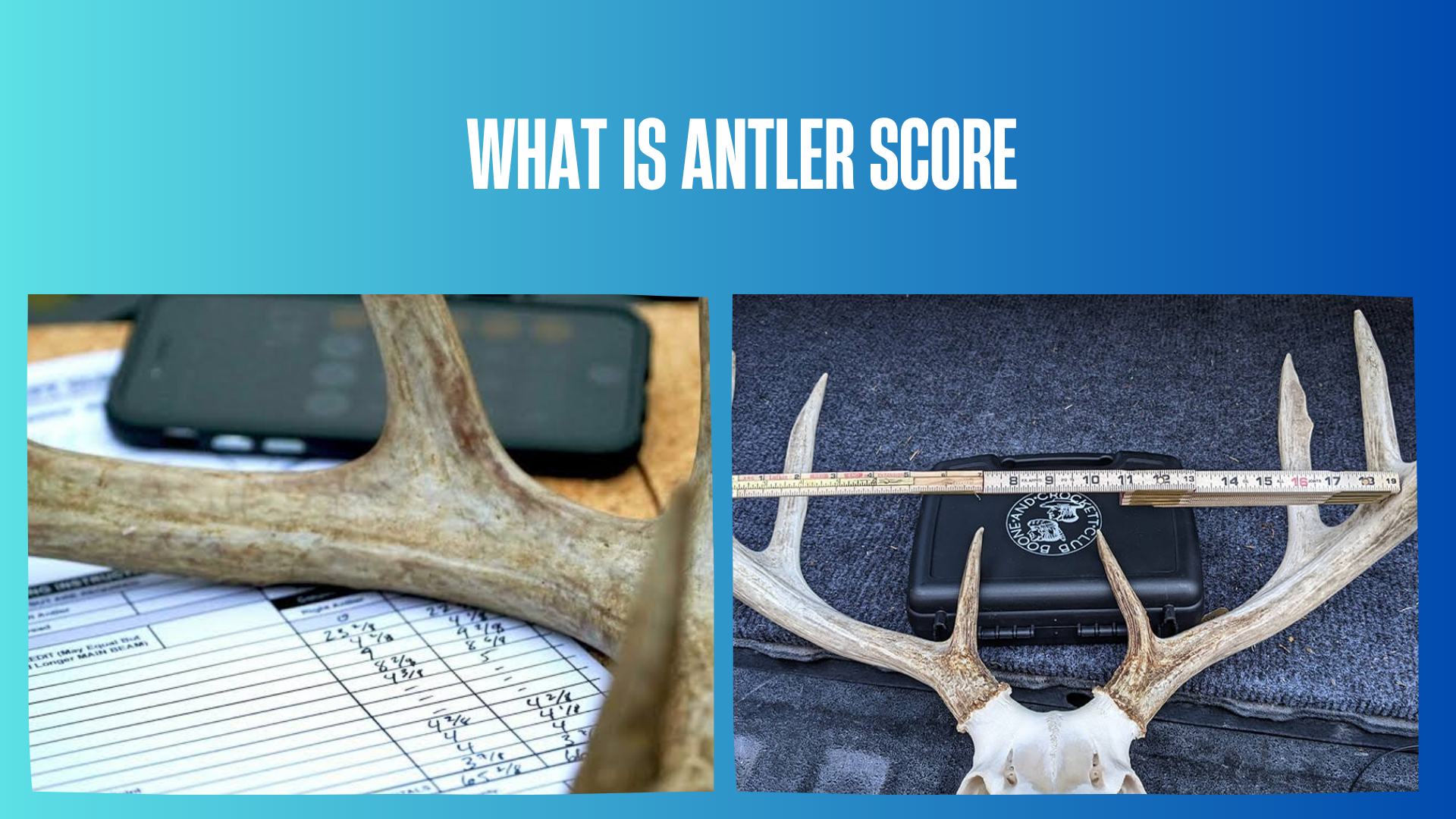

Antler score is a standardized numerical measurement used to describe the size and configuration of a deer, elk, or other antlered big-game animal’s rack. Instead of judging antlers only by appearance or counting points, an established scoring system measures features such as main-beam length, tine length, circumference, and spread.
The exact calculation depends on the species, whether the rack is classified as typical or non-typical, and which scoring organization is being used. In North America, the Boone and Crockett Club scoring system is one of the principal standards, and Pope and Young uses the Boone and Crockett measurement system for qualifying bowhunting trophies. This guide explains what an antler score means, how the basic measurements work, and why a gross score can differ from an official final score.
Quick Answer
An antler score is a number, normally expressed in inches and fractions of an inch, that summarizes a set of antler measurements under a defined scoring system. For many deer and elk categories, measurements include the main beams, normal points or tines, antler circumferences, and spread credit. A gross score describes overall measurable antler size before certain deductions, while a final or net score may account for differences between corresponding sides and other scoring rules. If a trophy is being considered for an official record program, use the current score chart and rules from the applicable organization rather than relying on an informal field estimate.
Antler Score at a Glance
| Term | What It Generally Means |
|---|---|
| Antler score | A standardized numerical measurement of an antlered trophy |
| Gross score | A measure of overall antler size before symmetry deductions under the B&C/P&Y system |
| Net or final score | The official score after the scoring system’s applicable deductions and adjustments |
| Green score | An unofficial score taken before the required drying period |
| Typical | An antler configuration evaluated according to the normal point pattern for its scoring category |
| Non-typical | A scoring category that accounts for substantial abnormal antler growth under its own rules |
| Official score | A score completed according to the record organization’s official procedures |
What Does Antler Score Actually Measure?
Antler scoring converts several physical dimensions of a rack into one standardized figure. It is more detailed than simply saying a buck is an 8-point or a bull is a 6×6.
For a typical North American deer rack, common measurements can include:
- Length of each main beam.
- Length of qualifying normal points or tines.
- Circumference, often called mass, at specified locations.
- Inside spread credit.
- Differences between corresponding measurements on the left and right antlers.
- Abnormal points where applicable to the scoring category.
The exact measurements are species-specific. A whitetail deer, mule deer, elk, moose, and caribou are not all scored with the same worksheet.
The Boone and Crockett Club provides separate official-style score charts for species and categories including typical and non-typical whitetail deer, mule deer, American elk, Roosevelt’s and Tule elk, moose, and caribou. Each chart includes its own measuring instructions.
Why Is Antler Score Measured in Inches?
Antler scoring is fundamentally a system of linear measurements. Lengths and circumferences are measured and combined according to the score chart, so hunters often describe a rack by saying that it “scores 140 inches” or “grosses 320.”
Official Boone and Crockett examples are commonly displayed in eighth-inch fractions, such as 176-6/8. That level of precision is one reason an informal visual estimate and an official score can differ.
What Is the Boone and Crockett Antler Scoring System?
The Boone and Crockett Club developed a standardized North American big-game records system to make trophy measurements consistent. The modern system was adopted in 1950 after earlier record-keeping methods were refined.
According to the Club, the purpose extends beyond comparing large racks. Its records program has also been used as a long-term source of information associated with big-game conservation and wildlife-management trends.
You can learn more through the Boone and Crockett Club’s big-game records information.
What Is the Difference Between Gross and Net Antler Score?
This is one of the most important concepts for beginners.
Gross Score
A gross score is intended to describe the rack’s overall measurable antler growth before deductions for lack of symmetry. Boone and Crockett states that the gross score for antlered animals includes the typical frame without symmetry deductions, total abnormal-point lengths, and total inside spread.
Because it emphasizes total antler size, hunters often use gross score in everyday conversations about how large a rack appears.
Net or Final Score
Under Boone and Crockett and Pope and Young records procedures, the net score is referred to as the final score. It incorporates the scoring rules for symmetry and the appropriate handling of abnormal points for the category.
Therefore, two racks with nearly identical gross size can finish with different final scores if one rack is substantially more asymmetrical.
The official distinction is explained in the Boone and Crockett records-program policies.
Simple Example of Gross vs. Net Score
Imagine two hypothetical typical whitetail racks that each total about 150 inches before deductions.
| Example | Gross Measurement | Symmetry Difference | Illustrative Result |
|---|---|---|---|
| Rack A | 150 inches | Small differences between sides | Net remains relatively close to gross |
| Rack B | 150 inches | Larger left-to-right differences | Net finishes farther below gross |
This is only an illustration of the concept, not an official score calculation. Actual deductions must be determined using the correct score chart and measurement rules.
What Does Typical Antler Score Mean?
A typical score evaluates a rack according to the normal antler configuration established for that species and scoring category.
For a typical whitetail, for example, the system recognizes normal points that rise from the main beams in the accepted typical configuration. Measurements from corresponding features on the two sides are compared when calculating the final typical score.
A rack does not have to be perfectly symmetrical to be scored as typical. Natural variation is normal. However, substantial abnormal growth may affect how the rack scores and whether a non-typical category is more appropriate.
What Is a Non-Typical Antler Score?
A non-typical rack has abnormal antler features substantial enough to be evaluated under the applicable non-typical scoring rules.
Examples can include unusual extra points or growth that does not follow the normal point pattern for that species.
Non-typical does not mean inferior. Some of the largest recorded deer racks are dramatically non-typical. It is simply a different scoring classification.
Boone and Crockett maintains separate scoring charts for categories such as typical and non-typical whitetail deer, mule deer, and American elk.
What Parts of a Deer Rack Add to the Score?
For a typical whitetail scored under the Boone and Crockett framework, the important measurements generally include several major groups.
Main Beams
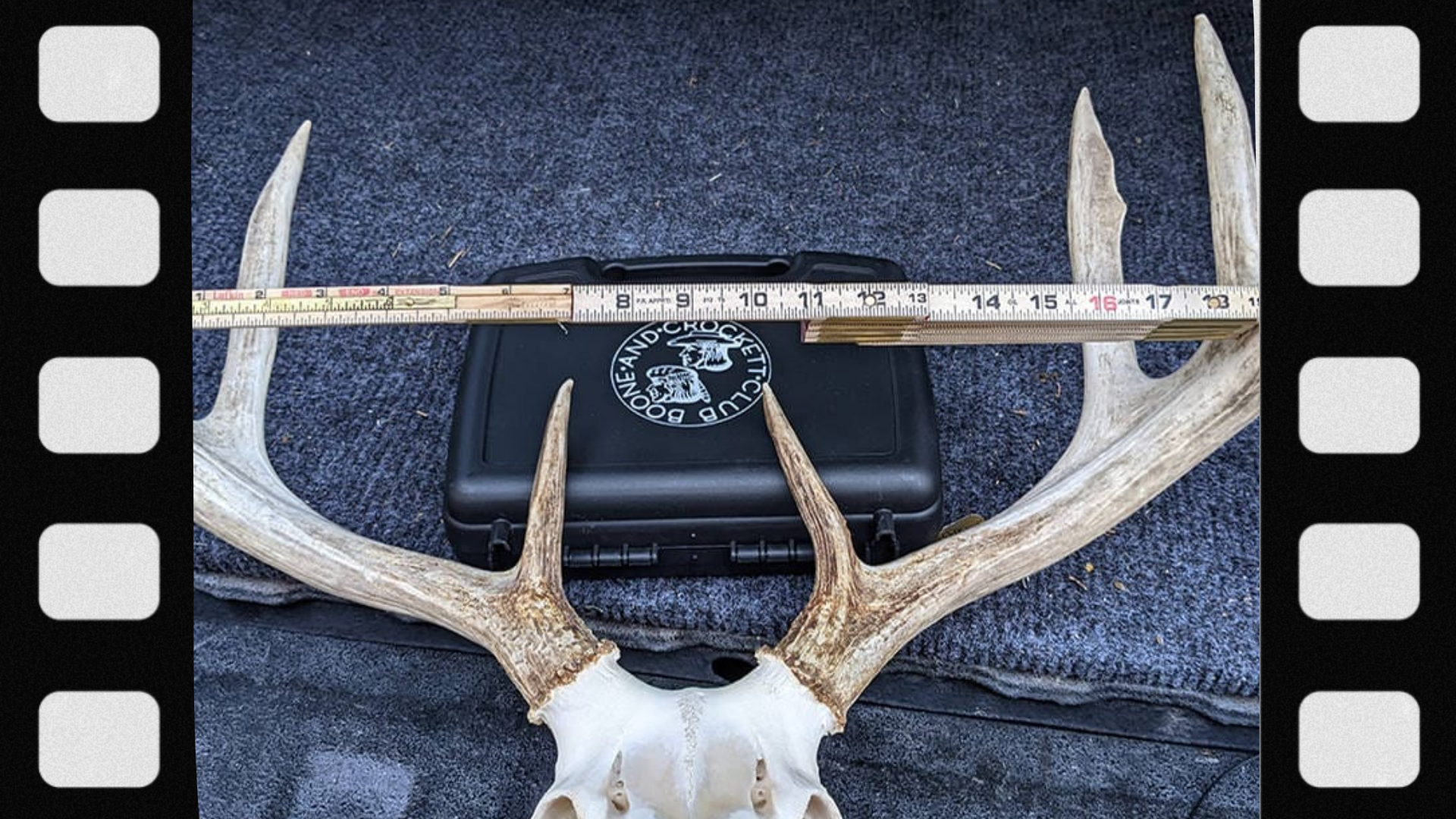
The main beam is the primary antler structure extending outward and forward from the burr. Each beam is measured according to the scoring chart’s prescribed path.
Normal Points or Tines
The lengths of qualifying normal points are measured individually. Hunters often refer to these measurements by designations such as G-1, G-2, G-3, and so on.
Mass or Circumference
Circumference measurements quantify antler mass at designated positions along each main beam. These measurements matter even on a rack whose points are not exceptionally long.
Inside Spread Credit
The inside distance between the main beams contributes spread credit under applicable antler scoring systems. It should not be confused with the widest outside dimension of the rack.
Does the Number of Points Equal Antler Score?
No. Point count and antler score describe different things.
An 8-point whitetail has a certain number of countable antler points under the convention being used, but that says little about how long the beams are, how tall the tines are, how much mass the rack carries, or how wide its inside spread is.
A heavy, wide 8-point can therefore score higher than a smaller 10-point.
This is why “How many points does it have?” and “What does it score?” are separate questions.
Does Antler Spread Equal the Score?
No. Spread is only one portion of the overall calculation for species whose score includes spread credit.
A visually wide rack may look impressive but have shorter beams, shorter tines, or less mass than a narrower rack. Conversely, a relatively narrow animal can still score strongly if it carries long beams, tall points, and substantial circumference.
Spread is therefore useful information, but it should not be treated as the entire score.
Does Antler Mass Matter?
Yes. Circumference measurements are an important part of scoring many antlered big-game categories.
This explains why two bucks with similar spreads and tine lengths can still finish with noticeably different scores. The heavier-antlered animal may accumulate more inches through its circumference measurements.
What Is a Green Antler Score?
A green score is an unofficial measurement taken before an antlered trophy has completed the required drying period for official Boone and Crockett/Pope and Young measurement.
Under current B&C/P&Y records policy, antlers, horns, skulls, or tusks must generally air-dry at habitable room temperature for at least 60 days before official measurement. A score obtained before that period is complete is considered a green score and is not an official records score.
Antlers can lose a small amount of dimension as they dry, so a green estimate may not exactly match the later official measurement.
Why Is There a 60-Day Drying Period?
The drying period helps standardize official measurements. Fresh antlers and skull material can change slightly as moisture is lost, so measuring every trophy after a prescribed period makes comparisons more consistent.
Boone and Crockett specifies that attempts to artificially alter the normal drying process can make a trophy ineligible for its records program.
See the current B&C/P&Y records policies for official details.
Is a Home Antler Score Official?
No. You can measure your own antlers to obtain a useful estimate, but that does not make the number an official record-book score.
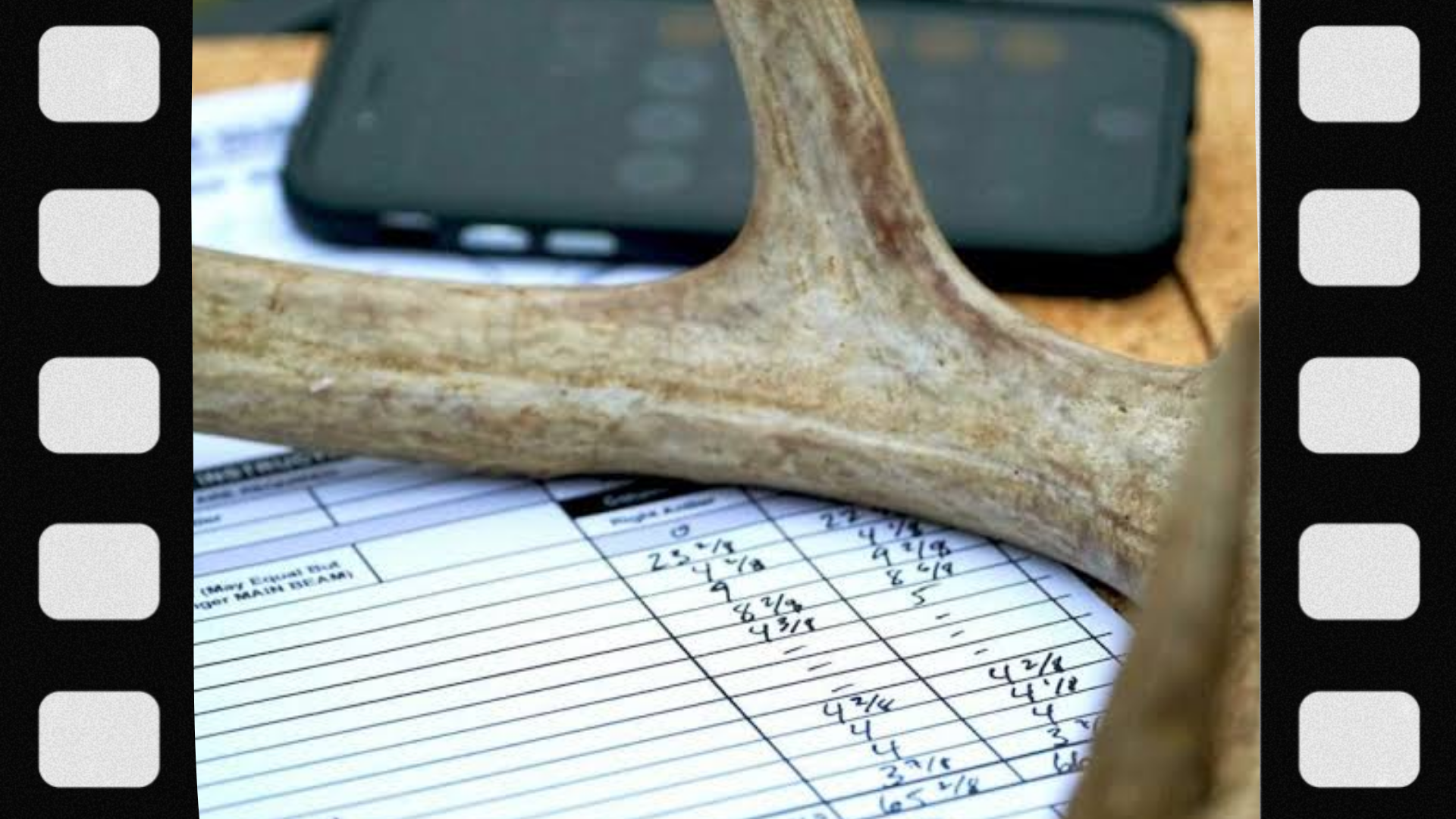
For a Boone and Crockett records entry, the Club requires a completed original score chart signed and dated by an Official Measurer, together with the other required entry materials.
If you simply want to understand approximately what a rack scores, self-measuring is perfectly useful. If record-book eligibility matters, contact an appropriate official measurer and follow the current program rules.
Boone and Crockett vs. Pope and Young Antler Scores
Boone and Crockett and Pope and Young are closely related from a measurement standpoint. Boone and Crockett states that Pope and Young has used the Boone and Crockett scoring system since Pope and Young’s founding in 1961, and the organizations collaborated on the current joint official measurers manual.
The major distinction is records-program eligibility. Boone and Crockett’s program focuses on the trophy and accepts qualifying trophies taken with legal equipment under its rules, while Pope and Young is specifically associated with qualifying bowhunting trophies.
The scoring procedures and eligibility rules should therefore be treated as related but separate issues.
The organizations’ shared approach is described in the joint B&C/P&Y scoring manual information.
Does Species Change How Antler Score Is Calculated?
Yes. There is no single universal antler formula that is applied identically to every big-game species.
For example, separate Boone and Crockett score charts exist for:
- Typical American elk.
- Non-typical American elk.
- Roosevelt’s and Tule elk.
- Typical whitetail deer.
- Non-typical whitetail deer.
- Typical mule deer and blacktail deer.
- Non-typical mule deer and blacktail deer.
- Moose.
- Caribou.
Use the chart designed for the exact species and category rather than applying a whitetail method to an elk or mule deer.
What Is Considered a Good Antler Score?
There is no universal “good” antler score.
A meaningful benchmark changes with:
- Species and subspecies.
- Typical versus non-typical classification.
- Geographic region.
- Habitat quality.
- Animal age.
- Nutrition and environmental conditions.
- The scoring system being discussed.
- The hunter’s personal goals.
A number that would represent a very large whitetail cannot be directly compared with an elk score because the species have very different antler structures.
Record-book minimums are also not definitions of whether an animal is “good.” They are thresholds for particular records programs. Hunting success should not be reduced to an antler number.
Does Antler Score Tell You the Age of a Deer?
No. Antler score alone cannot reliably establish an animal’s exact age.
Age can influence antler development, but nutrition, genetics, habitat, health, weather, injuries, population density, and other environmental conditions also affect antler growth.
Montana State University Extension notes that deer generally do not produce their largest antlers until later in life, but individual animals vary considerably.
Score should therefore be understood as a measurement of the antlers, not a direct age measurement.
Can You Estimate Antler Score While the Animal Is Alive?
Hunters often estimate rack size in the field by evaluating features such as spread, main-beam length, tine length, and apparent mass. This is commonly called field judging.
However, field estimates are approximate. Viewing angle, distance, vegetation, movement, lighting, and body size can distort apparent dimensions.
For records purposes, Boone and Crockett specifically states that its measurers should not score the antlers or horns of restrained live animals except in qualifying research settings.
In a hunting situation, positive species identification, legal-animal requirements, a safe shot opportunity, and ethical judgment are more important than attempting to calculate a precise score on a live animal.
Why Do Hunters Care About Antler Score?
Hunters and wildlife professionals use antler scores for several different reasons.
- Standardized comparison: A scoring system provides a common way to describe antler dimensions.
- Records: Organizations maintain historical records of notable big-game specimens.
- Personal interest: Hunters may score a memorable animal without any intention of entering a record book.
- Wildlife history: Long-term records can contribute information about big-game populations and management.
- Field-judging practice: Learning the parts of an antler score can help hunters estimate size more consistently.
Boone and Crockett notes that its records database is also part of a broader conservation record used to examine wildlife-management trends.
Antler Score Is Not the Same as Hunting Success
A high antler score can be interesting, but it should not be treated as the sole measure of a successful hunt.
A lawful, safe, fair-chase hunt that results in responsibly recovered game has value regardless of whether the antlers qualify for a records program. The Boone and Crockett Club itself notes that there is more to hunting and conservation than the final score of a trophy.
Hunters should still prioritize:
- Positive animal identification.
- Current hunting regulations.
- Safe firearm or archery handling.
- Knowing the target and what lies beyond it.
- Ethical shot selection.
- Legal game recovery.
- Respect for private property.
- Proper meat care and avoidance of waste.
Common Antler-Scoring Mistakes
Confusing Point Count With Score
Point count is only one visible feature of a rack. Score also reflects beam length, tine length, mass, spread credit, and other measurements.
Using Outside Spread Instead of the Required Spread Measurement
The widest outside dimension is not automatically the spread value used in an official score. Follow the applicable chart instructions.
Ignoring Circumference Measurements
Mass contributes meaningful inches. Estimating only spread and tine length can produce a poor approximation.
Calling a Green Score Official
A measurement made before the required drying period is not an official B&C/P&Y final score.
Mixing Gross and Net Scores
When someone says a buck “scores 150,” ask whether that means gross or final/net score. The numbers can differ significantly on an asymmetrical rack.
Using the Wrong Species Chart
Whitetail, mule deer, elk, moose, and caribou require category-specific measurements. Use the correct current score chart.
Estimating From Photographs as if It Were Exact
A photo can make antlers appear wider, taller, or heavier depending on perspective and lens distortion. Photo-based estimates should be treated as estimates.
How to Get the Most Reliable Antler Score
- Identify the species and correct scoring category.
- Determine whether the rack should be evaluated as typical or non-typical.
- Download the current score chart from the scoring organization.
- Follow its measurement instructions precisely.
- Record measurements consistently in the required units.
- Label your result as an estimate if you measured it yourself.
- If official recognition matters, allow the required drying period.
- Contact an Official Measurer for the appropriate records program.
The Boone and Crockett score-chart library is a practical starting point because each downloadable chart includes measuring instructions.
Final Answer: What Is Antler Score?
Antler score is a standardized way of expressing the size and configuration of an antlered big-game trophy through a series of measurements. Depending on the species and scoring category, those measurements can include main beams, tines, circumferences, spread credit, abnormal points, and comparisons between the two sides. A gross score represents overall measurable antler size before applicable symmetry deductions, while the Boone and Crockett/Pope and Young final score follows the full scoring rules. For an official score, use the correct current score chart and an authorized measurer rather than relying only on a field or home estimate.
FAQs
1. What does antler score mean?
Antler score is a standardized numerical measurement used to describe the size and configuration of a set of antlers.
2. Is antler score measured in inches?
Yes. North American systems such as Boone and Crockett use linear measurements expressed in inches and fractional inches.
3. What measurements make up a deer antler score?
For common deer categories, measurements can include main-beam length, normal tine length, circumference or mass, spread credit, and other category-specific measurements.
4. What is gross antler score?
Gross score describes overall measured antler size before deductions for differences between corresponding sides under the B&C/P&Y framework.
5. What is net antler score?
Net score is the resulting score after applying the scoring system’s required deductions and rules. Boone and Crockett/Pope and Young refer to the net score as the final score.
6. Why is net score lower than gross score?
It may be lower because the final calculation accounts for left-to-right differences and other rules applicable to the chosen typical or non-typical category.
7. What does green score mean?
A green score is an unofficial measurement taken before the required drying period has been completed.
8. How long must antlers dry before an official Boone and Crockett score?
Current B&C/P&Y policy generally requires at least 60 days of air drying at habitable room temperature before official measurement.
9. Does an 8-point buck have a higher score than a 10-point?
Not necessarily. A large 8-point can have longer beams, more mass, greater spread, and longer tines than a smaller 10-point and therefore score higher.
10. Is antler point count the same as antler score?
No. Point count describes the number of qualifying points, while score combines multiple measurements.
11. Does outside spread count in Boone and Crockett score?
Do not assume so. The applicable score chart specifies which spread measurement contributes to the score. For many antler categories, inside spread credit is the relevant value.
12. Does mass count toward antler score?
Yes. Circumference measurements contribute to the score in many deer and elk categories.
13. Do tine lengths count toward score?
Yes, qualifying point lengths are major components of many antler scoring formulas.
14. What are G1, G2, and G3 on deer antlers?
These are labels used on scoring charts to identify successive normal antler points or tines along the main beam.
15. What is a typical antler?
A typical rack follows the established normal antler configuration for its species and scoring category closely enough to be evaluated under typical scoring rules.
16. What is a non-typical antler?
A non-typical rack includes significant abnormal antler growth that is evaluated under the applicable non-typical scoring rules.
17. Is non-typical worse than typical?
No. The terms describe scoring categories, not trophy quality. Many exceptional record animals are non-typical.
18. Can I score deer antlers myself?
Yes, you can make an unofficial estimate by following a current score chart. An official records entry requires the organization’s official procedure.
19. How accurate is a home antler score?
It can be close when measurements are taken carefully, but mistakes in baselines, circumference locations, point classification, and spread measurements can change the result.
20. Is an online antler calculator an official score?
No. A calculator can help estimate a score, but an official record score requires compliance with the scoring organization’s measurement and verification requirements.
21. Who can officially score a Boone and Crockett trophy?
For an official records entry, Boone and Crockett requires a score chart completed and signed by an Official Measurer under its current procedures.
22. Does Pope and Young use the same antler scoring system?
Pope and Young uses the Boone and Crockett scoring system, although its records-program eligibility requirements differ because Pope and Young focuses on qualifying bowhunting trophies.
23. Do elk and deer use the same score formula?
No. They have separate species-specific scoring charts and measurements.
24. Is a 300-inch elk the same size as a 300-inch deer?
No meaningful direct comparison can be made from the number alone because elk and deer have different antler structures and scoring categories.
25. Can antler score tell you a deer’s age?
No. Age influences antler development, but score alone cannot reliably determine exact age because nutrition, genetics, health, and environmental conditions also affect growth.
26. Can you accurately score antlers from a photograph?
Not usually. You can make a rough field estimate, but perspective and lack of known dimensions make precise photo scoring unreliable.
27. Do broken antler points affect score?
They can. The applicable score chart and records policies determine how damaged or broken portions are handled.
28. Do velvet antlers score differently?
Records-program treatment of velvet differs by organization. Boone and Crockett generally requires velvet to be removed before official Awards Program measurement, while Pope and Young recognizes qualifying velvet categories under its current rules.
29. Can shed antlers receive an official Boone and Crockett record-book score?
A pair of loose shed antlers is not eligible for B&C/P&Y record entry because the original inside spread cannot be verified on an intact skull plate, although sheds can still be measured informally.
30. Where can I find an official antler score chart?
The Boone and Crockett Club provides downloadable species-specific score charts with measurement instructions at Boone-Crockett.org.
Read more: