
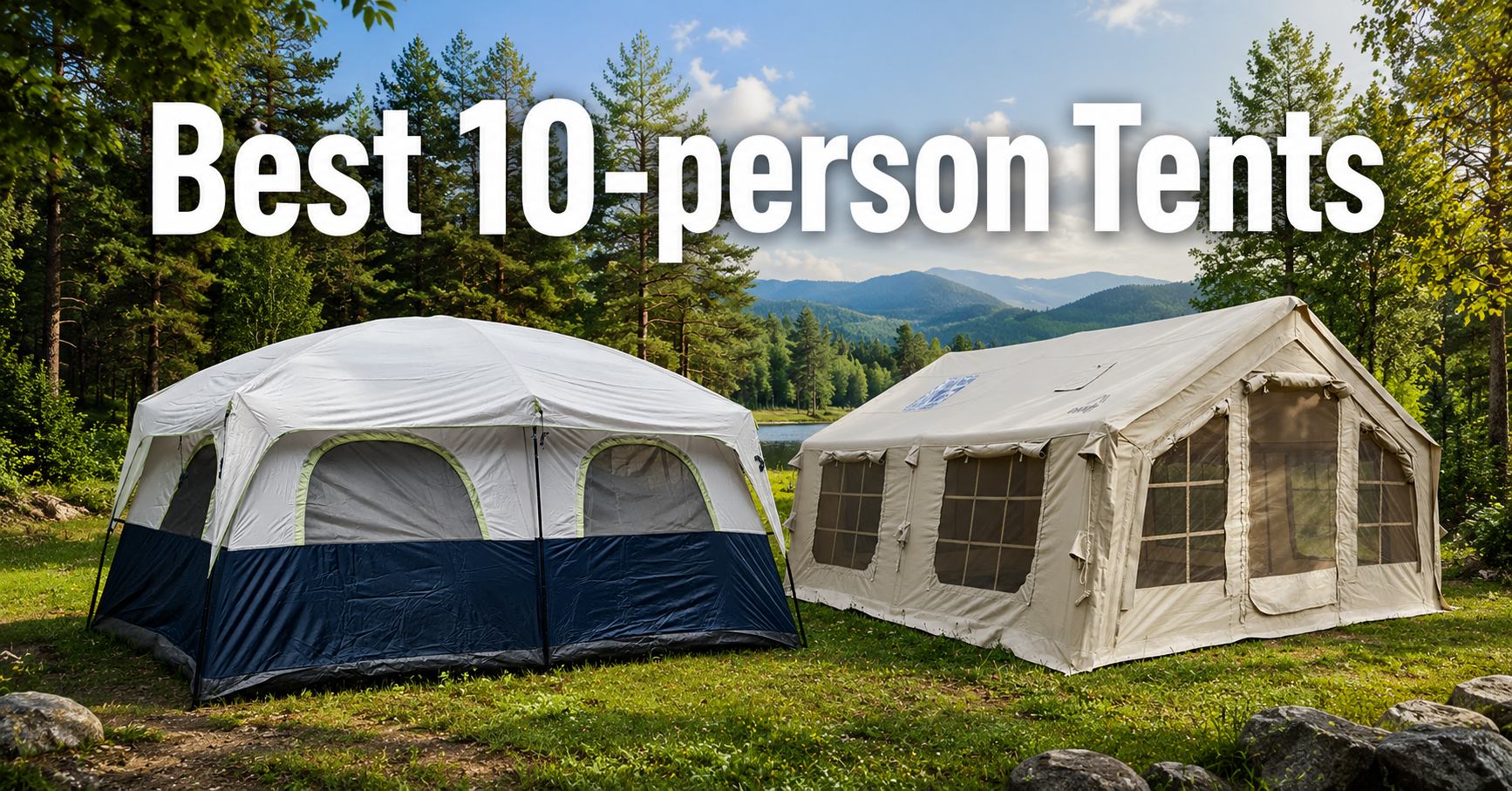

A “10-person” label usually describes how many sleeping pads can be arranged across the floor—not how many adults can live comfortably with duffels, boots, cots, air mattresses, coolers, and a clear path to the door. For most families and hunting-camp groups, the real decision is not maximum occupancy. It is whether the tent provides enough usable floor space, standing height, ventilation, privacy, weather coverage, and setup practicality for the number of people who will actually share it.
This comparison focuses on three distinct tents from the supplied Amazon list: a dark-interior cabin tent, a long two-room family tent, and a straight-wall cabin tent. All are car-camping shelters rather than backpacking tents. Each has a different strength, and none should be treated as a severe-weather shelter, a lightning shelter, or a substitute for checking campground conditions and emergency plans.
Quick Picks
- Best Overall for Usable Headroom: CORE Tent for Family Camping | 10 Person / 11 Person / 12 Person Large Multi Room Cabin Tents for Car Camping & Outdoor Adventures — The selected 10-person CORE variation combines a 14-by-10-foot floor, 86-inch center height, nearly straight walls, adjustable ventilation, two doors, and an official “5 people plus gear” comfort recommendation.
- Best for Blackout Sleep and Daytime Naps: EVER ADVANCED 10 Person Camping Blackout Design Tent, Multi Room Tent for Family, Portable Family Cabin Tent for Outdoor, Large Tents with Rainfly and Carry Bag, 2 Doors, Water-Resistant, 14ft x 10ft x 84in — Dark-rest fabric, two rooms, two doors, 84-inch height, four large windows, and a porch-style side-door awning suit families who value privacy and reduced morning light.
- Best for Long Floor Space and Three Queen Air Mattresses: UNP Camping Tent 10-Person-Family Tents, Parties, Music Festival Tent, Big, Easy Up, 5 Large Mesh Windows, Double Layer, 2 Room, Waterproof, Weather Resistant, 18ft x 9ft x78in — An 18-by-9-foot footprint, 78-inch peak, two doors, a divider, and five mesh openings give large groups a long, flexible sleeping layout.
Direct answer: The CORE Tent for Family Camping | 10 Person / 11 Person / 12 Person Large Multi Room Cabin Tents for Car Camping & Outdoor Adventures is the strongest all-around choice for most family car-camping groups because the selected 10-person model has tall, nearly vertical walls, a verified 14-by-10-foot floor, an 86-inch center height, a room divider, two doors, and a manufacturer comfort recommendation of five campers plus gear. Its main trade-off is that the traditional-pole cabin design is heavy and needs careful staking and guying in changing weather.
Important tent-safety limits: A camping tent is not a safe place during lightning, a tornado, damaging winds, wildfire evacuation, falling-tree danger, or flash flooding. Move to the appropriate sturdy shelter or hard-topped vehicle when official guidance calls for it. Never operate charcoal, a fuel-burning stove, heater, grill, generator, or combustion lantern inside these tents or near openings; carbon monoxide is odorless and can build up quickly. Follow campground fire restrictions, local rules, manufacturer instructions, and current weather alerts.
Best 10-Person Tents Comparison
| Product | Best For | Floor Size | Peak Height | Practical Capacity Note | Layout and Ventilation | Listed Weight | Weather Trade-Off | Amazon |
|---|---|---|---|---|---|---|---|---|
| CORE 10 Person Straight Wall Cabin Tent | Families prioritizing standing room and usable wall space | 14 ft x 10 ft | 86 in | Manufacturer lists 10 by industry standard and 5 people plus gear as the most comfortable fit | Two doors, room divider, lower vents, mesh ceiling, storage pockets, electrical-cord access | About 32 lb for the selected model | 1200mm fabric, taped rainfly, and sealed seams are listed; cabin profile still needs full staking and conservative weather judgment | Check |
| EVER ADVANCED 10 Person Blackout Tent | Light-sensitive sleepers, children’s nap schedules, and privacy | 14 ft x 10 ft | 84 in | Manufacturer says it fits three queen air mattresses; ten sleepers will be much tighter once gear and walkways are included | Two doors, divider, four large roll-up windows, overhead mesh, skylight, side-door awning option | Current listing data describes roughly 44.6 lb; verify the selected variation | Manufacturer describes water- and sun-resistant fabric; blackout material can feel warmer or darker when vents are closed | Check |
| UNP 10-Person Two-Room Tent | Long sleeping layouts, three queen air mattresses, festivals, and mild-weather group trips | 18 ft x 9 ft | 78 in | Listing says ten sleeping bags or three queen air mattresses; leave additional room for luggage and door access | Two doors, removable divider, large mesh roof, five large mesh window/door openings | Approximately 21 lb in current listing data; verify color and variation | Listing describes 185T polyester with PU1000mm coating; the long fiberglass-pole shape is better suited to fair or moderate conditions than exposed storms | Check |
Capacity note: Tent occupancy ratings are based on close sleeping arrangements. Air mattresses, cots, hunting packs, muddy boots, dog crates, clothing, and interior walkways reduce practical capacity. When comfort matters, choose more floor area than the minimum sleeping calculation suggests.
What “10 Person” Means in Real Camping
A full 10-person sleeping arrangement typically places bags or pads close together with little space for equipment. That can work for a one-night group event in mild weather, but it is less comfortable for a family trip where people need to change clothes, enter at night, store bags, manage children, or keep wet gear away from bedding.
The better way to estimate capacity is to draw the floor dimensions on paper and add the actual dimensions of every mattress, cot, crate, and storage bin. Then reserve a door path at least wide enough for the largest camper to exit without stepping over sleeping people. A room divider creates privacy, but it does not create extra floor space.
- Ten sleeping bags: Possible only in a close, gear-light layout that uses most of the floor.
- Three queen air mattresses: A common manufacturer claim for 14-by-10-foot or 18-by-9-foot tents, but door access and personal storage may be limited.
- Four queen air mattresses: CORE lists this as a maximum arrangement, while also recommending five people plus gear for the most comfortable use.
- Cots: Often consume more usable room than sleeping pads because legs, frames, and side access create dead space.
- Hunting or outdoor gear: Boots, packs, coolers, layers, and equipment can take the floor area of one or more additional sleepers.
1. Best Overall for Headroom: CORE Tent for Family Camping | 10 Person / 11 Person / 12 Person Large Multi Room Cabin Tents for Car Camping & Outdoor Adventures
Best use case: Family campground stays, hunting-base-camp sleeping space, and groups that care more about standing and organizing gear than carrying the lightest tent.
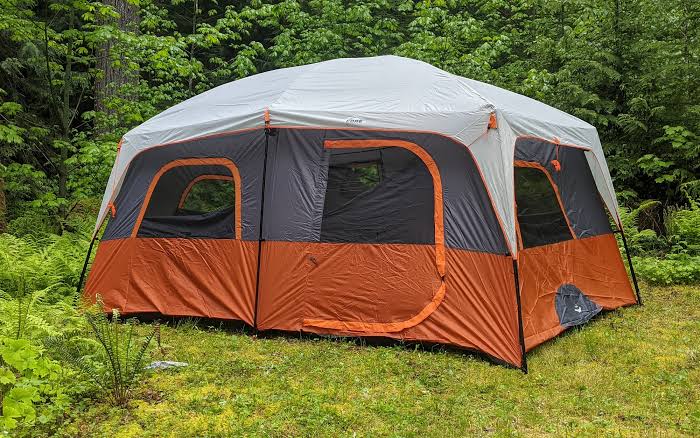
The selected 10-person CORE model is a traditional-pole straight-wall cabin tent identified as model 40034. The manufacturer lists a 14-by-10-foot floor, 86-inch center height, 68D polyester fabric with a 1200mm water-resistance specification, a polyethylene floor, steel poles, two doors, a room divider, storage pockets, adjustable lower vents, mesh ceiling, electrical-cord access, and a packed weight of about 32 pounds.
The nearly vertical walls are the decisive advantage. Dome tents lose usable volume as the walls slope inward, making the edge of the floor difficult to use with cots, bins, and tall air mattresses. The CORE keeps more shoulder and headroom near the perimeter, which makes a 140-square-foot floor feel more livable during multi-night trips.
CORE’s own capacity guidance is unusually useful: ten people is the industry-standard maximum, while five campers plus gear is the most comfortable arrangement. That is a realistic target for families who want room to stand, change, and keep a central walkway. The divider can separate adults and children, sleeping and changing zones, or clean bedding from equipment, but sound and light still pass through a fabric partition.
The weather system includes water-repellent fabric, sealed seams, and a taped rainfly. Those features improve rain resistance, but a tall cabin tent presents more surface area to wind than a lower dome. Stake every corner, tension all guylines, recheck them as fabric settles, and avoid exposed sites when strong wind or severe weather is forecast. No manufacturer wind statement should be treated as permission to remain in a dangerous storm.
Pros
- Nearly straight walls preserve usable standing and storage space around the perimeter.
- Verified 86-inch center height is the tallest among the three distinct models compared.
- Manufacturer provides a realistic comfort recommendation of five campers plus gear.
- Two doors reduce nighttime traffic through one entrance.
- Lower vents and a mesh ceiling support low-to-high airflow when weather permits.
- Room divider and storage pockets help organize a large shared interior.
Cons
- Approximately 32-pound packed weight limits it to vehicle-supported camping.
- Traditional pole setup is slower than an instant-frame design and is easier with two adults.
- Tall cabin walls create more wind exposure than a lower-profile dome.
- The standard rainfly does not provide the extended enclosed vestibule found on the separate full-rainfly model.
- Four queen mattresses may technically fit, but they leave little practical room for gear or movement.
Maintenance: Dry the tent completely before storage, remove soil from pole joints, inspect the polyethylene floor for punctures, check seam tape and zipper tracks, and replace bent poles, damaged stakes, or frayed guylines through the manufacturer rather than improvising structural repairs.
2. Best Blackout Option: EVER ADVANCED 10 Person Camping Blackout Design Tent, Multi Room Tent for Family, Portable Family Cabin Tent for Outdoor, Large Tents with Rainfly and Carry Bag, 2 Doors, Water-Resistant, 14ft x 10ft x 84in
Best use case: Families with children, shift workers, festival campers, or light-sensitive sleepers who value reduced daylight and a flexible porch-style opening.
The EVER ADVANCED tent uses a 14-by-10-foot cabin layout with an 84-inch center height. The manufacturer describes dark-rest interior fabric, a removable room divider, two doors, four large zippered roll-up windows, overhead mesh, a skylight, a rainfly, and a side door that can be raised as an awning when correctly supported.
The blackout treatment is the reason to choose this model. Reduced morning light may help children nap, allow adults to sleep later, and add privacy at busy campgrounds or festivals. It is not total darkness, and the effect depends on closing the windows and doors. Closing every panel also reduces airflow, so users need to balance darkness against heat and condensation.
The manufacturer lists space for three queen air mattresses. That arrangement uses much of the floor; a smaller group will have a better experience if it reserves one zone for bags, changing, and entry. The two-door layout is useful when the divider is installed because each side can have a more direct exit, reducing the need to cross someone else’s bedding.
Current listing data places the packed weight around 44.6 pounds, making it the heaviest option here. That weight may reflect the dark fabric, large pole set, rainfly, stakes, and porch configuration. It is best for campgrounds where the vehicle is close to the site. Buyers should verify the selected navy variation, model information, and included awning supports because Amazon pages can combine colors and versions.
Pros
- Dark-rest interior reduces direct daylight for naps and later sleep.
- Four large windows, overhead mesh, and two doors offer several ventilation choices.
- Room divider supports two sleeping or privacy zones.
- Fourteen-by-ten-foot floor and 84-inch height provide generous cabin space.
- Side-door awning can create a shaded transition area in suitable weather.
- Manufacturer describes space for three queen air mattresses.
Cons
- Blackout performance is reduced when windows and doors are opened for maximum airflow.
- Dark fabric can make the interior feel warmer if ventilation is restricted in sun.
- Current listing weight is substantially heavier than the UNP and CORE options.
- Awning mode adds fabric and poles that must be lowered before wind or unattended periods.
- Large footprint needs a wide, level campsite clear of roots, drainage channels, and falling-branch hazards.
Care note: Do not dry-clean, machine-dry, or apply unapproved chemicals to blackout fabric. Follow the current manual, use mild spot cleaning, and store the tent loose and dry when possible. Inspect dark coatings for peeling, tackiness, or heat damage before each season.
3. Best Long Floor Plan: UNP Camping Tent 10-Person-Family Tents, Parties, Music Festival Tent, Big, Easy Up, 5 Large Mesh Windows, Double Layer, 2 Room, Waterproof, Weather Resistant, 18ft x 9ft x78in
Best use case: Mild-weather family camping, festivals, backyard sleepouts, and groups that want three queen-mattress zones across a long rectangular floor.
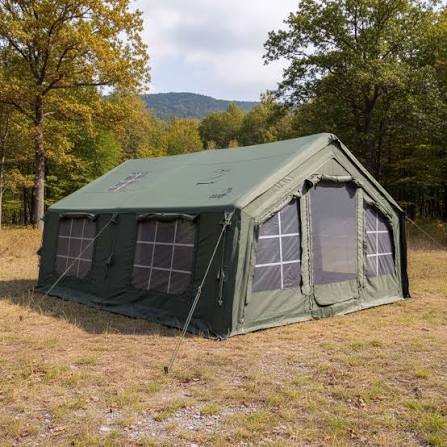
The selected dark-green UNP variation is an 18-by-9-foot, 78-inch-high two-room tent. Current listing descriptions identify 185T polyester with a PU1000mm coating, a rainfly with awning coverage, fiberglass poles, two doors, a removable privacy divider, a large mesh roof, and five large mesh window or door openings. The listing states that two people can pitch it in roughly ten minutes after learning the process.
Its 162-square-foot floor is the largest by area in this comparison, although it is only nine feet wide. That long shape works well for placing three queen air mattresses end-to-end or creating a sleeping zone at each end with a shared center. It can also fit a long row of sleeping bags for a youth group or festival trip, but ten-person use leaves little room for personal equipment.
The lower packed weight—approximately 21 pounds in current listing data—is attractive for a tent this large. The trade-off is a fiberglass-pole structure and a long, broad profile. Fiberglass can be practical for fair-weather family camping, but poles must be assembled gently, fully seated, and protected from crushing in storage. A long tent also requires more level ground and careful tensioning so the roof and rainfly do not sag.
The mesh roof and large windows support warm-weather airflow and stargazing when the rainfly is removed in settled conditions. Once the fly is installed and openings are closed for rain, condensation management becomes more important. Keep lower and upper vents open when safe, avoid pressing bedding against the walls, and never use combustion appliances to warm the interior.
Pros
- Largest verified floor area in the comparison at approximately 162 square feet.
- Eighteen-foot length creates flexible sleeping zones and fits three queen air mattresses according to the listing.
- Large mesh roof and five mesh openings support warm-weather ventilation.
- Two doors and a divider make the long interior easier to split into two zones.
- Approximately 21-pound listed weight is relatively manageable for such a large shelter.
- Large carry bag is intended to make repacking less restrictive than tightly sized tent bags.
Cons
- Fiberglass poles are more vulnerable to cracking or splitting than well-protected metal poles.
- Seventy-eight-inch peak height is lower than the CORE and EVER ADVANCED models.
- Long 18-foot footprint can be difficult to fit on standard tent pads.
- PU1000mm listing claim is modest compared with more storm-oriented tents and should not be treated as extreme-weather protection.
- Two similar UNP ASINs and multiple colors make variation verification important before ordering.
Setup advice: Practice at home, label or photograph pole positions, inspect every ferrule, and use all guylines. Do not force a pole into an incorrect sleeve or bend it sharply to compensate for a twisted tent body.
Which Tent Fits Your Group?
- Family of four or five with a lot of gear: The CORE offers the most useful wall shape and manufacturer-supported comfortable capacity.
- Children who wake early in bright tents: The EVER ADVANCED blackout interior provides the clearest specialized benefit.
- Three queen air mattresses: The UNP and EVER ADVANCED both list this arrangement; the UNP offers more total floor area, while the EVER ADVANCED offers darker fabric.
- Cots and tall storage bins: The CORE’s straight walls use the edge of the floor more effectively.
- Festival or backyard use in mild weather: The UNP’s long floor and mesh ventilation are practical when the site has enough space.
- Hunting base camp: The CORE is easier to organize around packs and changing space; keep all firearms unloaded and secured according to applicable law and never handle them in a crowded sleeping area.
- Campground with a small tent pad: Measure the full floor and guyline footprint before choosing. An 18-foot tent may not fit even when a site is advertised for a large tent.
Buying Guide: Seven Questions Before Ordering
- How many people need beds, and how many need gear space? Build the layout around actual mattress and cot dimensions, not occupancy alone.
- Will the campsite fit the full footprint? Add room for doors, stakes, guylines, and safe separation from fire rings, roads, and neighboring sites.
- Can two adults pitch it in poor light? Large tents are easier with teamwork. Practice before the trip and carry a headlamp for each setup helper.
- What weather is realistic? These are large car-camping tents for managed trips, not shelters for severe thunderstorms, high winds, snow loading, or exposed backcountry sites.
- How much standing room matters? Straight walls and an 86-inch peak benefit tall campers, cot users, and anyone changing clothes inside.
- Do you need darkness or maximum ventilation? Blackout fabric helps sleep but can reduce airflow when every cover is closed.
- Can the packed tent be transported and dried? A 30- to 45-pound wet tent is bulky. Confirm cargo space and a place at home where the shelter can be fully aired.
Weather, Fire, and Campsite Safety
The National Weather Service advises campers to know where to shelter before hazardous weather arrives and to use multiple ways to receive warnings. A tent provides no lightning protection. At the first sound of thunder, move to a substantial building or an enclosed hard-topped vehicle with the windows up, then follow current official guidance.
- Check above and below: Avoid dead limbs, leaning trees, rockfall zones, drainage channels, low ground, dry streambeds, and flood-prone areas.
- Stake and guy the tent: A freestanding shape can still move, collapse, or tear when it is not anchored.
- Keep heat outside: Never burn charcoal or operate fuel-burning stoves, lanterns, grills, or heaters inside a tent.
- Respect fire distance: Sparks can melt or ignite tent fabric. Follow campground rules and keep the shelter away from fire rings.
- Maintain exits: Do not block both doors with mattresses, bins, or equipment. Every camper should know how the zippers work in darkness.
- Use battery lighting: Choose maintained LED lanterns and headlamps rather than flame-based lighting.
- Monitor children and pets: Guyline trips, zipper entanglement, hot camp equipment, and wandering are common campsite risks.
- Leave when directed: A large tent and expensive gear are not reasons to delay evacuation for wildfire, flooding, or severe weather.
Maintenance and Storage
A large family tent lasts longer when it is dried, cleaned, and packed deliberately. Moisture trapped for even a short storage period can produce odor, mildew, coating damage, and corrosion.
- Shake out dirt and remove sticks before folding the floor.
- Air-dry the body, fly, footprint, guylines, and carry bag completely.
- Wipe poles clean and allow metal joints or fiberglass ferrules to dry.
- Inspect seam tape, fabric coatings, mesh, zipper sliders, pole sleeves, clips, and stake loops.
- Use only manufacturer-approved cleaners and repair materials.
- Store in a cool, dry location away from rodents, fuel, chemicals, and direct heat.
- Keep an inventory of poles, stakes, dividers, awning pieces, rainfly, and repair parts.
- Replace damaged structural components rather than relying on a temporary field repair for the next trip.
Common Large-Tent Mistakes
- Planning for ten adults plus luggage: Reserve floor space for gear and exits before assigning sleepers.
- Buying before measuring the campsite: Include the fly, doors, awning, stakes, and guyline footprint.
- Pitching for the first time after dark: Practice at home and mark poles or sleeves without damaging them.
- Leaving guylines loose because the tent stands: Proper tension supports the roof and rainfly when conditions change.
- Putting the tent in a low depression: Water follows terrain regardless of fabric claims.
- Letting mattresses touch the walls: Contact can transfer condensation and reduce airflow.
- Closing every vent to stay warm: Human breath creates moisture; use appropriate sleeping insulation instead of sealing ventilation.
- Cooking in the doorway or porch: Wind can direct flame and carbon monoxide toward the tent.
- Using an awning in strong wind: Lower it before leaving camp or when gusts are expected.
- Packing while damp: Dry the tent as soon as possible, even if it must be unpacked again at home.
Troubleshooting Large Family Tents
| Problem | Likely Cause | Safe Response |
|---|---|---|
| Rainfly touches the inner tent | Loose guylines, uneven staking, wrong pole position, or fabric sag | Reposition and tension the fly according to the manual. Do not over-tighten enough to distort poles or seams. |
| Water collects under the floor | Low campsite, oversized footprint extending beyond the tent, or drainage toward the shelter | Move to higher ground when safe. Fold the footprint inside the floor perimeter so it does not collect runoff. |
| Heavy condensation forms overnight | Closed vents, many sleepers, wet gear, humid air, or bedding against walls | Open protected vents, separate wet gear, create space around walls, and dry the tent during the day. |
| A fiberglass pole splinters | Forced bending, incomplete ferrule connection, crushing, age, or wind damage | Keep bare hands away from fibers, use the emergency sleeve only as directed, and order the correct replacement before the next trip. |
| Zipper separates or jams | Fabric tension, dirt, misaligned track, or overloaded doorway | Release nearby tension, clean the track gently, and avoid forcing the slider. Contact the manufacturer for repair guidance. |
| Blackout tent feels hot | Closed windows, direct sun, limited breeze, or an unsuitable site | Open screened ventilation, use shade when appropriate, hydrate, and move occupants out if heat becomes unsafe. |
| Door is blocked by mattresses | Layout was based on maximum capacity rather than egress | Rearrange or remove bedding. Keep at least one direct route to each usable exit. |
| Wind causes the walls to bow | Exposed site, loose guylines, poor stakes, or conditions beyond the tent’s practical limit | Move people to safer shelter when conditions threaten. Do not remain inside trying to hold poles during dangerous wind. |
| Tent will not fit back into the bag | Air trapped in fabric, poles packed randomly, or wet material increasing bulk | Dry and flatten components, follow the folding sequence, and avoid forcing zippers or kneeling on pole bundles. |
FAQs
1. What is the best 10-person tent in this comparison?
The CORE 10 Person Straight Wall Cabin Tent is the strongest all-around choice for most families because its straight walls, 86-inch height, two doors, ventilation, and five-people-plus-gear comfort guidance make the interior practical.
2. Is a 10-person tent comfortable for ten adults?
Usually not once luggage and walking space are included. Ten is generally a close sleeping-capacity rating. A smaller group will have a more comfortable multi-night experience.
3. How many people comfortably fit in the CORE 10-person tent?
CORE lists ten as the industry-standard sleeping maximum and five people plus gear as the most comfortable use.
4. Which tent is darkest inside?
The EVER ADVANCED model is the only blackout-focused option in this comparison. Its dark-rest fabric reduces daylight when doors and window covers are closed.
5. Which tent has the largest floor?
The UNP has the largest listed floor area at 18 by 9 feet, or about 162 square feet.
6. Which tent has the most headroom?
The CORE has an 86-inch center height, compared with 84 inches for EVER ADVANCED and 78 inches for UNP.
7. Which tent is lightest?
Current listing data describes the UNP at approximately 21 pounds, making it the lightest of these three large tents. Verify the selected color and ASIN before ordering.
8. Can one person set up a 10-person tent?
An experienced camper may manage it in calm conditions, but two adults are safer and more practical. Large fabric panels can catch wind, and long poles are easier to control with a helper.
9. How long does setup take?
Setup time depends on experience, wind, ground, and organization. The UNP listing describes roughly ten minutes for two people; the other traditional cabin tents should be practiced before relying on them at camp.
10. Are these instant tents?
No. These selected models use traditional pole systems rather than preattached instant frames.
11. Can these tents fit three queen air mattresses?
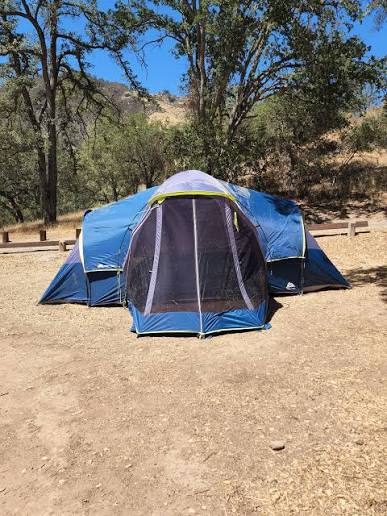
The EVER ADVANCED and UNP listings describe space for three queen air mattresses. This arrangement leaves less room for bags, doors, and movement.
12. Can the CORE fit four queen air mattresses?
CORE lists four queen mattresses as the maximum physical arrangement, but also recommends five campers plus gear for comfort. Four queens would use almost all available floor space.
13. Are these tents waterproof?
They are described as water-resistant or weather-resistant, not as guaranteed shelters in every storm. Correct site choice, fly installation, seam condition, staking, and rainfall intensity all affect performance.
14. Which tent is best in rain?
The CORE has the clearest manufacturer documentation: 1200mm fabric, a fully taped rainfly, and sealed seams. Even so, it should not be treated as a severe-weather shelter.
15. Which tent is best in wind?
None is intended for dangerous winds. The tall walls and large surface area of 10-person tents require conservative campsite selection, complete guying, and evacuation to safe shelter when warnings are issued.
16. Is a tent safe during lightning?
No. A tent provides no lightning protection. Move to a substantial building or enclosed hard-topped vehicle and follow current National Weather Service guidance.
17. Can I use a propane heater inside?
No fuel-burning heater should be used inside these tents. Fire, oxygen depletion, and carbon-monoxide poisoning can occur even when fabric or mesh seems ventilated.
18. Can I cook under the rainfly or awning?
Avoid cooking beneath attached tent fabric or near doors and windows. Heat, flame, grease, and carbon monoxide can damage the shelter and endanger occupants.
19. Do I need a footprint?
A correctly sized footprint can reduce abrasion and punctures. It must not extend beyond the floor edge, where it can collect rainwater underneath the tent.
20. How do I reduce condensation?
Use protected vents, keep wet items separate, avoid touching walls with bedding, and maintain airflow. Condensation can occur even when a tent does not leak.
21. Is a blackout tent hotter?
It can feel warmer when dark panels and window covers restrict airflow in direct sun. Use ventilation and shade appropriately, and do not keep people inside if heat becomes unsafe.
22. Are room dividers soundproof?
No. They create visual privacy and organization, but sound, light, airflow, and movement still pass around thin fabric dividers.
23. Which tent is best for cots?
The CORE’s straight walls make edge space more usable for cots. Measure each cot and leave clearance for frames, doors, and walking paths.
24. Which tent is best for a family with children?
The EVER ADVANCED suits families that prioritize naps and reduced morning light, while the CORE is better for standing room and organized gear. Choose based on the children’s sleep needs and group layout.
25. Which tent is best for hunting base camp?
The CORE is the most practical for organized vehicle-supported base camp because of its wall shape and gear space. Follow all land, hunting, firearm-storage, and fire restrictions.
26. Can these tents be backpacked?
No. Their size and packed weight make them car-camping shelters. The UNP is lighter than the others but still too bulky for normal backpacking.
27. Can I use a 10-person tent in winter?
These are not verified snow-load or expedition winter tents. Large mesh areas, tall walls, and family-camping pole systems are better suited to mild car-camping conditions.
28. How should I store a large tent?
Dry it completely, clean poles and zippers, inspect coatings and seams, and store it in a cool dry area away from fuel, rodents, chemicals, and direct heat.
29. What should I do if a pole breaks?
Move occupants if the structure becomes unstable. Use only the manufacturer-directed emergency sleeve or repair method, then replace the damaged pole before another trip.
30. Why is water under my tent?
The site may be low, drainage may run toward the shelter, or a footprint may extend beyond the floor and collect runoff. Relocate to higher ground when safe.
31. How much extra campsite space do I need?
Add several feet beyond the floor for doors, fly panels, awnings, stakes, and guylines. Confirm the campground tent-pad dimensions before arrival.
32. How do I choose between CORE, EVER ADVANCED, and UNP?
Choose CORE for standing room and comfortable gear organization, EVER ADVANCED for blackout sleep and privacy, and UNP for the longest floor and lower listed carrying weight.
Conclusion
After comparing the three distinct supplied models, the CORE Tent for Family Camping | 10 Person / 11 Person / 12 Person Large Multi Room Cabin Tents for Car Camping & Outdoor Adventures is the strongest overall choice among the best 10-person tents for family car camping. Its selected 10-person variation provides the tallest verified center height, nearly straight walls, two doors, useful ventilation, and a realistic manufacturer recommendation of five people plus gear. Its main trade-off is a bulky traditional cabin structure that requires full staking, adequate campsite space, and conservative weather decisions.
The EVER ADVANCED 10 Person Camping Blackout Design Tent, Multi Room Tent for Family, Portable Family Cabin Tent for Outdoor, Large Tents with Rainfly and Carry Bag, 2 Doors, Water-Resistant, 14ft x 10ft x 84in is the better specialized choice for reduced morning light, naps, and privacy. The UNP Camping Tent 10-Person-Family Tents, Parties, Music Festival Tent, Big, Easy Up, 5 Large Mesh Windows, Double Layer, 2 Room, Waterproof, Weather Resistant, 18ft x 9ft x78in is the better long-floor option for three queen mattresses or a row-style sleeping layout, although buyers should carefully verify the selected ASIN and color variation.
Reliable like-for-like current pricing was not stable enough to name a cheapest or best-budget tent. Verify current specifications, availability, variation, included parts, and seller information before ordering. Whichever tent you choose, measure your campsite, practice setup, keep exits clear, dry the shelter before storage, and leave the tent for appropriate safe shelter when lightning, severe wind, flooding, wildfire, or another official warning threatens.
SEO Summary
- SEO Title: Best 10-Person Tents: 3 Large Family Camping Tents Compared
- Meta Description: Compare the best 10-person tents for family car camping, blackout sleep, headroom, ventilation, weather protection, and group comfort.
- Primary Keyword: best 10-person tents
- Secondary Keywords: best 10 person family tent, large cabin tent, 10 person camping tent, multi-room family tent, blackout family tent, car camping tent, three queen mattress tent
- Search Intent: Commercial investigation focused on capacity, comfort, headroom, weather protection, ventilation, setup, and family car-camping suitability.
- External Authority Link Suggestion: National Weather Service campground weather-safety and preparedness guidance.
- Internal Link Ideas:
- Best Family Camping Cots for Large Tents
- How to Choose a Tent for Hunting Base Camp
- Best Blackout Tents for Family Camping
- How to Keep a Tent Dry in Heavy Rain
- Camping Safety Checklist for Families and Hunting Groups
Read more: How to Hunt Safely: A Beginner-Friendly Field Guide