
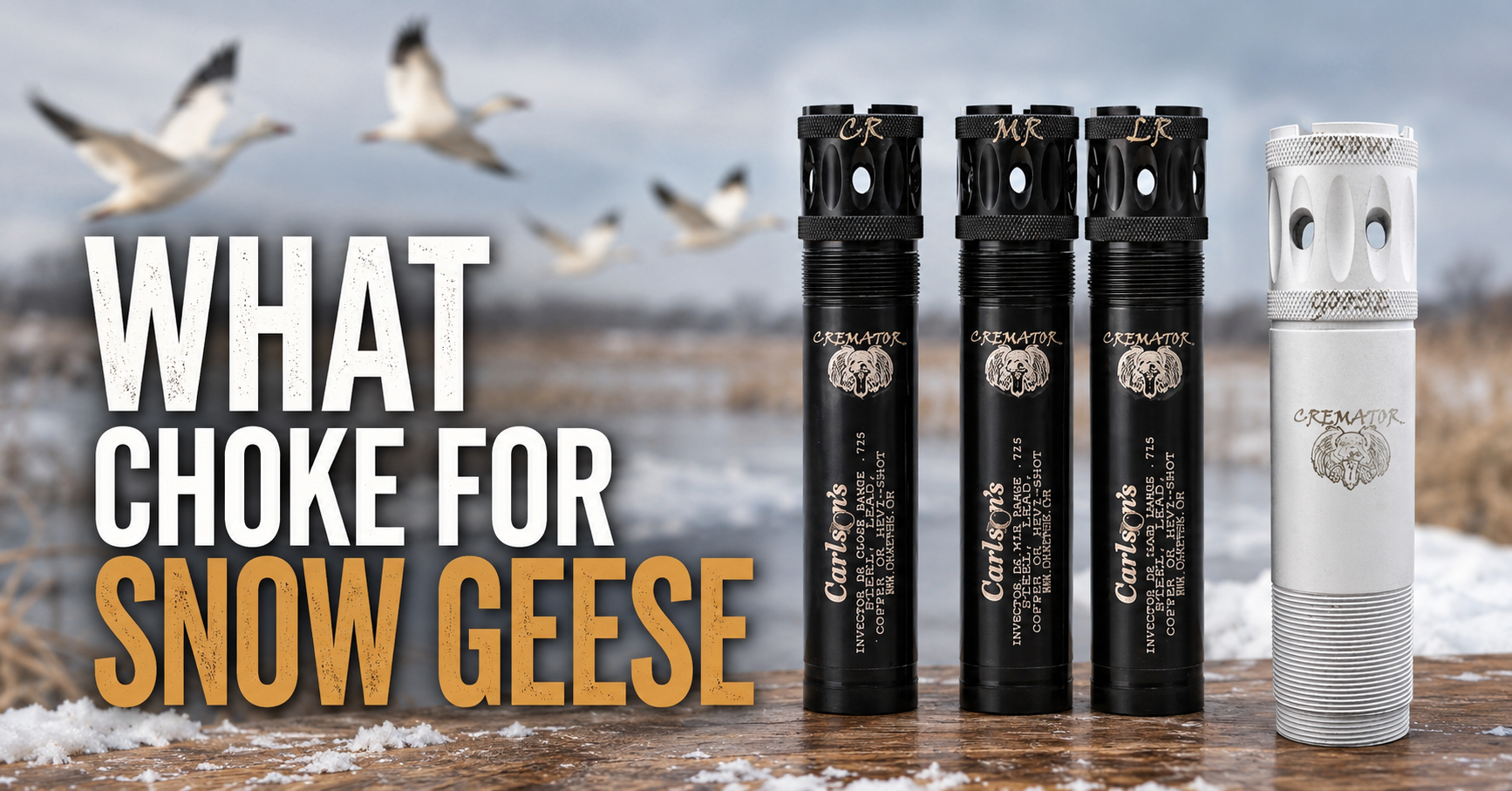

For most snow goose hunting situations, a Modified choke is the most practical starting point, especially when shooting steel loads at geese working between roughly 30 and 40 yards. An Improved Cylinder choke may produce a more forgiving pattern over close decoys, while an Improved Modified choke may be useful for somewhat longer opportunities if it is approved for the chosen non-toxic shot.
No choke is automatically right for every shotgun or load. The ethical choice is the choke that produces an even, adequately dense pattern with your exact shotgun, choke tube, and legal ammunition at the distances you can shoot consistently.
Quick Answer
Start with a steel-rated Modified choke for snow geese. Try Improved Cylinder if the birds consistently finish close over the decoys, or test Improved Modified if you need a denser pattern and the shotgun and choke manufacturers approve it for your load. Do not automatically use a Full choke with steel shot. Pattern the exact choke and non-toxic load on paper before hunting, and limit shots to distances where both the pattern and your shooting ability support a humane harvest.
Snow Goose Choke Recommendations at a Glance
| Hunting situation | Choke to test first | Main advantage | Important limitation |
|---|---|---|---|
| Geese finishing closely over decoys | Improved Cylinder | Wider, more forgiving pattern at close distance | Pattern density may fall off quickly as distance increases |
| Typical decoying shots | Modified | Versatile balance between pattern width and density | Still must be patterned with the exact load |
| Birds consistently staying farther out | Improved Modified | Potentially maintains a denser pattern farther away | Requires careful compatibility checks and may be too tight at close range |
| Mixed close and moderate distances | Light Modified or Modified | Useful compromise when distances change frequently | Choke names and constrictions vary among manufacturers |
| Full choke | Not the default choice for steel | May pattern some approved non-toxic loads densely | Some Full chokes are not approved for large steel shot; follow the manual |
The distances in this table are planning references rather than guaranteed performance limits. Two shotguns marked with the same choke designation can produce noticeably different patterns.
Important Safety and Legal Notice
Information was checked on August 17, 2026. In the United States, hunters pursuing snow geese must use shot approved as non-toxic for waterfowl hunting. The U.S. Fish and Wildlife Service’s non-toxic shot guidance lists the federally approved shot types.
State rules, season dates, shooting hours, licenses, permits, shotgun capacity requirements, conservation-order provisions, and public-land restrictions can change. Check the current regulations issued by the state wildlife agency and any applicable refuge or land-management authority immediately before hunting.
Special Light Goose Conservation Order rules are not identical to regular-season waterfowl regulations. Electronic calls, unplugged shotguns, extended shooting hours, or other special methods are legal only when the applicable state regulations specifically authorize them for that season and location.
Always follow the four fundamental firearm safety rules:
- Treat every firearm as if it is loaded.
- Keep the muzzle pointed in a safe direction.
- Keep your finger outside the trigger guard until ready to shoot.
- Be certain of the target and what is beyond it.
Why Modified Is a Good Starting Choke for Snow Geese
A Modified choke offers moderate constriction. It can provide enough pattern density for common decoying distances without creating the extremely narrow pattern associated with tighter constrictions.
Modified is particularly useful as a starting point because snow goose hunting conditions can change quickly. A flock may appear likely to finish, circle outside the decoys, and then make a closer pass from a different direction. A properly patterned Modified choke can provide a practical balance across these situations.
Steel shot often patterns more tightly than lead through the same nominal choke. For example, Browning’s choke-pattern guidance states that steel normally shoots approximately one choke designation tighter than lead in the same tube. Performance varies by shotgun, bore, choke geometry, pellet size, wad, and load, so this general tendency does not replace pattern testing.
When to Use Improved Cylinder
Improved Cylinder is worth testing when snow geese are consistently landing or finishing tightly over a well-positioned decoy spread. At close distances, a very tight pattern can be difficult to place accurately and may damage more edible meat.
A wider Improved Cylinder pattern may offer:
- More room for normal pointing error at close distance
- Better pattern coverage when several birds finish together
- Reduced risk of an excessively concentrated close-range pattern
- A practical option for hunters who deliberately limit themselves to close decoying shots
The limitation is that a pattern that looks excellent at 20 or 25 yards may become sparse at 35 or 40 yards. Pattern it at every distance you realistically expect to shoot.
When Improved Modified May Make Sense
Improved Modified may help when birds commonly circle outside the core of the spread and your current Modified pattern becomes too thin at those distances. It can also be useful in wind or open-country setups where geese are reluctant to finish completely.
Before using it, confirm all of the following:
- The choke tube is made for the exact choke system in your shotgun.
- The tube manufacturer approves it for the selected shot material and pellet size.
- The shotgun manufacturer approves the ammunition.
- The combination produces an even pattern rather than a small central cluster surrounded by large gaps.
- You can consistently hit moving targets at the intended distance.
A tighter choke does not extend ethical range automatically. If the pattern or your shooting performance is inconsistent, allowing the flock to pass is the responsible decision.
Should You Use a Full Choke for Snow Geese?
A Full choke is not the universal answer for snow geese, particularly with large steel pellets. Some modern Full chokes are designed and marked for steel, while others are not. Older fixed Full chokes may also have restrictions that differ from modern interchangeable systems.
Do not assume a choke is steel-compatible because it physically screws into the barrel. Check the markings, shotgun manual, choke manufacturer’s documentation, and ammunition instructions.
Even when a Full choke is approved, it may not produce the best pattern. Excessive constriction can result in an uneven distribution, a very small close-range pattern, or poor performance with a particular wad and pellet combination. Modified or Improved Modified frequently provides a more useful waterfowl pattern.
How Shot Material Changes Choke Selection
Steel Shot
Steel is widely available and commonly used for snow geese. Because it is harder and less dense than lead, its pattern behavior and shot-size selection differ from traditional lead loads.
A steel-rated Modified choke is a sensible first test. Improved Cylinder may already produce a relatively tight steel pattern, while tighter chokes require specific manufacturer approval.
Bismuth
Bismuth is denser and softer than steel. Depending on the specific load, it may behave more like a traditional lead load than steel does. This does not mean that every old shotgun or choke is automatically suitable.
Follow both the ammunition and firearm manufacturers’ instructions. Test Improved Cylinder, Modified, and other approved constrictions rather than assuming the choke that worked with steel will also be ideal for bismuth.
Tungsten-Based Non-Toxic Loads
Approved tungsten-based loads may use smaller pellets while still retaining substantial downrange energy because the material can be denser than steel. However, different tungsten formulations, wads, and blended loads may have different choke recommendations.
Use only federally approved non-toxic ammunition and follow the load manufacturer’s specific choke restrictions. More expensive ammunition does not eliminate the need to pattern the shotgun.
Does Shot Size Affect the Best Choke?
Yes. Pellet diameter affects the number of pellets in the payload, pattern density, retained energy, and how the load responds to constriction.
Common steel options for snow geese include No. 2, No. 1, and BB, but none is universally best:
- No. 2 steel: Often offers a useful pellet count for decoying snow geese at responsible distances.
- No. 1 steel: Provides a compromise between pellet count and individual pellet size.
- BB steel: Uses larger pellets but places fewer of them in a payload of comparable weight, making pattern gaps an important concern.
Denser non-toxic materials may perform effectively with smaller pellet sizes than steel. Follow the ammunition manufacturer’s guidance and test the complete combination rather than selecting a choke independently of the load.
How to Pattern a Shotgun for Snow Geese
Patterning shows what the shotgun actually does rather than what the choke label suggests. The process should be conducted at an established range or another location where shooting is lawful and where a safe backstop is available.
- Read the shotgun manual. Confirm the correct choke system, approved shot materials, shell lengths, and ammunition limitations.
- Inspect the shotgun and choke. With the firearm unloaded and the action open, verify that the barrel and choke are undamaged, unobstructed, and properly installed.
- Use the exact hunting load. Changing the brand, pellet size, payload, velocity, or wad can change the pattern.
- Set targets at realistic distances. Common testing distances include 20, 30, and 40 yards, but your tests should reflect the shots you intend to accept.
- Use a large sheet of paper. A small target can hide off-center patterns and misses outside the paper.
- Aim at a clearly marked center point. Use a stable shooting position so the test evaluates the load rather than avoidable aiming error.
- Fire more than one pattern per combination. Shotshell patterns vary from one shell to the next. Multiple targets provide a more reliable picture.
- Evaluate the center and distribution. Look for point of impact, overall density, large gaps, clumps, and inconsistent areas.
- Compare approved chokes. Test Improved Cylinder, Modified, and Improved Modified if each is compatible with the firearm and load.
- Establish a personal maximum distance. Stop where the pattern is no longer even and sufficient or where your field accuracy becomes inconsistent.
Hunter-Ed’s shotgun-patterning guidance recommends testing at several distances to determine how the same load and choke perform as range changes.
What Does a Good Snow Goose Pattern Look Like?
A useful pattern places pellets evenly throughout the central area without large gaps through which the bird’s vital region could pass. The densest portion should also be reasonably centered around the point of aim.
When examining the target, ask:
- Is the pattern centered, high, low, left, or right?
- Are pellets distributed evenly?
- Are there large empty areas within the main pattern?
- Does the pattern remain adequate at the farthest distance you plan to shoot?
- Does the pattern become excessively tight at close range?
- Does the result repeat across several shells?
Pellet percentage within a 30-inch circle can help compare combinations, but percentage alone does not establish an ethical range. A high percentage can still contain damaging clumps and large gaps. Uniform distribution and repeatability matter.
What Choke for Snow Geese Over Decoys?
For geese finishing well over decoys, test Improved Cylinder and Modified. Improved Cylinder may be ideal when most opportunities are close, while Modified offers extra pattern density if birds sometimes skirt the edge of the spread.
Decoy placement can be used to encourage high-percentage opportunities. Position the expected landing area so birds approach within the distance at which your chosen combination patterns reliably. Avoid setting the primary landing pocket so far away that every shot becomes marginal.
What Choke for Pass-Shooting Snow Geese?
For lawful pass-shooting at responsible distances, Modified is still the best starting test. Improved Modified may perform better with some loads, but only pattern testing can confirm that.
Pass-shooting distances are often underestimated because open sky provides few visual references. Use known landmarks or a rangefinder before the hunt to understand actual distances. A tighter choke cannot compensate for uncertain range, poor lead estimation, or insufficient practice.
Does Gauge Change the Choke Recommendation?
The general approach applies to 12-gauge, 20-gauge, and other legal shotguns: select compatible non-toxic ammunition, start with a moderate choke, and pattern the combination.
Gauge affects payload options, recoil, firearm weight, and pellet count, but it does not create a universal choke answer. A well-patterned 20-gauge in capable hands may be a responsible option for close decoying shots, while a poorly patterned 12-gauge does not become effective merely because it carries a larger shell.
Do You Need an Aftermarket Snow Goose Choke?
No. A factory steel-rated Modified choke may produce an excellent pattern. An aftermarket waterfowl choke can be useful when the factory tubes do not provide the desired pattern or when a hunter wants a constriction designed for a particular load.
Evaluate an aftermarket choke according to:
- Compatibility with the exact shotgun model and choke system
- Approval for the selected shot material and pellet size
- Pattern performance rather than marketing claims
- Ease of inspection and maintenance
- Manufacturer support and instructions
You do not need the most expensive equipment to hunt responsibly. Choose gear based on safety, compatibility, reliability, legal requirements, and proven pattern performance.
Common Choke Mistakes
Choosing a Choke Only by Its Label
Modified is a starting recommendation, not a guarantee. Bore dimensions, choke geometry, ammunition, and individual shotguns can produce different results.
Using Full Choke With Steel Without Verification
Some Full chokes are not approved for large steel pellets. Using an incompatible combination may damage the choke or firearm and can create unsafe conditions.
Patterning With Different Ammunition
Patterning an inexpensive practice load does not reveal how the hunting load will perform. Use the exact ammunition you intend to carry.
Judging the Pattern From One Shell
One target may be unusually good or poor. Shoot several patterns with each combination before drawing a conclusion.
Assuming Tighter Is Always Better
An extremely tight pattern may be difficult to place on close-moving birds and may contain uneven clumps. The goal is an effective, repeatable pattern rather than the tightest possible circle.
Taking Shots Beyond the Tested Distance
Do not treat the farthest patterning target as permission to shoot that distance automatically. Your moving-target accuracy, wind, flock position, visibility, and ability to identify an individual bird also matter.
Changing Chokes With a Loaded Shotgun
Unload the shotgun completely, open the action, and physically and visually confirm the chamber and magazine are empty before inspecting, tightening, removing, or installing a choke tube.
Field Safety in a Snow Goose Spread
Snow goose hunts may involve several hunters, large decoy spreads, dogs, blinds, vehicles, and rapid shooting. Agree on safety procedures before loading any firearm.
- Assign a clear zone of fire to each hunter.
- Identify where guides, dogs, vehicles, roads, buildings, livestock, and neighboring hunters are located.
- Call the shot clearly when hunting as a group.
- Do not swing a muzzle across another person.
- Do not shoot at an unidentified bird within a large flock.
- Avoid low shots when people, dogs, or equipment could be in the line of fire.
- Keep actions open and firearms unloaded when entering or leaving the blind.
- Use hearing and eye protection.
- Stop shooting when flock position or visibility makes target identification uncertain.
- Make every reasonable legal effort to retrieve downed or wounded birds.
What Not to Do
- Do not use lead shot for waterfowl hunting in the United States.
- Do not use a choke tube that is not designed for the shotgun’s choke system.
- Do not fire steel through an older barrel or tight fixed choke without manufacturer confirmation.
- Do not assume Conservation Order methods are legal during every snow goose season.
- Do not fire into the center of a flock without selecting and positively identifying an individual bird.
- Do not take shots beyond the distance at which you have patterned and practiced successfully.
- Do not continue shooting when hunters, dogs, buildings, roads, or equipment enter the zone of fire.
- Do not rely on a mechanical safety as a substitute for muzzle and trigger discipline.
Final Answer
For hunters asking what choke for snow geese, a steel-rated Modified choke is the most useful starting point. Improved Cylinder may be better for close decoying birds, while Improved Modified can be tested for greater pattern density at somewhat longer distances if the firearm and choke manufacturers approve it for the selected non-toxic load. Pattern the exact combination at realistic distances, follow current wildlife regulations, and do not shoot beyond your demonstrated pattern and skill limits.
FAQs
1. What is the best all-around choke for snow geese?
Modified is the most practical all-around starting point. It commonly provides a useful balance between close-range pattern width and moderate-distance density, but it must be confirmed through patterning.
2. Is Improved Cylinder good for snow geese?
Yes, especially when geese consistently finish closely over decoys. Its wider pattern may become too sparse at longer distances, so test it at every intended range.
3. Is Improved Modified good for snow geese?
It can be useful when a Modified pattern lacks sufficient density at the farthest responsible distance. Verify that the choke is approved for the selected non-toxic shot.
4. Can I use a Full choke for snow geese?
Only if the shotgun and choke manufacturers approve that tube for the specific shot material and pellet size. Full is not automatically better, and some Full chokes should not be used with large steel shot.
5. Is Modified choke safe for steel shot?
Many modern Modified choke tubes are steel-rated, but compatibility is model-specific. Check the choke markings and the shotgun manufacturer’s manual.
6. Does steel shot pattern tighter than lead?
Steel often patterns tighter than lead through the same nominal choke, but the result varies with the load, bore, choke design, pellet size, and wad. Pattern testing is still required.
7. What choke should I use with No. 2 steel for snow geese?
Start by testing Modified. Compare it with Improved Cylinder for close decoying shots and Improved Modified if greater density is needed and the combination is approved.
8. What choke should I use with BB steel?
Modified is a reasonable first test. Because BB loads contain fewer pellets than smaller shot in a comparable payload, check carefully for large pattern gaps.
9. What choke works with No. 1 steel?
Modified commonly provides a useful starting pattern, but compare approved chokes on paper. Individual loads can respond differently to the same constriction.
10. What choke should I use with bismuth?
Follow the ammunition and firearm manufacturers’ guidance. Bismuth may pattern differently from steel, so test Improved Cylinder, Modified, and other approved options rather than copying a steel setup.
11. What choke should I use with tungsten-based waterfowl loads?
Use only chokes specifically approved for the selected load. Tungsten formulations differ, and the ammunition manufacturer may provide particular choke limitations.
12. What choke is best for snow geese at 20 to 30 yards?
Improved Cylinder or Modified may work well. Improved Cylinder generally creates a wider pattern, while Modified may be helpful if some birds remain outside the closest decoys.
13. What choke is best around 35 to 40 yards?
Modified is the usual starting point. Your actual limit should be determined by repeatable pattern quality and moving-target proficiency rather than distance alone.
14. Can a choke make a shotgun effective at 60 yards?
A tighter choke does not automatically create an ethical 60-yard setup. Pattern density, pellet performance, range estimation, wind, and shooter skill can all become limiting factors. Avoid shots beyond your proven ability.
15. Do I need a special snow goose choke?
No. A compatible factory Modified choke may work well. Consider an aftermarket tube only if testing shows that it improves the pattern with your chosen load.
16. Are extended choke tubes better for geese?
Not automatically. They may be easier to identify, inspect, and change, but pattern performance depends on the complete design and load rather than extension alone.
17. Are ported chokes better for snow geese?
Porting does not guarantee a better pattern. Some hunters prefer ported designs, while others choose non-ported tubes for simpler cleaning and use around hearing-sensitive hunting partners or dogs.
18. Can I use the same choke for snow geese and Canada geese?
Possibly, but the appropriate load and pattern may differ because bird size, expected distance, and hunting conditions differ. Pattern the exact ammunition selected for each hunt.
19. Is the same choke suitable for snow geese and ducks?
A Modified choke can be versatile for both, but duck and goose loads may use different pellet sizes and pattern differently. Test each hunting load separately.
20. Does a 20-gauge need a tighter choke than a 12-gauge?
Not necessarily. Gauge alone does not determine the ideal constriction. Compare approved choke and load combinations in the individual shotgun.
21. Do 3½-inch shells require a different choke?
Not automatically. Shell length changes the available payload and recoil, but the choke must still be compatible with the shotgun, shot material, and pellet size. Longer shells do not guarantee better patterns.
22. How far away should I pattern my snow goose shotgun?
Test at the distances you expect to shoot, commonly including 20, 30, and 40 yards. Add or remove distances according to your hunting setup and personal shot limits.
23. How many pattern targets should I shoot?
Use several fresh targets for each choke and load combination. Multiple shots help reveal normal variation and prevent an unusually good pattern from producing a misleading conclusion.
24. Should I draw a 30-inch circle on the pattern?
A 30-inch circle can help compare pattern percentage and distribution. Center it around the densest portion, then also evaluate whether that portion aligns with the point of aim.
25. What if my pattern has large holes?
Test another approved choke or load. Changing ammunition can sometimes improve distribution more than increasing constriction.
26. What if my shotgun patterns high or to one side?
Repeat the test from a stable position to rule out aiming error. If the pattern remains displaced, consult the shotgun manual or a qualified gunsmith before hunting.
27. Do I need to re-pattern when changing ammunition brands?
Yes. Different wads, velocities, pellet quality, payloads, and components can significantly change the pattern even when the listed shot size is identical.
28. Is non-toxic shot required for snow goose hunting?
Yes for waterfowl hunting in the United States. Use a federally approved non-toxic shot type and check for additional state or land-specific restrictions.
29. Can I use an unplugged shotgun during a snow goose Conservation Order?
Only when the applicable state’s current Conservation Order regulations specifically allow it. Do not assume special provisions apply during regular seasons or in every state.
30. How often should a choke tube be inspected?
Inspect it before patterning and before hunting. With the shotgun completely unloaded, check that the tube is correct, clean, undamaged, and secured according to the manufacturer’s instructions.
Read more: