
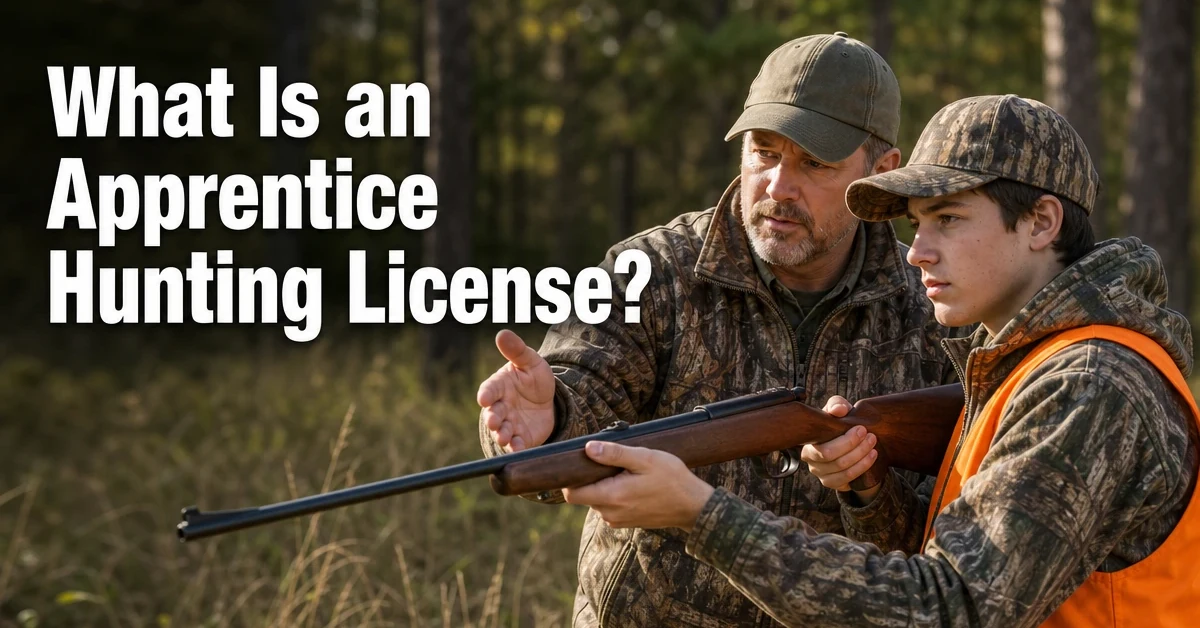

An apprentice hunting license is a temporary or introductory hunting license that lets a beginner hunt under the supervision of a qualified, experienced hunter before completing a full hunter-education course. It is designed to help new hunters learn safely in the field, but its eligibility, duration, mentor requirements, and permitted species vary by state. Always check your state wildlife agency’s current rules before hunting.
What an Apprentice Hunting License Allows
An apprentice license generally allows a first-time hunter to participate in hunting while accompanied by a licensed mentor. The mentor provides direct supervision, explains safe firearm or archery handling, and helps the apprentice learn regulations, identification, shot selection, field skills, and ethical recovery of game.
This license is commonly called a mentored hunting license, apprentice license, or trial hunting license. The name and exact program differ by jurisdiction.
How Apprentice Hunting Programs Work
| Program requirement | What it usually means | What to verify locally |
|---|---|---|
| Apprentice license | A beginner hunting credential issued before or during hunter education | Eligibility, cost, duration, and purchase method |
| Qualified mentor | An experienced hunter who directly supervises the apprentice | Minimum age, license status, distance requirements, and supervision rules |
| Hunter education | A safety course often required before obtaining a regular hunting license | Whether the apprentice may hunt before completing it and when it must be finished |
| Species permits | Additional tags, stamps, or permits may still be required | Species, weapon, season, and permit requirements |
| License limits | The license may be valid only for a set period or number of uses | Expiration date, renewal rules, and whether previous license holders qualify |
Who Can Get an Apprentice Hunting License?
Many states offer apprentice programs to adults, youth, residents, nonresidents, or some combination of these groups. Eligibility is not nationwide. Some programs are limited to people who have never held a hunting license, while others allow broader participation.
Previous hunting-license holders may be excluded in some jurisdictions. Age limits, residency categories, background requirements, and hunter-education deadlines can also differ. Do not assume that eligibility in one state applies elsewhere.
How to Get an Apprentice Hunting License
- Find the official wildlife agency website. Search for the state’s apprentice, mentored, or hunter-education hunting program.
- Read the current regulations. Confirm eligibility, license duration, fees, species, weapons, and mentor requirements.
- Choose a qualified mentor. Confirm that the person meets the state’s age, license, and supervision standards.
- Purchase the license through an approved channel. This may be an official online portal, license agent, or wildlife office.
- Obtain additional permits. An apprentice license may not replace deer, turkey, migratory-bird, bear, or other species-specific licenses.
- Complete hunter education as required. A regular hunting license may require successful completion of an approved course.
- Carry required documentation. Keep the license, permits, identification, and any required tags accessible while hunting.
What the Mentor Must Do
A mentor is not merely a hunting companion. The mentor must provide the supervision required by law and should remain close enough to control the situation, correct unsafe behavior, and help the apprentice make responsible decisions.
Before the hunt, the mentor should review:
- Firearm or archery safety rules
- Target identification and what lies beyond the target
- Safe loading, unloading, carrying, and transport
- Season dates, legal hours, bag limits, and species identification
- Property boundaries and landowner permission
- Weather, navigation, emergency communication, and first aid
- Ethical shot distance and recovery expectations
The mentor should emphasize learning and safe decision-making rather than pressuring the apprentice to harvest an animal.
Safety Rules for Apprentice Hunters
Every apprentice using a firearm should learn and follow these four universal rules:
- Treat every firearm as though it is loaded.
- Keep the muzzle pointed in a safe direction.
- Keep your finger outside the trigger guard until ready to fire.
- Be certain of the target and what is beyond it.
A mechanical safety is not a substitute for safe handling. The apprentice should follow the firearm manufacturer’s instructions, use compatible ammunition only, wear hearing and eye protection where appropriate, and never handle a loaded firearm while climbing, crossing an obstacle, or entering a vehicle.
Bow and crossbow users must also follow manufacturer instructions, use compatible arrows and broadheads, avoid dry-firing, and practice before hunting.
What an Apprentice Hunting License Usually Does Not Do
- It does not guarantee eligibility in every state.
- It does not necessarily replace a regular hunting license.
- It may not satisfy hunter-education requirements for a future license.
- It may not include species-specific permits or tags.
- It does not remove bag limits, season restrictions, or weapon laws.
- It does not allow unsupervised hunting when supervision is required.
- It does not authorize hunting on private land without permission.
Apprentice License Versus a Regular Hunting License
| Feature | Apprentice license | Regular hunting license |
|---|---|---|
| Primary purpose | Introductory, supervised hunting | General licensed hunting after meeting applicable requirements |
| Hunter education | May be issued before course completion, depending on state rules | Often requires an approved hunter-education certificate |
| Supervision | Usually required | May not be required for an otherwise qualified adult |
| Duration | Often limited or temporary | Usually follows the state’s normal license year or term |
| Additional permits | Often still required | Often still required |
Planning a Safe First Hunt
Choose a suitable outing
A short, low-pressure hunt in familiar terrain may be better for a beginner than a difficult overnight trip. Consider weather, walking distance, terrain, visibility, restroom access, communication, and the apprentice’s physical condition.
Practice before entering the field
Firearm hunters should practice safe loading and unloading, carrying positions, target identification, and accurate shooting from realistic legal positions. Archery hunters should practice with their actual hunting equipment and stay within a demonstrated ethical range.
Prepare a written plan
Share the destination, access route, expected return time, emergency contacts, vehicle details, and communication limitations with someone who is not on the hunt. Check weather and local restrictions before departure.
Make the experience educational
Teach scouting, wildlife identification, conservation, tracking, field care, and respect for private property. A successful first hunt can mean learning good judgment and enjoying the outdoors, even without harvesting game.
Common Mistakes to Avoid
- Assuming an apprentice license has the same rules in every state
- Failing to confirm whether a species tag or stamp is also required
- Allowing the mentor to supervise from too far away
- Taking a shot before positively identifying the species and target
- Ignoring property boundaries or public-land restrictions
- Using equipment that has not been practiced with beforehand
- Continuing a hunt after visibility, weather, health, or terrain becomes unsafe
- Measuring success only by harvesting an animal
Where to Verify Current Apprentice License Rules
Use the official fish and wildlife agency for the state where you will hunt. Look for the current hunting regulations booklet and the agency’s apprentice, mentored-hunting, or hunter-education page.
Verify the rules immediately before the hunt because license programs, fees, season restrictions, species permits, and supervision requirements can change. Official regulations override general online guidance.
FAQs
1. Is an apprentice hunting license the same as a hunter-education certificate?
No. An apprentice license is a hunting authorization for a supervised beginner in jurisdictions that offer the program. A hunter-education certificate confirms completion of an approved safety course. One may not automatically replace the other.
2. Can an adult get an apprentice hunting license?
In some states, yes. Other programs may limit eligibility by age, previous licensing history, residency, or participation in a specific mentored program. Check the issuing wildlife agency’s current requirements.
3. Does an apprentice hunter need a mentor?
Usually, an apprentice hunter must hunt with a qualified mentor. The mentor’s minimum age, license status, supervision distance, and responsibilities vary by jurisdiction.
4. Can an apprentice hunt without completing hunter education?
Some programs are specifically designed to allow supervised hunting before course completion. However, the apprentice may still need to complete hunter education before receiving a regular license. Confirm the deadline and course rules locally.
5. Does an apprentice license include a deer or turkey tag?
Not necessarily. Many jurisdictions require separate species licenses, tags, stamps, permits, or harvest authorizations. Review the regulations for the exact species and season.
6. Can an apprentice hunt on public land?
Possibly, but the apprentice must follow all public-land access rules, season restrictions, weapon regulations, and supervision requirements. Some public areas may have additional permits or restrictions.
7. Can a person use an apprentice license in another state?
Generally, no. Hunting licenses are issued under the laws of the jurisdiction where the hunt occurs. Obtain the appropriate license and permits from that state or authority.
8. What is the best way to prepare for an apprentice hunt?
Read the current regulations, complete safety training, practice with the actual equipment, plan the route and emergency contacts, confirm land permission, and hunt with a qualified mentor who prioritizes safe decisions over harvesting game.
Final Answer
An apprentice hunting license lets an eligible beginner experience hunting under the direct supervision of a qualified mentor, often before completing hunter education. The license is not standardized nationwide: duration, age limits, mentor rules, species permits, and eligibility vary by state. Check the current official wildlife regulations, obtain every required license or tag, practice safe equipment handling, and treat education and ethical decision-making as the main goals of the first hunt.